
MENU

Sections

  • About Us
    • Editors and Writers
    • Sponsorship Terms & Conditions
    • Code of Ethics
    • Sign Up for Cambridge Spy Daily Email Blast
  • The Arts and Design
  • Culture and Local Life
  • Food & Garden
  • Public Affairs
    • Commerce
    • Health
    • Ecosystem
    • Education
    • Senior Nation
  • Point of View
  • Chestertown Spy
  • Talbot Spy

More

  • Support the Spy
  • About Spy Community Media
  • Advertising with the Spy
  • Subscribe
November 8, 2025

Cambridge Spy

Nonpartisan and Education-based News for Cambridge

  • About Us
    • Editors and Writers
    • Sponsorship Terms & Conditions
    • Code of Ethics
    • Sign Up for Cambridge Spy Daily Email Blast
  • The Arts and Design
  • Culture and Local Life
  • Food & Garden
  • Public Affairs
    • Commerce
    • Health
    • Ecosystem
    • Education
    • Senior Nation
  • Point of View
  • Chestertown Spy
  • Talbot Spy
Ecosystem Eco Homepage Ecosystem Eco Portal Lead

A Real Bummer: New VMRC Report Suggest Continued Downturn for Blue Crabs

May 19, 2022 by Spy Desk
Leave a Comment

The Virginia Marine Resources Commission (VMRC) has announced the results from the 2022 Baywide Blue Crab Winter Dredge Survey which indicates a continued downturn in juvenile recruitment and a record low year of total blue crab abundance.

Total abundance of blue crabs in Chesapeake Bay declined in 2022 to 227 million crabs – the lowest abundance estimate in the 33-year history of the winter dredge survey. This decline is driven primarily by a third consecutive year of below average recruitment of juvenile crabs, even though the number of juveniles increased 18% from 2021 to 101 million crabs. The low numbers of juvenile crabs, and this year’s decline in the adult female crabs (which will spawn this spring and summer) will factor into decisions VMRC, the Maryland Department of Natural Resources (MD DNR), and the Potomac River Fisheries Commission (PRFC) make in regards to management measures for the 2022 blue crab season.

These three Chesapeake Bay jurisdictions, which are responsible for baywide management of blue crabs, have successfully managed harvest of blue crabs to prevent overfishing since 2008. Adult female crabs are the key to conservation, as each female can spawn an average of three million eggs per brood, averaging up to three broods per year. These adult females observed in the Winter Dredge Survey are likely to spawn from late May to mid-summer of this year, contributing to next year’s juvenile population. The number of adult female crabs (97 million) declined in 2022 and is below the target abundance of 196 million, but remains higher than in the period before 2008 when the Chesapeake Bay blue crab resource was declared a fishery disaster.

While the Chesapeake Bay jurisdictions have maintained fishing mortality of blue crab at safe levels, crabs still face many other challenges in the bay. Although Chesapeake Bay water quality and submerged aquatic vegetation continue to improve, blue crabs are still vulnerable to low oxygen levels from nutrient runoff and a lack of sea grasses which can leave vulnerable juveniles and soft crabs without habitat for refuge. Recruitment can be hindered by storms and currents which can wash crab larvae out of bay circulation, and growing abundances of predators, such as red drum and blue catfish, can increase natural mortality of blue crabs.

Virginia’s 2021 commercial crabbing season saw harvest of 18 million pounds of blue crabs, one of the lowest harvest levels in the last ten years, but baywide harvest remained well under the threshold fishing removal rate that would indicate overfishing. The 2011 benchmark blue crab stock assessment and subsequent updates establishes a threshold removal rate of 37%. This threshold is the maximum percentage of females that can be harvested annually without overfishing the population. The removal rate in 2021 of 26% by commercial and recreational fisheries indicates overfishing is not occurring. Juveniles observed by the winter survey contribute heavily to the next fall’s crab harvest, which could mean another year of low harvest for Virginia’s commercial crabbers in 2022. Although Virginia’s 2021 harvest fell 15%, high prices lead the total dockside value of crabs to increase 14% to $35 million.

The winter dredge survey is conducted annually by the Virginia Institute of Marine Science (VIMS) and MD DNR. Since 1990, the survey has utilized traditional crab dredges to sample blue crabs at 1,500 sites throughout the Chesapeake Bay from December through March. By sampling during winter when blue crabs are buried in the mud and sedentary, scientists can develop precise estimates of the number of crabs in the Bay.

The Chesapeake Bay Stock Assessment Committee (CBSAC), an advisory group under the Chesapeake Bay Program’s Sustainable Fisheries Goal Implementation Team (Fish GIT) which brings together state managers and technical experts to address blue crab issues, will hold a working meeting next week to discuss the results from the 2021-22 Winter Dredge Survey. The results will be published in the full CBSAC Annual Report this June, and provide science based recommendations for management. The Fish GIT and CBSAC are also planning a fall blue crab science workshop to identify which environmental factors are likely driving the low abundances and evaluate the need for a new blue crab benchmark stock assessment.

“We are concerned with the two consecutive years of poor recruitment,” said Pat Geer, Chief of Fisheries Management for VMRC and Chair of CBSAC. Geer continued, “However, fishing pressure on our spawning stock is still at acceptable levels and the spawning stock remains relatively healthy. We are hopeful a workshop planned for September will help explain these concerns with recruitment and lead to a new benchmark stock assessment that will address blue crab abundance in the Bay.”

VMRC’s Crab Management Advisory Committee will hold a public meeting on May 23rd at 4 PM at the VMRC Main Office to discuss these results and potential management measures for the coming fishing year. These results and data on the 2021 blue crab fishery will also be presented at the monthly meeting of the Virginia Marine Resources Commission on May 24th at the VMRC Main Office. See MRC.Virginia.Gov for more information about these meetings.

The Spy Newspapers may periodically employ the assistance of artificial intelligence (AI) to enhance the clarity and accuracy of our content.

Filed Under: Eco Homepage, Eco Portal Lead

How Does the State Plant 5 Million Trees? It’s Complicated

May 17, 2022 by Maryland Matters
Leave a Comment

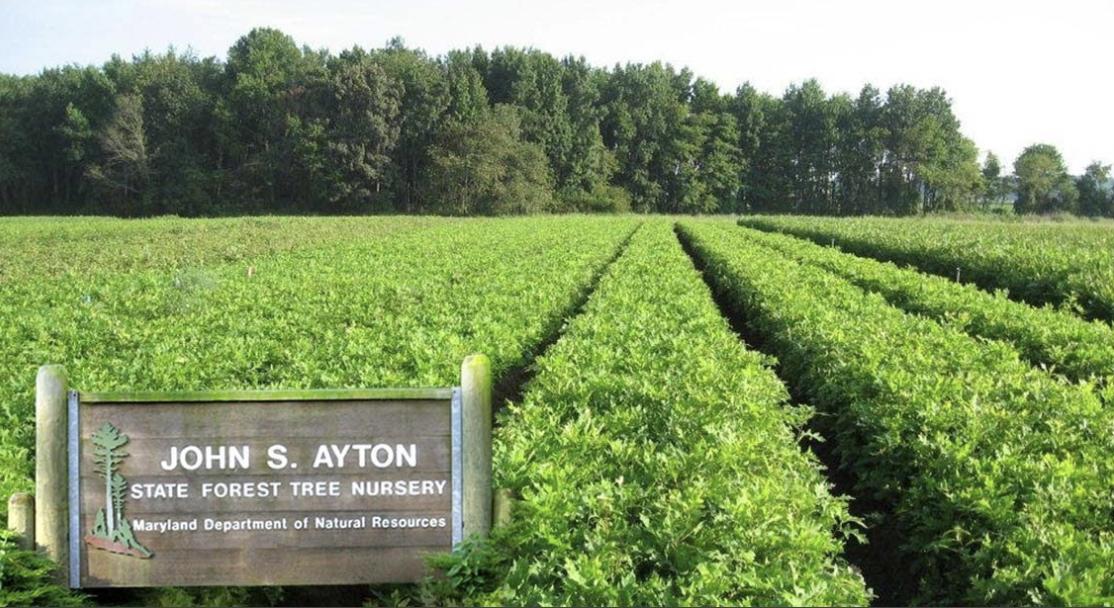
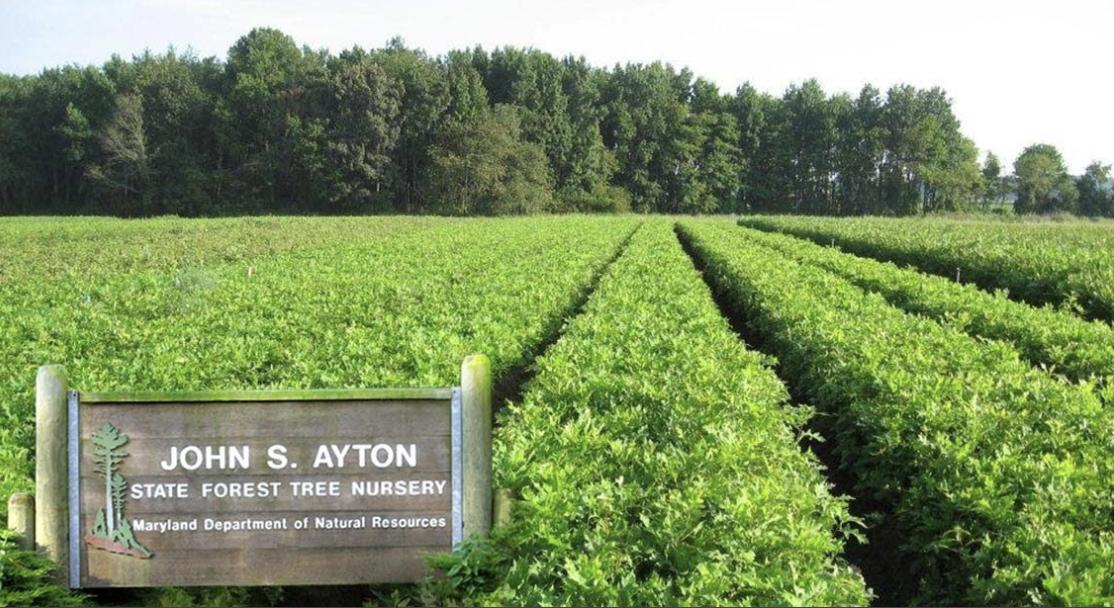
The John S. Ayton State Forest Tree Nursery in Preston will play a big role in helping Maryland meet is mandate to plant 5 million new trees by 2030. Maryland Department of Natural Resources photo.

Growing up in West Baltimore, Greg Burks never thought much about the lack of vegetation around him. But his younger brother suffered from asthma, and that was one of the family’s primary concerns.

“This is your brother’s inhaler,” Burks recalls his mother saying every time the boys went out to play. “Keep it with you.”

Only now does Burks realize that one of the reasons his brother needed an inhaler was that the level of ozone and other pollutants in their neighborhood was so high because there were so few trees around.

Now, Burks is poised to help families in Baltimore and other Maryland urban areas who struggle with their breathing because of air pollution. He manages the new Urban Tree Program for the Chesapeake Bay Trust, a nonprofit launched by state government in the 1980s dedicated to improving the watersheds of the Chesapeake Bay, Maryland Coastal Bays, and Youghiogheny River in Western Maryland. The trust’s mission is to plant 500,000 trees in urban areas over the next eight years.

“Marylanders’ lives depend on it,” Burks said in an interview. “That’s why this program exists. It’s for people who don’t have the resources to leave the city.”

Burks and his colleagues at the CBT are a small but important part of Maryland’s attempts to plant 5 million trees by 2030. That ambitious goal was set in legislation that the General Assembly passed in 2021, and it’s now up to a pastiche of state agencies, nonprofits, industry and environmental groups to make it happen.

On the one hand, it’s a bureaucratic process as all state government attempts to comply with new laws inevitably are. But on the other hand, it’s fused with optimism and imagination, and a sense that almost anything’s possible.

“If we can green our cities, we can improve our lifespan,” said Burks’ boss, Jana Davis, the president of the Chesapeake Bay Trust. “This isn’t just about science. This isn’t just about the environment. This is about human health.”

And while it may be a bit of a stretch to say so, some stakeholders believe the state’s execution of the tree planting law could be a template for how the government implements the Climate Solutions Now Act of 2022, the ambitious legislation that passed this year to reduce carbon emissions in Maryland by 60% by 2031 and hit net-zero carbon emissions by 2045.

At a minimum, said Suzanne Dorsey, the assistant secretary of the Maryland Department of the Environment, who is helping to oversee the implementation of the tree planting measure, it can serve as a way of tracking the state’s ability to meet the provisions in the new climate laws.

“It’s about counting and accounting,” she said. “I think the new legislation will require us to track more and to do more.”

Throughout the country — indeed, throughout the world — there is a campaign to plant as many trees as possible as a key ingredient to combating climate change. One nonprofit, called 1T.org, aims to see 1 trillion trees planted worldwide over the next several years. The organization has already received commitments from major corporations around the world to plant 33 billion trees, and now the advocacy group is turning its attention to states like Maryland.

The Tree Solutions Now Act passed in 2021. A less ambitious forest conservation bill, sponsored by state Del. Jim Gilchrist (D-Montgomery), passed overwhelmingly in the House last year, but when it landed in the Senate, the Education, Health and Environmental Affairs Committee, which was wrestling with the larger climate legislation, amended the House measure to put the 5 million tree planting requirement into law, and that’s how it emerged from the General Assembly.

The amended legislation called for 500,000 trees to be planted in urban areas, and an additional 4.5 million would be planted as part of a process known as aforestation — establishing a forest on land not previously forested.

The legislation required the state to assemble a stakeholder group to figure out how to implement the law. It makes tens of millions of dollars available for initial tree inventories and purchasing. And it laid out specific tasks for various state agencies and other organizations.

“Five million trees is a lot of trees,” Dorsey said.

The Commission for the Innovation and Advancement of Carbon Markets and Sustainable Tree Plantings began meeting earlier this year. Its membership, spelled out in the legislation, features representatives of the Maryland Department of the Environment; the University of Maryland College Park; the Maryland Commission on Environmental Justice and Sustainable Communities; the Maryland Farm Bureau; the Maryland Association of Counties; the Maryland Municipal League; and three environmental groups: Blue Water Baltimore, the Chesapeake Bay Foundation, the Maryland League of Conservation Voters, the Nature Conservancy, and the Patapsco Heritage Greenway.

Serving as ex-officio members: representatives of the State Treasurer’s office; the Maryland Department of Agriculture; the Maryland Department of Natural Resources; and the Maryland Forestry Foundation.

Beyond counting on the Chesapeake Bay Trust to oversee the planting of 500,000 trees in urban areas, the legislation spells out discreet roles for most of the state agencies: The Department of Natural Resources, which operates a tree nursery on the Eastern Shore, and the Agriculture department are responsible for most of the rest of the tree planting and will work with groups and local governments across the state to achieve that goal. MDOT is responsible for tree maintenance along state highways and for replacing whatever trees are removed for road construction. The Environment department is responsible for coordinating it all.

“I want to emphasize what a great collaboration this has been so far,” Dorsey said.

‘A game changer’ 

Several stakeholders praise the Chesapeake Bay Trust’s early planning for the new law, which will enable the nonprofit to begin handing out grants to other entities for tree planting as soon as state funds become available on July 1.

The irony is, trust leaders weren’t part of the early planning for the tree planting legislation.

“It was not our idea,” Davis said. “It’s the brainchild of other folks. But it’s an honor to be part of the process.”

As soon as they learned they were included in the bill, trust leaders mobilized to get ready, she said. “We knew if we didn’t start early we’d never be ready for the fall 2022 planting season.”

One of the first things they did was bring on Burks, the West Baltimore native who had worked for other nonprofits and institutions — most recently for Johns Hopkins University as a senior community programs manager focused on affordable housing, the digital divide and food deserts. He had never worked in the environmental space before.

Burks, who calls the urban tree planting program “a game changer,” convened a series of listening sessions around the city and state, to determine how to bring communities together, how best to implement the tree planting program, how to maintain the trees once they’ve been planted, and how to access civic resources.

“Greg Burks is a force of nature and a delight to work with,” Dorsey said.

The Chesapeake Bay Trust has already been sifting through dozens of grant applications from groups that want to plant trees. Some are seeking funding to plant just a few; others have the capacity to plant 10,000 trees in a fairly short time period. The applicants range from local governments and forestry boards to nonprofits to schools, churches and community associations.

The trust will have $10 million in tree planting grants to dole out this year — and has already received $14 million in spending requests. Davis said one of the things trust leaders like about the program is that it lets local leaders who know their communities best chart their own tree planting and maintenance strategies.

“The community interest in this program has been incredible — way larger than we thought,” she said. “Which speaks to the real community need.”

Other agencies are preparing to implement the law in different ways. The Department of Natural Resources has hired 12 tree planters and one assistant nursery manager.

And state agencies are putting private Maryland nurseries on alert that they’re going to have to increase their stock of saplings. Nurseries are among the biggest parts of the state’s agricultural sector.

“They’ve got to know that we’re about to order a lot more trees than we usually do,” Dorsey said.

Some local governments already have tree planting programs under way.

Baltimore County, for example, has had an unofficial goal of maintaining a 50% tree canopy for several years, and in an interview, County Executive John A. Olszewski Jr. (D) said the number has gone up during his administration thanks to a handful of tree planting initiatives, including a new one called the ReTree program, which focuses on urban and poorer communities in the county

The county government traditionally gives hundreds of trees away to residents on Arbor Day, and it makes free backyard trees available to property owners whose lots are one-tenth of an acre or bigger, Olszewski said. But the ReTree program relies on data the county is already using for environmental justice and equity initiatives to plot out where the heat islands are in the county and where trees are needed the most.

“We’re really being more intentional about it,” he said.

The tree plantings started a few months ago in Dundalk and will expand over the next several weeks into Essex, Owings Mills and Randallstown. About 1,000 trees will be planted this year through the new program.

The idea of using statistical analysis for a tree planting strategy “is surprisingly new,” Olszewski said. “We know the imperative of the environmental justice movement, and this aligns it with the data.”

David V. Lykens, the Baltimore County director of Environmental Protection and Sustainability, is the Maryland Association of Counties designee on the state’s new tree commission, and Olszewski said Lykens will discuss the counties’ successes on the tree planting front with others on the panel.

“We think we have a story to tell,” he said.

‘It’s wonky’

Even with so many stakeholders involved with implementing the state’s new tree planting law, there are sure to be some skeptics.

Colby Ferguson, director of government and public relations at the Maryland Farm Bureau, is a member of the tree commission and a supporter of the 5 million tree goal generally.

“It’s an interesting discussion,” he said. “I’m always trying to figure out what we’re trying to do here and what we’re not.”

For farmers, Ferguson said, the issue is how and where the 5 million trees will be planted, and what kind of acreage of arable land will be involved.

“We don’t want to be trading our prime farmland and our food for environmental practices,” he said. “We can’t trade food for carbon sequestration.”

That’s just one of the many questions the state tree commission is going to try to answer in the months ahead. The panel is supposed to issue a written report to the General Assembly this fall, outlining how the state can hit the 5 million tree mark by 2030. Members of the commission aren’t just looking into how to plant them and making sure the right tree species are going into the appropriate areas. They’re also figuring out how to maintain them and how to prevent invasive vines, which are becoming increasingly prevalent in Maryland, from overcoming them.

State officials are also going to keep track of how many trees are being planted, because so many entities — and even individual landowners who may plant a single tree — are going to be involved. They have to figure out how to count the carbon mitigation when the trees are all planted and as they mature. And they have also been directed by the tree planting legislation to set up a Maryland-based carbon offset market.

Carbon offset markets are just being established around the country. They enable businesses, including power plants, to purchase vouchers when they are unable to meet short-term carbon reduction goals. while they transition to more sustainable business practices. The money spent on carbon offsets are traditionally put toward emission reduction projects — including the planting of a new forest.

So the challenge for Maryland officials is figuring out what kind of entities might want to purchase carbon offsets from the state that match the emissions reductions from all the new trees. And they’ve also got to determine how much revenue a carbon market can generate and how much of that they can plow into additional tree plantings.

“It’s wonky,” said Dorsey, the Department of the Environment assistant secretary, who is slated to become deputy secretary on June 1. “This market is new and volatile. People are just getting into it.”

Earlier this month, the state tree commission met virtually to discuss the offset market. It was a challenging discussion, with technical terms like “MS4 acres of credit,” “additionality” and “ease of access into the market” being thrown around liberally.

“Some of you are as wonky as we are or maybe even more in the weeds, and some of you, your heads may really be spinning,” Dorsey conceded.

Maryland officials believe any offset market they set up based on the tree program can become a national model. But Anne Hairston-Strang, acting director of the Maryland Forest Service, laid out a warning about the limits of the carbon offset markets that almost anyone could understand.

“The prices we’re seeing in the carbon market aren’t going to fund aforestation,” she said. “So we’re going to have to look for additional funding.”

By Josh Kurtz
The Spy Newspapers may periodically employ the assistance of artificial intelligence (AI) to enhance the clarity and accuracy of our content.

Filed Under: Eco Homepage

The Fight Against the Chestertown Mosquitoes: A Chat with Darran Tilghman

May 9, 2022 by James Dissette
Leave a Comment

Soon the droning hum of one of humanity’s most omnipresent predators and card-carrying dangerous nuisances will be wrecking outdoor activities everywhere a spoonful of standing water can sustain mosquito larvae. 

In other words, anytime we go outside we’ll likely become a blood host to a squadron of mosquitoes despite the industrial strength cloud recently left by pesticide laced fogging trucks.

And again, our perennial questions: Why does the mosquito population seem to grow each year after incessant pesticide use; is the pesticide safe and effective; and are there alternatives?

Chestertown Environmental Committee member Darran Tilghman recently presented the Chestertown Town Council with studies disputing the effectiveness and safety of mosquito fogging and offered a new approach to the problem, one she feels could make Chestertown a model for dealing with summer mosquito invasions.

Tilghman and the committee gathered data showing that the pesticides being sprayed in Chestertown—banned in the European Union—may be doing more harm than good and that there are more effective ways to deal with the seasonal mosquito onslaught than spraying residential areas with Permethrin, a neurotoxin “strongly linked to respiratory disease, ALS, cancers, and childhood brain damage.” 

The Chestertown Environmental Committee recommends that residents take ownership of the solution by maintaining healthy backyards. Eliminating mosquito habitats like standing water and also targeting mosquito larvae with the organic bacillus in “Mosquito Dunks” can keep a yard free of mosquitoes for the whole summer by targeting only the larvae of the mosquito, blackfly and fungus gnat. Mosquito Dunks are inexpensive and may be found locally.

Here, Darran Tilghman encapsulates her presentation to the town council. She encourages residents to email their ward councilmembers to support healthier and more effective alternatives to the fogging trucks. 

This video is approximately eight minutes in length.

#

More highlights of the Chestertown Environmental Committee, Water & Habitat Work Group report:

Current strategy: Adulticide fogging with neurotoxin Permethrin

  • Ineffective: Kills ~10% of adult mosquitos in spray range (only the ones alive that day); does not affect larvae or prevent mosquito-borne disease. Only about 0.0000001% of spray hits a target mosquito.
  • Kills indiscriminately: Toxic to critically important pollinators including bees, bats, and butterflies, as well as birds & fish (many of these are mosquito predators).
  • Impacts human health: Strongly linked to respiratory disease, ALS, cancers, and childhood brain damage; banned in the EU; spraying is not permitted near schools or restaurants (but it is permitted on my front lawn). In addition to Permethrin, PFAs (forever chemicals) were found at dangerously toxic levels in three pesticides used for mosquito control by the Maryland Department of Agriculture (MDA).
  • Degrades water quality: Neurotoxins and PFAs stay in soils and groundwater, entering and damaging the Chester and the Chesapeake Bay ecosystem.
  • Expensive and creates dependence: Creates resistant “super skeeters”; the more mosquito predator population collapses, the more we pay to spray- $3,100 annually.


The Spy Newspapers may periodically employ the assistance of artificial intelligence (AI) to enhance the clarity and accuracy of our content.

Filed Under: Eco Homepage, Eco Portal Lead

Maryland Receives First Batch of Federal Funding to Restore Chesapeake

May 3, 2022 by Maryland Matters
Leave a Comment

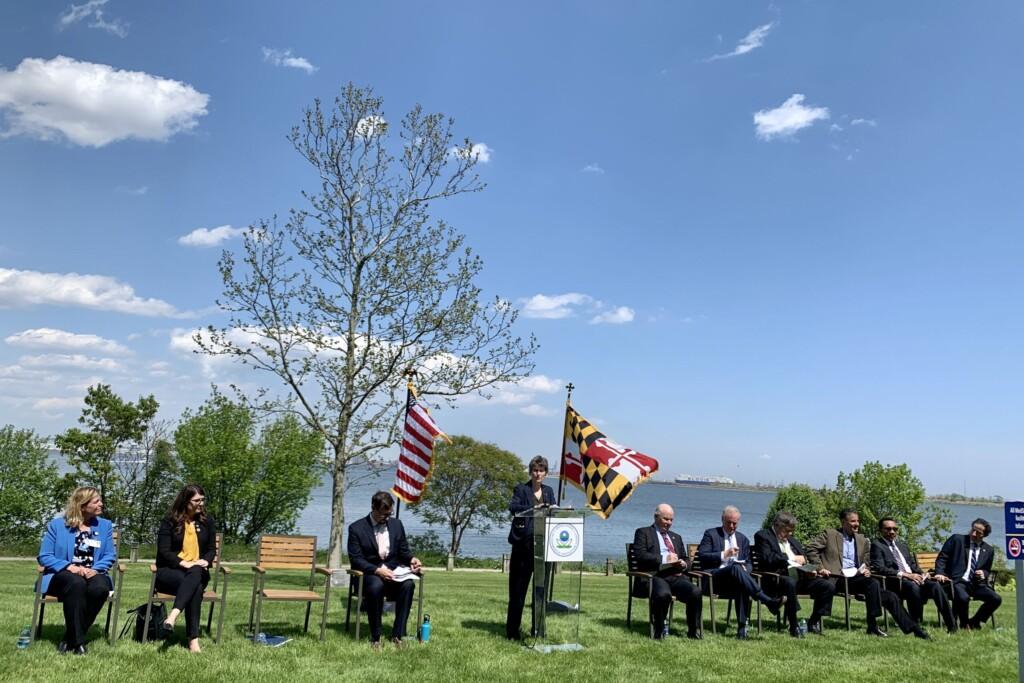
Janet McCabe, U.S. Environmental Protection Agency Deputy Administrator, announced the distribution of $40 million from the Bipartisan Infrastructure Law to fund projects that will improve water quality and help restore lands and rivers that impact the Chesapeake Bay at the MedStar Harbor Hospital in Baltimore. Also on hand, from left to right, were: Jill Donaldson, President of Medstar Harbor Hospital; Sen. Sarah Elfreth (D-Anne Arundel); McCabe; U.S. Sens Benjamin L. Cardin (D) and Chris Van Hollen (D); and U.S. Reps. Dutch Ruppersberger, John Sarbanes (D), Kweisi Mfume (D) and Jamie Raskin (D). Photo by Elizabeth Shwe.

More projects to clean up the Chesapeake Bay are expected to get underway after the U.S. Environmental Protection Agency announced on Monday the first release of funding from the trillion-dollar federal infrastructure effort to restore the estuary’s health and address climate change.

The Infrastructure Investment and Jobs Act, which President Biden signed last November, includes $238 million over the next five years for the U.S. Environmental Protection Agency’s Chesapeake Bay Program to support restoration projects.

“The Infrastructure Investment and Jobs Act provides a once in a generation opportunity — actually, it’s been more than a generation since this country saw this kind of investment — investment in on the ground efforts to protect natural treasures like the Chesapeake Bay and to improve using green and nature based infrastructure,” Janet McCabe, deputy administrator of the U.S. Environmental Protection Agency, said in front of the Patapsco River at MedStar Harbor Hospital in Baltimore on Monday.

McCabe announced that her agency will distribute $40 million directly to the six Bay watershed states and the District of Columbia as well as the National Fish and Wildlife Foundation from which community based organizations can apply for grants for Bay restoration projects.

The figure represents 85% of the first-year funding for Bay cleanup efforts. The agency received the funding two months ago and is already allocating it to states, which is an “incredibly quick turnaround” in federal government, McCabe quipped.

The state of Maryland will receive $3.21 million, Pennsylvania will receive $5.59 million, Virginia will receive $3.14 million, New York will receive $1.28 million, Delaware will receive $750,000, West Virginia will receive $500,000 and the District of Columbia will receive $500,000. The state funds will mostly go to farmers to improve local rivers and streams that run to the bay, according to a press release.

“It’s a very, very big deal what we’re doing here today,” said U.S. Sen. Benjamin L. Cardin (D). “You’re here today delivering a big check; please come back often with big checks,” he told McCabe. “Seventy-two percent of Marylanders live in the Bay watershed — this is their life.”

The Bay Program’s annual appropriation last year was $87.5 million, but funds from the infrastructure bill will raise the program’s annual funding to $138.1 million this fiscal year, according to the Chesapeake Bay Foundation.

“It is a cause for celebration,” Hilary Falk, the president of the Chesapeake Bay Foundation, said in an interview. “These dollars are also important because they can leverage other money and we can then get more programs on the ground.”

This federal investment for Chesapeake Bay cleanup efforts marks a shift from the Trump administration, which repeatedly tried to slash funding for the Chesapeake Bay Program, a regional partnership that has existed since 1983 and aims to restore the Bay’s health. However, Congress blocked his proposals to gut the program.

Federal agencies within the Chesapeake Bay Program recently pledged to minimize the impacts of climate change on the Chesapeake Bay Watershed. For instance, the U.S. Fish and Wildlife Service committed to leading a pilot study called Targeted Outreach for Green Infrastructure to prioritize public infrastructure needs in underserved communities at increased risk related to climate change, according to the pledge. And the National Park Service will conduct climate vulnerability assessments of all the coastal park sites of the Chesapeake Bay region and provide recommendations for climate resiliency.

“It is 400 years that we’ve been wrestling with the legacy of colonialism and over farming and suburban sprawl and industrialization, but in the last 40 years, we’ve made more progress than in the last 400 years — and that is a lot to be proud of,” said Adam Ortiz, the Mid-Atlantic Region administrator for the U.S. Environmental Protection Agency.

Rep. Kweisi Mfume (D), who grew up in Turner Station, said many Marylanders have a personal relationship with the Bay. But work still needs to be done to abate “human indifference” from those who don’t have that same relationship and believe the Bay will fix itself.

By Elizabeth Shwe

The Spy Newspapers may periodically employ the assistance of artificial intelligence (AI) to enhance the clarity and accuracy of our content.

Filed Under: Eco Homepage, Eco Portal Lead

Troika and ShoreRivers Teams Up: A Chat with Laura Era and Rebekah Hock

April 20, 2022 by The Spy
Leave a Comment

When one of Troika Gallery’s artists suggested in passing that a great spring theme would be a celebration of ShoreRivers conservation work, gallery owner Laura Era jumped at the chance.

For Laura, the idea of highlighting the role of water with so many of her artists was a perfect one, but it was also a personal one. For almost thirty years, Laura and her husband worked on the water before she devoted all her time and energy to her art work and keeping the gallery thriving. As a Eastern Shore native, she knew first hand how important environmental quality was for the Chesapeake Bay and its “guts” to use her term.

So on April 22, AKA, Earth Day, Troika will play host for “ShoreRivers@Troika Gallery which will feature their artists depicting the waterways of the Eastern Shore with a portion of sales supporting the clean water advocacy, restoration, and education work of ShoreRivers.

the April 22 reception will include Choptank Riverkeeper, Matt Pluta, who speak about the risks to water quality in the area and the many ways each of us can play a part in ensuring healthy, fishable, swimmable waterways.

The Spy, a fan of both ShoreRivers and Troika, stopped by the other day for a quick chat with Laura and ShoreRivers Rebekah Hock to hear more and view some of the great art that will be on display for purchase.

This video is approximately two minutes in length.

Troika Gallery located at 9 South Harrison Street, is open Monday, Thursday, Friday, and Saturday from 11am until 6:00 pm, and Sunday, Tuesday, and Wednesday by appointment. 410-770-9190. For more information about Troika Gallery please go here.

 For more information about ShoreRivers please go here.

The Spy Newspapers may periodically employ the assistance of artificial intelligence (AI) to enhance the clarity and accuracy of our content.

Filed Under: 6 Arts Notes, Eco Homepage, Eco Portal Lead

Chesapeake Ecosystem: Sewer Repair and ARPA Funding in Cambridge

March 28, 2022 by The Spy
1 Comment

It seems like everyone and their cousin is standing in line to qualify for ARPA funds to help their favorite project these days. The American Rescue Plan Act of 2021, which amounts to almost $2 trillion of federal grants to states and local municipalities, is finally reaches communities in need, but the challenge doesn’t stop there.

All of these communities, whether it be county commissioners or town council members, are now in the delicate process of determining the best use for those funds. And, as expected, while ARPA funds are a remarkable blessing in so many ways, the number of needy projects significantly outnumber the funding available.

The City of Cambridge is now in the process of deciding where its funds will be going, and Alan Girard, the Eastern Shore director of the Chesapeake Bay Foundation, makes a strong argument that $4.5 million of those funds needed to be used to repair and improve the city’s sewer pipes and infrastructure.

Over the last several years, Cambridge has faced increasing evidence that its current sewer pipe system is way out of date. With some piping as old as the 1930s, residents have reported seeing sewer in the streets, dirty diapers, and other pollutants that impact the quality of life and underscore the long-term threat to clean water.

The Spy sat down with Alan a few weeks ago to discuss this environmental challenge and how those ARPA funds could be the only way Cambridge can afford to get this expensive work done in a timely manner.

This video is approximately five minutes in length. For more information about Chesapeake Bay Foundation please go here.


The Spy Newspapers may periodically employ the assistance of artificial intelligence (AI) to enhance the clarity and accuracy of our content.

Filed Under: 2 News Homepage, Eco Homepage, Eco Portal Lead

Washington College joins Forces with American Bird Conservancy

March 25, 2022 by Spy Desk
Leave a Comment

–Through a unique partnership, Washington College has become an official test site for the American Bird Conservancy’s (ABC) bird-safe glass testing program, doubling the organization’s capacity to test and rate glass products. The College is running just the second testing tunnel for ABC and is the only college or university in the country to partner with the non-profit advocacy group in looking for ways to meet increased demand for solutions that address lethal glass collisions.

In just the first season, the College ran over 2,500 test flights and provided critical data back to ABC that helped gain approval for 10 new bird-friendly glass designs, which are in use by manufacturers in the U.S. and around the world, including in Brazil, Germany, Turkey, South Korea and the U.K. This spring, 15 new samples have been scheduled for testing between March and May.

Glass Collisions and the Threat to Birds

In the United States alone, glass collisions account for an estimated one billion bird deaths each year.

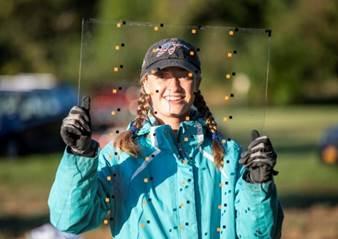
The root cause of glass collisions is the general reflectivity of the product. When it’s highly reflective, it’s generally reflecting back nature (trees, bushes, sky, etc.) and the bird sees that and wants to fly towards it. The simplest solution is glass with visible markings that birds can see. With markings spaced about 2 inches apart, most birds will pick up on the visual hint that it is solid and avoid flying into it.

ABC’s research into the efficacy of bird-safe glass began over 10 years ago. Since then, ABC has established itself as a leading advocate and has developed a standard rating system for bird-safe glass – the only rating system in use today.

The existence of the Foremans Branch Bird Observatory (FBBO) at Washington College laid the groundwork for this innovative partnership. Operating on a rural parcel of land just outside of Chestertown since 1998, FBBO is a major migratory bird banding station that focuses on monitoring seasonal movements of birds. FBBO has 92 mist nets spread over 55 acres and a rotating team that collects and bags over 15,000 birds annually. FBBO is part of the College’s River and Field Campus (RAFC), a living field lab that fosters environmental projects. With the infrastructure and process already in place, integrating the flights through the glass testing tunnel into the procedure before releasing them made for a smooth transition.

“It all started when our partners at ABC reached out and said, ‘You’ve got this great banding station, you’re banding birds daily…would you be willing to host a brand-new testing tunnel, to test the effectiveness of bird-friendly glass?’” said Michael Hardesty, Director, River and Field Campus at Washington College.  “Our answer was, absolutely!”

“It was easy to say yes to this partnership because of how incredible it is for bird conservation, but we knew it would also be such a great opportunity for our students,” added Hardesty. “The glass testing program represents the full spectrum of science moving to action, moving to implementation and our students get to witness all of that, and also to see an example of a field-based career opportunity that resulted from this partnership.”

The Testing Process

Washington College employs a Tunnel Technician as part of the project – Meghan McHenry (pictured above) a recent graduate — and during the testing season, which runs from March to November, each glass sample is tested about 80-100 times to measure key data points that determine its effectiveness. Every flight is recorded and the Technician then does a frame-by-frame analysis to record a standard set of behaviors, such as what direction the bird flew, any avoidance behaviors, the speed of the flight and if it was direct or indirect.

The tunnel itself is 24-feet long and completely dark, with the only light coming through two different panes of glass at the end of the tunnel. The testing process is fully controlled and designed to eliminate any bias by running test flights using the sample that is being evaluated, a control type and then no glass at all. If a bird does fly directly towards the glass in the test tunnel, it bounces off of a mesh net that has a little bit of give before reaching the glass, ensuring that no birds are harmed in the process.

This testing process is also important because glass that is bird-friendly isn’t friendly to the human eye. In order to achieve the widest adoption of these products, the goal is to find patterns that are both effective at preventing collisions and desirable from an aesthetic perspective. The good news is that most bird-friendly patterns are barely noticeable to people. At the conclusion of the testing of a sample, ABC assigns the product a rating called a “Material Threat Factor”, which is based on how many times the bird flies towards the tested glass.

As awareness of bird deaths due to glass collisions has spread, the demand for bird-safe glass has grown. In New York City, legislation now dictates that all glass under 75 feet tall on new buildings use bird-friendly glass that meets the ABC standard rating of 25. Chicago is considering similar legislation. LEED, the world’s leading green building certification system, now grants buildings a credit towards certification if they meet a requirement based on ABC’s rating system.

“At ABC we have always thought that sustainable buildings can’t really be sustainable if they are killing birds, and we are enjoying watching as the world’s designers start to realize that we are onto something,” said Christine Sheppard, Director of ABC’s Glass Collisions Programs.

In Maryland, legislation requiring state-owned and -funded buildings to have windows that are bird-safe has been introduced but not yet passed. It is expected to be re-introduced next session. Howard County already mandates that building projects meet bird-friendly design standards, marking a win for this effort in at least one of the state’s jurisdictions.

The Spy Newspapers may periodically employ the assistance of artificial intelligence (AI) to enhance the clarity and accuracy of our content.

Filed Under: Eco Homepage, Eco Portal Lead

Talbot County Council Approves Clarification Letter to MDE on Lakeside Project

March 23, 2022 by The Spy
Leave a Comment

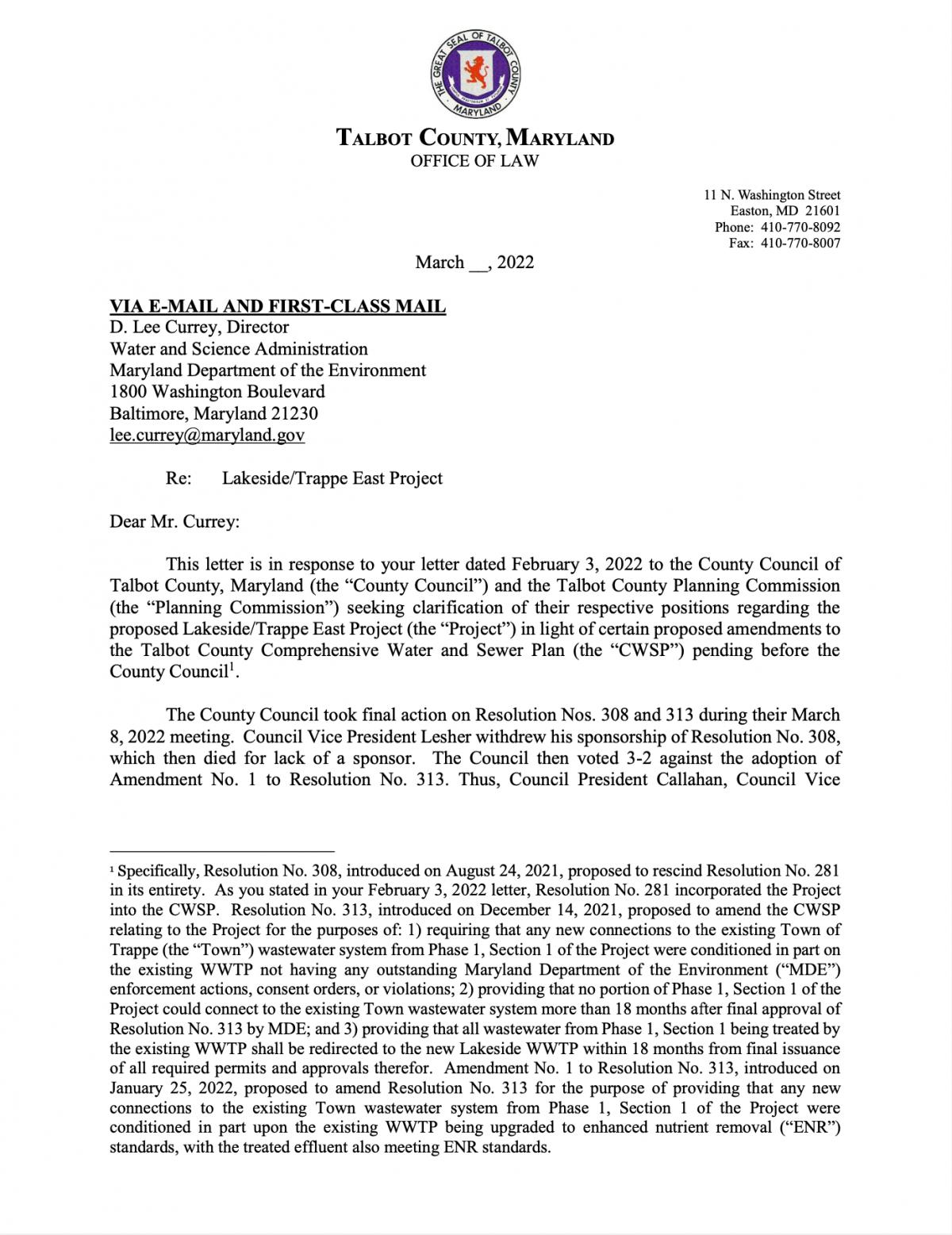
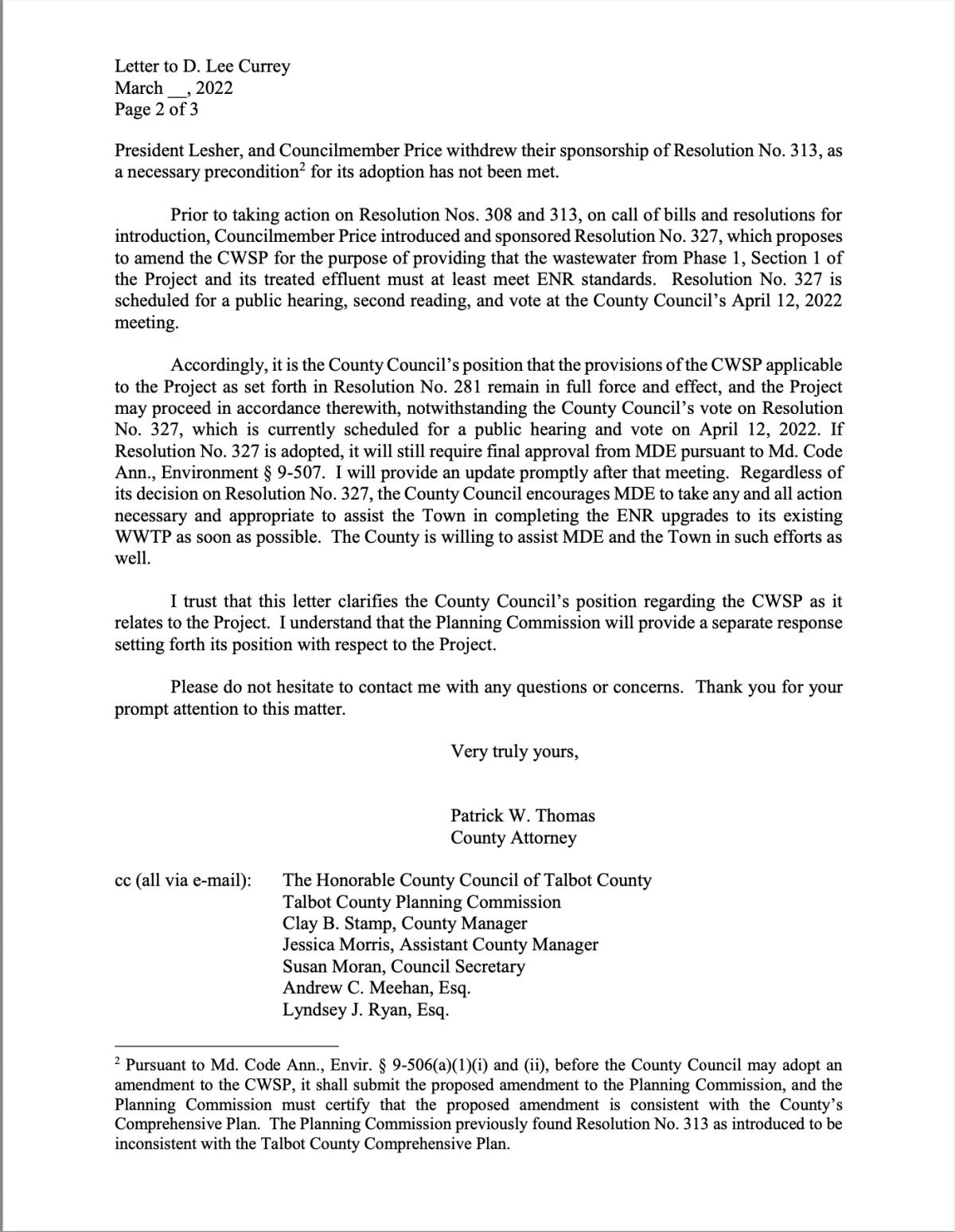
The Talbot County Council last night approved a letter by a vote of 3-2 to the Maryland Department of the Environment to clarify the Council’s position regarding the wastewater treatment plans for the Lakeside housing development in Trappe.

At the Council’s request, County Attorney Patrick Thomas drafted the letter to update the MDE on the Council’s deliberations on the proposed development water treatment plans. Council members Pete Lesher and Laura Price had recommended revisions to the draft prior to approval but were not able to gain the support of the majority of the Council members.

The letter noted that “the Project may proceed in accordance therewith, notwithstanding the County Council’s e Resolution No. 327, which is currently scheduled for a public hearing and vote on April 12, 2022. If Resolution No. 327 is adopted, it will still require final approval from MDE pursuant to Md. Code Ann., Environment § 9-507.”

Here is the full segment where the letter was discussed.

Final letter sent to Maryland Department of the Environment 


The Spy Newspapers may periodically employ the assistance of artificial intelligence (AI) to enhance the clarity and accuracy of our content.

Filed Under: 2 News Homepage, Eco Homepage, Eco Portal Lead, News Portal Highlights

CBEC in Grasonville Announces Summer Camp 2022

March 15, 2022 by Spy Desk
Leave a Comment

The Chesapeake Bay Environmental Center (CBEC) in Grasonville, Maryland will offer a full slate of youth summer programs, according to CBEC Education Coordinator Ashley Peris.

“All of us at CBEC are so excited to be able to offer a full slate of programs for area young people,” stated Peris. “We will be exploring the Bay, making new friends and enjoying the great outdoors. Our ‘hands-on, feet-wet’ approach enables campers to connect with nature through art, stories, games, nature hikes, and outdoor play; including direct encounters with live animals, birds, and fish.”

CBEC’s 2022 Summer Camp schedule includes two camp sessions for children now in grades 4, 5 and 6: Outdoor Adventure Camp, June 20-24, 9 a.m. to 3 p.m.; and Garden Chefs, August 8-12, 9 a.m. to 3 p.m.

For children now completing grades 1,2 and 3, CBEC Summer Camp options include Wild Discovery Nature Camp, set for July 18-22, 9 a.m. to 3 p.m.; and Art and Music Adventures, July 25-29, 9 a.m. to 3 p.m.

A fifth camp session, Water Wonders, is designed for pre-k and kindergarten children and is set for August 15-19, 9 a.m. to 12 noon.

“Our summer camp programs fill-up fast so we encourage parents to register early,” Peris said.

For detailed information about these camp sessions and easy online registration, visit the CBEC website page, bayrestoration.org/camps. Any questions may be directed to Ashley Peris, 410-8276694 or [email protected]. 


The Spy Newspapers may periodically employ the assistance of artificial intelligence (AI) to enhance the clarity and accuracy of our content.

Filed Under: Eco Homepage, Eco Portal Lead

Three Cheers to the Patricia Campbell by A.J. Metcalf

March 15, 2022 by Chesapeake Bay Foundation
Leave a Comment

Rumbling across the main stem of the Chesapeake Bay, the Patricia Campbell was carrying about 7 million juvenile oysters. Its captain, Karl Willey, was eyeing the GPS as the planting site in the Tred Avon River approached. Soon, a capable crew of deckhands and volunteers would be guiding the spat-on-shell oysters down the conveyor belt, toward the spreader, and into the murky waters below. After about an hour, the oysters were in their new home, cleaning and filtering the water around them.

For a boat that has traversed nearly every tributary in Maryland, the planting was just another day at the office in the vessel’s lengthy career. But this year is special for the Patricia Campbell; the boat is marking a milestone—its 20th year of service.

A marvel of a vessel when it was built in 2002 to accelerate CBF’s restoration efforts, today the 60-by-19-foot Patricia Campbell is as seasoned as the deadrise crab boats it often passes on its way to oyster sanctuaries. But even today it remains innovative and unique.

Karl Willey, the first and current captain of the vessel, said he knows of one other boat on the Chesapeake—Future Harvest—that has similar features. Built by a Virginia oyster company it is smaller and used for aquaculture.

“One of my favorite things about my job on the Patricia Campbell is seeing the spat-on-shell hit the water because I know they’re going to create oyster reefs and filter the water for years to come,” said Willey.

That process begins at CBF’s oyster restoration centers in Maryland or Virginia, where oyster larvae are added to oyster shells held in cages that are submerged in large holding tanks. Once the larvae stick to the shells, they become spat-on-shell. Then the cages are hoisted up by the Patricia Campbell‘s two-ton crane into a hopper on the boat.

The Patricia Campbell plants oysters at the Campbell Memorial Reef outside of Baltimore Harbor on July 31, 2019.

One of the Patricia Campbell‘s unique features is its conveyor belt, which can rapidly transport oysters from the hopper to the spreader. The spreader then fans the oysters out over a reef using GPS coordinates to ensure oysters are added where needed. The boat also has an open floor plan, enabling the crew to catch any snags and oversee the planting process.

“When we dedicated it, the Patricia Campbell was the first boat built specifically for oyster restoration,” said Paul Willey, who served as the project manager when it was built and is also Karl’s brother. “Thousands of boats have been built for oyster harvesting, but that was the first one for oyster restoration.”

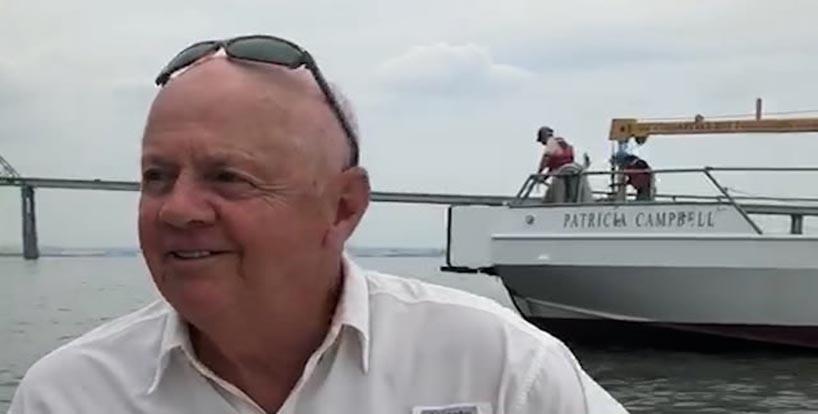
Former CBF Fisheries Director Bill Goldsborough thought up the design, and it was built by Midship Marine in Harvey, Louisiana. Longtime CBF Trustee Keith Campbell donated funds to build the Patricia Campbell, and it was named in honor of his wife.

In 2019, Campbell said the boat was inspired during a breakfast he had with Goldsborough and then-CBF President Will Baker. When Campbell mentioned his desire to get more oysters in the Bay, Baker asked Campbell for his support to build an oyster restoration vessel. Construction began soon after.

CBF Trustee Keith Campbell with the Patricia Campbell working behind him at the Campbell Memorial Reef in Baltimore.

Since that fateful breakfast, the “PC,” as it’s known at CBF, has added more than 336 million oysters to the Chesapeake Bay, traveled more than 22,000 miles, and completed about 300 trips. It has also served as a centerpiece for a community of more than a hundred interns and volunteers who have worked as crew members, some of whom have gone on to do restoration and conservation work elsewhere.

Throughout its operation, the Patricia Campbell has distributed most of those oysters onto Bay bottom inside oyster sanctuaries. Before significant oyster sanctuaries were established in Maryland in 2010, the vessel was used to add oysters to aquaculture leases held by CBF around Annapolis and in the Magothy River. Since then, CBF partnered with the National Oceanic and Atmospheric Administration (NOAA) to plant millions of spat-on-shell on restoration reefs in Maryland’s Little Choptank River, Harris Creek, and Tred Avon River.

The Patricia Campbell is also one of few vessels that can place oyster reef balls in the water for restoration. These three-dimensional concrete forms weigh about 300 pounds, and four at a time can be carefully lowered by the Patricia Campbell‘s crane. The PC has been used in reef ball projects to build fish habitat off Bill Burton Fishing Pier in Trappe, MD; add structure to an oyster sanctuary off the coast of Chesapeake Beach, MD; and as part of a research project to see if reef balls could help stabilize an eroding shoreline in Shady Side, Maryland.

Taken together, these planting efforts aim to stop the long-term decline of oysters in the Chesapeake Bay. Oysters throughout the Bay have declined to a fraction of their pre-industrial levels due to a combination of overharvesting, disease, and pollution. Yet, they’re vitally important to the health of the ecosystem. Adult oysters can filter up to 50 gallons of water per day, and their reefs provide habitat to fish, crabs, and hundreds of bottom-dwelling organisms. The bivalves are a source of food for birds, cownose rays, and other animals, as well as an important part of the regional fishing industry.

So what’s next for the Patricia Campbell? Karl Willey thinks the boat’s future is bright. In 2019, the boat received new engines and updated hydraulic systems.

The Patricia Campbell uses its crane to plant oyster reef balls off the coast of Chesapeake Beach, Maryland, in July 2021.

“That boat will continue to be a cornerstone of the Chesapeake Bay Foundation,” Willey said. “She’s got 1 billion oyster plantings in her. She’s ready to keep saving the oysters in the Bay from Baltimore to Chesapeake Beach.”

As for what type of boat innovation may be next for CBF, Paul Willey, who is now CBF’s director of education operations, is working on designs for an all-electric deadrise education vessel that could serve as a symbol for clean and green boating around the watershed.

Story and photos by A.J. Metcalf

The Spy Newspapers may periodically employ the assistance of artificial intelligence (AI) to enhance the clarity and accuracy of our content.

Filed Under: Eco Homepage, Eco Portal Lead

  • « Previous Page
  • 1
  • 2
  • 3
  • 4
  • …
  • 7
  • Next Page »

Copyright © 2025

Affiliated News

  • The Chestertown Spy
  • The Talbot Spy

Sections

  • Arts
  • Cambridge
  • Commerce
  • Ecosystem
  • Education
  • Food & Garden
  • Health
  • Local Life
  • News
  • Point of View
  • Senior Nation

Spy Community Media

  • Subscribe for Free
  • Contact Us
  • COVID-19: Resources and Data

© 2025 Spy Community Media. | Log in