MENU

Sections

  • About Us
    • Editors and Writers
    • Sponsorship Terms & Conditions
    • Code of Ethics
    • Sign Up for Cambridge Spy Daily Email Blast
  • The Arts and Design
  • Culture and Local Life
  • Food & Garden
  • Public Affairs
    • Commerce
    • Health
    • Ecosystem
    • Education
    • Senior Nation
  • Point of View
  • Chestertown Spy
  • Talbot Spy

More

  • Support the Spy
  • About Spy Community Media
  • Advertising with the Spy
  • Subscribe
November 8, 2025

Cambridge Spy

Nonpartisan and Education-based News for Cambridge

  • About Us
    • Editors and Writers
    • Sponsorship Terms & Conditions
    • Code of Ethics
    • Sign Up for Cambridge Spy Daily Email Blast
  • The Arts and Design
  • Culture and Local Life
  • Food & Garden
  • Public Affairs
    • Commerce
    • Health
    • Ecosystem
    • Education
    • Senior Nation
  • Point of View
  • Chestertown Spy
  • Talbot Spy
Ecosystem Eco Homepage Ecosystem Eco Portal Lead

Maryland Senate Democrats Pass Sweeping Climate Change Legislation

March 15, 2022 by Maryland Matters
Leave a Comment

The Maryland Senate passed an extensive climate change bill Monday night that would set the state on track to cut its greenhouse gas emissions to zero by 2045, partly by requiring large buildings to reduce their energy usage.

The Senate passed the Climate Solutions Now Act of 2022 in a 32-15 party-line vote, with Republicans opposed. The bill is now headed to the House of Delegates, where lawmakers  have introduced their own set of companion bills instead of a single sweeping measure.

The Climate Solutions Now Act would set the statewide greenhouse gas emission reduction goal to 60% below 2006 levels by 2030, expand the state’s electrical vehicle fleet, direct millions of dollars to school systems to build net-zero schools and establish a “green bank” that would invest state funds into private projects that reduce gas emissions, among many other provisions.

Monday’s vote came after a marathon Senate floor session last week, during which Republicans attempted a slew of failed amendments.

During committee deliberations, Sen. Paul G. Pinsky (D-Prince George’s) cut the bill’s most far-reaching provisions, which would have required all new buildings to use electric power, rather than fossil fuels, to provide space and water heating by 2024.

Pinsky, the bill sponsor and chair of the Senate Education, Health and Environmental Affairs Committee, said the amended bill “doesn’t go far enough.”

“But it makes a very important step forward,” he added.

Before the bill passed on Monday, Republicans renewed their claims that the bill would increase energy cost savings, particularly for low- and moderate-income residents who live in multifamily buildings, and not move the needle much on global climate change.

“This is going a bridge too far, but in a way it’s going to a bridge to nowhere because there’s no benefit…to the overall climate crisis,” said Minority Whip Justin Ready (R-Carroll). “It’s just going to raise energy prices.”

Sen. Mary Beth Carozza (R-Lower Shore) asked for climate solutions that do not threaten jobs or energy reliability and affordability for Marylanders.

But Pinsky contended that moving away from fossil fuels will be cheaper for the state in the long-run and highlighted that the Maryland Commission on Climate Change, which includes five Cabinet secretaries from the Hogan administration, approved recommendations for an all-electric construction code in a 24-2 vote.

“We can either be part of this movement or we can stand in the way of this movement — that’s our choice today,” Pinsky said.

.

A group of environmental advocates projected “electrify everything now” onto the State House on Monday evening to urge senators to pass the Climate Solutions Now Act. Courtesy by Jamie Demarco of the Chesapeake Climate Action Network.Before the Senate convened on Monday evening, a group of environmental advocates gathered on Lawyers’ Mall and projected the phrase “electrify everything now” with a picture of an electrical plug onto the State House to urge senators to pass the bill.“What do we want?” Victoria Venable, the Maryland director of the Chesapeake Climate Action Network, asked through a megaphone as senators were walking from the Senate office buildings to the State House.“Climate solutions!” the crowd yelled back.

The bill now requires the Public Service Commission to determine if there is enough capacity within the state’s grid to support an all-electric building code in the future. It also would require buildings of 25,000 square feet or larger to reduce emissions by 30% of 2025 levels by 2035 and to net-zero by 2040. But it exempts private and public schools, agricultural buildings and historic buildings from the new standards.

Pinsky predicted that even if the Public Service Commission concludes after their study that the state’s electrical grid can handle an all-electric building code, utility companies will still oppose sweeping climate legislation.

“The gas industry poisoned the well with disinformation and put their profit margin over the interests of the state,” Pinsky told Maryland Matters.“Now!” the crowd cheered.“When do we want it?” Venable asked.

Josh Tulkin, the director of the Maryland Sierra Club, said that he was disappointed that the Senate passed the bill without an all-electric code for new buildings, which he said was essential for the state to meet its greenhouse gas reduction goals. “We will need to do it, and that delay is not helpful,” he said.

Still, Tulkin praised the bill for maintaining a strong climate goal that begins to take important steps to reduce gas from existing buildings, electrify the state vehicle fleet and center environmental justice in more state programs. Pinsky’s bill would establish a Climate Justice Corps that would employ young people to work on clean energy or climate mitigation projects in communities disproportionately affected by climate change.

As the bill moves to the House of Delegates, Tulkin said he hopes lawmakers will amend the bill so that the Public Service Commission does not rely on analyses made by the utility companies about the state’s grid capacity. Instead, the Public Service Commission should rely on projections from third-party consultants, Tulkin said. “Utility companies should be providing information, answering questions, but not reaching conclusions.”

Emily Scarr, the Maryland director for Maryland Public Interest Research Group, said the bill “moves us in the right direction toward more efficient buildings powered by clean energy.” But she urged lawmakers to not invest any more in the state’s gas distribution network and argued it would be more expensive for Marylanders to rely on fossil fuel in the future.

“Decision-makers need to acknowledge that as Maryland moves away from fossil fuels, utilities will look to customers to cover the stranded costs of a gas infrastructure that will become increasingly useless,” she continued. “If regulators don’t recognize this moment, too many Marylanders will be trapped with the financial burden of ever increasing costs for outdated gas infrastructure.”

By Elizabeth Shwe

The Spy Newspapers may periodically employ the assistance of artificial intelligence (AI) to enhance the clarity and accuracy of our content.

Filed Under: Eco Homepage, Eco Portal Lead

Time to Spy … on the Great Horned Owl with CBEC

February 2, 2022 by Spy Desk
Leave a Comment

We are ready to “spy on” a nesting Great Horned Owl from the time she positively takes the nest, lays eggs, incubates and rears her owlets.  It’s exciting to get an up-close glimpse of this phase in the life of a ‘top of the food chain raptor’. 

CBEC wants to share this opportunity with its members, volunteers and community at large!  Follow the happenings on bayrestoration.org and click on the owl cam icon on the home page.  This will take you to the camera which is on 24/7 with sound.  We are actually 2’ from the bird when observing.  It does get addicting, just a warning!

Here is a rough timeline.  Remember these birds work on their own internal clocks, so here are a range of activities.

  • Now till the end of January or beginning of February, the birds (both male and female) will be checking on the nest periodically.  They are not there all of the time, but visit to ‘keep an eye on their core territory.’

  • End of January through February 15th possible laying of the eggs (usually 2 eggs about 2 days apart.)  The female will start incubating with the laying of the first egg.  It’s cold and she cannot let the egg(s) chill, so she is in constant attendance.  This goes on for 32-35 days.  Not a lot of action will be seen, as she may shift position; but, will be incubating constantly.

  • If eggs are viable (fertile, not chilled and development occurs) hatching should occur somewhere in the middle to end of March.  She will brood (stay sitting with the owlets under her staying warm) for about a week.  So, you might only get a quick glimpse of the chicks (owlets) if they poke heads out from under the female.

  • End of March owlets are able to maintain their own body temperature, so the female may leave the nest for short hunting forays.  Chicks look like they are unattended, but the female is always within “eyeshot.”

  • In April and May there can be lots of nest activity with the owlets getting their “nest legs.”  They will be hopping around, sleeping, picking on each other, feeding and growing rapidly.

  • Eventually after you see the owlets moving to different branches, getting stronger, flapping wings; they are soon ready to leave the nest.

As a side note, the owls don’t pay attention to the camera.  It’s just another “thing” hanging on the tree…no relevance to them.  At night an infrared light is on, so we can observe, but owls do not “see” or recognize infrared light.  So, all is taken into consideration for the welfare of the birds.  Enjoy and marvel.

That’s the cycle in a nutshell.  Check out the owl cam and watch what happens.  Also, one of our volunteers, Adele Claggett, has been recording the behavior of the male and female since December 1, 2021. To view these videos, go to birding.pictures and see what our owls have been up to during the pair bonding and pre-nesting stages.  If you have any questions, connect with Judy Wink
Executive Director Emeritusat
[email protected]. 


The Spy Newspapers may periodically employ the assistance of artificial intelligence (AI) to enhance the clarity and accuracy of our content.

Filed Under: Eco Homepage, Eco Portal Lead

Headed for Hurlock: The Rhythm of Chesapeake Migrations by Tom Horton

January 19, 2022 by Bay Journal
Leave a Comment

Because I hail from nearby Federalsburg, I can confidently describe the little village of Hurlock on the Eastern Shore of Maryland as unprepossessing, nothing remarkable, special for nothing much.

No reason, it would seem, ever to head for Hurlock.

Even within Dorchester County, which contains it, Hurlock’s flat farmscapes pale before the untrammeled gorgeousness of the great Blackwater marshes and the Choptank, Transquaking, Chicamacomico, Honga and Nanticoke rivers that lavish voluptuous meanderings on other county towns.

And yet, it is to Hurlock — specifically to the sprawling impoundments of its sewage plant — that every late autumn I head with my university classes around sunset to experience one of the great festivals of the Chesapeake Bay.

Gathering there nightly to rest, after foraging far-flung fields and wetlands, are hundreds of tundra swans, thousands of snow geese and Canada geese, squadrons of assorted ducks — all of it a delight for the eye and the ear. And that’s just for starters, I tell the class.

From 4,000 miles away, from across Alaska’s North Slope, the Bering Sea and the Yukon Territory the swans have come; the geese arrive from Labrador and Hudson Bay, and the ducks from prairie potholes as far off as Saskatchewan in Canada.

What a grand assemblage, as the western horizon fades from deep violet to black and the mellow, haunting halloooing of swans pierces the chill: Drawn from across the continent, the swans are headed for Hurlock. Having ridden the coattails of big northwest blows, they were likely airborne for 24 hours or more on the final leg of their journey.

It’s a bit of a conceit, this “headed for Hurlock” thing, because migrating waterfowl distribute throughout the great estuary. But I love how these hemispheric processions of life grace and enliven the humblest spots of the Chesapeake watershed.

I recall decades ago, exploring with my young daughter a tidal rivulet trickling from around Hurlock to Marshyhope Creek, the main tributary of the Nanticoke River. Pushing upstream in spots no more than a few feet wide were tiny wrigglers, baby eels returning from the Sargasso Sea, far out in the Atlantic Ocean, where all eels in North America go to spawn and die.

It remains more mysterious than the moons of Jupiter just why and how the eels do that, or how their spawn return. It is a remarkable journey, Abby understood, and she asked why they traveled so far.

Well, it’s obvious, I told her: They are headed for Hurlock.

We talked about how when I was a kid, schools of alewife and blueback herring thronged these little creeks every April, and how we spent cool spring evenings, campfires lit on the streambanks, dipping the silver fish for their fine-textured roe,  salting their flesh in crocks for pickling later on.

The herring spend most of their lives in the continental seas from Nova Scotia to the Carolinas, converging annually to spawn on Chesapeake tributaries where they were born.

Headed for Hurlock. These glad phenomena of migration lend ritual and rhythm, beauty and nourishment to the most nondescript spots — shad returning in April, ospreys in March, great blue herons in February, striped bass in May, monarch butterflies passing through in October. All of these comings and goings embroider the great estuary richly, weaving it into a larger context: the Bay migration-shed.

These far travelers evoke the word synecdoche, the Greek origin of which translates as “simultaneous understanding.” Migrations imply that a returning swan or duck or osprey is more than just a lovely creature, about more than just itself.

As the presence of brook trout in a stream betokens a whole watershed in natural enough shape to foster the very cleanest, coolest water, so the return of swans to Hurlock means that any number of way stations on the birds’ long journey remain good and natural. It also means that we have a responsibility to steward our portions of the route.

So, when I head for Hurlock with my students, we are looking not just for waterfowl but also for annual proof that wider webs of habitat along their way remain intact. The mellifluous swans, the raucous gaggles of geese, the sassing ducks, all of these are mere entry points, entangling the Chesapeake’s 64,000 square mile watershed in a vaster realm.

These annual comings and goings conjure up fundamental rhythms of the Bay itself. Tides moving in and out daily, the constant two-layered movements of fresher, lighter river water flowing south on top as heavier, saltier oceanwater licks north along the Bay’s bottom. Geologically, the Ice Ages drew the oceans back into their basins as glaciers swelled, leaving just a river valley where the Bay was. Then there were brief flowerings of estuaries when warmer interglacials melted the ice and the seas gorged every nook and cranny of the coastlines. Deflating with the ice ages, swollen with the interglacials, our Chesapeake “migrates” to a geologic cadence, water making love to the land.

The landscape joins in, too, autumnally inhaling swans and geese and ducks from across the continent and exhaling them back every spring, and beckoning spawning fish from the coastal seas to thrust up every river, celebrating spring, jazzing the watershed with new life.

So, apologies for having a little fun with Hurlock, where I’m headed this very afternoon. It is not just Hurlock, but a synecdoche, both a humble glimmer in the vaster Chesapeake scheme of things and a critical nexus in the ensorcelling web of life.

By Tom Horton

The Spy Newspapers may periodically employ the assistance of artificial intelligence (AI) to enhance the clarity and accuracy of our content.

Filed Under: Eco Homepage, Eco Portal Lead

After Two Years, Consensus on Oyster Policy Still Elusive in Maryland

January 18, 2022 by Bay Journal
Leave a Comment

It’s hard to come together over oysters in Maryland. Two years ago, seeking to get past seemingly endless conflicts between environmentalists and watermen, Maryland lawmakers ordered fisheries managers to try a more consensus-based approach to managing the state’s oyster population.

In a bill passed over Gov. Larry Hogan’s veto, the General Assembly directed the state Department of Natural Resources to work with scientists and help the DNR’s oyster advisory commission come up with ideas for rebuilding the oyster population while maintaining a sustainable harvest. Any recommendation would have to be supported by 75% of the panel’s members.

After meeting more than two dozen times, the DNR panel reported Dec. 1 that it had agreed on 19 recommendations — only one of which called for doing anything different about oyster management. That one urged the state to invest $2 million a year over the next 25 years to restore oysters in Eastern Bay, once a source of bountiful harvests, but which hasn’t been productive for the last two decades. The other recommendations called mostly for more shell or substrate to restore or replenish reefs, plus more research, data collection and evaluation of existing management practices.

“I think everybody was hoping for a little more consensus,” said Anne Arundel County Sen. Sarah Elfreth, a chief sponsor of the oyster management law and a member of the DNR advisory panel.

Hogan, in vetoing the bill, had argued that it would interfere with the oyster management plan the DNR had updated in 2019 and foil progress made in bridging disagreements. But the approach lawmakers spelled out in the 2020 law followed the format of more limited negotiations that had forged an agreement between watermen and environmentalists over oyster management in the Choptank and Little Choptank rivers on the Eastern Shore.

That effort, called Oyster Futures, produced a series of recommendations, some calling for changes in harvest rules and others proposing new restoration initiatives.

But the DNR commission’s oyster policy review was handicapped, participants agreed, by having to hold most of its meetings virtually. Some members, particularly watermen in rural areas of the Eastern Shore and Southern Maryland, had difficulty getting online or being able to participate.

“I was really disappointed in the process,” said Ann Swanson, executive director of the Chesapeake Bay Commission and member of the advisory panel. “We never got to the point where we could ever truly give and take — give on some harvest advancements in exchange for some ecological gain.”

The lack of in-person meetings prevented commission members from getting to know each other and understanding other points of view.

“We never ate together. We never chatted together,” Swanson said. “We’d come into a supercharged three-hour meeting, and so the conversations that you have that instill trust didn’t happen.”

The commission had plenty to talk about. A team of scientists from the DNR and the University of Maryland Center for Environmental Science analyzed the likely results of more than 70 different options for adjusting oyster management and restoration policies and practices.

Michael Wilberg, a member of the UMCES team, said computer modeling of various scenarios had helped the Oyster Futures group work through their differences. But the statewide review was hampered, he said, by the meeting handicaps and a fixed deadline for delivering recommendations to the governor and legislature.

“One of the important parts of this process is for people to propose new ideas and see us go out and try them and bring them back to the group,” he said. “That gets people talking to each other rather than trying to go around each other.

“I don’t feel we got quite to that level,” he added. “The group was just trying to get there, but we just ran out of time.”

Even so, Allison Colden, fisheries scientist with the Chesapeake Bay Foundation, said the computer modeling identified at least a couple of “win-win” scenarios that she thought could be the basis for agreement. But, she said, “we ended up with a result where we really didn’t come to consensus on anything with regard to making forward progress on oysters.”

A couple of the policy scenarios run through the computer model did project increases in oyster abundance and harvests alike, with more shells available to replenish worn-down reefs, Wilberg said.

“The problem I think people had … was how expensive they were,” he said. To achieve that modeled result, the state would need to invest about $20 million a year, he said, or 10 times what it spends now, to replenish reefs with recycled oyster shells and hatchery-spawned juvenile oysters.

Watermen likewise expressed frustration.

“I’m not real happy, but we’re moving,” said Robert Brown, Sr., president of the Maryland Watermen’s Association. He and others had argued that all the state needed to do was return to its longstanding practice of replenishing reefs with oyster shells and allowing watermen to transfer juvenile “seed” oysters from the Lower to the Upper Bay. Computer analysis didn’t support that, though.

Despite the commission’s near gridlock, watermen said the oyster population appears to be rebounding on its own, after two summers of good natural reproduction.

Wilberg agreed that there are signs that after decades of ups and mostly downs, the oyster population could be starting to stage a strong recovery. But oyster reproduction is uneven in Maryland’s portion of the Bay, he noted, and the ability to rebuild the stock is limited by the loss of many of the reefs that used to sustain the population.

“It’s possible that the future looks really rosy,” he said. But the model indicates that if current management practices continue unchanged, he added, “it looks like we should expect a slow decrease in the future, mainly because of the loss of [reef] habitat.”

As the last commission meeting ended, DNR Secretary Jeannie Haddaway-Riccio, who two years ago had called the legislature’s action “misguided,” strove to put the outcome in a positive light.

“I think that they did better than we expected,” she said, adding that members had worked through “incredibly hard circumstances.”

“We still have a lot of work to do,” she concluded, “but the fact that they were able to agree on some things is a great start.”

By Tim Wheeler

The Spy Newspapers may periodically employ the assistance of artificial intelligence (AI) to enhance the clarity and accuracy of our content.

Filed Under: Eco Homepage, Eco Portal Lead

Chesapeake Bay Environmental Center Reboots Mission

January 14, 2022 by Spy Desk
Leave a Comment

Like many similar organizations during the last two years, the Chesapeake Bay Environmental Center in Grasonville experienced a slowdown of operations because of Covid. It was forced to cut back on such popular activities as group facility rentals and environmental education experiences. At the same time, because of its convenient location, miles of serene nature trails, and access to the peaceful, pristine waters of the Chesapeake Bay, the CBEC premises frequently became a place for individuals and families to peacefully commune with nature and just-plain enjoy the outdoors.

Judy Wink, Executive Director Emeritus

“Despite the pandemic’s restrictions and safety protocols, we at CBEC stayed busy listening to our visitors, researching what their future could be. As a result, CBEC’s Board and staff have upgraded our mission, vision, and values to do even better what we’ve done for over 20 years,” said Carl Tenner, CBEC Board Chair. Associate Director, Vicki Paulas, was promoted to Executive Director and long-tenured Director, Judy Wink, graciously agreed to remain at CBEC, serving as Executive Director Emeritus. “Judy has played a vital role at our organization for a long time and we are excited she’ll continue on to help shepherd us along on CBEC’s course for the future”, stated Tenner.

A visit to the website – bayrestoration.org – will reflect the organization’s renewed vision and focus on the future. Of note, CBEC plans to build a new Education Pavilion at its Lake Knapp location, upgrade as well as construct new boardwalks on and around the woods, fields and wetlands on the property – including creating new trails in the northwestern portion of the property. A major component of building for the future will be restoring much of the shoreline and marshland in and around the Horsehead Peninsula, CBEC’s principal location.

“Along with the generous support of our members and friends, we’ve been fortunate to receive several Federal, State, and local grants to enable CBEC to enhance and expand its mission,” Executive Director Paulas stated. “While we’ve been known for the learning and fun of our nature-oriented summer camp programs, few know that our education programs extend year around.” CBEC frequently hosts field training for organizations like Maryland’s Department of Natural Resources, visits from elementary, middle and high school science and environmental education classes, as well as retreats for corporate, private and public organizations. Ms. Paulas clarified, “Few locations on the Chesapeake Bay offer the diversity of landscapes and environments – woods, meadows, and marshes – that our visitors can experience here at CBEC. And, we are so conveniently located, just over the Bay Bridge here in Queen Anne’s County.”

The Chesapeake Bay Environmental Center’s chief mission continues to be focused on environmental education, Chesapeake Bay wildlife and habitat research, and environmental stewardship and sustainability. Over the last 20 years, CBEC has hosted over 15,000 students, teachers, and researchers at its 510-acre preserve. Director Paulas calls it “hands-on, feet-wet” learning. CBEC maintains over four miles of trails and boardwalks, several elevated observation decks, a number of geocaching sites; even an “Owl Cam” for observing these fascinating birds’ habits without disturbing them. In the near future, CBEC also plans to install a similar “Osprey Cam” for viewers to observe these fascinating birds.

CBEC is headquartered in an LEED (Leadership in Energy and Environmental Design) certified building located in the center of the CBEC property. Besides staff offices, this “green” building includes a visitors’ and education center, conference rooms, a great hall, and kitchen. From this facility, visitors can easily access the numerous opportunities to experience the beauty of the Chesapeake Bay’s natural habitat. A dock, located on Marshy Creek, facilitates the numerous kayakers who want to directly experience the Bay from the water. CBEC maintains a number of kayaks for members and guests to use. “The Covid-19 ‘circumstances’ created a unique opportunity for us. The number of walkers, hikers, bikers, and – especially – kayakers has increased exponentially over the last year and a half,” commented Paulas.

“As a key community resource, all of us at CBEC look forward to strengthening and enhancing our services focused on education, conservation, stewardship and recreation,” said Board Chair, Tenner. “As a nonprofit organization, CBEC relies on memberships as well as public and private support. We welcome the interest and engagement of those who value the experiences and programs we offer.”

To learn more about CBEC’s mission, programs, membership and volunteer opportunities, visit their website at bayrestoration.org or call CBEC at 410-827-6694.


The Spy Newspapers may periodically employ the assistance of artificial intelligence (AI) to enhance the clarity and accuracy of our content.

Filed Under: Eco Homepage

From Agnes to Now: Perspectives from 50 years of Reporting by Tom Horton

December 28, 2021 by Bay Journal
Leave a Comment

When the rains began pelting the Chesapeake Bay’s six-state watershed with a scope and intensity not seen for centuries, I was in my third month as a Baltimore Sun reporter, still learning how to craft a basic news article.

Tropical Storm Agnes, in June of 1972, threw me the biggest story I would cover in an environmental journalism career that’s lasted almost 50 years.

Agnes struck when the Bay’s fish, crabs, oysters and seagrass meadows were all spawning and flowering and at their most vulnerable. In a few days it smothered the estuary with more sediment and other pollution than it normally receives in decades.

I was too new at my Sun job to even get my name on the front page pieces I wrote. But Agnes lent me valuable perspective: how rare and unpredictable events can drive environmental change more than all of the day-in-day-out stuff you can spend a whole career thinking is “reality.” Some of the declines ushered in by Agnes persist to this day.

If our human watch is puny in nature’s grand schemes, it’s still long enough to draw useful observations. Here are some things that seem notable to me, looking back over a half a century of chronicling the Bay.

Pollution

The visible pollution from industrial discharge pipes and smokestacks has been largely controlled. Bay rivers look cleaner than when I was growing up.

Largely invisible, the Bay’s current, biggest pollutant, nitrogen, was not even recognized as a problem by state and federal environmental agencies until the 1980s. It took a lawsuit by citizens, and scientists who risked their jobs, to change this. And not until the 1990s was one of the major sources of nitrogen — dirty air — deemed a “controllable” source. Bottom line: Restoration means attending to every piece of the puzzle.

Sewage treatment has been a triumph of technology, drastically reducing pollution from human waste even as the population in the watershed has more than doubled. Along with similar techno-fixes for cleaner air, this accounts for most of the modest progress we’ve made in Bay restoration. But this has also masked the other impacts of more people and more cars, such as more paving, more deforestation and fewer wetlands. And there’s not that much juice left to be squeezed from the sewage and air solutions.

Seafood

Whether it is rockfish or crabs or oysters, you cannot manage what you cannot count. A survey that measured the yearly spawning success of rockfish, or striped bass, beginning in 1954 was key to alerting managers to an alarming decline in the 1980s. This led to a five-year fishing moratorium and current management that put rockfish on a relatively sustainable path.

Similarly, a Baywide blue crab survey began in 1990 picked up declines and gave Maryland and Virginia the proof needed in 2008 to take dramatic conservation steps. Crabs are managed fairly sustainably now.

For those things we did not count or invest with enough scientific effort — species like shad and oysters — the results were predictable: a shad moratorium since 1978 in Maryland and oysters reduced to around 1% of historic populations.

Survey, sample, monitor, measure — not sexy, so easy to cut in budgets. But no count, no manage.

Lands of the watershed

We all know that the Bay’s 40-million-acre watershed was green, mostly forested and the Bay was healthy before European colonists arrived.

But just as important, often overlooked, it was wet! This was courtesy of millions of beavers, damming and ponding, spreading and slowing the flows of water. There were also countless other natural wetlands, many drained long ago for development and farming. All that wetness sponsored bacteria that transformed polluting nitrogen into harmless forms.

We know this from Grace Brush, a Johns Hopkins scientist, who extracted sediment cores from the Bay’s bottom, analyzing what was washing off the land and living in the Bay going back thousands of years. The evidence is that wet-loving plants were much more dominant for most of the Bay’s history. For the Bay’s restoration we not only need greener landscapes, but wetter ones, too.

Agriculture remains a big pollution source, but farmers have proved to be capable of remarkable transformations, like a major shift from plowing to not plowing (conservation tillage, through which seeds are drilled into last season’s crop stubble.)

This minimizes erosion, sediment and chemical runoff and energy use. Add to it the fast-growing use of cover crops, planted post-harvest to suck up leftover fertilizer before it can run off to the Bay; new attention to soil’s organic content with an ability to store carbon; and innovative uses of animal manure to keep it out of polluting runoff.

Looking ahead, I don’t know if we will learn to feed ourselves without fouling the water. Looking back, it seems like we could.

We’ve protected close to a quarter of the Bay’s watershed from development, which seemed impossible in 1972. You weren’t even allowed to form a local land trust in Virginia then. It’s the clearest success we’ve had in my life. Globally and locally, we’re hearing aspirations of protecting half of our lands for nature, or at least in undeveloped status, a worthy and achievable goal.

Ecosystem services

Not sure I knew the phrase “ecosystem services” until the 1980s, but it’s developed bigtime during my watch. It means documenting the cleansing, filtering, buffering, habitat enriching values we get — for free — from wetlands, oyster reefs, forests, beavers, menhaden and mussels, etc., if we just let them do their thing.

We haven’t yet taken the next step seriously enough, which is to accord these services literal value, to act as if they are just as critical to our economy as cash and credit.

The future

There’s a humongous piece of the puzzle still missing — attention to stabilizing the human population, whose growth is a consequence of running our economy like it must grow without limit or face ruin. That’s like saying you have to become obese or starve, with no option to just be healthy. Prosperity without growth is the idea economically.

Finally: Climate change, scarcely mentioned in a book I wrote on saving the Bay as recently as 2003, will make doing everything mentioned earlier even more critical.

Tom Horton, a Bay Journal columnist, has written many articles and books about the Chesapeake Bay, including Turning the Tide and Island Out of Time. He currently teaches writing and environmental topics at Salisbury University.

The Spy Newspapers may periodically employ the assistance of artificial intelligence (AI) to enhance the clarity and accuracy of our content.

Filed Under: Eco Homepage, Eco Portal Lead

Regulators Ease Shutdown Order on Troubled Md. Poultry Rendering Plant

December 28, 2021 by Bay Journal
Leave a Comment

Maryland regulators have let a problem-plagued Eastern Shore poultry rendering plant resume operations two days after ordering it shut down because of pollution violations and potential wastewater releases.

Valley Proteins Inc. reached an agreement on Dec. 23 with the Maryland Department of the Environment that allowed it to restart its Linkwood plant but extends for now a ban on discharging any of its wastewater into a tributary of the Transquaking River.

Instead, the interim consent order signed by the MDE and the Winchester, VA-based company requires it to continue pumping wastewater from on-site lagoons and hauling it elsewhere to be treated. It also mandates lowering levels in the impoundments over the next 20 days to reduce the risks of leaks or overflows.

Under the order, Valley Proteins can only resume discharging wastewater to the Transquaking, a Chesapeake Bay tributary, after it has reduced lagoon levels sufficiently and can comply with pollution limits in its permit. It must notify the MDE two hours before resuming discharges and upon any other changes in its treatment operations.

Neighbors and environmental groups have complained for years about the Valley Proteins plant, which takes up to 4 million pounds of chicken entrails and feathers daily from poultry processing plants and renders them into pet food.

The rendering plant is the river’s largest single source of nutrient pollution, which fuels algae blooms and reduces oxygen levels in the Chesapeake Bay and its tributaries below what’s healthy for fish and other aquatic animals.

Mike Smith, the company’s vice chairman, said that partial rendering operations resumed the night of Dec. 23 and that work is under way to repair and restart the wastewater treatment system at the plant.

“Once the system kicks in and treats our water properly, we will discharge again,” he said by email, adding that the company would then also “begin to run again at full production.”

The MDE had ordered Valley Proteins to suspend operations at the Linkwood facility two days earlier, on Dec. 21, after a series of inspections from Dec. 10 through Dec. 20 found multiple violations, including an illegal discharge into a holding pond, discharges of sludge and inadequately treated wastewater into a stream leading to the Transquaking and leaks and overflows from treatment tanks.

Regulators had directed the company earlier to stop discharging wastewater until its treatment system could meet pollution limits in its permit. The Dec. 21 order to suspend operations was prompted by the MDE inspector finding the company’s wastewater lagoons were nearly full.

The MDE’s inspections were triggered by drone images provided to the agency on Dec. 10 by ShoreRivers, a coalition of Eastern Shore riverkeeper organizations, which showed a discolored discharge from the rendering plant’s wastewater outfall.

Earlier this year, ShoreRivers, the Chesapeake Bay Foundation and Dorchester Citizens for Planned Growth notified Valley Proteins they intended to sue over pollution violations at the Linkwood plant, including repeatedly exceeding discharge limits on fecal coliform bacteria, nitrogen, phosphorus and ammonia.

The plant has been operating on an outdated discharge permit since 2006, and in September the MDE proposed new limits that would require upgrading the company’s wastewater treatment system. The state had at one time offered to provide nearly $13 million in public funds to pay for that upgrade, but lawmakers cut the amount in half. The MDE subsequently withdrew the offer and vowed to take enforcement action after finding more pollution violations there. That new permit is still pending.

In the Dec. 23 interim consent order, the MDE directs the company to hire an outside engineer and submit a plan within 100 days for improving the Linkwood facility’s wastewater treatment system. The company agreed to pay fines of $250 per day per violation if it fails to comply with any of the order’s terms.

By Timothy B. Wheeler

The Spy Newspapers may periodically employ the assistance of artificial intelligence (AI) to enhance the clarity and accuracy of our content.

Filed Under: Eco Homepage Tagged With: discharge, environment, Maryland, plant, poultry, rendering, valley proteins, violations, wastewater

Bay Ecosystem: Lawrence Wetlands Preserve Is Becoming a Reality

December 27, 2021 by James Dissette
Leave a Comment

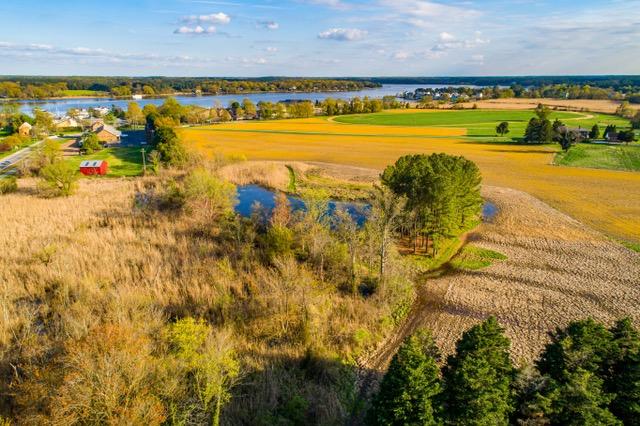
Thanks to a $250,000 grant from the National Park Service Chesapeake Gateways program, Sultana Education Foundation continues with its most complex project yet—the restoration and preservation of the Lawrence Wetlands Preserve.

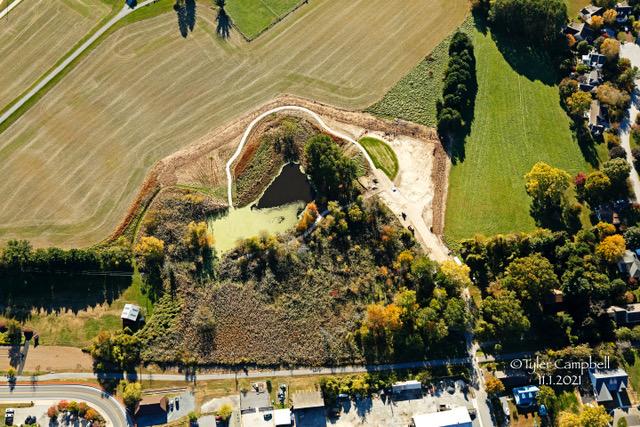
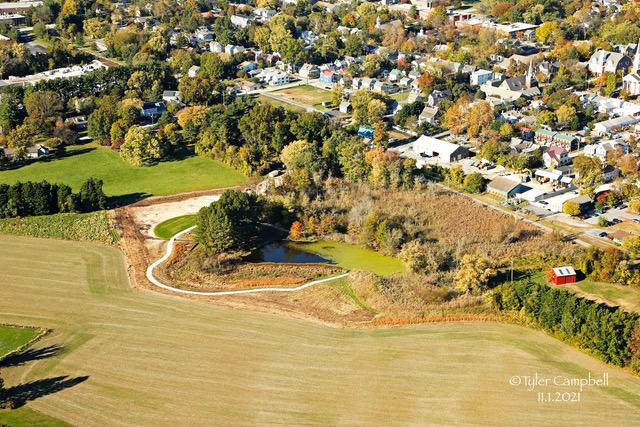
Adjacent to the hiking trail and hidden from sight by a wall of phragmites, the 8.5-acre wetlands is a “pocket park” of diversity “including woodlands, non-tidal marsh, shrublands, warm grass meadows, swampland, and a freshwater pond draining into the Chester River.”

This unique environment will become a perfect watershed classroom for Sultana Education Foundations’ ongoing mission to provide students with transformative educational experiences and learn about the Chesapeake Bay watershed and its natural and human history.

President of Sultana Education Foundation Drew McMullin says that projects have already started with the planting of more than 400 trees to create a woodland buffer along with two pollinator meadows, and a network of wetland pedestrian boardwalks.

McMullin calls attention to the fact that the Preserve will also be open to the public as a walking park, an invaluable addition to the community.

In 2022 a 1200 square foot nature center building will be built for indoor classes to allow year-round educational courses.

Sultana Education Foundation has had a 20-year relationship with the National Park Service, reaching back to the Schooner Sultana initiative’s days and the maintenance of interpretative websites for the Chester River Water Trail and Sassafras River Water Trail, part of the greater Captain John Smith Chesapeake National Historic Trail.

“We were one of the very first to become a Chesapeake Gateways Network partner and we’ve been incredibly fortunate over the last 20 years to have the support of the National Park Service and role that they have played for us is to jump start every new initiative we’ve ever done,” McMullen says.

Here, Drew McMullen and Bob Campbell, Gateway Planning and Development Manager for National Park Service, share a Zoom meeting with the Spy to discuss the future of Lawrence Wetland Preserve.

This video is approximately nine minutes in length. For more about Chesapeake Bay Gateways Network, go here. For more about Sultana Educational Foundation, go here. Credits: Still photos by Tyler Campbell and Sam Shoge.

The Spy Newspapers may periodically employ the assistance of artificial intelligence (AI) to enhance the clarity and accuracy of our content.

Filed Under: Eco Homepage, Eco Portal Lead

Md. Orders Linkwood Chicken Rendering Plant Shut Down for Corrective Actions

December 23, 2021 by Bay Journal
Leave a Comment

Maryland regulators have ordered a shutdown of a problem-plagued Eastern Shore chicken rendering plant after a tip from an environmental group led them to discover a batch of new pollution violations there.

The Maryland Department of the Environment on Dec. 21 directed Valley Proteins Inc. to cease operations at its facility in Linkwood in Dorchester County until it can meet its wastewater discharge permit limits and reduce the risk of overflows from its storage lagoons. The MDE threatened to fine or suspend the plant’s permit altogether if it failed to comply with prescribed corrective actions.

Michael A. Smith, vice chairman of the Winchester, VA, based company, said it had agreed to a temporary shutdown until it can lower the levels of its storage lagoons and meet permit requirements.

“We are working cooperatively with MDE to resolve the issue as quickly as possible,” Smith said.

The shutdown order comes after a series of MDE inspections this month found multiple problems at the facility. According to MDE inspection reports, those included an illegal discharge into a holding pond, discharges of sludge and inadequately treated wastewater into a stream leading to the Transquaking River, and leaks and overflows from treatment tanks.

At Valley Proteins’ poultry rendering plant, workers clean up sludge that was discovered in a stream leading to the Transquaking River. (MD Department of the Environment)

The inspections were triggered by drone images provided by ShoreRivers, a coalition of Eastern Shore riverkeeper organizations, showing a grayish discharge from the rendering plant’s wastewater outfall, according to a letter MDE Secretary Ben Grumbles wrote to a Valley Proteins executive.

Choptank Riverkeeper Matt Pluta, a member of ShoreRivers staff, said that while doing aerial surveillance on Dec. 10, he saw “a large, discolored discharge” coming from the Linkwood facility and flowing downstream toward the Transquaking.

The MDE inspected the plant later the same day and reported it found acidic, inadequately treated wastewater being released into a stream, chlorine-treated wastewater leaking onto the ground, and foam and wastewater overflowing from another treatment tank.

The following week, more MDE inspections found waste sludge in a stream outfall leading to the Transquaking, continuing improper discharges both to the stream and onto the ground and inadequate cleanup of earlier detected leaks, spills and overflows. The MDE also found raw chicken waste on the ground. Regulators ordered the plant to cease discharges until the wastewater could be treated sufficiently to meet its permit limits.

“Chemical spills, tanks are overflowing, illegal discharges coming from all over the treatment process. It’s an absolute mess,” Pluta said of the conditions described in the inspection reports.

Neighbors and environmental groups have complained for years about the Valley Proteins plant, which takes up to 4 million pounds of chicken entrails and feathers daily from poultry processing plants and renders them into pet food.

The Transquaking, which flows into Fishing Bay, a Chesapeake Bay tributary, has been classified for more than two decades as impaired by nutrient pollution. The rendering plant is the river’s largest single source of such pollution, which fuels algae blooms and reduces oxygen levels in the water below what’s healthy for fish and other aquatic animals.

In his Dec. 16 letter to the company, the MDE’s Grumbles called the Linkwood plant’s operations “unacceptable.” He said the company’s recent compliance record “indicates a pattern of improper operations and poor decision-making regarding water pollution and air emissions issues.”

Another follow-up inspection on Dec. 20 found evidence of more sludge having been discharged in recent days, despite cleanups of earlier releases and leaks. The inspector also found that the plant had stopped discharging and its wastewater lagoons were filling up, despite some of the wastewater being trucked away. That prompted the shutdown order.

Valley Proteins’ Smith said the company is complying.

“We have a plan in place to move as much of our incoming supply to other [renderers] and or landfills in the short term,” he said by email. The company also has arranged, he said, to lower the levels in its storage lagoons by trucking “treated clarified water” from them to an unnamed local wastewater plant.

Sludge from the Valley Proteins chicken rendering plant in Linkwood, MD, fouls a stream leading to the Transquaking River. (MD Department of the Environment)

“We have seen our system improve over the last few days and anticipate being able to operate shortly,” he concluded.

MDE spokesman Jay Apperson said Valley Proteins is putting together a plan for returning to operation, but he said the company’s plan would have to persuade the MDE that it will comply with its discharge limits and other permit requirements.

In April, Pluta’s ShoreRivers group joined with the Chesapeake Bay Foundation and Dorchester Citizens for Planned Growth to threaten a lawsuit against the company, accusing it of repeatedly exceeding discharge limits on pollutants such as fecal coliform bacteria, nitrogen, phosphorus and ammonia.

Grayish liquid on the ground that, according to an MDE inspector, leaked from a chlorine treatment chamber at Valley Proteins’ wastewater treatment plant. (MD Department of the Environment)

The plant has been operating on an outdated discharge permit since 2006, and neighbors and environmental groups have been calling on the MDE to impose tighter requirements. Meanwhile, in 2014, the company applied for state approval to nearly quadruple its wastewater output, from 150,000 gallons to 575,000 gallons daily.

In September, the MDE released a new draft permit that would tighten limits on what the company could discharge. State regulators set caps on discharges of nitrogen and phosphorus that would require the company to upgrade its wastewater treatment facility, even if it did not expand operations.

State regulators also vowed to seek “a significant financial penalty” as well as corrective actions for a series of water and air pollution violations it had documented at the Shore facility.

That represented a shift in the MDE’s approach to the rendering plant. Earlier this year, the department had planned to provide Valley Proteins nearly $13 million to upgrade the wastewater treatment system at its Linkwood facility. Some lawmakers objected to giving public funds to a private company with a history of discharge violations, and the legislature limited such grants to half of any projected cost. After finding more violations at the plant, the MDE subsequently withdrew the grant offer.

Critics of the plant welcomed the MDE’s pledge to take enforcement action. But at hearings in October and November, they demanded that the state put more teeth in the plant’s discharge permit. They called for independent monitoring of its discharges, curbs on any planned increase in the rendering plant’s operations until it corrects all deficiencies and the MDE pledges to fine and take enforcement action for any future violations.

Pluta said the latest developments add to his concerns about the rendering facility and about the state’s ability to oversee it.

“We recognize that there’s a need for this type of operation,” he said, “but if you can’t operate within the guidelines of the law, of your permit, then you shouldn’t be able to operate at all.”

Pluta also questioned whether the MDE has enough staff and resources to ensure compliance, noting that the MDE only discovered problems there after he reported seeing a suspicious discharge.

“They’ve been inspecting monthly and didn’t come up with all this stuff,” he said.

The public comment period on Valley Proteins’ draft permit, which was extended for 60 days, remains open until Jan. 14, 2022.

MDE spokesman Jay Apperson said department officials will consider all comments received in making a final decision on the company’s permit application.

But Apperson also released a statement from the MDE secretary, saying, “We are much more focused on enforcement and correcting any ongoing violations before taking any actions on a draft permit.”

By Timothy B. Wheeler

The Spy Newspapers may periodically employ the assistance of artificial intelligence (AI) to enhance the clarity and accuracy of our content.

Filed Under: Eco Homepage Tagged With: chicken rendering plant, dorchester county, environment, linkwood, mde, overflows, permit, pollution, storage lagoons, valley proteins, violations, wastewater discharge

National Park Service Awards $250,000 for Sultana’s Lawrence Wetlands Preserve & Center 

November 22, 2021 by Spy Desk
Leave a Comment

The Sultana Education Foundation (SEF)  announced that the National Park Service Chesapeake Gateways program has provided $200,000  in funding in support of the Lawrence Wetlands Preserve – a new urban nature center the  Foundation is developing in Chestertown, Maryland. This award brings the National Park Service’s  investment in the project to $250,000, as well as the contribution of considerable technical and  planning support. When open to the public in 2023, the Lawrence Preserve will function, in  association with the Holt Education Center, as a National Park Service partner visitor contact  station on Maryland’s Upper Eastern Shore for information, education, and to get official  Chesapeake passports stamped.  

Photo by Sam Shoge

Established with the help of a $1 million lead gift from philanthropist Michael Lawrence, the 8.5- acre Lawrence Wetlands Preserve is centrally located in walking distance to Chestertown’s historic  downtown and Sultana’s LEED Platinum Holt Education Center. While diminutive in size, the  Lawrence Preserve boasts diverse habitats, including woodlands, non-tidal marsh, shrublands,  warm grass meadows, swampland, and a freshwater pond draining into the Chester River. The  Preserve’s “watershed in miniature” will provide an ideal setting for students to learn how land use  impacts the health of the Chesapeake Bay. The Preserve will also be accessible to the public,  providing a new natural space in Chestertown’s growing downtown. 

“We are honored by the NPS Chesapeake Gateways’ support and commitment and are proud to  have the Park Service as a partner for the Lawrence Wetlands Preserve,” said Sultana Education  Foundation President, Drew McMullen. ‘Our relationship with the National Park Service spans two  decades, and they have provided initial support for many of our core public and educational  programs.”

Photo by Tyler Campbell

“NPS Chesapeake Gateways applauds Sultana Education Foundation’s vision to create a new  outdoor Chesapeake watershed classroom for students that also serves as an oasis of green space for the Chestertown and surrounding community,” said Wendy O’Sullivan, Superintendent of the  NPS Chesapeake Office. “The Lawrence Preserve is the latest example of how the Sultana team is a  leader and model for place-based environmental education and Chesapeake storytelling on  upper Eastern Shore.” 

“We are fortunate to have the Sultana Education Foundation in our community and we eagerly  await the completion of the Lawrence Wetlands Preserve. We see this new facility as a tremendous asset for young people in our area and for our community as a whole,” commented  Chestertown Mayor, David Foster.  

Photo by Tyler Campbell

The Park Service is one of several major organizational partners supporting the Lawrence Preserve,  including the Stories of the Chesapeake Heritage Area, the Maryland Heritage Areas Authority, the  John Ben Snow Memorial Trust, the Indian Point Foundation, the Shared Earth Foundation, the  Gosnell Foundation, and the Schumann Charitable Trust. 

Work on Sultana’s Lawrence Preserve began in June with the installation of a site-wide trail  network and extensive landscape engineering. This fall, the Foundation planted 400+ trees to  create a woodland buffer around the property’s border, as well as two warm grass pollinator  meadows. Development of the property will continue in 2022 with the construction of a 1,200  square foot nature center building allowing the Preserve to operate on a year-round basis, as well  as a system of wetland pedestrian boardwalks. 


The Spy Newspapers may periodically employ the assistance of artificial intelligence (AI) to enhance the clarity and accuracy of our content.

Filed Under: Eco Homepage, Eco Portal Lead

  • « Previous Page
  • 1
  • 2
  • 3
  • 4
  • 5
  • …
  • 7
  • Next Page »

Copyright © 2025

Affiliated News

  • The Chestertown Spy
  • The Talbot Spy

Sections

  • Arts
  • Cambridge
  • Commerce
  • Ecosystem
  • Education
  • Food & Garden
  • Health
  • Local Life
  • News
  • Point of View
  • Senior Nation

Spy Community Media

  • Subscribe for Free
  • Contact Us
  • COVID-19: Resources and Data

© 2025 Spy Community Media. | Log in