
MENU

Sections

  • About Us
    • Editors and Writers
    • Sponsorship Terms & Conditions
    • Code of Ethics
    • Sign Up for Cambridge Spy Daily Email Blast
  • The Arts and Design
  • Culture and Local Life
  • Food & Garden
  • Public Affairs
    • Commerce
    • Health
    • Ecosystem
    • Education
    • Senior Nation
  • Point of View
  • Chestertown Spy
  • Talbot Spy

More

  • Support the Spy
  • About Spy Community Media
  • Advertising with the Spy
  • Subscribe
December 6, 2025

Cambridge Spy

Nonpartisan and Education-based News for Cambridge

  • About Us
    • Editors and Writers
    • Sponsorship Terms & Conditions
    • Code of Ethics
    • Sign Up for Cambridge Spy Daily Email Blast
  • The Arts and Design
  • Culture and Local Life
  • Food & Garden
  • Public Affairs
    • Commerce
    • Health
    • Ecosystem
    • Education
    • Senior Nation
  • Point of View
  • Chestertown Spy
  • Talbot Spy
Education Ed Homepage

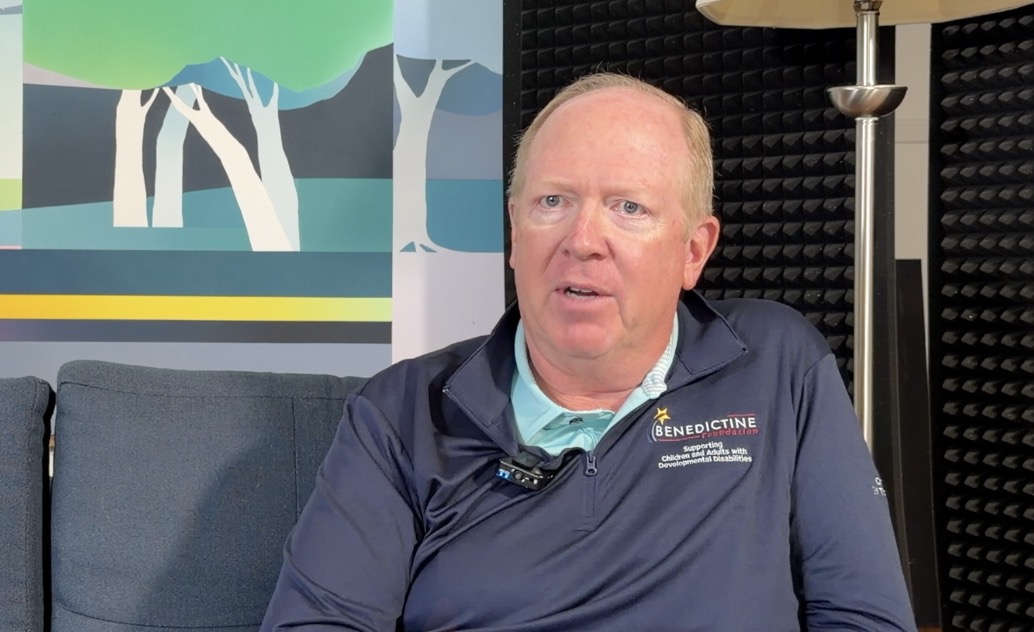
Benedictine’s Next Chapter: A Chat with Executive Director Scott Evans

October 23, 2025 by The Spy
Leave a Comment

It can never be said enough times how lucky the Mid-Shore is to have such a remarkable place as Benedictine in our region.  And that is the reason we continue to invite Scott Evans, its Executive Director to stop by the Spy Studio at least once a year for a check in session.
Benedictine is one of the Eastern Shore’s most impactful yet quietly integrated institutions. While many know it as the long-standing school in Ridgely, Evans reminds us it is far more than that. With nearly 400 employees and a $30 million annual budget, Benedictine is one of the region’s largest private employers—anchoring not only a school for children with developmental and intellectual disabilities but also a broad network of adult residential and employment programs across Talbot, Caroline, and Anne Arundel counties.

In our chat review, Scoott discusses how Benedictine’s mission extends beyond its classrooms and campus—helping people live, work, and thrive as part of their local communities. He also talks candidly about the challenges of staffing and funding a mission-driven organization tied to public education and state support, as well as the optimism surrounding Benedictine’s $14 million capital campaign, now nearing completion. The project, years in the making, represents a major investment in modern residential facilities designed to meet the evolving needs of students and adults with autism and developmental disabilities—an undertaking that Evans calls “the next chapter” in Benedictine’s 65-year legacy.

This video is approximately eight minutes in length. For more information or to donate to Benedictine, please visit this page.
The Spy Newspapers may periodically employ the assistance of artificial intelligence (AI) to enhance the clarity and accuracy of our content.

Filed Under: Ed Homepage

Bryan Matthews Returns to Steady the Helm at Washington College

October 20, 2025 by James Dissette
Leave a Comment

A 1975 graduate of Washington College, Bryan Matthews knows nearly every corner of his alma mater. Over more than 25 years he has served in athletics, admissions, student affairs, and now in the president’s office, he is guiding the institution through some challenging times.

When Matthews stepped into the interim presidency in mid-August, Washington College was in what he calls “a financially challenging situation, to put it mildly.” Since then, he and his cabinet have carried forward former President Sosulski’s  steps to bring the budget back into balance. “Positions were cut, expenses reduced, and a zero-based budgeting process was installed,” he said. “We’re now in a manageable position. It doesn’t mean everything’s great—but it’s stable.”

Enrollment trends have also turned slightly upward. The incoming freshman class exceeded budget projections and improved net tuition revenue, providing what Matthews described as “a modest but meaningful boost.” The college still faces a small shortfall this year, but the focus now, he said, is on increasing revenue through enrollment growth and retention. “That’s where my history as a coach and recruiter serves me well,” he said. “I like it, I understand it, and I see it as our best opportunity for sustainable growth.”

Matthews is quick to emphasize that faculty programs were protected during the cuts. “No faculty were let go, and no academic programs were dropped,” he said. Most of the expense reductions came from staff attrition and voluntary retirements. “This is the first semester that people are flying the airplane with a smaller crew,” he added. “There’s strain, but there’s also remarkable determination.”

Returning to the College after a decade away, Matthews has been struck by how teaching and learning have evolved. “Ten years ago, classroom technology was clunky. Now it’s seamless—it drives the conversation instead of interrupting it,” he said. “Our faculty have really embraced experiential learning, no matter the discipline.” He shared the story of a junior chemistry major who spent last summer doing graduate-level research at Montana State University. “That’s the level of preparation happening here,” he said proudly.

Matthews’s listening tour during his first eight weeks brought him face-to-face with every academic and staff department. What he found, he said, was a community that had weathered hard years but remained resilient. “Crisis brings people together. We may not agree on everything, but we’re aligned—we want to succeed and thrive.”

He sees that same interdependence extending beyond the campus. “What would Washington College be without a successful Chestertown, and what is Chestertown without a thriving college?” he asked.

His sense of rootedness is personal for him. After earning his B.A. in political science and M.A. in psychology from Washington College, Matthews served as captain of the lacrosse team before taking his first campus job as lacrosse coach and assistant director of admissions. He went on to coach and teach at the U.S. Naval Academy for 12 years before returning to Washington Collge to hold multiple leadership roles—director of athletics, assistant to the president for special projects, associate vice president of administrative services, and interim vice president and dean of students. During that time, he completed his Ed.D. in Educational Leadership & Innovation from Wilmington University.

Off campus, Matthews’s commitment to Kent County has been just as steady. He has served as vice president of KRM Development Corporation, director of community and government relations for the Dixon Group, president of the Kent County Chamber of Commerce, and a board member for both the Mid-Shore Community Foundation and Kent County Character Counts.

Looking ahead, Matthews is energized by new initiatives such as the Warehime School of Business, made possible by a $15 million gift from alumna Beth Wareheim. The new building will stand at the campus entrance, symbolizing renewal. “It’s transformational,” he said. “Not just for business majors, but for students across disciplines.”

Still, he is pragmatic. “Washington College is a mission-oriented business, not a passion project,” he said. “We need to pay our bills, pay our people, and support our academic mission. Right now, the ship is stable—and that’s a good place to start.”


This video is approximately sixteen minutes in length.

The Spy Newspapers may periodically employ the assistance of artificial intelligence (AI) to enhance the clarity and accuracy of our content.

Filed Under: Ed Homepage

John Lewis: Guiding Gunston’s Next Generation

October 7, 2025 by James Dissette
Leave a Comment

http://

When John Lewis arrived at The Gunston School sixteen years ago, he wasn’t yet the seasoned Head of School he is today; he was a young educator drawn to what he calls “the ecosystem of school,” a living, breathing network of teachers, students, and ideas that thrive when curiosity and purpose align.

Lewis grew up in Montgomery County and attended a large public high school before heading to Georgetown University, where baseball first brought him to campus. But academics quickly took hold. “I became more of an academic than an athlete,” he says. His work as a resident assistant awakened a deeper interest in education, which led to his first teaching post at Culver Academies in Indiana.

From there, Lewis’s path wound through international schools in Quito, Ecuador, and Singapore, experiences that deepened his understanding of cultural and educational diversity. He went on to earn master’s degrees from both Harvard and Columbia before returning to the U.S. to take on leadership roles in New Jersey schools. When a headhunter called about “a little school in Maryland looking for a young leader,” he followed his instincts east and never looked back.

Sixteen years later, Gunston’s wooded waterfront campus just outside Centreville reflects Lewis’s philosophy of education as both intellectual rigor and ethical grounding. “We’re a community of choice,” he explains. “Families come because they believe in our values—academic excellence, personal attention, and environmental stewardship.”

While he trained as an English teacher, Lewis now teaches AP Government, a course he calls perfectly suited to today’s ever-changing political landscape. “There’s never a day without a major headline to discuss,” he says. The class keeps him close to students and grounded in the daily pulse of learning.

Lewis emphasizes that Gunston’s strength lies in its intimacy: a culture where no student can truly get lost, where teachers and students share respect for each other. “High school kids are a lot of fun,” he says. “Watching ninth graders arrive uncertain and leave as confident young adults; that’s the best part of this job.”

As both educator and parent—his own daughter is now a Gunston student—Lewis experiences the school from both sides. “It’s wonderful to see her challenged and supported by the same teachers I work with,” he says.

Throughout his role as Head of School, Lewis holds close to his guiding mantra: “The question ‘Where do I want to go?’ really begins with ‘Who am I?’ When students understand themselves, they make better choices—for college and for life.”

For those who have never visited the 75-acre campus along the Corsica River, Lewis encourages them to stop by.

This video is approximately nine minutes in length. For more about The Gunston School, please go here.

The Spy Newspapers may periodically employ the assistance of artificial intelligence (AI) to enhance the clarity and accuracy of our content.

Filed Under: Ed Homepage

High School Arrests Underscore Issue of Persistent Violence

September 10, 2025 by Zack Taylor
Leave a Comment

Just two days into the school year, the assault on a safety monitor at Cambridge-South Dorchester High School gave rise to a lengthy, chaotic hallway brawl that injured staff trying to intervene, and resulted in the arrest of two students, aged 15 and 14, on numerous charges.

The police response to the September 3 incident included ten Cambridge police officers, seven sheriff’s deputies, and five state troopers – nearly every officer on duty in the area, according to Sheriff Jimmy Phillips.

This case is part and parcel to a broader issue of frequent violence in county schools. During the last school year, Superintendent Dr. Jymil Thompson reported that of the 2,100 students who were suspended, 1,500 were tied to violent incidents,  the bulk of which came from Cambridge-South Dorchester High School and Mace’s Lane Middle School.

But a new initiative to address the persistent trend of student violence that, at the secondary- and even middle-school level, was proposed for this semester is not being implemented due to a funding shortfall.

Piloted successfully this summer at North Dorchester High School, the program, known as the Violence Prevention Initiative, received positive feedback from students.  The initiative teaches skills in communication, problem-solving, and conflict resolution to curb fights and disruptions.

The program targets students, parents, teachers, and staff for a full community impact. It was set to begin this September at the two schools with the highest suspension rates, but a lack of available funds has delayed the rollout.

Earlier this year, the school district faced a $10.19 million deficit, which forced cuts to after-school and summer programs. Implementing the program at the county’s two high schools would cost about $40,000 each, and each of the schools said they had only $5,000 available, leading to a shortfall of $70,000 to implement the initiative in both high schools, Thompson told The Spy.

Through feedback during the sessions, officials learned that major precursors of violence in Dorchester schools include a lack of self-control among students, misunderstanding, lack of awareness and empathy, and the power of fear.  Such fear may lead students to aggression under the belief that fighting back is the only way to protect themselves from humiliation or being seen as weak or cowardly.

Seeking outside support, program developers Rebecca Redmer and Phil Whitelock presented the initiative to Cambridge City Commissioners, as well as pursuing grants, philanthropic gifts, and tax-deductible donations via Redmer’s nonprofit, Someone to Walk With. Whitelock, a published author who runs courses on violence prevention, said a limited launch is still possible this year regardless of full funding from the schools.

Thompson called the initiative a “vital step to address the violence in our schools,” and that not implementing the program is a real lost opportunity to improve the educational climate in the school system.


The Spy Newspapers may periodically employ the assistance of artificial intelligence (AI) to enhance the clarity and accuracy of our content.

Filed Under: 2 News Homepage, Ed Homepage, Education

Dr. Bryan Matthews Appointed as Interim President of Washington College

August 18, 2025 by Spy Desk
Leave a Comment

As per a letter to Alumni and Friends of the College from  Richard T. Wheeler, Chair, Washington College Board of Visitors & Governors

I am pleased to share that the Board of Visitors and Governors has approved the appointment of Dr. Bryan Matthews ’75 as Interim President of Washington College.

Bryan brings with him deep and lasting connections to Washington College—his wife, Sue Dunning Matthews, is a member of the Class of 1975, and their son Garrett graduated in 2012—its alumni, and the Chestertown community. These ties, along with his understanding of the College’s culture and values, are qualities many of you highlighted as essential in leading the institution through this important transitional period.

Bryan began his service to the College in 1978 as head coach of men’s lacrosse and assistant director of admissions. From 1982 to 1994, he served as head men’s lacrosse coach and assistant professor of physical education at the United States Naval Academy. He returned to Washington College in 1994 as Director of Athletics, and over the following two decades, he served in a variety of leadership roles, including Associate Vice President for Administrative Services, Assistant to the President for Special Projects, and Interim Vice President for Student Affairs (2004–2006).

Since his departure from the College in 2016, Bryan has continued to serve the Chestertown area. He was Vice President at KRM Development, focusing on commercial real estate planning and management, and most recently became Director of Community and Government Relations with the Dixon Group. His deep familiarity with Washington College, Chestertown, Kent County, and the Eastern Shore will be a considerable asset during this interim period.

The Board, in partnership with the cabinet, faculty, and staff, remains steadfast in its commitment to building a strong and sustainable financial foundation for the College. This includes effective resource management, support for our enhanced enrollment and marketing strategies, and continued advancement of curricular and co-curricular reforms. We are especially focused on the strategic goals of student success and outcomes, as outlined in our existing strategic framework.

We believe Bryan’s unique perspective and extensive experience position him well to contribute meaningfully to these priorities during this transitional period.

Bryan will officially begin his tenure on Tuesday, August 19. I want to extend my sincere gratitude to the many members of the Washington College community—faculty, staff, alumni, and board members—who offered insights on the qualities we sought in an interim president. Your input was instrumental in leading us to this appointment.

Sincerely,

Richard T. Wheeler ’86

Chair, Washington College Board of Visitors & Governors

The Spy Newspapers may periodically employ the assistance of artificial intelligence (AI) to enhance the clarity and accuracy of our content.

Filed Under: 7 Ed Notes, Ed Homepage

Washington College President Michael Sosulski Steps Down

July 8, 2025 by Washington College News Service
Leave a Comment

Washington College announced Monday that President Michael J. Sosulski will step down later this summer to become president of Lake Forest College in Lake Forest, Illinois. Sosulski will continue to serve through July. Trustee emeritus and former Board Chair Steve Golding ’72 will assume the role of provisional Chief Operating Officer while the Board of Visitors and Governors finalizes interim leadership plans and prepares for a national search for Sosulski’s successor.

Sosulski was appointed as the College’s 31st president in the summer of 2021, arriving at a pivotal moment. Like many small liberal arts colleges, Washington faced a challenging financial landscape, including an $11 million deficit. Under Sosulski’s leadership, the College worked to stabilize its finances and revitalize enrollment through improved recruitment and marketing strategies. Since 2021, applications have risen by 120%, and the College’s endowment has reached an all-time high of more than $330 million.

Sosulski’s tenure leaves a considerable imprint on the institution. In 2022, the College invested $20 million in first-year residence hall renovations and campus-wide Wi-Fi upgrades. Other notable campus improvement projects include the redesign of the Owings Library Terrace and student-inspired renovations to the Western Shore residence halls. The College also began the process of removing three outdated residence halls—Dorchester, Cecil, and Talbot—to make way for the new home of the Warehime School of Global Business, Economics, and Social Impact. Funded by a $15 million gift from Beth Warehime Rizakos ’13—the largest single donation from an individual in the College’s history—the facility is scheduled to open in January 2028.

In 2023, Washington College received a $54.7 million gift from the Hodson Trust, significantly enhancing its ability to make a college education more accessible and affordable to students from diverse backgrounds.

Sosulski also oversaw the launch of the Innovation Plant, an entrepreneurship center that will be located at 800 High Street in one of the former Dixon Valve Company warehouse buildings. The project—currently in the design phase—has secured approximately $5 million in public and private support. Once completed, the Innovation Plant will support both Washington College students and local entrepreneurs in launching and growing businesses on the Eastern Shore.

Other key initiatives during Sosulski’s presidency include:

  • Launching the Washington College Principles of Free Expressionto foster open dialogue and debate;
  • Reinvigorating alumni relations with initiatives such as a fall homecoming and the relaunch of Washington College Magazine;
  • Introducing a sophomore-year experience to boost student retention;
  • Strengthening civic engagement through the creation of the Thomas V. Mike Miller Jr. Director of Civic Engagementrole; and
  • Expanding athletics by adding men’s and women’s golf teams and reinstating cross country and track and field.


The Spy Newspapers may periodically employ the assistance of artificial intelligence (AI) to enhance the clarity and accuracy of our content.

Filed Under: Ed Homepage, Ed Portal Lead, WC

MD Senate Panel’s vote on Blueprint bill straddles House, Administration Versions

March 22, 2025 by Maryland Matters
Leave a Comment

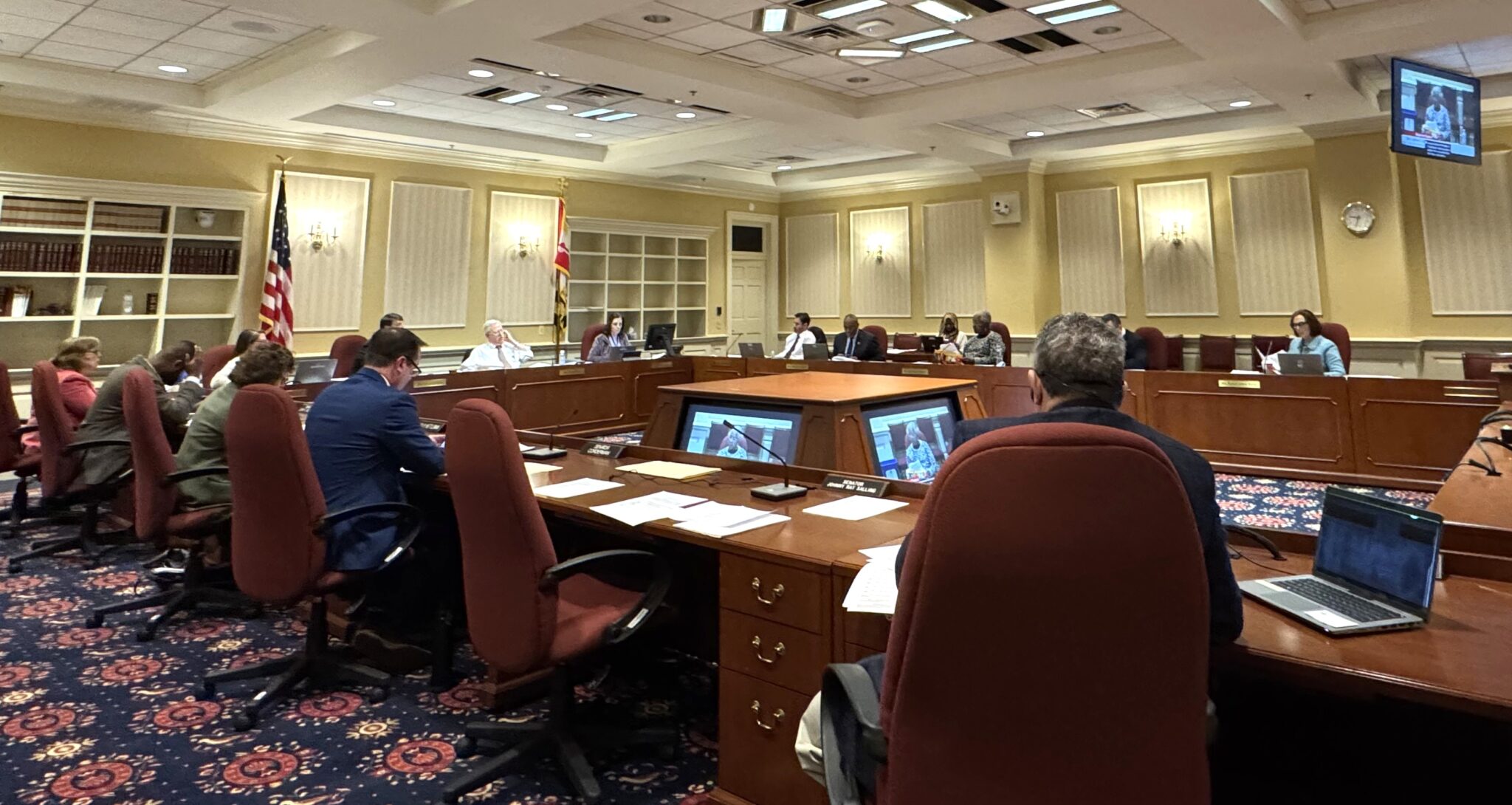
Senate Budget and Taxation Committee voted Friday for amendments to the Blueprint for Maryland’s Future that splits the difference between House and administration versions. (Photo by William J. Ford/Maryland Matters

A Senate committee advanced parts of Maryland’s sweeping education reform plan Friday, splitting the difference between versions of the bill advanced by the House and the Moore administration and setting up a showdown in the waning days of the legislature.

The Senate Budget and Taxation Committee approved a four-year pause in the start of funding for teacher “collaborative time” — something the administration supports — but also voted to keep funding for community schools — something the House insisted on.

Senate Bill 429 still needs to be taken up by a second Senate panel, the Education, Energy and the Environment Committee, which is scheduled for Monday. That gives lawmakers just two weeks to approve a Senate bill and hammer out differences with the House before the April 7 end of the General Assembly session.

The so-called “Excellence in Maryland Public Schools Act” was sparked by the state’s fiscal crisis and by the repeated call from local school officials for flexibility in the implementation of the Blueprint for Maryland’s Future, the sweeping 10-year, multibillion-dollar education reform plan.

Gov. Wes Moore introduced a bill that keeps the goals of the plan largely intact, but delays funding and implementation of some portions.

One portion is the proposal for an increase in teacher “collaborative time,” or time that teachers spend on planning, training and working with individual students, as opposed to time in front of a classroom. The Blueprint calls for teachers’ classroom time to be cut from 80% of their day to 60%; the administration bill would delay the start of that for four years, in part because it would require the hiring of at least 12,000 new teachers at a time when the state faces a teacher shortage.

The House rejected that plan, and set collaborative time to begin in 2026. But the Senate went with the governor’s version in what Budget and Taxation Committee Chair Guy Guzzone (D-Howard) called a “pacing” of the initiative.

“Whenever you don’t extend the full amount, if, in fact, you want to get to the full amount, by definition, it has to go out further,” Guzzone told reporters after the committee’s vote.

The committee did agree with the House version and rejected the administration’s call for a two-year freeze on funding for community schools, those located in low-income neighborhoods Sen. President Bill Ferguson (D-Baltimore City) has said such a delay would negatively affect students.

The Senate committee also agreed with the House to “hold harmless” funding for multilingual learners, students in poverty and those in special education — exempting those students from any per pupil funding reductions that might come down. The committee on Friday also added students at the Maryland School for the Blind, Maryland School for the Deaf and the SEED School of Maryland.

The committee was more generous than either the House or the administration when it comes to Consortium on Coordinated Community Supports, a part of the Blueprint plan that deals with mental health, behavioral and other wraparound services for students. The House agreed with the governor that it should be cut from $130 million this year to $40 million in fiscal 2026, but senators want to cut the fund to $70 million next year and raise it to $100 million in fiscal 2027 and each year after.

But senators sided with the administration on “foundation” funding, or per pupil spending. Under the Blueprint, it was slated to grow from $8,789 per pupil this year to $9,226 next year, but the administration proposed reducing the growth to $9,063 next year and slowing the pace of growth for several years after. The Senate committee agreed, but the House voted to keep the original Blueprint funding levels.

With an eye toward looming cuts to the federal government, another Senate amendment made Friday would freeze funding increases if federal funds or revenue projections by the state’s Board of Revenues in December decrease by 3.75%.

Senate Majority Leader Nancy King (D-Montgomery), a member of the Budget and Taxation Committee, earlier this week defended delays in Blueprint goals for the time being.

“There’s a lot of good that’s already come out of the Blueprint, and a lot more that is going to come as we go,” King said Tuesday. “I don’t think it would be a bad thing if we just slowed it [collaborative time] down a bit.”

The Senate Education, Energy and the Environment will review, and possibly vote on, the other parts of the bill Monday that deal with teacher programs, initiatives and other incentives before sending it to the full Senate for consideration and then back to the House.

Del. Vanessa Atterbeary (D-Howard), chair of the House Ways and Means Committee, said during a press conference Thursday to announce a framework for the overall fiscal 2026 budget, that negotiations on the Blueprint are ongoing. But Atterbeary said she and Del. Ben Barnes (D-Prince George’s and Anne Arundel), chair of the Appropriations Committee, have made their positions “pretty clear.”

“Where we stand and where the House stands in … protecting those that are most vulnerable, particularly those in community schools,” she said. “So we’ll see what the Senate does, and we’ll link up with them and negotiate that in the days to come.”

By William J. Ford
Creative Commons License

The Spy Newspapers may periodically employ the assistance of artificial intelligence (AI) to enhance the clarity and accuracy of our content.

Filed Under: Ed Homepage, Ed Portal Lead

Harvesting Hope seeks reading volunteers

February 4, 2025 by The Cambridge Spy
Leave a Comment

Harvesting Hope Youth and Family Wellness, Inc., is currently calling for people who want to help improve literacy for the youth of Dorchester County. These “Harbor Helpers” volunteer to read with individual students or small groups for one hour per week. Books and materials will be provided, as will literacy support training.

The requirements are

  • Be 16 years old or older
  • Pass a Criminal Background Check
  • Complete Orientation
  • Love Reading

For more Information Contact [email protected]

“Please note that, at the point of registration, there is more than one option to provide assistance,” said Charlene Jones, Director of Programs for the John & Janice Wyatt Foundation, which sponsors the local Campaign for Grade Level Reading. “Once you have registered you will be contacted by Harvesting Hope with information for the mandatory orientation and background check.”

Jones continued, “We look forward to working together to improve our children’s grade level reading skills.”

The Spy Newspapers may periodically employ the assistance of artificial intelligence (AI) to enhance the clarity and accuracy of our content.

Filed Under: 5 News Notes, Ed Homepage

Wood Foundation awards $100K grant to Radcliffe Creek School

January 24, 2025 by Spy Desk
Leave a Comment

: RCS student, Hazel Joiner, learning to spell through hands-on, multisensory instruction

Radcliffe Creek School (RCS) was recently awarded a generous grant from the Kathy and Jerry Wood Foundation to support needs-based scholarships for deserving students. The $100k grant award will remove significant financial barriers for area families who struggle to access the school’s individualized educational services, ensuring area children—who have learning differences such as dyslexia, dysgraphia and ADHD—can receive the academic interventions they rely upon to be successful in the classroom.

Each year, more than half of Radcliffe Creek’s student body receives some form of financial aid to attend the School. This year alone, over $526,000 in assistance has been committed to help families in need whose children learn differently. Head of School, Peter Thayer, explained, “Many of our students haven’t succeeded in traditional learning environments and need the small class sizes, daily interventions and customized instruction we provide here at RCS every day. However, accessing our services can be an enormous challenge for area families, who never expected to send their children to a private school. The generosity of the Kathy and Jerry Wood Foundation to provide this substantial support for scholarships will be a life-changing gift for many families. We are profoundly grateful to the Wood Foundation for making a Radcliffe education possible for these children.”

The Kathy and Jerry Wood Foundation, established in 2006, supports youth in attending nonprofit and educational institutions that aid in the intellectual, physical and moral development of American students. Through scholarship support, the foundation works to advance learning throughout the United States.

The foundation, based in Annapolis, Maryland, was also the area Kathy and Jerry Wood called “home.” Before their deaths, Jerry founded the Annapolis Sailing School and together, the couple transformed the school into the largest commercial sailing school in the United States. Later, the Woods established the sailboat show and the powerboat show, revolutionizing the boat show industry. For this work, the couple was credited with helping to shape the modern recreational boating industry and build broad recognition for the City of Annapolis as the “Sailing Capital of America.”

As the only K-8 school on Maryland’s Eastern Shore specialized in educating children with learning differences, Radcliffe Creek School (RCS) continues to stand out as a critical resource for area families. RCS students hail from eight counties, from Prince George’s County in Maryland to Sussex County in Delaware. To learn more about the immersive, individualized education program offered at Radcliffe Creek School, visit www.radcliffecreekschool.org or call 410-778-8150.


The Spy Newspapers may periodically employ the assistance of artificial intelligence (AI) to enhance the clarity and accuracy of our content.

Filed Under: Ed Homepage

Morgan State professor fined for presenting himself as licensed architect

December 18, 2024 by Spy Desk
Leave a Comment


The Baltimore Banner reported yesterday that Professor Dale Glenwood Green at Morgan State University was not a licensed architect and had forged his credentials. Green is well known for his work on the historic Hill neighborhood in Easton.

Read the full story here.

The Spy Newspapers may periodically employ the assistance of artificial intelligence (AI) to enhance the clarity and accuracy of our content.

Filed Under: Ed Homepage

  • 1
  • 2
  • 3
  • …
  • 12
  • Next Page »

Copyright © 2025

Affiliated News

  • The Chestertown Spy
  • The Talbot Spy

Sections

  • Arts
  • Cambridge
  • Commerce
  • Ecosystem
  • Education
  • Food & Garden
  • Health
  • Local Life
  • News
  • Point of View
  • Senior Nation

Spy Community Media

  • Subscribe for Free
  • Contact Us
  • COVID-19: Resources and Data

© 2025 Spy Community Media. | Log in