MENU

Sections

  • About Us
    • Editors and Writers
    • Sponsorship Terms & Conditions
    • Code of Ethics
    • Sign Up for Cambridge Spy Daily Email Blast
  • The Arts and Design
  • Culture and Local Life
  • Food & Garden
  • Public Affairs
    • Commerce
    • Health
    • Ecosystem
    • Education
    • Senior Nation
  • Point of View
  • Chestertown Spy
  • Talbot Spy

More

  • Support the Spy
  • About Spy Community Media
  • Advertising with the Spy
  • Subscribe
December 6, 2025

Cambridge Spy

Nonpartisan and Education-based News for Cambridge

  • About Us
    • Editors and Writers
    • Sponsorship Terms & Conditions
    • Code of Ethics
    • Sign Up for Cambridge Spy Daily Email Blast
  • The Arts and Design
  • Culture and Local Life
  • Food & Garden
  • Public Affairs
    • Commerce
    • Health
    • Ecosystem
    • Education
    • Senior Nation
  • Point of View
  • Chestertown Spy
  • Talbot Spy
2 News Homepage Uncategorized

Cambridge Nursing Assistant is 2025 CNA of the Year

October 15, 2025 by Zack Taylor
3 Comments

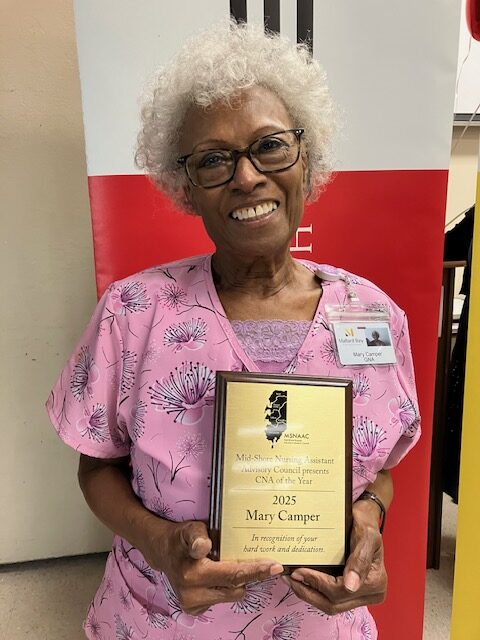
Mary Camper, of Cambridge, a longtime certified nursing assistant at Mallard Bay Nursing and Rehab, has been recognized as the Mid Shore Nursing Assistant Advisory Council’s 2025 Certified Nursing Assistant of the Year.

The award was presented during a recent ceremony at the University of Maryland Shore Regional Health’s Health and Education Center in Easton.

Mary Camper, winner of the 2025 Certified Nursing Assistant of the Year, has been doing the job for 46 years.

Camper has worked as a certified nursing assistant for 46 years, dedicating her career to providing hands-on care for patients and supporting her colleagues.  

Her nomination from Mallard Bay highlighted the qualities that earned her this year’s honor, describing her as “the embodiment of what healthcare should be” and praising her dedication, leadership, and professionalism.

Selection for the award is based on a wide range of criteria designed to reflect the skills and values of the nursing assistant profession. Judges consider work ethic, leadership skills, professionalism, compassion for others, teamwork, dedication to healthcare, attendance, friendliness with families and visitors, flexibility on the job, safety skills, and professional image.

The annual recognition is organized by the Mid Shore Nursing Assistant Advisory Council, which supports healthcare in the community by promoting the nursing assistant profession. 

The Council provides resources and networking opportunities to help nursing assistants build their skills and advance in the field. Its annual “CNA of the Year” award highlights the role nursing assistants play in patient care and honors those who exemplify the profession at its best.

By honoring Camper with this year’s award, the council recognized not only her decades of experience but also her continued dedication to the people she serves at Mallard Bay and the broader Cambridge community.

The Spy Newspapers may periodically employ the assistance of artificial intelligence (AI) to enhance the clarity and accuracy of our content.

Filed Under: 2 News Homepage, Uncategorized

Thousands of Maryland Seniors Notified of the End of their Medicare Advantage Plans

October 14, 2025 by Maryland Matters
Leave a Comment

Walkersville resident Marlene Eyler, 74, works as a host at a restaurant and cares for her 20-year-old grandson who lives with her. And now she has to add the chore of finding a new Medicare insurance plan to her challenges.

Eyler, who learned recently that she will lose her Medicare Advantage plan with Aetna, is one of thousands of Maryland seniors expected to receive notice this month that their supplemental Medicare plans will no longer be available next year, sparking frustration, fear and confusion.

“I’m very happy with Aetna, I haven’t had any issues with them,” Eyler said. “I’m just frustrated with the state of Maryland that they can’t give the older people better insurance.”

Insurance carriers say that Maryland’s unique hospital system is costly for them to do business in, and several are reducing their coverage in the state or pulling out of counties entirely. But that leaves residents like Eyler forced to navigate finding a new health care plan for next year.

“I’m taking care of him,” she said of her grandson, “plus having to worry about all this insurance stuff. And I have to work because I can’t pay the bills without working.”

Dean Slaughter, a 70-year-old Annapolis resident, is tired of having to change Medicare Advantage plans year after year. He recently got a letter from Aetna as well, telling him that his plan will no longer be available in 2026.

“Now we get to sit down and do the dog-and-pony show – see what’s out there, which is not much to offer. The insurance companies are leaving the state of Maryland,” Slaughter said.

Industry experts say as many as 100,000 Medicare recipients in Maryland, like Slaughter and Eyler, will have to scramble to find a new health care plan by the end of the year or risk losing coverage at an age where many require costly medical care.

About a quarter of Maryland Medicare recipients use a supplemental program called Medicare Advantage that helps retirees use a private insurer for additional health coverage such as vision, dental and transportation assistance that the standard Medicare plans may not offer.

But there’s been a long-running problem that’s coming to a head: State officials and people in the health care industry say the Medicare Advantage market in Maryland is more expensive than in most other states because of Maryland’s unique hospital payment system.

In recent years, the state has offered insurers a grant to help cover some of their costs and encourage them to keep offering the coverage in the state. That grant is going away, however, and some insurance companies have shrunk their presence in the state as a result.

A spokesperson for Humana said that the insurance company will no longer offer one of its Medicare Advantage plans in five major Maryland jurisdictions.

“Humana has exited one Medicare Advantage plan in Maryland for next year,” according to the statement. “Beginning Jan. 1, 2026 … Humana Gold Plus SNP (HMO DSNP), will no longer be available in the following counties: Anne Arundel, Baltimore, Harford, Howard and Baltimore City.”

Humana says that those affected by the termination will maintain their current coverage through Dec. 31, 2025, but they will need to find new coverage during the Medicare Annual Election Period, which runs from Oct. 15 through Dec. 7, if they want coverage next year.

Aetna shrunk its Medicare Advantage coverage to just three counties next year.

“Each year, we assess our ability to meet the health care needs of our members and adjust our plans to ensure they can deliver an excellent and sustainable member experience,” a spokesperson for Aetna said in a written statement. “In 2026, in Maryland, we will offer Medicare Advantage in the following counties: Frederick, Harford and Montgomery.”

Part of the issue comes from Maryland’s unique Total Cost of Care hospital payment model, in which a state board called the Health Services Cost Review Commission (HSCRC) sets hospital rates. Under the current system, insurance carriers pay higher hospital rates than in other states and get reimbursed by the federal government for Medicare Advantage services at lower rates than elsewhere. Meanwhile, insurance carriers are unable to negotiate hospital rates under their plans.

As a result, it’s more expensive to use Medicare Advantage in Maryland than in other states, and Maryland seniors aren’t getting the same quality of benefits, a spokesperson for CareFirst said in a recent statement.

Insurers reducing their footprint in the state leaves residents like Jie Shen, a 68-year-old living in Cockeysville, having to look for a new plan. That often means finding new doctors and hospitals for health care services.

“This is getting very frustrating,” Shen said. “I just want to stay on one plan at this point. I don’t know which one to choose.”

While there is time to search for a new plan, Medicare Advantage recipients note that the options available in Maryland are dwindling as carriers pull out of the state.

“It’s a hassle,” Slaughter said. “All of a sudden, you’re working with people who don’t even know you, and it’s not the way I want it … I feel like I am a number, and a cattle in line instead of a person, and it’s degrading.”

Even those who will still have their plans in 2026 are worried about what may come down the pipeline later.

Sharon Vickers, 78-year-old resident of Pasadena, was relieved to hear that her Medicare Advantage plan with CareFirst will continue into next year.

“I was concerned. Especially since my husband has passed, not having someone to sit and talk about it and discuss it,” she said.

As many Medicare recipients do, she works with an insurance broker to help find appropriate coverage for her needs. The broker informed her that she would be “comfortable this year,” but that he couldn’t “guarantee anything for next year.”

But she feels that the Advantage plans are already too expensive for what they offer and may skip out on coverage entirely.

“I may be looking at one day not being able to afford health care coverage,” Vickers said. “I’ll do what I have to do when the time comes, and that may mean going without health care.”

Meanwhile, the Maryland model is undergoing a major transition this year, as state health officials and federal officials finalize new terms of the States Advancing All-Payer Health Equity Approaches and Development, or AHEAD, model.

Current negotiations appear to prompt the state to offer solutions to the stabilize Medicare Advantage. There may also be significant changes to the state’s Medicare rate-setting authority.

Shen, like other Medicare recipients, hopes something can be done so that insurers will stay in the state.

“I don’t know if the state can help, but that’s what I ask for,” he said. “They should do something.”

By Danielle J. Brown

The Spy Newspapers may periodically employ the assistance of artificial intelligence (AI) to enhance the clarity and accuracy of our content.

Filed Under: 2 News Homepage

‘Main Street Maryland’ Takes the Stage: A Chat with Christine McPherson

October 6, 2025 by The Spy
Leave a Comment

While Marylanders are still becoming familiar with their communities’ Main Street program throughout the state, on the Mid-Shore, that’s not an issue.  Over the last twenty years, our largest towns, including Cambridge, Chestertown, Denton, Easton, and Centreville, have all participated in the state’s Main Street program, and each one can point to tangible success stories as a result.

Maryland’s Main Street program is helping small towns across the state rediscover the power of their historic downtowns. Rooted in a national model from Main Street America, the initiative supports communities that want to revitalize their commercial cores while preserving local character, focusing on four key areas—design, promotion, economic vitality, and organization—to create a framework that’s as much about people as it is about place.

Starting next week, Main Street Maryland will take the stage in downtown Easton at the Avalon Theatre for a series of workshops, presentations, and to highlight our regional success for representatives from New Cumberland to Ocean City, and the Spy was curious to talk with Christine McPherson, who leads the Main Street effort in Maryland, to understand better how some of the State’s small towns are making real progress.

This video is approximately six minutes in length. For more information about Main Street Maryland, please go here.


The Spy Newspapers may periodically employ the assistance of artificial intelligence (AI) to enhance the clarity and accuracy of our content.

Filed Under: 1C Commerce, 2 News Homepage

Census Data Show Gradual Demographic Shifts in Dorchester

October 5, 2025 by Zack Taylor
Leave a Comment

Dorchester County’s population is changing slowly but steadily, according to the latest American Community Survey and state census data. The numbers reflect both the county’s historic roots and signs of gradual diversification, while also underscoring ongoing economic and social challenges.

Poverty remains among the highest in the state at 20.1 percent

Dorchester’s economy continues to show strain. The poverty rate is estimated at 20.1 percent, which is among the highest in the state, and has decreased slightly from 20.3 percent in 2010.  Employment is dominated by private wage and salary work, which accounts for 71 percent of jobs. Government employment accounts for 19 percent, and approximately 9 percent of workers are self-employed.

These figures point to a reliance on wage-based jobs and limited growth in entrepreneurial or large-scale economic sectors. With higher poverty rates than neighboring counties, Dorchester faces particular challenges in workforce development, access to opportunity, and long-term financial resilience.

Grandparents play essential roles in child-rearing

Dorchester County has about 25,100 citizens of voting age. Women represent 53.7 percent of that group, while men make up 46.3 percent. The gender balance is in line with state averages but highlights a slightly higher proportion of women in the county.

Language diversity is growing, although it remains modest compared to more urban counties. About 5.9 percent of residents speak a language other than English at home. Among those, 2.5 percent report speaking English less than “very well.”

Family structures also reflect unique pressures. More than 500 grandparents live with their grandchildren, and approximately one-third of those grandparents are responsible for the children’s daily care. This suggests that multigenerational households play a significant role in the social fabric of the county.

White population shrinks by 6.2 percent

Dorchester County’s population is estimated at just over 32,600 people. White residents remain the largest group, accounting for approximately 61.9 percent of the total population. This is down from 67.6 percent recorded in the 2010 Census. Black or African American residents make up roughly 25.3 percent of the population, a figure that has declined slightly over the past decade.

Other groups are gaining in size. Residents identifying as two or more races now make up 8.1 percent of the population, while Hispanic or Latino residents account for nearly 6 percent. Asian residents represent about 1.3 percent. The shifts are gradual, but they signal a more diverse community than in previous generations.

Low levels of migration

The county is marked by residential stability. More than 92 percent of people lived in the same home in consecutive years, according to the 2018–2022 survey period. Just over 13,000 households are occupied, with an average size of 2.34 people in owner-occupied housing and 2.54 in rentals.

Mobility into the county is modest. About 5.5 percent of households reported moving into their current home in 2021 or later, while nearly 19 percent moved between 2018 and 2020. This reflects a population base that is deeply rooted, with many long-term residents and relatively low levels of in-migration compared to urban areas of Maryland.

Looking ahead: diversity may bring change 

The demographic and economic data tell a story of gradual change in a county that retains strong continuity. Dorchester is slowly diversifying, but the pace is measured compared to other regions of Maryland. Housing and residency patterns indicate a stable, rooted community, while high poverty levels underscore ongoing economic vulnerabilities.

For local government, schools, and community organizations, the findings may shape future decisions about resource allocation, public services, and economic development priorities. The needs of long-term residents will remain a central focus, but a more diverse population and multigenerational households will also play an increasingly significant role in shaping the county’s future.


The Spy Newspapers may periodically employ the assistance of artificial intelligence (AI) to enhance the clarity and accuracy of our content.

Filed Under: 2 News Homepage, Cambridge, Uncategorized

Maryland Unveils ‘Historic’ $340 Million Settlement with Conowingo Dam Owner

October 3, 2025 by Maryland Matters
Leave a Comment

Maryland officials unveiled a $340 million settlement Thursday and issued a new water quality certification to the Conowingo Dam, clearing the way for dam owner Constellation Energy to seek a new 50-year federal license to operate the hydroelectric facility.

The deal also resolves years of contentious litigation over the nearly century-old dam, which has become an environmental flashpoint in recent years as its overwhelmed reservoir has allowed polluting sediment to overflow into the Susquehanna River.

Particularly during severe storms, water overflowing from the Conowingo reservoir carries nutrients like nitrogen and phosphorus downstream, contributing to “dead zones” for underwater life in the Chesapeake Bay and hampering a struggling multistate effort to clean up the bay.

The settlement between Maryland, Constellation and a pair of clean water advocacy groups — Waterkeepers Chesapeake and the Lower Susquehanna Riverkeeper — includes $87.6 million for pollution reduction measures, including planting of trees and underwater grasses. It also includes more than $60 million to improve fish passage over the dam, control invasive species and create a hatchery for freshwater mussels to be planted in the river; and another $77.8 million to clean up trash and debris rushing down the Susquehanna.

The Conowingo Dam in Maryland is a 550-megawatt hydroelectric power station on the Susquehanna River operated by Constellation Energy.

Constellation will also pay $18.7 million to explore, and possibly begin, dredging at the dam’s reservoir. But any dredging is still a long way off. All parties are waiting for a U.S. Army Corps of Engineers study that will use computer modeling to assess the impacts of dredging on the reservoir and river downstream. Once that study is complete, likely in late 2026 or 2027, the Maryland Department of the Environment will decide how to use dredging payments that Constellation must make annually for 25 years.

Even then, the agency could move toward getting a dredging permit, could call for more studies — including evaluating the potentially lucrative reuse of silt dredged from behind the dam — or could designate Constellation’s dredging payments to other environmental projects if the Corps study indicates dredging is inadvisable.

Robin Broder, executive director of Waterkeepers Chesapeake, said Thursday that she feels confident dredging will happen eventually.

Lower Susquehanna Riverkeeper Ted Evgeniadis said his team believes dredging is an economic and viable option. Prior estimates, which found that dredging would cost Constellation “hundreds of millions of dollars every year for 50 years,” are no longer accurate, he said.

“Dredging is much different today than it was 10 years ago, 15 years ago, 20 years ago. There are new technologies today, whether it’s a hydraulic dredge or an ejection dredge,” Evgeniadis said. “All of these new things that have come up over the years are going to be looked at.”

A news conference Thursday at the foot of the dam — near where fishermen cast their lines and below scores of circling vultures and waterbirds — featured what one Constellation official said would usuallyt be considered “strange bedfellows”: Maryland state officials, leaders of environmental nonprofits and Constellation Energy CEO Joseph Dominguez.

Dominguez jokingly turned his pocket inside out Thursday, telling the crowd: “Yeah, this is costly for us. And yeah, I don’t have anything but lint left in my pockets on this one.”

“But I’m glad it’s resolved. I’m glad we can get up here and proudly say we’re doing all of this work,” said Dominguez, praising Gov. Wes Moore’s “steady hand” in the negotiations over the dam, which has 11 turbines, and can produce up to 572 megawatts of electricity, enough to power 165,000 homes.

The story goes back to 2018, when Maryland issued a water quality certification to the dam’s previous owner, Exelon. Constellation and its energy generation portfolio split from Exelon in 2022 to became a standalone business.

That certification would have required the company to mitigate the nutrient and sediment overflows, or make compensatory payments to the state that Exelon said could have totaled $172 million a year. That’s because the dam contributes an estimated 6 million pounds of nitrogen and 260,000 pounds of phosphorus to the bay each year, according to the Maryland Department of the Environment.

Exelon challenged Maryland’s certification in court, and eventually the two parties reached a closed-door deal in which Exelon accepted a number of environmental conditions and agreed to pay about $200 million over 5o years toward restoring the Susquehanna and easing fish passage over the dam. In turn, Maryland waived its authority to issue the water quality certification, to the ire of environmental groups.

That’s where a federal court said Maryland went wrong. In December 2022, the District of Columbia Circuit Court of Appeals invalidated the 50-year hydropower  license issued by the Federal Energy Regulatory Commission  because it said Maryland could not waive its authority to issue the certification.

That sent Maryland back to the negotiating table — now with Constellation and the two environmental groups, who had also challenged the original water quality certification as not going far enough to protect the ecosystem. This was happening just as Moore was taking office.

“We inherited a project that was mired in lawsuits, had frustrations on all sides, where the future of the largest source of renewable energy in our state was in question, while environmental impacts were being unchecked,” Moore said. “I had people who said to me — they had a lot of words — but it all could get summed up in basically a few simple sentences: Stay away from the Conowingo Dam, because that problem is just too difficult to solve.”

Moore’s new environment secretary at the time, Serena McIlwain, having just arrived from California’s Department of the Environment, had to quickly get up to speed on the Conowingo Dam, along with the state’s other environmental challenges.

“I was told that, well, everything kind of went wrong with the negotiations before we started. One was, we didn’t have the right people at the table,” McIlwain said. “And I said to my team, make sure the right people — the waterkeepers — are at the table.”

Maryland learned “hard lessons” from the court’s rejection of the previous settlement, said Maryland Attorney General Anthony Brown. This time, the state issued a revised version of the 2018 water quality certification, along with the settlement.

“The Department of the Environment will retain full power to enforce compliance with water quality standards — and that matters,” said Brown, who called the settlement a “historic victory” for Marylanders and the Chesapeake Bay.

Getting to the finish line was challenging. Brown said it took more than 30 mediation sessions. McIlwain said there were times when some of the parties were “ready to walk out the door.” Among the biggest sticking points was the dredging issue, said Adam Ortiz, a deputy secretary at the Maryland Department of the Environment.

“We could have given up months ago. We really could have,” McIlwain said. “But I knew I needed my job, and I said: ‘You guys are going to get back at that table, and I’ll bring more food. I don’t care. We’re going to get it done.’”

Constellation’s Dominguez bemoaned the long road the dam operator had to walk in order to get its critical new license from FERC.

“It shouldn’t have taken us 10 years to sort through all of the issues here, and that’s a bit disappointing,” he said. “But … the resolution to those permitting issues often requires people coming together who have different interests, that sometimes have conflicting interests, and bringing those folks together and making something good happen.”

By Christine Condon

The Spy Newspapers may periodically employ the assistance of artificial intelligence (AI) to enhance the clarity and accuracy of our content.

Filed Under: 2 News Homepage

Dorchester in Focus: Vienna

September 27, 2025 by P. Ryan Anthony
Leave a Comment

Dorchester County, the heart of the Eastern Shore, is a place where history, heritage, and natural beauty come together. The county is home to storied waterways, abundant wildlife, and a rich cultural legacy that spans from Native American traditions to its historic role as a hub for agriculture and maritime activity.

It’s small towns, each with its own distinct character, that invite visitors to slow down, explore, and connect with a way of life deeply rooted in the past yet alive in the present. This video series will take you on a journey through these communities.

We begin with Vienna, an antique crossroads village southeast of Cambridge on the Nanticoke River. It has preserved its colonial charm and quiet lifestyle for more than three centuries, ever since Captain John Smith explored it in 1608. This small community is home to a 1768 Customs House, the Vienna Heritage Museum, and a waterfront park, among many historic properties.

The Spy Newspapers may periodically employ the assistance of artificial intelligence (AI) to enhance the clarity and accuracy of our content.

Filed Under: 2 News Homepage, Cambridge

Cambridge Commissioner Envisions Reviving Old Tolley Theater

September 25, 2025 by P. Ryan Anthony
7 Comments

Plans to rehabilitate the old Tolley Theater could help reinvigorate that part of town and expand the Cambridge Arts community.

On August 25, Cambridge City Commissioner Brett Summers made a surprise announcement at the council meeting, that there were plans to rehabilitate the old Tolley Theater on Race Street into an Arts center. If successful, it could help reinvigorate that part of town and expand the Arts community of Cambridge.

The building at 515 Race Street had been an Art Deco-style cinema since the 1920s. In the forties, it was the State Theatre, part of the Schine Circuit. It operated until at least 1950. Later, it was purchased by Gene and Shirley Tolley and given their name.

The 500 block of Race Street was listed as an Endangered Maryland site in 2014. This area is particularly significant because it reflects the evolution of decades of commercial development in Cambridge during the first part of the 20th century.

Gene was saddened when changing times forced the theater’s closure because it was “something for the young people to do.” In 2014, the Tolleys were operating a restaurant supply and catering business out of the building. They considered reopening the theater but feared that the condition of some nearby vacant buildings might keep customers away.

Still, in August of that year, Gene told the press that he wanted to work with a developer. “We want to see it stay as a community theater and showplace.  Somewhere for entertainment or activities.  Whatever we do we want the developer to respect it and keep it as a theater basically.”

But Gene died in 2020.

The Tolley Theater may become an arts center.

This year, Shirley approached Summers about what could be done with the building.

He thought they could create a nonprofit called Friends of Dorset Performing Arts Center. Rob Collison of Cambridge Title Co. drew up a contract. The next step would be to form a planning committee.

Initially, $300,000 would be needed for the leaky roof, rust, and other repairs. But the overall renovation would cost millions. The floor, which is even now, would be dug up and converted back to its original slanted design. The old balcony had, at some point, been turned into a second movie screen, and that would be changed back, as well.

Summers is putting out the word to designers, builders, and others. However, there’s currently not a lot of money to put toward the project. The committee would want to acquire money from the state but also draw in a benefactor. This could be helped by the interest in the venue already shown by such entities as WHCP radio.

A South Carolina native who has lived in Cambridge since 2000, Summers has a passion for the town and believes strongly in improving the quality of life here. That would include creating an arts center to compete with Easton’s Avalon Theater. It is an ambitious but worthy endeavor.

The Spy Newspapers may periodically employ the assistance of artificial intelligence (AI) to enhance the clarity and accuracy of our content.

Filed Under: Cambridge, 2 News Homepage

Baltimore Sun Puts Some Shade on Cambridge Harbor

September 22, 2025 by The Spy
Leave a Comment

In a Baltimore Sun article headlined “Seven years, $13M in tax dollars: What happened to Cambridge Harbor?” state and local officials acknowledge that the ambitious mixed-use project, which was planned to include an anchor hotel, fishing pier, shops, and residential development, is still “years away from any substantive progress.” They cite pending approvals and uncertain financing as major reasons for the delay. The Sun notes that pier funding has yet to be approved by the state, no hotel developer has been hired, and the city has not signed off on the plans.

According to the Sun’s review of tax filings and other records, Cambridge Waterfront Development Inc. (CWDI) has received $13.158 million in federal, state, and local grants over the past six years. That includes $8.8 million in state grants, $2.4 million in federal funding, $1.5 million from the American Rescue Plan Act, $204,000 directly from Cambridge, and $205,000 from Dorchester County. The records show that 27 percent went to construction, 24 percent to design, 24 percent to property acquisition, 18 percent to demolition, and 7 percent to operating costs.

CWDI chairwoman Angie Hengst said the group is working with city planning staff on required approvals and hopes to have a contract signed by the end of October.

Editor’s note: The Baltimore Sun may have a paywall for some readers.


The Spy Newspapers may periodically employ the assistance of artificial intelligence (AI) to enhance the clarity and accuracy of our content.

Filed Under: 2 News Homepage

Dorchester Schools Deepen Mediation Efforts to Address Student Conflict

September 19, 2025 by Zack Taylor
Leave a Comment

At its September 18 meeting, the Dorchester County Board of Education renewed and expanded its school-based mediation program by approving a new contract to address student conflict and social challenges that have persisted since valuable “developmental time” was lost during the pandemic years.

The $75,000 contract with the Easton-based Mid-Shore Community Mediation Center will help the school system’s mediation efforts begin to move from a reactive tool to something more embedded in school life, Mediation Center Executive Director Justin Acome said during his September 18 presentation to the Board of Education. 

Acome told the board that mediation is no longer just a tool for responding to fights but is beginning to function as part of everyday school culture. He said the approach is helping students rebuild relationships and learn how to resolve conflicts constructively, not simply avoid them.

He noted that the mediation process remains voluntary and confidential, which limits how broadly it can be applied. Still, he pointed out that the program has helped change the climate in participating schools. 

Many students continue to struggle with what he called a “socialization deficit” since COVID-19, when necessary developmental time was lost, Acome added. In his view, mediation offers a structured way for students to recognize the value of relationships and learn conflict resolution skills in a supportive setting.

The new contract will build on the existing mediation that has begun to “find its footing.”  More than just stepping in after a student conflict, it’s about getting into the space early and helping students rebuild relationships, and “not just avoiding conflict” but learning how to resolve them.

Acome acknowledged that mediation remains a voluntary and confidential process, which can limit opportunities to reach students before problems escalate. Still, he said the work has made a difference in school climate. 

Under the plan for the coming year, services will be concentrated at Mace’s Lane Middle School, while continuing to support Cambridge-South Dorchester and North Dorchester high schools, and the Dorchester Career and Technology Center.  Mediators will provide one-on-one sessions, student workshops, and maintain a more substantial on-site presence, aiming to intervene earlier and more consistently, he said.

While Acome praised the progress so far, he also said there is much work ahead, with regard to measuring results, expanding reach, and ensuring mediators maintain a consistent presence in county schools. 


The Spy Newspapers may periodically employ the assistance of artificial intelligence (AI) to enhance the clarity and accuracy of our content.

Filed Under: 2 News Homepage

DCPS Superintendent on School System’s Newfound Success

September 16, 2025 by P. Ryan Anthony
Leave a Comment

Recently, WHCP’s Jim Brady and The Cambridge Spy’s P. Ryan Anthony had their regular check-in with Dr. Jymil Thompson, superintendent of Dorchester County Public Schools. The focus was on DCPS’s move up in the rankings of Maryland school systems, after being in 23rd place in the state.

Dr. Thompson explained what DCPS did to raise their ranking, including the staff’s change of mindset from concentrating on discipline problems to a focus on academics. He talked about where there are still weaknesses and what opportunities they can harness.

Significantly, Thompson mentioned that the students need a solid foundation from the earliest grades so they can succeed later on. As for his expectations for the future, he has every intention of DCPS being ranked 15th in three years.

This video is approximately nine minutes long.

The Spy Newspapers may periodically employ the assistance of artificial intelligence (AI) to enhance the clarity and accuracy of our content.

Filed Under: 2 News Homepage

  • « Previous Page
  • 1
  • 2
  • 3
  • 4
  • …
  • 46
  • Next Page »

Copyright © 2025

Affiliated News

  • The Chestertown Spy
  • The Talbot Spy

Sections

  • Arts
  • Cambridge
  • Commerce
  • Ecosystem
  • Education
  • Food & Garden
  • Health
  • Local Life
  • News
  • Point of View
  • Senior Nation

Spy Community Media

  • Subscribe for Free
  • Contact Us
  • COVID-19: Resources and Data

© 2025 Spy Community Media. | Log in