
MENU

Sections

  • About Us
    • Editors and Writers
    • Sponsorship Terms & Conditions
    • Code of Ethics
    • Sign Up for Cambridge Spy Daily Email Blast
  • The Arts and Design
  • Culture and Local Life
  • Food & Garden
  • Public Affairs
    • Commerce
    • Health
    • Ecosystem
    • Education
    • Senior Nation
  • Point of View
  • Chestertown Spy
  • Talbot Spy

More

  • Support the Spy
  • About Spy Community Media
  • Advertising with the Spy
  • Subscribe
December 6, 2025

Cambridge Spy

Nonpartisan and Education-based News for Cambridge

  • About Us
    • Editors and Writers
    • Sponsorship Terms & Conditions
    • Code of Ethics
    • Sign Up for Cambridge Spy Daily Email Blast
  • The Arts and Design
  • Culture and Local Life
  • Food & Garden
  • Public Affairs
    • Commerce
    • Health
    • Ecosystem
    • Education
    • Senior Nation
  • Point of View
  • Chestertown Spy
  • Talbot Spy
1 Homepage Slider 2 News Homepage Health Health Lead Health Health Portal Lead News News Portal Highlights

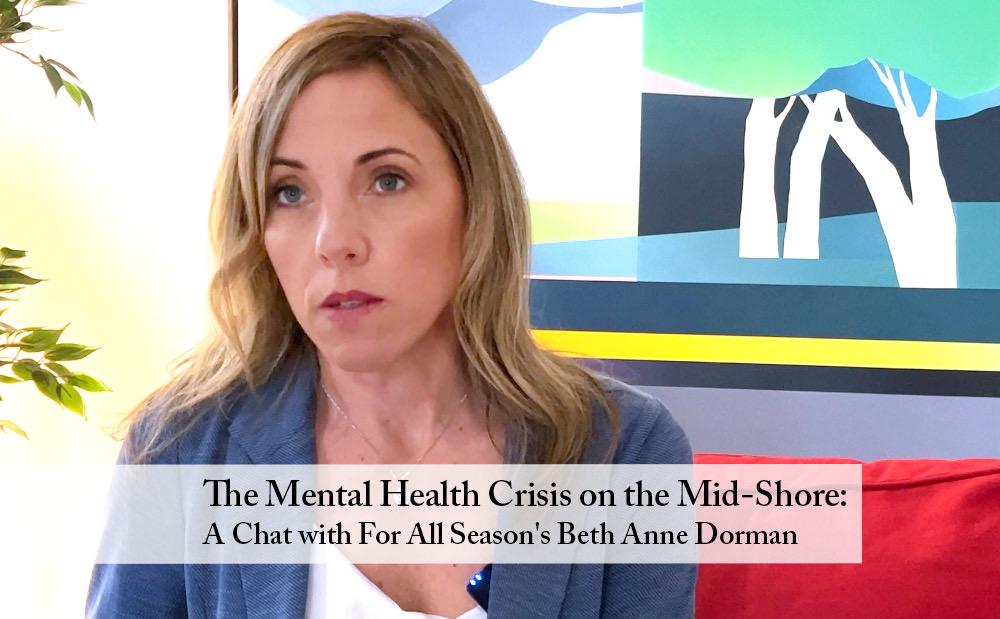
The Mental Health Crisis on the Mid-Shore: A Chat with For All Season’s Beth Anne Dorman

December 12, 2022 by Dave Wheelan
Leave a Comment

One of the most damaging aspects of the COVID pandemic, which is still very much in evidence on the Mid-Shore, has been the unprecedented toll on the mental health of children and their parents. While America had seen a significant rise in the number of families impacted by psychological and emotional trauma well before the coronavirus hit our shores, the combination of school closings, financial hardship, and social isolation created an unprecedented uptick in those seeking help.

In fact, American Psychological Association recently reported that six out of 10 psychologists say they don’t have openings for new patients. And locally, For All Seasons, the Mid-Shore’s largest mental health provider, has shown a 27% increase in therapy requests since the COVID years began.

For Beth Anne Dorman, the CEO of For All Seasons, there is a silver lining in this grim new reality. While this rise in both children and adults is indeed troubling, Dorman notes that these numbers also reflect a society where one’s mental health s finally being discussed on par with one’s physical health. This increased demand for services indicates that families are now having to have the kind of conversations about depression, anxiety, and trauma to lead individuals to get the help they need finally.

The Spy sat down with Beth Anne last week to discuss this unique challenge and how For All Seasons is using new and creative ways to manage this surge in demand.

This video is approximately six minutes in length. For more information about For All Seasons please go here. 
The Spy Newspapers may periodically employ the assistance of artificial intelligence (AI) to enhance the clarity and accuracy of our content.

Filed Under: 1 Homepage Slider, 2 News Homepage, Health Lead, Health Portal Lead, News Portal Highlights

The Choptank Health Update: Chestertown and Kent County

November 16, 2022 by The Spy
Leave a Comment

When Sara Rich came on board to lead the Choptank Community Health System in the summer of 2016, she and her board immediately started to work on a plan that would fundamentally change and improve the health care of the entire Mid-Shore. Despite the impact of COVID, Choptank has nonetheless moved forward on the nonprofit organization’s commitment to improve and expand affordable and accessible healthcare in the region.

Over the next few months, the Spy will be talking with Sara about Choptank’s increased support for local health needs and the advances they have made in Caroline, Dorchester, Kent, Queen Anne’s, and Talbot counties.

We begin with Chestertown the Kent County.

This video is approximately four minutes in length. For more information about Choptank Community Health System please go here. 


The Spy Newspapers may periodically employ the assistance of artificial intelligence (AI) to enhance the clarity and accuracy of our content.

Filed Under: Health Lead, Health Portal Lead

The Danger of Pancreatic Cancer: A Chat with Survivor Bill Shrieves

November 2, 2022 by Dave Wheelan
Leave a Comment

It the world of health education related to cancer, nothing can be more powerful and more effective than the testimony of someone who has survived the odds this this horrific disease. And in the case of pancreatic cancer, it’s hard not to be moved and motivated by the experience of Bill Shrieves.

The retired businessman, who heads up the Mid-Shore Pancreatic Cancer Foundation, was diagnosed 12 years ago and faced unbelievable odds.  Back then, and even now, most victims die within just a few months after the tumor has been identified, and the survival rate after four years is 11%. In fact, pancreatic cancer is the third largest cause of death with cancer patients.

Even more sobering is that pancreatic cancer is so hard to detect. As Shrieves points out, there are no standard tests, and the symptoms of the disease remain vague. That being said, abdominal and persistent low back pain are important clues, as is discolored urine, that something isn’t right. And increasingly, medical research is indicating  that adult onset diabetes might be another troubling sign.

With all that in mind, Bill Shrieves is determined to get the word out, particularly during Pancreatic Cancer Awareness Month, for folks to reach out to there doctor if they are noticing these symptoms, especially if pancreatic cancer runs in their family.

The Spy sat down with Bill last week to learn more.

This video is approximately minutes in length. For more information about pancreatic cancer, volunteering or make a donation please visit the Mid-Shore Pancreatic Cancer Foundation here.

The Spy Newspapers may periodically employ the assistance of artificial intelligence (AI) to enhance the clarity and accuracy of our content.

Filed Under: Health Lead, Health Portal Lead

The Journey Begins on a Mid-Shore Flagship Hospital

October 12, 2022 by Dave Wheelan
Leave a Comment

Last night a bit of Mid-Shore healthcare history was made. At a joint session of the councils of Easton and Talbot County, Shore Regional Health CEO Ken Kozel outlined the first major step in the creation of a flagship regional hospital for the five counties of the Mid-Shore of Maryland.

The first step is called a “Letter of Intent,” which will be sent to the State of Maryland’s Healthcare Commission next month. In short, this document demonstrates that the University of Maryland Medical System is serious about building a major state of the art health facility near the Easton airport in Talbot County.

But the second step is perhaps the more important of the two. In this case, UMMS will move forward with the documentation and filing of a “Certificate of Need.” Not only does UMMS need to document the need to build an expensive 350,000 square foot hospital, but that the community input of Caroline, Dorchester, Kent, Queen Anne’s and Talbot County citizens also needs to be documented.

“Building a new Regional Medical Center in Easton marks the most significant milestone in fulfilling our decades-long integrated facility and clinical service delivery plan,” said Ken Kozel, President and CEO of UM Shore Regional Health. “Our growing communities expect and deserve access to a state-of-the-art center with advanced clinical care.”

Since Shore Health System’s affiliation with UMMS in 2006 and subsequent merger with Chester River Health System to form UM Shore Regional Health in 2013, UM SRH and UMMS leaders have worked steadily with community partners throughout the five-county region to reimagine and improve health care delivery across roughly 2,000 square miles of rural communities. Investments in the region have included modern inpatient and outpatient health care services to the residents of Caroline, Dorchester, Kent, Queen Anne’s and Talbot counties on Maryland’s Eastern Shore.

UM SRH has spent the last several years laying the groundwork for the advancement of the new Regional Medical Center by making investments in other key supporting projects identified in the System’s integrated facility and clinical service delivery plan. The completion of the freestanding medical facility in Cambridge, several medical pavilions and stand-alone emergency rooms in the region, urgent care centers in Denton, Easton and Kent Island, and numerous major equipment upgrades have totaled over $150M in capital investments. Plans are also moving forward in Chestertown with the construction of an Aging & Wellness Center of Excellence on its current campus.

Submission of the CON marks the first of several regulatory actions over the next year required to move forward with relocating the current hospital on Washington Street in Easton, parts of which dates back to the early 1900s.

The new Regional Medical Center campus is slated to occupy over 230 acres off Longwoods Road near the intersection of U.S. Route 50, adjacent to the Talbot County Community Center. This location is approximately 3.5 miles from the current hospital, and will provide greater visibility, easier and safer access for ambulance and helicopter transport as well as ample parking for patients, staff and visitors.

The Spy caught up with Ken and Dr. Mohan Suntha, the University of Maryland’s Health System leader Dr. Mohan Suntha by Zoom yesterday in what the Spy hopes will be the first of a series on the new hospital project over the next few years.


This video is approximately 7 minutes in length. For more information about Shore Regional Health please go here.


The Spy Newspapers may periodically employ the assistance of artificial intelligence (AI) to enhance the clarity and accuracy of our content.

Filed Under: 1 Homepage Slider, Health Lead, Health Portal Lead, Spy Chats

Maryland Children Continue to Experience Mental Health Challenges

September 26, 2022 by Maryland Matters
Leave a Comment

Irene Diane is excited for her senior year at Bowie High School, serving as president of the school’s student government association and future aspirations to attend college.

But the 17-year-old Prince George’s County resident says mental health remains a challenge among her peers. One way to eliminate it: Maryland lawmakers should approve a statewide policy that mirrors legislation U.S. Rep. Ayanna Pressley (D-Mass.) introduced last year on Capitol Hill that diverts federal money for police in schools and use it to hire more school counselors and pay for other student services.

“Disciplining students for things that aren’t violent and implementing detentions and suspensions, that’s taken students out of the classroom,” Diane said. “It’s a disservice to take away their education.

“That affects a person’s mental health, especially Black and brown students and creates the school to prison pipeline.”

Irene Diane, 17, a senior at Bowie High School in Prince George’s County, said eliminating the school-to-prison pipeline serves as one way to eliminate mental health challenges among her peers. Photo courtesy of Irene Diane.

Mental health has become a major impediment in the nation to improving a child’s life, which the Annie E. Casey Foundation details in its latest 2022 Kids Count Data Book that assess children’s well-being nationwide and provides a state-by-state breakdown of services and performance.

The foundation’s 33rd edition focused on mental health and how the COVID-19 pandemic affected children and families when the virus crippled the nation beginning in March 2020.

The pandemic caused a delay in some data collection from the U.S. Department of Education’s National Assessment of Educational Progress. For instance, 4th grade reading and 8th grade math are based on 2019 data and high school graduation information from the 2019-20 school year didn’t come in time to publish in the data book.

Although national trends show children in poverty and parents who lack secure employment have become “better,” other factors became “worse,” such as 3- and 4-year-old children not in school and obesity increasing among those ages 10 to 17.

Black children ranked the highest in 2020 among those living in poverty, low-weight babies and being overweight or obese.

Nationally, the number of children ages 3 to 17 who experienced anxiety or depression increased by 25% from 9.4% in 2016 to 11.8% in 2020. The figures are based on those either diagnosed with or reported to have those symptoms by a doctor or health care provider.

During that same timeframe, Maryland ranked 13th in the nation with a 36% increase of children ages 3 to 17 with anxiety or depression either reported to or diagnosed by a doctor or health care provider.

Maryland ranked 19th in the nation for overall child well-being, which the foundation measured as “better.”

Among the foundation’s key indicators of economic well-being, education, health and family and community, Maryland ranked in the top half of 50 states and the District of Columbia.

‘Everyone deserves a break’

The Maryland Center on Economic Policy of Baltimore, which partnered with the foundation for the first time on the Kids Count report, offered some policy suggestions for Maryland lawmakers.

Benjamin Orr, president and CEO of the policy organization, said the legislature should extend the “modest” $500 child tax credit set to expire at the end of the year. The credit provides for families with annual incomes of $6,000 or less and have dependents with disabilities under the age of 17.

Del. Julie Palakovich Carr (D-Montgomery) sponsored legislation this year to extend the child tax credit until Jan. 1, 2027. The annual family incomes would increase to $15,000 and provide the credit for children 6 and younger or under 17 years old for someone with a disability.

Palakovich Carr’s legislation didn’t advance out of a House committee, but she said in a Twitter post June 4 she will “keep fighting to expand Maryland child tax credit to include more families.”

Orr also said legislators must ensure both the paid family and medical leave program and the education reform plan, Blueprint for Maryland’s Future, are implemented and funded.

“We just can’t say we did that and stop paying attention,” he said. “We have to make sure those programs are actually fully funded [and] that they are producing the benefits that legislators intended.”

Stephanie Maceiko, a 16-year-old student at Bowie High School in Prince George’s, offered an idea that wouldn’t cost much money, if anything.

The high school junior proposes reinstating a 30-minute advisory period at the school used most of last school year. Similar to a study hall, she said students sat in class to catch up on classwork, complete homework, or simply relaxed without live instruction from a teacher.

“It was such a positive benefit for the school,” she said.

Less than a month into this school year, Maceiko said the only break during her eight-hour school day is a 30-minute lunch period between her two-hour third period class.

Although she’s preparing to attend college after high school graduation, the pressure of trying to get into a four-year university can be stressful.

The impact of COVID-19 influenced Maceiko to focus more on her mental health, even if that means sacrificing extra credit on a long-term project or major assignment.

“If it’s impacting me mentally, then I’ll just have two points [missing] so I don’t drain myself to the point where it’s unhealthy,” she said. “I manage my time so it doesn’t get too hectic and not too overwhelmed. Everyone deserves a break…because you will push yourself over the limit.”

The Spy Newspapers may periodically employ the assistance of artificial intelligence (AI) to enhance the clarity and accuracy of our content.

Filed Under: Health Lead, Health Portal Lead

Handling Grief As a Man – and Finding One’s Way After the Death of a Spouse

September 12, 2022 by Spy Desk
Leave a Comment

The bereavement support group has wound down after about an hour and a half, with folks talking in small groups or milling around the table with homemade cookies and muffins, provided by the participants. Jack baked the bran walnut raisin muffins just the way he did when his wife was alive. The top of the muffins have been abundantly sprinkled with sugar. Jack would slice the top off for his wife, Diane, who liked the sweetness; he would eat the bottom half. Jack shares a muffin in this fashion with one of the women.

The only male member of the day’s 12-person-strong support group, Jack also participates in a weekly men’s-only meeting, where he is part of a very special brotherhood. I want to talk to Jack about this, but first, he tells me, he wants to talk with some of the women in the group that just broke up. The men in his support group, I have come to learn, encourage female company. The idea is that the companionship that’s been lost should be replaced, even at a much more casual level. It is a start. 

Ten minutes later, Jack and I are talking about the men’s group.

“We are like soldiers who have been in a foxhole. We have developed a love that is hard to explain,” Jack says, cutting to the chase. He credits the men’s group with aiming him toward light at the end of the tunnel when he couldn’t, he says, even see the tunnel. 

After Diane died suddenly of a heart attack, Jack was lost. After days in a haze of sadness and inactivity, he found himself looking for help. A friend suggested a Hospice-led bereavement support group—even though Diane hadn’t died while under Hospice care. (Bereavement support is available to anyone at all who wants this help.) Jack called the number he was given and got to speak to Lindy Barton, Talbot Hospice bereavement coordinator and social worker. She leads support groups at the Talbot Hospice office in Easton. Her wisdom and kindness are profoundly healing. 

“Grief exposes people to a different state of being and vulnerability,” says Lindy. In the group, the participants deeply support each other. “They are in a place of feeling safe to share concerns, emotions, and thoughts. They learn that it is okay to give themselves permission to grieve and that each of them will grieve in his own way, in his own time frame.”

“We five guys share our souls,” Jack says. Lindy also shares book recommendations with the group. “The green book, Understanding Your Grief by Alan D. Wolfelt, PH.D., she suggested was the eighth I’d read that touched on the subject of grieving,” he tells me. Finally, a chord was struck. Lindy had hit a home run.  

“What I learned in the very first sentence,” Jack continues, “is that grief is a process of adjusting. Yes, I’d had 54 years with my wife, and then she was gone.” The book reinforced that the loved one who is gone is honored when the one left behind resolves to take care of himself or herself. Jack has marked up the margins of the book with his comments and, here and there, a smiley face. Serving as the book’s bookmark: a photograph of his wife.

“We are more than classmates,” Jack offers. “We have developed nearly brother-like relationships while we help each other recover from loss.” They encourage each other to take action—to fill their time with things that will gratify, such as spending time with family. 

“The group participants learn that if the grief process is delayed, it is more difficult to discover hope and joy again,” Lindy adds.  “I have appreciated watching participants come to the understanding that it is okay to accept that life will never be as they once knew. We talk a lot about reconciliation and transitioning.” Lindy underscores, “The grief never fully goes away but it can be changed.”  However, she says, “As long as you can mourn, then you can dance again.”

Jack shares that the men’s group has moments of lightheartedness interlaced with the sadness that comes with devastating loss. The darkness certainly can overwhelm. Jack tells of learning that one of his cohorts was in such a black place that he was contemplating suicide. Jack listened. He asked questions. He gave support, love, and the assurance that he was there for him. His friend pulled through.

In the end, as Lindy explains, the men’s bereavement group is a collection of individuals moving toward a new normal. “Their communication with each other is heartwarmingly realistic as they express their concerns, hopes, dreams, and fears while learning that what they are going through is sometimes normal during periods of sorrow.

Weaving throughout many of the men’s discussions is the concept of mindfulness—“of being in the moment,” as Lindy explains it, offering that the best way to be in the moment is to “be kind, patient, trusting, accepting.” Certainly a good way to move through the healing process.

Sheila Feldman Buckmaster is a staff member at Talbot Hospice in Easton. For more information about Talbot Hospice’s various bereavement support groups, call Lindy Barton or Jody Gunn at 410-822-6681 (116).


The Spy Newspapers may periodically employ the assistance of artificial intelligence (AI) to enhance the clarity and accuracy of our content.

Filed Under: Health Lead

  • « Previous Page
  • 1
  • …
  • 4
  • 5
  • 6

Copyright © 2025

Affiliated News

  • The Chestertown Spy
  • The Talbot Spy

Sections

  • Arts
  • Cambridge
  • Commerce
  • Ecosystem
  • Education
  • Food & Garden
  • Health
  • Local Life
  • News
  • Point of View
  • Senior Nation

Spy Community Media

  • Subscribe for Free
  • Contact Us
  • COVID-19: Resources and Data

© 2025 Spy Community Media. | Log in