MENU

Sections

  • About Us
    • Editors and Writers
    • Sponsorship Terms & Conditions
    • Code of Ethics
    • Sign Up for Cambridge Spy Daily Email Blast
  • The Arts and Design
  • Culture and Local Life
  • Food & Garden
  • Public Affairs
    • Commerce
    • Health
    • Ecosystem
    • Education
    • Senior Nation
  • Point of View
  • Chestertown Spy
  • Talbot Spy

More

  • Support the Spy
  • About Spy Community Media
  • Advertising with the Spy
  • Subscribe
December 7, 2025

Cambridge Spy

Nonpartisan and Education-based News for Cambridge

  • About Us
    • Editors and Writers
    • Sponsorship Terms & Conditions
    • Code of Ethics
    • Sign Up for Cambridge Spy Daily Email Blast
  • The Arts and Design
  • Culture and Local Life
  • Food & Garden
  • Public Affairs
    • Commerce
    • Health
    • Ecosystem
    • Education
    • Senior Nation
  • Point of View
  • Chestertown Spy
  • Talbot Spy
3 Top Story Arts Library Guy

The Library Guy: Ann Finkbeiner on Wars in Space

November 27, 2020 by Bill Peak
Leave a Comment

The Library Guy, Bill Peak, speaks with Ann Finkbeiner, author of an article in the November edition of Scientific American entitled, “Orbital Aggression: How do we prevent war in space?” Finkbeiner explains why America depends so heavily on its satellite fleet, how our global adversaries are already toying with the idea of destroying those satellites, and how a major attack upon them could, quite literally, endanger civilization.
The Spy Newspapers may periodically employ the assistance of artificial intelligence (AI) to enhance the clarity and accuracy of our content.

Filed Under: 3 Top Story, Library Guy

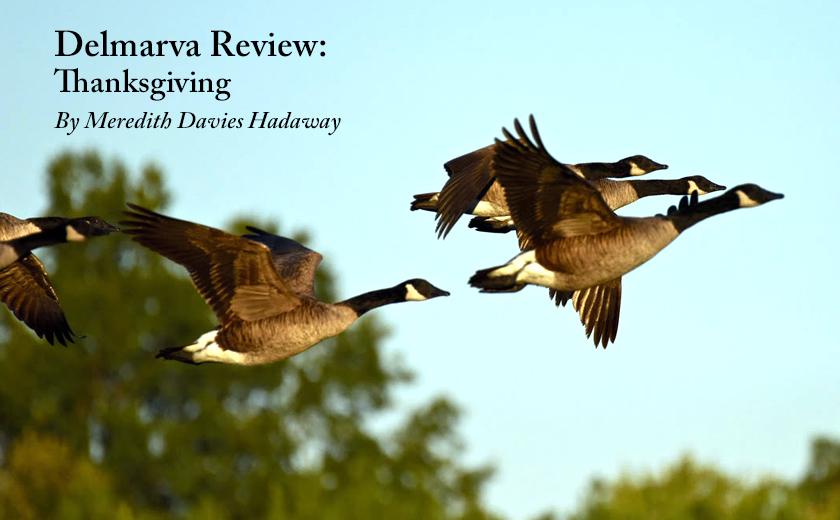
Delmarva Review: Thanksgiving by Meredith Davies Hadaway

November 26, 2020 by Delmarva Review
Leave a Comment

Delmarva Review: Thanksgiving by Meredith Davies Hadaway

Author’s Note:  It’s pretty quiet right now on the Chester River. We’ve pulled our boats and turned our gardens under. Now gray skies and bare trees come alive with the migratory birds that are my favorite Fall visitors. This poem is just to say, even with the disruption and the uncertainty of this season, I am grateful for all that remains.

Thanksgiving

Because I wake up here where a kingfisher flits
to a piling, where the heron strides his patient

watch, and a sparrow chips away at the feeder.

Birds go about their business, the winged
body of one soul, lodged briefly 

in another, stitching clouds to the tide. 

From somewhere a shotgun stutters. One goose
Tumbles—skims the edge of soft 

and familiar. No wind, no sound beyond
my own breathing. Just a thick, hovering 

sky. The bare limbs hold it
between them. 

Meredith Davies Hadaway has been a featured writer in Delmarva Review. She is the author of three poetry collections: Fishing Secrets of the Dead, The River is a Reason, and At The Narrows (winner of the 2015 Delmarva Book Prize for Creative Writing). She holds an MFA in Poetry from Vermont College of Fine Arts. Hadaway is a former Rose O’Neill Writer- in-Residence and chief marketing officer at Washington College.

Photography by Wilson Wyatt

Delmarva Review is an independent literary journal publishing the best of new prose and poetry selected from thousands of submissions nationwide, and beyond. It’s thirteenth annual edition was released this month. It receives partial financial support from individual tax-deductible contributions and a grant from the Talbot County Arts Council with funds from the Maryland State Arts Council. The review is available from Amazon.com and specialty booksellers like Mystery Loves Company, in Oxford. For more information, see the website: www.DelmarvaReview.org.

The Spy Newspapers may periodically employ the assistance of artificial intelligence (AI) to enhance the clarity and accuracy of our content.

Filed Under: 1 Homepage Slider, Delmarva Review

Looking at the Masters: Of Turkeys and Thanksgiving

November 26, 2020 by Beverly Hall Smith
Leave a Comment

The truth about Ben Franklin and the turkey:  No he did not recommend it for the National seal.  According to notes, he proposed “Moses standing on the shore, and extending his hand over the sea thereby causing the same to overwhelm pharaoh who is sitting in an open chariot.”  The motto he suggested should read “Rebellion to Tyrants is Obedience to God.” In a private letter to his daughter, he praised the turkey as “a much more respectable bird and a true original native of America,” while he denigrated selection of the eagle because he thought the design looked more like a turkey.  Ben was probably not aware of the Seventeenth Century Dutch painters’ still lives with turkeys. Such paintings were few and far between, and often the turkey’s head and wing feather were decorations on turkey tureens.

Monet “Turkeys” (1877)

Claude Monet painting “Turkeys” (1877) was commissioned by Ernest Hoschede, art collector and critic, and one of Monet’s best patrons.  “Turkeys” was one of four paintings that depicted the four seasons at Hoschede’s estate of Rottenburg in Montgeron.  They were to hang in the drawing room. The estate house can be seen in the background.  In typical Impressionist style, Monet uses little white paint to color the turkeys feathers.  Instead he uses colors of the rainbow; purple, indigo, green, yellow, orange and red the colors of sunlight when it shines through a prism. Brisk brush strokes were employed to show movement.  The green lawn complements the red wattles of the turkeys. Monet did not often paint animals, but he certainly made these turkeys appealing.

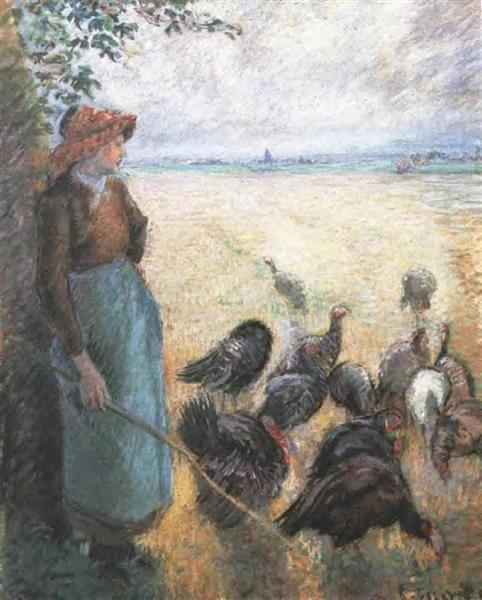
Pissarro  “Turkey Girl” (1884)

Camille Pissarro was called the grandfather of Impressionism.  He was much older than Monet and Degas, and others, and he took all of them under his wing with open friendship, advice, encouragement, and sometimes financial aid.  In the 1880’s he reverted to an earlier theme which Degas described as “peasants working to make a living.” “Turkey Girls” (1884) is one of several that depict girls working with sheep or goats or harvesting. Pissarro depicts a flock of black and brown turkeys which the girl is keeping in line with a stick.  Apparently this flock of turkeys is more interested in eating than roaming.  

Tanner, “The Thankful Poor”

Jennie Augusta Brownscombe was born in Honesdale, Pennsylvania.  Her mother Elvira Kennedy was a descendant of a Mayflower passenger.  Jennie became an active Daughter of the American Revolution and the Mayflower Descendants.  After studying painting in America and Paris, she became a painter, teacher, lecturer, and commercial artist for New Woman magazine.  “Thanksgiving at Plymouth” (1925) is the result of the Colonial Revival Movement that began in the 1880’s as industrialization, urbanization, and immigration increased.  Americans became increasingly conscious of their history.  Although most often seen in architecture and decorative arts, Browncombe and other artists became interested in Colonial history as a source for their subjects. This painting is her second version of this subject, the first titled “The First Thanksgiving” (1914).  After diligently researching the subject found in available resources, she produced one of the most popular paintings on the subject.  Unfortunately her sources were not very accurate, but fit well the American imagination.  The picture also depicts a young mother and her children in the forefront.  Women artists, previously thought inferior, worked to overcome this idea. Brownscombe sold reproduction rights for her paintings, and they were seen on calendars, greeting card, reproductions.

Tanner, “The Thankful Poor”

Henry Ossawa Tanner was born in Pennsylvania.  His father, a former slave, was an African Methodist Episcopal bishop.  His mother was a runaway slave who came to Pennsylvania via the Underground Railroad.  The family was well respected and Tanner was educated.  He studied in Paris, and as a result of French racial tolerance, he was able to do well, ultimately achieving an international reputation.  He painted mostly religious and genre subjects.  Two of his genre paintings showing the hardships of African American life, “The Thankful Poor” (1894) and “The Banjo Lesson” (1893), were not popular at the time, but they are now among his most famous works. In 2020, with the pandemic causing major disruptions in the world, specifically with the long food lines for so many, it seemed appropriate to include this painting. It is a thoughtful and simple reminder of what is important at Thanksgiving.

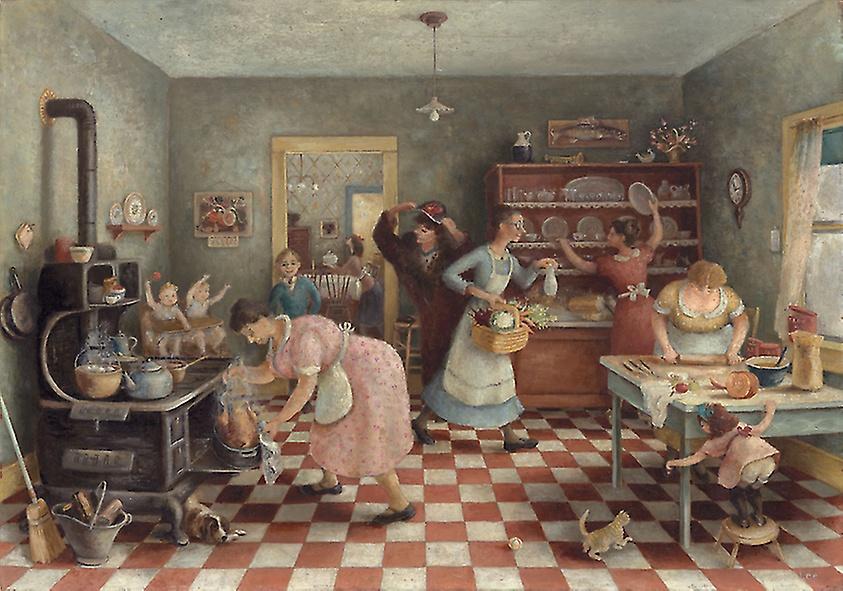
Lee  “Thanksgiving “    (1935)    28×40’’

Doris Emerick Lee was born in Aledo, Illinois. After studying art in Illinois, Kansas, and San Francisco, she painted murals for the United States Treasury, created art works for Life Magazine, she settled in Woodstock, New York where she established an art colony.  She remained in Woodstock for the rest of her life.  “Thanksgiving’’ (1935) (24’’x40’’) became a subject of articles in newspapers across the nation after it was exhibited at the Chicago Art Institute and won the prestigious Logan Purchase  Prize. The United States was in the midst of the Great Depression; the theme and style of the painting had immediate appeal nationwide.   “Thanksgiving” is depicted in Lee’s specific genre style.  Everyone could enjoy the delightful hustle and bustle of cooking the turkey, rolling out the pie dough, setting the table, and preparing the carrots and cauliflower.  The family dog licks up bits of food fallen from the oven, while a little girl, bloomers exposed, drops a treat for the cat. A new arrival is removing her hat, a young boy smiles in anticipation, and twins in a high chair cheer for joy.  A critic described this as “fresh, with the charm of innocence.” Lee’s nostalgic image depicts love of family, and despite the quaint style, it represents America at its best.

Despite our world situation in 2020, hopefully these paintings will bring the reader some peace and joy. A Happy Thanksgiving to readers. Stay well and stay calm.  

Beverly Hall Smith was a professor of art history for 40 years.  Since retiring with her husband Kurt to Chestertown six years ago, she has taught art history classes at WC-ALL and Chesapeake College’s Institute for Adult Learning.  She is also an artist whose work is sometimes in exhibitions at Chestertown RiverArts and she paints sets for the Garfield Center for the Arts.

The Spy Newspapers may periodically employ the assistance of artificial intelligence (AI) to enhance the clarity and accuracy of our content.

Filed Under: Arts Portal Lead, Arts Top Story

Art on Lockdown: Anne Watts

November 23, 2020 by Dave Wheelan
1 Comment

For the record, and well before the COVID crisis, Anne Watts has never bought into the concept of a graceful retirement. As the bandleader of the highly acclaimed Baltimore group Boister since 1997, Watts has always aspired to follow in the footsteps of Mick Jagger or the legendary Cab Calloway as artists committed to the long-haul with their work.

So it might not come as much of a surprise to learn the Anne hasn’t stopped working during the pandemic, even though live performances have come to a shrieking halt. However, what might be surprising to know is how the musician is channeling her energy into a weekly radio show on WHCP in Cambridge, where she has lived for the last decade with her husband and children. 

As Watts waits out the country’s health crisis, she has used the radio program “WomenWattage” to dig deep into the lives of remarkable women, many of them native to Cambridge like Harriet Tubman and Gloria Richardson, and use the show to share their stories, and, in her words, “drop the needle” on music that mattered to them. She also chats about the power of community radio to honor the dead and stay in touch with ancestors. 

The Spy caught up with Anne and her dog, Bo, a few weeks ago on the Cambridge waterfront. 

This video is approximately four minutes in length. WomenWattage is broadcast on WHCP every Wednesday from 1-2 pm and Saturday from Noon – 1 pm. 


The Spy Newspapers may periodically employ the assistance of artificial intelligence (AI) to enhance the clarity and accuracy of our content.

Filed Under: 1 Homepage Slider, Arts Portal Lead, Spy Highlights

Chesapeake Lens: Ma Dorothy by David Harp

November 21, 2020 by Chesapeake Lens
Leave a Comment

The David Harp photo is of Daniel Harrison, scraping for soft crabs near his home on Smith Island. A day in the life of a Chesapeake Bay Waterman goes from dawn to dusk, season after season, in every kind of weather. It’s a hard way to make a living, but to a true Waterman, it’s the only life worth living. 

The Spy Newspapers may periodically employ the assistance of artificial intelligence (AI) to enhance the clarity and accuracy of our content.

Filed Under: Chesapeake Lens

Delmarva Review: When Friendship Dies by Sue Ellen Thompson 

November 21, 2020 by Delmarva Review
Leave a Comment

Author’s Note:  The end of a long friendship is not unlike a death in the family: Suddenly, someone who was always there is gone. “When Friendship Dies” tells the story of two college classmates whose friendship survived marriage, children, geographical separation, and the death of a spouse. Then—unexpectedly but not without warning—it was over. It was my need to understand how this particular friendship was formed and what led to its demise that compelled me to write this memoir.

When Friendship Dies 

Memoir 

SO MUCH SNOW FELL DURING THE WINTER OF 1970-71 in Lincoln, Vermont, that when I looked out the window in the morning, I often thought my car had been stolen. Or that I’d forgotten to set the emergency brake, and it had rolled back down the steep mountain road where I was living in a charming but dilapidated farmhouse with another young woman who had just graduated from Middlebury College. It was so cold during the month of January that our pipes remained frozen for weeks, and we had to haul water for flushing the toilet and brushing our teeth by chopping a hole in the ice covering the river that ran through the backyard—something we often did in the pitch dark, in parkas over flannel nightgowns, with bare feet in unlaced boots. She was a teacher in a two-room schoolhouse; I was marking time as a legal secretary between summers at The Bread Loaf School of English, where I was studying for my M.A. We hadn’t been that close in college, but we both needed a place to live and wanted to stay in Vermont. The harsh confines of that winter turned us from survivors into friends—and, by the time the ice on the river began to buckle and the faucets ran freely again, into something more like sisters. 

We both married Middlebury men, had daughters eight months apart, and pursued careers that involved teaching and writing—she in upstate New York, Hawaii, and North Carolina, while I settled in southeastern Connecticut. But distance never mattered. For twenty-three summers we spent two weeks in July with our kids at her cabin in Maine. When she and her husband were living in Hawaii during the Kilauea eruptions of the early 1980s, my husband and I flew down to visit and from their deck watched the lava fountain and tumble, hissing, into the sea. During the more than three decades I lived in Mystic, Connecticut, we saw each other whenever she visited her mother in Newport, Rhode Island, where we cruised the shops on Bannister’s Wharf and drank wine in the bar at the Viking Hotel. Eventually we both gravitated back to Vermont: I bought a small cottage for weekends and vacations just over the mountain from Middlebury, while she and her husband found what would become their retirement home just north of town. Our friendship was a given. It would endure as long as we did. 

DECEMBER 2018

“You’re not really going to East Middlebury today, are you?” my husband asked, staring out the window of our Vermont cottage, watching as rain spread a gauze of ice over the snowy street. 

I hesitated before admitting why I was determined to drive to The Waybury Inn, thirteen treacherous mountain miles to the west, for lunch. “It’s taken me this long to pin her down,” I told him. “If I cancel now, I may never find out why she did it.” 

“She” was the friend of forty-eight years I’ll call Jane, and “it” was not to invite me to her second wedding, which had taken place six months earlier; in fact, she never even told me she was going to remarry. After her first husband, whom I’ll call John, died in 2013, I thought she was headed for a prolonged period of mourning. To my surprise, she flung herself almost immediately into an affair with a man she’d known for years, who took full advantage of her weakened emotional—and robust financial— condition. It didn’t last long, but she shared enough—how he persuaded her to buy an expensive boat so that he could sail it, how she discovered he was still involved with another woman— to make me feel relieved it was over. Then, just as it seemed she might be ready to explore the complicated grief she had postponed—for a husband who suffered from depression and had long since ceased to make her happy, but whom she had steadfastly refused to divorce—she met another man, a New England blueblood, the kind of man her mother might have chosen for her when she was a young Newport debutante. He was well dressed, well-mannered, and a former commodore of the New York Yacht Club. We socialized with them a number of times during their two-year courtship, but I was completely blindsided by her blunt text, “We got hitched.” Who, with adult children and grandchildren to please and provide for, gets married at our age? Given the fact that he had been divorced twice, I assumed they had opted for a quiet civil ceremony. 

I was wrong. When I asked for details, she admitted they’d had a church wedding in Middlebury with thirty-five guests. She sent me a few photos the next day, and I could make out the faces of several mutual acquaintances and former classmates. Why was I—the maid of honor at her first wedding and, I thought, her closest woman friend—not among them? The rejection and bewilderment I felt were visceral. 

After vacillating between hurt and anger for several days, I wrote her a long and very frank email describing my reaction and asking what I had done to provoke such treatment. Had I said something to upset her? Had I excluded her from some facet of my own life? Was she afraid I would judge her for re-marrying so soon after her husband’s death or probe her motivations too deeply? Perhaps I let my anger get the best of me, because all I received was a curt reply informing me that no explanation would be forthcoming. We both fell silent after that, but six months later she invited us to her annual Christmas party as if nothing had changed. “What should I say?” I asked my husband when the invitation arrived. “Say we’re not coming” was his advice. But I couldn’t do that—not without asking her face-to-face why she hadn’t told me about her wedding until it was over. 

She was already seated when I arrived at the Waybury, her arms folded tightly over a voluminous wool scarf. She didn’t move to embrace me. 

As we waited for the waitress to bring our food, Jane fired questions at me about everyone in my immediate and extended family. As an only child, she’d always been interested in the lives of my four siblings and their offspring. I gave brief answers— relieved, I suppose, not to have to broach “the subject” any sooner than was absolutely necessary. But when our food arrived and the questions kept coming, I wondered if she had any idea why I’d asked to have lunch with her. “Jane,” I said, when she stopped talking long enough to blow on her soup, “I have to know why you didn’t invite me to your wedding.” 

I was braced for a spirited self-defense. Instead, she declared flatly, “It’s not about you”—a common enough phrase whose full meaning I had yet to grasp. She went on to explain that her wedding had been an “extremely emotional” occasion—the implication being, I suppose, that it was too emotional to share with me. I wanted to interrupt with, But haven’t we shared dozens of ‘extremely emotional’ experiences over the years? Wasn’t I the first friend you told when your husband found out he had myelofibrosis? Weren’t you the one I called before dawn when my mother died? And didn’t you call me, weeping, from the highway when you didn’t reach your father’s bedside in time? Weren’t you still at the hospital when you called me to say your husband was gone? Haven’t we, in fact, shared almost every extremely emotional experience we’ve been through since our early twenties? I understood that a marriage ceremony is about two people, but when you have a church wedding with a few dozen guests, it would seem that you have chosen to let others share that very personal moment. Objections swirled in my head, but words deserted me. 

It’s not about you—she kept falling back on this phrase as I continued my probing and her side of the conversation floundered. It was typical of Jane to hide behind an all-purpose scrap of language when a more honest response required too much introspection. Another favorite was “Of course you do”—a phrase that could easily be modified to suit almost any context. A few years earlier, when I dropped what I thought would be a bombshell—that my husband was interviewing for a job in another state—her comment was “Of course he is,” the implication being that she had foreseen this turn of events and needed no further details. She often employed such conversational drop shots, if only to mask her unwillingness to engage at any greater depth. So, at first, I assumed that It’s not about you meant “It’s not about anything you did to upset me.” But when I asked her, with some embarrassment, about one of the faces I’d glimpsed in the wedding photographs she’d sent me—a woman I knew was only a casual friend—Jane blurted out that she’d run into her at the grocery store the day before and had invited her on the spur of the moment. I couldn’t help but think, You invited someone you ran into by chance, but not a friend who has stood by you for forty-seven years? Again, I was too incredulous to say anything. 

It wasn’t until we were waiting for the check that I realized “It’s not about you”—which Jane had said at least a dozen times in response to my repeated attempts to unearth her motivations— meant neither “You didn’t do anything to provoke me” nor “Stop trying to draw attention to your own hurt feelings.” She meant it quite literally: Sharing her decision to remarry—let alone inviting me to the wedding—had simply never crossed her mind. I had seen her cut people off before—most recently her stepbrother, after a dispute involving the distribution of family heirlooms. I had seen how quickly she put her forty-year marriage behind her. Did she associate our friendship with those decades she’d spent married to a man who had been a hero to both of us in our twenties but with whom she’d ended up locked in a relationship characterized by competition and conflict—a man she would never leave but who, mercifully, set her free by dying at sixty- two? 

I interrupted her rambling about how happy she was in the new life on which she had embarked. “So, what you’re telling me is that you want to leave everything and everyone associated with your old life behind, and that includes me?” She hesitated for just a moment. “Yes. Basically.” 

So that was it: I was part of the skin she was trying to shed. 

MAY 2013

This wasn’t the first time Jane had shut me out. The day her husband died, she called me from the hospital, sobbing. “Can you find me that poem that ends with the line about ‘your one wild and precious life’?” I immediately went to the Mary Oliver books on my shelf and copied “The Summer Day” into an email. 

A couple of weeks later, as we talked on the phone about plans for a memorial service, Jane said, “I want you to write a poem.” I cringed inwardly: I’d been asked to write poems for such occasions before, and I knew how impossible the task could be. “Why don’t I read that Mary Oliver poem?” I suggested. But Jane was adamant. “I want you to write a poem about John,” she insisted, “about how much he loved his kids and our land in Vermont. And I want it to say that although he was a lawyer, all he ever wanted was to be a farmer. And don’t forget to mention how he could fix anything mechanical. And you should say something about his orchard—he was so proud of those trees.” She went on and on, while I furiously took notes. Of course, I would do it, but I had only six weeks to pull something together. 

I began setting aside a couple of hours each day to work on my assignment. Periodically Jane would call, asking me how the poem was coming along but never pressing me for details. She wanted to hear it for the first time at the service. She was trusting me to do a good job. 

The result was a villanelle—a nineteen-line poem whose first and third lines alternated at the end of each subsequent three- line stanza and then reappeared as a concluding couplet. By varying the two repeated lines but keeping the end-rhymes, I was able to cover everything on Jane’s list. The poem began: 

He could fix what was broken, make anything grow,
was good with animals, feathered and furred,
liked churning rivers and winter’s blue snow,

could expound on a rare strain of apple or rose
while tuning an engine or tending a small herd
of cattle. The crops he’d always wanted to grow 

needed land to expand on, as all farmers know,
so he left his career as a lawyer behind and adjourned
to this place of white water and snow, 

where he and his life’s mate could both
have what they wanted: an orchard for him, and for her
a house that didn’t need fixing, where they could grow

older together, perhaps even old… 

I tinkered and tweaked, spending more and more time on the poem as the deadline approached. When Jane called a few days before the memorial service, I told her it was done. She didn’t ask to read it but only whether I thought it should be included at the beginning or the end of the service. I told her I thought the poem would be more appropriate as a final tribute. 

When I arrived at her house the day of the outdoor event, Jane didn’t mention the poem, but she must have seen the blue folder with the Middlebury College seal that I was carrying. I sat in the row behind her, holding it on my lap for almost two hours while John’s friends, their daughter, and John’s brother delivered their eulogies. I could feel tears welling and practiced some of the breathing exercises I’d learned in yoga. As a poet who was accustomed to public readings, I had perfected a number of techniques to keep my voice steady. I reminded myself that I was speaking for Jane, who was too overwhelmed by loss to speak for herself. I sat there with the folder pressed beneath my clasped hands, awaiting my turn. I felt as though I had a doorknob lodged in my throat. 

Then, suddenly, it was over. The minister who was officiating invited us all to join the family for a traditional Hawaiian pig roast in the field beyond the house. My husband gave me a startled look. Had there been a mistake? I tried to catch Jane’s eye, but she was already engulfed by family and friends. 

I was shocked. But I was also embarrassed, because I knew that there were times during the service when, instead of listening to the heartfelt reflections of others, I had been priming myself for my own performance. Perhaps I deserved to be ignored; after all, I’d been thinking about how my own words would be received when I should have been thinking about my friend. But that didn’t explain why it had happened. 

My husband and I ate quickly and told Jane we didn’t want to drive over the mountain in the dark. I left the blue folder on her desk. 

I had planned to stay in Vermont for the rest of the week while my husband returned to his job in Connecticut, assuming that Jane might need me to get through her first several days as a widow. When I didn’t hear from her, I called and invited her for dinner. We drank a great deal of wine and talked late into the night, but she never mentioned the poem. So after clearing the dishes I said, as gently as I could, “Jane, can you tell me why I wasn’t asked to read the poem?” 

She blushed furiously. “It was the kids’ decision. They only wanted their dad’s friends to speak at the service, and they regard you as one of my friends.” I was unprepared for this explanation. Although I knew that the marriage had been a contentious one, I hadn’t given much thought to how Jane’s children—whom I’d known since birth—might view me and my friendship with their mother. But I quickly came to the conclusion that if those two kids, now in their thirties, viewed their parents as being so at odds with one another that even their parents’ friends were relegated to opposing camps, then Jane had more serious issues to deal with than my injured ego. I wished that she had given me a heads-up when I first arrived at the service, but she was a grieving widow and couldn’t possibly be held to normal standards of etiquette. I told her that I understood. 

“Don’t worry,” she assured me. “On the anniversary of John’s death, I’m going to invite all of our Vermont friends to help scatter his ashes over the orchard and around the sugar- house. Afterward, we’ll have a huge bonfire and you can read the poem.” But when that first anniversary rolled around, Jane was in France with her new lover. She never once alluded to the significance of the date. 

Four years later, however, caught off guard by the news of Jane’s wedding, this incident came back to haunt me. In some intimate negotiation she’d had with her own nature, I’d once again been the loser. 

MT. CYANIDE, 2012

It was during her husband’s hospitalization for a bone marrow transplant that I first became aware of the fissures forming in our friendship. I had known that they were facing a crisis since his diagnosis seven years earlier, and I was fully prepared to support Jane in whatever way I could. I stepped up the frequency of my phone calls and emailed her almost daily. I visited her in the apartment she was renting in New York City, near Mt. Sinai Medical Center—which she misspelled so regularly in her emails that my husband began calling it Mt. Cyanide. But she didn’t seem to need the kind of one-on-one support I stood ready to provide, and I found the group emails she sent out—sprinkled with vague references to white cell counts and peripheral blasts but curiously devoid of any real information about her husband’s prognosis or her own emotional state—frustrating. They almost always ended with a request to “hold us in the light,” a Quaker commonplace although Jane was no Quaker. I suppose she meant “Keep us in your prayers,” but as a poet, my resistance to anything approaching a cliché or New Age platitude ran deep. Those emails left me feeling more like a casual friend than a close one—that I was merely part of the audience she’d assembled to witness her unfolding tragedy. 

I remember a phone call with Jane, following an email indicating that John had entered a critical phase in his treatment. I wanted to know more; I wanted to understand what he was going through and what it would take to emerge at the other end of this ordeal. I did some internet research and had a list of very specific questions to ask. But all she wanted to talk about was her budding friendship with a wealthy, socially prominent New York City woman married to a Middlebury alum—an Impressionist scholar and former curator at the Met. He, too, was being treated at Mt. Sinai, but I never found out the exact nature of his disease. All I heard about was their elegant New York City apartment, at which Jane had become a regular visitor. 

Was I jealous of this new friendship? Did I resent the fact that she’d spurned my attempt to show a more granular interest in her husband’s treatment? Both of these are possible, but all I felt at the time was disappointed by how easily Jane had let herself be distracted. 

VERMONT, 1970
The common wisdom is that shared values are what holds a marriage together, and I suppose that a friendship is not all that different. But aside from our Middlebury education, Jane and I defied that wisdom. She was the only child of wealthy parents and grandparents in Rhode Island, who spent Thanksgiving at the Agawam Hunt Club and had Christmas Eve dinner at Harbour Court, the New York Yacht Club’s waterfront mansion in Newport. I was the second of five children, and holiday dinners meant my mother standing in an apron over a six-burner stove and cousins, aunts, and uncles massed around a dining room table with three extra leaves. Jane’s parents divorced when she was in boarding school, and her father never let her forget how much he’d wanted a son. She responded by grasping every opportunity to prove her own worth: After earning a Ph.D. in education, she applied to law school and was accepted, although she had no intention of actually enrolling. Her mother compensated for her ex-husband’s disparagement by treating their daughter’s every achievement as if it were a Nobel Prize. I suppose Jane was as fascinated by my childhood tales of competing for food and my parents’ attention as I was eager to accept her invitations to Harbour Court. We each longed for more of what the other had grown up taking for granted. But was this the only basis for our friendship? 

My husband, who had known us both since we were in college, often asked why I put up with Jane’s treatment of me, which over the years had often been less than considerate. My stock response— “Because she’s the only woman I can be naked with”—was true. During my summer visits to Maine, we would frequently end up sharing the one small bathroom. I would step into the shower as she got out, so as not to waste the precious warmth and steam that were the only cure for a swim in the frigid cove. But there was more to our friendship, at least in the beginning, than a comforting lack of modesty. 

When we lived together in that Lincoln, Vermont farmhouse after graduating from Middlebury, I came home from work one day to find Jane dragging bales of hay from the back of a pickup truck to the house, whose fieldstone foundation she had already wrapped in plastic sheeting secured with furring strips. “Insulation,” she told me when I asked what she was doing. On another occasion that same winter, I was puzzled the first time I turned on the kitchen faucet and no water came out. It was Jane who took a hairdryer down to the basement to thaw out the pipes—and, when that failed, who threw on her parka and ventured out on the frozen river with an axe and a bucket. It seemed to me that there was no situation she was not equipped to handle. I was the one who had grown up in a big family, but it was Jane who knew how to survive. 

AS I DROVE BACK OVER THE MOUNTAIN following my lunch with Jane on that icy December day in 2018, I knew that our friendship was over—that, like the snow-laden barn next to the farmhouse we’d shared forty-seven winters ago, it had finally collapsed under the weight of too many slights. I passed the dirt road that led to that house and could see Jane in her Bean boots, barn jacket, and Nordic hat with tasseled earflaps, hauling those bales of hay and wrestling them in close to the foundation. I thought of the winter days when, after shoveling out her own car to get to work, she would trudge over to the shapeless mound where mine was parked and start scooping snow from the roof with her mittens. I thought of the day we went into a skid in Jane’s Volvo on a snow-covered back road and ended up with our right front fender submerged in a mountain stream. “Here, give me your hand,” she said, having already climbed out the driver’s side window and reaching back into the car to help me escape. I was so shaken that I had trouble clambering up the steep bank, but she had already flagged down a passing car that would take us home. I recalled the night in 1971 when snow sifted into her room through a window that, although closed, had plenty of gaps. She stood over my bed just before dawn, her blonde hair and the yoke of her flannel nightgown dusted with white. “Do you want to come in with me?” I asked, holding back the covers. Of course she did. 

Sue Ellen Thompson is the Featured Writer for Nonfiction in the new edition of the Delmarva Review (Volume 13). Her fifth book of poems, They, was published in 2014. An instructor at The Writer’s Center in Bethesda since 2007, she has previously taught at Middlebury College, Binghamton University, University of Delaware, and Central Connecticut State University. She received a Pushcart Prize, the Pablo Neruda Prize, two Pulitzer Prize nominations, and an Individual Artist Award from the state of Connecticut. In 2010, she won the Maryland Author Award from the Maryland Library Association. Website: sueellenthompson.com.

Delmarva Review is an independent literary journal publishing the best of new prose and poetry selected from thousands of submissions nationwide, and beyond. It’s thirteenth annual edition, released this month, features the new work of sixty-four authors. It receives partial financial support from individual tax-deductible contributions and a grant from the Talbot County Arts Council with funds from the Maryland State Arts Council. The review is available from Amazon.com and specialty booksellers like Mystery Loves Company, in Oxford. For more information, see the website: www.DelmarvaReview.org. 

#  #  #

The Spy Newspapers may periodically employ the assistance of artificial intelligence (AI) to enhance the clarity and accuracy of our content.

Filed Under: 3 Top Story, Delmarva Review

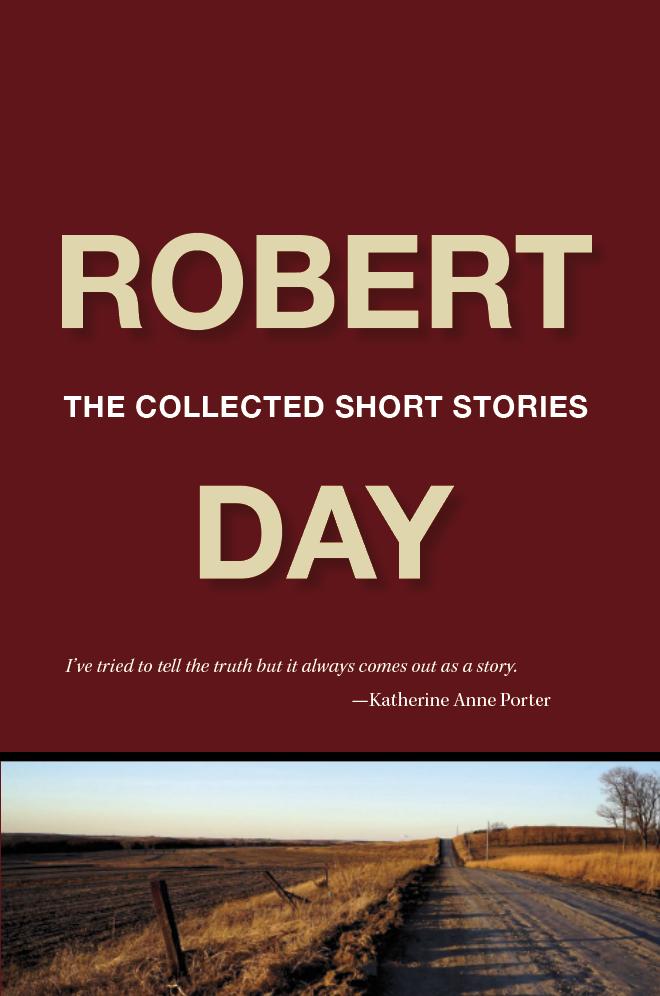
Book Review: For Not Finding You by Robert Day

November 14, 2020 by Jamie Kirkpatrick
Leave a Comment

I’ve come to the conclusion that there must be two versions of Robert Day; no, three. The first, and the one many Eastern Shore readers know best, is his Professor of English Emeritus at Washington College persona. Under that rubric, Professor Day helped to put Washington College’s creative writing program front and center among small liberal arts colleges across the nation. That he succeeded is a testament to both his teaching skills and the flowing power of his own writing, as well as his ability to inspire his students, many of whom still speak of him in tones reverential years after his retirement.

Robert Day’s second persona is his cowboy one. Once referred to as the “Cowboy of the Chesapeake,” Mr. Day hails from deep in the backcountry of western Kansas. Once upon a time, he played some serious baseball at the University of Kansas before turning to writing and penning his first successful novel, The Last Cattle Drive which was optioned for Hollywood movie rights, but alas, that tale ends with the word “optioned.” Undismayed, a few years later, Day drew upon those same Kansas roots to deliver a fine collection of stories, Speaking French in Kansas. Fortunately for his fans, that same laconic twang can be still heard in his latest work, For Not Finding You.
But before I get to that, there is the question of Mr. Day’s third persona: that of raconteur, boulevardier, un homme du monde à Paris (pronounced, as the French do, pa-RIS), to be exact. Monsieur Day has spent pas mal du temps in Paris as well as Kansas and somehow he’s managed to weave those two strands together in his newly released tale of love found, love unspoken, and ultimately (sadly) love lost in his latest literary offering, the aforementioned For Not Finding You.

One of the elements I like best about Day’s writing is his touch with dialogue. Scenes set in Kansas sound like Kansas: spare, authentic, wonderfully wry. Like “Patsy was no rose. Not even a shriveled flower at the stem’s end. Mostly thorns—especially if you crossed her.” Or “Talk is ventilation for the brain,” Buck said. “Just like you need to open the vents and damper on the Woodsman now and then to keep it from smoldering and getting creosote in the flue pipe. You don’t want smoke in your head.” When I read those words, I hear them plainly spoken and I see Patsy and Buck in all their Kansan glory. Robert Day is really good at that.

On the other hand, scenes set in Paris have that faint awkward touch that sounds like an American trying hard not to sound like an American. For all I know, Mr. Day may speak fluent French (he doesn’t, I’m told) but Leo Murdock, the narrator of FNFY, lives in the twilight of an expatriate American residing in Paris, one who is besotted with things Francophile but still observes the city and its scenes existentially, as though he’s looking at Paris through a slightly fogged lens. No matter; it all works, or as the French would say, “ça marche.”

But beyond dialogue, there’s knowledge. Of landscape; of heifers and cattle prices; of horse temperament, rattlesnakes, and snapping turtles; of fence building and windshield ranching and shelter belts and gardening and river quicksand. All the details of life on the prairie. This isn’t research; this is knowledge gained from the ground up; not book learning, but bootstrap Kansan stuff. It makes for fun reading and not a little disbelief—the good kind, not cynical but worthy of respect. “Good thinking,” as Buck likes to say.

Good as he is with dialogue and description, Day is at his best in developing his characters. And that they are: characters, real people, not just stuffed animals. As Buck says to Monique as he’s about to take her out for an evening ride, “I’m not harmless. But I’m not dangerous either.” But maybe that’s just Day looking in the mirror of his writing.

For Not Finding You is a good story for what it says, but it’s a better story for what it doesn’t say. There are words unspoken, conversations inferred. This is what distinguishes Day’s writing. He doesn’t spoon feed you, he lets you nibble and chew at your own pace and to reach your own conclusions. Questions hang in the air and Day lets you ponder their answer. A scene where Leo is thrown from his ornery horse stands as quirky metaphor for a near-miss in marriage. It also propels him years forward, still looking for—and not finding—the youthful love that got away. It’s touching; there’s a deep sense of bonjour, tristesse, a palpable, yearning kind of sadness that colors many of the story’s Parisian scenes and stands in stark contrast to the delightful humor of the Kansas plains.

Day is a wonderful writer and an even better storyteller. Maybe he’s the last of the “Prairie Populists,” not the “crazy old goat” who owns the Half Vast Ranch next door to Buck’s place. When I read one of Bob Day’s stories, I occasionally get thrown for a moment but I really don’t mind. I take a breath, dust myself off, and get back up in the saddle and ride off with him into the Kansas sunset. Or maybe even to Paris.

As a story, For Not Finding You is highly worth your reading while. Moreover, it proves that good writers really are like fine wine: they only improve with age. So pour yourself a glass of good French wine and settle in. At one point in the story, Leo muses that “small luxuries are better than big ones if you live in the country.” For Not Finding You is just that: a small luxury that, despite its country roots, looms much larger for its Kansas plainness and its Parisian sophistication. Its settings, characters, dialogue, and pace make for a lot of good thinking.

Jamie Kirkpatrick is a writer and photographer with homes in Chestertown and Bethesda. His work has appeared in the Washington Post, the Baltimore Sun, the Pittsburgh Post-Gazette, the Philadelphia Inquirer, the Washington College Alumni Magazine, and American Cowboy magazine. “A Place to Stand,” a book of photographs and essays about Landon School, was published by the Chester River Press in 2015.  A collection of his essays titled “Musing Right Along” was published in May 2017; a second volume of Musings entitled “I’ll Be Right Back” was released in June 2018.  Jamie’s website is www.musingjamie.com


The Spy Newspapers may periodically employ the assistance of artificial intelligence (AI) to enhance the clarity and accuracy of our content.

Filed Under: 3 Top Story, Arts Portal Lead

Delmarva Review:  Bread by Alamgir Hashmi

November 14, 2020 by Delmarva Review
Leave a Comment

Author’s Note: “Bread” arrived as part of a sonnet sequence, and a consolation, after much mulling over privation and constraint. Work and all life’s effort appeared, somehow, not to add up to the needed relationships or fulfillment. Some lines might suggest it, but there was no premonition of public calamities when I wrote the poem. It would seem, though, that the poem knew more than its author as it found its place (as sonnet IX.) eventually as part of a poem sequence about the COVID pandemic, titled “Virus Regulation” (https://newworldwriting.net/alamgir-hashmi-virus-regulation/). Retrospectively, thus, perhaps “Bread” telescoped into the future that many of us in the COVID-19 world must live with.

Bread

Warm bread from the oven,
your hands smell of dough,
baking, the science of hunger
or satisfaction. You only say
we are out of cinnamon
just as yesterday.
Another mile to go for spring water,
more herbs, and nuts for the buns. 

Year-round
it’s been
plowing or gathering,
prayers for good weather.
Is it this we live for?
One waiting, the other away. 

Alamgir Hashmi is the author of numerous books of poetry, including My Second in Kentucky (Vision) and A Choice of Hashmi’s Verse (Oxford), as well as volumes of literary criticism. His recent work appears in anthologies and journals including Poetry Review, Prairie Schooner, Poet Lore, New Letters, The New Quarterly, Chicago Review, Poetry London, Paris Voices, and Connecticut Review. Hashmi is a Rockefeller Fellow and Pushcart Prize nominee. As a professor he has taught English and literature in North America, Europe, and Asia. Web: www.alamgirhashmi.com

Delmarva Review is an independent, nonprofit literary journal published annually to encourage outstanding writing. It is supported in part by individual contributions and a grant from the Talbot County Arts Council with funds from the Maryland State Arts Council. Copies are available at Amazon and a number of regional bookstores. Website: DelmarvaReview.org.


The Spy Newspapers may periodically employ the assistance of artificial intelligence (AI) to enhance the clarity and accuracy of our content.

Filed Under: 3 Top Story, Delmarva Review

Looking at the Masters: Peter Paul Rubens  

November 12, 2020 by Beverly Hall Smith
Leave a Comment

Rubens was born in Antwerp, when it was under the Spanish Inquisition to root out Protestants.  The family fled to Protestant Germany, where Rubens grew up in Koln.  His father died when he was ten years old, his mother returned to Antwerp and the Catholic Church.  Rubens was engaged as a page to a Countess:  he learned courtly manners which would be extremely useful in his life.  Artistically talented, he was apprenticed in the Antwerp painter’s guild of St. Luke.  

Rubens proved to be an exceptional artist, was highly appreciated by the Catholic Church, kings, and nobles in Belgium, Italy, and Spain.  He was well received where ever he traveled, and his work was constantly in demand.  He maintained a large teaching studio,  and many of his students, including Anthony Van Dyke, became extremely successful.  With his great popularity and growing wealth, he was able to purchase and maintain a fine house, marry the woman he loved, and raise several children.  His personality and conversation were also much sought after, and when he traveled to foreign courts to complete commissions, he was often there on a diplomatic mission as well. 

His artistic style helped to initiate the Baroque.  His competence with an exceedingly wide range of subject matter from religion to mythology and portraiture was unique.  One particular subject matter which he reintroduced was wild animal paintings.  In Europe at this time, commoners hunted animals such as deer, rabbits, and birds for food.  Paintings depicting kings and nobles in hunting clothes were popular, but their hunts were for pleasure and trophies.  The larger world of Africa and the East was opening up; and with new colonies and an increase in trade, brought knowledge of a variety of strange and exotic animals.  Collecting these animals was the province of the very wealthy.  The Archduke of Brussels had several lions, tigers and others in his collection.  Rubens visited these animals frequently.  

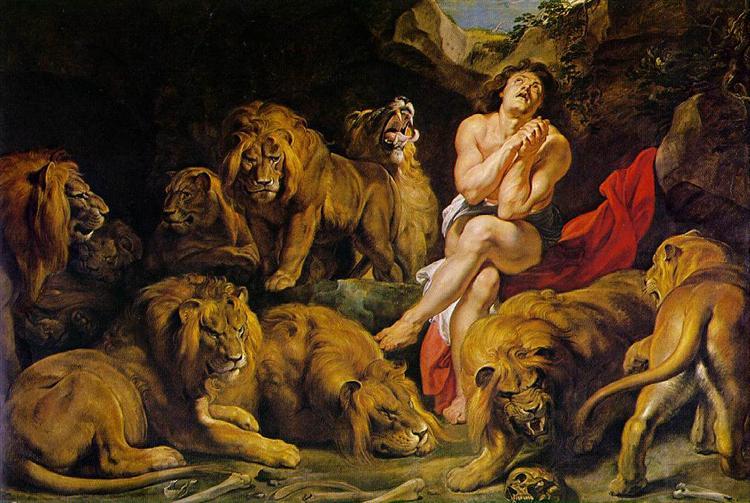
“Daniel in the lions Den”  (1614-16)         

“Daniel in the Lions Den” (1614-16) (88’’x130’’) (National Gallery of Art) was commissioned by Sir Dudley Carleton, the English Ambassador to The Hague in Belgium.  The painting was such a success that Carleton commissioned several other works from Rubens, and eventually became a dealer for his art.  Carleton was also a good friend to the famous Duke of Buckingham, referenced by Dumas in his novel The Three Musketeers. In exchange for the painting, Rubens acquired over one hundred pieces of classical sculpture from Carleton’s collection and amount of money. Rubens was a great collector.

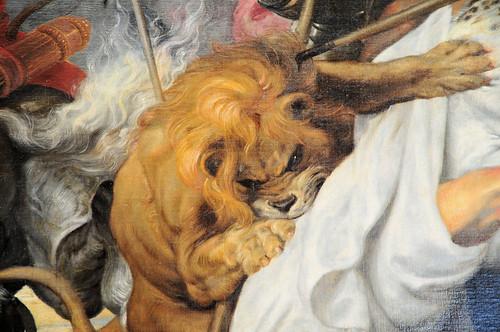
The story of Daniel (Daniel, 6: 1-28) depicts the Jewish prophet’s punishment for not worshiping the gods of Persia. Daniel is imprisoned in the lions den for a night, with the expectation that he would be dead by morning.  We see the various bones of other inhabitants of the den.  The lions are spectacular, and it is easy to see why this painting had such an impact on viewers. The lions were modeled on a species known in North Africa and Morocco as Barbary Lions, which served as models for lions in art from Ancient Egypt to the Nineteenth Century, and now almost extinct.  Rubens saw them in the Spanish governor’s menagerie in Brussels.  Some are sleeping and some resting, but two are snarling. The viewer can admire the brilliant painting of the smallest details.  

“Daniel in the Lions Den” (detail)

Daniel is depicted in prayer to God to protect him. In the Baroque manner, the viewer is placed in the heart in heart of the action and as a result of the size of the painting the viewer is close in size to Daniel and the lions. The Seventeenth Century Baroque style of painting does not present the meditative and quiet scene of the Renaissance style of the Fifteenth Century. In the intervening Sixteenth Century the Protestant Reformation put the Catholic Church on the defensive.  To counteract the Protestant movement, the Catholic Baroque, style, largely initiated by Rubens, generated all the emotional techniques available to artists. Rather than a clear blue sky and sunlight, Rubens and others created dark and brooding skies, or when inside, the dramatic change from the light pouring down on Daniel, to the extreme darkness of the den.  Another typical Baroque touch is the bright red cloak laid under Daniel.  Darkness creates mystery and the unknown, and the color red, the color of blood and fire, creates emotion. This painting, on display at the National Gallery, in Washington, DC, is not to be missed.

“Hippopotamus and Crocodile Hunt” (1615-16)

“Hippopotamus and Crocodile Hunt” (1615-16) (98’’ x 126’’) was commissioned by Maximilian, Duke of Bavaria for his summer residence.  Rubens probably went to Rome to see the dead hippo preserved in brine for his model.  With the Nile River and reeds and palm trees as background, three Arab riders on astride powerful Arabian horses spear the hippo.  They are assisted by two servants, one fallen and possibly dead, and the other attacking the charging hippo with a knife.  In the middle of this melee is the crocodile, mouth open with razor sharp teeth, nears the fallen servant.  Two loyal hunting dogs assist in the fight.  A white dog surges in from the left to attack the hippo, while a black dogs grabs and bites the crocodile’s tail.  The viewer is at the center of the hunt and the hunt which is moving forward in the composition as it explodes across the front of the canvas.  

The composition is dynamic.  Every outline is curved, and diagonals energize each form.  The hippo is at the center of the canvas at the high point of the triangular composition formed by the dog and man with the knife on the left and the injured man and the crocodile’s tale on the right.  Above this center grouping are the riders on horse back forming a semicircle that behind the aforementioned triangle.  Everything moves from the flying fabric, horse’s manes, rearing legs of horses, blowing reeds, and dark clouds moving across the blue sky.  Rubens’s use of color draws the viewer across the canvas; he uses white, red, and a variety of yellows to highlight the movement of the figures.  The more subtle use of green and blue, black and brown, move from left to right and back to front.  Rubens is a master of composition.  Nothing is static.  

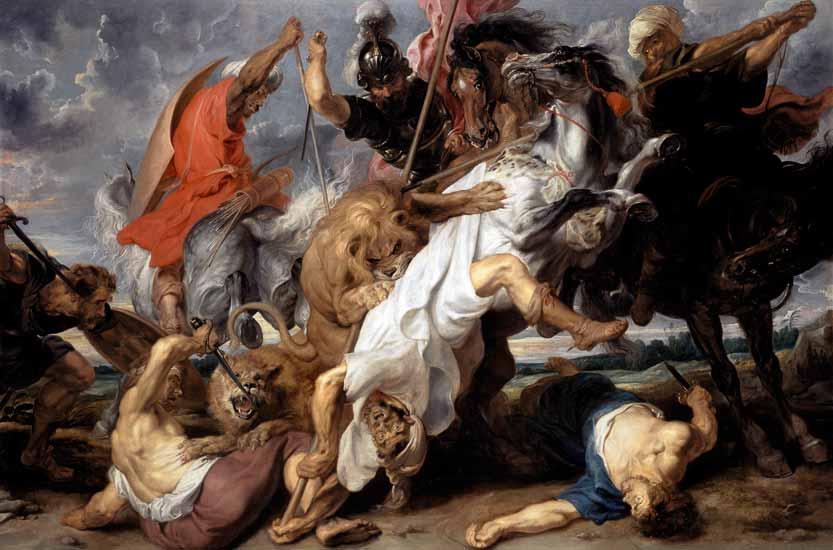
Lion Hunt” (1617)

         “Lion Hunt” (1617) (148.2’’x 98’’) is another hunt painting commissioned by Maximilian of Bavaria.  Rubens comments, “I have almost finished a large picture, entirely by my hand, and in my opinion one of my best, representing a Lion Hunt, with the figures life-sized.”  The hunts Rubens painted were influenced in part by tales told by noble men who had witnessed or participated in such hunts.  The male hunt participants are generally exotic types, Arab and African, and their servants. Rubens’s “Lion and Wolf Hunt” (1617-18) was purchased by King Charles I of England.  Beyond hunts with exotic animals, Rubens painted scenes with local animals such as “The Wild Boar Hunt” (1618-20) and scenes from mythology such as “The Hunt of Meleager and Atalanta” (1616-20), also know as “The Caledonian Boar Hunt,” and scenes of the goddess Diana and her nymphs hunting deer.

“Lion Hunt” (detail)

Rubens’s numerous Old Testament, New Testament, mythologies, and portraits hang in almost every museum, large or small, across the world.  He had a large and talented number of apprentices who worked with him on many of his paintings.  Never-the-less, he designed, oversaw, corrected, and painted the crucial parts of all of the work.  

With his beloved first wife, Isabella Brandt, he had three children.  He was grief stricken at her death.  A loving family man, witnessed by the numerous tender drawings and paintings of his family, he found love again with Helen Fourment who bore him a daughter several months after his death.  Rubens was unique among artists.  Not only was he an extremely popular and wealthy painter he enjoyed two successful and happy marriages.  It has been said of Rubens that he was definitely the right man for the right time.

Beverly Hall Smith was a professor of art history for 40 years.  Since retiring with her husband Kurt to Chestertown six years ago, she has taught art history classes at WC-ALL and Chesapeake College’s Institute for Adult Learning.  She is also an artist whose work is sometimes in exhibitions at Chestertown RiverArts and she paints sets for the Garfield Center for the Arts.

The Spy Newspapers may periodically employ the assistance of artificial intelligence (AI) to enhance the clarity and accuracy of our content.

Filed Under: 3 Top Story, Arts Portal Lead

Chesapeake Lens: Paddle to the Light by Bill Thompson

November 9, 2020 by Chesapeake Lens
Leave a Comment

In times like these, we all need moments of reflection. Peace and serenity don’t come easily but if you look, you can still find them. Photo by Bill Thompson. Title is “Paddle to the Light.” Early morning on the Choptank River.

The Spy Newspapers may periodically employ the assistance of artificial intelligence (AI) to enhance the clarity and accuracy of our content.

Filed Under: Chesapeake Lens, Spy Highlights

  • « Previous Page
  • 1
  • …
  • 102
  • 103
  • 104
  • 105
  • 106
  • Next Page »

Copyright © 2025

Affiliated News

  • The Chestertown Spy
  • The Talbot Spy

Sections

  • Arts
  • Cambridge
  • Commerce
  • Ecosystem
  • Education
  • Food & Garden
  • Health
  • Local Life
  • News
  • Point of View
  • Senior Nation

Spy Community Media

  • Subscribe for Free
  • Contact Us
  • COVID-19: Resources and Data

© 2025 Spy Community Media. | Log in