
MENU

Sections

  • About Us
    • Editors and Writers
    • Sponsorship Terms & Conditions
    • Code of Ethics
    • Sign Up for Cambridge Spy Daily Email Blast
  • The Arts and Design
  • Culture and Local Life
  • Food & Garden
  • Public Affairs
    • Commerce
    • Health
    • Ecosystem
    • Education
    • Senior Nation
  • Point of View
  • Chestertown Spy
  • Talbot Spy

More

  • Support the Spy
  • About Spy Community Media
  • Advertising with the Spy
  • Subscribe
December 8, 2025

Cambridge Spy

Nonpartisan and Education-based News for Cambridge

  • About Us
    • Editors and Writers
    • Sponsorship Terms & Conditions
    • Code of Ethics
    • Sign Up for Cambridge Spy Daily Email Blast
  • The Arts and Design
  • Culture and Local Life
  • Food & Garden
  • Public Affairs
    • Commerce
    • Health
    • Ecosystem
    • Education
    • Senior Nation
  • Point of View
  • Chestertown Spy
  • Talbot Spy
Arts Looking at the Masters

Looking at the Masters: Tree of Life

April 24, 2025 by Beverly Hall Smith
Leave a Comment

“Trees are Terrific…and Forests are Too” is the national theme this year for Arbor Day. Since ancient times trees have held a significant place in cultures worldwide. Trees have been considered sacred, offering immortality, and the axis mundi, the cosmic axis connecting heaven, earth, and the underworld. 
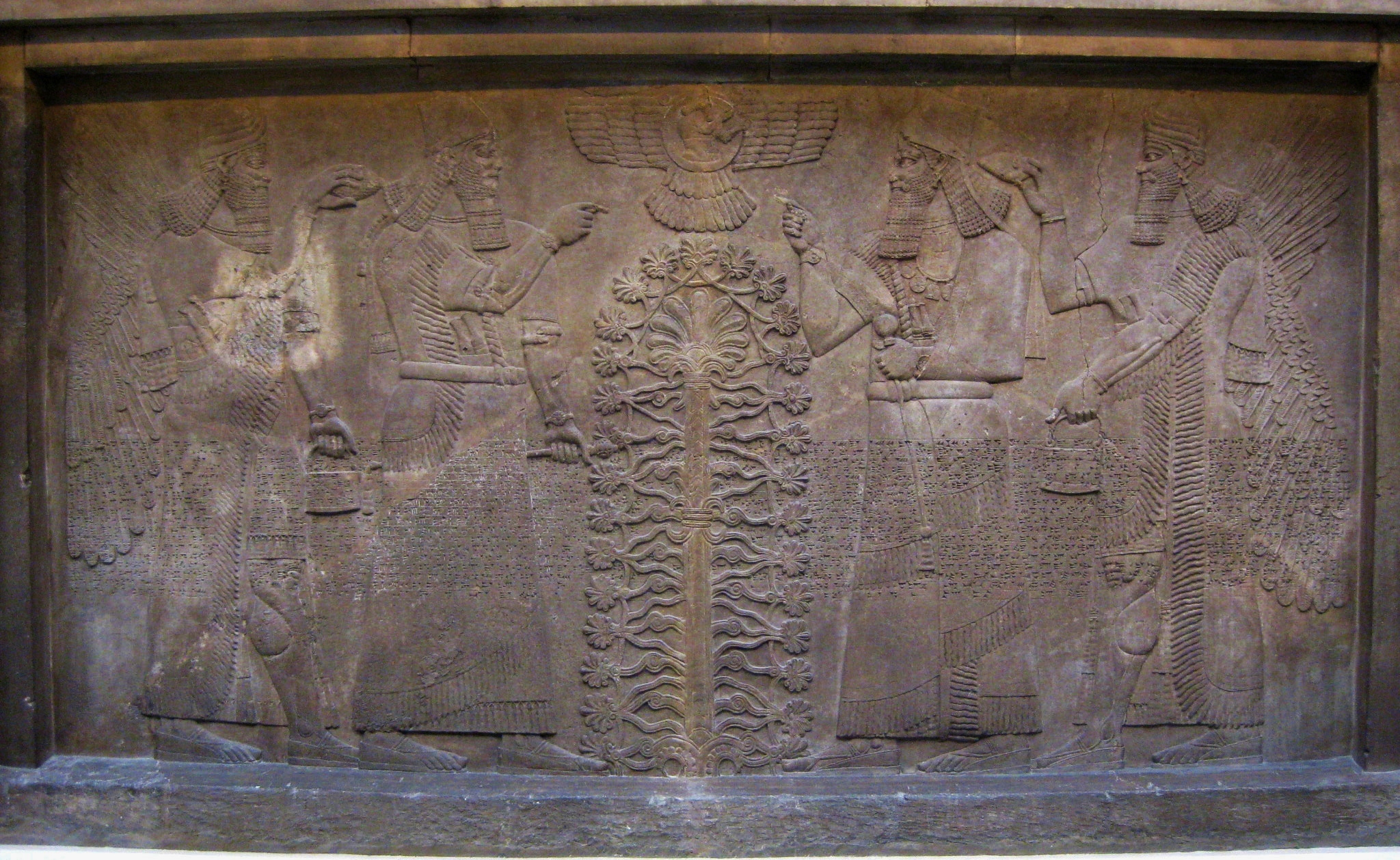
“Tree of Life” (883-859 BCE)

This image of the sacred Tree of Life (883-859 BCE) (Palace of Nimrud) is carved onto slabs of alabaster in the corridors of the palace of the first great Neo-Assyrian king Ashurnasirpal II. The tree of life is the central figure, and the king’s image is repeated on both sides of the tree. The fruit and seeds provided sustenance. They are also associated with fertility. The straight tree trunk is covered with fruit, and growing from it are rows of three and single branches. Round fruit is placed among the branches, and palmettos at the end of the branches. The fruit is often identified as a pomegranate. A crown of leaves tops the trunk. 

On both sides of the tree are duplicate images of King Ashurnasirpal II, both pointing above the tree to the circular disc supported by wings. In the circle is the image of the supreme god Ashur, God of war, wisdom, justice, and agriculture. Ashur’s placement above the divine tree legitimized the king’s rule of the heavens and the earth. He presents Ashurnasirpal II the ring that conveys the authority to rule. 
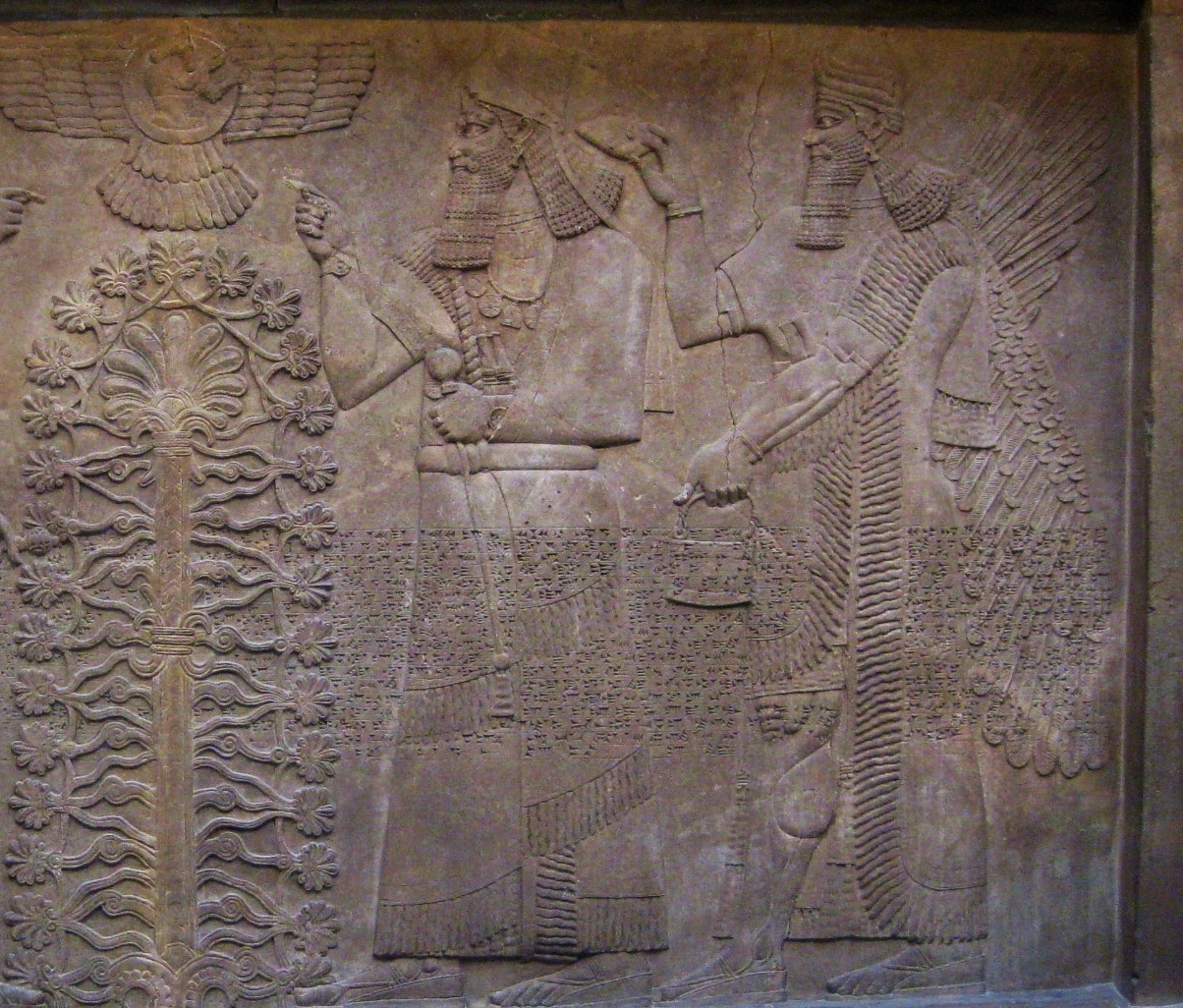
“Tree of Life” (detail of right side)

Beyond the king are winged genies, each carrying a pail of water and a pine cone. Frequently presented with the tree of life, the image is a depiction of the genie fertilizing and tending to the tree. Genies also are guardians of the king. Both the king and the genie are dressed in imperial robes. Long fringes of hair hang from the shoulders of the robes. The king wears a necklace and bracelet containing images of flowers and other sacred symbols. Men in Mesopotamia traditionally are depicted with long elaborately curled hair and beards, detailed mustaches and eyebrows, and fringes or tassels of hair on their robes. Hair was a symbol of strength. From the same location and time, Samson, from the Old Testament of the Bible, had long hair which was his strength. The male figures have exaggerated musculature in their arms and legs to show strength, noticeable in the figure of the genie. 


“Adam and Eve in the Garden of Eden” (1526)

The Jewish Torah, the first five books of the Old Testament in the Christian Bible, relates the story of Adam and Eve in the Garden of Eden. The prominent trees are the Tree of Life and the Tree of Knowledge of Good and Evil. God offers Adam and Eve the fruit of the trees to eat, including the Tree of Life, which would confer eternal life in Paradise. God forbids them to eat the fruit of only one tree, the Tree of Knowledge, which would confer the knowledge of good and evil.  

“Adam and Eve in the Garden of Eden” (1526) (46”x81’’), painted by German artist Lucas Cranach the Elder (1472-1553), depicts the story in which the serpent tempts Eve to eat the fruit, and she in turn convinces Adam to eat. The Tree of Life is rarely is depicted in the illustration of the story, whereas the Tree is Knowledge in prominent. The animals of Eden live together in peace: the lion and the lamb, deer, elk, wild boar, quail, heron, and white unicorn. Grape vines encircle the trunk; the tree produces an abundance of apples.  Slithering down the trunk, the serpent looks at Eve. A somewhat reluctant Adam scratches his head while making his decision. Cranach’s painting is typical of those telling this story. 
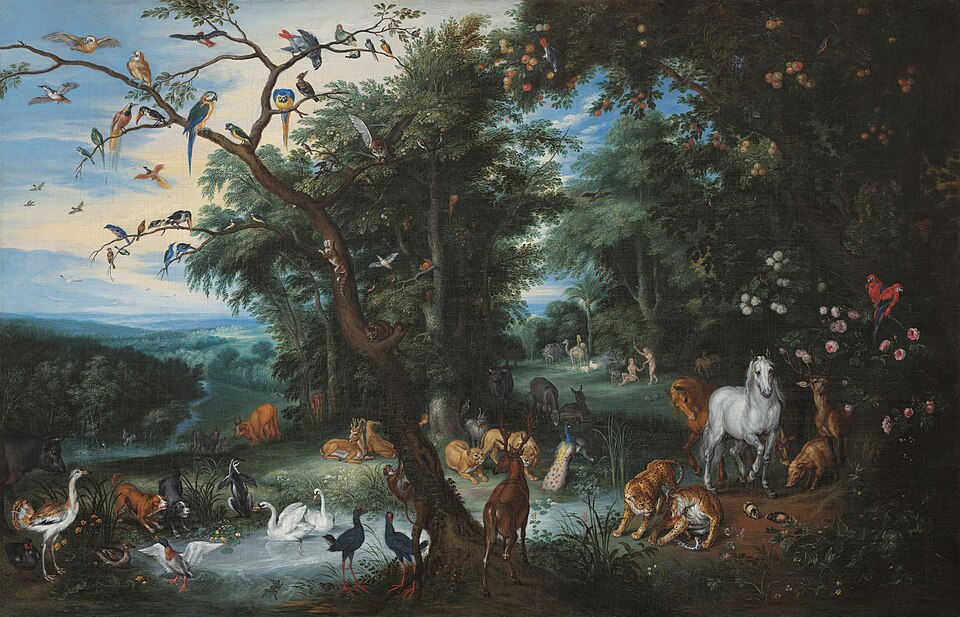
“The Garden of Eden” (1655-61)

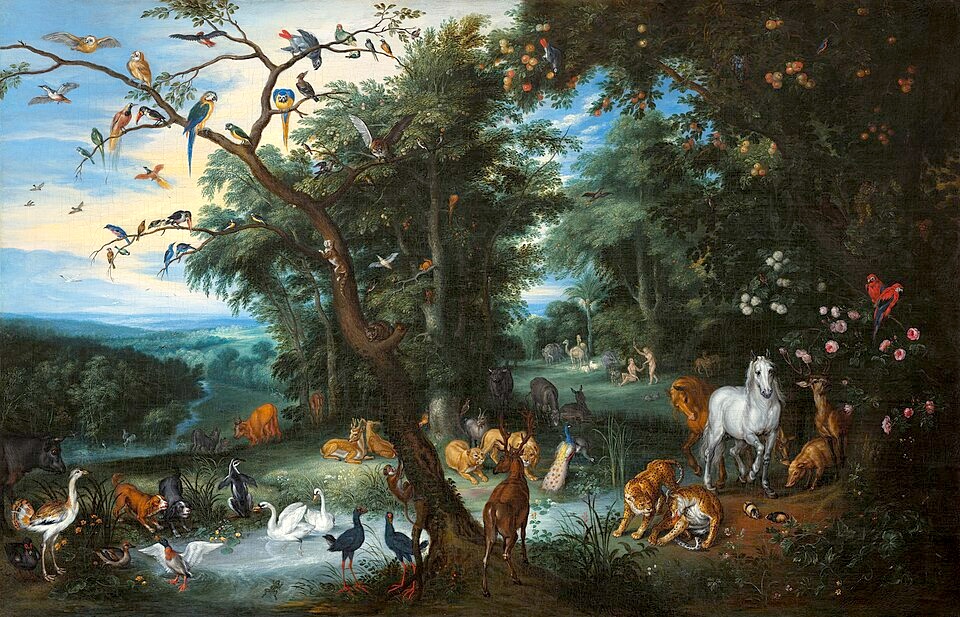
“The Garden of Eden” (1655-61) (23’’x35’’), by Flemish painter Isaak van Oosten (1631-1661), is a depiction of a large and glorious Paradise. Animals of all kinds are in pairs, and the birds are painted in great numbers. The trees are in full bloom. Plants, fruit, and flowers are abundant. Van Oosten preferred painting landscapes and animals, and created several of Eden. Although he was a Protestant, his paintings associate the Torah’s theological emphasis on Eden as the Promised Land for God’s people.  

Tree of Life” (1362-1367)

“Tree of Life” (1362-1367) (Court of the Myrtles) is one of the many times this Islam motif appears in the Quran and the Hadiths. Hadith is the Arabic word for a report or account of an event, and they are the sayings of Mohammad. The Quran mentions only one tree in the Garden of Eden, the Tree of Immortality, from which Allah forbids Adam and Eve to eat. They are tempted by Satan and eat from the tree.

Muslim prayer rugs frequently contain the image of the tree of life in the design. “Tree of Life” (1362-1367) is carved stucco on the walls of the Court of the Myrtles in the Alhambra in Granada, Spain. The design is symmetrical and balanced. Rather than one trunk, the design starts with three pine cones, surrounded by flower petals and a supporting geometric structure. The second level has two sayings from the Quran, and the geometric structure continues. The third level has a trunk-like design in the center which blooms into a peak at the top.  The curving sides of the tree, and the various designs within it create upward movement.  The Islamic Tree of Life is designed to show a connection between Heaven and Earth.
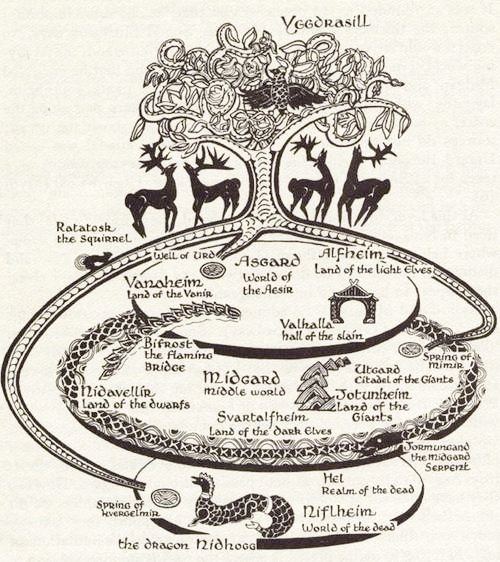
 

“Yggdrasil” (1847)

“Yggdrasil” (1847) is a depiction of the cosmic tree that is the central axis of the Norse universe and connects all nine realms. It has three roots. It is a sacred Ash tree, the source of all wisdom. Depicted here are the eagle with the head of a hawk perched in the tree and reports what it sees to the gods in Asgard who meet under it.  The four stags represent the four winds. They eat branches of the tree, and their antlers drop dew on the earth below. The first root leads to the well of Urd where the three fates (Norns) live. They tend the tree and determine the lifespan of people. The squirrel Ratatosk is the messenger to the gods, running back and forth from Asgard to Niflheim, the realm of the dead. In Asgard, the Bifrost Bridge is the rainbow that connects Midgard and Asgard. Heimdall stands guard over the bridge. He keeps his horn with him, and he will blow it to signal Ragnarök, the end of the world. Slain Viking warriors rest in Valhalla until they return to fight in this last great battle. 

The second root leads to Midgard, the realm of humans. Midgard also contains the regions of the dwarfs, the giants, and the dark elves. Midgard, mentioned in Beowolf, is surrounded by the Midgard serpent Jormungand. The third and lowest root leads to Niflheim. The goddess Hel presides over the dark realm Helheim, a world of ice where the dragon Nidhogg, tearer of corpses, presides. 

Yggdrasil represents the connection between life, death, and rebirth in Norse mythology. Unfortunately, the myth was passed down verbally and much of it has been lost. The Prose Edda, the first known writing of Norse mythology in Iceland during the 13th Century, has been attributed to Snorri Sturluson. The illustrations of Yggdrasil are not from the 13th Century; they were added to later printings of the Prose Edda. 

The symbolism of trees is significant for many belief systems and for many reasons. Buddha received enlightenment under the Bodhi tree, Christ’s lineage is traced through the Tree of Jesse, and today family trees have become more and more important. Arbor Day in Chestertown will be celebration this Saturday. For those who attend, saplings to plant will be distributed. Trees are important to sustain the environment. Enjoy Saturday in the park in Chestertown and plant a tree.

Note: Maryland Governor Wes Moore proclaimed April 2, 2025 as the 142nd annual Maryland Arbor Day celebration. In 2021 a Maryland initiative was to plant five million trees. As of this writing, Maryland has celebrated a milestone of one million trees planted.


Beverly Hall Smith was a professor of art history for 40 years. Since retiring to Chestertown with her husband Kurt in 2014, she has taught art history classes at WC-ALL and the Institute of Adult Learning, Centreville. An artist, she sometimes exhibits work at River Arts. She also paints sets for the Garfield Theater in Chestertown.
The Spy Newspapers may periodically employ the assistance of artificial intelligence (AI) to enhance the clarity and accuracy of our content.

Filed Under: Looking at the Masters

Looking at the Masters: The Limbourg brothers illustrate the story of Easter

April 17, 2025 by Beverly Hall Smith
Leave a Comment

The Limbourg brothers, Herman, Paul, and Jean, born between 1385 and 1388, were Dutch painters from Nijmegen, but they were active in Burgundy and other parts of France. King Philip the Bold of France employed Paul and Jean to paint manuscripts in February 1402. When Philip died in 1404, his brother Jean du France, Duke de Berry, employed the Limbourg brothers.  Their first commission was the Belles Heures (beautiful hours). They completed the work in 1409, followed by the Tres Riches Heures du Duke de Berry, the Grandes Heures du Duke de Berry, and others. The more famous Tres Riches Heures had not been finished when the brothers died in 1416, possibly of plague. 

Belles Heures of Jean du France, Duc de Berry, was intended for the duke’s private devotion. It contained prayers to be said at the nine canonical hours during the day. The manuscript contains nineteen different story cycles. Duke de Berry was an avid collector who wanted and could afford the very best. The fine parchment that was used has been critical to maintaining the rich colors of the illuminations. J.D. Rockefeller, Jr., purchased the manuscript in 1954 and gave it to the Metropolitan Museum, where it is installed in the Cloisters. The only manuscript entirely completed by the Limbourg brothers, it is considered to be one of the finest illuminated manuscripts of the Middle Ages.

There are too many images of the Easter story to include here. The Limbourg brothers were thorough in their illustration. They enclosed the pictures with elaborately detailed frames and extended the frames with borders of flowers.  

“Garden of Gethsemane”

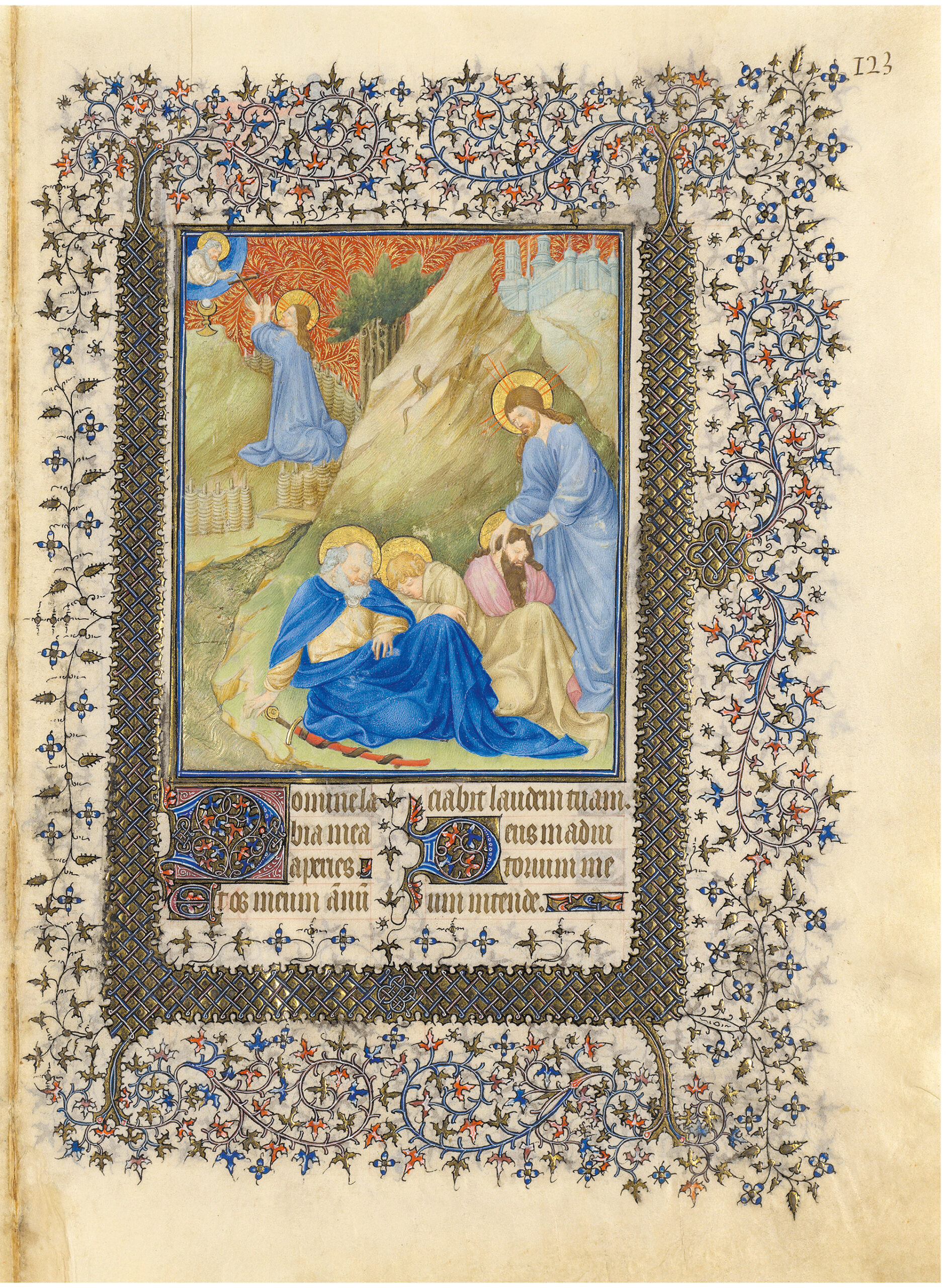
“Garden of Gethsemane” illustrates the artists’ interest in creating a realistic background. Properly proportioned figures, use of light and shadow to create depth, and interest in nature were new. In their manuscripts, the Limbourg brothers melded the existing International Gothic style with new ideas of the Renaissance. With the exception of the red and gold background of tree branches, the figures and landscape, including a road leading up to the city and a river flowing by, appear to be three-dimensional. Peter, John, and James, the three figures with Christ, have fallen asleep. Peter, the oldest with the white beard, has a red sword, around which a snake has coiled. Next to Peter is the young John. Christ touches James’s head. In the background, behind the wattle fence, Christ prays to God to take away the cup. God presents Him with a cross, a symbol of what is to come. The snake slithers up the nearby hill toward the town.

“Betrayal by Judas”

The Limbourg brothers concentrate on various participants among the crowd in the “Betrayal by Judas.” The figures get full attention, while the background is a simple flat pattern of dark blue and gold to indicate the scene takes place at night. Jesus and Judas are at the center. Judas gives the betraying kiss.  Halos are placed above both figures. A Roman soldier, in blue and yellow armor, grabs Christ’s robe. Another soldier has been pushed to the ground in front, and several helmeted soldiers stand in the background holding spears. One soldier holds a lantern just above Christ’s head. The Jewish official in pink, the same color as Judas’s cloak, holds a torch.  

Peter, standing at the right of Christ and Judas, has cut off the ear of Malchus, a servant of the high priest. Christ reaches down with his right hand to heal Malchus’s ear. Christ says to Peter, “Live by the sword, die by the sword.” (Mathew 26:52) The blue dragon, at the border of the manuscript, spits red fire.

“Christ Before Caiaphas”

After his arrest, Christ was taken to the home of Caiaphas, the high priest of the Jewish Sanhedrin. In “Christ Before Caiaphas,” the pattern of the dark blue and gold night sky is repeated. However, the scene is placed indoors. Caiaphas sits on an elaborate, three-dimensional throne with a gold canopy above him. The artists have paid great attention to the throne. It has three steps, leafy carvings on the sides of the steps and the chair, and a row of arches beneath the gold canopy. 

Caiaphas is depicted as an elderly man, holding an exceptionally large sword. Two figures, among the scribes and elders who have come to examine Christ, whisper their suspicions to Caiaphas. Christ is surrounded by soldiers holding flags and spears. On questioning, He will state that He is the expected Messiah, will be condemned for treason, and will be sent to the Roman governor. The blue dragon spits fire in the direction of Caiaphas.

Pilate Washing his Hands

“Christ Before Pilate” is the first of three scenes with Pilate. The second scene in the sequence is “Pilate Washing his Hands.” Both scenes take place in an elaborate interior setting. Pilate sits on a carved stone throne similar to the throne of Caiaphas. However, the artists have created additional levels: three columns supporting the gold canopy, the back of the throne and onlookers, and a roof and second-story addition. The basin into which the water is poured for Pilate to wash his hands of the condemnation of Christ is a mishap in perspective. It does not sit flat. The next scene will show Pilate offering to release Christ, but the crowd selects Barabas the thief instead.  

“Carrying the Cross”

“Carrying the Cross” is a depiction of the event as a parade. At the front, Jews blow trumpets and carry banners. Christ looks back at his mother who is accompanied by John, the young disciple. Others follow out the city gate to Calvary Hill. Judas has hung himself from a tree on a green hill in the background. Several events during the crucifixion are depicted next. 

“The Death of Christ”

The Limbourg brothers created an unusual scene for their time in “The Death of Christ.” They included all the events recorded by Matthew 27:45, 51-54: “From noon until three in the afternoon darkness came over all the land.” (45) ”At that moment the curtain of the temple was torn in two from top to bottom. The earth shook, the rocks split, and the tombs broke open. The bodies of many holy people who had died were raised to life.  They came out of the tombs after Jesus’ resurrection and went into the holy city and appeared to many people. When the centurion and those with him who were guarding Jesus saw the earthquake and all that had happened, they were terrified and exclaimed, ‘Surely he was the Son of God!’ “ (51-54) In the background, the unrepentant thief is blasted by fire, and the repentant thief is saved.

“Soldiers Asleep at the Tomb”

After the crucifixion, Christ’s body was taken to the tomb of Joseph of Arimathea, a wealthy Jew and follower of Christ. It was newly completed and unused. “Soldiers Asleep at the Tomb” contains the largest landscape attempted in this manuscript. The three soldiers who were sent to prevent the Christians from removing the body are asleep. Each has a weapon: a sword, a pike, and a shield. The shield, bearing a grotesque face, is prominently placed at the lower right. Unfortunately, the artists’ depiction of the carved stone tomb defies the rules of perspective. Instead of diminishing in size as the tomb recedes into space, it appears to become larger. Perhaps its location on a slight hill led to the mistake. 

A rocky ledge separates the foreground from the background landscape. The green trees and barren Calvary hill work well, except for the three slightly over-sized crosses. The thieves remain hanging on their crosses. The center cross of Christ is empty. Behind the hill, the towers of Jerusalem stand against the blue sky.

“Resurrection”

“Resurrection” repeats the scene of the soldiers sleeping beside the tomb. The resurrected Christ emerges from the tomb, carrying a red banner attached to the staff of a gold cross. It is a symbol of His victory over death. Red is a reference to the blood He has shed. His chest is bloodied where the Roman soldier Longinus pierced His side to confirm death. An angel supports Christ as He rises from the tomb. The golden globe of heavenly light is placed above Christ in the clear blue sky.

Happy Passover and Happy Easter 


Beverly Hall Smith was a professor of art history for 40 years. Since retiring to Chestertown with her husband Kurt in 2014, she has taught art history classes at WC-ALL and the Institute of Adult Learning, Centreville. An artist, she sometimes exhibits work at River Arts. She also paints sets for the Garfield Theater in Chestertown.

The Spy Newspapers may periodically employ the assistance of artificial intelligence (AI) to enhance the clarity and accuracy of our content.

Filed Under: Looking at the Masters

Looking at the Masters: Madonna and child in a garden

April 10, 2025 by Beverly Hall Smith
Leave a Comment

Images of Mary and Christ are plentiful, as are images of them sitting in a rose garden. Since most of the population from the Middle Ages onward through the 17th and 18th centuries could not read, religious painting and sculpture served to educate the congregation of believers. Iconography was a significant aspect of painting and sculpture. Images and everyday objects related to the stories helped the faithful remember the lessons as they went about their daily lives.

“Madonna in a Rose Bower” (1440-1442)

Images of the Madonna and Child in a rose garden were popular. “Madonna in a Rose Bower” (1440-1442) (20”x16”) (oil and tempera on wood panel) by German painter Stefan Lochner (1410-1451) is a stunning example. Mary and the infant Jesus sit on a red velvet bolster in an enclosed garden. The ground is a green carpet of perfectly patterned leaves. Young angels lean on the garden bench, looking adoringly at the mother and child. Four angels play music on a harp, a small organ, and two stringed instruments. Roses grow on a square metal trellis behind them.  Above them, two angels hold a gold cloth of honor, placed on thrones of kings and for Mary, Queen of Heaven. God, the father, and a white Dove, the Holy Spirit, look down on the scene from above. God, hands raised in blessing, and Jesus on Mary’s lap, represent the Holy Trinity. Lochner used gold lavishly to represent the heavenly space.

White roses are symbols of Mary’s purity, and red roses are symbols of the Passion of Christ. Jesus holds an apple which has been given to him by one of the young angels. Apples represent the original sin of Adam and Eve in the Garden of Eden, and Mary and Christ are referred to as the second Adam and Eve, who take away sin. Strawberry plants in the garden produce both flowers and fruit at the same time, a reference to Mary as both a mother and a virgin.

Mary’s broach and crown are examples of a painting technique used by Lockner, en rende-bosse, or encrusted enamel. In the 14th Century, encrusted enamel was applied to create three-dimensional pieces. Mary’s broach and crown are encrusted with gemstones. The figures on Mary’s broach are a virgin and a unicorn, both symbols of purity.

“Madonna and Child and Saints in an Enclosed Garden” (1440-1460)

“Madonna and Child and Saints in an Enclosed Garden” (1440-1460) (47”x58”) (oil) (National Gallery of Art) is by Netherlands painter Master of Flemalle, who has been identified as Robert Campin (1375-1444). He was a contemporary of Jan Van Eyck and teacher of Rogier van der Weyden. He settled in the Belgian city of Tournai in 1405-06, and he was a free master in the Guild of Goldsmiths and Painters. He purchased a house in Tournai in 1408. Campin was a popular artist who received numerous commissions from individuals, guilds, the Church, and civic groups. Records show he owned several houses, bought city bonds, and invested in mortgages. He was a prosperous artist. 

“Madonna and Child and Saints in an Enclosed Garden” illustrates the tradition of symbolism in religious art along with increasing interest in depicting nature. The Madonna and Child are again placed in an enclosed garden, a reference to Mary’s purity. Although she does not wear a crown, she is placed on a golden throne with an elaborate cloth of honor behind her. Her feet rest on a brocade pillow. She wears the traditional blue robe, this time a rich dark blue with a gold embroidered border. Jesus reaches for a quince held out to him by St. Barbara. The quince is a symbol of the resurrection of Christ. It also is associated with love and fertility. From the Greeks onward, it was presented to the bride on her wedding night. 

St. Barbara, dressed in red, was an early Christian saint. Her father was a rich pagan who locked her in a high tower to protect her from the world. While he was away, she had three windows built into the tower instead of the two he had planned, because the number three was the symbol of the Trinity. She secretly had become a Christian. Discovering her conversion, the prefect of the province had her dragged from the tower and tortured for several days. Her wounds healed overnight. Ultimately, she was beheaded. Her tower stands behind her in the garden.

In the corner of the painting, St Catherine of Alexandria, Egypt, reads an illuminated manuscript. She is the patron saint of students, teachers, and librarians. The daughter of the governor of Alexandria, Catherine went to the Emperor Maxentius to protest when he began the cruel punishment of Christians. He threw her into prison and subjected her to numerous tortures intended to kill her. She was fed by a dove from heaven, and her wounds were tended by angels. After these attempts failed, Maxentius ordered her run over by a wheel with spikes. The wheel broke. Catherine then was beheaded. The sword used to behead her and a broken wheel are placed at her feet in the painting.

John the Baptist, in the bright green cloak, stands beside the throne and holds a lamb. He traditionally is painted with unruly hair and a beard, representing his time spent in the wilderness. Under his green cloak he wears only a short tunic of animal skins. The lamb is the symbol of Christ. John the Baptist recognized Christ when he baptized Him, and called him “Lamb of God.” 

St Anthony of Egypt, the elderly bearded man in the dark gray robe and leaning on a cane, was raised as a Christian and preached the teachings of the Church for many years. He later became a semi-hermit, living a life of solitude and prayer. He helped to found several monasteries. He overcame numerous temptations visited on him by the Devil. St Anthony may have been a pig herder at one time. However, he ate no meat during his lifetime. The pig, a symbol of the sin of gluttony, most likely is a reference to his surviving all the Devil’s temptations. St Anthony is the patron saint of swineherds, domestic animals, and monks. 

The paradise garden contains several other flowering plants. Behind St Catherine is a purple iris, also known as a sword lily. The purple iris traditionally represents nobility.

“Virgin Among Virgins” (1475)

“Virgin Among Virgins” (1475) (43’’x67’’) (oil) was painted by the Master of the Legend of St Lucy, whose known work is dated between 1480 and1510. Although his name remains unknown, several paintings have been attributed to this Netherlandish painter from Bruges. Mary and Christ are seated in the center of a partially enclosed rose garden. The cloth of honor behind her is held by two angels. Her feet rest on a black and gold cushion, and she wears the traditional blue gown and a crown. The background is a panoramic scene of the city of Bruges. Dating for the Master of St Lucy’s paintings is often determined by the continued construction of the tower of Bruges.

Eleven virgin saints are presented in a semi-circle around Mary and Christ. Next to Christ is St Catherine, her red gown decorated with wheels and her hand raised as she marries Christ. Opposite is St Barbara in blue velvet with her black cloak decorated with towers. She too became the mystical bride of Christ. Mary Magdelene kneels on the ground, her bare feet toward the viewer. She holds the gold pot of ointment with which she anointed Christ’s body in the tomb. 

St Agnes, in a red gown, is seated on the ground and holds a lamb. Her beauty was so extraordinary that she had many suitors, all of whom she refused, claiming she was mystically married to Christ. She holds up the wedding ring. Imprisoned and tortured, she was sentenced to death by burning. The fire went out, and a soldier cut off her head, or stabbed her in the throat. 

St Ursala, who wears a gold and black brocade gown and is reading a book, undertook a pilgrimage from Britain to Rome with 1000 virgins. Having traveled as far as Cologne, they were attacked by Huns and killed with arrows. The point and fletching of an arrow can be seen under her gown, and an arrow rests on the border of the painting.

Three martyred saints sit behind St Agnes. St Cunera, in a light blue gown, holds a small cradle and an arrow. A companion of St Ursula, she may have survived the massacre of the virgins on the pilgrimage. St Agatha, in black, holds a pair of tongs with her breast. As a Christian she also refused to marry, and her suitor was so angered that he had her breasts cut off to disfigure her. St Margaret of Antioch, in white, was to be cast into the belly of a dragon sent by the Devil. She raised her cross and the dragon’s skin parted, freeing her. Behind her, in the distant landscape, St George kills a dragon.

“Virgin Among Virgins” (detail)

Behind St Ursula and dressed in white is St Apolonia, who holds a tooth in tongs. St Lucy, in green, holds a plate on which her two eyeballs are placed. She was beautiful and much desired, as were all the female saints, but she refused all marriage proposals because of her faith. According to several stories, she plucked out her own eyes to prevent men from desiring her, or their removal was part of her torture.  The last saint, who has not been identified, holds a crown and a bell. Behind them are red roses, an apple tree, a grape vine, and a quince tree.


Beverly Hall Smith was a professor of art history for 40 years. Since retiring to Chestertown with her husband Kurt in 2014, she has taught art history classes at WC-ALL and the Institute of Adult Learning, Centreville. An artist, she sometimes exhibits work at River Arts. She also paints sets for the Garfield Theater in Chestertown.

The Spy Newspapers may periodically employ the assistance of artificial intelligence (AI) to enhance the clarity and accuracy of our content.

Filed Under: Looking at the Masters, Spy Journal

Looking at the Masters: Primavera 

April 3, 2025 by Beverly Hall Smith
Leave a Comment

It is Primavera, or Spring in English. The term is derived from the Latin primus tempus. Spring began this year on March 20, and it will come to an end on June 20. Jonquils, forsythia, and cherry blossoms are beginning to bloom in Chestertown and surrounds.


“Primavera” (1487)

Sandro Botticelli (1445-1510), born in Florence, Italy, became one of the most renowned painters of the Renaissance.  His painting “Primavera” (1487) was commissioned by Lorenzo di Medici.  The work is tempera on a wood panel (80”x124”). Botticelli enlisted several Greek writers’ mythological sources for the painting, including Ovid, Virgil, Hesiod, and Plato. He also was influenced by the then popular philosophy of Neoplatonism as proposed by Marsilio Ficino (1422-1499). The Medici’s interest in Classical Greek and Roman literature led them to embrace Neoplatonism which valued the teachings of the ancients.  The Medicis sought to integrate Neoplatonism into the teachings of the Catholic Church. The Church did not agree or approve. 

“Primavera” (the coming of Spring) is not a depiction of any one story, rather it is a combination of many. The painting is read from right to left starting with Zephyrus, the god of the west wind, painted in cold blue. He represents the March wind. He chases and captures the beautiful wood nymph Chloris. She is dressed in a diaphanous gown, and her blond hair and gown are blown by the wind. She represents the beginning of Spring, a rose vine in her mouth. Zephyrus marries her and changes her into Flora, the goddess of Spring. As Flora, her hair is fashionably styled with a crown of flowers, and her dress is patterned with numerous flowers. 

She carries a large bouquet of white, red, and pink roses. The symbol of the three colors of roses often appears in Christian art. In the Old Testament Song of Solomon (2.1), the declaration “I am the Rose of Sharon, and the lily of the valley” establishes Mary’s identification with the rose. The rose is also called the queen of flowers, associating it with Mary as Queen of Heaven. The connection between Mary and the rose continued in the writing of many Medieval scholars. The rose was linked with Mary’s purity, glory, and sorrow. The white rose is a symbol of her purity; she often is referred to as the rose without thorns because she is without sin. The pink rose is a symbol of her joy at the birth of her Son, Jesus. The red rose is a symbol of her passion, when blood was shed by Christ’s sacrifice.  

Paintings in the Middle Ages and Renaissance often depicted Mary and other female saints in a rose garden, a paradise. The ground on which they stand is a Flemish millefleur (thousand flower) carpet design, often interpreted as paradise. The image is not intended to be realistic. The base color is a solid dark forest green with perfectly painted flowers of all seasons and types. According to one report, 190 plants and flowers are depicted in “Primavera,” of which 130 are identifiable.

The central figure is Venus, the goddess of love and beauty, with Cupid and the three Graces who often accompany her. Cupid is blindfolded and aims his arrow at one of the three Graces, who dance in a circle. Here, Venus represents the month of April. Fully clothed, she represents not earthly passion, but married women and motherly love. Her head is surrounded by the loose foliage of a myrtle tree. Hesiod described the birth of Venus as she arises naked from the sea and moves on land, clothing herself with the branches of a myrtle tree. The tree became sacred to Venus. Neoplatonists believed Venus ruled over both earthly passion and heavenly love, connecting this aspect of Venus with Mary. The goddess looks directly at the viewer, her hand raised in the peaceful gesture of welcome often seen in paintings of Mary.

The other trees forming the forest background are orange trees. The Medici crest contained five gold balls, and orange trees became symbolic in Florence of the Medicis. Venus’s bodice is decorated with gold chains decorated with flames. The flame was the symbol of St. Lawence who was martyred by burning. The painting was commissioned by Lorenzo (Lawrence) de Medici.

The three Graces were sisters who often accompanied Venus. Hesiod wrote that the three graces were Aglaea (Splendor), Euphrosyne (Joy), and Thalia (Good Cheer). Mercury, messenger of the gods is placed at the far left. He is dressed in red and wears winged sandals and carries a sword. Many scholars agree that he is modeled after Lorenzo di Pierfrancesco di Medici, cousin to Lorenzo the Magnificent. The painting was commissioned to celebrate his wedding. Mercury leads the entourage forward into the beauty of a new Spring.

“Springtime” (1872)

Although the story of Botticelli’s “Primavera” is still being discussed, Monet’s painting “Springtime” (1872) (12’’x16’’) (Walters Art Gallery, Baltimore) offers the viewer the quiet pleasure of Spring. It depicts Monet’s first wife Camille Doncieux who is reading in their garden at Argenteuil. The couple were married in 1870, and Monet frequently used her as a model. In fact, she was such a good model, Manet and Renoir also employed her.  Monet’s garden was a favorite background, enjoyed by him, his wife, and their son Jean. Madame Monet is dressed in a pink muslin dress, partly in shade and dappled by sunlight passing through the branches. 


Le Printemps (Springtime). Monet, Claude (French, 1840-1926). Oil on canvas, height 64.8 cm, width 80.6 cm, 1886. Purchased With a contribution from the National Art Collections Fund.

“Springtime” (1886) (26”x32’) was painted by Monet in his garden in Giverny. In an orchard of cherry trees, Monet’s 18-year-old step-daughter Suzanne Hoschede talks with his son Jean. The closeness of Monet with his family is evident in many of his paintings. Suzanne will become Monet’s second wife. 

This painting also demonstrates Monet’s advanced techniques in Impressionism. The integration of spring colors throughout the painting presents the viewer with a world filled with sunlight. His brushwork has become looser. The painting presents a field of sweet-smelling flowers, and the peace and comfort in the soft breeze of this spring day.

“Spring Bouquet” (1866)

“Spring Bouquet” (1866) (41”x32”) (Fogg Museum, Harvard University) is an early work by Renoir. The Impressionist style of painting outdoors (en plein air) was a new direction that emphasized how sunlight gave flowers a transient beauty. The still-life with flowers was a tradition with 17th Century Dutch painters who worked inside without the natural light of the Sun. As a student, Renoir had studied Dutch still-lives. Early in his career he was a porcelain painter. He chose a white Japanese vase with blue flowers to hold the bouquet, a tradition of Dutch painters and in keeping with the very popular Japanism of the French at the time.   

Renoir’s arrangement is casual and bountiful. Purple lilacs, white hydrangeas, and peonies are included. White and purple iris are at the top of the bouquet. Daisies poke their heads out around the edges. Four bunches of yellow cowslips, or perhaps primroses, draw the eye around the composition and form the necessary complement to the purple flowers. 

Instead of the using the dark, almost black background of Dutch paintings, Renoir has set his spring bouquet against a lightly speckled stone wall and on a light stone garden ledge. The sunlight produces the nuance of colors as it touches various petals in the bouquet. The bouquet casts a light gray blue shadow. Whether one knows the flowers or not, the viewer experiences joy, and serenity.

HAPPY SPRING 


Beverly Hall Smith was a professor of art history for 40 years. Since retiring to Chestertown with her husband Kurt in 2014, she has taught art history classes at WC-ALL and the Institute of Adult Learning, Centreville. An artist, she sometimes exhibits work at River Arts. She also paints sets for the Garfield Theater in Chestertown.

The Spy Newspapers may periodically employ the assistance of artificial intelligence (AI) to enhance the clarity and accuracy of our content.

Filed Under: Looking at the Masters

Looking at the Masters: Utagawa Hiroshige

February 13, 2025 by Beverly Hall Smith
Leave a Comment

Utagawa Hiroshige (1797-1858) was one of the most prolific and popular Ukiyo-e artists in Japan. The word Ukiyo-e means pictures of the floating world. They were woodblock prints developed during the Tokugawa shogunate in the Edo [Tokyo] period. A time of increased wealth, the Edo period embraced kabuki theatre, geishas, and courtesans. The early Ukiyo-e prints were produced from the late 17th to the early 18th Century. They began as black and white woodcuts. White was the color of the paper. Color was added later. The color palette was limited as each color was cut from a different block.  A certain amount of shading could be added to a block as artistically needed.

Utagawa Hiroshige was the last great master of the style. Born in Edo into a samurai family, he was orphaned in 1809. His father held the position of fire warden in charge of preventing fires in the Edo palace, a responsibility passed down to Utagawa. The fire warden had much free time, so Utagawa entered the Utagawa Art School, from which he took his first name. He was permitted to sign his work at age 12, and he took his art name Hiroshige.

Evening Snow at Takanawa (1842-47)

“Evening Snow at Takanawa” (1842-47) (8.5’’X13.5’’) (scene 2) is one of eight scenes Hiroshige made for the portfolio Eight Snow Scenes in the Eastern Capital. Unlike other ukiyo-e artists whose subjects were mostly images of geishas, courtesans, and kabuki actors, Hiroshige focused on landscapes. His early prints were of flowers and birds. Most of his works were his series of travel prints that he began in 1829-1830. He was invited in 1832 to join an official procession on the Tokaido Road from Edo (Tokyo) to Kyoto. “Fifty-Three Stations of the Tokaido Road” (1833-34), completed from his sketches and notes when he returned home, made him one of the most recognizable and popular ukiyo-e artists of his time. 

“Evening Snow at Takanawa” (1842-47) (8.5’’X13.5’’) (scene 2) is a panoramic view of a vibrant snow-white bank by deep blue water and under a grey sky. White snowflakes dot the sky and the water. Aware of European perspective, Hiroshige depicts the snow bank with a slightly gray front edge and a darker blue at the front edge of the water. The closer the object the more intense is its color, which then diminishes as distance is created. In reverse, the sky is a lighter gray at the water’s edge and becomes darker as it recedes into the distance. Holding it all together are the clouds and land at the front and back edges of the print, repeating the beige and gray pattern.

Fishing boats are anchored in the harbor. The colors of the boats repeat the black, white, and yellow-orange used to define the other objects in the print. The stone building is composed of gray, and a darker gray blue, with the white snow covering the roof. The house is gray with yellow-orange windows, and covered by a gray roof covered with the white snow. Several yellow carts are placed next to the stone building. The palanquin, a one passenger litter, is carried by two bearers dressed in green. Trudging through the snow is a man in bright blue pants, leading a horse and rider. Behind them, a man carrying an umbrella wears green pants and a dark blue jacket.  Also carrying an umbrella, is a woman who wears a purple kimono and geta shoes that are built up with wood to keep her feet out of the snow. An obi, the red tied decoration on her back, is not a backpack but an elaborately tied part of the kimono.  The artist’s signature, a go or geimei, also is in red.  

“Snow in the Grounds of the Fudo Shrine at Megura”

“Snow in the Grounds of the Fudo Shrine at Megura” is the third print in the series. It is a depiction of a Buddhist Temple dedicated to the deity Fudo Myo-o, the immoveable or unshakable one, a fierce looking and powerful deity who protects Buddhism and its believers. The shrine, located on a tall hill covered with pine trees, still exists. The red shrine is placed at the center of the composition, and it is balanced with a narrow blue lake and brown building, a long set of stone steps on the hill, and the red signature of the artist. The dark green of the surrounding trees is the complementary color to the red shrine with its green shutters. The day is bright, and the few people present do not engage with each other. The shrine, as depicted by Hiroshige, is a beautiful and restful place just outside the hustle and bustle of the city below.

“Street View, Looking Down the Kasumigaseki after a Snowfall”

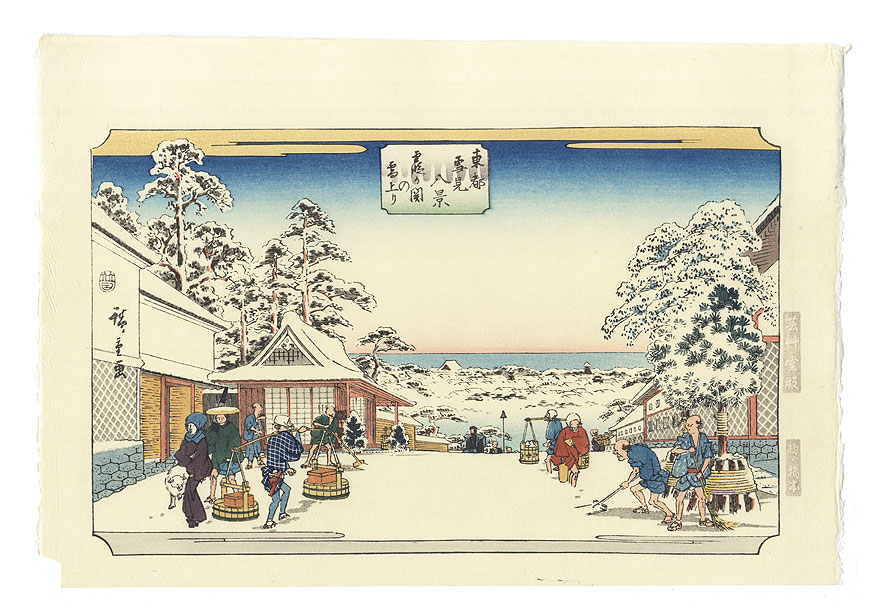
“Street View, Looking Down the Kasumigaseki after a Snowfall” is number 5 in the series. Kasumigaseki was, and is today, a busy hill street in Edo (Tokyo). Hiroshige depicts the panorama of Edo roof tops and a tower at the bottom of the hill. He concentrates on the people at the top of the hill who are going about their daily tasks. It is the morning after a snowfall, and workers on either side of the road are clearing the snow. Two men with shoulder poles carry boxes and cages. Buildings line the street. Kasumigaseki Street will become the street of important government buildings.

“Street View, Looking Down the Kasumigaseki after a Snowfall” (detail)

In the “Street View, Looking Down the Kasumigaseki after a Snowfall,’’ viewers have the opportunity to witness the brilliance of Hiroshige’s wood cut details produced in such a small area.

Snow at New Years Dawn at Susaki”

Japanese New Year is a celebration which begins on January 1 and continues until January 3. “Snow at New Years Dawn at Susaki,” plate 8 of the series, depicts the first sunrise that will represent the entire year. On this January day, the sky is clear, and new snow has fallen. A few people have come out to witness the rising of the Sun.  A woman in a purple kimono and a man with a fishing pole greet the day. Two others stand at the water’s edge of Susaki Bay, one man with his shoulder pole and the other balancing something on his head. Five sails move across the blue water. The nearby village is peaceful.  All last year’s business has been settled so that the New Year will begin afresh. New Year’s Day is supposed to be free of stress and anger left in the past. The day is to be full of joy and new beginnings.

Hiroshige created over 8000 Ukiyo-e wood cuts during his career. Many were in series formats. His final series was One Hundred Famous Views of Edo (1856-1859). He was never a wealthy man, as he was paid little for his work. He had two wives and one daughter, who may have been adopted. In 1856 he became a Buddhist Monk and retired from the world to complete One Hundred Famous Views of Edo. Ten years later the trade between Europe and Japan brought hundreds of Japanese woodcuts to Paris. Artists such as Monet, Van Gogh, and Whistler became collectors of Hiroshige’s prints, and his works influenced their own. Japonisme started a craze that exists today. Hiroshige died in 1858 and left this final message for his friends: 

“I leave my brush in the East, 
And set forth on my journey. 
I shall see the famous places of the Western Land.”


Beverly Hall Smith was a professor of art history for 40 years. Since retiring to Chestertown with her husband Kurt in 2014, she has taught art history classes at WC-ALL and the Institute of Adult Learning, Centreville. An artist, she sometimes exhibits work at River Arts. She also paints sets for the Garfield Theater in Chestertown.

The Spy Newspapers may periodically employ the assistance of artificial intelligence (AI) to enhance the clarity and accuracy of our content.

Filed Under: Looking at the Masters

Looking at the Masters: Hendrick Avercamp

January 23, 2025 by Beverly Hall Smith
Leave a Comment

A 17th Century Dutch artist, born in Amsterdam, Hendrick Avercamp (1585-1634) specialized in winter landscapes.  His father Barent Avercamp was the town apothecary of Kempen.  Hendrick was deaf, and he may not have been able to speak. He was known as the Mute of Kampen. He suffered frequent illnesses. Winter landscape became his most popular subject, although he also could paint portraits, and his sketches sold well. He was probably taught to draw and paint by the Flemish artist Gilles Conixloo (1544-1607) and the Dutch artist David Vinckbooms (1576-1632).

“Winter Landscape with Skaters” (1608)

 “Winter Landscape with Skaters” (1608) (30’’x60’’) (Rijks Museum) (oil on wood panel) is thought to be one of the earliest paintings by Avercamp. He enjoyed skating on the winter ice with his parents. The setting is the town of Kampen, with homes, other buildings, and a church. The trees are leafless; the sky is almost as white as the ice, but people are out and about, some at work, while others enjoy games on the ice. Several small boats are ice bound. Kemper was a prosperous town because it was on the trade route between the Rhine River and the Zuiderzee.

The Dutch people were Protestants and the first to believe in education for everyone. They owned their homes and land, worked hard, and prospered. The clothing they wore indicated whether they were on the day at leisure or   working. Throughout the scene well-dressed men and women walk about in groups, engaging in conversation. Others skate or play colf, an early form of golf. A figure near the center of the painting has fallen on the ice. Several horse-drawn sleds provide rides. Typical of Avercamp’s painting, so much is happening.  At the lower left corner is a bird trap, a piece of wood held up by a stick. Tucked in the corner, a dog chews on a dead carcass. At the horizon, and hard to see, are the sails of a ship setting out to sea. The Dutch used landmarks and wind to aid navigation. 

“Winter Scene with Skaters Near a Castle” (1608)

“Winter Scene with Skaters Near a Castle” (1608) (16’’ in diameter) (National Gallery, London), another of Avercamp’s early paintings, depicts a castle as the focal point. Many of the same winter activities are depicted. There is a snowball fight going on at the left, as two young boys, one in a blue top and the other in orange, chase a young girl in the open area of the painting. Birds perch in the branches of the dead tree. 

The winter scenes are attributed to the Little Ice Age, a climate phenomenon that began in the 13th Century and ended in the early 18th Century. Winter came early and lasted well into spring. Heavy snows were frequent. Temperatures during the time of Avercamp’s paintings averaged well below zero.

“Winter Scene on a Canal” (1610)

Avercamp’s “Winter Scene on a Canal” (1610) (20”x36”) (Toledo Museum, Ohio) presents much the same array of people and events. The Toledo Museum closely examined the painting and produced the next three close-up images.

Winter Scene on a Canal” (1610) (detail 1)

In the foreground at the left, the elderly man with the white beard carries a basket. He is warmly wrapped from his head to his heavy pants and thick shoes. A rooster and two hens pick at the ice where feed has been thrown.


#5 Winter Scene on a Canal” (1610) (detail 2)

Along the foreground to the right, three men stand together. One is a fisherman with a net. He has used his axe to cut a hole in the ice. He holds a long spear to reach deep into the water to catch fish, and has a net to keep them in. He talks with a second man. A third man is carrying two baskets.  The two men likely came to buy fish from the first man. Just behind this group is a man colfing.


Winter Scene on a Canal” (1610) (detail 3)

Next to the group of fishermen are two couples in traditional Dutch black clothing. The men’s cloaks reach down to their knees, and the women’s cloaks reach to the ground. The men wear white ruff collars and tall black hats. The men wear wool bouffant knee breeches, both warm and comfortable. Leather boots or hose and shoes complete their attire. The attention of the black dog has been caught by a young lady whose image is found in the full scene.


“Winter Landscape with Flask Players” (1625)

“Winter Landscape with Flask Players” (1625) is a portrait of Averkamp and his brother Lambert as they compete hitting flasks. Both men have dark beards, but we may guess that the artist wears the colorful clothing.  Looking on is a well-known fisherman, in the red hat, and his son. The tools of their trade are the hatchet and a basket to carry the fish. The son carries the net to lift the fish from the water.

Several ships and boats are placed in the background. A consequence of the Little Ice Age, landmarks necessary to carry on trade became harder to find. Sailors’ journals record a sense of placelessness, at times unable to see or sense where they were, where they were going, or how to find home. Their English, French, and Danish rivals were all looking for a trade route to Asia. 

Avercamp’s paintings show the resilience of the Dutch to enjoy, survive, and thrive in difficult times. His paintings, although generally on one theme, were popular. He painted many and he prospered.


Beverly Hall Smith was a professor of art history for 40 years. Since retiring to Chestertown with her husband Kurt in 2014, she has taught art history classes at WC-ALL and the Institute of Adult Learning, Centreville. An artist, she sometimes exhibits work at River Arts. She also paints sets for the Garfield Theater in Chestertown

The Spy Newspapers may periodically employ the assistance of artificial intelligence (AI) to enhance the clarity and accuracy of our content.

Filed Under: Looking at the Masters, Spy Journal

Looking at the Masters: A Victorian Christmas

December 19, 2024 by Beverly Hall Smith
Leave a Comment

Christmas traditions we cherish were established during Queen Victoria’s reign (1837-1901).  Others are as old as the ancient Roman Saturnalia celebration held on December 17, still others were traditions from the time of the Tudors. Decorating Christmas trees was one of the earliest and most important traditions.  Germans brought cut fir branches into the house for their wonderful scent. Queen Charlotte (1744-1818) of Germany, who married George the III of England in 1760, was known by 1800 to decorate fir branches in the Queen’s Lodge at Windsor. These decorations may or may not have been complete trees. The British public was not yet aware of this practice.


“Christmas with Queen Victoria and Prince Albert” (1848)

When Prince Albert of Germany married Victoria, he decorated a full tree. “Christmas with Queen Victoria and Prince Albert” (1848), was published in the Illustrated London News, and everyone emulated the Queen. By the end of the century, the Christmas tree had become one of the most important elements of the Christmas celebration. The wood-engraving by Joseph Lionel Williams is a depiction of Victoria and Albert standing by a table that holds a decorated tree and hand-made wood figures. Five of their girls look on with pleasure. The tree is decorated with lighted candles and hanging from it are highly decorated packages and an assortment of Christmas treats. The rich and the poor of England were able to decorate their trees with paper wrapped treats. 


“First Christmas Card” (1843)

The decoration of a Christmas tree was only one of the new elements added to the celebration of Christmas. Sir Henry Cole, the first director of the South Kensington Museum, was too late to write his usual Christmas letter, and he commissioned artist John Calcott Horsley (1817-1903), a member of the Royal Academy, to design somethings for him to send. “First Christmas Card” (1843) depicts a merry middle-class family raising a glass to toast everyone as they sit down to a sumptuous Christmas dinner. A wooden grape arbor frames this central scene. At one side a poor man and his family share a meal. At the opposite side, charity is shown to a woman holding her baby. The spirit of Christmas is shared by all. 

Sending Christmas cards became popular. Victoria encouraged her children to make cards, and poor children also began to make cards. Cole had1000 cards printed, and he sold those he did not send. The first illustrated newspaper was published by 1842, and the first printed books were available by 1863, among them was Dickens’s very popular A Christmas Carol. Advances in the printing industry included the ability to print hand-colored lithographs, and then machine-colored ones. The mass sprinting of wrapping paper, cards, books, and newspapers all became possible during the time. 

“Buying Mistletoe” (1850)

Mistletoe became popular in Victorian households by the 1870s. The green leaves and white berries were symbolic of fertility and romance. The berries represented male fertility. The Romans regarded mistletoe as symbolic of peace and love, and it was hung over doorways to protect the household. Druids and Celts also decorated with mistletoe since it was native to the British Isles and to Europe.  “Buying Mistletoe” (1850), a Victorian print, shows a middle-class woman and her daughter purchasing mistletoe from a girl in the woods. Mistletoe is a parasite that grows on the tops of trees and remains green and white throughout the winter months. Popular with the serving-class, mistletoe became popular because it was possible for any man to kiss a girl under it. If the girl refused, she would have bad luck in finding a husband the following year.

“Pulling Christmas Crackers”

Christmas Crackers were invented by Tom Smith sometime between 1845 and 1850. On a visit to Paris in 1840, he saw French bon bons made of sugared almonds wrapped in a paper twist. He brought the idea back to London. He made and tried to sell bon bons that included a message wrapped with the candy. They did not sell. As he sat by a fire, the idea came to add noise to the candy. He bought a recipe for fireworks that would make a small bang. He added a cardboard tube, a strip of paper treated with a small amount of gunpowder, a short sentiment, usually a joke, and some type of paper crown or hat. When both ends of the cracker were pulled, the strip of paper ignited the gun powder. He named them “Bangs of Expectation.” They delighted young and old. 


“By Royal Warrants Tom Smith’s Illustrated Catalogue of Christmas Novelties”

The Tom Smith company expanded its Christmas Novelties collection. It was appointed by the Queen in 1847 to be the official supplier of crackers and wrapping paper 

“Children Singing Christmas Carols” (1886)

The book Christmas Carols New and Old, by Henry Ramsden Bramley and Sir John Stainer, was published in 1871. “Children Singing Christmas Carols” (1886), a Christmas carol book for children, was published by Ward Lock and Company. Various artists illustrated the book. Victorian caroling originally was called wassailing, the word meaning be well and in good health. Carolers went about the town singing and receiving cups of wassail, a hot spicey drink, for their efforts. In later years, carolers received gifts they then distributed to the poor. 

Singing songs and dancing in a circle in Europe is thousands of years old. Saturnalia is just one of the origins. The word carole is French.  Carols were written for all four seasons. Christians in Rome sang them in Latin. The carols were not popular since most people did not understand the words. St Francis of Assisi wanted Christmas songs to be sung in native languages. He also introduced pageants. Christmas carols were first introduced to England in 1426 by a Shropshire chaplain. During the age of Cromwell and Puritanism, Christmas caroling was considered pagan, and the practice was outlawed. Caroling was revived in 1880, and new carols were written, such as “Good King Wenceslas,” “God Rest Ye Merry Gentlemen,” and “We Three Kings of Orient Are.”

WASSAIL!


Beverly Hall Smith was a professor of art history for 40 years. Since retiring to Chestertown with her husband Kurt in 2014, she has taught art history classes at WC-ALL and the Institute of Adult Learning, Centreville. An artist, she sometimes exhibits work at River Arts. She also paints sets for the Garfield Theater in Chestertown.

The Spy Newspapers may periodically employ the assistance of artificial intelligence (AI) to enhance the clarity and accuracy of our content.

Filed Under: Looking at the Masters, Spy Journal

Looking at the Masters: St Lucy

December 12, 2024 by Beverly Hall Smith
Leave a Comment

The Feast of St Lucy is celebrated on December 13 in Sweden, Denmark, Norway, Finland, and other places where there are Scandinavian immigrants. St Lucy is venerated as a saint in the Roman Catholic, Anglican, Lutheran, and Eastern Orthodox churches. She lived from 238 until 304 CE in Syracuse, Sicily. Her parents were wealthy, was a devout Christian who early in her life had dedicated herself and her worldly goods to helping the poor. Lucy was engaged unwillingly to a wealthy, pagan bridegroom who became enraged when he learned he would not get her dowery of money and jewels. 


“Lucy Before the Judge” (1532)

The Roman Emperor Diocletian prosecuted Christians. Lucy’s bridegroom brought charges against her. “Lucy Before the Judge” (1532) (95”x 93”) was painted by the Venetian artist Lorenzo Lotto (1480-1556/57). Lucy confronts the judge. She points toward the white dove, representing the Holy Spirit, and explains her Christian beliefs. Known for paintings featuring unique poses, Lotto surrounded Lucy with a collection of onlookers. Whether there is agreement or disagreement is unclear. The figure in gray standing in front of Lucy is not identified, although he may be the bridegroom trying to stop Lucy’s testimony.

As her penance, Lucy was ordered by Paschsius, the Governor of Syracuse, to burn a sacrifice to the Emperor Diocletian. When she refused, he sentenced her to a brothel, where she would be defiled.  Jacobus de Voragine (c.1230-1298), who compiled The Golden Legend, which became the most popular retelling of the lives of the saints, tells of Lucy’s response: “The body is not soiled unless the soul consents; and if in despite my body is ravished, my chastity will be doubled. Thus, you canst not ever force my will. And as for my body, here it is ready for every torture. Why delay thou? Son of the Devil, begin! Carry out thy heinous design!” 


“Lucy Dragged by Oxen” (1410)                                                                                                                                                

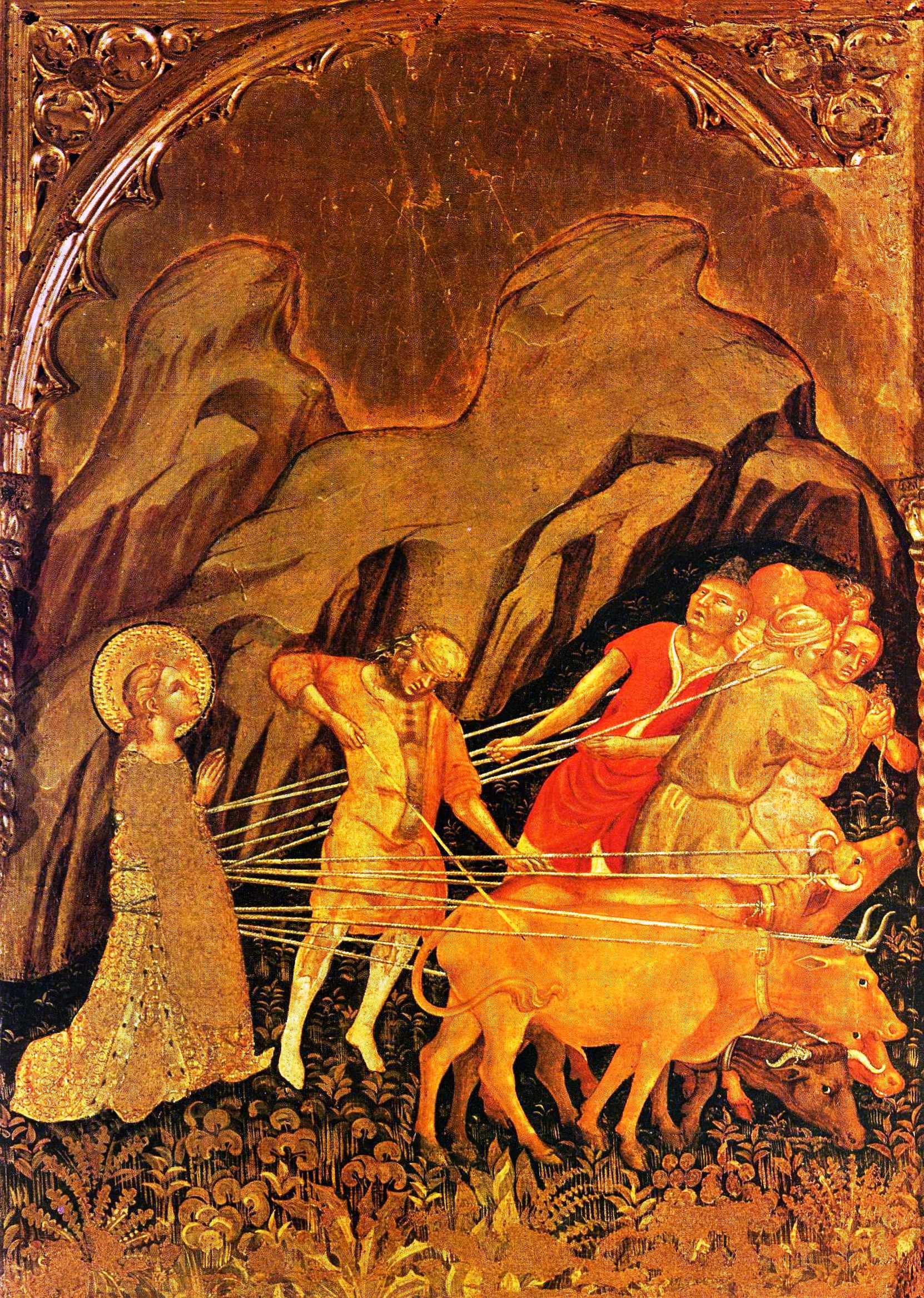
“Lucy Dragged by Oxen” (1410) is part of an eight-panel altarpiece for St Lucy’s Church in Formo, Italy, by Venetian painter Jacobo del Fiore (c.1370-1493) who was commissioned by the church of St Lucy. His work was influenced by the French Gothic style which can be seen in Lucy’s gold gown, resembling a French tapestry with gardens of flowers. When Lucy was sentenced to the brothel, her body became infused with the Holy Spirit and became so heavy the guards could not move her. She was chained to oxen, and over a thousand men still could not move her.


“Lucy in the Burning Bush” (1320)

“Lucy in the Burning Bush” (1320), also by del Fiore, is a depiction of the next attempt to bring about her death. Paschsius became so angry that he ordered a fire be built with pitch, resin, and boiling oil added. Still Lucy survived.


“The Martyrdom of St Lucy” (1505-1510)

“The Martyrdom of St Lucy” (1505-1510) is by the Master of the Figdor Deposition (1480-1500), an Early Netherlandish painter. When Lucy did not burn, Paschsius grew even angrier. A man uses a bellows to blow air into the fire to heat it up. Finally, a soldier takes up his sword and stabs her in the neck. Also in the painting, Lucy being pulled by oxen to the brothel can be seen in the left background. Farther left, a soldier tries to behead Lucy. In the middle ground, Lucy receives her last communion and dies. 


“The Last Communion of St Lucy (1585-86)

“The Last Communion of St Lucy (1585-86), by Venetian painter Paolo Veronese (1528-1588), is a rare single depiction of the Lucy story from The Golden Legend.  Lucy receives Holy Communion before she dies. The priest offers her bread and wine, and an assistant holds a small cup to collect her blood. 


“St Lucy” (1472)

The legend of St Lucy had become a popular story by the 6th Century, and many images of her were painted. The images were not presented in story form so much as through iconographic symbols. “Saint Lucy” (1472) (30”x33”) (tempura and gold on wood) is in the collection of the National Gallery in Washington, DC. Italian artist, del Cossa was from Ferrara, and he also worked in Bologna. Lucy was said to be very beautiful, and her family’s wealth made her a desirable wife. Her story tells that to make herself less desirable, she plucked out her eyes. In the painting, she holds two of her symbols: in one hand, a black palm branch denoting her martyr’s death, and in the other, two eyeballs as if they were flowers.


“St Lucy” (1625-30)

“St Lucy” (1625-30) (41”x31”), also in the National Gallery of Art, is by Spanish painter Francisco de Zurbaran (1598-1664). St Lucy became particularly popular during the Catholic Reformation. In de Zurbaran’s painting, she carries two eyeballs on a plate. Protestantism led to a major revival in the Roman Catholic Church. Saints, like Lucy, were praised for their steadfastness to the Church, and their images hopefully would inspire the congregations. The stories of St Lucy offered various reasons for why and when she plucked out her eyes. Her sight miraculously did return. 


Christmas Card (before 1916)

The Christmas card, produced by Adele Soderberg, illustrates the modern version of St Lucy’s Day on December 13. A young girl, chosen to represent St Lucy, leads the procession through town. She is dressed in white and wears a wreath holding candles. She traditionally is followed by a group of young girls, dressed in white, and/or a group of boys, wearing white robes and cone shaped hats with stars. She serves coffee and baked goods. A popular treat is saffron buns. Songs are sung, and concerts are held. Traditions are developed in each community.

The Latin name Lucia is the root for lux, or light. St Lucy brings light in the darkness of winter. Thus, the candles in the wreath. Many people observe the tradition of placing candles in windows of their houses, beginning on December 13.

Happy St Lucy Day to Everyone


Beverly Hall Smith was a professor of art history for 40 years. Since retiring to Chestertown with her husband Kurt in 2014, she has taught art history classes at WC-ALL and the Institute of Adult Learning, Centreville. An artist, she sometimes exhibits work at River Arts. She also paints sets for the Garfield Theater in Chestertown.

The Spy Newspapers may periodically employ the assistance of artificial intelligence (AI) to enhance the clarity and accuracy of our content.

Filed Under: Looking at the Masters

Looking at the Masters: A Christmas Carol

December 5, 2024 by Beverly Hall Smith
Leave a Comment

A Christmas Carol (1843) (title page of first edition)

Charles Dickens’s A Christmas Carol was published by Chapman and Hall in London in1843. The first illustrator John Leech created four hand-colored etched plates and four black and white wood engravings. His first illustration was “Mr. Fezziwig’s Ball” from Ebenezer Scrooge’s early life when he was in love and happy. By Christmas Eve, the first edition of 6000 books had sold out. Two new editions were sold out by the New Year. The story has never been out of print. The celebration of Christmas grew in popularity, and the Victorians developed new traditions.

Leech’s etching, the first appearance of the Ghost of Christmas Past, shows the jolly and rotund Mr. and Mrs. Fezziwig leading the dance. Fezziwig’s annual Christmas parties were famous. Known for his generosity and kindness, Fezziwig has provided a feast for all. A fiddler plays music from the balcony. Fezziwig’s elderly mother sits with some children and smiles at the joyous occasion. A young couple enjoy a kiss under the mistletoe. Holly hangs    from the ceiling. 

”Marley’s Ghost” (1843)

In “Marley’s Ghost” (1843), Scrooge’s former partner who has just died is an unexpected visitor on Christmas Eve. Dressed in his burial clothes, Marley drags chains and weights, the penance for his sins. Scrooge, in his nightclothes, sits near a small fire, eating a meager dinner. Only one candle lights the room. Leech has depicted the candle flame as a ghostly light. Marley warns Scrooge of the sins they both have committed in their business, and he forecasts the arrival of three spirits that will visit before Christmas Day. Scrooge must mend his cruel and miserly ways, or he will end up like Marley.

The Ghost of Christmas Present” (1843)

Leech draws upon the popular image of Father Christmas for “The Ghost of Christmas Present” (1843). He wears a dark green robe with white fur collar and sleeves. The room is filled with hanging greens. His torch and the fire provide light and warmth. His robe does not cover his chest, and his feet are bare. He wears a holly wreath decorated with mistletoe atop his curly brown hair. Around his throne are a rabbit, plum pudding, sausages, hams, and assorted other meats. He has a bowl of warm punch ready to share with Scrooge. He says to Scrooge, “Come in! Come in! and know me better, man.” He smiles, his eyes twinkle, and his voice is welcoming. 

This image is one of the most popular in the story. The Spirit introduced Scrooge to another world. They first visit a flourishing market, where the rich are purchasing provisions for their feasts. The Spirit then takes Scrooge to a poor man’s house, and then to the home of his nephew, Fred. Every year the kindly nephew invites Scrooge to the party, but he never attends. They visit the home of Bob Cratchit, Scrooge’s poor clerk. Scrooge learns about tiny Tim and that he will not live long. The Ghost repeated Scrooge’s own words to him, “If he be like to die, he had better do it, and decrease the surplus population.”

“Ignorance and Want” (1843)

The theme of the woodcut “Ignorance and Want” (1843) was for Dickens a main element in A Christmas Carol. The Spirit shows Scrooge two starving, and poor children. Scrooge asks, “Spirit, are they yours?” “They are Man’s,” said the Spirit, looking down upon them. “And they cling to me, appealing from their fathers. This boy is Ignorance. This girl is Want. Beware them both, and all of their degree, but most of all beware this boy, for on his brow I see that written which is Doom, unless the writing be erased. Deny it!  Slander those who tell it ye! Admit it for your factious purposes, and make it worse. And bide the end!” “Have they no refuge or resources?” cried Scrooge. “Are there no prisons?” said the Spirit, turning on Scrooge for the last time with his own words. “Are there no workhouses?”

Dickens was born into the middle class. His father was a spend-thrift. He squandered the family money and was committed to debtor’s prison. Dickens was forced to sell everything. His interest in the poor was established as a result, and he visited several locations where children were forced to work in intolerable conditions. He intended A Christmas Carol to send a moral message and to expose the dire circumstances created by the Industrial Revolution. He wrote letters, gave speeches, and fought to address the deplorable conditions of children in as many ways as he found possible.

“Bob Cratchit and tiny Tim” (1878)

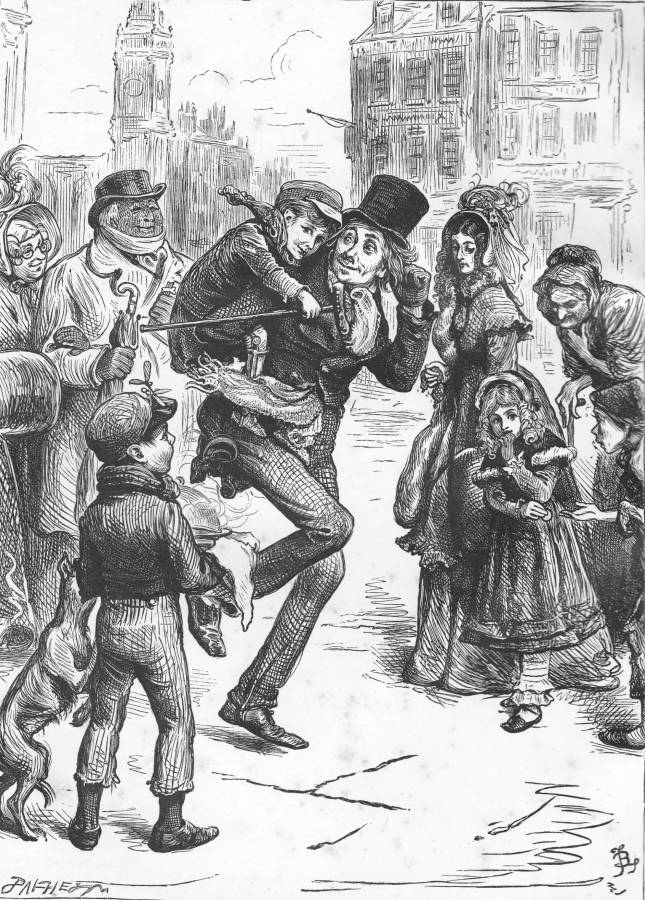
Dickens enlisted artists to create additional images for the early publications of A Christmas Carol.  The black and white illustrations by Fred Barnard (1846-1896) are thought to be superior to the work by earlier artists. Barnard called himself the Charles Dickens among illustrators. “Bob Cratchit and tiny Tim” (1878) was another of the popular Dickens’s images. Bob Cratchit carried tiny Tim all over town, but particularly to church. His devotion to Tim was noted by everyone, young and old, rich and poor. A young boy with his dog delivers a large platter with the Christmas bird. A wealthy woman looks askance at the poor old woman. Her well-dressed daughter looks at an urchin who reaches out her hand. The young girl discretely hands the poor child a coin. The city of London is the backdrop. The distant clock tower resembles Big Ben.

“The Last of the Spirits, The Pointing Finger” (1843)

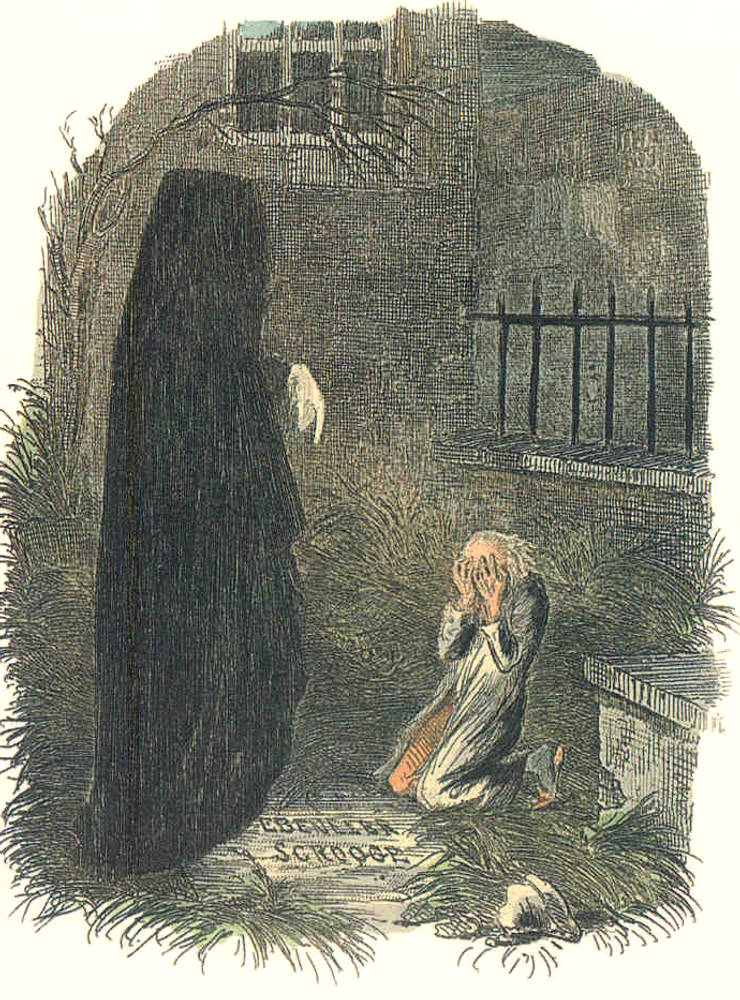
In Leech’s “The Last of the Spirits, The Pointing Finger” (1843), the Spirit 

of Christmas Present takes Scrooge to a graveyard. Scrooge implores, “Before I draw nearer to that stone to which you point, answer me one question. Are these the shadows of the things that Will be, or they the shadows of things that May be, only?” The Ghost points downward to the grave. Scrooge responds, “Men’s courses will fore-shadow certain ends, to which, if persevered in, they may lead. But if the courses be departed from, the end will change. Say it is thus with what you will show me!” Dickens wrote, “Scrooge crept toward it, trembling as he went, and followed the finger, read upon the stone of neglected grave his own name. EBENEZER SCROOGE 

“Cratchit and the Christmas Bowl” (1843)

Leech’s illustration “Cratchit and the Christmas Bowl” (1843) presents a changed Scrooge. He shares a drink with Bob Cratchit. Dicken’s text reads: “A merry Christmas, Bob! said Scrooge, with an earnestness that could not be mistaken, as he clapped him on the back. A merrier Christmas, Bob, my good fellow, than I have given you for many a year! I’ll raise your salary, and endeavor to assist your struggling family, and we will discuss your affairs this very afternoon, over a Christmas bowl of smoking bishop, Bob! Make up the fires, and buy another coal-shuttle before you dot another i, Bob Cratchit!” 

Have a Dickens of a Christmas


Note: Quotated material is drawn from Charles Dickens’s A Christmas Carol. 

1 Samuel 7, during the end of the time of the judges, Israel experiences revival under the leadership of Samuel. The nation repents of their sin, destroys their idols, and begins to seek the Lord (1 Samuel 7:2–4). Samuel gathered the people at Mizpah where they confessed their sin, and Samuel offered a sacrifice on their behalf (verses 5–9). (1 Samuel 7:13–14). To commemorate the divine victory, “Samuel took a stone and set it up between Mizpah and Shen. He named it Ebenezer, saying, ‘Thus far the LORD has helped us’” (verse 12). Ebenezer means “stone of help.” From then on, every time an Israelite saw the stone erected by Samuel, he would have a tangible reminder of the Lord’s power and protection. The “stone of help” marked the spot where the enemy had been routed and God’s promise to bless His repentant people had been honored. The Lord had helped them, all the way to Ebenezer.


Beverly Hall Smith was a professor of art history for 40 years. Since retiring to Chestertown with her husband Kurt in 2014, she has taught art history classes at WC-ALL and the Institute of Adult Learning, Centreville. An artist, she sometimes exhibits work at River Arts. She also paints sets for the Garfield Theater in Chestertown.

The Spy Newspapers may periodically employ the assistance of artificial intelligence (AI) to enhance the clarity and accuracy of our content.

Filed Under: Looking at the Masters, Spy Journal

Looking at the Masters: Pablita Velarde

November 14, 2024 by Beverly Hall Smith
Leave a Comment

Pablita Velarde (1918-2006) was born in the Santa Clara Pueblo in Espanola, New Mexico.  Her Indian name Tse Tsan means Golden Dawn in the Tewa language. Velarde is one of America’s foremost Native American painters. She and her sister attended St Catherine’s Indian School in Sante Fe. At age fourteen Pablita was one of the first women to attend the Studio Art School in in Santa Fe, founded by Dorothy Dunn in1932. She taught what she called “flat-style painting,” memory paintings intended to preserve the old ways of the Pueblo before they disappeared. 

“Basket Making” (1940s)


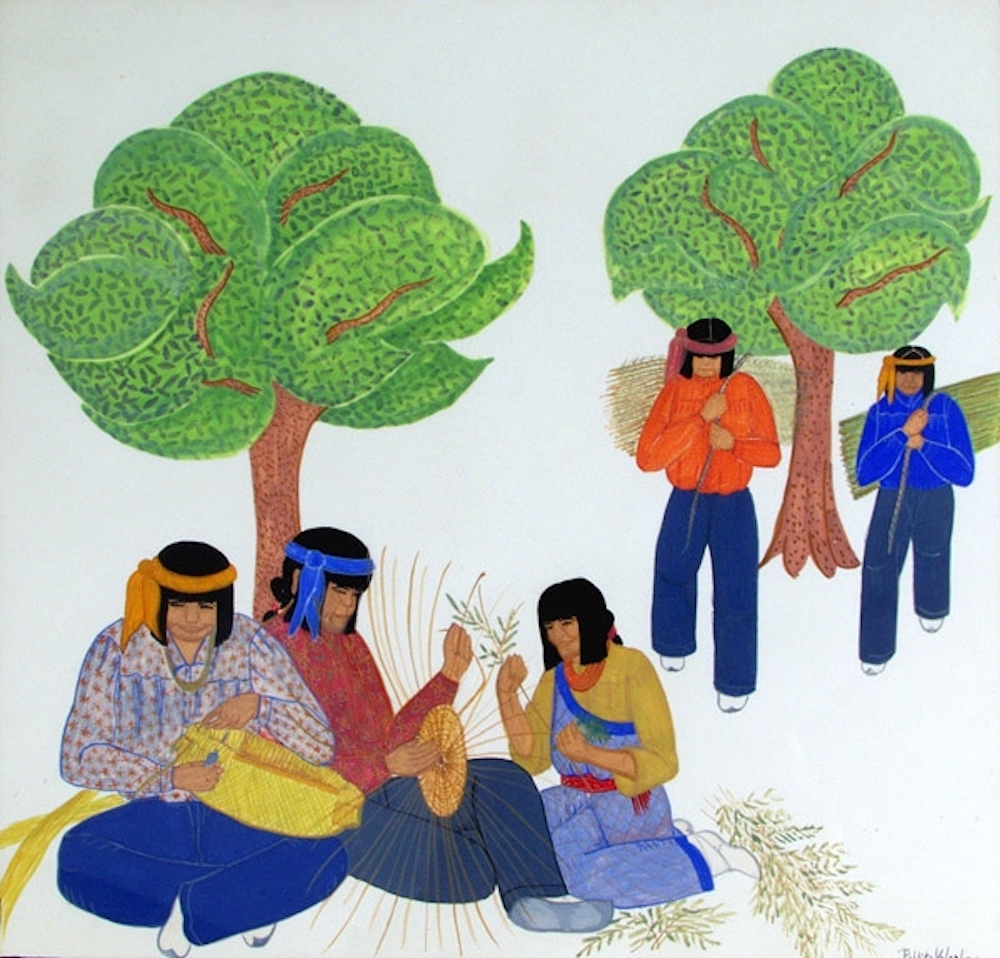
Velarde received a commission in 1939 to paint scenes of traditional Indian life prior to1900. The work was a WPA project, part of the National Park Service, for the visitor center at the Bandelier National Monument in Los Alamos, New Mexico. She began the project in 1937, and she completed over 700 paintings by 1943. “Basket Making” (1940s) (12’’x11’’), in the flat-style, is a depiction of a man wearing a red shirt, sitting under a tree, and weaving a basket of yucca leaves. The man beside him is weaving a twill basket. The woman next the them is stripping the leaves from the yucca stem. Two men in the distance carry bundles of yucca leaves and flat stems that would be used to weave twill baskets. Velarde described her time at Bandelier: “I figure, I’ve learned more about my own people…than I would have…and I appreciate what the old ones have tried to pass on…I want the earth to remember me through my work.”


“Three Woman Grinding Corn” (1940s)

In “Three Woman Grinding Corn” (1940s) (13’’x8’’) Velarde depicts the process of grinding blue corn into flour. Cobs of blue corn hang at the rear of the pavilion, and two women are grinding corn in the traditional way, each using a manos, the long round stone rolled across a metates, the large stone on the ground. A third woman sifts the ground corn to remove any hard kernels. Pueblo Indians planted red, yellow, white, blue, black, and multicolored corn. Each had a particular use. Blue corn is high in protein and contains potassium and calcium, as well as other nutrients. It is also easier to digest and has antioxidant and anti-inflammatory properties.


”Santa Clara Women Selling Pottery” (1940s)

Maria Martinez (1887-1980), from San Ildefonso Pueblo, and her family of potters began experimenting with new techniques and created the world- famous black-ware pottery. “Santa Clara Women Selling Pottery” (1940s) is a display of black-ware pottery shapes and sizes, decorated with heavily incised traditional symbols. Behind the pots are eight colorfully dressed women of the Pueblo. One carries a papoose. Velarde has included a pueblo building behind them. Straight, symmetrical lines on a pot represent rain in the desert and feathers represent daily prayers. Among the other patterns are bear claws and Avanyu, the god who formed the Rio Grande River, and who is depicted as a water serpent. 


“Turtle Dance” (1953)

Velarde painted the traditions of the past in great detail. “Turtle Dance” (1953) is a depiction of a religious ceremony performed on January 1, the beginning of the new year. The turtle is believed to be the first animal to move at the arrival of the new year. Dancers wear evergreen branches, turtle shells, bells, and feathers. The sound of their moccasins scraping gently in the sand creates the sound of rain.  The dancers welcome back the sun. The dance is performed by about 100 men, lined up according to their height from tallest to shortest, representing respect for the elders, who are the tallest.  A new song is created each year to accompany the dance. 

Two medicine men are in the front row. Between them, and to the left side of the painting, and on the roof of the pueblo are Koshare, dressed in black and white striped costume. They are clowns who participate in Pueblo ceremonies. They continue to participate to this day. On January 1, 2025, the Turtle Dance will be performed for the public at the Taos Pueblo.

In 1954 Velarde was awarded, along with eleven other Native Americans, the French Order of the Palmes for excellence in art. It was the first time foreigners were given this honor since it was founded by Napoleon in 1808.


“Old Father Storyteller” (1960)

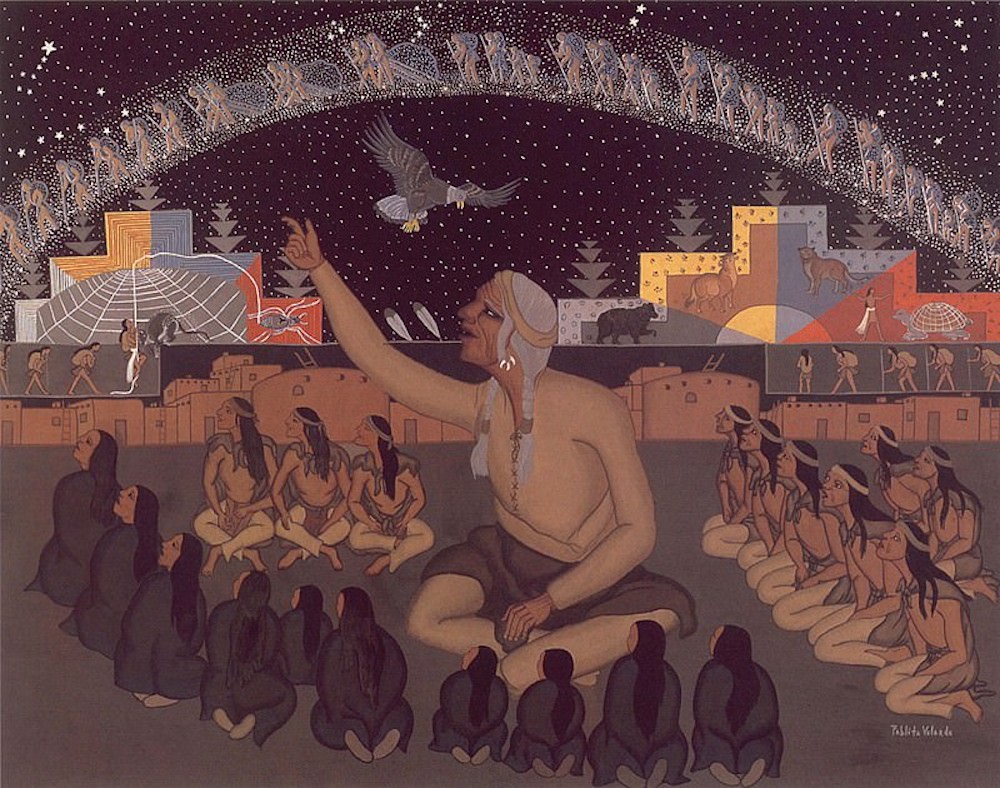
Velarde wrote and illustrated the children’s book Old Father Storyteller in 1960. It was one of her most popular images and the subject of “Old Father Storyteller” (1960) (18’’x14’’). The painting was made into a print. Velarde’s father was a respected storyteller at the Santa Clara Pueblo: “I was one of the fortunate children of my generation who were probably the last to hear stories firsthand from Great-grandfather or Grandfather. I treasure that memory, and I have tried to preserve it in this book so that my children as well as other people may have a glimpse of what used to be.”

In “Old Father Storyteller” the over-sized storyteller sits cross-legged at the center of the composition. He points to the arch of stars as he tells migration stories to the women, children, and men who listen intently. Velarde has included an imaginary structure composed of Indian patterns. It contains animals that are important to the people and part of the stories. A large spider web and spider appear on the left side of the work, with warriors trying to climb onto it. An eagle soars across the sky at the center, and a bear, two other animals, and a turtle occupy the right side. On both sides, warriors carrying sacks may be bringing offerings to the animals. The book was selected as one of the best Western books of 1960. It is still a best seller.

During Velarde’s long career, she received many honors. She was declared a Santa Fe Living Treasure in 1988.  In 1990 Velarde received the Lifetime Achievement Award from the Women’s Caucus for Art.  Founded in 1972, the organization supported women artists, art historians, students, educators, and museum professionals. Its affiliation with the United Nations in 1975 extended its influence beyond the United States. The Pablita Velarde Museum of Indian Women in the Arts was opened in Sante Fe in1912. She received a Doctorate in Arts from the University of New Mexico in Albuquerque in 2005, the year before her death.


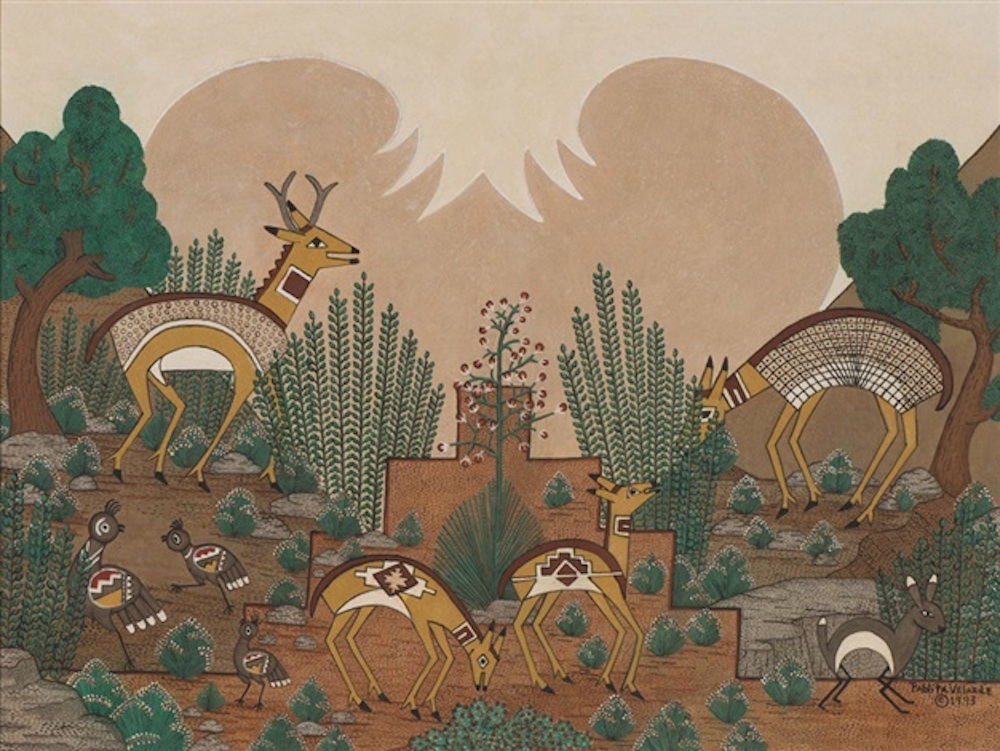
“Mimbres – Antelopes, Quails, and Rabbit” (1993)

Velarde’s painting skills developed during her career. She used several paint mediums, and she also made paint from natural materials which she used in what she called her earth paintings. “Mimbres – Antelopes, Quails, and Rabbit” (1993) (18’’x24’’) (print from an earth painting) is a depiction of one of her several Pueblo Indian subjects. The people and their customs included images of animals important to them. Mimbres indicates that the animals are kin, part of a group of persons with common ancestry. Velarde’s animal paintings are often childlike, but also are abstract. Antelope are a significant food source, and their hides are used for necessary items. Quail are considered sacred, and their feathers are used in ceremonies. They are messengers between the earth and sky, connecting the physical and spiritual worlds. They are also an important food source. Rabbits were a significant food source and respected. Each of the animals is painted with Pueblo patterns.           

“First Twins” (1979)

In a 1979 interview, Velarde commented on women and painting: “Painting was not considered women’s work in my time. A woman was supposed to be just a woman, like a housewife and a mother and chief cook. Those things I wasn’t interested in.”


Beverly Hall Smith was a professor of art history for 40 years. Since retiring to Chestertown with her husband Kurt in 2014, she has taught art history classes at WC-ALL and the Institute of Adult Learning, Centreville. An artist, she sometimes exhibits work at River Arts. She also paints sets for the Garfield Theater in Chestertown.

The Spy Newspapers may periodically employ the assistance of artificial intelligence (AI) to enhance the clarity and accuracy of our content.

Filed Under: Looking at the Masters

  • « Previous Page
  • 1
  • 2
  • 3
  • 4
  • 5
  • 6
  • …
  • 13
  • Next Page »

Copyright © 2025

Affiliated News

  • The Chestertown Spy
  • The Talbot Spy

Sections

  • Arts
  • Cambridge
  • Commerce
  • Ecosystem
  • Education
  • Food & Garden
  • Health
  • Local Life
  • News
  • Point of View
  • Senior Nation

Spy Community Media

  • Subscribe for Free
  • Contact Us
  • COVID-19: Resources and Data

© 2025 Spy Community Media. | Log in