
MENU

Sections

  • About Us
    • Editors and Writers
    • Sponsorship Terms & Conditions
    • Code of Ethics
    • Sign Up for Cambridge Spy Daily Email Blast
  • The Arts and Design
  • Culture and Local Life
  • Food & Garden
  • Public Affairs
    • Commerce
    • Health
    • Ecosystem
    • Education
    • Senior Nation
  • Point of View
  • Chestertown Spy
  • Talbot Spy

More

  • Support the Spy
  • About Spy Community Media
  • Advertising with the Spy
  • Subscribe
December 6, 2025

Cambridge Spy

Nonpartisan and Education-based News for Cambridge

  • About Us
    • Editors and Writers
    • Sponsorship Terms & Conditions
    • Code of Ethics
    • Sign Up for Cambridge Spy Daily Email Blast
  • The Arts and Design
  • Culture and Local Life
  • Food & Garden
  • Public Affairs
    • Commerce
    • Health
    • Ecosystem
    • Education
    • Senior Nation
  • Point of View
  • Chestertown Spy
  • Talbot Spy
Arts Looking at the Masters

Looking at the Masters: Paul DiPasquale

September 11, 2025 by Beverly Hall Smith
Leave a Comment

Paul DiPasquale is a well-known contemporary sculptor who lives in Richmond, Virginia. Born in New Jersey in 1955, he received his undergraduate degree in sociology and art from the University of Virgina. His MA in sculpture was from Virginia Commonwealth University. He has been an instructor, resident artist, and visiting artist at Northern Virginia Community College, Maryland Institute College of Art, College of William and Mary, and Virginia Commonwealth University. 

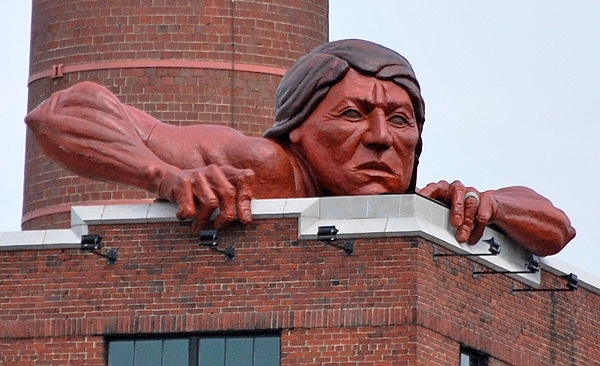
“Connecticut” (2010)

“Connecticut” (1983) (13’ x 25’ x 9’) (fiberglass and resin) (2,400 pounds) is a large sculpture of an American Indian that was created for the roof of a liquor store in Washington DC. The Native American word is quinnehtukgut, and means “beside the long tidal basin.” “Connecticut” looked over the tidal basin of the Potomac River. A dispute among the owners of the store caused DiPasquale to look for a new home for the sculpture.  CBS, ABC, NBC, National Public Radio, and the Associated Press took up story. The New York Times wrote “Connecticut” was “the only Native American statue in the Capital of America.”

“Connecticut” is a striking image. His strong hands grasp the roof top as he pulls himself forward with his muscular shoulders and arms to look over the land below. He is not frightening, rather he is curious to see what his land has become. He is a remarkable presence. His journey was just beginning.

The Best Products Company, owned by the Lewis’s who actively supported and collected up-and-coming artists’ work, leased “Connecticut” in 1983 and placed the sculpture on top of the Bethesda showroom on September 1983. It brought lots of publicity, was very popular, and remained there for only eight months.  Montgomery Country refused any further permits. 

“Connecticut” found a new home in 1985 atop a concession stand at The Diamond stadium of the Richmond Braves. It was a Richmond landmark for 25 years until the Braves moved to Georgia in 2009. Before the move in 2009, “Connecticut” had been declared a historic landmark by the American Institute of Architects.

“Connecticut” (2010), the image in this article, found another new home in Richmond on the roof of the Power Plant at the Lucky Strike building overlooking the James River, where it remained a feature of the Richmond city skyline. As of 2019, “Connecticut” has been in storage needing repair after decades of deterioration. Calls to have the sculpture returned continue.
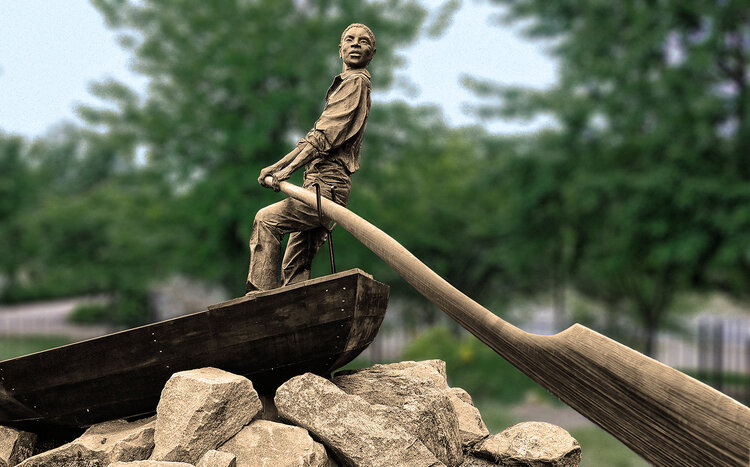
”Headman ” (1993)

Di Pasquale won the original “Headman” sculpture commission in 1988. The commission was to create a statue as a memorial to the African American bateaumen, important to the economic development and prosperity of Richmond in the 18th and 19th Centuries. The commission was not large, but DiPasquale, a new resident of Richmond, stated, “The Headman project really peels back a part of history of Richmond that people still aren’t aware of. Many of the boatmen – called headmen – who steered and poled and oared the barges and boats through Richmond’s canal system were freed blacks, along with indentured workers from Ireland and England. That was what got me interested in the commission…to honor the black contribution to the success of the canal system.” The original “Headman” (1988) (fiberglass) disappeared in May 1989. The legs of the statue were sawed off, and the work was missing until October when the vandalized statue was found in Hanover County shot with over 400 bullet holes. The case has not been solved. Infuriated citizens of Richmond raised $25,000. to have DiPasquale recast the memorial in bronze.

“Headman” (1993) (14’ high with a 23’ sweep of the oar) was installed in the same location on Brown’s Island near to Haxall Canal, but with a protective fence. The African American headman stands with his hands on the oar, looking over his shoulder, his legs, back, and arms row the boat over the canal. The boat is real and made of cypress and oak, the back removed. DiPasquale carved the oar. The work inspired the Richmond flag committee to place the headman at the center of their new city flag in 1991. Nine stars surrounding the headman represent the nine states that were originally Virginia lands. 

”Arthur Ashe” (1992)

DiPasquale met Richmond native, tennis champion, and civil rights supporter Arthur Ashe (1943-1993) in 1992. He made nine pencil and crayon sketches of Ashe in preparation for a statue. Approving the sketches Arthur’s wife, Jeanne Moutoussamy-Ashe, suggested a non-profit organization, Virginia Heroes, as a possible source of funding. Virginia Heroes raised the necessary $400,000.
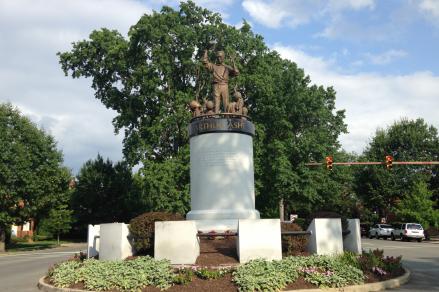
”Arthur Ashe Memorial” (1996)

“Arthur Ashe Monument” (1996) (12-foot-tall bronze figure) (21-foot-tall granite pedestal) (87,000 pounds) depicts Ashe in a warmup suit, surrounded by children. He holds a tennis racket in one hand and a group of books in the others. The books are placed higher than the tennis racket at Ashe’s request to emphasize the importance of education over sports. The sculpture was designated a National Historic Landmark as a representative of the Old and the New South (December 1997).
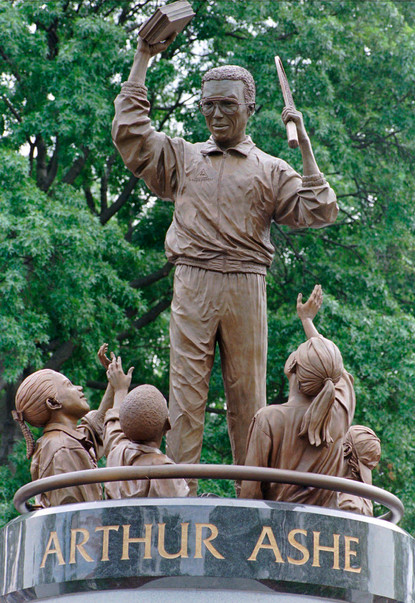
‘Arthur Ashe Memorial” (detail)

DiPasquale was familiar with disagreements concerning his work. The Ashe family and others in Richmond felt the memorial should be placed on Monument Avenue where several statues of Confederate generals including Robert E. Lee, Jeb Stuart, and Jefferson Davis were placed between 1890 and 1929. The controversy over the placement of the statue was intense and was covered by the national press. DiPasquale was criticized by a local gallery owner who stated his work was “of very limited artists merit” and was forced on the city without review by art experts. The city council voted 7-0 in favor of Monument Avenue. Di Pasquale was named the 1996 Richmonder of the Year for his sculpture of the Ashe Memorial. The George Floyd protests in Richmond in 2020 resulted in most of the Confederate statues being removed from Monument Ave. The Arthur Ashe Memorial remains.

DiPasquale held a visiting artists position at the American Academy in Rome in 1996 and 1998. 

”Dr. Martin Lurther King, Jr Monument” (2004)

DiPasquale’s sculptures have not always been controversial. The Martin Luther King Foundation of Hopewell, Virginia, commissioned a portrait bust to celebrate Dr. King’s visit to the Hopewell Courthouse on March 29, 1962. “Dr. Martin Luther King, Jr” (2004) (8’ tall) (bronze with granite base) DiPasquale chose to depict King with folded arms and a pen in his right hand. The inscription reads “The pen is mightier than the sword.” Martin Luther King III described the work as “of the very many, one of the very few which actually look like my father. I am very pleased with his presence in this likeness.”

”Neptune” (2005)

After an international search the commission for “Neptune” (2003-2005) (bronze) (34’ tall) (12 tons) was awarded to DiPasquale. Commissioned by the Virginia Museum of Contemporary Art, formerly the Contemporary Art Center of Virginia Beach, “Neptune” is placed at the entrance to Neptune Park on the Virginia Beach boardwalk. Local businesses raised the funds for the project through private donations in just 120 days. The sculpture was a gift from the community to the Virginia Beach City Council. The City has held an annual Neptune Festival since 1974 to celebrate its maritime legacy. Neptune is the Roman god of the sea and freshwater, and of earthquakes and horses. 

Rising from a rock base, 12’ tall, with an octopus, 8’ across, and two dolphins, 17’ and 15’ long, Neptune, 10’ tall, holds the shell of a loggerhead turtle, 11’      in diameter.  He looks out to sea. The trident is the symbol of his power. 

The scale of the sculpture required that it be cast in three sections. DiPasquale and his partner and friend James Xu worked in a Chinese foundry where the ancient lost-wax technique was used. The three pieces were then shipped to Richmond and welded together in place. DiPasquale intended the image to remind viewers of the damage done to the environment and the sea by human pollution. The ancient Romans held the festival of Neptune in July. The 51st Neptune Festival on the Virginia Beach boardwalk will be held this year from September 26 until September 28.

In 2005 the NAACP awarded DiPasquale the Spingham medal, the highest honor awarded by the organization. DiPasquale continues to exhibit his work in America and in Europe. Among his recent works is the “Memorial to Fallen Officers” (2013) (bronze and granite) (20’ tall), commissioned by the Virginia Beach Police Association as a tribute to 14 officers who died while performing their duties. A sculpture (2014) (7’ tall) of Jimmy Dean, the singer and breakfast meat king, was commissioned for the Jimmy Dean Museum in Plainview, Texas. Another recent work is a portrait bust (2020) of Richmond lawyer Oliver W. Hill, an African American, who prosecuted the case against segregation in Brown v. Board of Education. Other work is in the Smithsonian National Air and Space Museum and the Baltimore Aquarium. 

“I think we need more public art, and Richmond has a good reputation as an art-friendly city. One of the things I love most about our town is that we have many monuments and statues honoring our great Richmonders.”

Writer’s Note: Paul DiPasquale and I were colleagues at Northern Virginia Community where I taught art history. I remember “Connecticut.” BHS


Beverly Hall Smith was a professor of art history for 40 years. Since retiring to Chestertown with her husband Kurt in 2014, she has taught art history classes at WC-ALL and the Institute of Adult Learning, Centreville. An artist, she sometimes exhibits work at River Arts. She also paints sets for the Garfield Theater in Chestertown.
The Spy Newspapers may periodically employ the assistance of artificial intelligence (AI) to enhance the clarity and accuracy of our content.

Filed Under: Looking at the Masters

Looking at the Masters: Spain in the Golden Age – Granada’s Alhambra

September 4, 2025 by Beverly Hall Smith
Leave a Comment

Alhambra (1238-1492)

During the Golden Age of Spain, from 711 until 1492, Muslims ruled Al-Andalus from Cordoba to Toledo and Seville to Granada. The Nasrid Kingdom of Granada (1238-1492) was the last independent Muslim kingdom in Spain. Prior to the Nasrid rule, the Vizier of Granada was Samuel ha-Nagid (933-1056), a Jewish scholar, statesman, poet, military commander during wartime, and leader of the Jewish community. He built his palace and gardens on the Sabika Hill where the Alhambra now stands. On December 30, 1066, in one of the only pogroms carried out by the Muslims against the Jews, Samuel’s palace was stormed and destroyed, and he was killed.  Muhammad I founded the Emirate of Granada in 1238, initiating a period of prosperity and culture. Refugees who fled from the north during the Spanish Reconquista created an even more diverse and tolerant population. The Alhambra, the new palace built on the Sabika Hill by the Nasrid dynasty, was surrendered on January 2, 1492, by Boabdil, the last Emir of Granada, to the Catholic monarchs Isabella I and Ferdinand II.

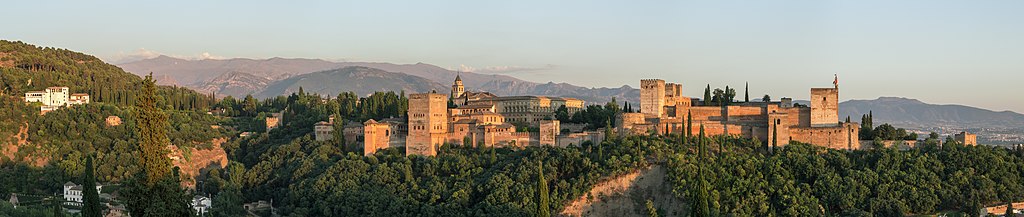
The Arabic word Alhambra means red or vermillion castle. It was given the name because of the clay containing iron used in the construction of the mile of walls that surround the 35-acre fortress and castles. The wall has 30 towers and four main gates. The main gate (1348), the south entrance, was named the Gate of Justice. The steep ramp with a ninety-degree turn permitted defense on either side. The sculpture of a hand, the five fingers symbolic of the Five Pillars of Islam, is above the gate. The Palace del Partal Alto (1273-1309) is the oldest of the palaces on the Hill. It is now a private residence. The Comares Palace and Tower and Hall of the Ambassadors were part of the expansion during the years 1314 until 1345. The Comares Palace is the center of the Nasrid palace complex. Next to it is the Mexuar, the administrative center where audiences were held, the council met, and records were kept.

Hall of the Ambassadors

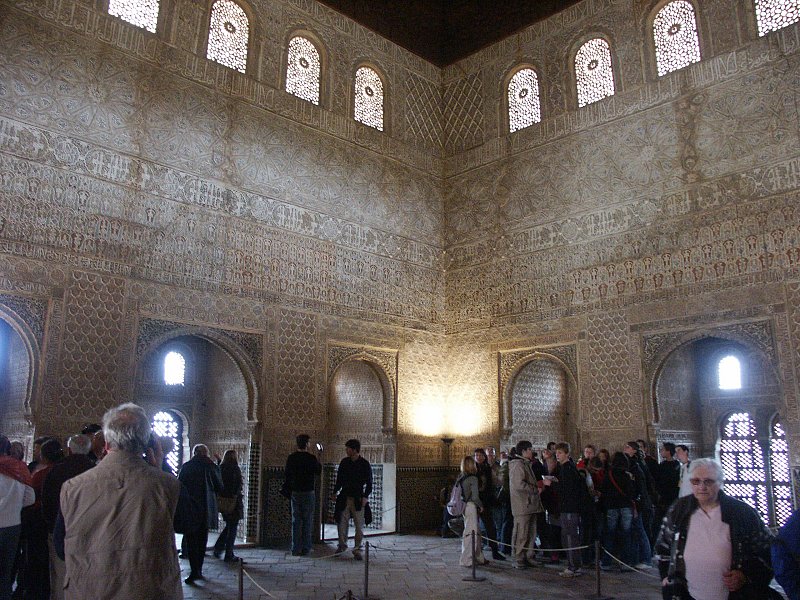
The Hall of the Ambassadors was square, 37 feet on each side, and 75 feet tall. All the walls contain three arched doors that lead to rooms and balconies. The stucco carvings include the usual Muslim themes, and the inscriptions are taken from poems and the Koran. Many of the inscriptions call for Allah to save the people from the devil: “My help from the wrath of God and from all the devil who allows the breaking of hell; and free me from the evil of the envious when he is ready to envy. And there is no other living divinity than that of God whom I must praise eternally. The praise of the God of the centuries.”

The center niche on the wall to the right contained the throne. On March 31, 1492, the Alhambra Decree (Edict of Expulsion) was signed by Isabel and Ferdinand in the Hall of Ambassadors. Jews had until July 31, 1492, to either convert to Catholicism or leave Spain. Don Isaac Abravenel, a Portuguese Jew and respected councilor and financier who funded the voyage of Columbus to the new world, and Abraham Seneours, a Sephardic rabbi and senior member of the Castile government, plead not to sign the document to no avail.  Abravenel emigrated and Seneours converted.  The humanitarian crisis was enormous.  Thousands of Jews went into exile. 

Hall of the Ambassadors Ceiling

From the square room of Earth to the circular dome of Heaven, the Hall of the Ambassadors was constructed with the finest materials and technology the Muslims had developed. The ceiling was constructed of 8017 interlinked pieces of cedar wood and embedded with lapis lazuli to represent the Seven Heavens of Islamic Paradise. The dead are transported to one of the Seven Heavens

based upon their respective virtues. Lapis Lazuli, deep blue in color, is a semi-precious stone deemed sacred since ancient times. Its name comes from the Persian word lazward (gem) and the word azure (blue) from several languages.

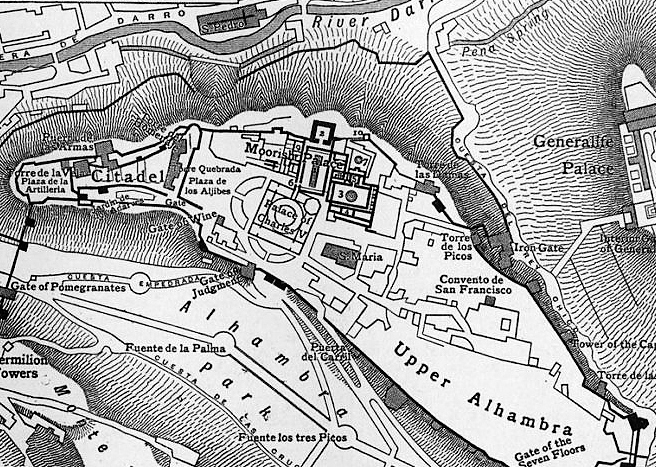
Plan of the Alhambra

The Alhambra covers 35 acres on the Sabika Hill. The Citadel/Fortress can be seen at the left. The Moorish palace of the Nasrids is at the center top of the plan. The Hall of the Ambassadors, marked #2, projects beyond the Courtyard of the Myrtles, the center of the palace. The Courtyard of the Lions is marked #3. Two small rooms just behind the courtyard are the Hall of Abencerrojes, marked #4, and the Hall of the Two Sisters, marked #5. The other buildings were constructed after1492 by the Catholic rulers. This image is cropped, but the gardens, called Generalife, continue in all directions.

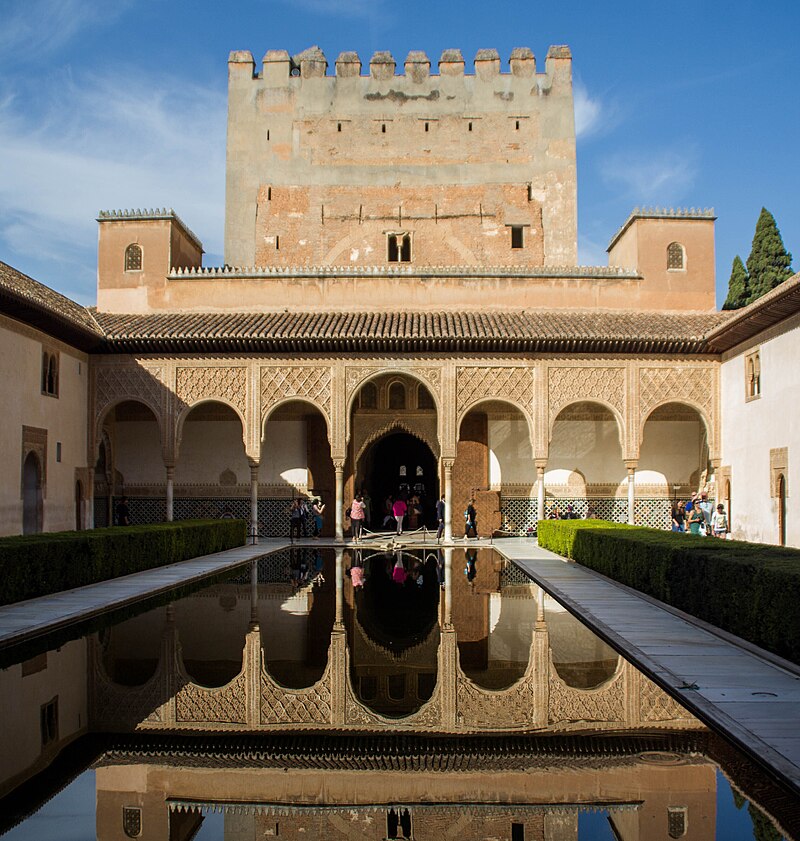
Patio de los Arrayanes (Courtyard of the Myrtles) (1314-1325)

Patio de los Arrayanes (Courtyard of the Myrtles) (1314-1325) was built by Isma’il I, fifth Nasrid sultan, and modified by his successors. The courtyard contains a reflecting pool that is140 feet long and 74 feet wide. Its name comes from the hedges of myrtle trees that were planted on both sides of the pool. Myrtles trees had white flowers and a sweet fragrance. For Jews, myrtles are one of the four plants used to build temporary huts, called sukkah, to celebrate God’s protection during their 40 years of wandering after the Exodus. For Christians, myrtles represent the promise of restoration and a blessing, their fragrance a divine favor. The Comares tower can be seen at the end of the courtyard. The pool was designed so that no movement of the water would alter the reflection of the tower. The horseshoe arches are decorated with stucco carvings.

Tile and Trees of Life

The tiled wall at the end of the courtyard represents the wide variety of Islamic geometric patterns. On top of the tile are continuous stucco carvings including Tree of Life designs. The Koran mentions the Tree of Immortality from which Adam was forbidden to eat the fruit. Although the image is used frequently, it does not have a specific religious meaning. The branches extending from a central core represent personal spiritual growth and development and the proliferation of the faith.

Patio of the Lions (1362)

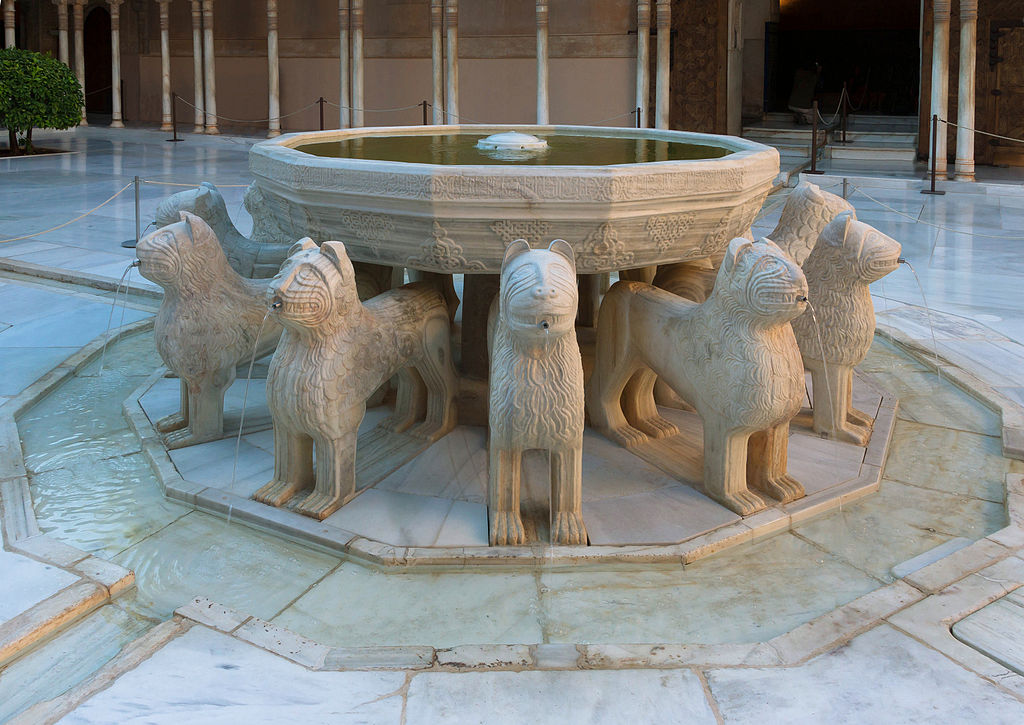
Mohammad V built the Patio of the Lions in 1362. Located on the east side of the Comares Palace, the courtyard is 116 feet long and 66 feet wide. It is surrounded by 124 white marble columns.  The famous dodecagon (12-sided) fountain with its twelve white marble lions sits at the center.  The rooms off the courtyard were the private quarters of the royal family and harem.

Lions Fountain

The lions represent the twelve tribes of Israel from the Torah (Old Testament). They were a gift to Mohammad V from the Jews. Water flowed from the center of the fountain and out the mouths of the lions. The inscription around the rim of the basin is a poem by Ibn Zamrak (1333-1393), an Andalusian Arab. His poetry can be found in many places in the Alhambra. The text of the poem describes the beautiful fountain, the strength of lions, and the hydraulic system and how it worked. 


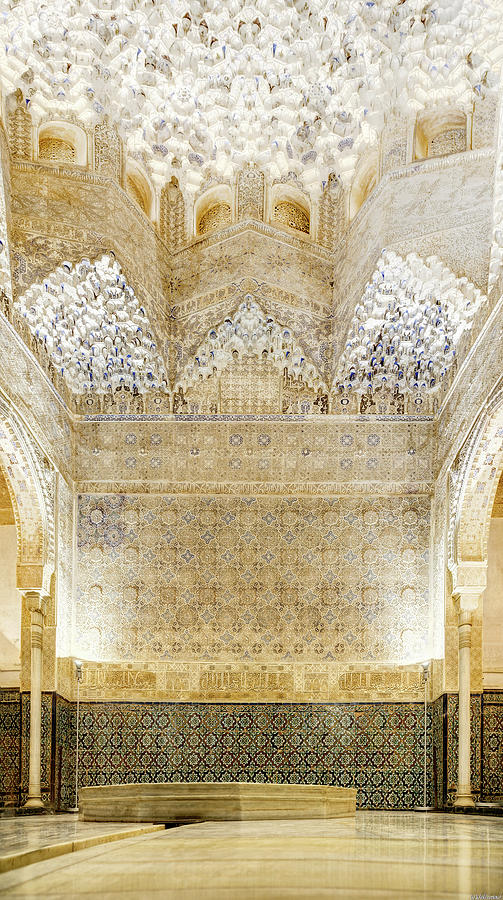
Hall of Two Sisters

Sultan Mohammed V built The Hall of Two Sisters to serve as the residence of his wife and the royal family. The two large slabs of marble that form part of the floor inspired the name. No part of the wall and ceiling is undecorated, and the muqarnas ceiling is considered one of the finest examples of Nasrid architecture. The base of the dome appears to be hanging lace. 

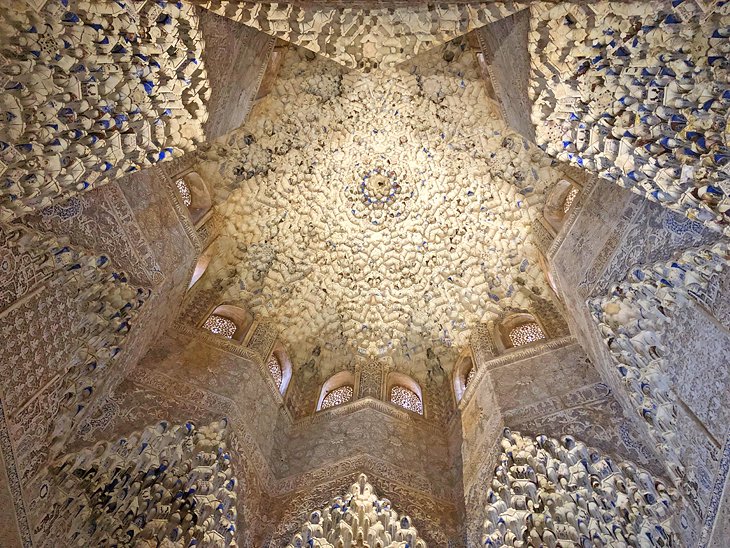
Hall of Two Sisters Dome

The dome is eight-sided with sixteen windows.  It is constructed with over 5000 small wedge-shaped wooden muqarnas that form 16 lacey domes and the central flower shape. A simpler form of muqarnas was used in the construction of the Great Mosque of Cordoba, and elaborated over time by Muslim architects until they achieved this form.

Hall of Two Sisters Ceiling Muqarnas

Here the muqarnas were painted white. Turquoise, amber, and gold paint was used to create the intricate surface detail 

Hall of the Abencerrages

The Hall of the Abencerrages (sons of the saddler) is another example of elegant Nasrid architecture. Abu al-Hasan Ali, who ruled from 1464 until 1485, suspected one of the Abencerrages knights was having an affair with his favorite slave, who became his wife. He invited 30 chiefs of the Abencerrages to a banquet in the Hall, and he had them all beheaded. The heads were piled in the fountain. The stain remains on the floor where the fountain water ran red. 

Hall of the Abencerrages Dome

The eight-pointed star design contains 16 windows. The dome rises above the windows.

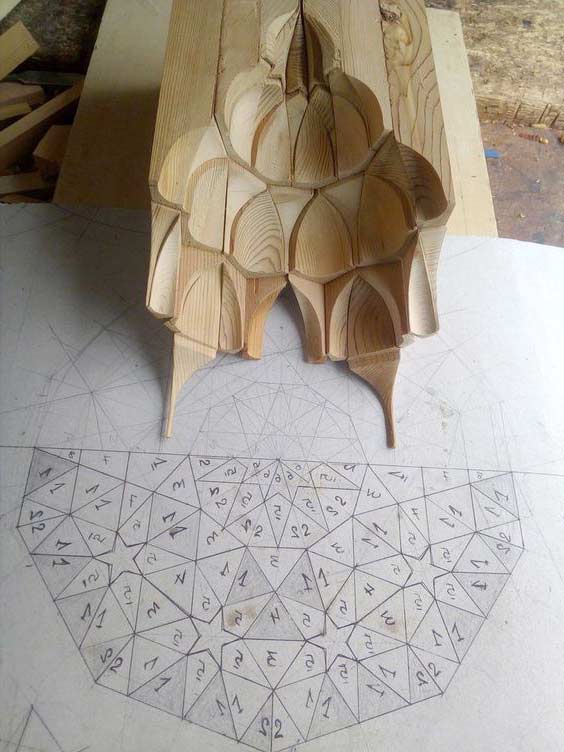
Model of Muqarnas

The muqarnas structure is a complex mathematical development which the Muslims used most successfully.

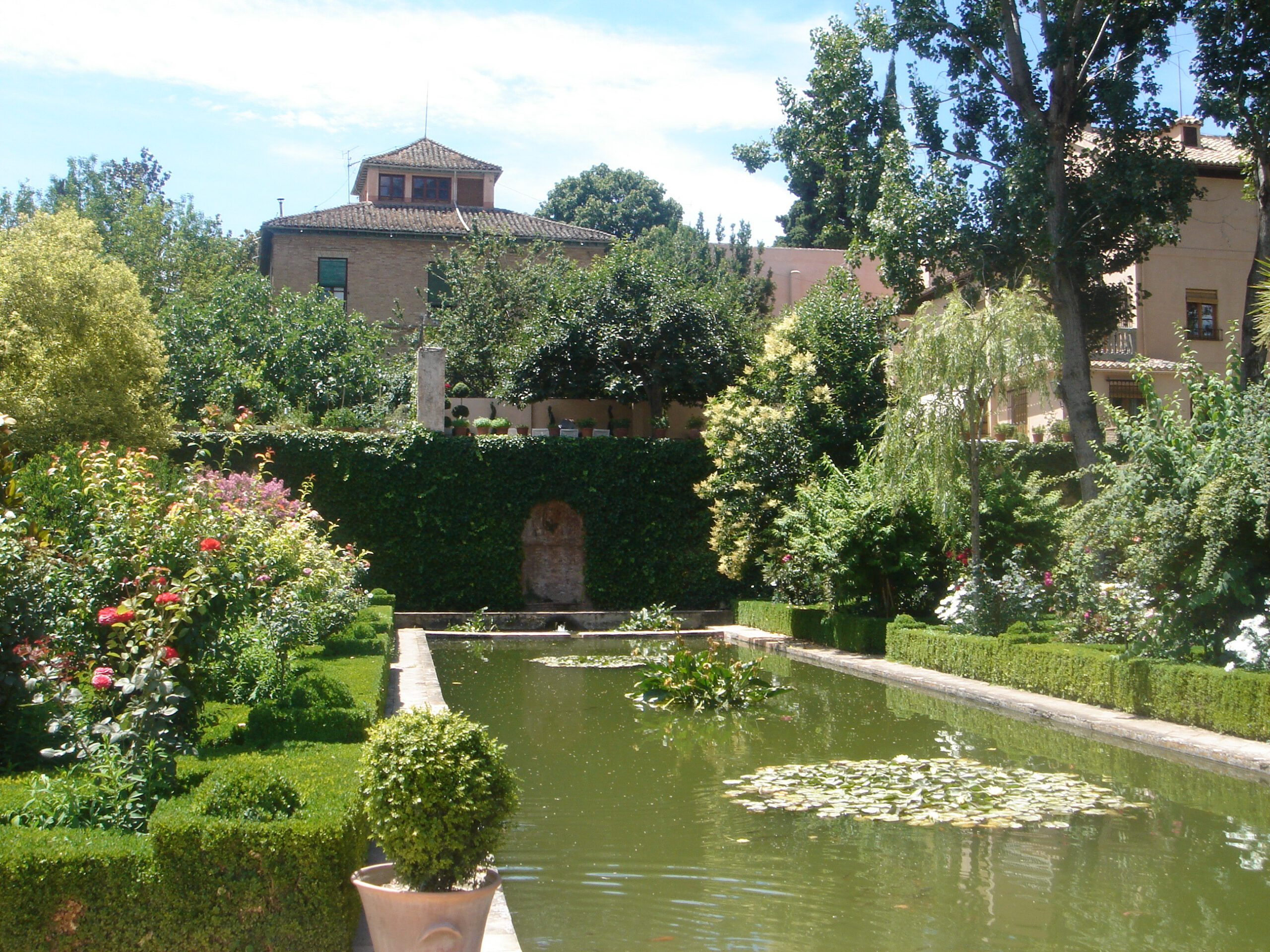
Generalife

The extensive gardens that surround the palaces are known as the Generalife. The name is Arabic, Jannat al-arifa. Jannat means paradise. Water channels, walkways, stairs, fountains, trees, flowers, fruits, and vegetables abound. Artistry and intellect are combined. The sights and smells of the garden create a sense of paradise.  A passage in the Koran 2:25 describes “gardens, underneath which running waters flow…”

Washington Irving lived in one of the Alhambra apartments for three months. A plaque marks his apartment.  He wrote Tales of the Alhambra (1832), a collection of essays that brought international recognition to the Alhambra. When he first arrived in Grenada, he described it as, “a most picturesque and beautiful city, situated in one of the loveliest landscapes that I have ever seen.” After his stay he said, “How unworthy is my scribbling of the place.”


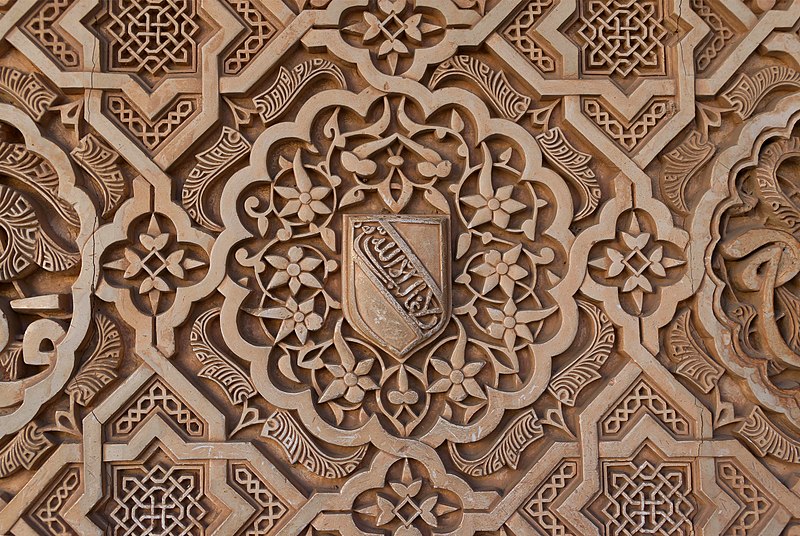
Crest of the Nasrids (1013-1492)


Beverly Hall Smith was a professor of art history for 40 years. Since retiring to Chestertown with her husband Kurt in 2014, she has taught art history classes at WC-ALL and the Institute of Adult Learning, Centreville. An artist, she sometimes exhibits work at River Arts. She also paints sets for the Garfield Theater in Chestertown.

The Spy Newspapers may periodically employ the assistance of artificial intelligence (AI) to enhance the clarity and accuracy of our content.

Filed Under: Looking at the Masters, Spy Journal

Looking at the Masters: Spain in the Golden Age – Seville

August 28, 2025 by Beverly Hall Smith
Leave a Comment

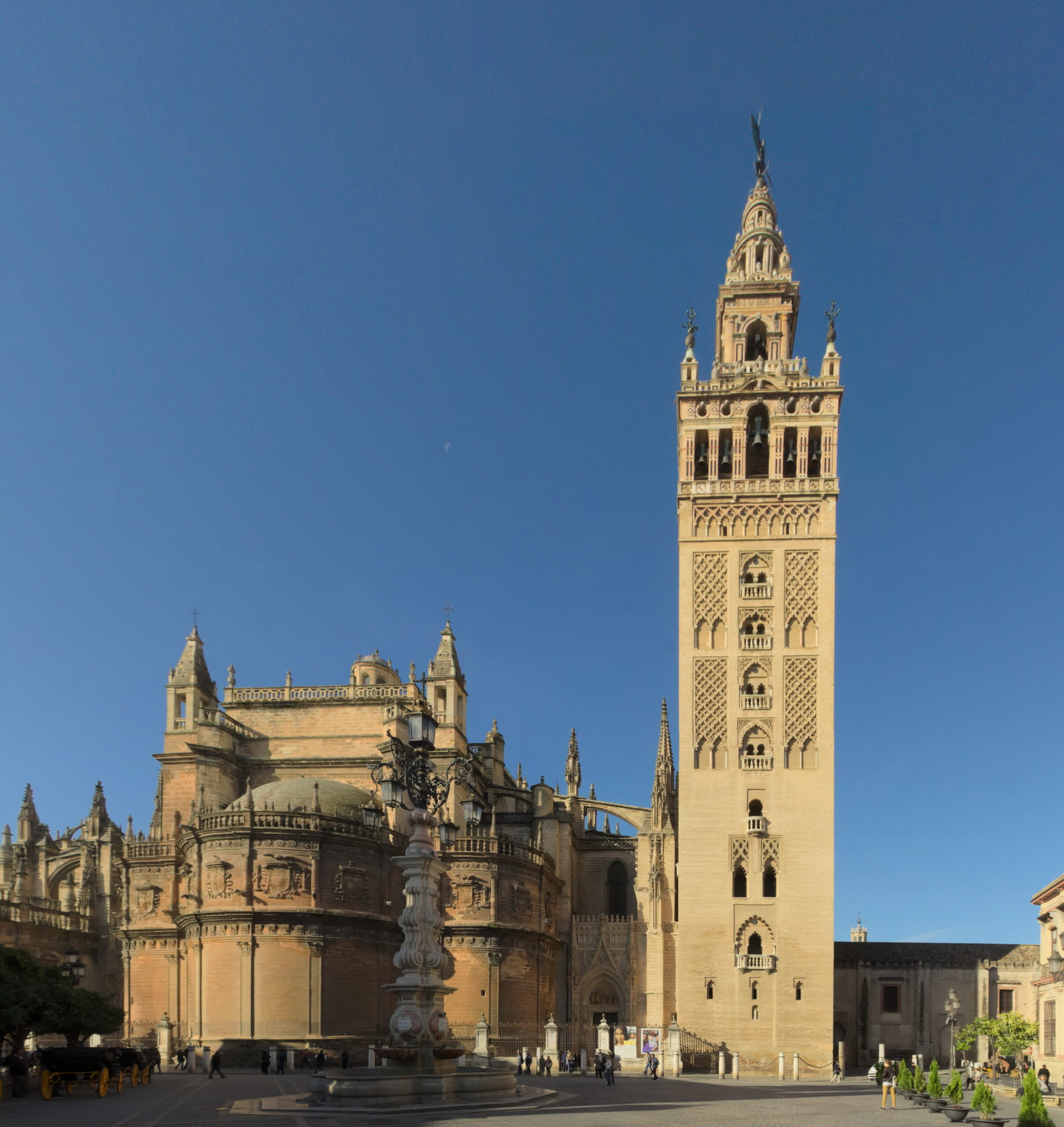
Giralda, Seville (1184-1198)

A significant component of a mosque is its minaret, the tower from which the muezzin calls the faithful to prayer five times each day. The minaret of the Great Mosque of Cordoba (951-952) was 177 feet tall. It was entirely enclosed in 1593 when it was converted to the bell tower of the cathedral. The Giralda (minaret) of the mosque in Seville was built over a period of years from 1184 until 1198, during the reign of the Almohad dynasty. It was 343 feet tall and 45 feet square. The minaret remained unchanged when the mosque was rebuilt in 1434, during its conversion to a Gothic-style cathedral. The minaret was constructed from local brick, along with stone taken from nearby walls, a palace, and the remains of a Roman city. The tower contains 35 ramps. The outer decoration is designed to match the ramps. The middle section of the tower has the most windows to let in light. Two blind arcades were placed on either side. Ninety-two columns were topped with marble capitals. The Giralda remains the tallest structure in Seville, and it has become a symbol of the city.


Three stages of the Giraldo design

The drawing at the left is a depiction of the original design (1198) of the Almohad tower. The drawing at the right is a depiction of the bells and the cross that were added after the building was declared to be a Catholic Cathedral in 1400.  The cast bronze female figure carrying a spear and shield in the center drawing was added in 1568. This rotating sculpture is 13 feet tall and functions as a weathervane. It was called Giraldillo, the Spanish word meaning to turn. The inscription is from Proverbs 18: “The name of the Lord is a fortified tower.”  Sometime during the 16th Century, people noticed the tower acted as a sundial, casting its shadow on the pavement below. Giralda was registered as a World Heritage Site in 1987 by UNESCO. 

The Caliphs of the capital cities of Al-Andalus, Cordoba, Toledo, Seville, and Granada, all had fortified castles called Alcazars. The Alcazar of Cordoba, near the Great Mosque, was restructured starting in 1236 when Christian’s took over the city. Today the Alcazar of los Reyes Christianos is surrounded by lush gardens. A sculpture of Isabella and Ferdinand with Columbus recognizes that their first meeting was at this Alcazar. Toledo’s Alcazar is on the highest hill. 


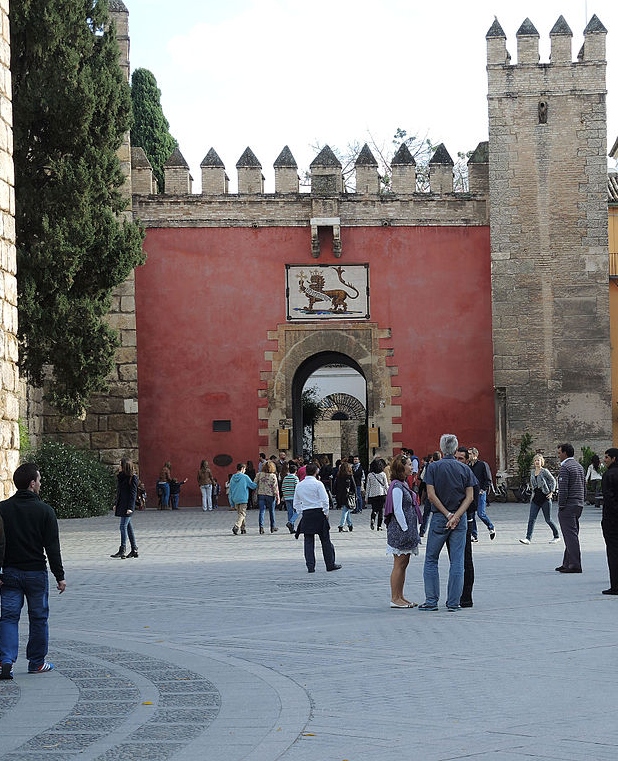
Porta del Leon

The Real Alcazar of Seville and the Alhambra of Granada are outstanding examples of Muslim architecture. Real Alcazar Seville (1150-1492), like all fortified castles was built over the original Roman fortress. In 1150 Seville became the new capital of Al-Andalus under the Almohad Caliph, and the fortress was called Al-Mubarak (The Blessed). The fortification was extended to include six palaces, and later to create nine. In 1163 the Alcazar became the official residence of Caliph Abu Ya’qub Yusaf, who expanded the structure, tearing down many of the existing palaces and building twelve more. This pattern of renovations over hundreds of years is typical.

The Porta del Leon was the main entrance into what was the 11th Century Almohad palace Al-Mubarak. The 28-foot-high defense wall has two large towers and a battlement with saw-tooth merlons across the top. The tile mural depicts a lion wearing a crown, holding a crucifix, and standing on a spear. At the corners, keys are held together by a gold cord.  The inscription on the banner “Ready for everything” was taken from Virgil’s Aeneid. The lion mosaic tile, historically as accurate as possible, was made in 1892. The gate has been called the Porta del Leon from then on. It was renovated c.1939 following the Spanish Civil War (1936-1939).


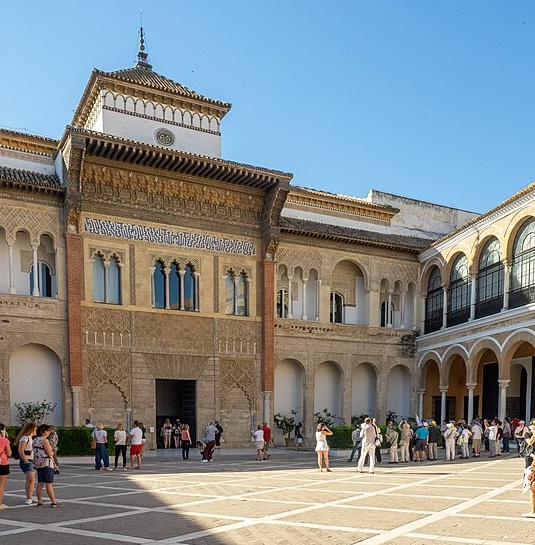
Patio de la Monteria (Courtyard of the Hunt) (1364)

From 1350 until his death in 1369, Pedro I of Castile ruled in Seville. He decided to build a new Alcazar in 1364, with the entrance to his palace across the Patio de la Monteria which was opposite of the Porta del Leon. Porta de la Monteria (Hunting Gate), led into the courtyard where hunting parties gathered. Pedro was raised in an era of religious tolerance and had a strong relationship with the Jews and the exiled Nasrid sultan Muhammad V of Granada. Muhammad gladly sent skilled Muslim craftsman to build the place. As a result, the Alcazar of Seville and the Alhambra of Granada are the greatest example of Mudejar architecture. 

The first level of the entrance door to the Palace has two multi-lobed blind arcades decorated with carved vegetable and geometric patterns known as sebka.  These patterns had been developed in Muslim art over the centuries and by the 14th century had become extraordinary in the detail and variations. The window level was created to reflect both the lobed arches and tall pointed arches blending Muslim and Gothic styles. The blue and white Kufic inscription above the windows celebrates the building’s creator: “The highest, noblest and most powerful conqueror, Don Pedro, by God’s grace the King of Castile and León, ordered the construction of these Alcázares, and these palaces, and these façades, completed in the year 1402.”  “There is no victor but Allah” also is inscribed on the façade.

The Casa de la Contratacion (House of Trade for the Americas), on the right, was constructed at the direction of Isabella of Castile in1503. The founding of America on October 12, 1492, had brought a boom in trade to Spain. The Casa de la Contractacion was established for the merchants, admirals, and those who regulated the booming trade. The Alcazar is located on the Guadalquivir River. Seville became the major center of trade for Spain.

Patio Doncellas (Patio of Maidens) (1356-66)

Patio Doncellas (Patio of Maidens) (1356-66) was the center courtyard of Pedro’s palace. The official life of the court took place there. Pedro’s love of Mudjedar design is evident. The long reflecting pool is surrounded by gardens originally filled with orange trees. The large arches in the middle of each side lead into various reception rooms with stairs to the upper story. The lower arches are multi-lobed while the upper story arches are round in the style of Catholic churches in the Renaissance. The courtyard was covered over sometime between 1581 to 1584 with white and black marble pavement. Between 2002 and 2005, the hidden courtyard was discovered and found to be in good condition. The original garden was restored. 

The name “Patio of Maidens” was drawn from a 1360 Muslim story about the tribute of 100 maidens to be paid annually to the Caliphs from the Christian kingdoms of Spain. The truth of this story is questionable.


Ceramic Tile

This ceramic tile was used in the decoration of the Patio of the Maidens. Exquisite Muslim arabesques, geometric, leafy and floral designs, and texts were applied to ceramic wall tiles. This type of wall decoration became popular in Seville and Granada.  Seville became a center for the lustreware ceramic pottery in the 11th Century.  The Muslims brought the process to Al-Andalus. Seville was the major shipping center for Islamic ceramics that became popular in Europe. The fusion of the Islamic and Gothic styles became popular with royalty and the church. Commissions bearing their choice of subject came in from Italy, France, and other European countries.  Muslim pottery techniques were further developed in Europe. An example is Italian Majolica.


Salon de los Embajadores (Hall of the Ambassadors) (1366-69)

The Hall of the Ambassadors (1366-69) is entered from the Patio of the Maidens. The hall served as King Pedro’s throne room, the most lavish room in the palace and meant to impress. The room is square in the Islamic Qubba design and represents Earth. The ceiling represents the dome of Heaven. Triple horseshoe arches with marble columns and gold capitals line the four walls. A decorative rectangular frame is set within a large arch, with three blind arches. Another rectangle frames the entrance. The lower walls are covered with geometric ceramic tiles topped by border designs and large rectangles decorated with carved plaster work. Rows of tile and plaster work and blind arcades link the walls. The top level was redesigned in 1526 to include wrought iron balconies. The frieze containing portraits of Spanish monarchs was painted by Diego de Esquivel in 1599.  


Dome of Salon de los Embajadores (1427)

The original dome was replaced in 1427. The new dome was created by Islamic architects who found a means to successfully turn the flat square ceiling into a rounded dome. When assembled, the carved wood sections (muquarnas) projected from the flat surface of the wall reaching to a central circle. The muquarnas were then covered with gold. The Hall of the Ambassadors is considered to be one of the best examples of Mudjedar architecture. 


Sala de Audiences (Chapterhouse and Hall of Trade)

Near the Hall of the Ambassadors is The Hall of Trade. It contains the Alejo Fernandez painting “The Virgin of the Navigators” (1535). The opening of trade with the Americas by Catholic Spain was of major significance and celebrated in this painting. The Virgin Mary descends from Heaven, high above the ships at sea. Her cloak shelters royals and navigators including Christopher Columbus, Amerigo Vespucci, Ferdinand II of Aragon, and Carlos V. Four side panels contain depictions of Saint Sebastian with a sword and a bow and arrow (top left), Saint James the Moor-Slayer on a white horse (bottom left), patron saint of sailors St Elmo holding a ship (top right), and Saint John the Evangelist with a book, pen, and eagle (bottom right). Seville Cathedral is the final resting place of Christopher Columbus.

In addition to the interior courtyards and patios, the Real Alcazar contained many gardens: the Garden of Poets, the Garden of Dance, and the kitchen gardens. The Garden Levi was dedicated to King Pedro’s Jewish councilor and treasurer. Pools, ponds, water channels, fountains, and water spouts were created to provide beautiful settings with relaxing sounds. Planted with 200,000 plants representing 187 species, the gardens reflect the Quran’s description of Paradise.

The final article in this series is the Alhambra in Granada.


NOTE: Seville remains a city of orange trees. They grow on every street. The fruit is a special bitter orange that is used in cooking, specifically for making marmalade. Jars are labeled Sevillian Marmalade. 


Beverly Hall Smith was a professor of art history for 40 years. Since retiring to Chestertown with her husband Kurt in 2014, she has taught art history classes at WC-ALL and the Institute of Adult Learning, Centreville. An artist, she sometimes exhibits work at River Arts. She also paints sets for the Garfield Theater in Chestertown.
The Spy Newspapers may periodically employ the assistance of artificial intelligence (AI) to enhance the clarity and accuracy of our content.

Filed Under: Looking at the Masters, Spy Journal

Looking at the Masters: Spain in the Golden Age–Toledo and Seville

August 14, 2025 by Beverly Hall Smith
Leave a Comment

Synagogue El Transito (1355-57)

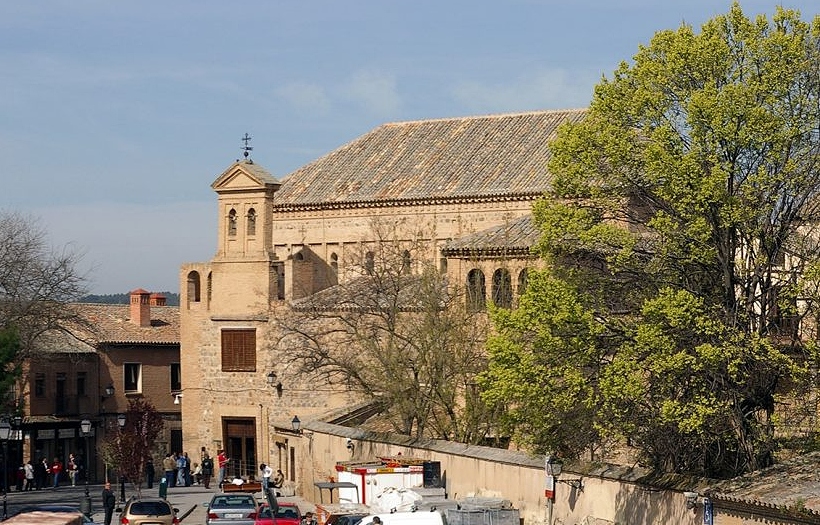
The city of Toledo had eleven synagogues during its golden age. Today only two of the synagogues remain. Last week’s SPY article touched upon the Ibn Shoshan Synagogue/Santa Maria le Blanca (1180). The Synagogue of Samuel ha-Levi/Synagogue El Transito, on the Calle Samuel Levi, dates from 1355-57. It was a private home and yeshiva (school). Samual ha-Levi held the positions of chamberlain, treasurer, judge, and councilor to the Christian King Pedro of Castile. The Jewish ha-Levi family had served the Christian Castilian House of Burgundy since 1200.  The family included one of the last Jewish poets in Spain who wrote in the Arab style during the 12th and 13th Centuries. 

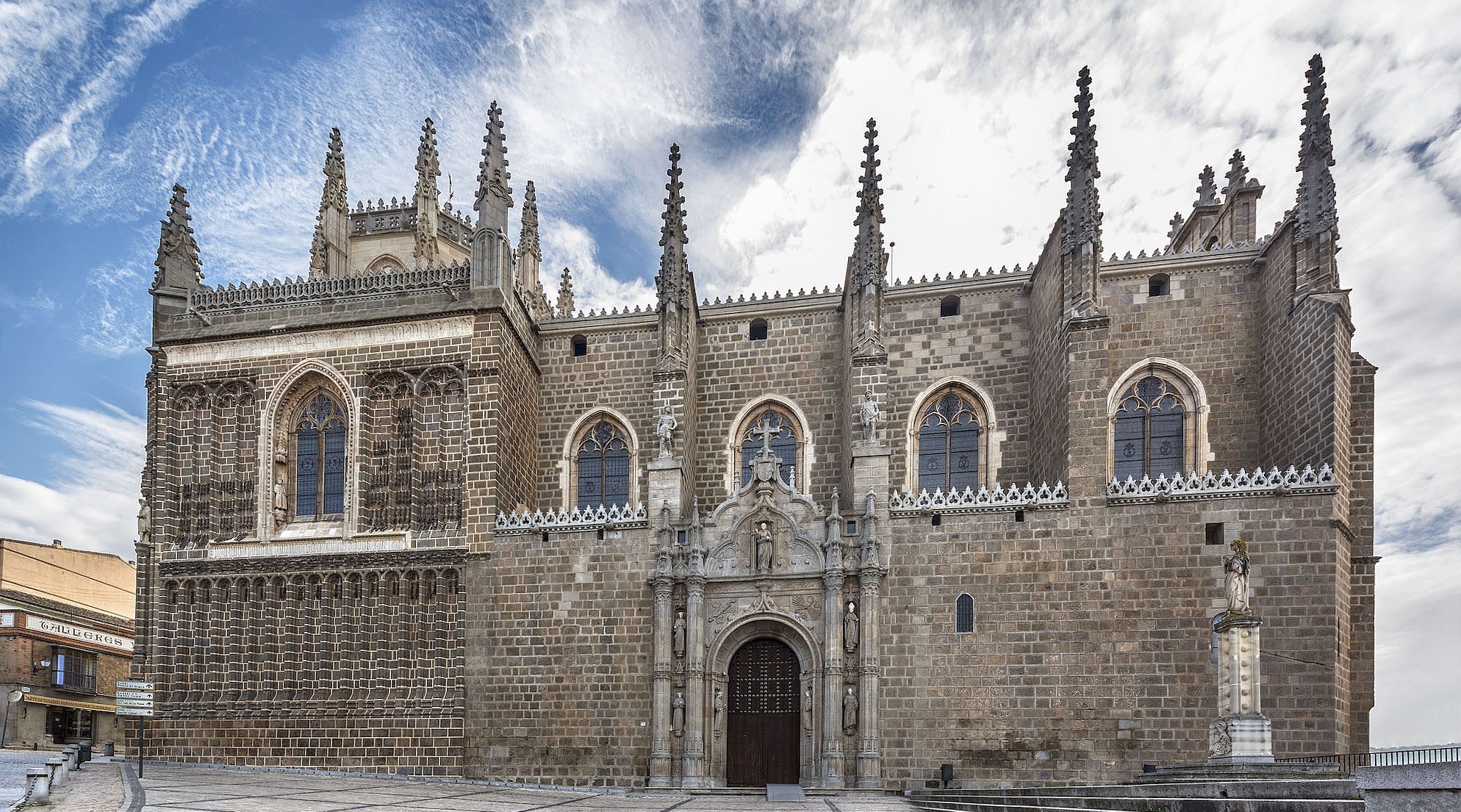
As can be seen in the photograph, the size and height of the Synagogue exceeded the height restrictions applied to synagogues. It is taller than the two-story buildings across the street. King Pedro may have given permission to deviate from these restrictions in appreciation for ha-Levi’s work for him. The designer was master mason Don Meir Abdie, one of the King’s architects and builders. The synagogue was annexed to the ha-Levi palace.

Synagogue El Transito (interior)

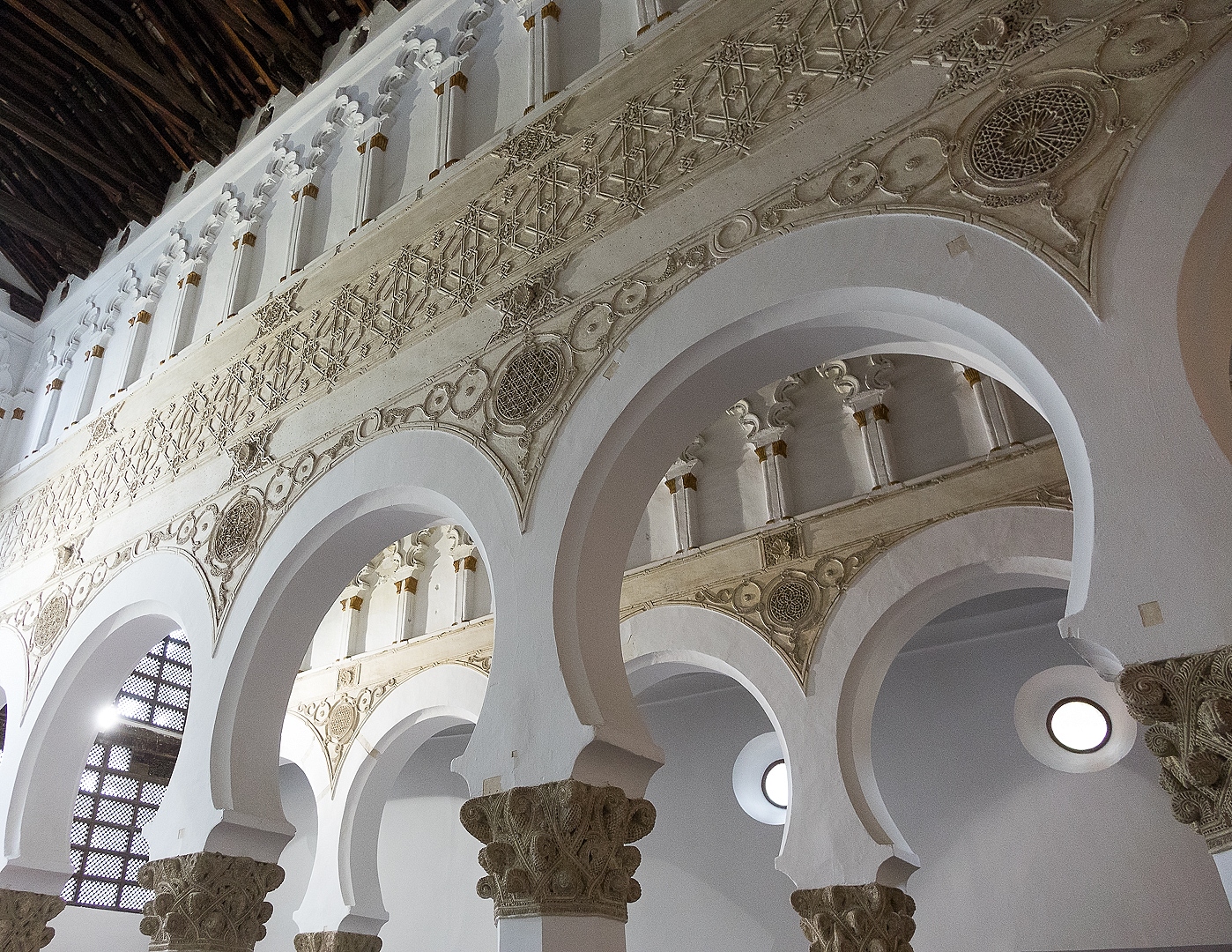
The prayer hall was 76 feet long by 30 feet wide and 40 feet tall.  Along the upper wall are large frames of larch wood with floral patterns of inlaid carved polychrome and ivory. Only a section of the original mosaic floor is preserved. The women’s gallery with five openings can be seen at the right of the southern wall. 

The wooden ceiling is composed of joined beams, interlaced with supporting rafters. The decoration of the square in the center represents the stars of heaven. The vegetal designs in the floor mosaics represent earth. Together they represent the close connection of heaven and earth. The designs are a reference to the city of Jerusalem and Temple Mount, the highest point in the city, where King Solomon built the First Temple. Stucco decoration and inscriptions reference the Jewish people’s desire to return to Jerusalem.  

At the present time, the Temple Mount is the location of the Al Aqsa Mosque, and it is closed to Jews. The only section of the old temple Jews can access is the western retaining wall, known as the Wailing Wall.

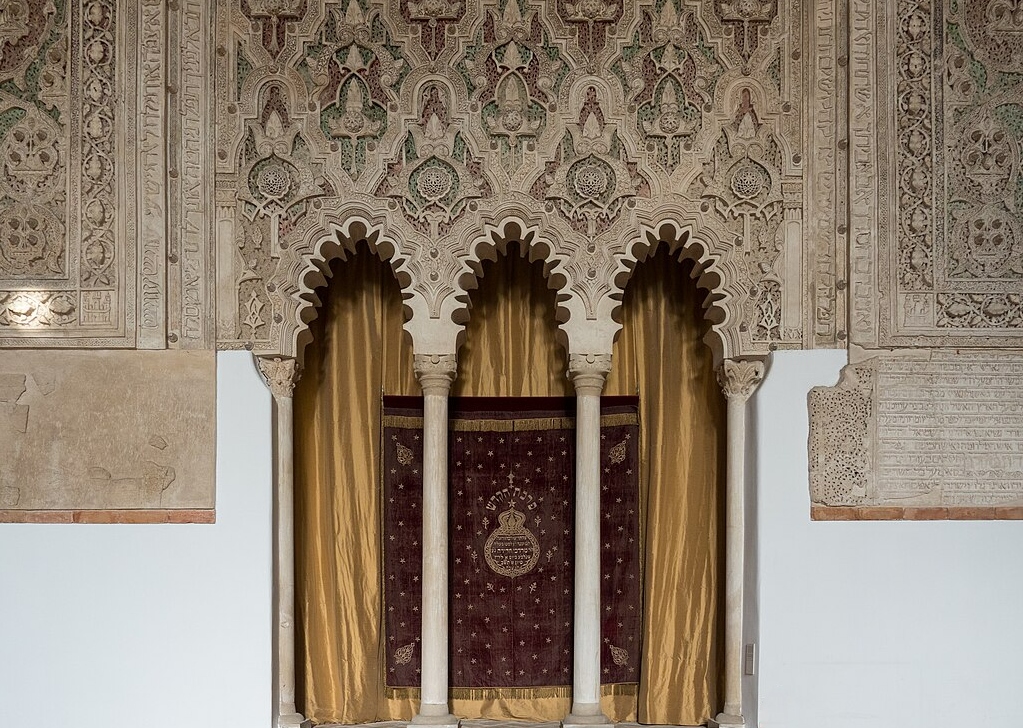
Torah Niche

The Torah niche, on the eastern wall of the synagogue, has three multi-lobed arches. It is decorated with plants, family symbols, and interlacing designs. The inscriptions are carved in Kufic, the Arabic script, and include text praising the King and text from the Book of Psalms. Samuel ha-Levi was also praised: “The exalted pious prince of princes of the tribe of Levi…has exceeded in all deeds by building a house of prayer for the Lord God of Israel…and he commenced building this house in the year 1357.” 

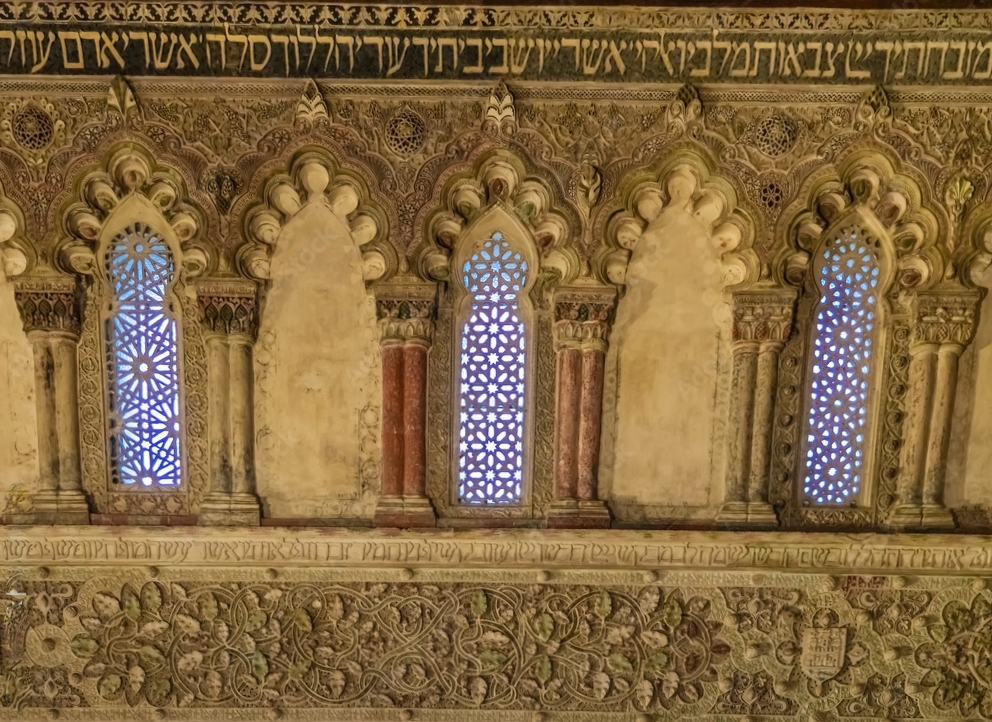
Upper Wall (detail)

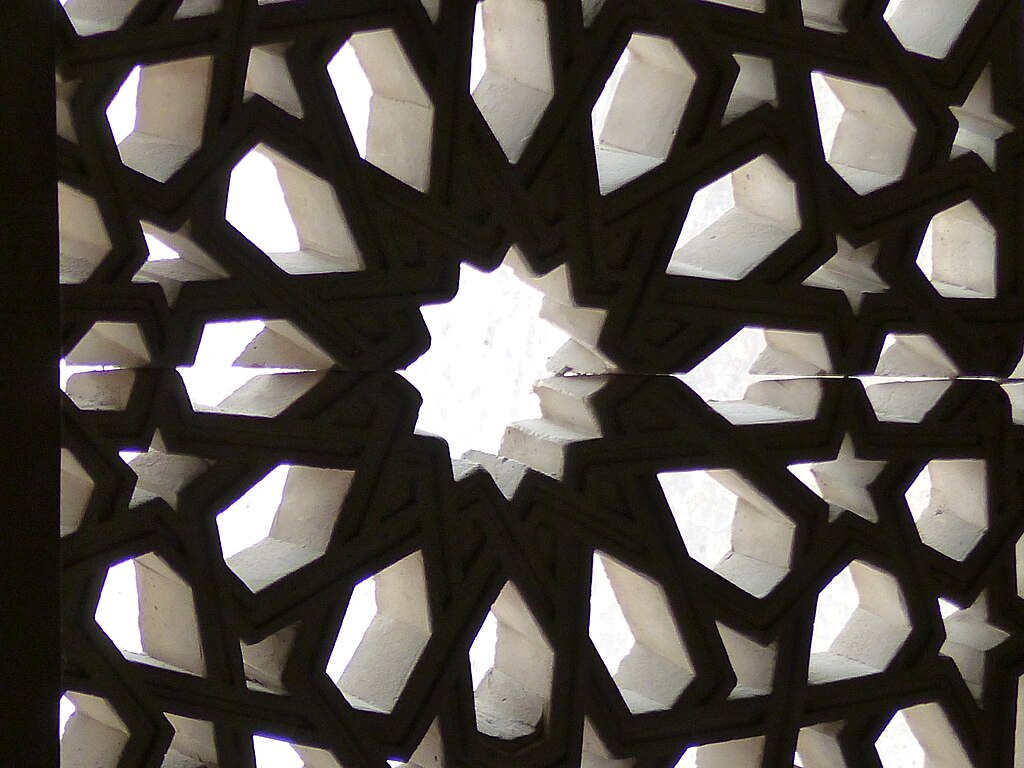
Elaborate carving continues around the upper wall. ha-Levi imported cedar beams from Lebanon for the construction. The cedars of Lebanon famously were used by King Solomon in his construction of the First Temple. The delicate leaf and flower interlacing is punctuated with family crests. The horseshoe arches are multi-lobed. The gold mosaic text is set against dark blue mosaics. The iron window grills, popular in Mudejar buildings, were a unique feature that added to the eloquence of their structures.

Window Grill (detail)


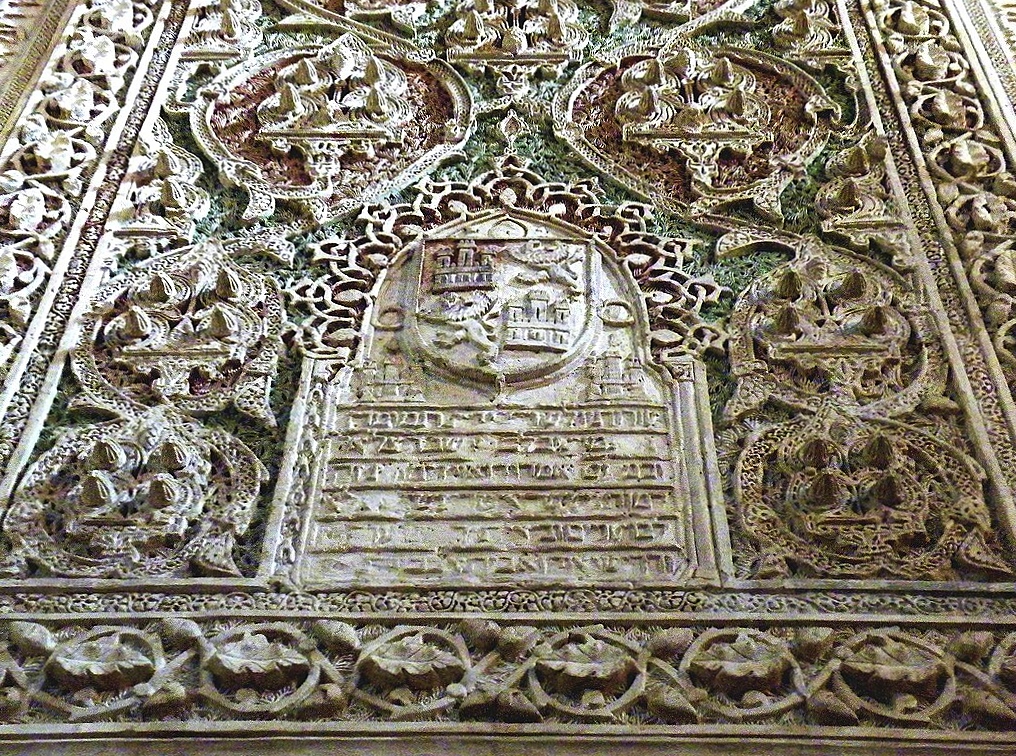
Castile and Leon Coat of Arms

The inclusion of King Pedro’s coat of arms illustrates his esteem for ha-Levi. He was trusted with the seal of the King. Text is placed under the coat of arms: “See the sanctuary now consecrated in Israel, And the house which was built by Samuel with a pulpit of wood for reading the law, With its scrolls and its crowns all for God.  And its lavers and lamps to illuminate, And its windows like the windows of Ariel.”

King Pedro was criticized by his rivals for his tolerance of the Jews. He finally turned against ha-Levi, accusing him of embezzlement. He was put into prison in 1360, and he died there from torture. 

When all Jews were expelled from Spain in 1492, the synagogue was converted to a Catholic church, El Transito (Assumption of the Virgin), and it was given to the Order of Calatrave. Restoration of the synagogue began in 1879. It had been declared a National Monument in 1877. It was officially established as the Museo Sefardi in 1964. In 1968, its official name became the National Museum for Hispanic-Hebraic Art, and it remains so today. The museum section adjoining the synagogue includes a garden in which contemporary Jewish sculpture is displayed.

Monastery of San Juan de los Reyes (1477-1504)

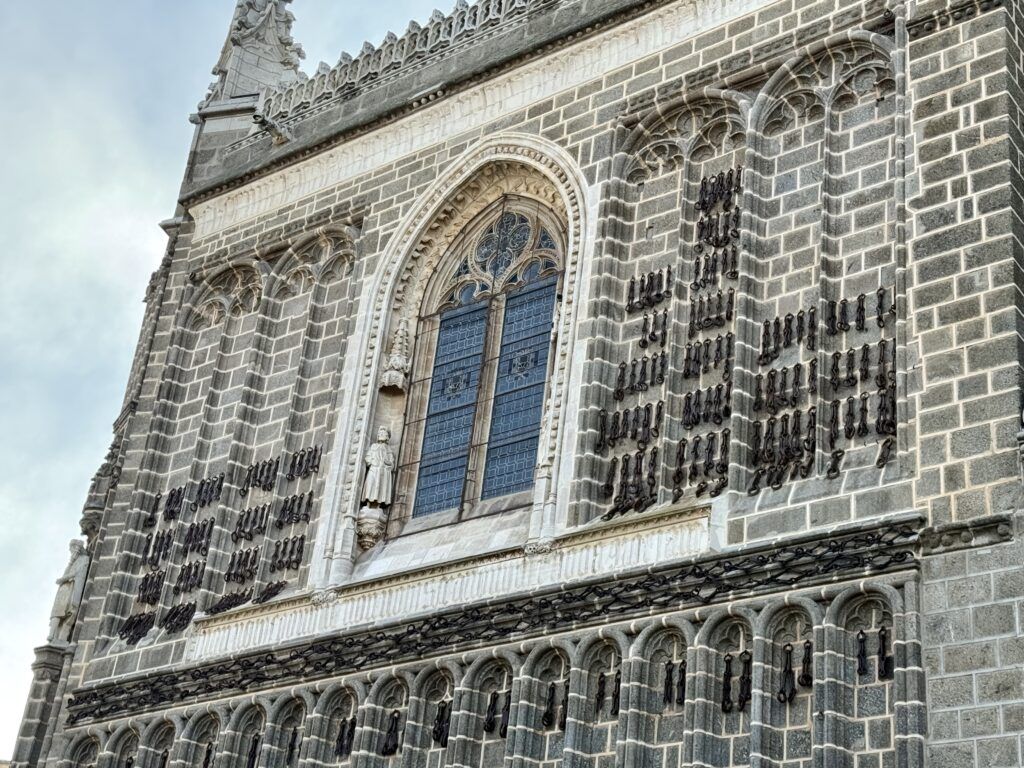
Across the road from El Transito is the Monastery of San Juan de los Reyes (1477-1504), built by Isabella and Ferdinand and dedicated to the birth of their son Juan and their victory over Alfonso V of Portugal at the Battle of Toro (1476). However, it remains unclear who won the battle. The Queen ordered the placement on the walls rows of manacles and shackles that were worn by the Christian prisoners who were held by the Moors and Africans in Granada and later freed by the Reconquista.

Monastery of San Juan de los Reyes (detail of chains)


Monastery of San Jaun de los Reyes


The monastery church was built in the Catholic Gothic style (pointed arches). The walls were constructed of cream-colored limestone. Throughout there are sculptures of saints, animals, and plants. The most repeated sculpture is the coat of arms of Isabella and Ferdinand held by an eagle, the icon of St John. Napoleon’s troops occupied the monastery and set it on fire. The church and one cloister remained standing. Restoration began in 1883 and was completed in 1967

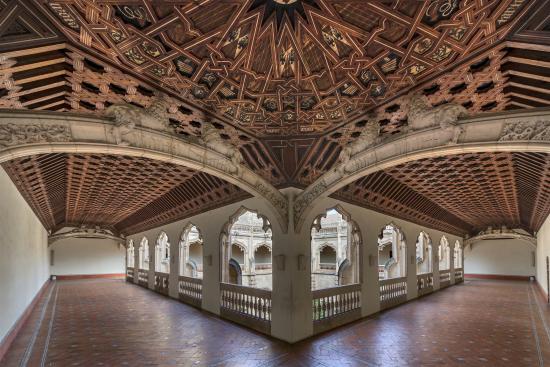
Monastery of San Jaun de los Reyes


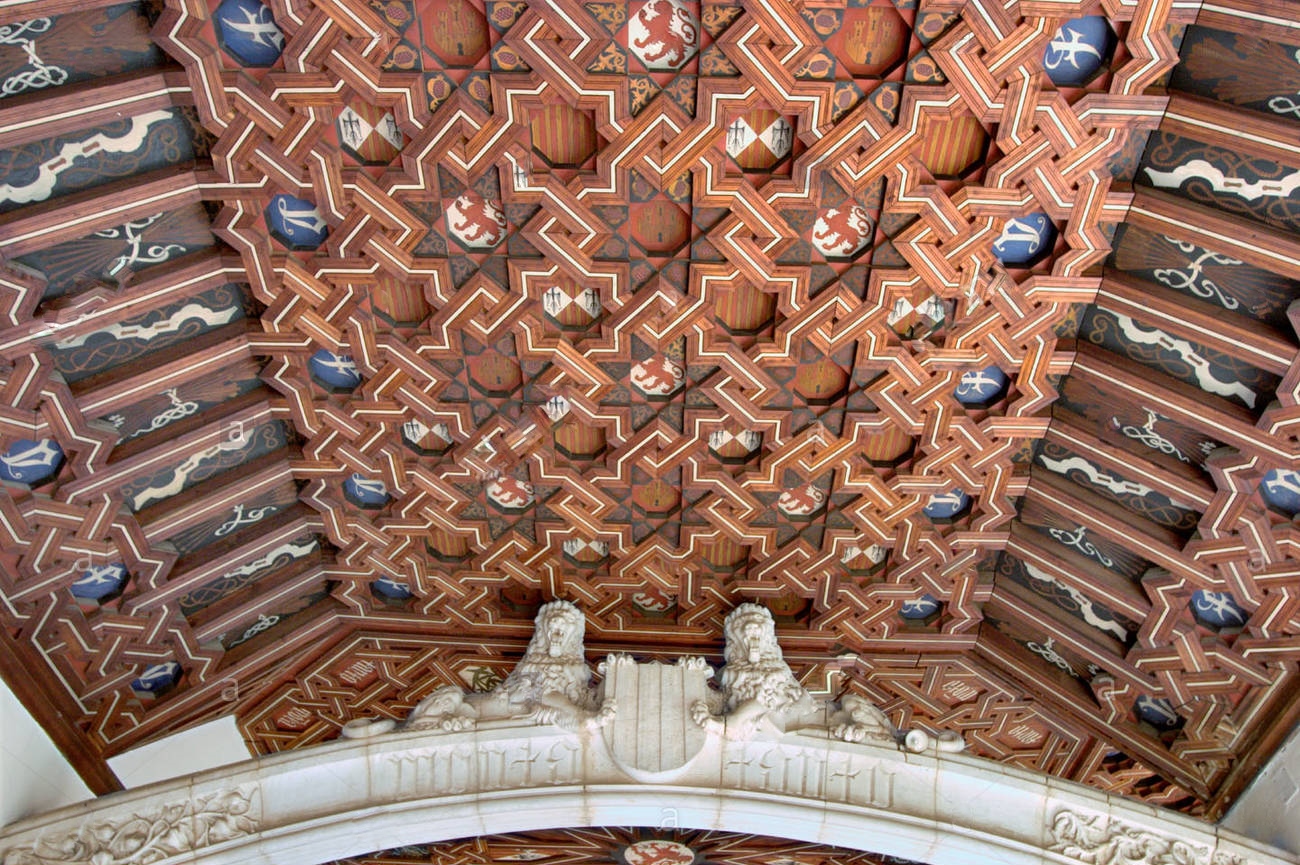
The lower level of the cloister walk was decorated with images of saints, fantastic beasts, and temptations.  Isabelle and Ferdinand had the upper level constructed with a ceiling in the style of the Mudejar, which continued to be popular among the Catholics. The upper level included a ceiling of larch wood. Geometric carvings included coats of arms, lions, arrows, and other symbols of Spain. When the Muslims and Jews were driven from Spain, an exception was made for the Mudejar master craftsmen.

Upper Level of the Cloister (detail)

The Golden Age of Spain series will continue with Seville and the Alhambra in Granada.


Beverly Hall Smith was a professor of art history for 40 years. Since retiring to Chestertown with her husband Kurt in 2014, she has taught art history classes at WC-ALL and the Institute of Adult Learning, Centreville. An artist, she sometimes exhibits work at River Arts. She also paints sets for the Garfield Theater in Chestertown.
The Spy Newspapers may periodically employ the assistance of artificial intelligence (AI) to enhance the clarity and accuracy of our content.

Filed Under: Looking at the Masters

Looking at the Masters: Spain in the Golden Age–Cordoba and Toledo

August 7, 2025 by Beverly Hall Smith
Leave a Comment

Cordoba was the first capital of the Muslim Umayyad dynasty in Al-Andalus, Spain. The Great Mosque of Cordoba was the topic of this series in the SPY on 7/31/25. The Muslim caliphate included Jews and Catholics as members. 


Patio of the Cordoba Synagogue (1315)

Simply called the Cordoba Synagogue, the building was completed in 1315 and remained in use as a synagogue until 1492, when Al-Andalus fell to the Catholic monarchs Isabel of Castile and Ferdinand of Aragon. It is a small structure that suggests it was a private synagogue of a wealthy Jew. It is located on 20 Calle de los Judios, the heart of the Jewish community. The architect is thought to have been Isaac Makheb. The design is termed Mudejar, the Islamic Gothic style of Spain. The small size reflected the requirement that its worship spaces be smaller than those of Catholic churches. The courtyard and surrounding wall are approximately 90 yards square. Limestone was used in the construction of the wall because it was readily available. 


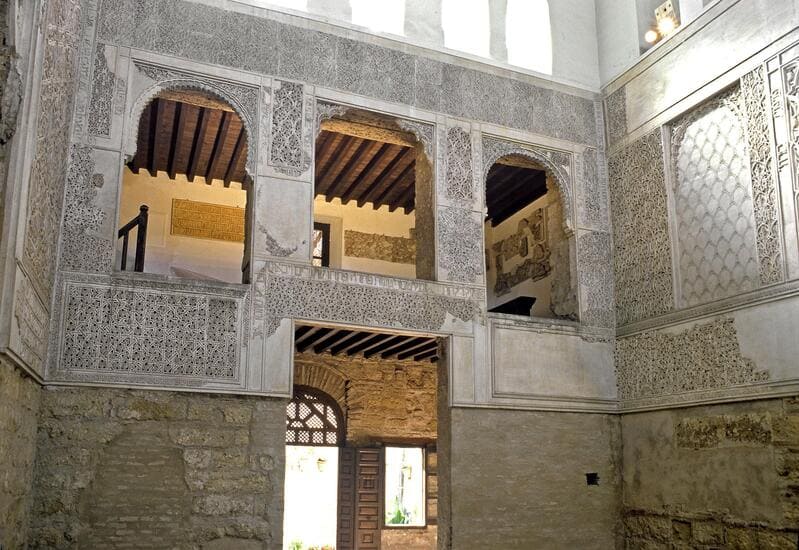
Front Door, Entrance Hall, Women’s Gallery from Prayer Hall

The photograph was taken inside the Prayer Hall, looking out to the west wall entrance doorway and hall. The women’s gallery is on the second floor, the wood stair railing visible at the left. The maskilta, a water basin for ritual ablutions, was in the entrance hall. The ceilings of both the entrance hall and the women’s gallery are supported by elaborately decorated wood beams.

The practice of separating men and women during the prayer service in Orthodox synagogues began with the building of the Second Temple in Jerusalem (518 CE). The separation did not diminish the role of women; they were equal to men. Separation was intended to allow individuals to concentrate and not be distracted.  Several inscriptions are written in bands that surround the carved blocks of Islamic geometric and vegetal decorations. In the women’s gallery an inscription from the Song of Songs (4:4) praises women: “Your neck is like the tower of David, built with rows of stones, on which hang a thousand shields, all of them shields of warriors.” The interpretation is that a woman’s beauty is like a tall tower, and it represents her strength and the protection she offers.


Torah Wall

The major focus in the Prayer Hall is its eastern wall, where the Torah scrolls are placed in the heikhal (ark), directing worshippers’ attention toward Jerusalem. The placement of the Torah was established by Cordoba’s leading Sephardic Jewish citizen Maimonides, in the Mishneh Torah: “When building a synagogue…a heikhal should be built to hold a Torah scroll in it. The heikhal should be built in the direction of prayer in that town [toward Jerusalem], so that they [the congregation] should face the heikhal when they pray. And a bimah should be set up in the center of the house, to enable the reader of the Torah or one who admonishes the congregation, to go up to it so that everyone will be able to hear him…” The bimah and seating no longer survive.

One inscription praises the Temple in Jerusalem, creating a connection between the two synagogues; “I will bow down toward your holy heikhal and praise Your name for Your mercy and Your truth, for You have magnified Your word above all Your name…” (Psalms 138:2)

The inscription to the right of the Torah wall is a recognition of a donor: “This minor sanctuary has been refurbished by Yitzhak Mahab son of the wealthy Ephraim in the Hebrew year 5075 (1315 CE) may God remove curses from our nation and rebuild Jerusalem soon.”

Notable in the Cordoba Synagogue are the numerous Hebrew inscriptions on all the walls. Many are from Psalms and show Jewish hope to return to Jerusalem: “Pray for the peace of Jerusalem; those who love you shall be blessed. Peace be within your walls, prosperity within your palaces.” (Psalms 122:6-7) “Be merciful to me, O God, be merciful to me; for my soul trusts in You; in the shadow of Your wings I will take refuge until these great troubles pass by.” (Psalms 57:2)

Proverbs 8:34 is quoted on the south wall: “Happy is the man who listens to me, watching next to my doors every day, guarding the jambs of my entrances! Open the doors and let a just people enter, saver of loyalty!”

From the east wall: “I will prostrate towards your holy temple and praise your name because of your kindness and loyalty, for you have magnified your promise above your renown. One thing you have asked from Yahweh, this I intend; to live in Yahweh’s house every day of my life to enjoy Yahweh in grace and early visit his temple.“ 


Prayer Hall

There are five arched windows, each 24 by 59 inches, on the three walls, that allow natural light to flow into the space. The decorated wood beams that support the ceiling are partially visible. The carved geometric patterns on the blind arches are separated by wide bands of vegetal and geometric designs. There are narrow bands of text around each section.

After 1492, the Synagogue was converted to a hospital, then the Hermitage of St Crispin, after that an infant school. In 1885, it was included as one of the monuments on the Spanish Cultural Heritage list. 


“Ben Maimonides” (1964)

Moses Ben Maimonides (1138-1204) was a prolific writer, philosopher, astronomer, physician, and most important, a Torah scholar of the Middle Ages. He was born in Cordoba and lived there until he and his family were forced either to convert to Islam or leave. He moved around, living in Morocco and Egypt. For a time, he was the personal physician of Saladin, the sultan of Egypt and Syria, who recaptured Jerusalem during the Third Crusade in 1187. Maimonides died in Fustat in Egypt and was buried in Tiberias, Israel.

The eight-hundredth birthday of Maimonides was recognized by the Spanish government by changing the name of the Calle de los Judios to Tiberias Square. For the first time in 443 years a service was conducted in the Synagogue, the only one to survive the years of persecution.  Restoration of the synagogue was begun in 1977, and the building was reopened as a museum in 1985 to celebrate Maimonides 850th birthday. 


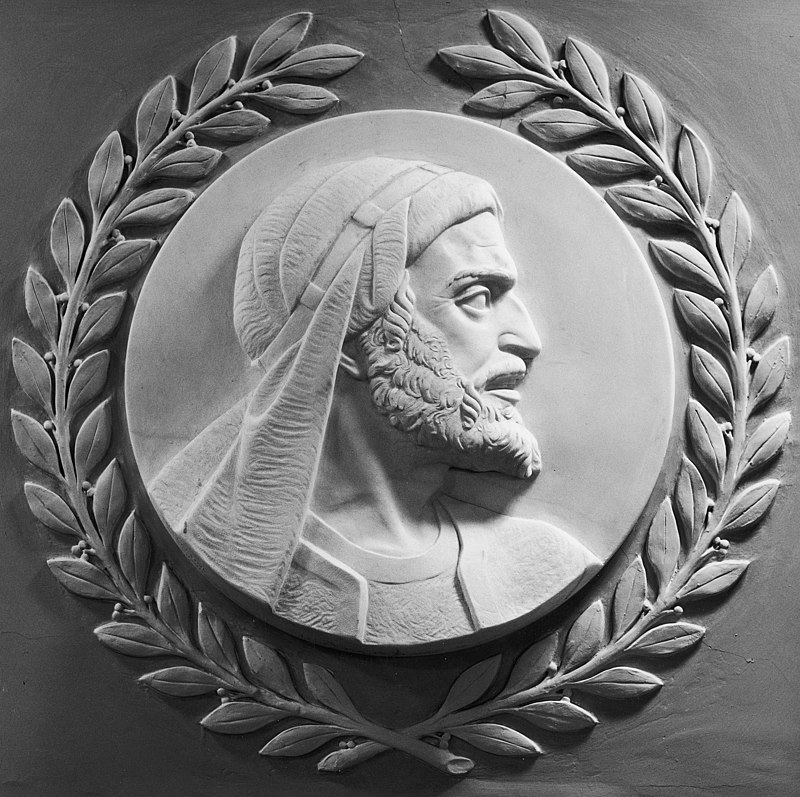
“Maimonides” (1950)

“Maimonides” (1950) (28”) (marble) was sculpted by Brenda Putnam and placed in the United States House of Representatives with 23 other plaques dedicated to great historical law givers.

The Caliphate of Cordoba broke apart in 1031, and several new kingdoms were created.  Many Cordoba citizens migrated to the nearby city of Toledo, where the Muslim and Christian rulers were able to keep the city safe and prosperous. Different languages, religions, and cultures were tolerated for those who paid tribute to the rulers. There were at least eleven synagogues in Toledo.


Entrance to Santa Maria le Blanca (Ibn Shoshan Synagogue) (1180)

Santa Maria le Blanca was originally the Ibn Shoshan Synagogue (1180). It is one of the oldest synagogues, and remains standing on 4 Calle Reyes Catholicos. The synagogue courtyard contained the Rabbi’s residence, a ritual bath and study hall. The wooden entrance door is decorated wi Muslim geometric patterns. 


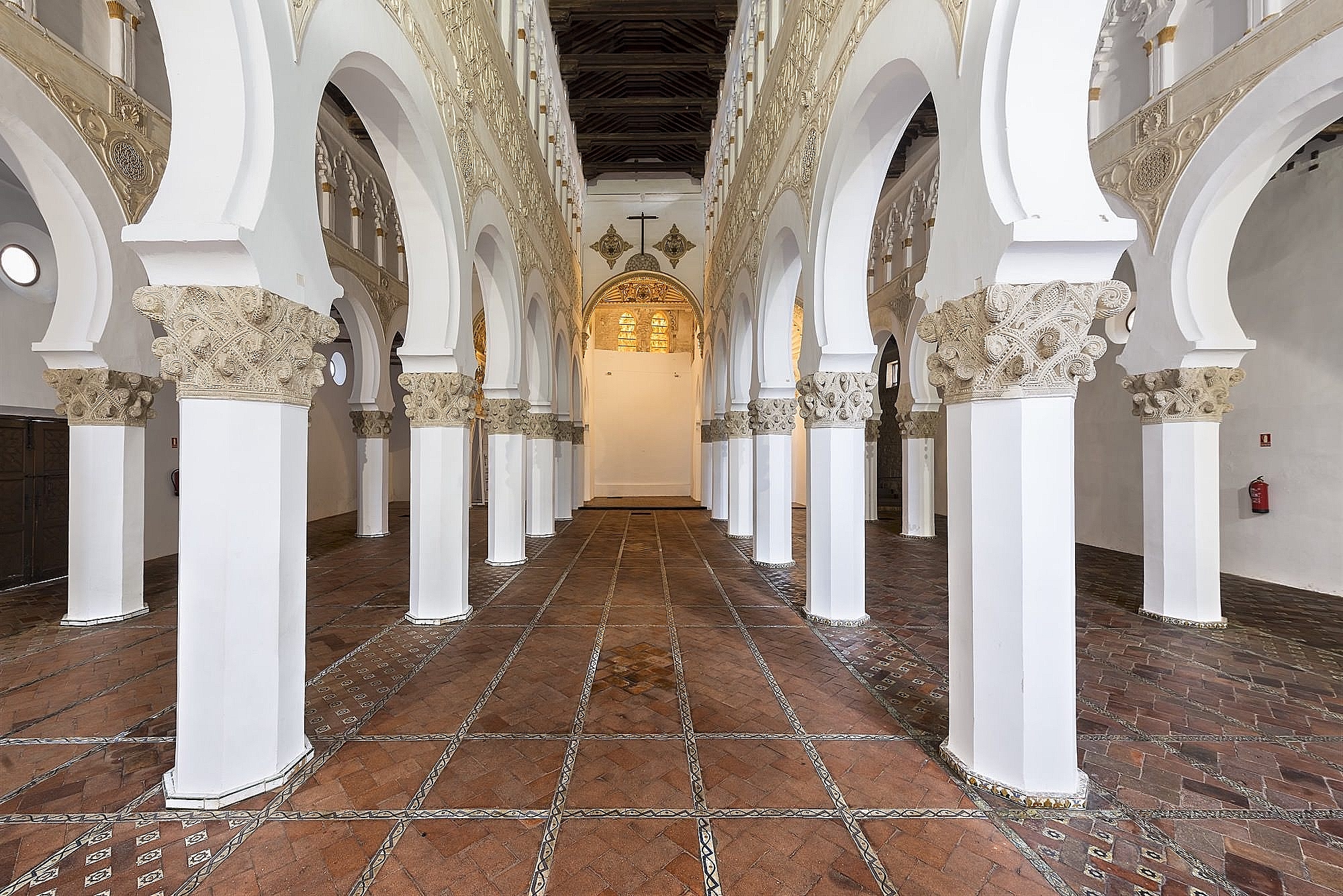
Santa Maria le Blanca/Ibn Shoshan Synagogue

The synagogue, in the style of the Muslim Almohad caliphate, was constructed of brick and mortar with plain white walls. It had a women’s gallery, subsequently lost along with the bimah center platform, where the torah was read, and the seats. There are five aisles; the center nave aisle is the tallest. The building is between 85 and 92 feet in length and 62 and 75 feet in width. The white columns are topped with carved pinecone capitals in Roman Corinthian and Byzantine styles. The arches above are simple horseshoe arches. Unfortunately, the original floor tiles have survived only as fragments. The red tile floor with the blue and gold bands was installed as part of a 19th century reconstruction.


Pinecone Capital (detail)

The pinecone capitals were carved of stucco in a variety of designs. They were ochre in color, a contrast with the white octagonal columns.  

Pinecone Capital (detail)


Spandrels, Blind Arcades, Islamic Decoration

The white walls and columns give the synagogue a sense of openness. The main decoration can be found above the horseshoe arches. The low relief stucco carvings are depictions of scallop shells, tendrils of plants, geometric interlacing, and different knotwork designs. The geometric patterns of the wrought iron grilles in the windows help defuse the light and create interesting shadows on the plain white walls.

Anti-Jewish preacher Vincente Ferrer instigated the sacking of the synagogue in 1391. It was taken over by the Catholics and consecrated in 1401 as a Catholic church. The building was given to the Order of Calatrava, and dedicated to St Mary the White, named after a sculpture in the Cathedral. Three Renaissance chapels were added between 1550 and 1556, but they did not intrude on the synagogue interior. In the 16th Century the church was used as a military barracks, warehouse, and dance hall. It suffered one more humiliation when Napoleon used the space to stable his horses. The government returned the church to a local parish in 1856. The Church of Santa Maria de Blanca was added in 1930 to the Spanish Cultural Heritage list of monuments. The Jewish community of Toledo requested in 2013 that the synagogue/church be opened, not for worship, but as a museum.

The next article in this series will discuss the synagogue/church of El Transito and other Catholic structures in Toledo.


Beverly Hall Smith was a professor of art history for 40 years. Since retiring to Chestertown with her husband Kurt in 2014, she has taught art history classes at WC-ALL and the Institute of Adult Learning, Centreville. An artist, she sometimes exhibits work at River Arts. She also paints sets for the Garfield Theater in Chestertown.

The Spy Newspapers may periodically employ the assistance of artificial intelligence (AI) to enhance the clarity and accuracy of our content.

Filed Under: Looking at the Masters, Spy Journal

Looking at the Masters: Spain in the Golden Age – Cordoba

July 31, 2025 by Beverly Hall Smith
Leave a Comment

The Golden Age of Spain lasted from 711 until 1492 CE. Muslims migrated from Arabia across the straights of Gibraltar to the Iberian Peninsula of Spain and settled in what they called Al-Andalus. Originally part of the Holy Roman Empire, the region was conquered in the 5th Century by the Visigoths, who were Germanic Christians. Cordoba was the first Al-Andalus capital, founded in 756 CE by the caliphs of the Umayyad dynasty. Their rule of Al-Andalus lasted for 800 years until the Catholic Monarchs Isabel of Castile and Ferdinand of Aragon took over in 1492.

Great Mosque of Cordoba (785-1236)

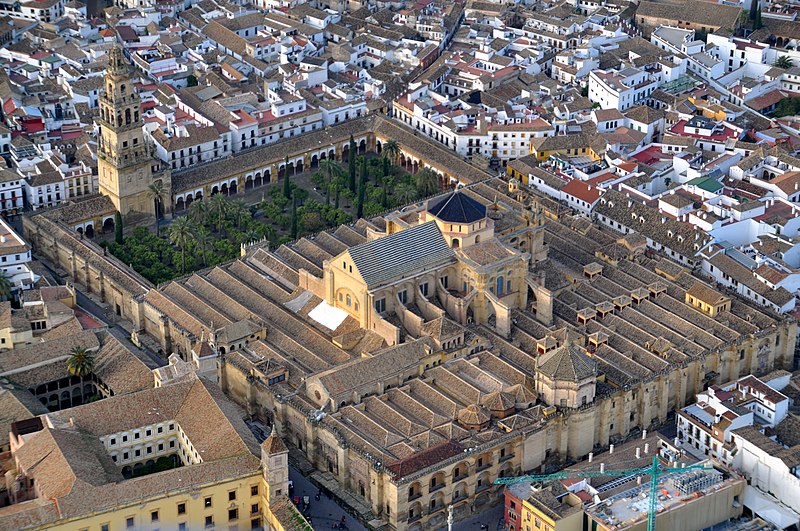
The civilization that Abd-al-Rahman I created was splendid and included not only Muslims, but also Jews and Christians. Cordoba was one of the most cultured cities of the age with a population over a half million, free schools, a university, science center, and Moorish library containing 400,000 volumes. The Great Mosque of Cordoba (785-1236) is one of the most significant Muslim buildings outside Mecca. It was modeled after the Great Mosque of Damascus in Syria. The mosque, Mezquita in Spanish, contained a large courtyard garden in front. The main entrance is under the tall tower, a minaret, from which the faithful were called to prayer by a muezzin. The mosque was constructed on the site of a Visigoth Christian church. Construction of the original mosque began in 785-86. The structure was 242 by 259 feet and contained eleven aisles. It was completed in one year. The structure was expanded to 590 by 425 feet by the next rulers. The roof above each aisle was constructed using a basic gable design with two sides sloping from the roof line 

At the center of the mosque is the Cathedral of Our Lady of the Assumption. King Ferdinand III of Castile reclaimed Cordoba in 1236, and he converted the mosque into a cathedral dedicated to the Virgin Mary. Small chapels were constructed within the mosque, outside doors to the chapels were added, and the Royal Chapel was completed in 1371. The original construction was largely unchanged by these additions. Major changes in the building were not made until 1523, when King Charles V of Castile and Aragon (1519-1558) gave his permission to build the Renaissance church. Sixty columns in the mosque were torn down. Seeing the mosque and cathedral within it for the first time, the King became infuriated. He is reported to have said, “You have built what you or anyone else might have built anywhere; to do so you have destroyed something that was unique in the world.” 

Beyond the cathedral, the last outer wall of the mosque, called the Qibla, is faced by worshipers when they pray, because they are facing the Kaaba and Mecca.  Under the small tower structure in the center of the qibla wall is the Mihrab, a prayer niche. It is the most sacred area of the mosque. 

Patio de los Naranjos (784)

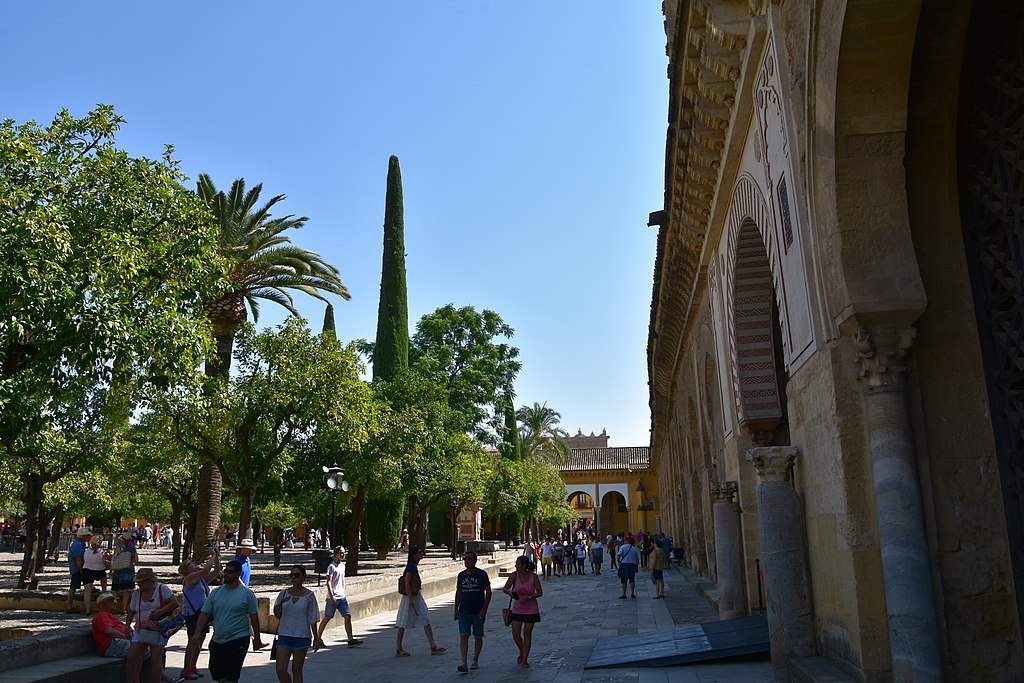
The Patio de los Naranjos (Oranges) (784) is a courtyard, or sahn, the oldest continuously planted Islamic Garden. The sahn was placed in front of the prayer hall so that worshippers could gather, interact, and prepare for prayer. The fountains provided water for ablutions, cleansing before prayer. 

Muslims created gardens where ever they lived because they came from dry dessert land. The gardens are rain gardens. Water channels lead to circular collectors around each tree. The collected rain filters through sand. When a collector is full, the water flows through the channel to the next collector.  This unique design allowed flourishing gardens to exist. Along with the large number of orange trees are pomegranate, cypress, and palm trees. The garden later was divided into three sections, each with a Renaissance fountain at its the center.

Hypostyle Hall

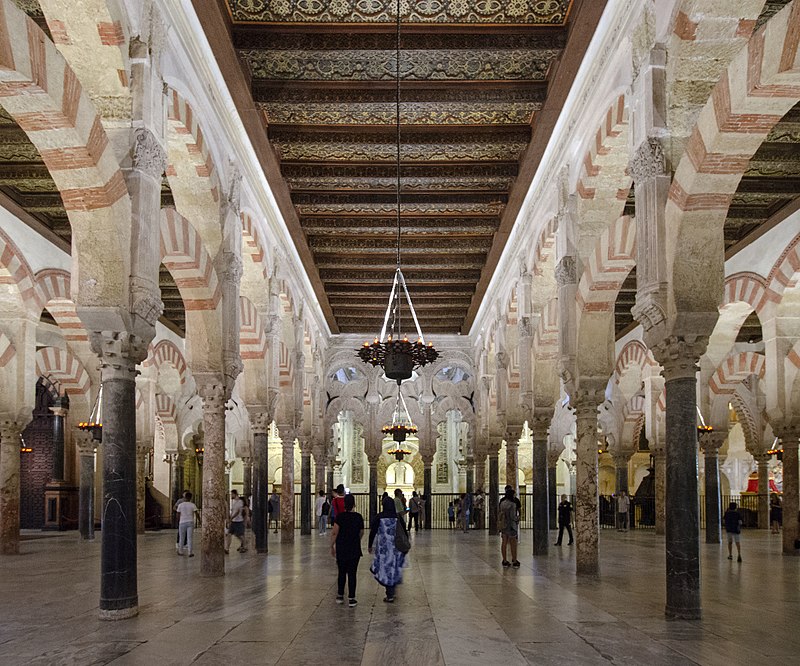
Entering the mosque from the front brings visitors into the massive and impressive Hypostyle Hall.  Prayer begins here. The Muslims used the remains of the Roman and Visigoth columns and capitals in the construction of the mosque. The term hypostyle comes from the Greek word meaning under pillars to describe columns supporting a roof. The two levels of Roman and Visigoth columns and capitals are topped with red and white horseshoe arches. The horseshoe arch, also called Moorish arch, was found in Umayyad construction in Damascus and used often by the Visigoths. The mosque contains over 800 columns. The horseshoe arches are composed of red brick and white limestone. At one time, steps led to the Minbar (pulpit) where the Imam delivered khutbah (sermons).  

Ceiling Beams (detail)

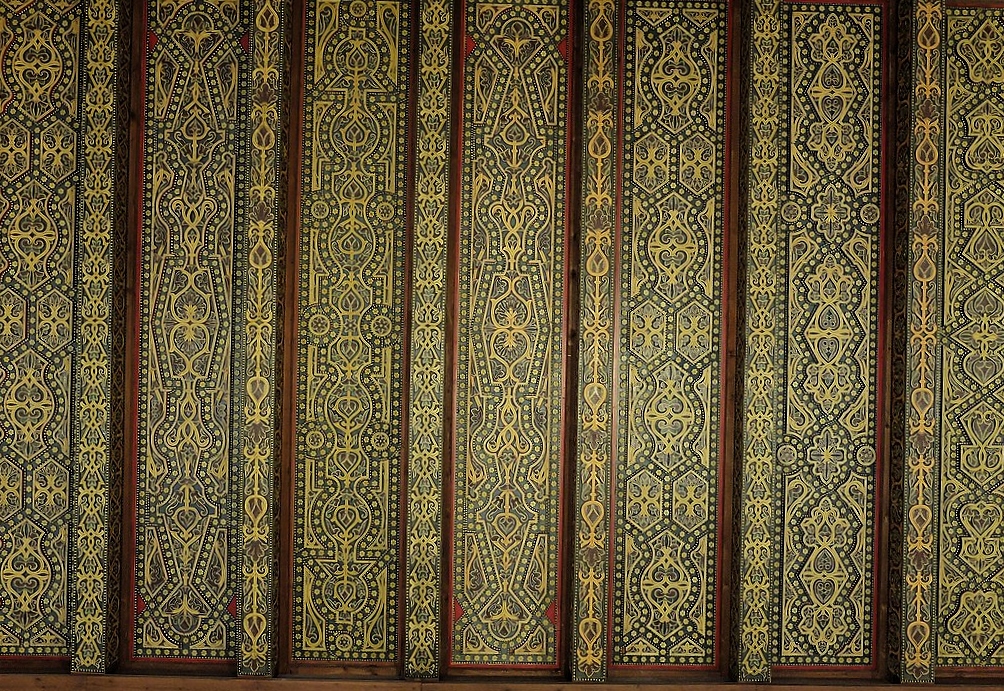
 Some of the beams are simple wood planks, but others are elaborately carved and decorated as can be seen here. These are inlaid with gold mosaic tiles in intricate geometric patterns.  Jasper, marble, and porphyry stones add color. 

Multilobed Horseshoe Arches (detail)

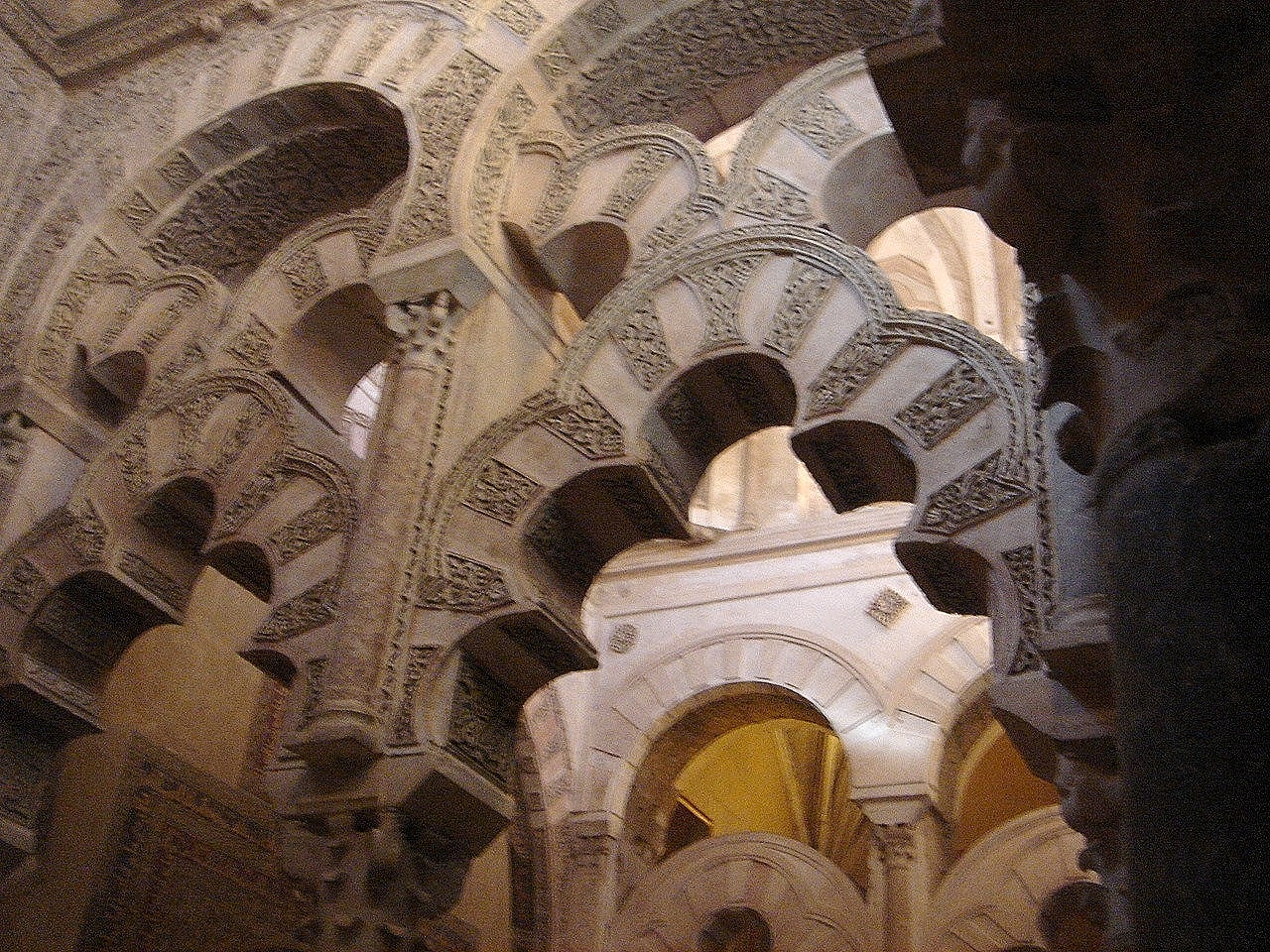
Closer to the qibla wall, the horseshoe arches are multilobed, cross-ribbed, and stacked. They are carved elaborately with arabesques, geometric designs, and calligraphy from the Koran. The increased decoration reflects the worshippers’ increased devotion as they moved toward the wall.

Maqsurah to Mihrab

Abd al-Rahman III became the caliph of Cordoba in 929. He added the multilobed arches in front of the Maqsurah, the closed off space before the Mihrab, with wide aisles, decorated ceiling beams, and hanging lamps. The lamps are symbols of Allah: “Allah is the Light of the heavens and the earth. His light is like a niche in which there is a lamp, the lamp is in a crystal, the crystal is like a shining star, lit from ˹the oil of˺ a blessed olive tree, ˹located˺ neither to the east nor the west, whose oil would almost glow, even without being touched by fire. Light upon light! Allah guides whoever He wills to His light. And Allah sets forth parables for humanity. For Allah has ˹perfect˺ knowledge of all things.’’ (24:35) “That light shines˺ through houses ˹of worship˺ which Allah has ordered to be raised, and where His Name is mentioned. He is glorified there morning and evening.” (24:37)

Mihrab (961-976)

The mosque was expanded during the 9th and 10th Centuries. The Mihrab, the niche in the outer wall in the floor plan, is the part of the mosque nearest Mecca, and the direction for congregational prayer. The Mihrab was rebuilt and decorated by al-Hakam II. Only 13 by 3 feet, the Mihrab is magnificent. In 971 Al-Haham II requested Nicephorus II, Byzantine Emperor from 963 until 969, to send craftsmen to create the gold mosaic for the Mihrab and the dome above it. An elegant horseshoe arch caps the entrance to the small interior room. The arch is covered with a fine glass mosaic in several colors, many covered with gold. The Byzantine capital was Constantinople, formerly part of the Greek empire, and its craftsmen were masters. They directed the project and trained the caliph’s craftsmen. This cultural exchange between Muslims and Christians worked well despite their political and religious differences.

The lower wall supporting the arch is marble carved with tree of life designs. A rectangular blue and gold mosaic contains Koran text. Above are six blind arcades with variations of plants that form the tree of life.

Koran inscription (detail)

The Koran inscriptions touch on the importance of the creators of the work. The Koran does not specifically state no human images should be depicted, but it encourages the appreciation of beauty as a reflection Allah’s creation for a deeper connection to the divine. The red glass tiles probably were imported from Constantinople, as were several of the other colored tiles. Surrounding the mosaics are stone carved bands of vines and flowers, the expert work of the local craftsmen.

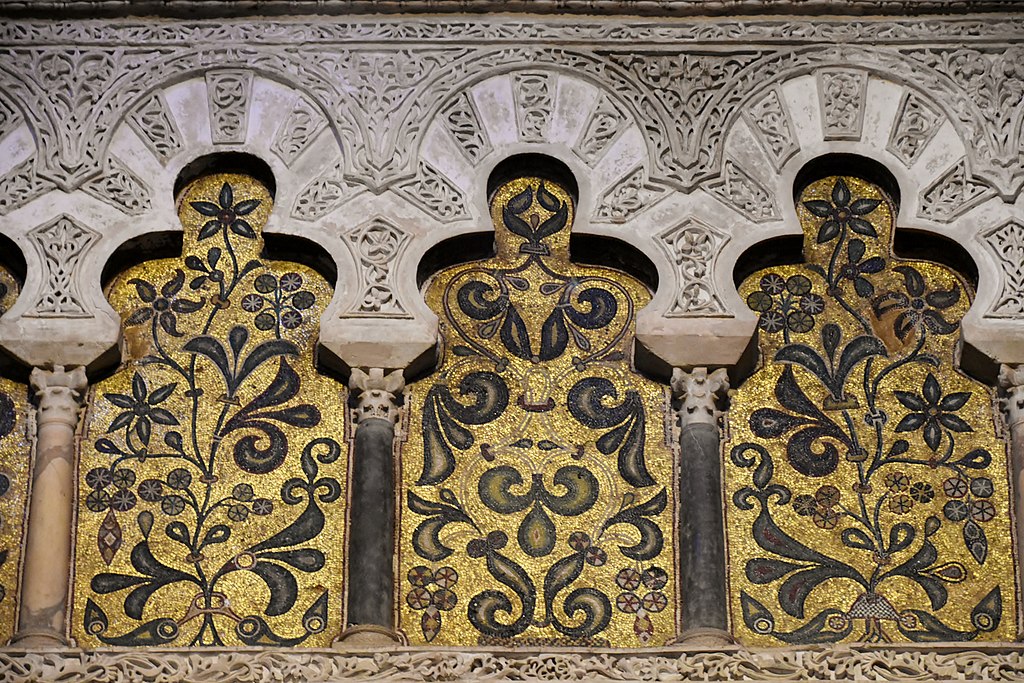
Trefoil Blind Arcades (detail)


With backgrounds of gold mosaics, the trefoil (three) lobed blind arcades are decorated with different stylized plant motifs. They are surrounded by more of the vegetal carvings and geometric designs so much a part of the architecture of Al-Andalus.

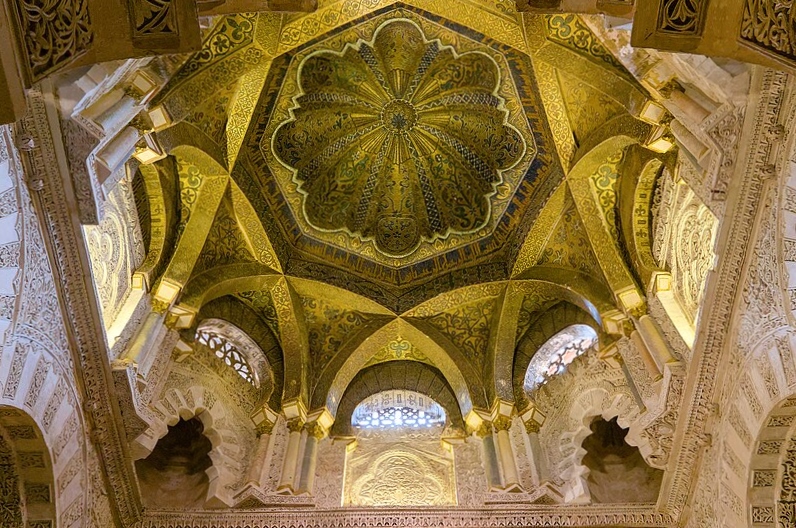
Dome of the Mihrab (961-976)

The dome of a mosque was symbolic of heaven and connected earth with the heavenly realm. The dome is supported by multilobed horseshoe arches placed upon slender columns of marble, granite, jasper, and onyx. Interlacing arches rise above the columns, a band of blue and gold script surrounds the octagon that supports the unique shell-shaped dome. The filtered natural sunlight and the shadows create a greater sense of the celestial, the spiritual nature of Allah, the light. The dome is both traditional and innovative.  The Muslim craftsmen of Al-Andalus were just beginning.

The exploration of Al-Andalus will continue next time with Jewish Cordoba and Toledo.


Beverly Hall Smith was a professor of art history for 40 years. Since retiring to Chestertown with her husband Kurt in 2014, she has taught art history classes at WC-ALL and the Institute of Adult Learning, Centreville. An artist, she sometimes exhibits work at River Arts. She also paints sets for the Garfield Theater in Chestertown.

The Spy Newspapers may periodically employ the assistance of artificial intelligence (AI) to enhance the clarity and accuracy of our content.

Filed Under: Looking at the Masters, Spy Journal

Looking at the Masters: Camille Pissarro

July 24, 2025 by Beverly Hall Smith
Leave a Comment

Jacob Abraham Camille Pissarro (1830-1903) was the oldest of the Impressionist artists and considered a father figure, teacher, mentor, and supporter. He also was a prolific painter. Pissarro was born on the island of St Thomas, then part of the Danish West Indies. His father Gabriel Pissarro, a French Jew from Portugal, had moved to St Thomas to manage the hardware store owned by his recently deceased brother. He married his brother’s wife, and they had four children. The marriage was a scandal, and Camille and his siblings grew up as outsiders. All four children attended an all-black primary school. He met Danish artist Fritz Melbye in 1849, and Melbye took over Pissarro’s artistic education. He became Pissarro’s great friend and mentor. Pissarro later would do the same for the younger Impressionists. Pissarro and Melbye traveled to Venezuela and painted scenes from Caracas and St Thomas. 

Pissarro traveled to Paris in 1855 to serve as an assistant to Melbye’s brother. He studied the work of contemporary Barbizon painters Daubigny, Millet, and Corot, and realist painter Courbet, and all became friends. He was introduced to plein air painting. His first exhibit at the Paris Salon in 1868 was a success. The paintings he exhibited made his reputation, yet they were not of the Impressionist style that he would soon embrace. 

The Franco-Prussian war made it necessary for Pissarro to move to London, as was the case with several of his fellow artists. He met the art dealer Durand-Ruel and the artist Monet.  He married his mother’s maid Julie Vellary in 1871, and they had seven children, six of whom became painters. On returning to Louveciennes, outside Paris, he found that of the 1500 paintings he had made over the period of 20 years, and had to leave behind, only 40 remained.

The family moved to Pontoise in 1872 and remained there until 1884. Pissarro became one of the group of Impressionists artists who called themselves Société Anonyme des Artistes, Peintres, Sculpteurs et Graveurs. His paintings of working-class people in rural towns were fully Impressionistic. He participated in all eight of the Impressionist exhibitions. 


The Place du Havre, Paris” (1893)


Pissarro suffered from a recurring eye infection that became severe in 1893. It prevented him from sitting outdoors and painting en plein air. He was determined to continue to paint outdoor scenes, but from the upper rooms of hotels in the cities of Paris, Rouen, Le Havre, Dieppe, and London. His reputation by that time was well-established and as he hoped his paintings of the new the new Paris designed by Haussmann attracted buyers. Pissarro painted “The Place du Havre, Paris” (1893) (24’’x29’’) from his window of the Hotel Garner during a visit for a few weeks. The large building to the right is the Gare St Lazare train station. Renoir and Monet had painted scenes of downtown Paris, but had long since turned to other themes. Pissarro revived the interest in Paris scenes. The wide avenues, Haussmann buildings, horsedrawn carriages, gas and then electric lights, and the continuous hustle and bustle as seen from above allowed him to capture the energy of the streets. 


“Rue Saint-Honore, in the Afternoon, Effect Rain” (1897)


Although city scenes were not a part of his usual subject matter, he excelled in these paintings. He said he could “see down the whole length of the boulevards, almost a bird’s-eye view of carriages, omnibuses, people, between big trees, big houses that have to be set straight.” He chose to depict the most important streets in Paris, and influenced by Monet, he chose different times of day and different weather conditions.  

“Rue Saint-Honore, in the Afternoon, Effect Rain” (1897) (32”x26’’) was one of several pieces he painted before moving on. Just over one mile long, Rue Saint-Honore was the center of Paris Haute Couture. High-end fashion houses, boutiques, designer shops, and art galleries attracted wealthy Parisiennes. Several horse-drawn carriages are parked at the curb, while others ply the crowded boulevard. Haussmann buildings line the street. The restaurant on the corner has a red and white awning and tables on the sidewalk. The plaza contains trees, a large fountain, and street lights. People, most with open umbrellas, populate the scene. More awnings and decorated store fronts are across the street. Pissarro was expert at handling the wet street and the gray atmosphere.


“Boulevard Italians, Morning Sunlight” (1897)

From February through April 1897, Pissarro recorded the Boulevard des Italians and the Boulevard Montmartre from his room in the Grand Hotel de Russie. He found “terribly difficult views” for his “Boulevard Italians, Morning Sunlight” (1897) (29”x36”) (National Gallery of Art, Washington, DC). 

The street was busy, with passenger omnibuses picking up and discharging passengers among the many individual carriages. Two rows of trees line the street, and the large sidewalks are full of people. Pissarro included a tall red advertising kiosk on the right sidewalk.  The kiosks were covered with flyers promoting all manner of things–theatre, opera, restaurants, the circus, cigarettes. The invention of lithography made it possible to print advertisements quicker and cheaper to promote the new bourgeois entertainments. The posters of Toulouse-Lautrec come to mind.


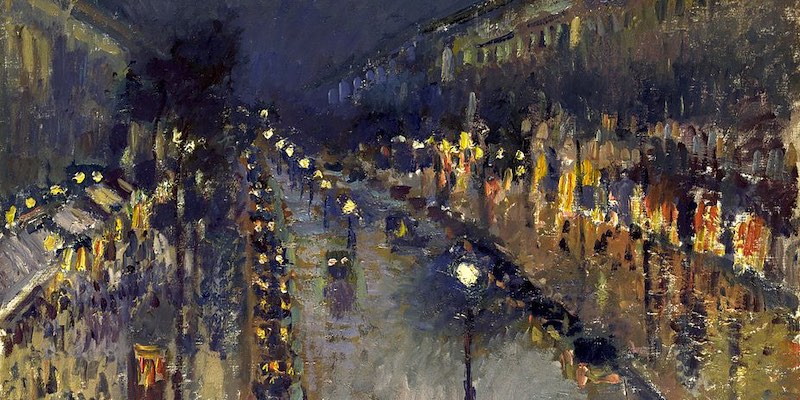
“Boulevard Montmartre at Night” (1897)


“Boulevard Montmartre at Night” (1897) (21”x26”) is considered one of Pissarro’s masterpieces, equal to Van Gogh’s “Starry Night” (1889). Painting at night was difficult, and when successful was exceptional. Gas lights lined city streets in the 19th Century, but they were replaced by the white electric lights in 1878, included in this scene. Street lights were one of Hausmann’s ideasto make Paris safer, and they made night life possible. Pissarro painted 14 scenes of Boulevard Montmartre in sunlight, snow, rain, fog, and mist, and in the morning, afternoon, and evening. Carriages are parked along the sidewalks, waiting for passengers. Shops and restaurants run the whole length of the street. Dashes and dots of brushwork suggest this active scene.


“Boulevard Montmartre at Night” – detail (1897)


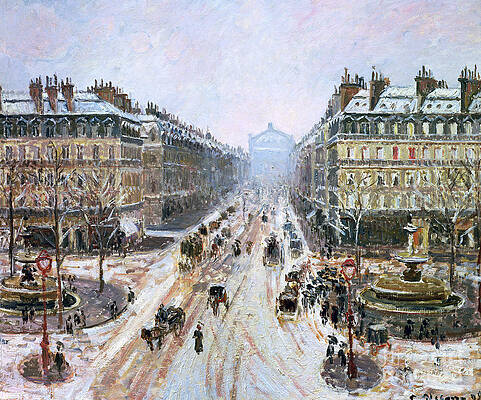
“Avenue de l’Opera, Snow Effect” (1898)


Pissarro created 15 paintings in 1898 from his room in the Grand Hotel du Louvre on the Place du Palais Royal. His room provided a view of the Avenue de l’Opera, the Place du Theatre Francais, and the Rue Saint-Honore. In “Avenue de l’Opera, Snow Effect” (1898) (26”x21”), two large roundabouts can be seen on either side of the wide thoroughfare that leads to the distant, newly constructed Paris Opera House (1861-1875). With the industrial revolution in full swing, the newly wealthy middle class formed associations to fund institutions such as the opera house. In the past, opera stages were part of royal palaces and available only to members of the ruling classes. The Paris Opera House, designed by Charles Garnier (1825-1898), is obscured by the mist in this painting, but it was and is grandiloquent. Pissarro chose to show the effects of a heavy snow fall, leaving roof tops and awnings tipped with white. The line of buildings and the tracks in the snow create a strong perspective view.

The years from 1897 until 1898 brought several tragedies into Pissarro’s life. His son Lucien suffered a stroke and another son Felix died of tuberculosis at age 23. The Dreyfus Affair concerned an Army Captain, who was Jewish and wrongfully accused and convicted of being a German spy as a result of antisemitism. Pissarro, a Jew, lost some of his friends who were antisemitic. Never political of religious in his paintings, he did write a few letters in support of Dreyfus’s innocence. He was able to separate politics from painting, and in a letter to his son Lucien to tell him of Felix’s death, he wrote: “I am delighted to be able to try to do these Paris streets, which are so often called ugly, but which are so silvery, so luminous and so lively”.

“Garden of the Tuileries on a Spring Morning’’ (1899)

Pissarro took an apartment at 204 rue de Rivoli that faced the Jardin des Tuileries.  He painted six views of the garden. “Garden of the Tuileries on a Spring Morning’’ (1899) (29”x36”) is a depiction of the park, created by Queen Catherine de Medici in 1564, located between the Louvre and the Place de la Concorde. The garden was opened to the public in 1667. The two steeples of the church of Sainte-Clotilde can be seen in the distance.  Pissarro’s dealer Durand-Ruel happily took the paintings to sell. The paintings were so successful that Pissarro took the same rooms later in 1899. He created another 14 paintings of the garden and 8 views of the Place du Carousel. 

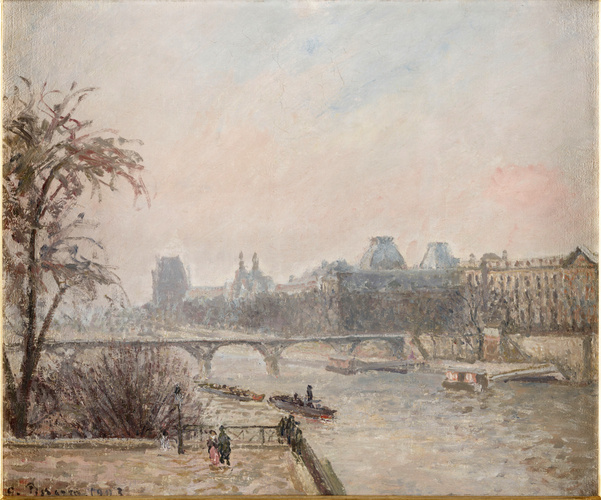
“The Seine at the Louvre” (1903)


From 1900 until 1903, Pissarro painted views of the Louvre from the second floor of a house on Place Dauphine. “The Seine at the Louvre” (1903) (19’’x22”) is his last painting. It is a depiction of an overcast fall day. The buildings of the Louvre are shrouded in a blue-gray mist. Some boats ply the river. A few people are on the Square du Vert-Galant at the lower left. In summer it is a green space with a variety of trees. The Pont des Arts (1803), a pedestrian bridge between the Louvre and the Institut de France, spans the river. It was the first iron bridge in Paris. The bridge became famous in 2008 for the love locks that people attached to the rails. 

Pissarro died of sepsis on November 13, 1903. His wife and remaining children were present. Many prominent artists attended his funeral, among them Monet, Renoir, and Matisse. The next generation of French painters, the Fauves and Matisse, recognized the importance of Pissarro to Impressionism and the liberation of art for the future. Pissarro was and continues to be considered the father of Impressionism.


Beverly Hall Smith was a professor of art history for 40 years. Since retiring to Chestertown with her husband Kurt in 2014, she has taught art history classes at WC-ALL and the Institute of Adult Learning, Centreville. An artist, she sometimes exhibits work at River Arts. She also paints sets for the Garfield Theater in Chestertown.
The Spy Newspapers may periodically employ the assistance of artificial intelligence (AI) to enhance the clarity and accuracy of our content.

Filed Under: Looking at the Masters, Spy Journal

Looking at the Masters: Gustave Caillebotte

July 17, 2025 by Beverly Hall Smith
Leave a Comment

Impressionist artist Gustave Caillebotte (1848-1894) was from a wealthy Parisienne family. He grew up near the area of the St. Lazarre train station. He received a law degree in 1868 and a license to practice law in 1870. During the Franco-Prussian War, he served in the Garde Nationale Mobile de la Seine. As a result of a visit in 1871 with Leon Bonnat, who was a painter, art collector, and professor at the Ecole des Beaux-Arts in Paris, Caillebotte changed direction and began to study art. His talent was evident, and within a short time, he set up his own studio in his parent’s house. His father died in 1874 and his mother in 1878, leaving Gustave and his two brothers very wealthy. They moved into an apartment on the Boulevard Haussmann in Paris. 


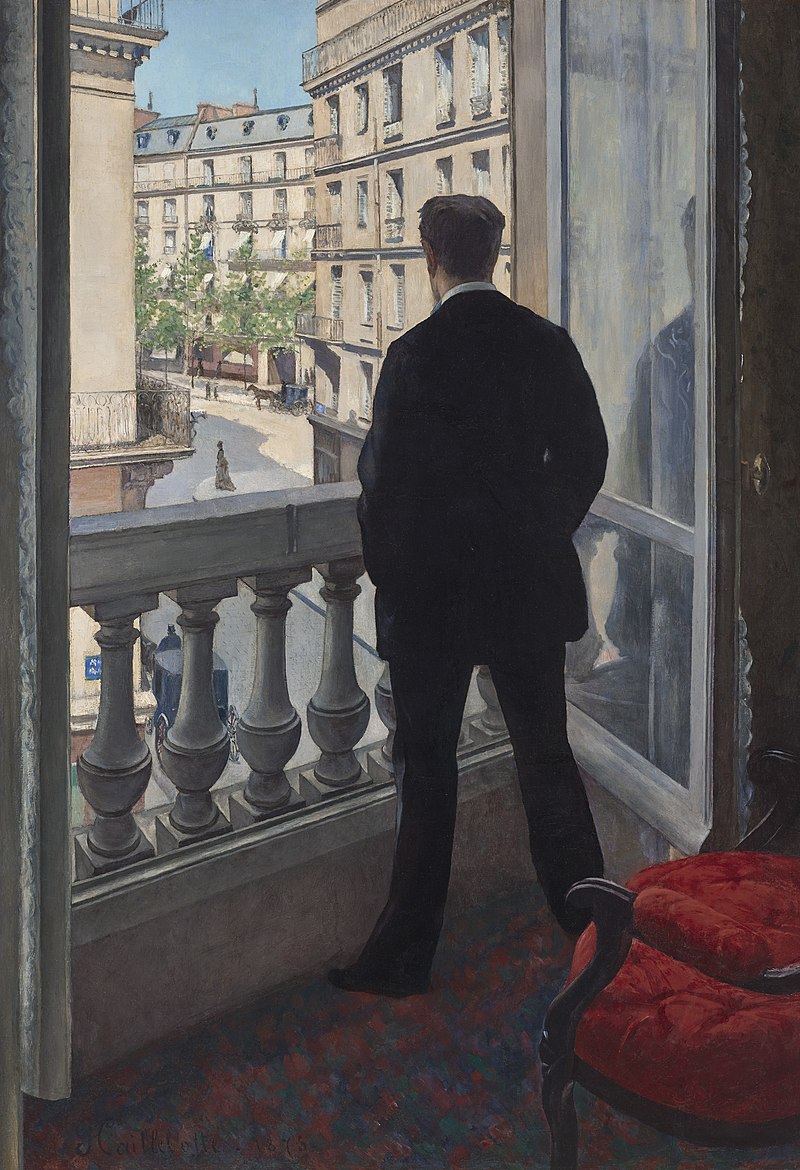
“Young Man at the Window” (1876)


“Young Man at the Window” (1876) (32”x46”) depicts Caillebotte’s brother Rene, standing on the balcony of one of the new apartments on rue de Miromesnil and overlooking the Boulevard Haussmann. The apartment is luxurious, with a colonnaded balcony rail, large glass windows that are open, a carpet with deep red and blue flowers, and a handsome carved chair with rich red upholstery. These details indicate wealth. 

Caillebotte was fascinated with the new architecture of Paris, instituted during the period of 1853 until 1870 by Baron George-Eugene Hassmann. He was commissioned by Emperor Napoleon III to tear down the overcrowded, unhealthy slums and to build a more spacious and hygienic Paris. His reorganization resulted in wide boulevards that connected the various parts of Paris and new buildings with mansard roofs and dormer windows that allowed greater light into the rooms. The roof and windows in this work were a signature of Haussmann’s buildings. New squares, sewers, fountains, aqueducts, and parks were constructed. The view out the window includes the wider avenues and sidewalks and new buildings that stretch into the distance. This new Paris became one of Caillebotte’s favorite subjects.


“Le Pont de l’Europe” (1876)


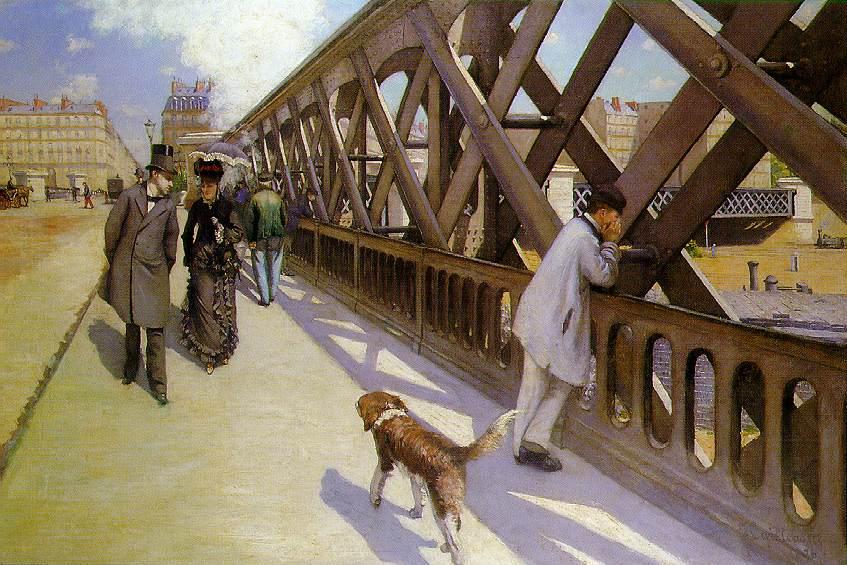
In January 1877, Monet, Sisley, Degas, Manet, and Renoir met in Caillebotte’s apartment on rue de Miromesnil to plan a third exhibition of the Impressionist group. “Le Pont de l’Europe” (1876) (49”x71”) was one of Caillebotte’s paintings included in the exhibition, and it was one of the stars of the show. The large bridge off the plaza was one of Haussmann’s renovations. It connected six avenues named after a European capital, and it spanned the railroad yard of the Gare Saint-Lazare. The view is from the Avenue of Vienna. Construction of railways, bridges, and train stations, the result of the invention of the steam engine, was taking place across Europe.

Caillebotte made several preliminary sketches for the painting, adjusting the perspective and the placement of the people. He paid careful attention to the construction of the bridge trusses. Caillebotte, like Millais, was interested in the common people, and he included at the front of the painting a worker looking out from the bridge. A dog leads the viewer into the composition. A well-dressed man wearing a hat and a woman in black stroll along the bridge. This young woman is often considered a prostitute, because women in public, especially at train stations, was against the social norm of the time. The man is thought to be Caillebotte and his companion Anne-Maris Hagen.  Caillebotte remained single. 

Also in the exhibition was Monet’s “Le Pont de l’Europe, Gare Saint-Lazare,” an alternate view of the bridge. Monet and Caillebotte were great friends. Caillebotte purchased a Monet painting in 1874, and left 16 Monet works to the State in his will. He was not only a painter in the group, but also a patron.  His wealth made it possible to support the other members by purchasing their work and providing any necessary funds to support group efforts. 


“Skiffs” (1877)


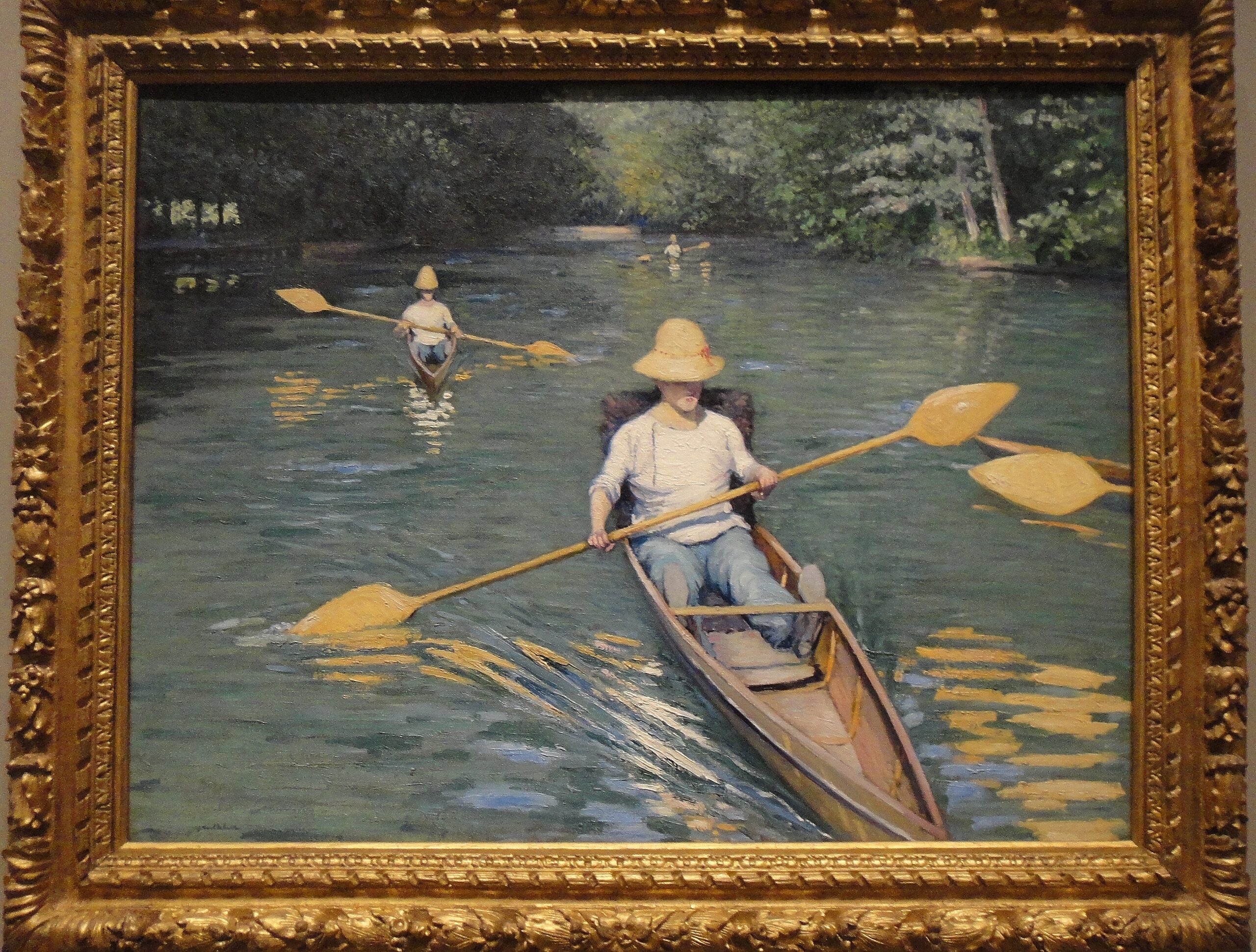
Caillebotte came to Monet’s attention through his paintings of rowers, swimmers, and fishermen, created at his family estate at Yerres, a small town southeast of Paris. Both men were boaters, and Caillebotte also designed boats. They also discovered they were avid gardeners.  Cailebotte’s “Skiffs” (1877) (35”x46”) is in the collection of the National Gallery of Art in Washington, D.C. It is one of several of his paintings of boats from 1877 until 1878. He was interested in everything that was going on in the art world, and his Impressionist instinct about color is evident. He uses fresh blues, greens, and yellows, and he painted with broad brush strokes to depict moving water. In “Skiffs” it is a sunny day, and the shadows across the rowers’ white tee-shirts are blue, not gray. The yellow coloring of the oars, hats, and sunlight on the water help to emphasize the rapid movements of the rowers. 

He continues to display his interest in perspective that was influenced by his keen interest in photography and Japanese prints. His tendency to crop and zoom-in is demonstrated in the work.  He places the view slightly above the rowers so the perspective hides their faces. Skiffs are flat bottomed boats that easily tip over if not handled correctly.  The energy Caillebotte creates in this painting helps the viewer to experience the challenge faced by the rowers.


“The Uphill Path, Chemin Montant” (1881)


In May of 1881, the Caillebotte brothers bought land on the Seine at Gennevilliers and built a holiday home they named Petit Gennevilliers. It was a popular sea-side resort in Argenteuil and Trouville. Caillebotte picked and chose from realism and Impressionist styles. “The Uphill Path, Chemin Montant” (1881) (39”x49’’) demonstrates that he had fully embraced Impressionist color and brushwork. The couple enjoy a leisurely stroll along a garden path on a sunny day. The sky is a bright blue. A dark orange parasol and a straw hat protect the couple who are at present on a shady part of the path, but will walk into the sunlight. Broad brush strokes of green, dark blue, yellow, and light green paint create a rich grassy lawn, with shadows crossing it from the trees on the right. The doorway to the Italian style villa is at the left. The color of the woman’s parasol, the villa’s shutters and brick walls, and a section of wall farther along the path draw the viewer’s attention deeper into the garden. Caillebotte’s unique sense of perspective is highlighted by the diagonal line of the house’s cement fence and the molding along its second story. The garden ends in a bright yellow sunlit patch of grass and a green hedge. This work was sold for $6.73 million at Christie’s in New York in 2003, and in 2019 for $22.1 million at Christie’s in London.


“Chrysanthemums in the Garden at Petit-Gennevilliers” (1893)


Caillebotte stopped showing his work in 1884, and he dedicated his time to gardening. “Chrysanthemums in the Garden at Petit-Gennevilliers” (1893) (39”x24’’) (Metropolitan Museum, New York City) is one of the many paintings he made of his garden and of flowers. Like other artists, he made still-life paintings, many of cuts of meat and fish, and some of flowers. Chrysanthemums were popular in Europe and France because of their variety of colors, as can be seen in this painting. The flowers also were popular because of their association with Japan. Chrysanthemums were symbols of longevity and the Japanese imperial family. This close-up composition is the result of his idea of decorating the panels of dining room doors with images of plants, an idea shared with his close friend Monet. His paintings included long paths of dahlias and sunflowers. He also grew orchids. 


Caillebotte in his greenhouse at Petit Gennevilliers (1892) (photograph)


Caillebotte maintained over the years close connections with several of the Impressionists. Renoir often came to stay at Petit-Genneviliers, and he served as the executor of Caillebotte’s will. Many of Caillebotte’s 500 paintings are in private collections. When he died in 1894 at the early age of 45, he left 68 paintings to the French government. They were not his own, but works he had purchased over the years to support Monet (14), Cezanne (5), Degas (7), Renoir (10), Sisley (9), Manet (4), Pissarro (19), and Millet and others. The Impressionists still were not welcomed in French museums.  Caillebotte stipulated the paintings were to be shown in the Luxembourg Palace, where the works of living artists were displayed. As executor, Renoir ultimately negotiated that 38 of the works would be shown at the Palace. The near-sighted French government had rejected the offer for the donation of the rest of the collection again in 1904 and 1908. The government finally accepted the donation in 1928, but it was too late. Other claimants had emerged and the paintings were sold.

Caillebotte’s works were not popular, because he did not need to exhibit his work. His reputation was based upon his support of the arts. His popularity and international fame as an artist are the result of the 2024 exhibition of his works at the Musee d’Orsay in Paris and the exhibition in 2025 at the Art Institute of Chicago.

 If he had lived instead of dying prematurely, he would have enjoyed the same upturn in fortunes as we did, for he was full of talent. He was as gifted as he was conscientious, and when we lost him, he was still at the beginning of his career. (Claude Monet)


Beverly Hall Smith was a professor of art history for 40 years. Since retiring to Chestertown with her husband Kurt in 2014, she has taught art history classes at WC-ALL and the Institute of Adult Learning, Centreville. An artist, she sometimes exhibits work at River Arts. She also paints sets for the Garfield Theater in Chestertown.


The Spy Newspapers may periodically employ the assistance of artificial intelligence (AI) to enhance the clarity and accuracy of our content.

Filed Under: Looking at the Masters

Looking at the Masters: Jacques-Joseph Tissot

July 10, 2025 by Beverly Hall Smith
Leave a Comment

Jacques-Joseph Tissot (1836-1902) was a successful painter and printmaker in the 19th Century. Born in Nantes, a port city in France, he would continue throughout his life to be interested in painting images with ships. His parents Marcel Tissot, a successful drapery merchant, and milliner Marie Durand influenced his interest in fashion and art. He decided by age 17 to become an artist, and by age 20 he was in Paris studying at the Ecole des Beaux-Arts. He learned to paint in the classical style. Hippolyte Flandrin, a well-respected Academic painter, was his major instructor. Tissot met life-long friends in Paris, among them Whistler, Manet, Oscar Wilde, and Degas, who became his mentor. He had success at the Paris Salon in 1859 with his paintings based on the popular story of Faust. Gounod’s opera Faust and Carre’s play Faust and Marguerite influenced the works. Tissot’s earlier works featuring medieval stories were considered by critics to be of the old style. Critic Paul de Saint-Victor wrote, “It is sad to see an intelligent and gifted artist betraying his talent with pedantic imitations.”

“Two Sisters” (1863)

“Two Sisters” (1863) (83’’x54’’) is characteristic of Tissot’s meticulous attention to detail. The two sisters stand on a grassy lawn beneath the trees.  The older sister’s white gown has a sheer layer of fabric decorated with laces draped over the well-fitted gown. Her red hair ribbon, red flowers tucked into her black ribbon belt, and black hat with red feathers are well matched. The younger sister’s white pinafore, appropriate for her age, has just the right amount of ruffles and lace.  The younger sister carries a round fancy basket that repeats the shape and colors of the hat. Fashion seems to be the subject of the painting. The sisters appear to be posing, revealing little of themselves. 

“Mlle L.L. in Red” (1864)

Tissot showed “Two Sisters” and “Mlle L.L. in Red” (1864) (49”x39”) for the first time at the Paris Salon of 1864 to illustrate his competency in depicting contemporary images. “Mlle L.L. in Red” is a mystery. The subject remains unidentified. Her red jacket was worn by the Zouaves, a French corps of soldiers formed in Algeria, who continued to wear their North African style uniform. The rows of bright red pom poms caught attention. Her lap and legs are merely suggested under the voluminous black skirt. Complementing her red jacket are the dark green color of the carpet and the red and green colors played out in the wall paper and the fabric covering of the chair. The subject appears to be a reader; she has books and loose papers in her room. The mirror behind her reflects an open door, and a card or photograph is tucked into the frame of the mirror. Charming and mysterious, she engages the viewer in a nonchalant manner. 

However, in 1864, another critic commented that Tissot created “genuine paintings…whose greatest merit consists in the sincerity of their modern feeling.” In Le Grande Journal, Jules Castagnay wrote, “Mr. Tissot, the crazy primitive of the most recent Salons, has suddenly changed his manner and moved closer to Mr. Courbet, a good mark for Mr. Tissot.” 

“Portrait of the Marquise de Maramon” (1866)

“Portrait of the Marquise de Maramon” (1866) (50”x38’’) is one of many portrait commissions received by Tissot. This portrait of the wealthy Marquise is more intimate than the group portrait of the family (1865). The setting is in their Chateau du Paulhac in Auvergne, France. Dressed in a deep pink peignoir, with rows of ruffles, the Marquise stands on a dark fur rug and leans on the fireplace mantle. She turns her head as if to recognize someone in the room.  A black scarf with a small silver cross is tied around her neck. The cross is a small item, certainly placed there by her choice for a personal reason. 

The room is lush. Red velvet drapery hangs from the fireplace and the window. It is evening. The candles on the mantle do not cast much light. The color of the bowl of flowers on the mantle, the same color as her gown, is designed to repeat the color of the gown. The portrait bust calls attention to the family’s nobility.  A ceramic Japanese dragon rising from waves sits on a white glove, the mate to the glove that the Marquise is wearing, another touch that adds a mystery.  The Louis XVI stool with needlework placed on top indicates she is a lady of leisure. Tissot borrowed this painting from the Marquis to show it at the 1867 Universal Exhibition in Paris.

Tissot, like many Parisians, was fascinated with Japanese art and artifacts, and he was among the great collectors of them. He included a Japanese folding screen and a Japanese ceramic in the painting. English Pre-Raphaelite artist Dante Gabriel Rossetti, visiting Paris in November 1864, wrote to his mother that he had purchased four Japanese books and on visiting Madame Desoye’s shop on the Rue de Rivoli “found all the costumes there were being snapped up by a French artist, Tissot, who it seems is doing three Japanese pictures, which the mistress of the shop described to me as the three wonders of the world, evidently in her opinion quite throwing Whistler into the shade.” In 1869, French art critic and novelist Champfleury wrote about Tissot’s passion: “The latest original event of note is the opening of a Japanese studio by a young painter with sufficient means to afford a small townhouse on the Champs-Élysées.” Tissot also was the drawing master for Prince Tokugawa Akitake, the brother of the last Shogun and leader of the Japanese delegation to Paris in 1867-68.

Tissot served on the French side in the Franco-Prussian War and later with the Paris Commune during the resistance. After the war in 1871, he traveled to London, where he remained for the next eleven years. He learned etching and drew cartoons and caricatures. He was employed by Thomas Bowles, the editor of Vanity Fair magazine. His work was shown at the Royal Academy in London under his pseudonym Coide. Tissot purchased a house in St John’s Wood, popular with British artists. The writer and art critic Edmond de Goncourt described it as “a studio with a waiting room where, at all times, there is iced champagne at the disposal of visitors.”

“The Ball on Shipboard” (1874)

Tissot believed London would be a source of patrons with money. He became a member of the Art Club in 1873. The member artists were popular with the wealthy industrialists of the day. The Industrial Revolution was changing the economy from hand-made to machine-made. From 1760 to 1830, iron and steel production, trains and ships powered by steam, use of electricity, use of machines in the production of goods, and advances in communication changed Britain and Europe. Tissot’s love of the sea, which he shared with Whistler, his interest in fashion, and his talent for storytelling communicated through his paintings appealed to numerous patrons. 

“The Ball on Shipboard” (1874) (51”x33”) combines several of his interests. A variety of national flags are sewn together as an awning. People are enjoying a sunny day. Many of them are beautiful young women dressed fashionably. Some walk about the deck, some sit in mixed company groups, and others go below deck. It is interesting to note that most of the men are older. 

Tissot continued to paint images of society, and the sale of his paintings added to his wealth. However, critiques were mixed. John Ruskin described Tissot’s paintings as “mere painted photographs of vulgar society.” The writer of an article in The Athenaeum said there were “no pretty women, but a set of showy rather than elegant costumes, some few graceful, but more ungraceful attitudes, and not a lady in a score of female figures.”  Another critic found the piece “garish and almost repellent.” Despite the British Victorian prudishness, prominent art dealer William Agnew, purchased “The Ball on Shipboard” and easily sold it for a nice profit.

Degas invited Tissot to show his work in the first Impressionist exhibition in 1874. Tissot refused, but remained friends with Degas and Manet and others of the Impressionist group 

“The Gallery of the HMS Calcutta, Portsmouth” (1876)

Victorian society was gender-segregated, which resulted in social and sexual tensions. Tissot represented this tension in “The Gallery of the HMS Calcutta, Portsmouth” (1876) Both women are dressed in white, a popular color choice at the time, and their dresses are decorated with bows and ribbons. The hourglass figure is achieved with a tight bodice over a corset. The woman with yellow bows holds a large fan in front of her face, not looking at the junior naval officer and the woman next to him. Fans were used for secret messages. An open fan at the left ear meant “do not betray our secret.” 

Curves are plentiful in Tissot’s composition, from the curves of the ladies to the curves of the wicker chairs on deck. Even the shape of ship’s gallery, a type of balcony at the back of a ship that houses the officers’ quarters, is curved. Questions about motives and relationships abound.

American-British writer Henry James, whose novels often told the story of marital situations between English and Europeans, described the painting as “hard, vulgar and banal.” Another critic suggested Tissot chose to name the ship Calcutta because it was a play on words from the French “Quel cul tu as” (What an arse you have). The painting was exhibited in 1877 and was sold to Johon Robertson Reid, a Scots painter who became president of the Society of British Artists in 1886.

There may be another reason the ship was named Calcutta. It was a second-rate British ship of the line with 84 guns. Built in Bombay in 1831, it was recommissioned to serve in the Crimean War in the Baltic. It also served from 1856 until 1858 in the second opium war in the Far East. In 1858, Calcutta was the first ship of the line to visit Japan.

Tissot met the Irish beauty Kathleen Newton in 1875, and the couple formed a strong relationship until her death from tuberculosis in 1880. Since she was a divorced Irish Catholic, they could not marry. However, they lived together openly and had a son, Cecil George Newton (b.1878). Kathleen was Tissot’s lover, companion, and muse. She was frequently a female figure in his paintings. After her death, Tissot sold the London house and moved back to Paris. He became interested in spiritualism, popular at the time, and even held a séance.  

“Artists and their Wives” (1885)

“Artists and their Wives” (1885) (58’’x40’’) is a depiction of well-known painters and sculptors attending the celebratory lunch on Varnishing Day at the restaurant Le Doyen in Paris. Varnishing day was the day before the opening of the Paris Salon when artists put the final coat of varnish onto their paintings. The artists and their friends could then view the exhibition privately before it was opened to the public the next day. The painting was exhibited at two solo exhibitions, in Paris in 1885 and in London in 1886.

After the death of Kathleen, Tissot painted a series of 15 paintings titled “The Women of Paris” (1885).  A Roman Catholic, he also turned his attention to religion. He began a series of paintings that he believed told the truth of the Bible stories of the life of Christ. He traveled to the Holy Land several times between 1886 and 1896. He produced 365 watercolor images, of which 270 were published in a book that became a bestseller. After finishing the project, he began a series of pictures based on Old Testament stories.  He died before he could finish the project. 

After 11 years in London, Tissot never surrendered his French citizenship. One of his biographers described him “the most English of all French painters.”

The writer of an article in the journal L’Artiste (1869) concluded, “While our industrial and artistic creations may perish, and our customs and our costumes may fall into oblivion, a painting by Mr. Tissot will be enough for archaeologists of the future to reconstruct our era.”


Beverly Hall Smith was a professor of art history for 40 years. Since retiring to Chestertown with her husband Kurt in 2014, she has taught art history classes at WC-ALL and the Institute of Adult Learning, Centreville. An artist, she sometimes exhibits work at River Arts. She also paints sets for the Garfield Theater in Chestertown.

The Spy Newspapers may periodically employ the assistance of artificial intelligence (AI) to enhance the clarity and accuracy of our content.

Filed Under: Looking at the Masters

Looking at the Masters: Guiseppe De Nettis

July 3, 2025 by Beverly Hall Smith
Leave a Comment

Italian artist Giuseppe De Nettis (1846-1884) was born into a wealthy family in Barletta, Italy. He trained for a short time in the Italian classical style of painting. At the age of 21, he moved to Paris, the heart of the art world at the time. He was engaged by Adolphe Goupil, founder of Goupil & Cie (1850), the leading art dealer and publisher in Paris in the 19th Century, to create saleable genre paintings. His works were exhibited in the Salons, and he received a Gold Medal and was made a member of the Legion of Honor. He became a success and his work was in demand.


“Japanese Ladies Admiring a Screen” (1870)

“Japanese Ladies Admiring a Screen” (1870) (watercolor and pencil) (14’’x11’’) responded to the interest in Japanese ukiyo-e prints that were introduced to France in the 1860s. The prints were among De Nettis’s early purchases of art.  The patterns of Japanese silk kimono fabrics and the lanterns and screens fascinated French patrons and artists alike. Van Gogh amassed one of the largest collections of ukiyo-e prints. The classical style of painting that De Nettis learned is obvious in his use of traditional techniques of color and light. The composition is pleasing, and a prospective buyer would have enjoyed the lavish kimonos and the patterns on the lanterns and folding screens. The small scale would have appealed to buyers with moderate funds and normal size houses. 

In 1869, De Nettis married Leontine Lucille Gruvelle (1842-1913), an accomplished and beautiful woman, who often served as his model. De Nettis fled Paris for London in 1870 to avoid the Franco-Prussian War and the siege of Paris from September 1870 until January 1871. Monet, Pissarro, and Sisley were among the artists who went to London, and Degas visited his family in New Orleans. On his return to Paris, De Nettis stopped in Italy and was the first artist to depict the eruption of the Mt Vesuvius volcano.


”La Grenouillere”

When De Nettis returned to Paris in 1872, he began painting cityscapes and the people of Paris. La Grenouillere was a floating restaurant on the Seine at Croissy-sur-Seine. It was a popular gathering place for Monet, Renoir, and other Impressionists. “La Grenouillere” (1873-74) (14”x11”) is a depiction of four fashionably dressed women, walking down a stone stairway to engage a boatman to row them across to the restaurant. The day is sunny and the flowers are popping out on the hill. The women perhaps anticipate a pleasant boat ride. 

Having met several of the Impressionists, De Nettis began exploring some of their techniques:  painting outdoors, exploring suggestive brushstrokes, and using the colors of sunlight to create shadows. For example, the shadows on the white dress of the woman engaged with the boatman are painted blue, not gray. 

Degas invited De Nettis to show his work in the first Impressionist Exhibition in 1874. His five paintings, not well liked by some of the Impressionists, were hung in a dark spot. He did not show with them again. His work continued to combine elements of both Realism and Impressionism.  De Nettis’s Paris home became a popular salon for artists, poets, writers, musicians and others, including Oscar Wilde, Alexander Dumas, and Emile Zola. De Nettis often cooked “lasagne alla Barlettana,” an Italian dish that received cheers from the guests, “Viva De Nettis.” 


“Le Place du Pyramids” (1875)

De Nettis also chose to paint images of the reconstruction of famous landmarks that were damaged during the Franco-Prussian War. “Le Place du Pyramids” (1875) (36”x30”) is a depiction of an iconic Parisian location. It was named in honor of Napoleon’s victory in Egypt in 1789. The statue of Joan of Arc is prominent at the center. Advertisements cover the scaffolding around the building. Parisiens going about their daily business walk through the busy square, passing by market carts, carriages, and a horse drawn bus. The sky is gray and the pavement wet. Le Place du Pyramids is in the middle of Rue de Rivoli, near the eastern end of the Tuileries Gardens.


“Arc de Triomphe” (1875)

“Arc de Triomphe” (1875) (21”x16’’) is a depiction of another well-known Paris landmark, under scaffolding for repair of damage during the Franco-Prussian War. The painting represents the resilience of the Parisiennes. It is autumn, and the tree leaves have turned orange. A wealthy couple on horseback enjoy a ride along the Champs-Elysees. They have passed under the Arc de Triomphe. De Nettis was adept at painting horses, and like Degas, he often painted the races at Longchamp. People are about to cross the road, among them a red-haired woman in a bright plaid coat, a well-dressed woman in black, and a young girl wearing red socks. The trio is probably an upper-class mother, her daughter, and a maid or nanny. 

The figures are painted realistically. The avenue is created with casual brushstrokes of a variety of beiges and browns, but also blues. Across the Champs-Elysees, the horse drawn carriage, people, trees, and distant buildings are more Impressionistic. De Nettis’s use of black paint throughout the painting distinguishes him from the Impressionists. 


“La parfumerie Violet, on the Boulevard des Capucines” (1880)

“La parfumerie Violet, on the Boulevard des Capucines” (1880) is a depiction of what was one of the most elegant boulevards in Paris. The Maison Violet was opened in 1827 by Francois-Etienne Violet. Famous for its fragrances, its perfumes received a great many awards and patents for their scents. The studio of the famous French photographer Felix Nadar (1820-1910) was located at 35 Boulevard des Capucines. The rich and famous came there to have their photographs taken. The studio also was the location of the first Impressionist exhibition in 1874.


“Breakfast in the Garden” (1884)

“Breakfast in the Garden” (1884) (34”x46’’) is one of De Nettis’s last works. His beloved wife Leontine and their son Jacques sit at a table in the shade of overhanging trees, and they enjoy breakfast in the sunny garden.  The table is set with coffee cups, silverware, a China cream and sugar set, a vase of spring flowers, and a white tablecloth with napkins. In front of the table is an empty wicker chair where De Nettis had sat. Leontine and Jacques concentrate on a curious duck that has come close. Other ducks are on the lawn and under the shade of nearby trees. De Nettis painted a happy time with his family. His skill at painting in the Impressionist style, when he wanted to, is fully visible. 

During his short career, De Nettis painted in Paris, on yearly trips to London, and while visiting Italy. He was named Knight of the Order of the Crown of Italy in 1875.

De Nettis died in 1884 at the young age of 38 from a stroke. He was honored in 1886 with a memorial exhibition at The Galerie Bernheim Jeune in Paris. Other exhibitions followed. In1984, he was honored with a 300 lire postage stamp. Since De Nettis chose to go his own way at a time when the popularity of Impressionism was on the rise, his works became eclipsed for a time. Today, his work is considered among the best of his time.


Beverly Hall Smith was a professor of art history for 40 years. Since retiring to Chestertown with her husband Kurt in 2014, she has taught art history classes at WC-ALL and the Institute of Adult Learning, Centreville. An artist, she sometimes exhibits work at River Arts. She also paints sets for the Garfield Theater in Chestertown.

The Spy Newspapers may periodically employ the assistance of artificial intelligence (AI) to enhance the clarity and accuracy of our content.

Filed Under: Looking at the Masters

  • « Previous Page
  • 1
  • 2
  • 3
  • 4
  • …
  • 13
  • Next Page »

Copyright © 2025

Affiliated News

  • The Chestertown Spy
  • The Talbot Spy

Sections

  • Arts
  • Cambridge
  • Commerce
  • Ecosystem
  • Education
  • Food & Garden
  • Health
  • Local Life
  • News
  • Point of View
  • Senior Nation

Spy Community Media

  • Subscribe for Free
  • Contact Us
  • COVID-19: Resources and Data

© 2025 Spy Community Media. | Log in