
MENU

Sections

  • About Us
    • Editors and Writers
    • Sponsorship Terms & Conditions
    • Code of Ethics
    • Sign Up for Cambridge Spy Daily Email Blast
  • The Arts and Design
  • Culture and Local Life
  • Food & Garden
  • Public Affairs
    • Commerce
    • Health
    • Ecosystem
    • Education
    • Senior Nation
  • Point of View
  • Chestertown Spy
  • Talbot Spy

More

  • Support the Spy
  • About Spy Community Media
  • Advertising with the Spy
  • Subscribe
December 6, 2025

Cambridge Spy

Nonpartisan and Education-based News for Cambridge

  • About Us
    • Editors and Writers
    • Sponsorship Terms & Conditions
    • Code of Ethics
    • Sign Up for Cambridge Spy Daily Email Blast
  • The Arts and Design
  • Culture and Local Life
  • Food & Garden
  • Public Affairs
    • Commerce
    • Health
    • Ecosystem
    • Education
    • Senior Nation
  • Point of View
  • Chestertown Spy
  • Talbot Spy
3 Top Story Arts Looking at the Masters

Looking at the Masters: Pieter Brueghel the Elder and Netherlandish Proverbs     

October 13, 2022 by Beverly Hall Smith
Leave a Comment

Pieter Brueghel the Elder (1525/30-1569) became a member of the Antwerp Painters Guild in 1551. We know little of his life before that date except that he was an accomplished artist. On his return from a trip to Rome (1552-1553) to view the work of Italian Renaissance artists, the path that non-Italian artists took at the time, he began to create drawings for engravings by Quatre Vents, the most prestigious printer in Antwerp. During his career, Brueghel made over 80 drawings for prints.

Brueghel lived during volatile political and religious times in the Netherlands. Protestantism was growing, particularly in Antwerp, a cosmopolitan city, the center of north-south trade, and a major port. Calvinism was particularly strong in Antwerp. Charles V of Spain, ruler of the Netherlands, had established in 1552 a special court to prosecute non-Catholic heretics, and he declared in 1549 the Netherlands was a province of Spain. His son Philip II, an extremely devout Catholic, continued the rule of the Netherlands on his father’s death in 1556. Ultimately, Philip declared he would never rule over heretics and brought in the Duke of Alva in 1567 to put down the Protestant revolt. The Eighty Years’ War (1568-1648) split the Dutch Protestants in the north from the Belgian Catholics in the south. 


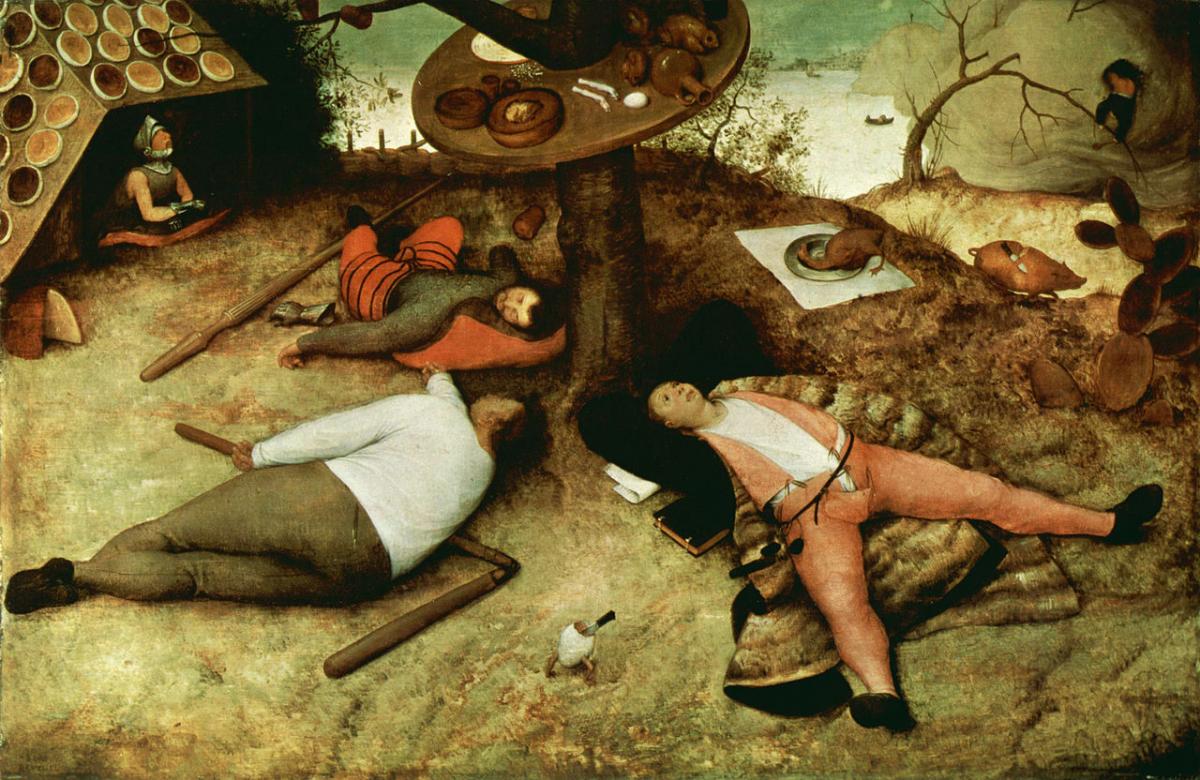
The Land of Cockayne” (1567)

Brueghel’s paintings, many depicting Old Testament stories with subtle criticisms of Catholicism and the government, by necessity began to change. As the religious and political situation worsened in Antwerp in the 1560’s, and prisons filled with so-called heretics, and the Protestant resistance grew stronger, Brueghel turned to the less controversial subject matter of peasant dances and peasants at work during the seasons. In the last two years of his life, Brueghel painted popular myths and Netherlandish proverbs. 

“The Land of Cockayne” (1567) (20.4’’x30.7”) depicts a medieval myth that describes an imaginary land reached by eating one’s way through a rice pudding mountain. “All ye who are lazy and gluttonous be ye peasant, soldier, or scholar, get to the land of Cockayne and taste there all sorts of things without labor. The fences are sausages, the houses covered with cakes; capons and chickens fly around ready roasted.” Under a round table full of food, a scholar with his books and fur-lined robe, lies spread legged and sated. The peasant, flail under him, forms the second spoke of a wheel pattern. A soldier dressed in red, with a spear, forms the third spoke of the wheel. The fourth spoke is a duck, its head lying obligingly on a plate ready to be chopped off. Wheels are circles symbolic of the sun and rays of light, and they represent eternal life. The wheel of fortune, a tarot wheel, can bring either good or back luck. At the left, a soldier under a roof tiled with cakes, opens his mouth and waits for a cake to fall in.  At the far right, a pig walks by, a carving knife stuck in his hide. Behind the pig is the rice pudding mountain, and a figure holding a spoon is falling from the tunnel he has just eaten his way through. “The Land of Cockaigne” depicts a land very different from the economically stressed situation of the time. 
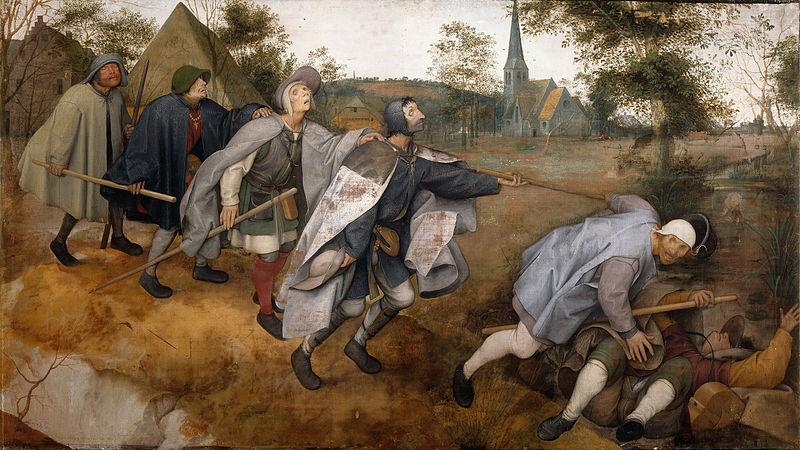
“The Blind Leading the Blind” (1568)

    “The Blind Leading the Blind” (1568) (33.8”x 60.6’’) depicts a verse from the Gospel of Matthew (15:14): “Let them alone; they be blind leaders of the blind. And if the blind lead the blind, both shall fall into the ditch.” Six blind men walk across the composition from left to right. The first blind man at the lower right has already fallen into the ditch, with the others not far behind. Ophthalmologists have been able to determine that one of the men suffers from corneal leukemia, another from atrophy of the globe, and a third has had his eyes removed. Brueghel’s ability to depict details is remarkable. The blind men clearly are dressed as members of the peasant class. Many of Brueghel’s paintings include images of the blind as well as cripples with crutches and people with deformities.  Such people were not unusual in his time. 

The church of St Anne, from the village of St Anne, Pede, is set in the background at the right. Whether the church is Catholic or Protestant is not certain. The Catholic church believed that good deeds and charitable acts were important for entry into heaven. However, the Protestant church believed that faith alone would serve as entrance to heaven. Thus, beggars and the infirm saw a deep decline in charitable donations.  

“The Misanthrope” (1568)

“The Misanthrope” (1568) includes the proverb written on the painting. “Because the world is so untrue, I go my way so full of rue.” Defined as a person who dislikes and mistrusts other people, the elderly misanthrope in the painting tries to shut himself off from the world. In a long black cape that hides all but his long nose, long white beard, and his clenched hands, he turns his back and seems to walk out of the painting. But he cannot remove himself from the world. Unknown to the misanthrope, a young man is about to cut his purse from his person, and he is about to step on three sharp snares on the ground ahead of him. The robber is encircled by a globe with a cross on top symbolizing the universal nature of the church, which he clearly does not embrace–or he represents. They both have passed by a pastoral landscape with a shepherd guarding his black and white sheep. In other words, they pay no attention to the good shepherd who protects his flock safe from harm.


“The Peasant and the Birdnester” (1568)

Brueghel had many proverbs to choose from, as they were much in use in the Netherlands. Erasmus of Rotterdam published Adagia (1500) containing 800 collected proverbs. In his 1508 version there were over 3000 items, and his last edition in 1536 contained 4,151 entries. “The Birdnester” (1568) depicts the proverb: “He who knows where the nest is has the knowledge. He who robs the nest, has the nest.” The peasant smiles and points at the foolish peasant who is risking his life by climbing the tree to get the bird nest, unaware that he is about to walk into the river. The thief has lost his hat while he hangs precariously from the high tree. He has the nest in his hands, but can he safely get down from the tree? 

Influenced by 15th Century Netherlandish paintings, Brueghel has included several flowers at the left edge of the river. The most visible and identifiable is the single purple iris. Symbolism for the iris comes from the Greek goddess of the rainbow named Iris, and the iris appears in the Old and New Testaments. The first reference is from Genesis (9:13) in which God says to Noah, “I have set my bow in the cloud,” as a covenant between man and God that he will not destroy the Earth with a flood. The three petals of the iris represent the trinity, and the iris re-emerges each spring from the cold winter earth. The presence of the iris may indicate there is still hope for these two.

“The Merry Way to the Gallows” (1568)

“The Merry Way to the Gallows” (1568) was one of Brueghel’s last paintings. In 1567, the Duke of Alva and the Spanish army arrived in the Netherlands to rid the land of all Protestants. The gallows were in full use. Executions were popular entertainment events; people of all ages attended. The gallows take center stage in the painting. It is a lopsided structure; the lower support legs almost appear to be walking. Two peasant men and a woman dance in a circle at the foot of the gallows. Behind the dancers, a man plays a bagpipe. Bagpipes were common in Netherlandish art, symbolic of rowdiness. Villagers come up the hill from the town to see the execution.

Two men at the lower left appear to look out at the vast panoramic landscape that forms more than half the painting. One gestures into the distance. In the lower left corner, a man in dark clothing squats on the ground and shits, mocking the state. All three ignore the gallows and the justice it should represent.

The painting has an alternative title: “The Magpie on the Gallows.” Magpies have a long symbolic history. In Europe the magpie was considered intelligent, but also represented deceit and opportunism. Magpies destroy farm crops and steal food from other birds’ nests. They also steal any shiny object they see. Two magpies are prominent in the painting. One sits on top of the gallows at the center of the composition. A second magpie sits at the base of the gallows on the branch of a dead tree. Magpies are associated with people who gossip, and in Brueghel’s time spiteful gossip often led to arrest and execution. The skull of a horse on the slope at the right of the gallows adds to the atmosphere of death. 

To the right of the gallows and lower on the hill is a wooden cross, the one symbol of the church present in the painting. In contrast to the gallows, the rest of the landscape includes green trees, a distant winding river, and mountains that are a reminder of the Alps. In the left middle ground is the grey stone of a hilltop castle. A mill with its water wheel is tucked into the lower left corner. The green pasture by the mill contains sheep, and a miller, clothed in white, can be seen in the doorway. Life goes on.

Brueghel was critical of the political and religious strife that were destroying the Netherlands, and in earlier paintings he included subtle, and not so subtle, references to his distain. One painting in particular, “The Massacre of the Innocents in Bethlehem” was retouched to make the babies into bags of wheat. Before he died, he had his wife burn some of his paintings that were too sarcastic or critical, fearing harm would come to her if she kept them. He told her to keep “The Magpie on the Gallows” for herself.

Beverly Hall Smith was a professor of art history for 40 years.  Since retiring with her husband Kurt to Chestertown in 2014, she has taught art history classes at WC-ALL. She is also an artist whose work is sometimes in exhibitions at Chestertown RiverArts and she paints sets for the Garfield Center for the Arts.
The Spy Newspapers may periodically employ the assistance of artificial intelligence (AI) to enhance the clarity and accuracy of our content.

Filed Under: 3 Top Story, Looking at the Masters

Looking at the Masters: Fujiko Nakaya 

October 6, 2022 by Beverly Hall Smith
Leave a Comment

Fujiko Nakaya was born in Sapporo, Japan, in 1933. She was inspired by her father Ukichiro Nakaya, well-known physicist, researcher, and founder of Iwanami Productions (1950), maker of educational films and documentaries. He specialized in glacial studies, and he made the first artificial snowflake. Ukichiro also was a Sumi-e artist of Asian ink brush paintings.  He was dedicated to issues concerning the environment and art, interests he passed on to his daughter. Nakaya graduated from the High School of Japan Women’s University, Tokyo. She came to Northwestern University in Evanston, Illinois, to study painting. She received her BA in 1957, and then went to Paris and Madrid where she studied painting until 1959.

“Fog Sculpture #47773” (1970)

Nakaya soon would change from painting to fog sculpture: “I used to paint clouds. And at a certain point I wanted a more direct experience-oriented form of art that painting couldn’t provide. I felt unsatisfied with the painting as a medium and started thinking about working with temperature difference which is responsible for changes in a lot of forms of nature—in animals and in people and things. I made dry ice clouds on a plate with a heater underneath. So, I was experimenting with the change of form through temperature differences.”  

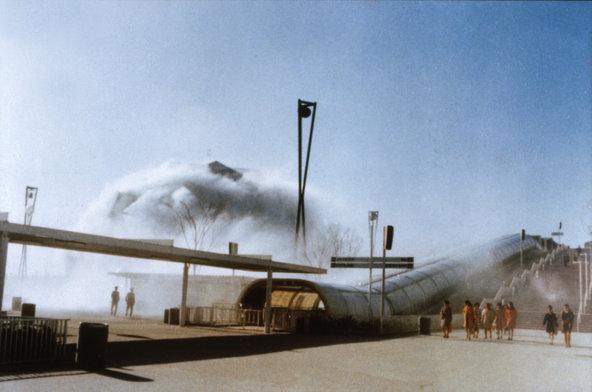
In 1966, Nakaya joined EAT (Experiments in Art and Technology), a non-profit established by engineers and artists, including the POP artist Robert Rauschenberg, to facilitate collaboration between the two. Nakaya’s “Fog Sculpture #47773” (1970) was chosen to represent EAT at EXPO ’70 in Osaka. The theme of the EXPO was “Progress and Harmony for Mankind.”  One of the exhibitors was the Pepsi Company that sponsored a Buckminster Fuller-type geodesic dome. As one of the EATS group of 75 artists and engineers from America and Japan, Nakaya was responsible for the outside of the PEPSI Pavilion.  

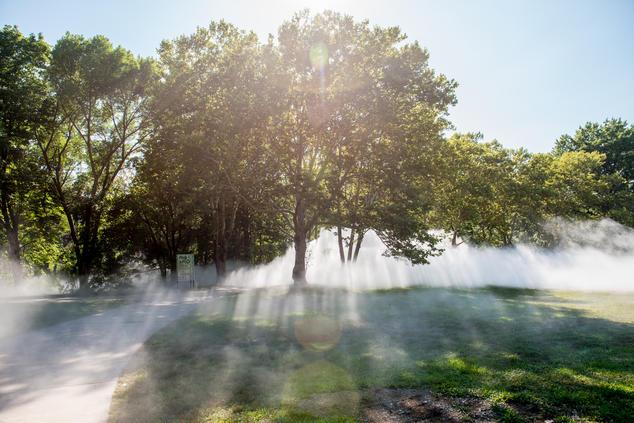
Collaborating with American physicist Thomas Mee, Nakaya helped develop a process for creating fog. Pressurized water was forced through a tiny nozzle and hit a pin that separated water into droplets about 20 microns wide. The droplets were so small they remained suspended in air for a long time, like fog. 

Nakaya succeeded in manufacturing artificial fog on a massive scale in order to cover the Pavilion.  Billions of droplets of water (fog) surrounded the Pavilion and spread out to visitors. “Fog Sculpture #47773” was considered the most spectacular exhibit at the EXPO. 

Since 1970, Nakaya has produced more than 80 fog gardens, falls, and geysers all over the world. Nakaya explained, “When you experience nature with your body, the quality of the experience really sticks…I want to create a situation where people can establish a physical relationship with nature…Through this relationship, we gain the instinctive wisdom to make decisions to preserve nature.”

Continuing her experiment to perfect the technique, Nakaya patented in 1989 a device for the purpose of making cloud/fog sculpture from water. The numbers included in the titles of her fog sculptures are the international code for the closest weather station.


“Foggy Wake in a Desert #94925” (1982)

“Foggy Wake in a Desert” (1982) (Canberra, Australia) was the result of Nakaya’s collaboration with scientist Dr. Yasushi Mitsuta of Kyoto University to investigate the impact that one square kilometer (3280.84 square feet) of fog would have on the desert. The project took place on a landscape Nakaya designed, near the National Gallery of Australia. Nine hundred nozzles pumped the foggy mist from 12:30 until 2:00 pm daily. The climate and ecological changes were recorded for ten years. Science and art came together, and “Foggy Wake in a Desert” was a success. In 1983, it became a permanent installation in the Sculpture Garden of the National Gallery of Australia, Canberra. 


“Opal Loop, Cloud Installation #72503” (1980)

Nakaya designed her first indoor fog project for the Trisha Brown Dance Company in New York City in 1980. At times the fog came down from above the dancers, and at other times it moved across the stage while dancers appeared and disappeared in the mist. The fog also rolled out into the audience, enveloping them in the environment of the performance. “Opal Loop, Cloud Installation” has been performed several times since. 

Nakaya has worked with artists all over the world to provide fog sculptures to accompany concerts. She participated in international sculpture conferences and exhibitions. One was in Washington, D.C. in 1980. She began making videos of her projects in 1979. She founded Video Gallery SCAN in Tokyo to promote video art in Japan. Nakaya participated in the First International Water Sculpture Competition (1983) organized by the New Orleans Museum of Art.


“Children’s Forest #47660” (1992)

According to Nakaya, “Fog reacts to local meteorological conditions…landscape can appear to be largely static until fog is introduced.” She introduced fog into public parks, across bridges, in parking lots, and where ever she is invited to share her unique art. All the fog sculptures invite interaction with visitors. “Children’s Forest #47880” (1992) (Showa Kinen Park, Tachikawa, Tokyo, Japan) provides an example of peoples’ playful response to fog sculptures.  

“Fog Bridge” (2013)

Nakaya created fog sculpture for number of museums including the Guggenheim Museum, Spain in 1993 and 1998/99, the Tate Modern in London, and the Pompidou Center in Paris 2017. Fog sculpture installations in the United States include the University of Michigan Museum of Art, Ann Arbor, Michigan, in 2010. “Fog Bridge #72494” (2013) (Exploratorium, San Francisco), celebrated the 75th anniversary of the Golden Gate Bridge. “Fog Bridge” was 150 feet long bridge that enshrouded visitors with fog for ten minutes every half hour. It was pre-programmed to interact with real-time weather. If the wind was coming from the east, the 800 small nozzles would make fog only on the east side of the bridge. “Fog Bridge” is a permanent installation at the Exploratorium. Nakaya states, “Fog makes visible things become invisible and invisible things – like wind – become visible”.

“Veil” (2014)

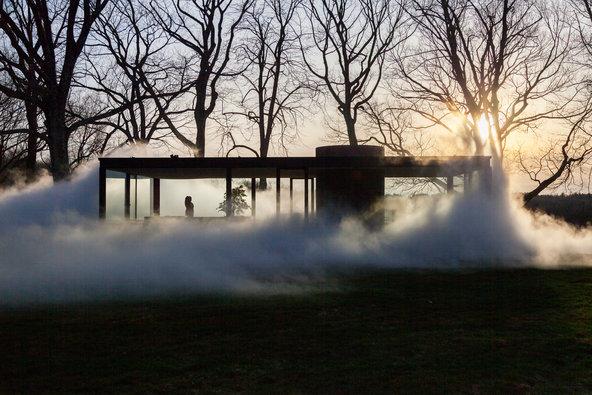
 For American architect Philip Johnson’s Glass house in New Canaan, Connecticut, Nakaya created “Veil” (2014). Fog shrouded the house for 10-15 minutes each hour, creating a unique experience for visitors of the transparency of the glass, the changing time of the day, and the surrounding landscape.

“Fogscape” (2015)

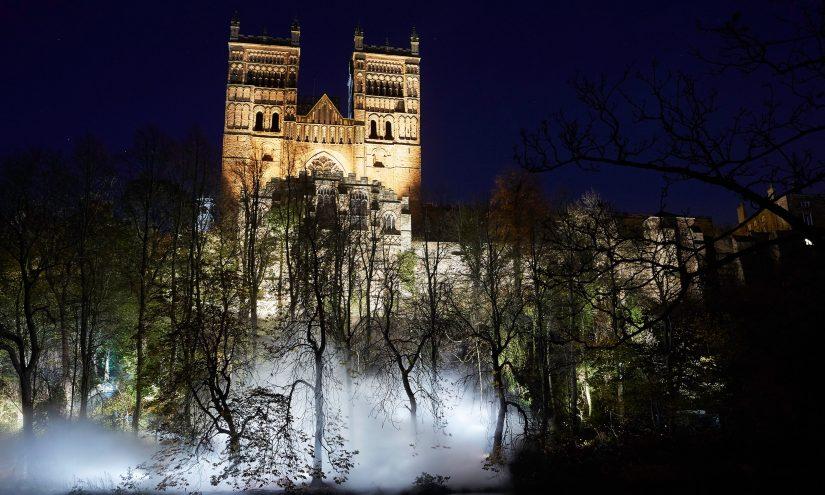
Durham Cathedral, England is one of the historical locations for Nakaya’s fog sculptures “Fogscape” (2015). Fog sculpture is one of several off-shoots of installation art, happenings, and performance art that began in the late 1950’s and has been continued by such artists as Christo. They open up the experience to numerous visitors and encourage participation. They last for a short time but are photographed extensively and are either recorded on video or published in books.


“Fog x Flow” (2018)

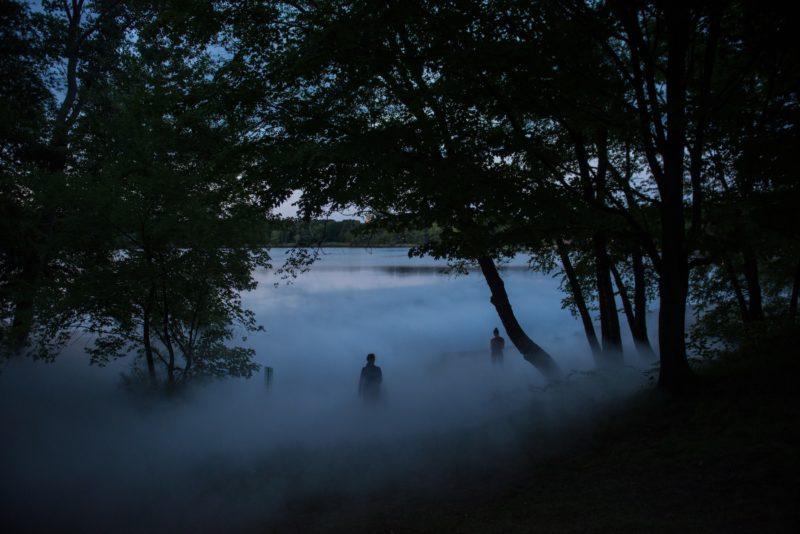
“Fog x Flo” (2018) was a series of five fog sculptures to celebrate the 20th anniversary of Boston’s Emerald Necklace Conservancy. It was established in 1998 as a private non-profit stewardship organization to restore and maintain Boston’s public parks designed by Frederick Law Olmstead. Olmstead was the 19th Century landscape architect responsible for the design of over 100 public parks and recreation grounds in America. Boston’s Emerald Necklace Park had been neglected for over 50 years. Nakaya’s fog sculptures transformed the parks into another magical environment. As with all Nakaya’s fog sculptures, she insists the mechanics are visible and audible.

“Fog x Flo” (2018)

“Fog has a very democratic status. It’s constantly moving, and when two droplets collide, they each go off a little, making room for each other. It makes the world a little bigger—for everyone.”  (Nayaka, n.d.)


“Fog x Flo” (2018)

“If you have even one little experience with fog, you start to see things differently. Nature is so complex. We can’t understand its complexity. If you tap one spot it will open up so many things and enlarge imaginations.” (Nakaya, 2013)

Beverly Hall Smith was a professor of art history for 40 years.  Since retiring with her husband Kurt to Chestertown in 2014, she has taught art history classes at WC-ALL. She is also an artist whose work is sometimes in exhibitions at Chestertown RiverArts and she paints sets for the Garfield Center for the Arts.


The Spy Newspapers may periodically employ the assistance of artificial intelligence (AI) to enhance the clarity and accuracy of our content.

Filed Under: 3 Top Story, Looking at the Masters

Looking at the Masters: Alfred Sisley

September 29, 2022 by Beverly Hall Smith
Leave a Comment

Alfred Sisley (1839-1899) was a founding member of the Anonymous Society of Painters, Sculptors, and Engravers in Paris. The group of artists were students at the Ecole des Beaux-Arts, and all painted in “plein air” (outdoors) near Paris at the Forest of Fontainebleau. The original group of artists included Sisley, Monet, Renoir, and Bazille, and they quickly were joined by several others. The group held their first exhibition in Paris in1874. A critic, making fun of the title of Monet’s painting “Impression Sunrise,” wrote sarcastically how impressed he was. From that time on, the group has been known as the Impressionists. 


“The Bell Tower at Noisy-le-Roi, Autumn” (1874)

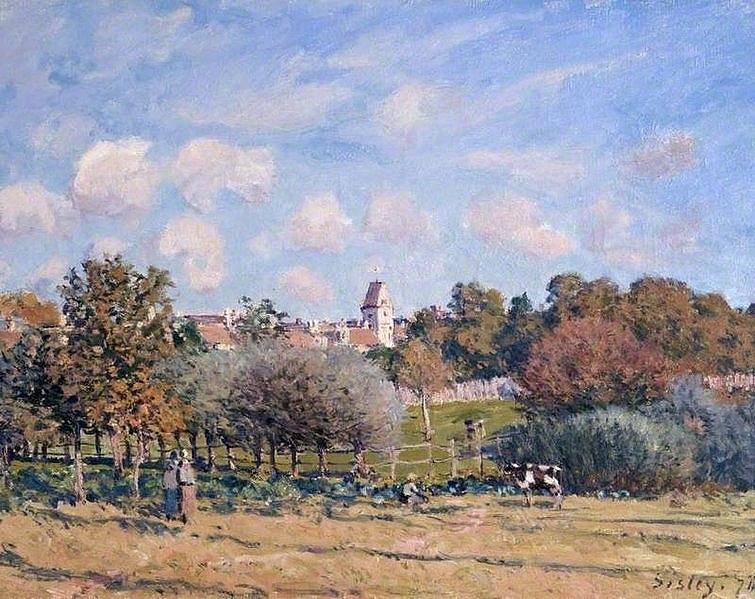
Alfred Sisley is one of the lesser-known Impressionists who became popular after his death. “The Bell Tower at Noisy-le-Roi, Autumn” (1874) (17” x 24”) illustrates Sisley’s style and his talent. The inspiration for the Impressionists was the scientific discovery that sunlight, which illuminates everything, was composed of the colors of the rainbow: purple, blue, green, yellow, orange, and red. All Impressionists began painting in plein air, but Sisley never stopped. He was not a painter of people or the bustling city life of Paris. He was the painter of landscapes and villages up and down the Seine near Paris. He and his family lived in several of these villages his entire life, and local landscapes never failed to inspire him. He painted the villages, fields, forests, and rivers that composed the beauty of the French countryside.

“The Bell Tower at Noisy-le-Roi, Autumn” presents the viewer with a field that has been harvested, a few town residents, and a black and white spotted cow in front of a wooden fence. The fence divides the fields from the town’s bright yellow-green lawn. The sunlight on the field is painted with bright yellow, green, and orange. The deeper furrows in the field are blue, green, and purple. In contrast, the shade under the autumn trees is painted in cool greens and blues. 

The orange tile roofs of village houses and the bell tower can be seen beyond the trees.  It is a beautiful fall day with a blue sky and scudding white clouds. The complementary colors of orange and blue, green and red, and yellow and purple are distributed throughout the peaceful village scene.  

Half the painting is of the sky, the white clouds shadowed underneath with light orange paint. Sisley once said to a critic, “…the sky cannot only be a background…I always begin by painting the sky.” He explained his approach in a letter to his friend Adolphe Tavernier: “The sky is not simply a background; its planes give depth (for the sky has planes, as well as solid ground), and the shapes of clouds give movement to a picture. What is more beautiful indeed than the summer sky, with its wispy clouds idly floating across the blue? What movement and grace! Don’t you agree? They are like waves on the sea; one is uplifted and carried away.”


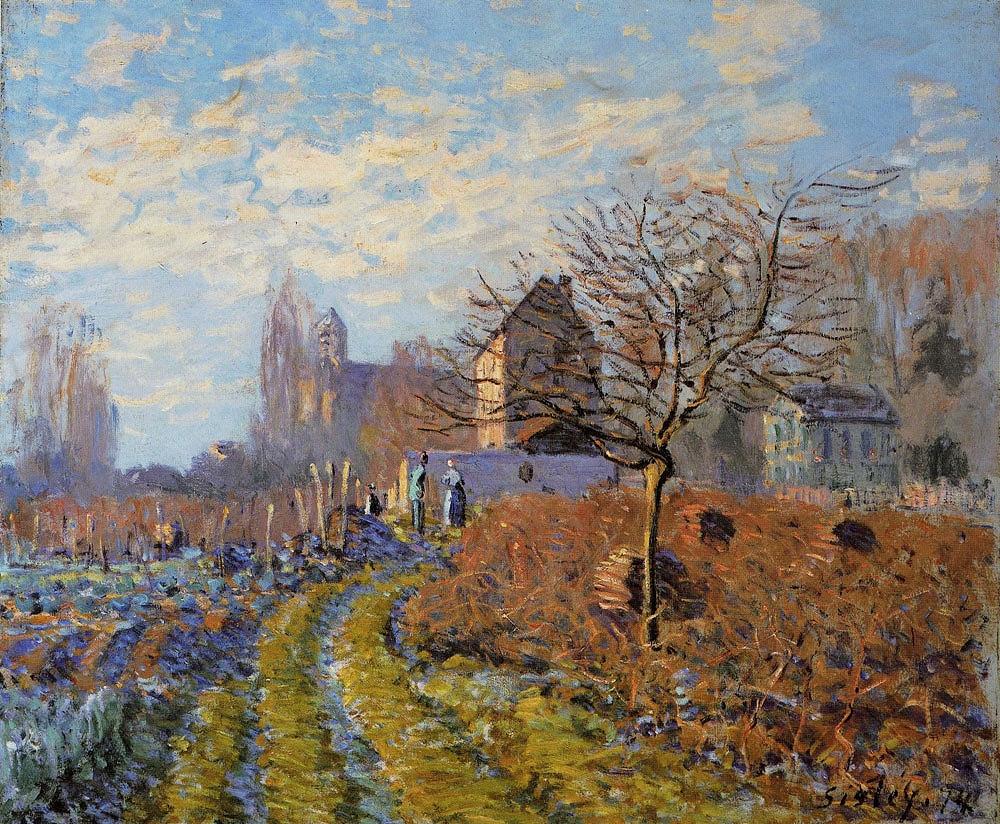
https://ts.spycommunitymedia.org/files/2022/09/2-White-Hoar-Frost-St-Martin-Autumn-Indian-Summer-1874.jpg

“White Hoar Frost, St. Martin, Autumn, Indian Summer” (1874) (18’’x 21.5’’) depicts another scene of autumn, but it shows the unending variation Sisley found outside his own front door. Autumn is on full display, and the nearby tree has lost all its leaves. At the right, the plants in the field have gone gold and orange, and stacks of logs are ready for winter fires. The furrows are deep and depicted with dark blue and purple in contrast with the yellow and orange of the harvested crops. Sisley’s paintings include a small number of figures, letting the viewer know that the townsfolk are there and active. 

The nearer buildings are painted with wide brush strokes and more intense colors to emphasize the solid structures. As the buildings recede into the distance, they are painted with lighter, feathery brush strokes. Sisley employs the technique of aerial perspective: more distant objects are affected by the atmosphere and appear fainter and bluer.

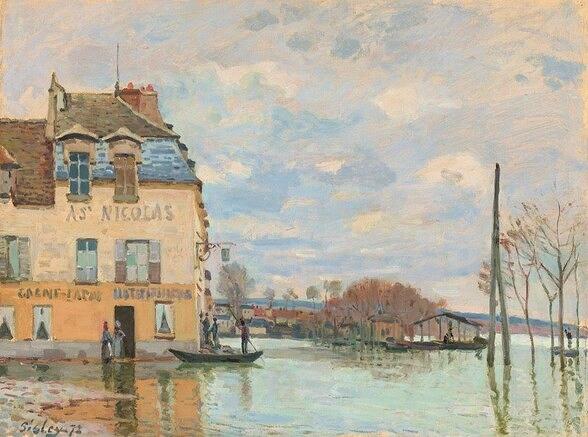
“The Flood at Port Marly” (1872)

During his lifetime Sisley painted two series of major floods of the Seine at Port Marly. His first-hand record of the floods was unique among the subjects painted by the Impressionists.  “The Flood at Port Marly” (1872) (18.25’’ x 24’’) (National Gallery of Art, Washington, D.C.) is one of four paintings he made of the 1872 flood. He captures the swollen river as it rises to the door of the Restaurant a Saint Nicholas. Two women stand on a slip of land in front of the door while a boatman poles his boat in the water. Two others stand around the corner on a set of stairs that have not been submerged. Above them a wrought iron bracket displays the restaurant’s name. At the right a pilon and a few trees bring balance to the foreground of the composition. One figure stands among the trees on an outcropping that is surrounded by water. Another figure rows a boat in front of a shed.  More trees and houses recede into the distance. 

Sisley details the three-storied structure of the Restaurant: curtains at the windows, shutters both open closed, tall windows with stone cornices on the third floor, and sloped roofs of grey-blue slate and tiles, and multiple chimneys. The painting is composed mainly of the complementary colors blue and orange. Sisley artfully places several horizontal dark blue and purple dashes across the center of the composition, with small touches of the darker colors on the roof of the restaurant and on the foliage of the trees that recede into the background. Sisley was a master of composition, arranging everything to create harmony, balance, and calm even in a dire situation. 

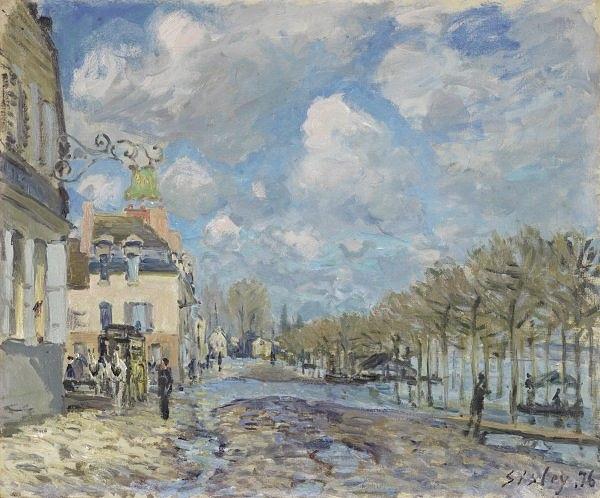
“Flood at Port Marly” (1876)

Water was another of Sisley’s favorite subjects, and he frequently painted bridges over water and landscapes including rivers. His ability to observe sunlight, movement, and reflections on water was unique. Four years after the 1872 flood, Sisley painted seven pictures of the 1876 flood. At that time, he was able to chronicle the flood from the beginning to the end. As the flood increased, the village of Port Marly was submerged. “Flood at Port Marly” (1876) (19.5’’ x 24’’) depicts the waters of the Seine flowing across the street. Sisley set up his easel around the corner from the Restaurant a Saint Nicholas, the second building on the left. A coach drawn by white horses appears with luggage piled high. Rows of trees, rowers in a boat, and the dark roofed shed can be seen across the street.

Steven Mallarme, French poet and art critic, wrote an article on Impressionism for The Art Monthly review in London shortly after he saw Sisley’s 1876 paintings of the flood: “He captures the fleeing effects of light. He observes a passing cloud and seems to depict it in its flight. The crisp air goes through the canvas, the foliage stirs and shivers.”

Born in Paris to English parents, Sisley was therefore English. However, he lived and worked almost his entire life in France. He visited England only a few times. The last time, in 1897, he married his companion of 31 years, Marie-Louise Adelaide Eugenie Lescouezec. They had a son and a daughter. Sisley applied for French citizenship in1898, but he was refused. 

Sisley asked his longtime friend Monet to look after his children when he died. Marie-Louise died in 1899, Sisley three months later. That year, Monet asked George Petit, an art dealer and promoter of Impressionism, to hold an auction of Sisley’s paintings to help support the children. One of “The Flood at Port Marly” paintings sold for 43,000 francs to Count Isaac de Camondowho. Interest in Sisley’s art was thus established. 

The well-known art critic, painter, and art theorist Wynford Dewhurst (1864-1941) wrote in one of books on Impressionism: “Rare are the artists who distinguish themselves in every branch of art, lucky the man who excelled in one. An example of the latter is Sisley, ‘pausagiste’ [landscapist] pure and simple, who has left a legacy of some of the most fascinating landscapes ever painted.”

Beverly Hall Smith was a professor of art history for 40 years.  Since retiring with her husband Kurt to Chestertown in 2014, she has taught art history classes at WC-ALL. She is also an artist whose work is sometimes in exhibitions at Chestertown RiverArts and she paints sets for the Garfield Center for the Arts.


The Spy Newspapers may periodically employ the assistance of artificial intelligence (AI) to enhance the clarity and accuracy of our content.

Filed Under: 3 Top Story, Looking at the Masters

Looking at the Masters: Samuel Findley Breese Morse

September 22, 2022 by Beverly Hall Smith
Leave a Comment

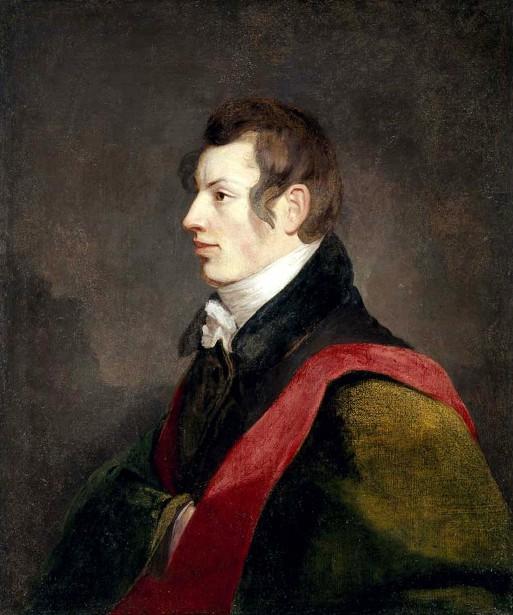
Samuel Morse “Self-Portrait”

Born in 1791 in Charlestown, Massachusetts, Samuel Findley Breese Morse was raised by Jedidiah Morse, a well-known minister and supporter of Calvinism and Federalism. Samuel was an “eccentric” student, but he did graduate from Phillips Academy in Andover, Massachusetts, and graduated (Phi Beta Kappa) from Yale in 1810. He studied religious philosophy, mathematics, and science. However, he began his career painting miniature portraits, and he worked as a clerk in a Boston book store. His interest in art was discouraged by his father, who finally relented and supported Samuel going to England (1811) to study with the American painter Washington Allston. He remained in England for three years, met the prominent American painter Benjamin West, and his artistic talent earned him admission to the Royal Academy in London in 1811. His “Self- Portrait” (1812) (10.75’’ x 8.85’’) evidences his skill as an artist. It is in the collection of the National Portrait Gallery, Washington, D.C.

During his three-year stay in London, Morse produced several paintings in the popular Neo-Classical style based on Italian Renaissance realism and history and mythology.  “Dying Hercules” (1812) and “Judgment of Jupiter” (1814) were well received in London. However, Morse was well aware of the issues that caused the War of 1812, and felt the Federalists, who supported England in America “were cowards, a base set, [I] say they are traitors to their country and ought to be hanged like traitors.” During the presidency of Monroe, the Federalist party collapsed.

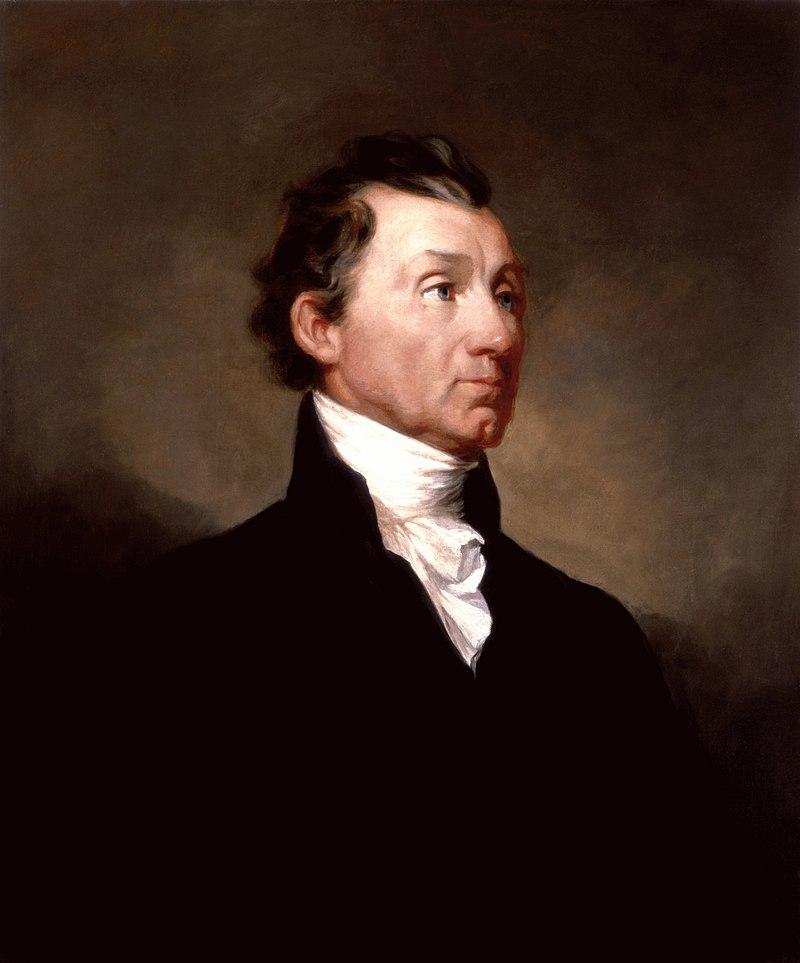
“James Monroe” (1819)

Morse returned to America in 1815, and he established residence in Greenwich Village in New York City. Americans were not interested in history or myth, and he began as an itinerant portrait painter. Notable early portraits were of president “John Adams” (1816) and “James Monroe” (1819). Adam’s portrait is in the Brooklyn Museum, and Monroe’s is in the White House.  Morse painted portraits of other famous Americans including Eli Whitney (1822), De Witt Clinton (1826), William Cullen Bryant (1829), and Noah Webster (n.d.). 

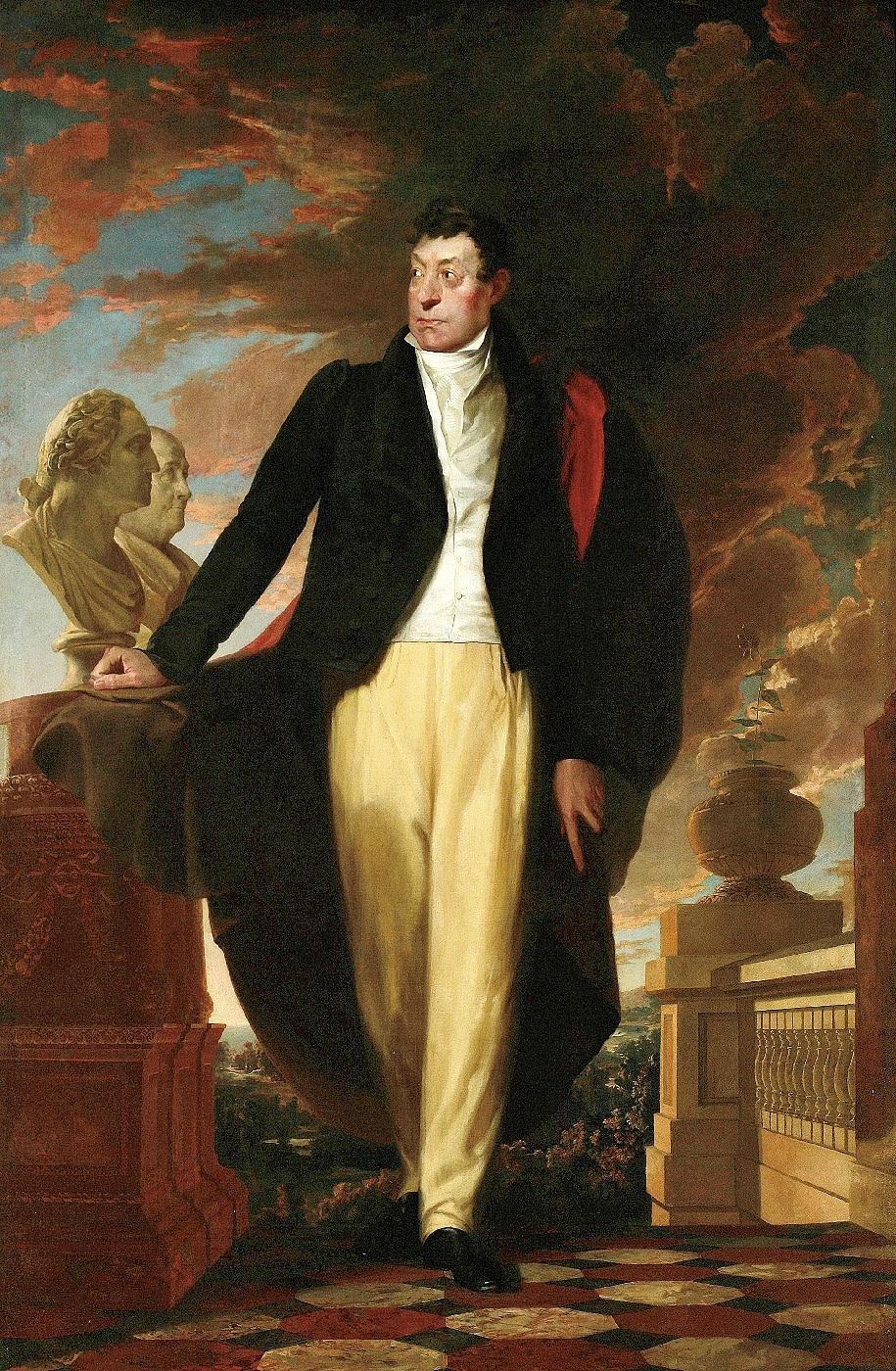
“Marquise de Lafayette” (1825-26)

The Marquise de Lafayette was an American celebrity after his participation in helping to win the American Revolution. Morse’s “Marquise de Lafayette (1825-26) was commissioned by the City of New York. The two men discussed the Revolution, and their friendship strengthened Morse’s already significant embrace of America and democracy. George Washington and Lafayette were fast friends, and Lafayette’s pose is reminiscent of the 1780 portrait of Washington by Charles Willson Peale. 

Lafayette stands on the top step of a porch. A flourishing landscape and a dramatic blue sky with turbulent red, gold, and dark clouds provide the backdrop. Instead of creating a stormy effect, the rose glow of a sunset after a storm gives a sense of power and presence to the figure of Lafayette. 

The porch has an inlaid marble floor, with stone balcony railings and a large carved vase. The new shoots of a leafy vine growing from the vase perhaps represent the young Democracy. Three stone pedestals at the left hold busts of George Washington and Benjamin Franklin.  A third pedestal, on which Lafayette rests his right hand, is empty. Likely, it was intended as a tribute to Lafayette, who someday would have his bust placed there to mark his accomplishments. 


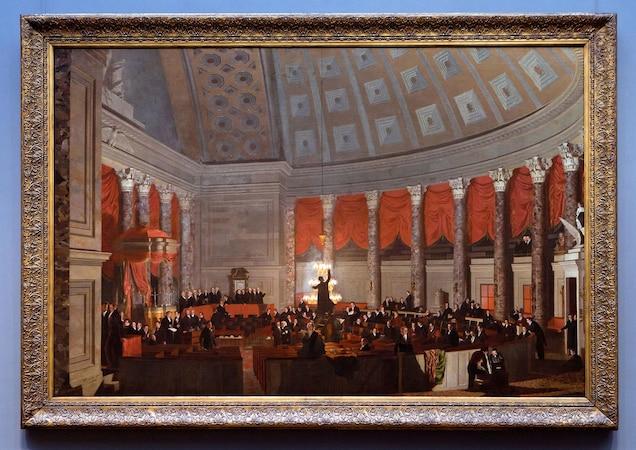
“The House of Representatives” (1822)

Morse painted “The House of Representative” (1822) (7.5’ x 11’) (National Gallery of Art, Washington, D.C.). The commission for four panels for the Rotunda of the Capitol would pay the artist $10,000. Morse traveled to Washington to make an accurate drawing of the House architecture with 80 people in the chamber. Morse choose to set the scene at night to illustrate the dedication of the house members to their work. The painting was exhibited in 1823 in New York City, but it was not a success. John Adams questioned if an American artist was up to the task. Morse’s close friend James Fenimore Cooper wrote a letter, published in the New York Evening Post arguing the Capitol would be an “historic edifice” and must showcase American art. The painting was not chosen, and Morse blamed Daniel Webster and John Adams, a Federalist, who voted against it.

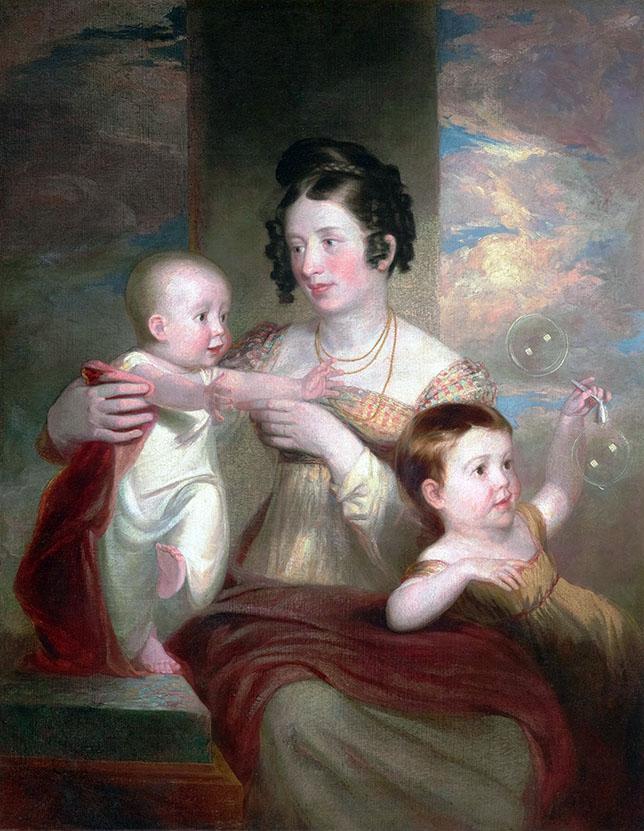
“Mrs. Morse and Two Children” (1824)

Morse married his first wife Lucretia in 1818. “Mrs. Morse and Two Children” (1824) depicts her with their two children Susan and Charles. Morse chose a classic triangular pose, with a dark column placed behind his wife. He encircles them with a dark red shawl and darker green in the left background, and the cushion and Lucretia’s skirt. However, he centers the tender interaction of the three figures in a soft, pastel palette of the Rococo. To match their rosy pink cheeks and light clothing, Morse paints a soft blue and pink sky. Lucretia tenderly embraces baby Charles, an active and delighted child. Susan happily plays with a bubble pipe.

The love of his wife and children is evident in this painting. Attached to the painting was a letter Morse wrote just before leaving for Washington in 1824: “A thousand affecting incidents of separation from my beloved family crowded upon my recollection. The unconscious gayety of my dear children as they frolicked in all their wonted playfulness, too young to sympathize in the pangs that agitated their distressed parents; their artless request to bring home some trifling toy; the parting kiss, not understood as meaning more than usual; the tears and sad fare wells of father, mother, wife, sister, family, friends; the desolateness of every room as the parting glance is thrown on each familiar object, and farewell, farewell seemed written on the very walls, — all these things bear upon my memory, and I realize the declaration that the places which now know us shall know us no more.” Unfortunately, Lucretia died in 1825, soon after the birth of their second son James.

“Gallery of the Louvre” (1831-1833)

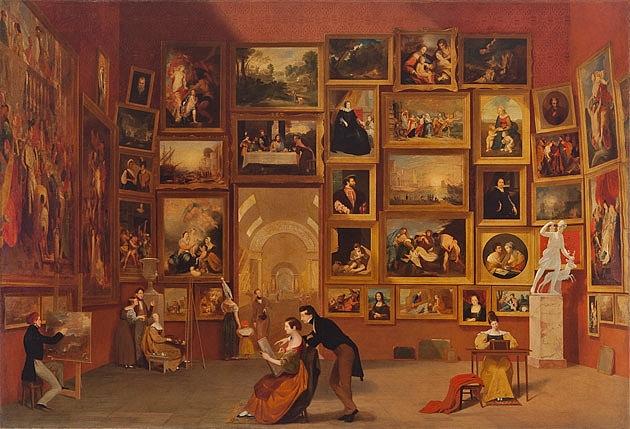
Morse was a founder of the National Academy of Design in New York City, and he served as its first president from 1826 to 1845. The Academy became the center of the arts in Greenwich Village. Returning to Europe in1831, Morse decided to paint “Gallery of the Louvre” (1831-1833) (6 ft. x 9 ft.). The painting includes 38 miniatures of works by Renaissance and Baroque masters. He thought this painting would be an excellent teaching tool for his students and an introduction for Americans to the splendors of European art. The work took months, and Morse moved a scaffolding he invented around the Louvre in order to have a closer look at each painting. Masterpieces by da Vinci, Raphael, Titian, Tintoretto, Caravaggio, Rubens, and Rembrandt are among the works included. The miniature of the “Mona Lisa” is placed in the center of the canvas on the lowest row of paintings. The fourth painting in the row is of Rubens’s beloved second wife Suzanne Fourment. Morse’s recent loss of his own wife might have influenced the placement of the Rubens portrait.

In the foreground of the canvas, Morse leans over the shoulder of his daughter Susan giving her advice concerning the drawing she is sketching. At the left, Richard Habersham, a young artist from Georgia and a roommate of Morse’s in Paris, is working on a landscape study. In the left corner are James Fenimore Cooper and his wife and daughter Susan, an art student seated in front of her easel and holding a palette. Cooper was a long-time friend, and spent many days with Morse in the Louvre. He described his time with Morse: “I sit and have sat so often and so long that my face is just as well-known as any Vandyke on the walls. Crowds get round the picture, for Morse has made quite a hit in the Louvre, and I believe that people think that half the merit is mine.”

In the arched doorway is the American sculptor Horatio Greenough and a women and child in traditional Briton costumes. Greenough, hat in hand, looks across the gallery to the ancient sculpture of “Diana and a Deer,” placed on a pedestal in the right corner. A young woman, wearing a gold gown, sits at a table painting a miniature. She may be Miss Jorester, a young woman who took lessons from Morse in the Louvre, or his deceased wife Lucretia. The figures were added to the canvas after Morse returned to New York. 

Morse exhibited “Gallery of the Louvre” in New York City on August 9,1833. The work received critical praise, but it sold for only $1300. Morse had hoped for $2500. When Morse did not receive a commission from the Government to paint one of the history panels in the Capitol building, he became depressed: “Painting has been a smiling mistress to many, but she has been a cruel jilt to me. I did not abandon her, she abandoned me.” “Gallery of the Louvre” sold in 1982 for $3.5 million to the Terra Foundation for American Art in Chicago.

The name of the artist Morse and the name of the inventor of the telegraph and code Morse are the same. Morse did abandon art, and he turned to science. A talk he had heard years earlier at Yale (1810) inspired him to use the wooden canvas stretcher bars from his studio to construct his earliest version of the telegraph. After a great deal of trial and tribulation, Congress funded wiring American from coast to coast, and Morse received a patent in 1844. Morse purchased in 1847 the estate Locust Grove on the Hudson River. In 1848 he married Sarah Elizabeth Griswold. They had four children.

On May 24, 1844, Morse sent his partner Alfred Vail the first telegraph message from Washington to Baltimore: “What hath God wrought.”

Beverly Hall Smith was a professor of art history for 40 years.  Since retiring with her husband Kurt to Chestertown in 2014, she has taught art history classes at WC-ALL. She is also an artist whose work is sometimes in exhibitions at Chestertown RiverArts and she paints sets for the Garfield Center for the Arts.

The Spy Newspapers may periodically employ the assistance of artificial intelligence (AI) to enhance the clarity and accuracy of our content.

Filed Under: 3 Top Story, Looking at the Masters

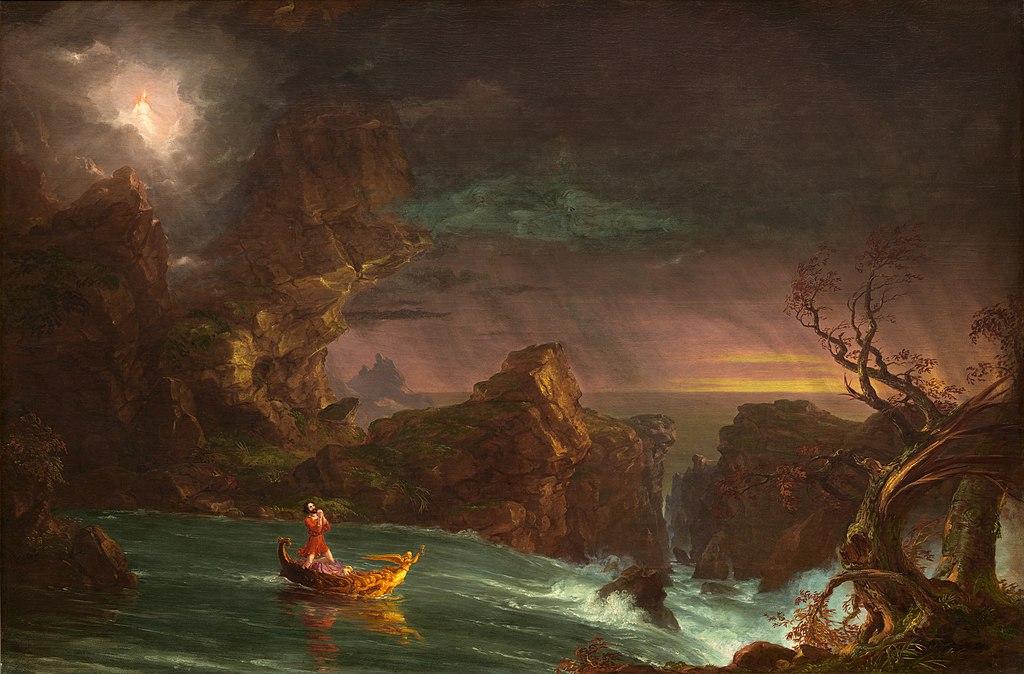
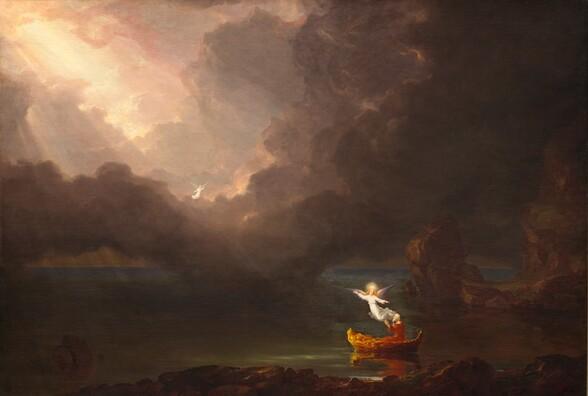
Looking at the Masters: Thomas Cole and his Voyage of Life

September 8, 2022 by Beverly Hall Smith
Leave a Comment

Born on February 1, 1801, in Lancashire, England, Thomas Cole emigrated to the United States with his family in 1818. The family moved in 1819 to Steubenville, Ohio where he learned to use oil paint from an itinerant artist. Cole essentially was a self-taught portrait artist. He began drawing from nature in 1823, while he was in Pittsburgh. Later that year he studied at the Pennsylvania Academy of Fine Arts in Philadelphia. Moving to New York City in 1825, Cole became enamored with the natural beauty of the Catskills. He exhibited a small collection of Catskill landscapes in October 1825 in New   York City. He was discovered by Asher B. Durand, a well-respected artist and engraver. Durand helped organize the National Academy of Design in New York City. Thomas Cole became a member in 1826.   

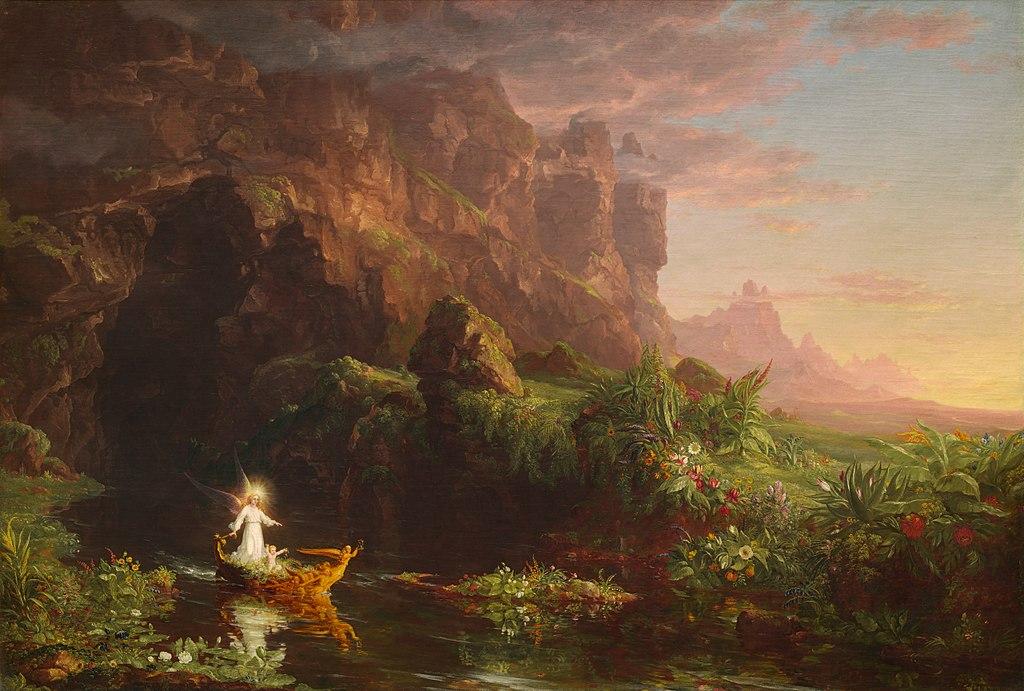
Childhood” from Voyage of Life (1842)

Cole’s landscape paintings were supported by a number of influential patrons including Robert Gilmore, Jr. (1774-1848) of Baltimore.  He was a merchant and shipowner with the East-India company, and one of America’s most important patrons and collectors of art before 1850. Another Cole patron was Samuel Ward, Sr. (1786-1839), a New York City banker and philanthropist. Cole wrote: “I have received a noble commission from Samuel Ward, a commission to paint a Series of Pictures the plan of which I conceived several years since and had an opportunity of presenting to him in the Spring. The Subject is to execute in four pictures about 6 ft. 6 in. or 7 ft. long each, and is entitled Voyage of Life…The subject is an allegorical one, but perfectly intelligible & I think capable to making a strong and moral religious impression.” The commission price was $5000.

Cole’s theme divided the journey into “Childhood,” “Youth,” “Manhood,” and “Old Age.” “Childhood” was begun in September 1839. Cole was determined that his paintings should create a “higher style of landscape” reflecting a moral and religious message. The four landscapes follow a river flowing through the same landscape and the four seasons. “Childhood” depicts an abundance of spring flowers in a sun filled landscape. An elegant gold vessel emerges from a dark cave deep in a mountain that Cole describes as “emblematic of our earthly origins, and the mysterious Past.”

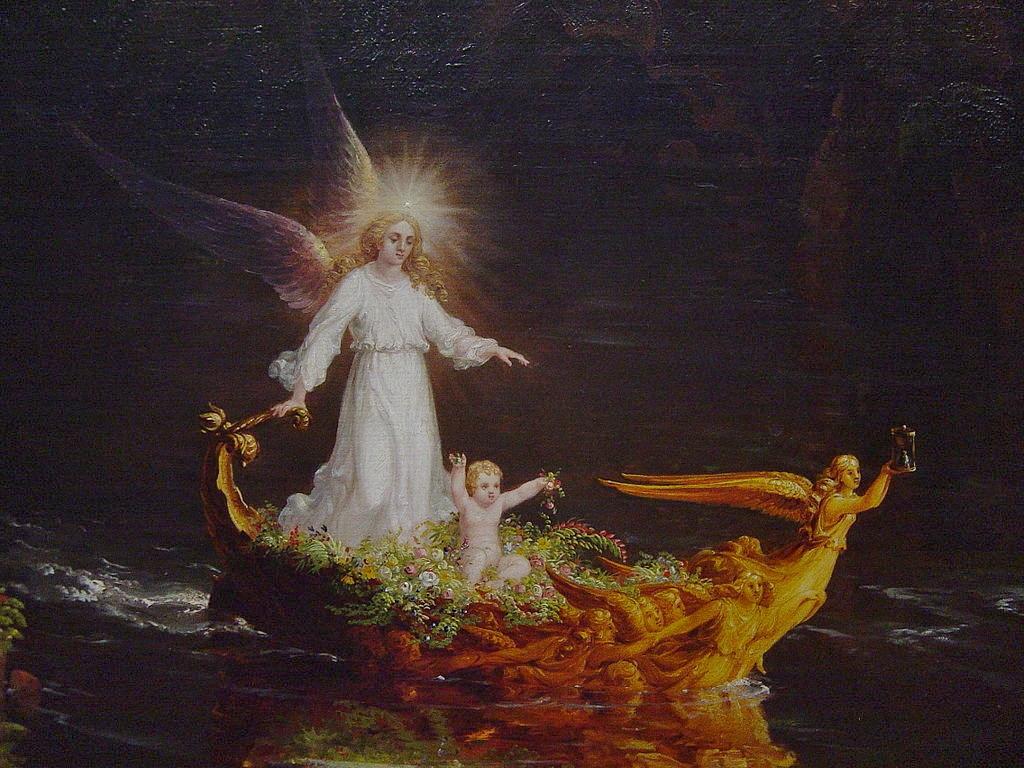
“Childhood” (detail)

A radiant guardian angel is at the tiller of the vessel. The figurehead is a gold angel holding an hourglass, representing time. Several sculpted gold angels form the body of the vessel. A joyful infant sits among the flowers, arms raised and looking forward. The river flows smoothy toward the viewer.

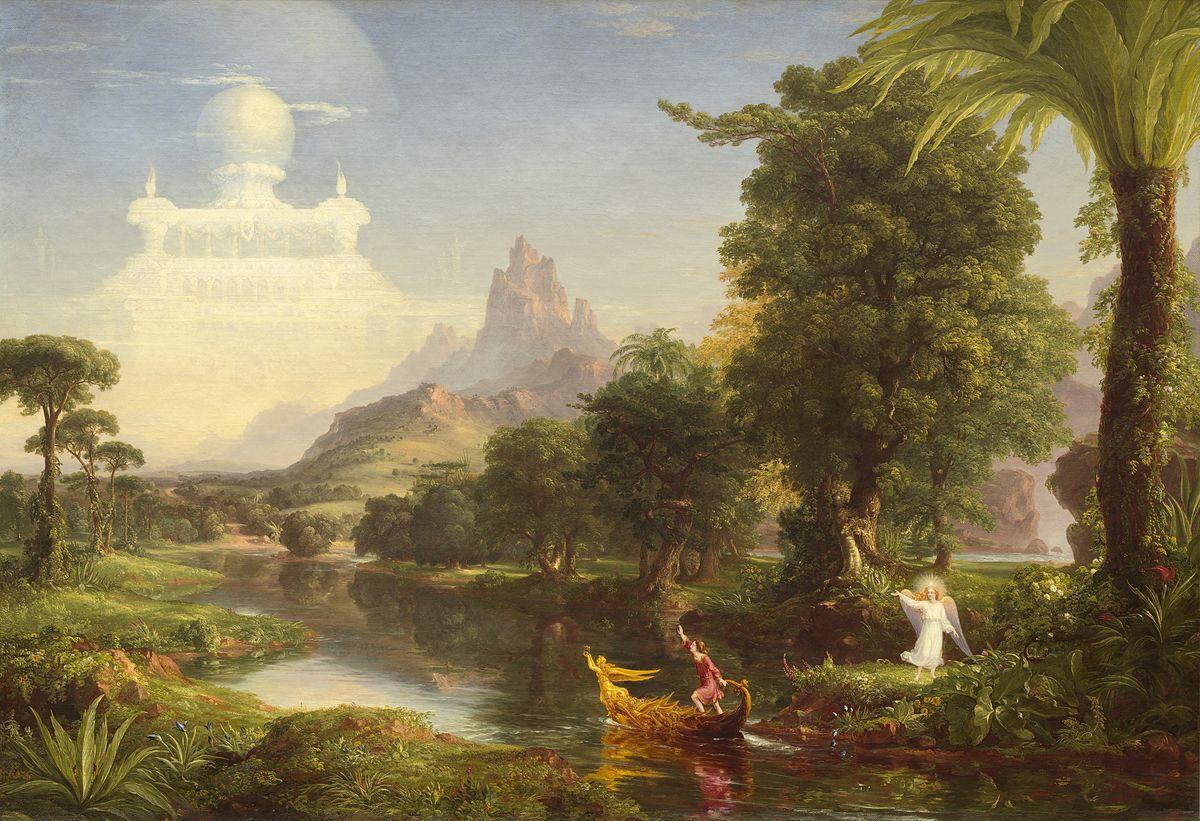
“Youth” (1842)

“Youth” (painted in early 1840) depicts a young man holding the tiller of the gold vessel. The guardian angel stands on the shore, waving good-bye. The river winds through the landscape which expands into a rich summer panorama. The clouds above form a glowing white temple. Cole described the scene: “The scenery of the picture–its clear stream, its lofty trees, its towering mountains, its unbound distance, and transparent atmosphere—figure forth the romantic beauty of youthful imaginings, when the mind elevates the mean and common in the magnificent, before experience teaches what is the Real.”

“Manhood” (1842)

“Manhood” was painted in the summer and fall of 1840. The man is carried by rushing and choppy water from the cave where he floated peacefully as a child. Cole wrote about the scene: “The helm of the boat is gone; the voyager has lost control of his life. The angel looks down from the clouds as he [the man] is whirled forward toward violent rapids and bare, fractured rocks. Only divine inspiration can save the voyager from a tragic fate.” The man kneels and prays. The figurehead still holds the hourglass. Cole’s fall landscape is under a dark and stormy sky. However, the sun breaks through in the distance.

“Old Age” (1842)

The river is calm. The storm clouds part in the distance to reveal an angel and the rising sun. The old man rides in the vessel which is battered and missing the figurehead. The edge of the river has been reached, and the old man has passed by the rocky landscape. The heavens are opening. For Cole it was the man’s Christian faith that saved him: “The chains of corporal existence are falling away; and already the mind has glimpses of immortal life.”

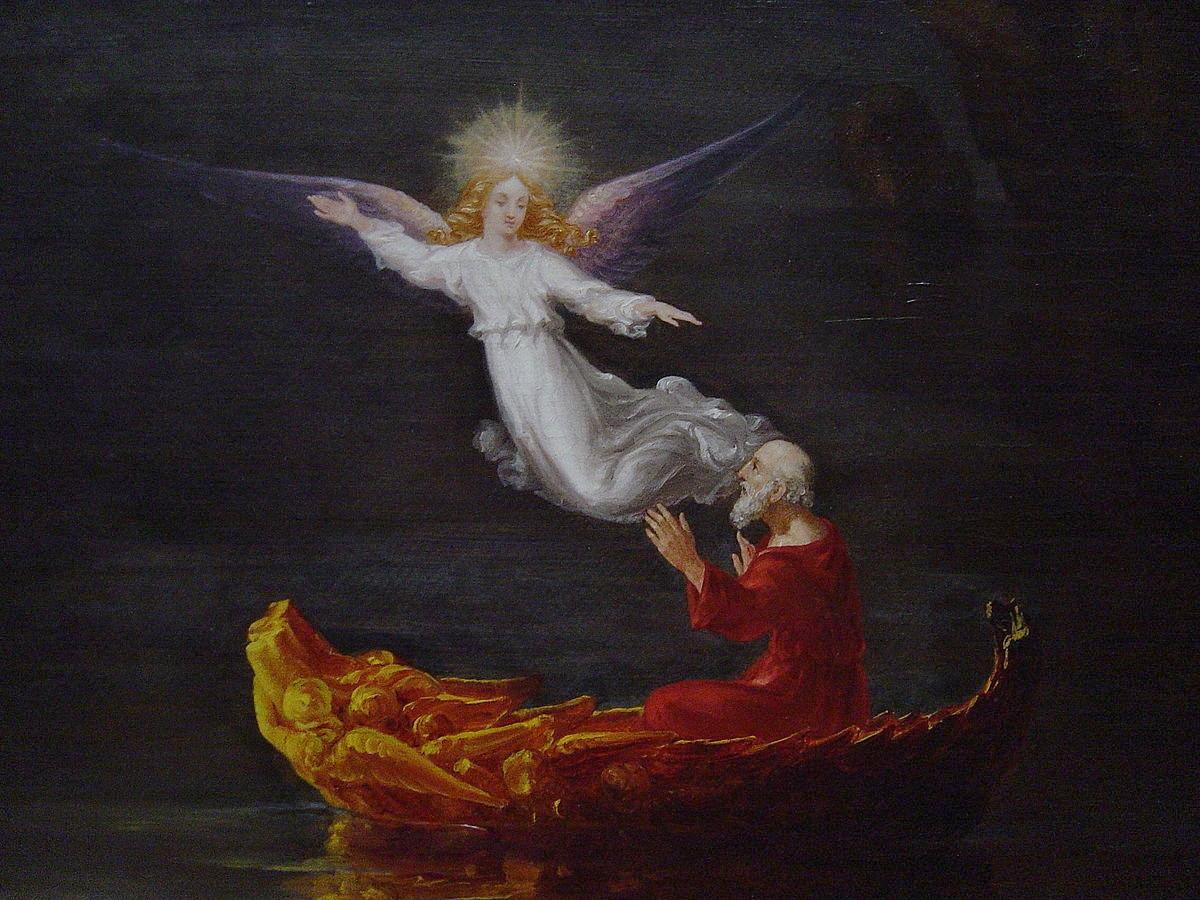
“Old Age” (detail)

Pointing toward to heavenly light, the guardian angel is with the old man. His arms wide-spread, he thankfully accepts the forgiveness he perceives in the distance.

Cole’s patron Samuel Ward, Sr. died in 1839, before the commission was completed. Ward’s heirs created difficulties for Cole about showing the work in a public exhibition. Cole went to Rome during the winter of 1841-42, and there painted a second set of the series. Cole wrote about the difficult circumstances: “I shall take the series to England & shall endeavour to dispose of them there. I have but little hope of doing so. The fashionable taste (if I may dignify if with such a name) is for works of another order, pictures without ideas, mere gaudy display of color and Chiro Scuro without meaning, showy things for the eye. If I do not dispose of my pictures in England, I must take them home and hang them in my own rooms & content myself with the conviction that the time will come when they will be more valued.”

Cole and his good friend William Cullen Bryant, poet and editor of the New York Evening Post, agreed that “God’s nature” was a refuge from the industrialization and ugliness that was occurring in American cities. The series has been interpreted by historians as Cole’s response to “Manifest Destiny.” The term coined in1845 expressed the belief that the United States was destined by God to conquer the continent. For Cole and Bryant, and others like them, this ultimately meant to civilize nature.

“If I live to be old enough. I may sit down under some bush, the last left in the utilitarian world, and feel thankful that intellect in its march has spared one vestige of an ancient forest for me to die by.” (Thomas Cole)

Beverly Hall Smith was a professor of art history for 40 years.  Since retiring with her husband Kurt to Chestertown in 2014, she has taught art history classes at WC-ALL. She is also an artist whose work is sometimes in exhibitions at Chestertown RiverArts and she paints sets for the Garfield Center for the Arts.
NOTE: When Cole returned to American, the second set of paintings were a great success when they were exhibited. The first set is now in the Munson-William-Proctor Art Institute in Utica, New York. The second set, described in this article, hangs in the National Gallery, Washington, D.C.

The Spy Newspapers may periodically employ the assistance of artificial intelligence (AI) to enhance the clarity and accuracy of our content.

Filed Under: 3 Top Story, Looking at the Masters

  • « Previous Page
  • 1
  • …
  • 11
  • 12
  • 13

Copyright © 2025

Affiliated News

  • The Chestertown Spy
  • The Talbot Spy

Sections

  • Arts
  • Cambridge
  • Commerce
  • Ecosystem
  • Education
  • Food & Garden
  • Health
  • Local Life
  • News
  • Point of View
  • Senior Nation

Spy Community Media

  • Subscribe for Free
  • Contact Us
  • COVID-19: Resources and Data

© 2025 Spy Community Media. | Log in