

Mary Vaux Walcott (1860-1940), considered to be one of America’s most important naturalists, recorded in watercolor paintings over 1000 North American plants. She became known as the Audubon of Botany. Her parents were Sarah and George Vaux, well-educated and wealthy Philadelphia Quakers. Mary was given a set of watercolors when she was eight years old, and she began to paint flowers. Her contribution would extend beyond painting pretty flowers.

”Watercolor Study (1873)
Mary’s talent at a young age is apparent in this early work “Watercolor study” (1873). She signed the sketches “M.M. Vaux 4th month 1873.” The pansies are well drafted, the colors softly modeled, and the texture appears velvety. She paints the shadow cast by the blooms and stems.

‘Child’s Head” (5-20-1878)
Although Mary did not pursue portraiture, this early work is an indication that her talent went far beyond the ability to render flowers. In her time, women were considered incapable of painting anything but flowers.
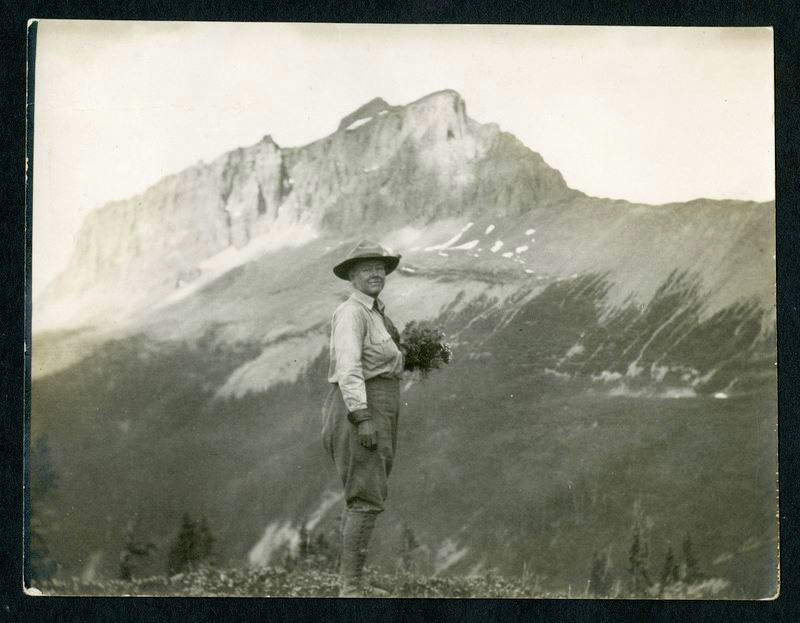
‘Mary VauxxWalcott in Canadian Rockies with Wild Flowers” (1920’s)
Mary Vaux graduated in 1879 from the Friends Select School in Philadelphia. No specific record states that she ever studied painting. She worked on the family farm, and the family took trips in the summer to the Rocky Mountains in Canada. After her mother died in 1880, she became solely responsible for the care of her father and two brothers.
Her father and an uncle were interested in mineralogy, and she and her younger brothers George and William were educated in science. Mary was an active mountain climber, photographer, and painter. She and her brothers were founding members of the Alpine Club of Canada in 1906, and she became an advocate for women wearing trousers because they were safer when climbing.
The adventurous Vaux family made their first transcontinental trip in 1887 by rail, carriage, stagecoach, ferry, horseback, and foot through the American and Canadian Rockies. They were among the first passengers to ride on the newly constructed Canadian Pacific Railroad. The 10,000-mile journey included a train crash and derailment. In the Selkirk Mountains in British Columbia, they photographed the nearby Illecillewaet Glacier. From 1887 until 1912, Mary Vaux took over 2500 photographs of the glacier. The Vaux family wrote about climate change causing the shrinking of the glaciers. In a letter written in 1912 to her future husband Charles Walcott, Mary Vaux wrote, “The glaciers must be measured, and I shall hope to use the camera seriously, and get all I can.” The Vaux collection of photographs of the glaciers is in the Whyte Museum in Banff, Alberta, Canada.
Mary Vaux wrote in her article “Camping in the Canadian Rockies” for Canadian Alpine Journal, “A camera is a very delightful adjunct, for it is pleasant to have some tangible results to show, on your return home. A Kodak, if no larger instrument can be managed, yields most satisfactory results, although the better records from a larger-sized camera are an increased delight, when one has the patience and skill to obtain them. For changing plates in camp, an improvised tepee can be made of the blankets, and, if this is done after sundown, is quite satisfactory.”
Her search for wild flowers involved an enormous commitment of time and energy, and it was dangerous work. She was relentless, scrambling around rocks, over ledges and cliffs. Perched safely or precariously, she made quick but careful studies in the field. Full watercolor paintings, finished in camp, were the same size as the plant.
Her younger brother died in 1908. By 1911, her other brother’s responsibilities made it impossible for him to travel with her, and her father had become too old. She decided to travel alone to continue photographing the glacier and painting the flora. She traveled with a female friend from time to time.
In 1914, over her father’s strong objection, she married Dr. Charles Doolittle Walcott, who was Secretary of the Smithsonian Institution. The two worked together for three or four months every year in the Canadian Rockies and elsewhere. He pursued his well-respected studies in paleontology, and she painted hundreds of watercolors of native plants.
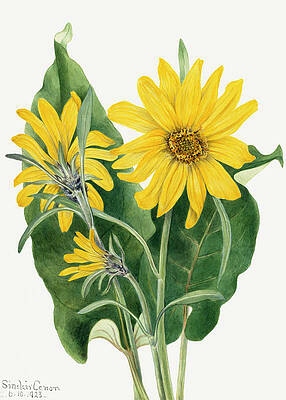
”Arrowleaf Balsamroot” (1923)
On one trip, a botanist asked Mary Vaux Walcott to do a painting of a rare blooming arnica flower. It was so successful, he encouraged her to consider botanical illustration. She took up the idea and initiated another of her important contributions. “Arrowleaf Balsamroot’’ (1923) is a depiction of a plant that grows across the western United States in the Black Hills of South Dakota, Arizona, the Mojave Desert of California, and in the British Columbia and Alberta provinces of Canada. It blooms in May and June in both mountain forests and desert grasslands.
The Nez Perce, Cheyenne, and Salish tribes, among others, used the plant for both food and medicine. Lewis and Clark collected specimens of the plant from the White Salmon River in 1806 and brought them back to the East with other discoveries. Known also as the Oregon Sunflower or Okanagan Sunflower, the arrowleaf balsamroot is the official flower of Kelowna, British Columbia, Canada.

”Rocky Mountain Cassiope” (1924)
“Rocky Mountain Cassiope” (1924) is a depiction of a plant that can be found in the west from Alaska to California in subalpine areas growing close to the ground and in rocky crevices. The plant makes a significant contribution to snowmelt and stream flow. Walcott depicts the low growing plant with red stems that hold small white star-shaped flowers. The name Rocky Mountain refers to the plant’s location and Cassiope, from Greek mythology, refers to its star-shaped flowers. Cassiopia, an Ethiopian Queen, boasted that she and her daughters were more beautiful than the 50 Nereids (sea nymphs) who are symbols of everything beautiful about the sea. An angry Poseidon, God of the Sea, killed them and turned mother and daughters into a constellation.
The Smithsonian Institution published Mary Vaux Walcott’s North American Wild Flowers in 1925. The five-volumes included 400 of her watercolor illustrations along with scientific information, medicinal uses, and poetic references. Proceeds from sales were donated to the Smithsonian endowment. William Edwin Rudge (1876-1931) had developed a new printing technique known as the Smithsonian Process. Mary Vaux Walcott wrote to a friend in 1924, “The result is a reproduction that can hardly be told from the original sketch.” Each volume had 80 prints and like her watercolors, the flowers were printed at their “natural size.”
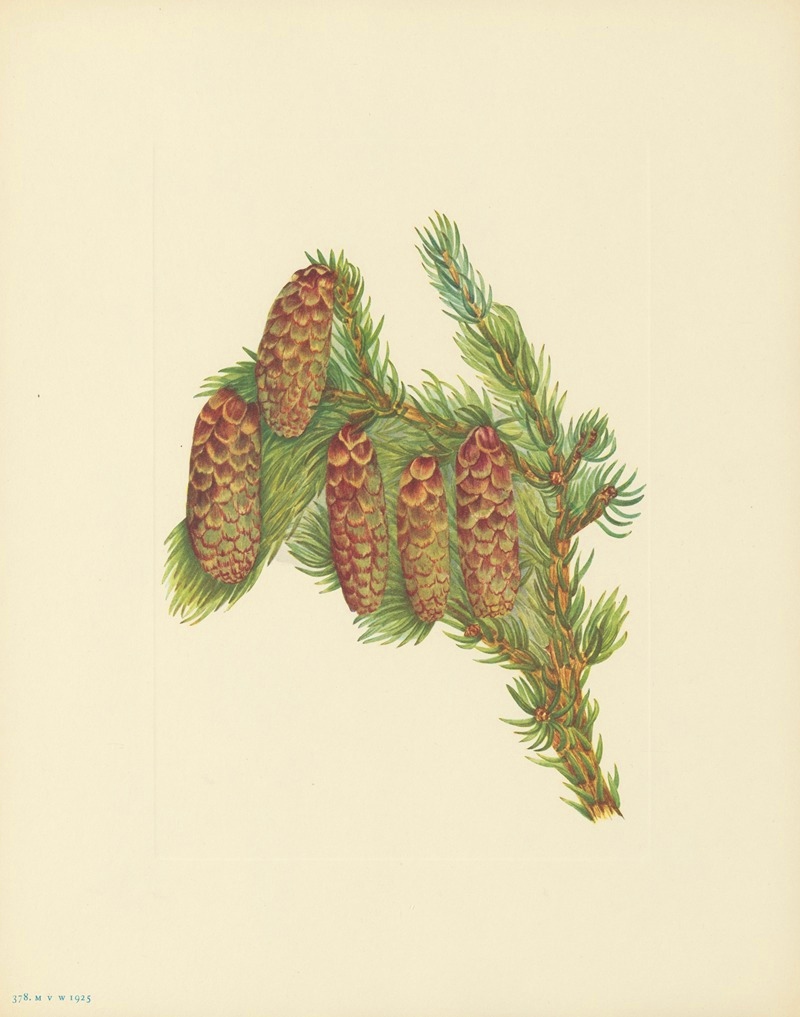
”Engelmann Spruce” (1925)
The Engelmann Spruce was first identified in the mid-19th Century by George Engelmann, a German-born doctor and botanist who lived in St Louis, Missouri. He was an authority on conifers, or cone bearing trees. In tribute to his discovery of this previously unknown conifer, the spruce was given his name. The watercolor “Engelmann Spruce” accurately depicts the cones and branches.
Found in high mountains the tree can live for as long as 300 years. The wood is light in weight, has a straight grain, and is strong. The Engelmann Spruce can be used for construction, and because it is odorless and has little resin, it is used in making barrels and food containers. However, its real value is in the quality of the sound when the wood has been used to make soundboards for guitars, harps, violins, and pianos.
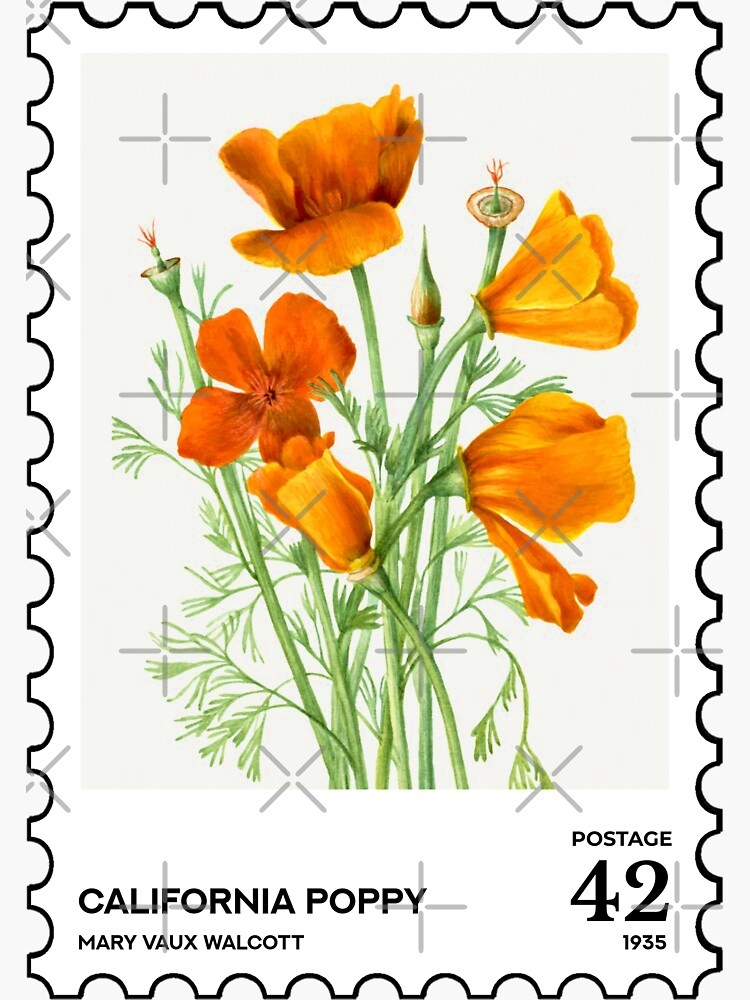
”California Poppy” (1935)
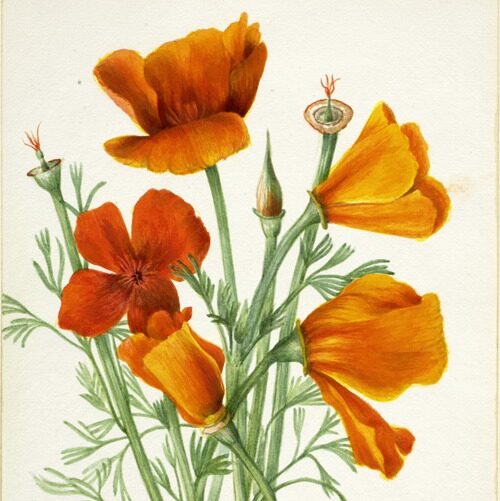
In 1935 the United States Post Office Department issued the California Pacific Exposition stamp, featuring Mary Vaux Walcott’s “California Poppy” watercolor, signed and dated 4-10-35. The state flower of California, the poppy is an annual that self-seeds, but it is not an invasive plant. The flowers can be bright orange or yellow. They bloom from February to September.
Mary Vaux Walcott excelled at many endeavors during her life time. She is recognized as the first woman to climb to the height of 10,000 feet on Mount Stephens in British Columbia (1900). A mountain in British Columbia was given the name Mount Mary Vaux in 1908. She was a significant influence in the establishment of the National Park Service in1916. The Walcotts established the Charles D. and Mary V. Walcott Research Fund for geological and paleontological research. It exists today. When her husband died in 1927, she created the Charles Doolittle Walcott Medal in his honor. It is awarded every five years by the National Academy of Science. President Calvin Coolidge appointed her to the Board of Indian Commissioners in1927, and she served until 1932. She visited over 100 reservations. She became the president of the Society of Women Geographers in 1933.
She continued to lecture on botany and photography. The lectures attracted as many as 3.000 attendees. Walcott continued to collect and press hundreds of plant specimens for the Smithsonian and donated hundreds of her flower watercolors which are now housed in the Smithsonian American Art Museum. She was an extraordinary hostess during her many years in Washington, DC. Friend of many important people, she was especially close to President Herbert Hoover and his wife Lou, who also were Quakers. Walcott led the funding and building of the first Quater Meeting House in the national capital. She stopped climbing mountains in 1939. She died in 1940. The Smithsonian Institution reprinted her work and the “x Rhyncattleanthe Mary Vaux Walcott” hybrid orchid was named in her honor.
“I don’t know why it is. Women have time for bridge parties and dances, yet they miss so much by not turning their attention to scientific studies and using their eyes. There is a thrill one receives from breaking a rock and finding a fresh fossil that nothing else can give. There is the romance of not knowing what one will find.” (Mary Vaux Walcott)
Beverly Hall Smith was a professor of art history for 40 years. Since retiring to Chestertown with her husband Kurt in 2014, she has taught art history classes at WC-ALL and the Institute of Adult Learning, Centreville. An artist, she sometimes exhibits work at River Arts. She also paints sets for the Garfield Theater in Chestertown.
Write a Letter to the Editor on this Article
We encourage readers to offer their point of view on this article by submitting the following form. Editing is sometimes necessary and is done at the discretion of the editorial staff.