
MENU

Sections

  • About Us
    • Editors and Writers
    • Sponsorship Terms & Conditions
    • Code of Ethics
    • Sign Up for Cambridge Spy Daily Email Blast
  • The Arts and Design
  • Culture and Local Life
  • Food & Garden
  • Public Affairs
    • Commerce
    • Health
    • Ecosystem
    • Education
    • Senior Nation
  • Point of View
  • Chestertown Spy
  • Talbot Spy

More

  • Support the Spy
  • About Spy Community Media
  • Advertising with the Spy
  • Subscribe
January 11, 2026

Cambridge Spy

Nonpartisan and Education-based News for Cambridge

  • About Us
    • Editors and Writers
    • Sponsorship Terms & Conditions
    • Code of Ethics
    • Sign Up for Cambridge Spy Daily Email Blast
  • The Arts and Design
  • Culture and Local Life
  • Food & Garden
  • Public Affairs
    • Commerce
    • Health
    • Ecosystem
    • Education
    • Senior Nation
  • Point of View
  • Chestertown Spy
  • Talbot Spy
3 Top Story

Md. General Assembly Overrides Gov. Hogan’s Veto of Congressional Redistricting Plan

December 10, 2021 by Maryland Matters
Leave a Comment

Heading into the special session this week, two congressional redistricting proposals were on the table: one put forward by Democratic legislative leaders’ Legislative Redistricting Advisory Commission, and another from Republican Gov. Lawrence J. Hogan Jr.’s Maryland Citizens Redistricting Commission.

On Monday, lawmakers advanced the Legislative Redistricting Advisory Commission (LRAC) proposal out of the House Rules and Executive Nominations Committee and didn’t move the Maryland Citizens Redistricting Commission (MCRC) redistricting plan forward.

On Tuesday, the House of Delegates approved the LRAC proposal following an unsuccessful attempt by Republicans to amend it by replacing its map with the map proposed by the MCRC.

On Wednesday, the Senate passed the LRAC redistricting plan after Republican senators made a similar attempt to amend it.

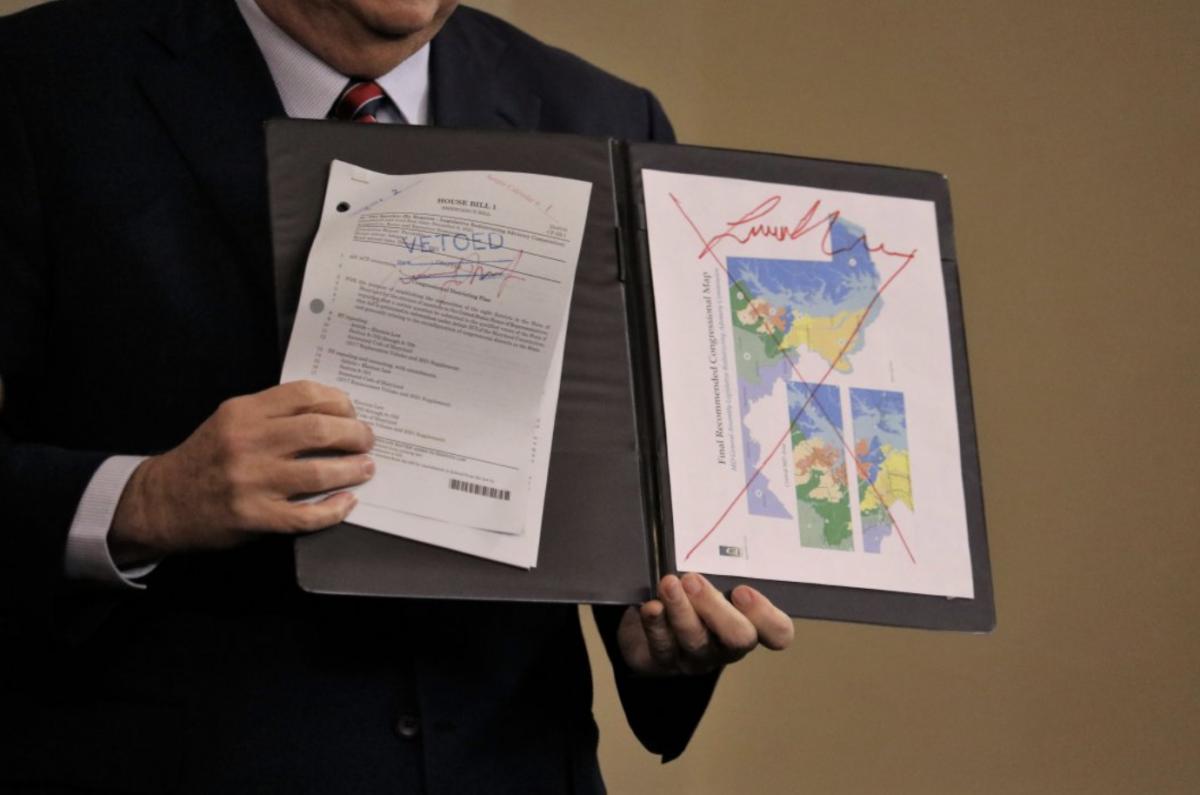
Gov. Lawrence J. Hogan Jr. (R) pushes a veto stamp onto the congressional redistricting proposal passed by the Democratic supermajority in the General Assembly. Photo by Danielle E. Gaines, Maryland Matters

On Thursday, Hogan vetoed the LRAC redistricting plan at a press conference at 2:15 p.m.

And the General Assembly swiftly overrode Hogan’s veto, roughly an hour and a half after he announced it. The House voted 96-41 in favor of an override, the Senate supported the move 32-14.

Hogan’s veto was not a surprise. The governor had promised to oppose any redistricting proposal that differed from the one put forward by his Maryland Citizens Redistricting Commission, a panel that included three Republicans, three Democrats and three unaffiliated voters. Hogan appointed the three co-chairs of that commission.

Democrats hold a veto-proof majority in both the House of Delegates and the state Senate. And they also overrode Hogan’s vetoes of several measures from the 2021 legislative session during the special session.

Senate President Bill Ferguson (D-Baltimore City) and House Speaker Adrienne A. Jones (D-Baltimore County) convened the Legislative Redistricting Advisory Commission, which they are members of.

The debate over Maryland’s congressional maps won’t end with the override votes. Fair Maps Maryland, an organization with ties to Hogan, announced plans for a lawsuit challenging the congressional redistricting plan just moments after the state Senate approved it Wednesday evening.

Hogan said he opted to veto the maps Thursday rather than waiting until the end of the legislative session to “allow the court process to begin.”

On Monday, U.S. Attorney General Merrick B. Garland announced a lawsuit challenging the Texas’ redistricting plan that the state’s Republican-led legislature approved in October. Garland charged that plan would disempower Black and Latino voters.

Hogan echoed Sen. Stephen S. Hershey (R-Middle Shore), who suggested on Wednesday that Garland should also scrutinize the Maryland General Assembly’s redistricting plan.

“He needs to take a look at exactly what we’re doing here in Maryland with respect to the same reason that he’s suing the state of Texas,” Hershey said Wednesday.

The LRAC map includes two majority Black districts — the 4th and the 7th — and creates a 5th Congressional District with a Black plurality for a total of three districts with a majority people of color.

In the current congressional map, the 4th and 7th are majority Black and the 5th has a white plurality. The Maryland Citizens Redistricting Commission map would have included one majority Black district and three additional districts with a majority people of color.

“These gerrymandered maps will be challenged in both the federal and the state courts,” Hogan said Thursday.

The congressional map adopted by the Legislative Redistricting Advisory Commission. Screenshot from the Maryland General Assembly website.

Democratic lawmakers have defended the LRAC congressional map. Senate President Pro Tem Melony G. Griffith (D-Prince George’s), a member of the LRAC, said during Wednesday’s floor debate that the commission was “very mindful” of complying with the Voting Rights Act.

“I’m confident that we have provided the opportunity for minority voters to vote for their preferred candidate, as we intended,” Griffith said.

While Republicans have highlighted the fact that the MCRC aimed to minimize county splits in its congressional redistricting proposal, Democratic lawmakers have said compactness is secondary to compliance with the Voting Rights Act and minimizing population variances.

The legislative panel also aimed to keep as many voters in current districts as possible while the MCRC opted to not consider existing districts at all when drawing up maps.

“Maryland’s geography is unique, and our population is varied,” Senate Majority Leader Nancy J. King (D-Montgomery) said Wednesday. “Taking all that into consideration, I am confident that this map is a fair one, and one that reflects the lived experience of Marylanders.”

Just one Democratic lawmaker in either the House of Delegates or the Senate voted to sustain Hogan’s veto: Del. Gabriel T. Acevero (D-Montgomery). Acevero said in an interview that “gerrymandering is wrong no matter the party.”

Acevero said that, despite his objections to the LRAC map, he didn’t find the Maryland Citizens Redistricting Commission map any better.

“The commission was pretty much chosen by Hogan,” Acevero said. “It’s not independent.”

Acevero said all lawmakers and Hogan should support the federal For The People Act, which would require nonpartisan redistricting commissions across the country. That legislation, sponsored by Maryland Rep. John P. Sarbanes (D), passed the U.S. House of Representatives earlier this year but has been blocked by Republicans in the Senate.

“What we need is both parties calling on the U.S. Senate to abolish or reform the filibuster and pass the Freedom to Vote Act, which does away with partisan redistricting,” Acevero said. “I believe in democracy and I think the democratic thing to do is for senators to do their job.”

Asked if he had received or worried about blowback from his fellow Democrats, Acevero replied, “Come on, man. I’m always going to do what I think is the right thing.”

The General Assembly isn’t done with redistricting, either: Lawmakers will tackle state legislative redistricting when they return for their regular session in January. As with congressional redistricting, lawmakers will weigh proposals from both the MCRC and the LRAC.

The LRAC hasn’t released a legislative redistricting proposal yet.

Like the MCRC’s congressional proposal, that panel’s legislative redistricting proposal received an “A” rating from the Princeton Gerrymandering Project, which scored the plan based on competitiveness, partisan fairness and geographic features. The LRAC congressional map received an “F” based on those criteria. Democratic lawmakers took issues with Princeton’s scoring system because it doesn’t factor in Voting Rights Act compliance.

Constitutionally, Hogan can’t veto the General Assembly’s legislative maps, but his proposed maps become law if the General Assembly doesn’t pick an alternative within the first half of the 2022 legislative session.

By Bennett Leckrone, Josh Kurtz, and Danielle E. Gaines

The Spy Newspapers may periodically employ the assistance of artificial intelligence (AI) to enhance the clarity and accuracy of our content.

Filed Under: 3 Top Story Tagged With: Congress, congressional, Gov. Larry Hogan, Maryland, Maryland General Assembly, override, redistricting, veto

Nonprofit Group Formed to Endorse Md. Redistricting Commission Maps

July 1, 2021 by Maryland Matters
Leave a Comment

A bipartisan pair of former lawmakers that lost narrow elections in 2018 have formed a nonprofit group to pressure the General Assembly to accept new legislative and congressional district maps being drafted by a commission created by Republican Gov. Lawrence J. Hogan Jr.

Fair Maps Maryland is the brainchild of former Hogan communications strategist Doug Mayer, former Howard County Executive Allan Kittleman (R) and former state Sen. James Brochin (D-Baltimore County). The group will push lawmakers to adopt the maps that will eventually be drawn up by the Maryland Citizens Redistricting Commission.

The commission, a nine-member, multi-partisan panel created by executive order to draw up congressional and legislative maps that Hogan will propose to the General Assembly, is currently conducting public hearings ahead of the release of Census redistricting data later this summer.

The commission is still months away from drawing up maps, but Fair Maps Maryland launched Thursday to support the commission’s work. The group aims to abolish “politically motivated gerrymandering” and push for the full implementation of the commission’s “nonpartisan redistricting plan,” according to a press release.

Mayer will serve as the group’s spokesman, and Kittleman and Brochin will serve as its first two board members. All three men have ties to Hogan: Brochin endorsed the governor in 2018, arguing that challenger Ben Jealous (D) was moving the Democratic party too far to the left; Hogan appointed Kittleman to the Maryland Workers Compensation Commission after he was ousted as county executive by Calvin B. Ball III (D); and Mayer worked in the Hogan administration for years.

And although Mayer departed the Hogan administration in 2018, he has continued to work as a political strategist. He most recently headed up Marylanders for Tax Fairness, a group that opposed the new digital advertising tax and advocated against overriding a Hogan veto of that bill.

The Maryland Citizens Redistricting Commission is currently undertaking a round of regional public hearings before untabulated Census redistricting data is released in August. Although the commission’s maps are months away from being drawn, Mayer said he was confident any maps the commission submits will be an improvement over the state’s current configuration.

“An overstimulated toddler could draw fairer maps on the back of a cocktail napkin,” Mayer said.

The group’s Thursday launch was accompanied by a 60-second advertisement entitled “Pop Quiz” that takes aim at Maryland’s 3rd Congressional District, comparing the district’s odd shape to a fighting crab and a broken-winged pterodactyl, borrowing a phrase from a federal judge.

A website for the group also highlights the 3rd Congressional District as “a prime example of gerrymandering and the absurdities it creates.”

The Maryland Citizens Redistricting Commission is Hogan’s latest bid to reform the state’s redistricting process. His previous attempts to do so through legislation have been rebuffed by the General Assembly, where Democrats hold a veto-proof majority in both the House of Delegates and Senate. Any maps that Hogan eventually proposes can ultimately be redrawn by the General Assembly.

Hogan’s executive order creating the commission laid out a slew of requirements for proposed districts. The commission’s districts must “respect natural boundaries” and, to the extent practical, keep communities whole. The districts must also be compact and comply with state, federal, judicial and constitutional requirements.

Hogan’s order further bars the commission from taking into account where incumbents and potential candidates live and the political affiliation of residents.

The executive order also requires, to the extent practicable, that the commission draw single-member districts for the House of Delegates.

Maryland is one of only a few states that currently uses both single and multi-member legislative districts — a practice that some residents have opposed during the Maryland Citizens Redistricting Commission’s first round of public hearings.

The commission has conducted public hearings for the northern, southern and western regions of the state, as well as the Eastern Shore since the beginning of June. Residents who have testified at those public hearings have overwhelmingly urged commission members to keep communities whole in their proposed maps, with single-member legislative districts also being a common request.

Other residents have urged the commission to be flexible and consider using both single multi-member districts.

Some have criticized Hogan’s requirements for what the commission can and cannot consider: At the commission’s public hearing for the northern Maryland region, Maryland Legislative Coalition co-leader Edward Johnson said panelists should “think outside the box”  in drawing up proposed maps and consider inviting the General Assembly to participate in the process.

“Unless you invite all stakeholders to participate and give their opinions during meetings of the commission, you are Hogan’s commission and not a bipartisan citizens commission, which should be your intention,” Johnson said.

Information about how Fair Maps Maryland is funded, and exactly how much cash the organization has, was not readily available. Mayer said the group will register as a grassroots lobbying organization in November, at which point more specific funding information will be available. He added that the organization currently has at least “six figures” in financial commitments from Marylanders.

“We’re very confident that we’ll be able to have the resources necessary to make sure Marylanders understand what’s going on with redistricting in Maryland, and why it’s important,” Mayer said.

The nonprofit group RepresentUs found that Maryland and dozens of other states are under “extreme” risk for gerrymandering in a report earlier this year. The Thursday release from Fair Maps Maryland charged that Maryland “is widely regarded as one of the worst offenders in the nation” when it comes to partisan redistricting.

Maryland’s 2012 congressional district map faced multiple court challenges and was addressed by the U.S. Supreme Court three times, ultimately cementing the justices’ stance that it is not the judiciary’s place to settle disputes over partisan gerrymandering in Maryland or other states.

“Gerrymandering not only attempts to silence political opponents, but it also discourages progress and innovation by preventing the free exchange of ideas and deepening political divisions,” Brochin said in the release. “I look forward to being part of Fair Maps Maryland and working hard so that every Marylander, in every corner of our state, can enjoy their right to free and fair elections.”

The group is also pushing for a transparent map-drawing process,  that mapmaking was largely done behind closed doors a decade ago.

“Ensuring fair electoral maps for Marylanders isn’t just about good government and serving the public in the present moment — it’s also about safeguarding our democratic processes for the future,” Kittleman said in a statement. “Over time, gerrymandering has eroded voting rights on both sides of the aisle, across our country. As Marylanders, and as Americans, we must stand up for what is right and set an example for the rest of the nation.”

The map-making process is expected to reach fever pitch in late September, when final U.S. Census bureau figures are released. The release of Census data was delayed this year due to the COVID-19 pandemic.

Mayer said Fair Maps Maryland’s board will likely expand, and the group hopes to partner with “like-minded organizations” to raise awareness about the redistricting process.

By Bennett Leckrone

The Spy Newspapers may periodically employ the assistance of artificial intelligence (AI) to enhance the clarity and accuracy of our content.

Filed Under: Maryland News Tagged With: commission, Congress, gerrymandering, Maryland, Maryland General Assembly, redistricting

Copyright © 2026

Affiliated News

  • The Chestertown Spy
  • The Talbot Spy

Sections

  • Arts
  • Cambridge
  • Commerce
  • Ecosystem
  • Education
  • Food & Garden
  • Health
  • Local Life
  • News
  • Point of View
  • Senior Nation

Spy Community Media

  • Subscribe for Free
  • Contact Us
  • COVID-19: Resources and Data

© 2026 Spy Community Media. | Log in