
MENU

Sections

  • About Us
    • Editors and Writers
    • Sponsorship Terms & Conditions
    • Code of Ethics
    • Sign Up for Cambridge Spy Daily Email Blast
  • The Arts and Design
  • Culture and Local Life
  • Food & Garden
  • Public Affairs
    • Commerce
    • Health
    • Ecosystem
    • Education
    • Senior Nation
  • Point of View
  • Chestertown Spy
  • Talbot Spy

More

  • Support the Spy
  • About Spy Community Media
  • Advertising with the Spy
  • Subscribe
January 22, 2026

Cambridge Spy

Nonpartisan and Education-based News for Cambridge

  • About Us
    • Editors and Writers
    • Sponsorship Terms & Conditions
    • Code of Ethics
    • Sign Up for Cambridge Spy Daily Email Blast
  • The Arts and Design
  • Culture and Local Life
  • Food & Garden
  • Public Affairs
    • Commerce
    • Health
    • Ecosystem
    • Education
    • Senior Nation
  • Point of View
  • Chestertown Spy
  • Talbot Spy
00 Post to Chestertown Spy News Maryland News

Moore’s Redistricting Commission Recommends ‘Congressional Map Poncept’

January 21, 2026 by Maryland Reporter
Leave a Comment

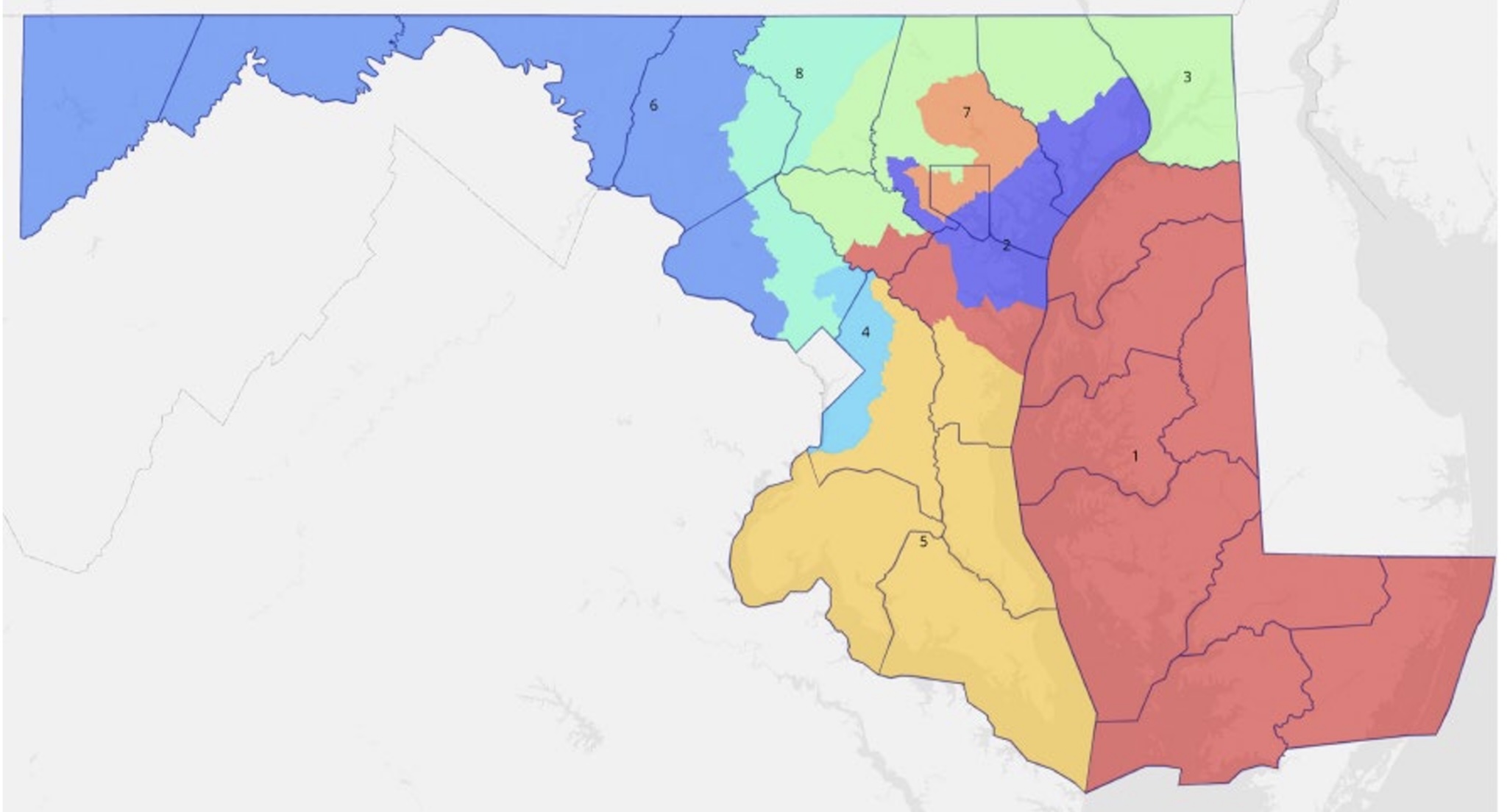
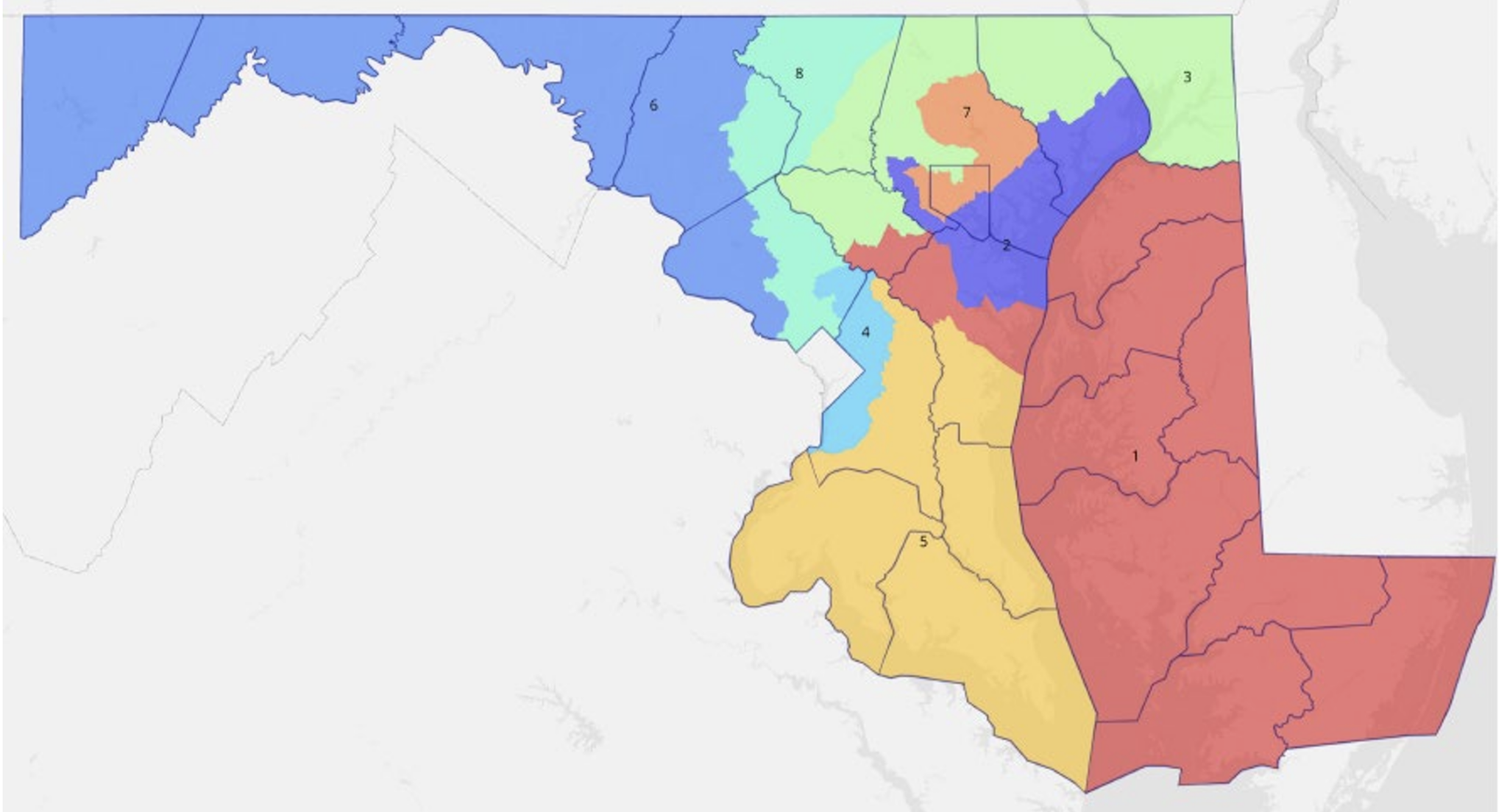
The redistricting plan approved “in concept” Tuesday by the Governor’s Redistricting Advisory Commission. The map would shift Democratic voters into the 1st District, currently held by GOP Rep. Andy Harris, and will require changes to equalize population in the districts. (Map courtesy Governor’s Redistricting Advisory Commission)

A five-member panel voted behind closed doors Tuesday to advance a “congressional map concept” that will be used as a guide for legislation that will attempt to redraw the state’s eight congressional districts.

The Governor’s Redistricting Advisory Commission voted 3-2 to recommend the map to Gov. Wes Moore (D) and the Maryland General Assembly. U.S. Senate Angela Alsobrooks (D), who chaired the panel, said the vote followed a “transparent redistricting process.”

“From the start, our commitment has been simple: Put Marylanders in the driver’s seat,” Alsobrooks said in a statement following a roughly one-hour meeting that the public could not observe.

“This process has been conducted in the open, with opportunities for the public to participate, weigh in, and submit their own map proposals for consideration,” her statement said. “All Marylanders — regardless of party, background, or ZIP code — can engage with this process, see the options, and make their voice heard.”

The concept map overhauls the 1st District — the state’s lone Republican district, held by GOP Rep. Andy Harris. While the district currently includes the Eastern Shore, Cecil, and part of eastern Baltimore County, the conceptual map would have it stretching from the Eastern Shore over the Bay Bridge through Anne Arundel County and into part of Columbia in Howard County. The shift moves more liberal Democrats into the district held by Harris, the chairman of the conservative House Freedom Caucus.

Changes to districts held by Democrats do not appear to threaten control of those seats.

The vote was blasted by state Republicans, with House Minority Leader Jason Buckel (R-Allegany) saying it “confirmed what we have been saying all along: that this Commission had nothing to do with fairness, nothing to do with the wants and needs of our citizens, and, quite frankly, nothing to do with Maryland.”

“Instead, this Commission has everything to do with D.C. partisan politics and the desires of the Democratic National Committee,” Buckel said. “This Commission was merely a drawn-out political sham with a predetermined outcome: To rid Maryland of any Republican representation in Congress and disenfranchise voters in Western Maryland and the Eastern Shore. Nothing drives this home more than their absurd end product.”

National Democratic leaders, who have been pressing Maryland to respond to redistricting schemes in GOP states, hailed the vote.

“Partisan Republican hacks were counting on Democrats to roll over while they gerrymander congressional maps in Texas, Missouri, North Carolina and Florida,” House Minority Leader Hakeem Jeffries (D-N.Y.) said in a statement. “They were wrong. Arrogant and corrupt Republicans started this battle. Democrats will end it. We will ensure that there is a free and fair midterm election in November.”

But redistricting still faces a difficult future in Maryland, where Senate President Bill Ferguson (D-Baltimore City), a member of the commission, is opposed to midcycle redistricting. A redistricting bill, should it reach the Senate, is not expected to receive a vote from the full chamber.

Ferguson and fellow commission member, Cumberland Mayor Ray Morriss, a Republican, voted against the proposed map Tuesday.

Ferguson said in a statement that the map “fails the Governor’s own test. It breaks apart more neighborhoods and communities than our existing map, and it fails the constitutional requirement of one person, one vote. We heard from no Boards of Elections. We heard nothing from the Office of the Attorney General of Maryland, which would have to defend this process and outcome. We heard no testimony to the impact on our election cycle. Ultimately, a flawed process has delivered a flawed product.”

Morris, who said he was asked to serve on the commission to ensure fair congressional districts, said that, “After a while, it became obvious that definition of fair that was being put out there was what was fair for the Democratic Party.”

The governor’s office said it will send the proposed map to the House speaker’s office, and from there “it will be in the hands of the Maryland General Assembly,” Moore said recently, noting that it “is not an administration bill.”

Moore has defended the commission he empaneled as transparent. But there was little public notice for Tuesday’s closed-door meeting, the second time the panel met and made decisions in private.

Four of the five members reached by Maryland Matters said they believed the meeting should have been held in public, and that the public would have benefited from witnessing the deliberations. But former Attorney General Brian Frosh, a commission member, said that while the closed-door meeting bothered him “it’s the governor’s commission, and he can run in any way he wants…. If he says, you’re going to do this in private. I think we end up doing it in private.”

The work of the panel at times seemed slapped together. There was initial confusion about how districts needed to be drawn or if changes would affect local election boards. Alsobrooks, in the panel’s first meeting, promised in-person meetings, but those never materialized.

“I’ve had concerns about the way this process has moved forward from the get-go,” Ferguson told reporters during a meeting before the commission met.

The legislation will start in the House.

House Majority Leader Del. David Moon (D-Montgomery) said a bill could be introduced quickly — possibly as early as the end of next week.

“If you’re the Speaker’s office, you can get it done pretty quickly, but there’s still logistical process, right?” Moon said, adding that there are some “logistical” hurdles that will need to be overcome.

“It’s going to be a multiday process, but I do think we are talking a matter of days, not weeks,” Moon said. “And again, if there’s a will to act, I do believe you’ll see the House wanting to act as soon as possible. I would hope this could be a conversation handled in the first month of session.”

The map approved by the commission will not likely be the one that goes to lawmakers, said Del. C.T. Wilson (D-Charles), a member of the commission who expects to lead the bill on the floor and may also be its sponsor.

“That map will not be the map submitted with the bill,” Wilson said. “It will be zeroed out. That was a concept of the map … because time is an issue. When citizens put maps in, they’re not going to be exact. If they were, well, that’d be a whole other question, wouldn’t it?”

The concept map increases the number of majority-minority districts from two to three. Two have populations that are at least 50% Black voters. But the map also included population deviations some members said would not meet strict “one person, one vote” population standards used by the courts.

Ferguson’s statement called the map “objectively unconstitutional.” He said the new map will likely result in the current map facing a court challenge. Democrats, he warned, risk losing seats the party currently holds.

Former Attorney General Brian Frosh, a member of the commission, said Ferguson’s characterization was inaccurate.

“We voted on a map in concept,” Frosh said, “The map needs to be tweaked. I don’t think it requires major changes. But it’s not perfectly aligned in terms of the numbers. You have to be within a few votes one way or another, a few people one way or another. It probably is out of line in a way that can be fixed.”

Frosh said the tweak should take “half an hour or 45 minutes by the folks at the Department of Legislative Services.”

The adjustments may not matter. Ferguson is a staunch opponent of mid-cycle redistricting, and any bill passed by the House is likely to be sent to the Senate Rules Committee to die without a committee hearing or full Senate vote.

The commission recommended the concept map following a series of 10 meetings — two of which were closed to the public.

More than three dozen maps were submitted by the public. The maps ranged from the basic, with no supporting documentation, to sophisticated iterations that included party registration and demographic data. But in two meetings one map, which was later tweaked, clearly garnered most of the attention.

“To me, when 28 out of 30 people all talk about the same map, it seems just, I don’t know, it just seemed a little odd to me,” Morriss said. “Everybody seemed to know which map they were going to talk about.”

When asked if he felt an outcome had been predetermined, Morriss said it “definitely gave the perception, to me, that something could be a little odd about it. Statistically, it just didn’t add up. So, yes.”

Morriss questioned the vote by the panel, noting that most of the public testimony did not support mid-cycle redistricting.

“I look back at the beginning, when over 70% of the people didn’t want to move forward,” Morriss said. “I think that said a lot. I think what the public got from this was what the Democratic party wanted for the state of Maryland, and for their national agenda. I don’t think the public really got a real — let’s use the word fair — a real, fair analysis of the congressional districts in the state.”

Wilson rejected that argument, saying testimony of roughly 30 people in each meeting was not the only consideration for the commission.

“This was a hearing,” Wilson said. “Not a poll.”

Moore appointed the panel in November, saying he he wanted to ensure the maps drawn in 2022 were “fair.” He has never provided a definition of the term.

But his efforts came as Republican states began hyper-partisan mid-cycle redistricting. The effort, kicked off in Texas, was seen as a way to improve chances of keeping a GOP majority in Congress in this fall’s elections.

In an interview a week ago, Moore said Maryland was reacting to Republican states who recast their maps to eliminate Democrats in Congress.

“The point is this is that if the rest of the country is going to go through a process of determining whether or not they have fair mass in a mid-decade process, then so will the state of Maryland,” Moore said during The Daily Record’s Eye on Annapolis opening day event.

In Maryland, the Democratic Party holds a 2-1 registration advantage over Republican voters, with Democrats accounting for about 50% of registered voters and the GOP and unaffiliated voters accounting for about 25% each.

Even so, Democrats hold seven of eight congressional seats in Maryland; 25 years ago, Republicans held four of the eight seats.

“It was not necessarily, in my mind, what was fair to all of the voters of the state of Maryland,” Morriss said of the commission’s work. “Especially in this case, the Republicans and the unaffiliated voters.”

Frosh said the commission and its recommendation was a response to Trump and MAGA Republicans policies on immigration, voting rights and the push for Republican states to redraw their own districts.

“I think that we can’t be holier than thou in this situation. If the Supreme Court says all you need to do is have an equal number of votes and not openly discriminate, then that’s what we should do,” Frosh said. “Why should we? Why should we cede that advantage to the Republican states? And I just think we’ve got to fight back, and as the old saying goes, you don’t bring a knife to a gunfight.”

Wilson agreed and said complaints about fairness from Maryland Republicans are not persuasive when racial equity is under attack by the Republicans at the federal level.

“The one thing I will clearly say is that my children are a protected class, and we can’t pretend that African Americans are the same thing as being Republican,” Wilson said. “And I don’t hear them saying that … about Texas, about Florida, about Missouri. I don’t see them fighting for a protected class of people in a country with a history of racism and violence.

“And to be clear, they still have a voice. They can still vote,” said Wilson. “My people couldn’t vote for the longest time. They can still vote.”

By Bryan P. Sears
Maryland Matters reporter Dianne J. Brown contributed to this report

The Spy Newspapers may periodically employ the assistance of artificial intelligence (AI) to enhance the clarity and accuracy of our content.

Filed Under: 00 Post to Chestertown Spy, Maryland News

Maryland Caucus with Foxwell and Mitchell: Should Maryland Start Melting ICE?

January 21, 2026 by Len Foxwell and Clayton Mitchell
Leave a Comment

Editor’s Note: Beginning this month, the Spy’s From and Fuller and Maryland Caucus with Foxwell and Mitchell will broadcast twice a week to cover the wide range of issues expected to shape the 2026 campaign.

Every week, Maryland political analysts Len Foxwell and Clayton Mitchell break down the politics and personalities shaping the state and the region on the Spy podcast Maryland Caucus.

This week, Len and Clayton discuss how Maryland should respond to increased activity by the federal government’s ICE agency across the state. They also share their political hot takes for the week.

This video is approximately 18 minutes in length.

The Spy Newspapers may periodically employ the assistance of artificial intelligence (AI) to enhance the clarity and accuracy of our content.

Filed Under: 00 Post to Chestertown Spy, Spy Highlights

Breaking the Cycle, One Father at a Time: A Chat with Corey Pack

January 21, 2026 by Dave Wheelan
Leave a Comment

Some people stumble into their life’s work. Others are pushed into it by circumstance. For former Talbot County Council president Corey Pack, the Responsible Fathers Initiative began as more of a calling. After 25 years in Maryland state government as a probation supervisor, Pack saw the same men cycle through the system again and again—followed, years later, by their sons and daughters. It was a pattern that troubled him deeply, not just as a public servant, but as a citizen watching families unravel in slow motion.

Pack came to believe that the system was largely reactive, stepping in only after harm had already been done. While he understood its limits, he felt compelled to try something different—to work upstream, where prevention might still be possible. In 2019, he left state service and launched the Responsible Fathers Initiative, focusing on one basic but often neglected idea: that engaged, supported fathers can change the trajectory of families and communities.

The program began inside the Talbot County Detention Center, working directly with incarcerated men. When the pandemic hit in 2020, Pack and his partners pivoted quickly, moving the program online and keeping it running when many others shut down. In fact, Talbot County became the only jurisdiction in Maryland to operate a fatherhood program continuously throughout that first year of COVID, eventually expanding to include mothers, youth, and community-based programs.

Since then, the initiative has grown well beyond its original scope, partnering with schools, nonprofits, Washington College, and agencies across Talbot and Dorchester counties. At its core, though, the mission remains simple: help men move from being occasional contributors to fully committed fathers, and keep asking one central question—how do adult choices affect the child? In this interview, Pack talks candidly about what he’s learned, what works, and why he remains optimistic, even when the work is hard.

This video is approximately six minutes long. For more information about the Responsible Fathers Initiative, please go here.

The Spy Newspapers may periodically employ the assistance of artificial intelligence (AI) to enhance the clarity and accuracy of our content.

Filed Under: 00 Post to Chestertown Spy, 1 Homepage Slider

Unnerved by Al Sikes

January 21, 2026 by Al Sikes
Leave a Comment

In what would be perceived as a heretical act, Senator John Thune should attempt to save the Trump Presidency. The President needs pushback from people who have supported him and hold positions of respect and power.

Thune, 65, a Senator from the solidly Republican state of South Dakota, is the Majority Leader in the U.S. Senate. He has been in the Senate since 2005 and has enjoyed wide bipartisan respect. His stature now hangs in the balance. As does President Trump’s presidency. As does the Western Alliance known as the North Atlantic Treaty Organization (NATO).

Understandably, Thune has been broadly supportive of Trump. After all they are both Republicans and I suspect Thune generally supports Trump’s directions, if not his style. And to the degree he might have misgivings, his Party’s leader is the President, and to compromise his power is a fraught exercise.

But what should he do when Trump begins to act like Vladimir Putin? Putin has immeasurably weakened Russia in pursuing his Ukraine obsession. Russian deaths, the alienation of many of Russia’s best and brightest, the sapping of financial strength, and beyond are the prices Russians are paying. So even though Trump has thrown Putin a lifeline, since it doesn’t include dominance over the whole of Ukraine, Putin continues to pursue his mad obsession.

The President, likewise. has for some years eyed Greenland and I take Greenland’s potential as a strategic asset in geopolitics at face value. But I also take at face value that the coalition of Western nations could enhance Greenland’s military posture and therefore the West’s geopolitical protection and leverage.

Trump’s obsession stands in the way. He wants credit. He wants the history books to declare his greatness. Treaty-making to achieve important ends would be a lengthy process—tedious and without the promise of star power.

Returning to NATO. It is a valuable combination of political and defense assets that gives its Member States protection. And it costs each Member a whole lot less since the costs are shared. And going it alone could never be the power equivalent of the coalition.

The whole of NATO’s leadership rejects Trump’s unilateral moves on Greenland. And the whole of NATO leadership is not a humble combination. Heels are dug in—understandably. France, Germany, the Netherlands, Norway and Sweden are moving troops to Greenland. And as history verifies when ego-centric leaders begin to loudly maneuver, bad things often happen.

This unfolding affair brings to mind Trump’s broader vulnerability. Unnerving Americans! People do not like to be unnerved. For most, politics, even governance, is something preferred in the rear-view mirror. Stuff happens, and then a year or so later, we get to express ourselves in the voting booth. If we don’t like, say, a tax, then we vote the Party out that championed it.

Back to John Thune. Blowing up NATO is not a tax that can be easily reversed. International politics are enormously complex turning on a range of assessments and temperamental Heads of State. NATO needs to be protected and protect is what real leaders do.

According to voter polls, the Republican Party has enjoyed a perceptual advantage. Trump is threatening that popularity with unnerving moves, some superficial and others anything but.

He decided to put his name on the Kennedy Center. He bulldozed the East Wing of the White House. He began using the tax code to buy votes. All of this is happening and much more as people worry about the implications of artificial intelligence in their own lives. And while trying to understand cryptocurrencies, they run into the Trump family with their massive stake. Or, find their favorite consumer goods more and more expensive.

Trump is at the edge, the cliff’s edge. Blowing up NATO in a volatile, even toxic environment, will evoke harm that even the less engaged will intuitively understand.

John Thune can quietly let the White House know he does not support taking Greenland by force. That Trump better use the force of diplomacy, not troops on the ground.

Relatedly, the Supreme Court must wake up. While I understand the Court’s studious pace, the Nation faces a use of executive power that is not just unconstitutional but perverse. When a country does something the President doesn’t like, he lashes out with a tariff. He doesn’t even pretend to get Congressional approval, even though the authority to use tariffs as broadly as the President has done is clearly a Congressional prerogative. The arguments before the Court’s Justices were in early November. It is time for a decision; the failure to act on a timely basis engages an institutional risk that is not acceptable.

Al Sikes is the former Chair of the Federal Communications Commission under George H.W. Bush. Al writes on themes from his book, Culture Leads Leaders Follow published by Koehler Books. 

The Spy Newspapers may periodically employ the assistance of artificial intelligence (AI) to enhance the clarity and accuracy of our content.

Filed Under: 00 Post to Chestertown Spy, 3 Top Story

From and Fuller Morning Brief: One Year of Trump

January 20, 2026 by Al From and Craig Fuller
Leave a Comment

Editor’s Note: Beginning this month, the Spy’s From and Fuller and Maryland Caucus with Foxwell and Mitchell will broadcast twice a week to cover the wide range of issues expected to shape the 2026 campaign.

On January 20th, one year after Donald Trump’s inauguration, Craig and Al reflect on his first year in office, discussing promises made, policies implemented, and the impact on both domestic and international perceptions.

This video is approximately nine minutes in length.

The Spy Newspapers may periodically employ the assistance of artificial intelligence (AI) to enhance the clarity and accuracy of our content.

Filed Under: 00 Post to Chestertown Spy, From and Fuller

Some Novel Ideas to Soothe your Soul by Maria Grant

January 20, 2026 by Maria Grant
Leave a Comment

During troubled times like these, it’s a good idea to take a break and read a novel. Why? Because this pastime forces you to think about life in its totality–the world’s history, misdeeds, progress, and sometimes offers the possibility of hope.

I have found solace in novels this past year. Here are some of my favorites.

Unsheltered by Barbara Kingsolver. I’m a huge fan of all her work. I loved Demon Copperhead and The Poisonwood Bible. Unsheltered does not disappoint. It’s about two families who live next door to each other in New Jersey, 145 years apart. In both cases, their homes are falling apart, and no one has the wherewithal to shelter their family from within. This construct allows Kingsolver to contrast the fear of a Trump presidency (well-founded, I might add) with the controversy that ensued over Darwin’s ideas, considered radical at the time. Such a construct confronts the possibility of the collapse of not only our societies, but our shelters and the social order. This theme encourages readers to think about how to seek their own shelters as the world shifts around us. 

The Correspondent by Virginia Evans. I was a bit skeptical about this novel as the story is told through letters, emails, and journal entries. I ended up loving it. The story is about a retired law clerk named Sybil who writes to family, friends, authors, and academics. These correspondences illustrate the power of connection while grappling with the human condition, grief, joy, aging, and the power of forgiveness. NPR named it the best book of the year. I agree. 

Heart the Lover by Lily King. As a former undergraduate and graduate student of English literature, I’m a sucker for novels with tons of literary references. Heart the Lover is chock full of them. While reading the novel, I couldn’t stop thinking about how much research went into all the back stories about authors, their plots, and famous sentences. Heart the Lover is about a woman who ultimately wants to be a writer. It’s about what happens when friends turn into lovers, when friends screw up, wise up, find themselves, and realize what they have lost in the process. Literary references in the novel include The Great Gatsby, The Magic Mountain, Ulysses, Finnegan’s Wake, Confessions of Saint Augustine, The Aeneid, Othello, Macbeth, Crime and Punishment, Anna Karenina, Madame Bovary, As I Lay Dying, The Sun Also Rises, and The Golden Bowl. In referencing these novels, King emphasizes how literature shapes the characters’ understanding of love, loss, and personal identity. 

An Inside Job by Daniel Silva. If you are seeking a delightful escape into the world of art, finance, and Italy, this is the novel for you. An Inside Job is Silva’s 25th book in the Gabriel Allon series. I have read all of them. They are a great way to learn more about Renaissance art, the art dealing industry, and espionage tactics. Plus, the novel is just a good old-fashioned engaging “who-done-it” page turner. In this novel, a painting in the Vatican that may have been painted by da Vinci goes missing, and a young intern in the Vatican’s art department turns up dead. Allon uncovers a network of lies stretching from the Vatican to financial brokers to the Italian mafia. 

Among Friends by Hal Ebbott. This novel is about two families whose long-term friendship is shattered by a shocking betrayal during a birthday celebration at a New York country house. It dives deep into the fascinating exploration of what happens when you are betrayed by your best friend. How do you recover? Can you recover? Can you mentally convince yourself that everything can return to the way it was? I read this novel a few months ago, and its major themes continue to haunt me. I find myself thinking about the characters and their reactions to various events a crazy amount of time. I’m glad I read this book. 

What I love about all these novels are the themes of the devastating ramifications of our decisions, our mistakes, and the difficulties of leading a truly moral life. 

In The Picture of Dorian Gray, Oscar Wilde wrote, “Modern morality consists in accepting the standard of one’s age. I consider that for any man of culture to accept the standard of his age is a form of the grossest immorality.” 

Something to think about in 2026. 

Maria Grant, formerly principal-in-charge of the federal human capital practice of an international consulting firm, now focuses on writing, reading, music, bicycling, and nature.


The Spy Newspapers may periodically employ the assistance of artificial intelligence (AI) to enhance the clarity and accuracy of our content.

Filed Under: 00 Post to Chestertown Spy, 3 Top Story, Maria

Recovery by Jamie Kirkpatrick

January 20, 2026 by Jamie Kirkpatrick
Leave a Comment

Up until a week ago, I still had all my original parts. But that was then; now, thanks to one of the minor miracles of modern medicine, I have a new (left) knee. The surgery itself went well, and heartfelt thanks go out to my surgeon and all the selfless people in the OR and the Recovery Room who took such good care of me. I didn’t know it at the time, but surgery was the easy part. The real journey was yet to come…

Friends who had been there before told me. “Stay ahead of the pain.” “Take all your meds, even the scary ones,” they said. “Be sure to do all your physical therapy,” they advised. They were right, of course, but there was something else they didn’t tell me: “Don’t get discouraged. Recovery takes time so be patient and be a good patient. You’ll need a lot of help.” Now, a week into recovery, I know that to be true.

Trauma, even when it’s planned in advance and carried out by caring professionals, is, well, traumatic. Maybe you think you can see the pain coming, maybe you even intellectually understand it, but you don’t really feel it ’til it hits you in the solar plexus, or, as in my case, in the left knee. And, sadly, you have to feel it to truly understand it. It has to hurt to heal.

The first day after my surgery was a seductive honeymoon. The cutting was done, the worst was over. Wrong! On that second day, the pain blockers were still conscientiously doing their job so it felt like my recovery would be a piece of cake. Not only would I be able to stay ahead of the pain, there wasn’t that much of it. I ditched the walker, put away the heavy duty pain meds. Little did I know…

Since that day, life has slowed to a crawl, or, to be more precise, to a limp with a cane. Existence lies somewhere between a chair, the couch, and bed. Time is measured in twenty minute increments of ice therapy. Every six hours, there are two Extra Strength Tylenol; at other intervals, there’s an antibiotic, an anti-inflammation pill, low-dose aspirin for my heart, and a little pink pill to help keep me regular. (Sorry! Too much information?) There’s not much I can do for myself: the heavy lifting—literally, figuratively— falls squarely on my wife. Were it not for her, someone would undoubtedly find me covered in cobwebs when the snow melts. If there is a special line reserved for caregivers to enter heaven, she’s at the front of it.

Some day soon, I know I will turn the proverbial corner and begin to feel better. I wish I felt so certain about that other pain we’re all feeling: the endless turmoil and duplicity, the ugly viciousness on the streets of Minneapolis, the storm clouds over Greenland that threaten to unravel NATO from within. No unearned, gifted Nobel Prize can ever ease the pain of all the trauma we are suffering from a botched surgery performed by a glowering, demented quack and his twisted team of enablers. Should we somehow survive this mess, our recovery will be long and painful. But this I know: it will be worth it.

I’ll be right back.

Jamie Kirkpatrick is a writer and photographer who lives on both sides of the Chesapeake Bay. His editorials and reviews have appeared in the Washington Post, the Baltimore Sun, the Philadelphia Inquirer, the Pittsburgh Post-Gazette, the Washington College Alumni Magazine, and American Cowboy Magazine. His most recent novel, “The Tales of Bismuth; Dispatches from Palestine, 1945-1948” explores the origins of the Arab-Israeli conflict. It is available on Amazon and in local bookstores. His newest novel, “The People Game,” is scheduled for publication in February, 2026. (It’s available for pre-order now on Amazon.) His website is musingjamie.net.


The Spy Newspapers may periodically employ the assistance of artificial intelligence (AI) to enhance the clarity and accuracy of our content.

Filed Under: 00 Post to Chestertown Spy, 3 Top Story, Jamie

Reza Jafari Appointed to Association of Community College Trustees Board of Directors

January 20, 2026 by Chesapeake College
Leave a Comment

Chesapeake College Board Chair Reza Jafari has been appointed as the Northeastern representative to the Board of Directors of the Association of Community College Trustees (ACCT) by Carol Del Carlo, ACCT Chair.

ACCT is a national nonprofit organization representing more than 6,500 elected and appointed trustees governing over 1,200 community, technical, and junior colleges nationwide. As a member of the ACCT Board of Directors, Jafari will contribute to national leadership, policy development, and advocacy efforts that strengthen community colleges and the students they serve.

“Community colleges play an utterly critical role in expanding access to education, strengthening local economies, and empowering students for upward careers,” Jafari said. “It is an honor to serve on the ACCT Board of Directors and to represent the Northeastern region at the national level. I look forward to working with fellow trustees across the country to advance the mission and impact of community colleges.”

Jafari brings decades of leadership experience spanning higher education, economic development, technology, and global innovation. He currently serves as Chair of the Chesapeake College Board of Trustees and is the Chairman, CEO, and Founder of e-Development International, an executive advisory group based in Easton, Maryland. His career includes senior executive roles in global communications and technology organizations, as well as extensive service on state, national, and international boards and commissions focused on innovation, workforce development, and economic growth.

“Reza’s appointment reflects both his deep expertise and his long-standing commitment to education and public service,” said Chesapeake College President Dr. Clifford Coppersmith. “His leadership at the local level and his global perspective make him an exceptional representative for our region and for community colleges nationwide.”

Throughout his career, Jafari has served in leadership roles with organizations including the Maryland Economic Development Commission, the United Nations’ ITU TELECOM, and the UN Broadband Commission for Digital Development. His work has consistently emphasized innovation, connectivity, and educational opportunity.

Jafari holds an M.B.A., a Specialist in Education postgraduate degree (SEd), and ABD/Ph.D. in Instructional Systems Technology and Innovation from Indiana University, Bloomington.

For more information about AACT visit www.acct.org. To learn more about Chesapeake College visit www.chesapeake.edu.

The Spy Newspapers may periodically employ the assistance of artificial intelligence (AI) to enhance the clarity and accuracy of our content.

Filed Under: 00 Post to Chestertown Spy, 7 Ed Notes

Spy Spotlight: Checking in on Camp Wright

January 19, 2026 by The Spy
Leave a Comment

Camp Wright, the Episcopal summer camp on Kent Island, is one of those Mid-Shore gems that is easy to overlook, but it has been serving young people since the 1930s with its two-hundred-acre site at the foot of the Chesapeake Bay Bridge. In fact, on average, Camp Wright serves approximately 1,500 kids each year, both day campers and overnighters, through its special blend of recreational activities and spiritual connections.

And for decades, Wright has been able to pay its way through the support of its modest camper fees, contributions from local churches and individuals, but recently the camp realized that unless outside funds could be raised to stabilize its waterfront from erosion, one of the Chesapeake Bay’s greatest coastal assets would be lost.

That is why the Spy invited Myron Richardson, the treasurer of the Episcopal Diocese of Easton, to speak about Camp Wright, its history, and current needs.  Myron helps oversee the diocese’s finances and has a long view of its work with children and families. In this conversation, he walks us through the history and mission of Camp Wright—from its early roots in caring for children, to how the camp operates today, and the challenges of sustaining a major waterfront ministry on the Chesapeake Bay.

This video is approximately four minutes in length. For more information about Camp Wright or to make a donation, please go here.

The Spy Newspapers may periodically employ the assistance of artificial intelligence (AI) to enhance the clarity and accuracy of our content.

Filed Under: 00 Post to Chestertown Spy, Spy Highlights

Thoughts on the 2026 State Budget by David Reel

January 19, 2026 by David Reel
Leave a Comment

The ninety-day 2026 regular session of the Maryland General Assembly is now underway.

There is almost universal consensus that the top priority before they adjourn is to enact a balanced state budget when a $2.6 billion deficit is currently projected. It could be more.

The options to reach a balanced budget this session are comparable to the options considered last session. Then and now, they include new taxes, tax increases, new fees, fee increases, transfers from the state’s “rainy-day” reserve fund, borrowing money, shifting the funding for state-mandated programs and services from the state government to county governments, and spending cuts. There is no consensus yet on any of these options this session.

Governor Moore has said there will not be tax increases. He said much the same last year, calling for a “high bar” on tax increases. When all was said and done, he approved a balanced budget funded with a package that included the above budget balancing options.

New to the dialogue and deliberations budget debates this year is Delegate Joseline Pena Melnyk who was unanimously elected last month to serve as Speaker of the House.

Speaker Melnyk has delivered mixed messages so far in the session. She has said she “doesn’t expect” any tax changes this session from her chamber. She followed that with, “I’m not sure about that. I hope not.” Then she said “But to be honest, I haven’t had an opportunity yet to talk to my committees about those issues. Session hasn’t even started, but I can tell you the taxes [are] definitely off the table.”

Senate President Bill Ferguson has said, “Our focus is going to be on living within our means. He has said his chamber won’t be the ones to put forward a plan to increase the cost of living for Marylanders. When asked if he’s concerned the House of Delegates may float proposals to raise taxes and fees, Ferguson said he can’t speak for the members in the lower chamber, just that he knows “where the Senate will be.”

Another matter that merits watching in the 2026 session is how the relationship between the Democratic super majority and the Republican minority in the House of Delegates may change with Speaker Penya Melnik’s approach to leadership.

One reporter covering the opening day of the new session observed that the new speaker ushered in a new era with a leadership style geared toward bipartisanship, civility, and finding solutions that involve delegates from across the state, including Republicans, to ensure everyone’s ideas are heard.

If that occurs, it will be a major change from the historic pattern of decision-making in Annapolis. Republican minorities in the Maryland House of Delegates and the Maryland Senate have long endured legislative decision-making where the minority caucus has had their say, but the majority caucus has not seriously considered what the minority has to say, and the majority caucus has always had their way.
We will know soon if and how these changes play out.

Speaker Melnyk has also expressed a desire for further accountability in state government spending.

This is not surprising given recent widespread and regular media coverage of two audit reports conducted by the bipartisan Office of Legislative Audits (OLA) in the Maryland Department of Legislative Services.

In one audit, OLA auditors reported Maryland’s overpayment of $807.4 million in unemployment benefits, $760 million of which the auditors have deemed unrecoverable because the state did not act in time to pursue recovery.

In another audit, OLA auditors reported the State Highway Administration (SHA) overcharged $360 million in unauthorized expenses to federally funded projects that need to be paid back.

Last week, there were media reports that the OLA, Maryland Department of Human Services’ inspector general, and the U.S. Department of Agriculture’s inspector general have been made aware of allegations by two former state employees of payment errors in Maryland’s Supplemental Nutrition Assistance Program (SNAP), formerly referred to as food stamps.

Pursuing greater transparency and accountability on state spending is not new. In 2020, a Maryland Efficient Grant Application Council was created and charged with developing recommendations for greater oversight and accountability on state grants to not-for-profit organizations in Maryland. The deadline for their recommendations was originally July 1, 2024. Now the deadline is July 1, 2027. It remains to be seen if this new deadline will be met.

Last week, Maryland General Assembly Republicans called for creating a special investigative committee with subpoena power to discuss the SHA audit, the unemployment overpayment audit, and the whistleblower allegations on the SNAP program. Such a committee is not unprecedented, but the last one was put in place at least twenty years ago.

Time will tell if and how Speaker Pena Melnyk will achieve success in her expressed desire for further accountability in state government spending.

Time will also tell if and how Speaker Pena Melnyk will achieve success in ushering in a leadership style characterized by bipartisanship, civility, and finding solutions that involve delegates from across the state, including Republicans, to ensure everyone’s ideas are not only heard but are also respected and given serious consideration.

Going forward, President John F. Kennedy’s thinking on bipartisanship is a great model for Governor Moore and every member of the General Assembly.

JFK said — “Let us not seek the Democratic answer or the Republican answer, but the right answer.”

David Reel is a public affairs and public relations consultant who lives in Easton.

The Spy Newspapers may periodically employ the assistance of artificial intelligence (AI) to enhance the clarity and accuracy of our content.

Filed Under: 00 Post to Chestertown Spy, 3 Top Story, David

  • 1
  • 2
  • 3
  • …
  • 30
  • Next Page »

Copyright © 2026

Affiliated News

  • The Chestertown Spy
  • The Talbot Spy

Sections

  • Arts
  • Cambridge
  • Commerce
  • Ecosystem
  • Education
  • Food & Garden
  • Health
  • Local Life
  • News
  • Point of View
  • Senior Nation

Spy Community Media

  • Subscribe for Free
  • Contact Us
  • COVID-19: Resources and Data

© 2026 Spy Community Media. | Log in