MENU

Sections

  • About Us
    • Editors and Writers
    • Sponsorship Terms & Conditions
    • Code of Ethics
    • Sign Up for Cambridge Spy Daily Email Blast
  • The Arts and Design
  • Culture and Local Life
  • Food & Garden
  • Public Affairs
    • Commerce
    • Health
    • Ecosystem
    • Education
    • Senior Nation
  • Point of View
  • Chestertown Spy
  • Talbot Spy

More

  • Support the Spy
  • About Spy Community Media
  • Advertising with the Spy
  • Subscribe
December 9, 2025

Cambridge Spy

Nonpartisan and Education-based News for Cambridge

  • About Us
    • Editors and Writers
    • Sponsorship Terms & Conditions
    • Code of Ethics
    • Sign Up for Cambridge Spy Daily Email Blast
  • The Arts and Design
  • Culture and Local Life
  • Food & Garden
  • Public Affairs
    • Commerce
    • Health
    • Ecosystem
    • Education
    • Senior Nation
  • Point of View
  • Chestertown Spy
  • Talbot Spy
3 Top Story Arts Arts Portal Lead

Looking at the Masters: How St Nicholas Became Santa Claus in America

December 17, 2020 by Beverly Hall Smith
Leave a Comment

St Nicholas of Myra (270-343 CE) (Greece) and the numerous miracles he performed were the inspiration for St Nicholas Day celebrated on December 3, 2020. He was buried in the Church of St Nicholas in Myra.  The great schism (1054) officially separated the Eastern Orthodox and Roman Catholic Churches.  The Byzantine Empire was conquered in 1087 by the Seljuk Turks who brought the religion of Islam. A group of Italian Catholic merchants in Myra secretly removed the bones of St Nicholas from the Church and took them to the Italian town of Bari.  They bones were interred in the Basilica of San Nichola and remain there still. The first Crusade (1096) departed from Bari, and St Nicholas’s miracles involving the saving of people, particularly seafarers, became popular with the Crusaders. On their return from the Holy Land, the Crusaders spread the cult of St. Nicholas in Europe.  By the Fifteenth Century stories had evolved to include St Nicholas the gift giver and patron saint of children. Children all over Europe celebrated St Nicholas Day and left shoes or stockings by the fire; if they were good children, they would receive a gift, if not, they might receive a switch.
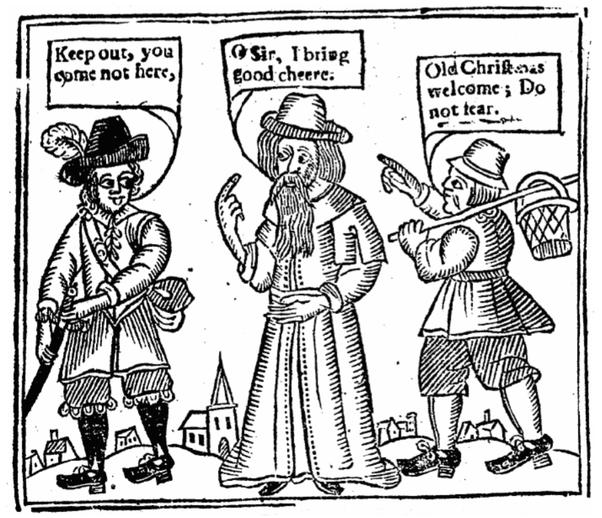
“The Vindication of Christmas” (1652)

St Nicholas Day suffered a setback in Germany when Martin Luther (1483-1546) stated that Christmas Day, December 25, was the appropriate time for gift giving to celebrate the Christ Child, Christkind in German.  In England, Oliver Cromwell (1647) declared Christmas was a “Popish” tradition and punished those who observed Christmas on December 25.  He promoted the idea that Christmas really was derived from the Roman pagan festival of Saturnalia.  The people revolted.  In 1652, “The Vindication of Christmas, O Sir I bring good cheer to Pilgrims, ”an anonymous print was circulated.  A Puritan on the left is about to draw his sword while Old Father Christmas, dressed in a long gown similar to the robes of St Nicholas, calms the Puritan, and a commoner welcomes Old Christmas.  

The Examination and Tryall of Old Father Christmas (1658)

Josiah King’s pamphlet “The Examination and Tryall of Old Father Christmas” (1658) depicts a white haired and bearded Father Christmas,  this time in Bishop’s robe and mitre, similar to the early images of St Christopher. He wears a long fur stole, and although he is in prison, he sits in a chair with a nailed leather back and curved arm.  Accused by the Commonwealth of idleness, drunkenness, profligacy and other debaucheries, Father Christmas was not restored to his proper role until 1600, when Charles II came to the throne

Festival of St Nicholas on December 6, 1810

From their arrival n America, Puritan colonists banned Christmas in the Massachusetts Bay Colony until 1681. It was Dutch immigrants in New Amsterdam that brought the stories and legends to New York. On St Nicholas Day in Holland, seafaring men went to the harbor to take part in church services for St Nicholas.  On their way home they would pick up small gifts, such as oranges imported from Spain, to put in the stockings or shoes of children.  Coincidentally, St Nicholas often was shown with three golden balls representing the gift he gave to the father of three daughters for their dowry.  The oranges represent the golden balls.  Alexander Anderson’s engraving for the New York Historical Society’s annual meeting in 1810 officially recognizes the first “Festival of St Nicholas on December 6, 1810”.  St Nicholas is depicted in traditional bishop’s robes and on the hearth a Dutch teakettle, waffles, cat, and stockings.  On the mantle, the good little girl holds several gifts in her arms, and her stocking overflows. The bad little boy holds a switch and his stocking is full of switches as well.

“Old Santa Claus with much delight” (1821)

A small paperback book titled The Children’s Friend:  A New-Year’s Present, to the Little Ones from Five to Twelve was published in 1821 by William Gilley in New York. The book included eight illustrations of the poem “Old Santa Claus with much delight,” that tells of Santa Claus’s visit on Christmas Eve, December 24, not December 6. Riding in a sleigh pulled by a reindeer, Santa wears the red robe associated with a bishop.  In other illustrations for the poem he is depicted as tall and thin, quietly putting toys in stockings hung on the children’s bed post.

Another contributor the image of Santa Claus was Washington Irving (1783-1859). Famous for his novels “The Legend of Sleepy Hollow” and “Rip Van Winkle,” he wrote under the assumed name of Diedrich Knickerbocker, a satire titled A History of New York from the Beginning of the World to the End of the Dutch Dynasty (1809). In the story Irving described Sinter Klaas as a rascal in a blue three cornered hat, a red waistcoat, and yellow stockings. The figure of Santa Claus was by this time a jolly heavy man who smoked a traditional Dutch long white clay pipe.  He rode over the roof tops in a horse drawn wag and dropped the children’s gifts down the chimney.

A poem called “A Visit from Saint Nicholas”, known familiarly as “The Night before Christmas,” was published anonymously in the Troy Sentinel, on December 24, 1823. The author, disputably, Clement Moore, was a Biblical scholar, a professor and a poet, who taught at the Theological Seminary of the Episcopal Church in New York City, did not admit to authorship of the poem for twenty-two years.  The poem contributed a number of new details about Santa Claus. He was dressed all in fur, with a broad face and a little round belly, and he filled the stockings hung by the fire. Moore’s unique contribution to the Santa Claus image was the names and number of eight reindeer: Dasher, Dancer, Prancer, Vixen, Comet, Cupid, Donner and Blitzen.  Moore presented a peaceful vision of the arrival of Santa Claus in contrast to the more traditional public festivities of drinking, eating, carousing and general rowdiness as the revelers ran riot in the town.  Santa Claus became a family centered figure, and as Moore put it, “A wink of his eye and a twist of his head soon gave me to know I had nothing to dread.”
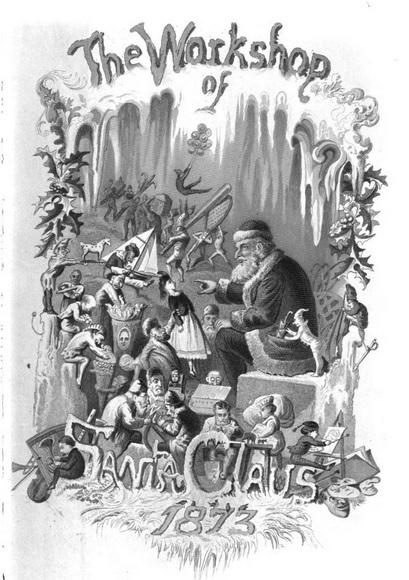
“The Workshop of Santa Claus” (1873)

Louisa May Alcott, of Little Women fame, wrote in 1856 a poem titled “Christmas Elves,” which would have made another addition to the story of Santa Claus if her publisher had decided to use it. However, in 1857, Harpers’ Weekly published a poem titled “The Wonders of Santa Claus” that included these verses: “He keeps a great many elves at work, All working with all their might, to make a million of pretty things, Cakes, sugarplums and toys, To fill the stockings, hung up you know, By the little girls and boys.”  Godey’s Lady’s Book, (Christmas 1873) contained the image “The Workshop of Santa Claus.” Numerous elves sew, hammer and otherwise busily make toys. The caption reads: “Here we have an idea of the preparations that are made to supply the young folks with toys at Christmas time.”  The same issue also contained an article by a socially conscious writer who informed the reader that contemporary toymakers were not elves, but real people, mostly struggling foreigners. “Whole villages engage in the work, and the contractors every week in the year go round to gather together the six day’s work and pay for it.”
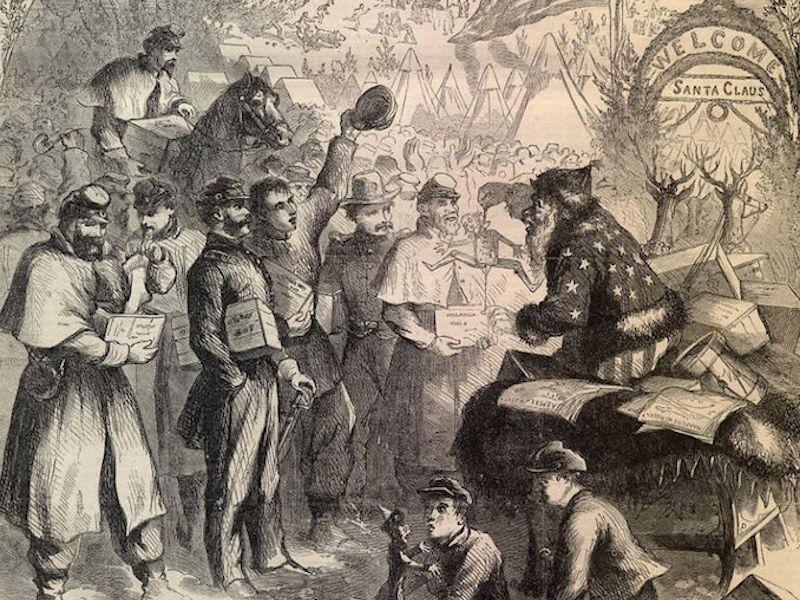
“Santa Claus at the Union Camp” (1863)

The artist who most influenced the evolving image of Santa Claus was Thomas Nast, an immigrant from Bavaria and a famous political cartoonist. Nast, inspired by his German background and “The Night before Christmas,” created what was to become the iconic image of Santa Claus.  However his first depiction of Santa Claus, published by Harper’s Weekly (1863), drawn and printed during the American Civil War, was not what one would expect.  “Santa Claus at the Union Camp” depicts a white bearded Santa dressed in a jacket with white stars and pants with white stripes.  Although a black and white image, the intended reading of the red, white and blue of the American flag is obvious.  This patriotic Santa passes out gifts to Union troops.  A strong Union supporter, Nast included a small boy holding a puppet with a noose around its neck that looks very much like Jefferson Davis. 

“Merry Old Santa Claus” (1881)

Thomas Nast continued to draw images of Santa Claus for Harper’s Weekly for the next thirty years, completing thirty-three Santa’s. The iconic image is “Merry Old Santa Claus” (1881).  His red suit, arm-load of toys, pack on his back, white beard, smiling jolly face, and a long stemmed pipe, this Santa composed the model for all Santa’s to follow. One more part of the story came from Thomas Nast. He began noting “Santa Claussville, N.P.” in the corner of his works, to identify the North Pole as Santa’s home.

 After the end of the Nineteenth Century, Santa Claus’s image was secure. Writers such as Frank Baum, commercial companies such as Montgomery Ward and Coca Cola, and song writers and singers such as John Marks and Gene Autrey continue to add delightful bits of information about Santa Claus.  St Nicholas from Myra, Kris Kringle or Kristkind from Germany, Old Father Christmas from England, and Sinterklaas from Holland, all participated in bringing Santa Claus to America. 

Beverly Hall Smith was a professor of art history for 40 years.  Since retiring with her husband Kurt to Chestertown six years ago, she has taught art history classes at WC-ALL and Chesapeake College’s Institute for Adult Learning.  She is also an artist whose work is sometimes in exhibitions at Chestertown RiverArts and she paints sets for the Garfield Center for the Arts.

 

The Spy Newspapers may periodically employ the assistance of artificial intelligence (AI) to enhance the clarity and accuracy of our content.

Filed Under: 3 Top Story, Arts Portal Lead

At the Academy: The AAM Members Show 2020

December 15, 2020 by The Spy
Leave a Comment


While the Academy Art Museum has distinguished itself over many years with its art exhibitions’ quality and depth, there will always be a particular fondness and community gratitude for its annual Members Show.

Representing well over one hundred artists, the yearly event is a fitting acknowledgment of our region’s gifted painters, and it also reminds us of the unique role that art plays on the Mid-Shore. It summarizes in one place the diversity and abundance of the exceptionally talented artists that live among us. This substantial number of creatives enrich our region well beyond what is found on their canvases, and the Academy’s tradition of putting a spotlight on their works only reminds us how fortunate we are.

Last week, the Spy talked to Mehves Lelic, the Academy’s curator, about the show and the remarkable talent it represents.

This video is approximately two minutes in length. For more information about the Academy Art Museum, please go here.


The Spy Newspapers may periodically employ the assistance of artificial intelligence (AI) to enhance the clarity and accuracy of our content.

Filed Under: Arts Portal Lead, Arts Top Story

Art on Lockdown: Yuh Okano

December 14, 2020 by James Dissette
Leave a Comment

When I first saw Yuh Okano’s silk scarves during an outdoor Chestertown artist market, I was impressed by the unique spectrum of colors in her work. I wanted to know more about her creative process and ascendance as an artist whose work has been collected by the Museum of Modern Art and many international exhibitions.

Turns out, after befriending fellow artist Faith Wilson while attending many of the same art shows, Okano decided last February to make Chestertown her home after 20 years in New York City.

Okano’s residence on High Street is more like a workshop and gallery. The first floor is a fabric dying room and workspace where yards of silk is stretched hammock-like. These are her blank “canvases” that will be painted and dyed with her visions of the natural world.

The second floor is a gallery for her favorite works from the past and new creations for sale. Okano explains that the fascinating small shadow boxes on the wall are fabric concepts from which larger projects may evolve but often stand alone as art in miniature.

Okano says that her childhood in Japan was influenced by her family of artists, including an uncle who was a renowned famous graphic designer. In the early 1980s, her artistic pathway brought her to the US and Rhode Island School of Design.

“To this day, my network of friends from RISDY, and artists I’ve met along the way, have formed a valuable network. We help each other,” she says.

Drawing heavily from the natural world, Okano exhibits a rich and joyful chromatic scale offset by creations that lean more toward muted olive and cinnamon earth tones.

From bold to subtle, all on silk or fine wool, her commercial work offers ornate necklaces, flower pins, shawls, and handbags of Devore fabric.

 If you visit her gallery, you must see her Shibori Dumpling Bag,

Okano’s fabric art appears in museums and galleries worldwide from Japan and MoMa to Finland and Denmark, and she has taught fabric arts in equally diverse countries.

Scan her website for a full introduction. These few minutes do not do justice to the range of this artist’s work.

This video is approximately 7 minutes in length. To see her prolific range of art, visit her website here.

The Spy Newspapers may periodically employ the assistance of artificial intelligence (AI) to enhance the clarity and accuracy of our content.

Filed Under: 1 Homepage Slider, Arts Portal Lead, Spy Highlights

Chesapeake Lens: Sunset Fishermen by Carole Niemand

December 12, 2020 by Chesapeake Lens
Leave a Comment

Photographer: Carole Niemand, Rock Hall.  On a November evening, birds gather for a little night fishing. Sky and water complete the circle of life.

The Spy Newspapers may periodically employ the assistance of artificial intelligence (AI) to enhance the clarity and accuracy of our content.

Filed Under: Chesapeake Lens

Delmarva Review: Leaving Spain by David Salner

December 12, 2020 by Delmarva Review
Leave a Comment

Author’s Note: We visited Robert and Eva in Spain during his brave, final battle with cancer. He had great insights for us concerning the big events taking place in his adopted land.

Leaving Spain

for the memory of Robert Greenway,

Headed for the Alicante station
on a stretch of EU highway no one drives,
we open the lunch bag packed by Eva
containing slices of sesame rye,
olives, chunks of queso manchego,
almonds, an empanada, still warm.

Our train stops in Valencia, accelerates
through orange groves, past irrigation trenches.
Each holds a narrow gloss of water,
mirrors a fragment of the sky.
Blocks of quartz stacked by the tracks
shatter sunlight into green, translucent shards. 

From before we left, the image of a lizard
streaks across the shoulder of the pool
and leaves a blur upon the sunbaked day,
a hazel stain on alabaster. Surrounded by cactus,
high above the seaside calamari stands,
stucco walls trace sharpened pencil lines 

against a perfect blue, a depth of sky.
In this land, all things are marked by demarcation, the clash
of elements at their edges. But in the stucco house—
darkness. Robert will sleep all afternoon,
or try to. Wake from a double-dose—
chemo, radiation—gulp the air he needs 

to entertain his friends with talk
about events in Barcelona, about the red and yellow
ribbons of Valle de los Caídos, where the tyrant
lies buried, will not always be. His face lights
to an hour’s conversation for words
are the reward for what he lives through, 

a run of words he chisels into time, our lasting stone.
Surrounded by parched olive groves
and ragged rows of pomegranate, we talk
past sundown, when a soft breeze comes to us
flowing from a range of bluffs down to the sea,
a gray mirage below a gauzy sky. 

We watch a spume climb from the waves
into a haze, an opal mix with no horizon line.
No past or future. The present is a veil of clouds,
an envelope for hearts to beat within.
Twilight. In the corner of an eye,
the pain leaks back. 

**
We are prepared to tiptoe from the house
and let him sleep, but he wakes in the afternoon
and follows us to where the sun beats down
upon the cobbles. With Eva bracing him,
he stands before a purple bougainvillea,
grins into the future, waves. 

♦

David Salner, from Delaware, has worked as iron ore miner, steelworker, machinist, longshoreman, teacher, baseball usher, and librarian. Honored by nine Pushcart Prize nominations, including for “Leaving Spain,” his poetry appears in recent issues of Delmarva Review, Threepenny Review, Ploughshares, Salmagundi, River Styx, Beloit Poetry Journal, and many other magazines. His fourth poetry collection is The Stillness of Certain Valleys (Broadstone Books, 2019). Salner has an MFA from the Iowa Writers’ Workshop. A novel about the workers building the Holland Tunnel is due in March. Website: www.DSalner.wix.com.

Delmarva Review is an independent literary journal publishing the best of new poetry and prose selected from thousands of submissions annually. Its 13th edition publishes new work by 64 authors, including David Salner and Sue Ellen Thompson. It receives partial financial support from a Talbot County Arts Council grant with funds from the Maryland State Arts Council. Readers can buy copies from specialty booksellers like Mystery Loves Company, in Oxford, or from Amazon.com and other online booksellers. Website: www.DelmarvaReview.org.

#  #  #


The Spy Newspapers may periodically employ the assistance of artificial intelligence (AI) to enhance the clarity and accuracy of our content.

Filed Under: 3 Top Story, Delmarva Review

Looking at the Masters: The Art of Hanukkah Lamps

December 10, 2020 by Beverly Hall Smith
Leave a Comment

The Jewish celebration of Hanukkah begins at sundown on December 10, and ends at sundown on December 18, 2020. Also known as the Festival of Lights. The festival commemorates the re-conquest of the land of Israel and the re-dedication of Solomon’s Temple. The land of Israel, including the city of Jerusalem, was conquered by Antiochus III (ruled 222-186 BCE), King of Syria, who at first dealt kindly with the Jews. When he was defeated by the Romans and made to pay them heavy taxes, he extracted the tax in gold from the treasury in the Holy Temple of Jerusalem. The treasury held the half shekel each adult male Jew gave annually for the upkeep of the Temple, and an amount for orphans to be paid when they came of age and went out on their own.

At Antiochus’s death his son Seleucus IV further oppressed the Jews. He was followed by his brother Antiochus IV, called the Madman. Defeated in a war with Rome, Antiochus IV returned to Jerusalem and ordered his army to attack the Jews. Thousands died. Jewish worship was forbidden, the scrolls of Law were burned, rituals were forbidden, and Jews were made to eat pork. Thousands of Jews fled and hid in the hills of Judea. From 167 BCE to 160 BCE, Judah Maccabee and his brothers led battles to reclaimed the land. They cleared the Temple of the Syrian and Greek idols and built a new altar. The re-dedication of the Temple was held on the twenty-fifth of the month of Kislev (November-December) in 139 BCE.

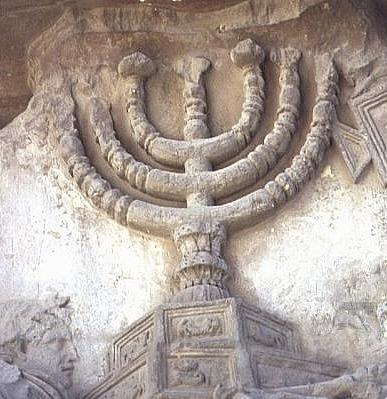
Golden Menorah from Arch of Titus, Rome (81 CE)

The original Gold Menorah was stolen when Antiochus IV savaged the Temple; a new one of crude metal menorah was made for the re-dedication. A Menorah has six cups of equal height to hold the consecrated oil, representing among other things, the tree of life and the six days of creation, and a seventh taller cup in the center representing the light of God. However, there was only a small amount of purified olive oil was found, and it was only enough for one night.

The Hanukkah miracle occurred as the one day’s worth of oil burned for eight days, the time necessary to prepare new oil. A new celebration of Hanukkah was declared, and a new lamp was created. Hanukkah lamps had eight oil cups and with a ninth, the Shamash, with oil to light the others. The new lamp celebrated the miracle of eight days of light and the rededication of the Temple.

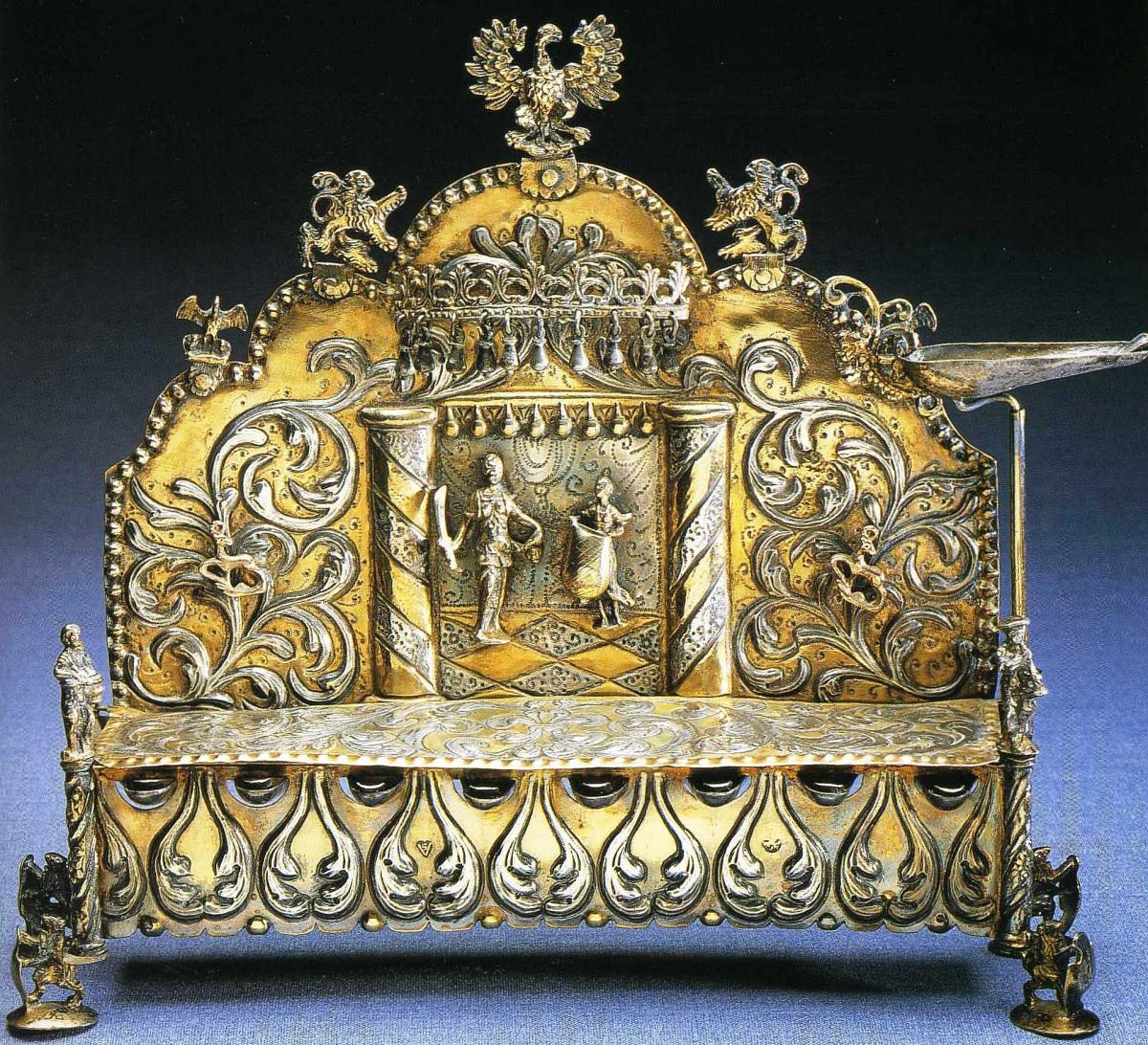
Hanukkah Lamp (1680)( Frankfort, Germany) (10’’ x 12’’ x3’’)

Lighting the Hanukkah lamp is the most significant part of the celebration. The honor of lighting the lamp goes to a woman. The Talmud and other scholars state that women contributed to the victory of Hanukkah and compare their part in the victory to that of Judith (Book of Judith, Apocryphal Gospels which are excluded from Hebrew and Protestant books) and her victory over the Assyrians. Centered on the lamp is the image of Judith and Holofernes. Judith, a beautiful widow of Bethulia in the sixth century BCE, was determined to save her city from the Assyrians. Nebuchadnezzar, King of Assyria had sent his general Holofernes to conquer the town. He laid siege to the town and their victory was assured as the people of Bethulia would soon starve.. Judith dressed in her finest and with her maidservant went to the camp to see Holofernes. She promised to aid him with the conquest and an easy victory if he promised to spare her people. Holofernes was charmed. In three days, at the dark of the moon, she would lead him to a secret entrance into the city. Until then she agreed to stay in the camp and only asked to go outside in the evening to pray.

On the evening before the attack, she contrived to get Holofernes very drunk, and using his sword she cut off his head. Stuffing it into a bag, she and her maid went out to pray as usual. When the soldiers came to wake Holofernes, they found him dead. Without a leader the army foundered, and the city was saved.

The Talmud states that Jews could not rely on miracles, but should ask God to give them the strength to do the impossible. One story about Judith quotes her: “Give into my widow’s hand the strength that I plot.” Another version of the story relates that she took food into the camp so as not to break Jewish dietary laws. This act presents another aspect of Judith’s link with Hanukkah. Today potato Latkes are a traditional food for Hanukkah: however, they originally were made with cheese. Potatoes were not found in Israel until well after they were brought to Europe from South America and America by Christopher Columbus. In Europe and Israel eating cheese latkes was the tradition. Judith’s food included cheese made from goats and sheep and was extremely salty. She fed Holofernes cheese on his last night; to quench his thirst he drank heavily, and passed out. Cheese latkes became forbidden in the Fourteenth Century when Jews began to fry food in chicken fat (schmaltz), which violated kosher dietary laws not to eat dairy with meat, thus the potato latke. Cheese is still a part of Hanukkah meals as kugel or rugelach. Both cheese and oil remain a part of Hanukkah to remind the Jews of the miracle associated with Judith. Ashkenazi Jews are known for the potato latke. On Hanukkah, the Sephardic tradition features fried jelly doughnuts (Sufganiyot).

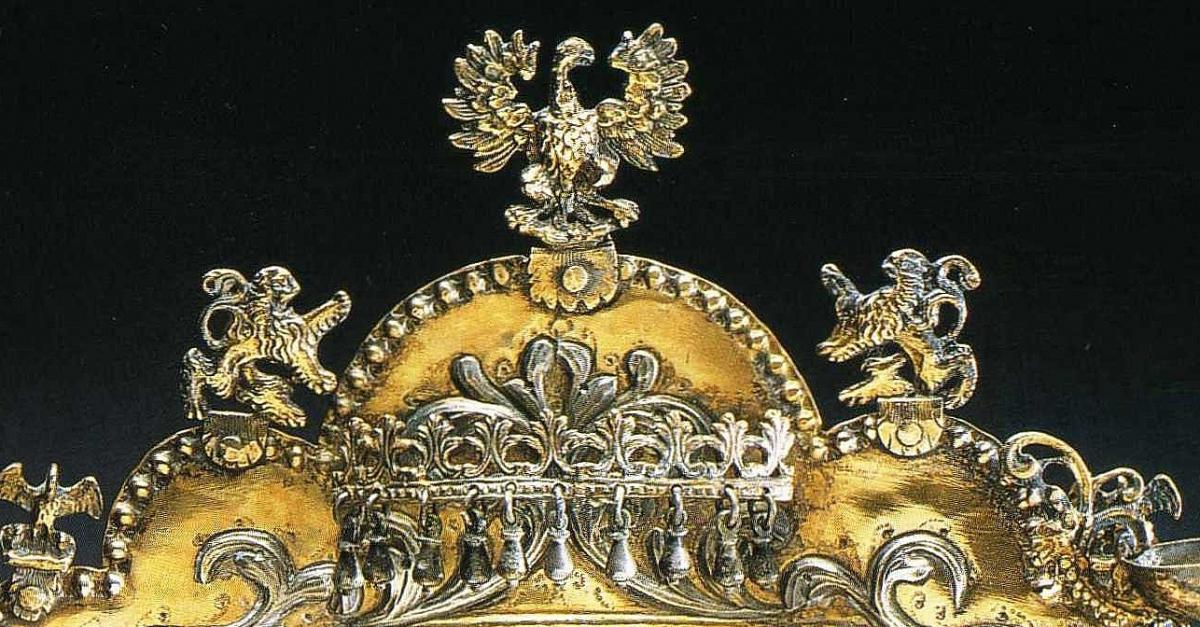
Hanukkah lamp (1680) (detail)

Lions and eagles frequently are depicted on Hanukkah lamps. Two rampant lions appear on either side of this bench lamp The Lion of Judah is the symbol of the Israelite tribe of Judah. In Genesis 49:8-10, Jacob blesses his son Judah: “Judah your bothers will praise you; your hand will be on the neck of your enemies. You are a lion’s cub, Oh Judah. The scepter will not depart from Judah, nor the ruler’s staff from between his feet.” Three eagles refer to God sending eagles to fight against the Egyptians as the Jews crossed the red Sea. On Mt Sinai, God said to Moses (Exodus 19:4): “You yourself have seen what I did to Egypt, and how I carried you on eagles’ wings and brought you to yourself.” The Talmud states that eagles fly the highest of all birds and carry their young on their backs rather than in their claws as other birds do. In this way if an eagle is attacked, the children are protected, and the eagle will sacrifice itself for its children.

Hanukkah lamp (17th century) (14’’x16’’)

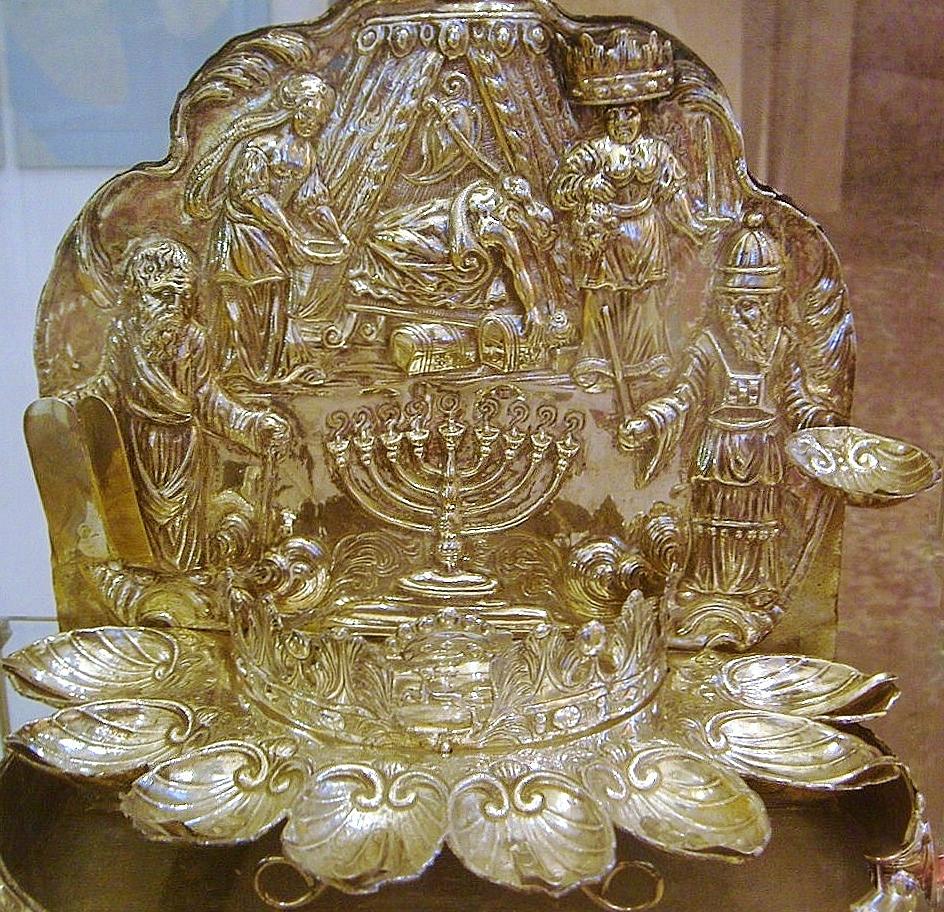
Early Hanukkah lamps use oil and not candles as we see today. A second Hanukkah bench lamp depicts Judith and her maidservant in Holofernes’s tent. The beheaded general is depicted on the bed his arm lying over a chest. Judith holds Holofernes sword in her left hand and his head in her right hand. The maid servant opens the bag to receive the head. The city of Bethulia appears to sit upon Judith’s head, perhaps an attempt by the artist to place it in the background outside of the tent. Behind the maid servant are waving palm branches. A Hanukkah lamp with burning oil is centered in the composition. To the left Moses holds his staff in his left hand with the waters of the Red Sea swirling at his feet. In his right hand he supports the two tablets of the Ten Commandments. On the right Moses’ brother Aaron is depicted in the garb of a priest of the Temple: a mitre or turban on his head, a breastplate of judgment set with five stones, and a robe with pomegranates and golden bells on the hem as tassels. In his left hand he holds the ninth oil cup, the Shamah, and in his right a sword. “Thou shalt make holy garments for Aaron they brother for glory and for beauty.” (Exodus 28:2)

Hanukkah lamp (1706-32)(Johan Adam Boller)

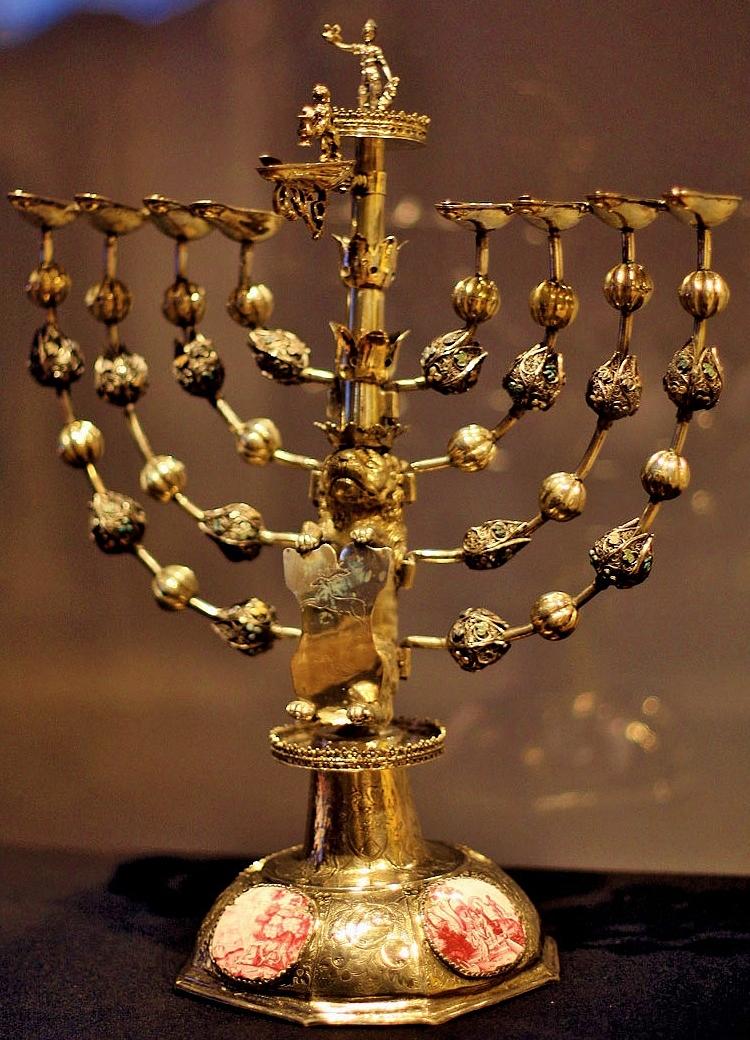
In the early Eighteenth Century, Johan Adam Boller (1706-32), a member of a famous silversmith atelier in Frankfort, created a Hanukkah lamp that resembled the shape of a menorah rather than the bench type Hanukkah lamp mostly seen in houses. The eight stems are decorated with alternating flowers, knobs and bells. The description of the Golden Menorah God gave to Moses states that seven stems should have intermittent almond blossoms with rings of other leaves and petals. Judith is placed at the top, and at the lower point of the shaft a rampant lion holds a shield with deer and a bird engraved on it. Four roundels at the base with scenes of Rebecca meeting Abraham at the well, and three scenes from the life of Jacob, her son represent new images. Also new are cloisonné enamels and the use of color in the roundels and in some of the flowers. Hanukkah lamps were often wedding presents, and symbols of the family were frequently included.

Dreidel

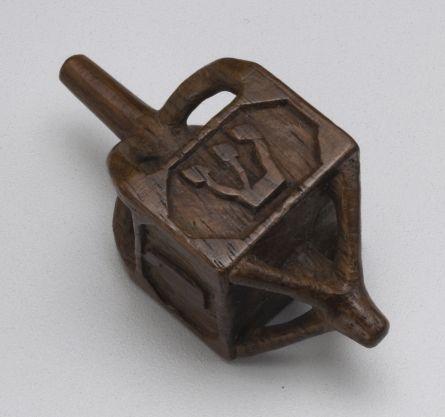
A game using a dreidel is another part of the Hanukkah celebration. A dreidel is essentially a top that each person spins to win gelt, a small Jewish coin first minted in the Middle Ages. Like the yearly donation of shekels to Holy Temple, gelt was given to teachers as a thank-you gift for sharing their knowledge. Today gelt is more familiar seen as gold foil covered chocolate coins adorned with symbols of Judaism. On the four sides of a dreidel are the Hebrew letters nun, gimel, hay and shin which explain something about the game. In Yiddish nun stands for nothing, gimel for all, hay for half, and shin for put in. When put together into a Hebrew phrase they stand for “a great miracle happened there” which brings us full circle, referencing the miracle of the eight days of light.

To my Jewish friends, particularly Dena, Happy Hanukkah.

Beverly Hall Smith was a professor of art history for 40 years.  Since retiring with her husband Kurt to Chestertown six years ago, she has taught art history classes at WC-ALL and Chesapeake College’s Institute for Adult Learning.  She is also an artist whose work is sometimes in exhibitions at Chestertown RiverArts and she paints sets for the Garfield Center for the Arts.
The Spy Newspapers may periodically employ the assistance of artificial intelligence (AI) to enhance the clarity and accuracy of our content.

Filed Under: 3 Top Story, Arts Portal Lead

Chesapeake Lens: “The Hayfield” by Paul Hanley, Jr.

December 5, 2020 by Chesapeake Lens
Leave a Comment


The hues, tints, and textures of our Chesapeake Bay landforms are at their most beautiful at sunset. Even with all that is going on, it can still be a peaceful world. “The Hayfield” by Paul Hanley, Jr., Worton, MD

The Spy Newspapers may periodically employ the assistance of artificial intelligence (AI) to enhance the clarity and accuracy of our content.

Filed Under: 3 Top Story, Chesapeake Lens

Looking at the Masters: The Story of Saint Nicholas

December 3, 2020 by Beverly Hall Smith
Leave a Comment

Who was St Nicholas?  St Nicholas’s feast day is celebrated on December 5 in the Eastern Orthodox Church and December 6 in the Roman Catholic Church in the west. He was born in the Greek city of Patara on March 15, 270 CE and died on December 6, 343 CE. Patara was a vibrant coastal city on the southwest coast of Lycia, the Mediterranean coast of modern day Turkey. His parents were wealthy, devout Christians.  According to legend he was an exceptional child who preferred to memorize scripture and go to church. The priesthood was a logical vocation.  The factual details of his life are minimal, but over time legends of his kindness and charity, his ability to intervene in serious situations saving lives, and his many miracles increased his growing popularity. He became known as Nicholas the Wonderworker and the patron saint of sailors, merchants, archers, repentant thieves, prostitutes, brewers, pawnbrokers, unmarried people, students, coopers, fisherman, pharmacists, and especially children. Clearly stories about his life and after-death miracles grew substantially.

St Nicholas (16th century Greek Icon)

 Nicholas was made the Bishop of Myra in a unique way. When the Bishop of Myra died, the priests could not decide how to choose a new Bishop.  In a dream, the most respected of the priests was told that the first priest to enter the church the next morning was to be made Bishop. He went to the church and stayed up all night to be there in the morning. Nicholas, who had been away, arrived early in the day and went first to the church to pray. As the first priest to enter the church, he was proclaimed Bishop of Myra. Nicholas was canonized a saint in 1466. His depiction is generally determined by whether the artist is Eastern Orthodox or Roman Catholic. St Nicholas is depicted with a halo, holding the Bible and with giving a blessing with his right hand.  As a Bishop he is can be depicted wearing a cassock with mitre and Crozier.  

Nicholas giving a sack of gold (14th century Italian fresco)

Nicholas’s acts of charity began after his wealthy parent’s death, and he felt the need to dispose of his inheritance. His first act of charity was to help a neighbor who unfortunately had lost most of his money and could not afford dowries for his three daughters. In the dark of night, Nicholas went to the house and dropped a sack of gold through the window. The father was able to provide a dowry for his eldest daughter. Nicholas repeated the nighttime visit with a second sack of gold. The father and daughters told everyone about the mysterious gifts, and the father was determined to find out who the benefactor was. When the sack of gold arrived for the third daughter, her waited and watched.  Seeing Nicholas, he followed him and praised him for his generosity and kindness in providing for his daughters and saving them from prostitution.  Nicholas pledged him to silence and assured him the gift was from God.

Nicholas saving sailors from the storm at sea (Byzantine fresco)

On a voyage by Nicholas to the Holy Lands a great storm came up arose. The Golden Legend by Jacobus Voragine ( 1228-1298) records that the sailors called out to Nicholas,  “Servant of God, if what we have heard of thee is true, let us make trial of it at this moment.” Nicholas replied “You called me, here I am.” Nicholas assisted with the sails, ropes, and tackle and the storm ceased.  He told them to thank God, not him.

Miracle of the Grain (Lorenzetti, A. 1332-34, Italian)

 A famine broke out in Myra in the years 311 to 312 CE, and the people were close to starving.  Nicholas was made aware of an Imperial ship in the harbor loaded with grain, Nicholas talked with the ship’s captain.  The ship’s cargo of grain had been weighed in the city of Alexandria was headed to the Emperor in Constantinople.  The weight of grain was assured and it must reach Constantinople.  Nicholas convinced the captain that some of the grain could be offloaded in Myra and the captain and crew would not be punished.  Persuaded, the captain gave Myra enough grain to feed the population for two years and enough to sow for the next year’s harvest.  When the ship arrived in Constantinople, the weight of grain was equal to the original weight; nothing was missing.

Nicholas of Myra saves the lives of condemned prisoners (Byzantine)

While visiting other parts of his diocese, Nicholas he was called back urgently to Myra because its ruler, Eustathius, had wrongly condemned three innocent men to death, and their execution was imminent. Hurrying back, Nicholas arrived as the executioner held his sword over the head of one of the prisoners.  Nicholas either commanded the executioner to  put down his sword, or as shown in the painting,  he grabbed the sword with his bare hands.  The unjustly accused men were released and proved innocent.  One version says that Eustathius later confessed his sin to Nicholas,  and after a completing a penance was absolved.

Nicholas Resurrects Three Children (Nicholas Book of Devotions, 1577 French)

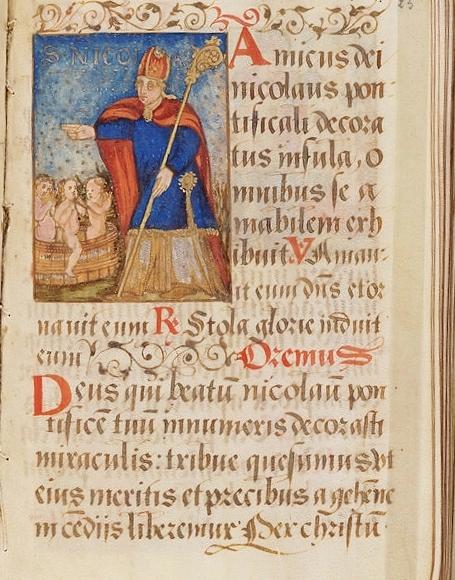
Nicholas became especially venerated for his help to children.  In one rather peculiar, but frequently reported story, Nicholas was again faced with a looming famine.  On passing by an inn, Nicholas was offered a meal of pork by the inn keeper.  Observing the pork in the pickling barrel, Nicholas realized the meat was not pork, but children.  The inn keeper had cut them into small pieces and was pickling them to sell as pork. Nicholas immediately restored the children’s bodies and brought them back to life. 

In a true story, Nicholas was imprisoned for five years during the reign of Diocletian (r 284-316 CE) who was trying to rid the Roman Empire of Christians.  Nicholas was released when Constantine became Holy Roman Emperor, adding Holy to the title as he made the Empire Christian.  A disputed legend puts Nicholas at the First Council of Nicaea (325 CE). It was called by Constantine to settle the Arian heresy that Christ was not God in flesh brought by Bishop Arius.  Nicholas purportedly slapped Arius and as a result put into chains, stripped of his robes, and imprisoned.  He prayed all night, and the next morning when they came to his cell, he was dressed in his Bishops robes, unchained, and sitting quietly reading.  Constantine freed him and restored his Bishopric. The result of the First Council of Nicaea was to repute the Arian heresy, and the Nicene Creed was written.  Nicholas was credited by some accounts as having signed the document.

Saint Nicholas Day is celebrated today mostly in European countries.  On December 6, children put a pair of shoes by the hearth, and St. Nicholas comes during the night and secretly places small gifts in them.  His legend lives on today. St Nicholas has become known to Americans as Santa Claus.  How this transformation happened will be the subject of a SPY article on December 17.

Beverly Hall Smith was a professor of art history for 40 years.  Since retiring with her husband Kurt to Chestertown six years ago, she has taught art history classes at WC-ALL and Chesapeake College’s Institute for Adult Learning.  She is also an artist whose work is sometimes in exhibitions at Chestertown RiverArts and she paints sets for the Garfield Center for the Arts.
 

The Spy Newspapers may periodically employ the assistance of artificial intelligence (AI) to enhance the clarity and accuracy of our content.

Filed Under: Arts Portal Lead, Arts Top Story

Delmarva Review: Eyes of the Crab by Ann LoLordo

November 28, 2020 by Delmarva Review
Leave a Comment

Author’s Note:  I learned of the discovery of this exoplanet in the newspaper. What intrigued me was the discussion of the parent star lodged in the constellation Cancer and the “subtle tugs” on that star, suggesting the presence of another planet. It was not unlike the pull of someone close to me who had died several years before, the detritus of the loss and the challenge of trying to move on.

Eyes of the Crab 

55 Cancri d, star in the constellation Cancer,
dragging five sibling planets,
bathed in watery clouds.

We are only two, running in the starry dark,
away from the cancer house
where we sat up with our mother, talking,
talking until she dozed off from the morphine.

Rocks fall to earth. Celestial disruption.
Stones placed on a headstone.
Two sibling planets, skittering backwards,
trying to recover, trying to align.  

This poem was nominated for a Pushcart Prize. Maryland writer Ann LoLordo’s poetry has appeared in Southern Poetry Review, The MacGuffin, The Greensboro Review, Puerto del Sol, The Sow’s Ear Poetry Review, as well as Delmarva Review. She is a former journalist who now works for a global health nonprofit organization as a writer, editor, and communications director.

Delmarva Review is an independent literary journal publishing the best of new prose and poetry selected from thousands of submissions nationwide, and beyond. The thirteenth annual edition was released this month. Partial financial support comes from individual contributions and a grant from the Talbot County Arts Council with funds from the Maryland State Arts Council. The review is available worldwide from Amazon.com and from specialty booksellers like Mystery Loves Company, in Oxford. See the website: www.DelmarvaReview.org.

The Spy Newspapers may periodically employ the assistance of artificial intelligence (AI) to enhance the clarity and accuracy of our content.

Filed Under: 3 Top Story, Delmarva Review

Chesapeake Lens: The Bay Bridge by Albie Sayer

November 28, 2020 by Chesapeake Lens
Leave a Comment


The Bay Bridge connects two very different worlds with water as the common denominator. Crossing is optional. “The Bay Bridge” by photographer Albie Sayer near Rock Hall.

The Spy Newspapers may periodically employ the assistance of artificial intelligence (AI) to enhance the clarity and accuracy of our content.

Filed Under: Chesapeake Lens

  • « Previous Page
  • 1
  • …
  • 101
  • 102
  • 103
  • 104
  • 105
  • 106
  • Next Page »

Copyright © 2025

Affiliated News

  • The Chestertown Spy
  • The Talbot Spy

Sections

  • Arts
  • Cambridge
  • Commerce
  • Ecosystem
  • Education
  • Food & Garden
  • Health
  • Local Life
  • News
  • Point of View
  • Senior Nation

Spy Community Media

  • Subscribe for Free
  • Contact Us
  • COVID-19: Resources and Data

© 2025 Spy Community Media. | Log in