
MENU

Sections

  • About Us
    • Editors and Writers
    • Sponsorship Terms & Conditions
    • Code of Ethics
    • Sign Up for Cambridge Spy Daily Email Blast
  • The Arts and Design
  • Culture and Local Life
  • Food & Garden
  • Public Affairs
    • Commerce
    • Health
    • Ecosystem
    • Education
    • Senior Nation
  • Point of View
  • Chestertown Spy
  • Talbot Spy

More

  • Support the Spy
  • About Spy Community Media
  • Advertising with the Spy
  • Subscribe
January 22, 2026

Cambridge Spy

Nonpartisan and Education-based News for Cambridge

  • About Us
    • Editors and Writers
    • Sponsorship Terms & Conditions
    • Code of Ethics
    • Sign Up for Cambridge Spy Daily Email Blast
  • The Arts and Design
  • Culture and Local Life
  • Food & Garden
  • Public Affairs
    • Commerce
    • Health
    • Ecosystem
    • Education
    • Senior Nation
  • Point of View
  • Chestertown Spy
  • Talbot Spy
00 Post to Chestertown Spy News Maryland News

Moore’s Redistricting Commission Recommends ‘Congressional Map Poncept’

January 21, 2026 by Maryland Reporter
Leave a Comment

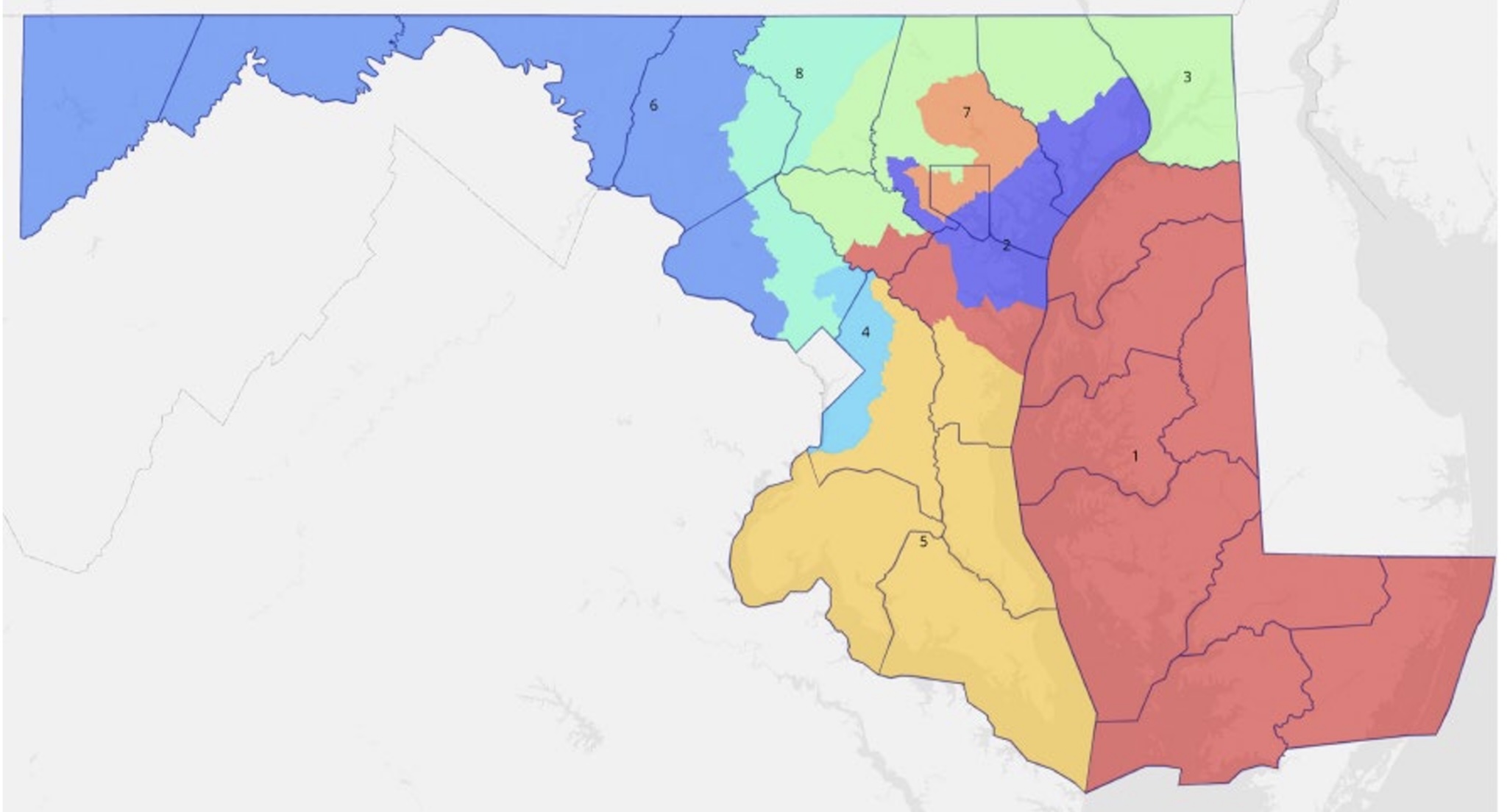
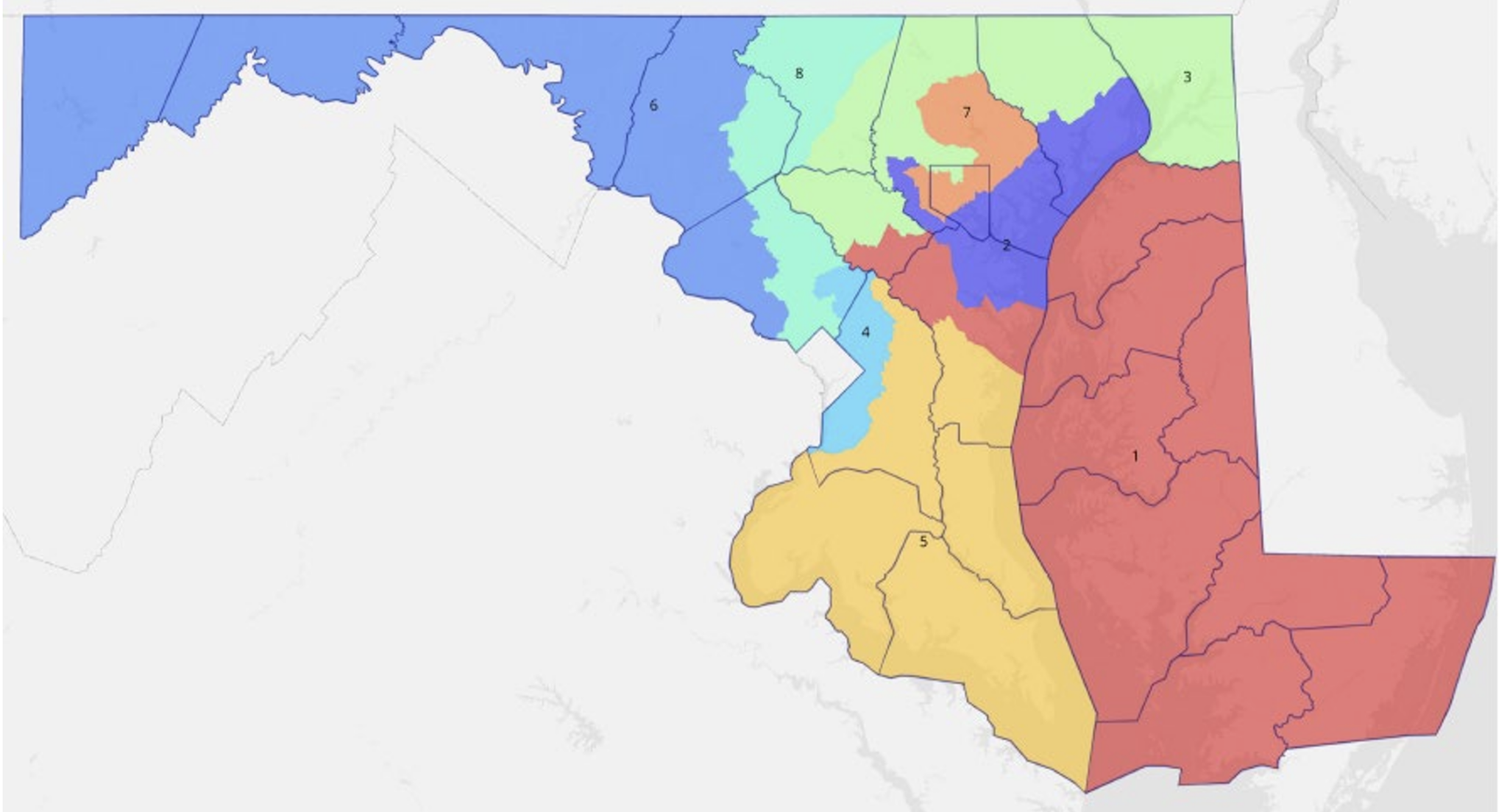
The redistricting plan approved “in concept” Tuesday by the Governor’s Redistricting Advisory Commission. The map would shift Democratic voters into the 1st District, currently held by GOP Rep. Andy Harris, and will require changes to equalize population in the districts. (Map courtesy Governor’s Redistricting Advisory Commission)

A five-member panel voted behind closed doors Tuesday to advance a “congressional map concept” that will be used as a guide for legislation that will attempt to redraw the state’s eight congressional districts.

The Governor’s Redistricting Advisory Commission voted 3-2 to recommend the map to Gov. Wes Moore (D) and the Maryland General Assembly. U.S. Senate Angela Alsobrooks (D), who chaired the panel, said the vote followed a “transparent redistricting process.”

“From the start, our commitment has been simple: Put Marylanders in the driver’s seat,” Alsobrooks said in a statement following a roughly one-hour meeting that the public could not observe.

“This process has been conducted in the open, with opportunities for the public to participate, weigh in, and submit their own map proposals for consideration,” her statement said. “All Marylanders — regardless of party, background, or ZIP code — can engage with this process, see the options, and make their voice heard.”

The concept map overhauls the 1st District — the state’s lone Republican district, held by GOP Rep. Andy Harris. While the district currently includes the Eastern Shore, Cecil, and part of eastern Baltimore County, the conceptual map would have it stretching from the Eastern Shore over the Bay Bridge through Anne Arundel County and into part of Columbia in Howard County. The shift moves more liberal Democrats into the district held by Harris, the chairman of the conservative House Freedom Caucus.

Changes to districts held by Democrats do not appear to threaten control of those seats.

The vote was blasted by state Republicans, with House Minority Leader Jason Buckel (R-Allegany) saying it “confirmed what we have been saying all along: that this Commission had nothing to do with fairness, nothing to do with the wants and needs of our citizens, and, quite frankly, nothing to do with Maryland.”

“Instead, this Commission has everything to do with D.C. partisan politics and the desires of the Democratic National Committee,” Buckel said. “This Commission was merely a drawn-out political sham with a predetermined outcome: To rid Maryland of any Republican representation in Congress and disenfranchise voters in Western Maryland and the Eastern Shore. Nothing drives this home more than their absurd end product.”

National Democratic leaders, who have been pressing Maryland to respond to redistricting schemes in GOP states, hailed the vote.

“Partisan Republican hacks were counting on Democrats to roll over while they gerrymander congressional maps in Texas, Missouri, North Carolina and Florida,” House Minority Leader Hakeem Jeffries (D-N.Y.) said in a statement. “They were wrong. Arrogant and corrupt Republicans started this battle. Democrats will end it. We will ensure that there is a free and fair midterm election in November.”

But redistricting still faces a difficult future in Maryland, where Senate President Bill Ferguson (D-Baltimore City), a member of the commission, is opposed to midcycle redistricting. A redistricting bill, should it reach the Senate, is not expected to receive a vote from the full chamber.

Ferguson and fellow commission member, Cumberland Mayor Ray Morriss, a Republican, voted against the proposed map Tuesday.

Ferguson said in a statement that the map “fails the Governor’s own test. It breaks apart more neighborhoods and communities than our existing map, and it fails the constitutional requirement of one person, one vote. We heard from no Boards of Elections. We heard nothing from the Office of the Attorney General of Maryland, which would have to defend this process and outcome. We heard no testimony to the impact on our election cycle. Ultimately, a flawed process has delivered a flawed product.”

Morris, who said he was asked to serve on the commission to ensure fair congressional districts, said that, “After a while, it became obvious that definition of fair that was being put out there was what was fair for the Democratic Party.”

The governor’s office said it will send the proposed map to the House speaker’s office, and from there “it will be in the hands of the Maryland General Assembly,” Moore said recently, noting that it “is not an administration bill.”

Moore has defended the commission he empaneled as transparent. But there was little public notice for Tuesday’s closed-door meeting, the second time the panel met and made decisions in private.

Four of the five members reached by Maryland Matters said they believed the meeting should have been held in public, and that the public would have benefited from witnessing the deliberations. But former Attorney General Brian Frosh, a commission member, said that while the closed-door meeting bothered him “it’s the governor’s commission, and he can run in any way he wants…. If he says, you’re going to do this in private. I think we end up doing it in private.”

The work of the panel at times seemed slapped together. There was initial confusion about how districts needed to be drawn or if changes would affect local election boards. Alsobrooks, in the panel’s first meeting, promised in-person meetings, but those never materialized.

“I’ve had concerns about the way this process has moved forward from the get-go,” Ferguson told reporters during a meeting before the commission met.

The legislation will start in the House.

House Majority Leader Del. David Moon (D-Montgomery) said a bill could be introduced quickly — possibly as early as the end of next week.

“If you’re the Speaker’s office, you can get it done pretty quickly, but there’s still logistical process, right?” Moon said, adding that there are some “logistical” hurdles that will need to be overcome.

“It’s going to be a multiday process, but I do think we are talking a matter of days, not weeks,” Moon said. “And again, if there’s a will to act, I do believe you’ll see the House wanting to act as soon as possible. I would hope this could be a conversation handled in the first month of session.”

The map approved by the commission will not likely be the one that goes to lawmakers, said Del. C.T. Wilson (D-Charles), a member of the commission who expects to lead the bill on the floor and may also be its sponsor.

“That map will not be the map submitted with the bill,” Wilson said. “It will be zeroed out. That was a concept of the map … because time is an issue. When citizens put maps in, they’re not going to be exact. If they were, well, that’d be a whole other question, wouldn’t it?”

The concept map increases the number of majority-minority districts from two to three. Two have populations that are at least 50% Black voters. But the map also included population deviations some members said would not meet strict “one person, one vote” population standards used by the courts.

Ferguson’s statement called the map “objectively unconstitutional.” He said the new map will likely result in the current map facing a court challenge. Democrats, he warned, risk losing seats the party currently holds.

Former Attorney General Brian Frosh, a member of the commission, said Ferguson’s characterization was inaccurate.

“We voted on a map in concept,” Frosh said, “The map needs to be tweaked. I don’t think it requires major changes. But it’s not perfectly aligned in terms of the numbers. You have to be within a few votes one way or another, a few people one way or another. It probably is out of line in a way that can be fixed.”

Frosh said the tweak should take “half an hour or 45 minutes by the folks at the Department of Legislative Services.”

The adjustments may not matter. Ferguson is a staunch opponent of mid-cycle redistricting, and any bill passed by the House is likely to be sent to the Senate Rules Committee to die without a committee hearing or full Senate vote.

The commission recommended the concept map following a series of 10 meetings — two of which were closed to the public.

More than three dozen maps were submitted by the public. The maps ranged from the basic, with no supporting documentation, to sophisticated iterations that included party registration and demographic data. But in two meetings one map, which was later tweaked, clearly garnered most of the attention.

“To me, when 28 out of 30 people all talk about the same map, it seems just, I don’t know, it just seemed a little odd to me,” Morriss said. “Everybody seemed to know which map they were going to talk about.”

When asked if he felt an outcome had been predetermined, Morriss said it “definitely gave the perception, to me, that something could be a little odd about it. Statistically, it just didn’t add up. So, yes.”

Morriss questioned the vote by the panel, noting that most of the public testimony did not support mid-cycle redistricting.

“I look back at the beginning, when over 70% of the people didn’t want to move forward,” Morriss said. “I think that said a lot. I think what the public got from this was what the Democratic party wanted for the state of Maryland, and for their national agenda. I don’t think the public really got a real — let’s use the word fair — a real, fair analysis of the congressional districts in the state.”

Wilson rejected that argument, saying testimony of roughly 30 people in each meeting was not the only consideration for the commission.

“This was a hearing,” Wilson said. “Not a poll.”

Moore appointed the panel in November, saying he he wanted to ensure the maps drawn in 2022 were “fair.” He has never provided a definition of the term.

But his efforts came as Republican states began hyper-partisan mid-cycle redistricting. The effort, kicked off in Texas, was seen as a way to improve chances of keeping a GOP majority in Congress in this fall’s elections.

In an interview a week ago, Moore said Maryland was reacting to Republican states who recast their maps to eliminate Democrats in Congress.

“The point is this is that if the rest of the country is going to go through a process of determining whether or not they have fair mass in a mid-decade process, then so will the state of Maryland,” Moore said during The Daily Record’s Eye on Annapolis opening day event.

In Maryland, the Democratic Party holds a 2-1 registration advantage over Republican voters, with Democrats accounting for about 50% of registered voters and the GOP and unaffiliated voters accounting for about 25% each.

Even so, Democrats hold seven of eight congressional seats in Maryland; 25 years ago, Republicans held four of the eight seats.

“It was not necessarily, in my mind, what was fair to all of the voters of the state of Maryland,” Morriss said of the commission’s work. “Especially in this case, the Republicans and the unaffiliated voters.”

Frosh said the commission and its recommendation was a response to Trump and MAGA Republicans policies on immigration, voting rights and the push for Republican states to redraw their own districts.

“I think that we can’t be holier than thou in this situation. If the Supreme Court says all you need to do is have an equal number of votes and not openly discriminate, then that’s what we should do,” Frosh said. “Why should we? Why should we cede that advantage to the Republican states? And I just think we’ve got to fight back, and as the old saying goes, you don’t bring a knife to a gunfight.”

Wilson agreed and said complaints about fairness from Maryland Republicans are not persuasive when racial equity is under attack by the Republicans at the federal level.

“The one thing I will clearly say is that my children are a protected class, and we can’t pretend that African Americans are the same thing as being Republican,” Wilson said. “And I don’t hear them saying that … about Texas, about Florida, about Missouri. I don’t see them fighting for a protected class of people in a country with a history of racism and violence.

“And to be clear, they still have a voice. They can still vote,” said Wilson. “My people couldn’t vote for the longest time. They can still vote.”

By Bryan P. Sears
Maryland Matters reporter Dianne J. Brown contributed to this report

The Spy Newspapers may periodically employ the assistance of artificial intelligence (AI) to enhance the clarity and accuracy of our content.

Filed Under: 00 Post to Chestertown Spy, Maryland News

Cephas wins in Cambridge; ex-mayor’s comeback attempt falls short

December 4, 2024 by Maryland Reporter
Leave a Comment

Cambridge voters on Tuesday rejected an attempt by a scandal-scarred former mayor to return to office.

In a runoff to become the Eastern Shore city’s next mayor, City Council President Lajan Cephas defeated former Mayor Andrew Bradshaw, with 787 votes, or 53%, to Bradshaw’s 697 votes, or 47%. She’ll succeed Mayor Stephen Rideout, who won a special election to replace Bradshaw in 2022 but chose not to seek a full term this year.

Bradshaw conceded in a video posted to social media Tuesday night, saying Cephas “has the ability to be a great leader for the city.”

Bradshaw resigned as mayor in 2022 after being charged by the state prosecutor’s office on 50 counts of distributing revenge porn on social media — a development that attracted national headlines. An apologetic Bradshaw reemerged to attempt a political comeback this year, saying he was worried about the direction of the economically pressed city and felt he had unfinished business to complete.

Cephas, a council veteran, served as acting mayor for nine months following Bradshaw’s resignation — and she will again for the rest of the year. Rideout resigned effective Tuesday because he is moving out of town. Cephas will be officially sworn in as mayor next month.

Both Bradshaw and Cephas laid out similar priorities in the election, including the importance of economic development in Cambridge, the imperative of jump-starting a stalled waterfront development proposal and the need to address decades of racial and economic disparities in the city. Race, in a city where the population was 47.4% Black and 38.19% white, according to the 2020 Census, may have been a factor in the election outcome.

Cephas, a former corrections officer who now sells insurance, is the second Black woman elected as the city’s mayor. Victoria Jackson-Stanley, who was the first woman and first African-American to serve in the top job, was mayor from 2008 until 2020, when she was defeated by Bradshaw.

Cephas and Bradshaw and a third candidate for mayor, former City Commissioner La-Shon Foster, appeared on the regular election ballot in October, but none of them got more that 50% of the vote, triggering Tuesday’s runoff. Cephas finished with 42.5% in October, compared with 41% for Bradshaw and 16.5% for Foster, who was eliminated from the runoff as the third-place finisher.

Although municipal elections in Cambridge are nonpartisan affairs, the Maryland Democratic Party weighed in on Cephas’ behalf in the runoff’s final days, blistering Bradshaw for his prior scandal. Democrats said they were moved to intervene because Bradshaw was being bankrolled by Republicans for his comeback attempt.

“Andrew Bradshaw hasn’t explained how he’s changed from the man who catfished as his ex-girlfriend in a deliberate, sustained campaign of humiliation against her while he sat in the mayor’s office,” a state Democratic spokesperson, Luca Amayo said earlier this week. “His rush to reclaim power reveals a troubling disregard for the harm his crimes caused as he seeks to lead once again.”

There is little evidence, though, that the Democratic news releases swayed the election result.

The Spy Newspapers may periodically employ the assistance of artificial intelligence (AI) to enhance the clarity and accuracy of our content.

Filed Under: 2 News Homepage, Cambridge

Mid-Shore Local Towns Face ‘Hundreds of Millions’ in Lost Property Tax Revenue Due to Mailing Snafu

February 22, 2024 by Maryland Reporter
Leave a Comment

Local governments face hundreds of millions in lower property tax collections after a state agency missed a key mailing deadline.

The State Department of Assessments and Taxation failed to mail about 107,000 updated property tax assessments before the deadline at the end of last year, according to senior state lawmakers. Left unfixed, county governments might receive a quarter of a billion dollars less in anticipated property tax revenue over a three-year period.

News of the error trickled out to key lawmakers and county leaders late Tuesday night.

“We haven’t gotten to the absolute details yet,” said Senate Budget and Taxation Committee Chair Guy Guzzone (D-Howard) on Wednesday. “We know it exists. We know there was a mistake made. We know that it’s significant. We rely on the assessments to be accurate and in all cases, right and so, they need to be accurate period.”

The State Department of Assessment and Taxation reviews property values on a triennial basis. Each county and Baltimore City is effectively split into thirds. Every year, one third of each jurisdiction is assessed with the property values phased in over three years.

There are roughly 2.3 million residential properties in the state. This figure does not include commercial properties, railroads or land owned by public utilities, which are also taxed but assessed annually.

This year, residential properties saw a nearly 26% increase in assessed value over the current value. Assessments on commercial properties during the same period increased nearly 18%.

In a statement provided to Maryland Matters Wednesday evening, SDAT’s director, Michael Higgs, explained what went wrong but vowed that property owners would receive their assessment notices soon.

“SDAT utilizes the services of the State’s preferred vendor, the League for People with Disabilities, for the printing and mailing of these reassessment notices, which are typically sent in the final days of December each year,” Higgs said. “This year, SDAT learned of an error in the League’s process that resulted in approximately 107,000 notices not being sent. The League has since resolved the error and the missed recipients will receive notices in the coming weeks.”

Many lawmakers still have not been fully briefed on the problem.

“We are very concerned about any instances of government officials missing legal deadlines to execute their duties,” said House Minority Leader Jason C. Buckel (R-Allegany). “While no one in our caucus has been briefed on what has happened with SDAT, media reporting makes clear that something has obviously gone wrong. We also want to make sure that property owners aren’t subjected to tax bills that are improper under Maryland law. It’s not their fault that SDAT may have failed to abide by Maryland law.”

Some details were consistent among interviews conducted by Maryland Matters.

Guzzone, Senate President Bill Ferguson (D-Baltimore City) and House Ways and Means Chair Vanessa Atterbeary (D-Howard) and House Appropriations Chair Ben Barnes (D-Prince George’s and Anne Arundel) all acknowledged being initially briefed on the problem.

“Obviously, it’s very concerning,” said Ferguson. “I have heard that this is not the first time that something along this line has happened. And so, we’re exploring options for what might be possible but obviously everyone has to pay their fair value.”

The late assessments touch every county and all property classifications that are assessed by the department.

Atterbeary called it a “big mess up.”

Atterbeary, Ferguson, Guzzone and Barnes all said they are just starting to search for a solution.

Left unaddressed, the problem could cost local governments an estimated $250 million over three years.

Both Guzzone and Atterbeary confirmed the size of the potential fiscal hit to local governments.

“It’s a big loss of revenue,” said Atterbeary. “We’ll need a one-year fix and look at how SDAT is structured and does it continue to make sense.”

Part of that fix could include emergency legislation to allow the assessments to be sent out late while protecting property owners’ right to appeal.

The department could put in an emergency bill that allows lawmakers to move quickly to extend the already expired deadline.

“It doesn’t necessarily have to be done in a standalone bill,” said Guzzone. “It could be in another something already existing.”

One such vehicle could be Senate Bill 1027, sponsored by Guzzone, which defines the term “taxpayer” as it applies to property tax appeals.

Atterbeary said lawmakers could also consider putting the changes into the Budget Reconciliation and Financing Act, a separate piece of legislation that is different from the operating budget, used to implement a variety of legislative and financial actions.

But extending the deadline after the fact will raise eyebrows and may draw a legal challenge.

Higgs said SDAT is working with lawmakers to craft a solution.

“The legislation will ensure that the State reassessment can be completed fairly and accurately and that all appropriate revenues are collected,” he said. “Every account in this group will receive a notice in the coming weeks and will be provided with the full 45-day timeframe for appealing the reassessment.”

The effect on state and municipal government budgets is unclear.

“I didn’t get a total number, but it was in the hundreds of millions of dollars, not in the tens of millions,” Ferguson said. “My guess is that would make sense, based on the increased assessment this year, being I think it was, overall, a 20% increase in value overall. So that seems consistent.”

Property taxes are the largest source of revenue for local governments.

“This news is alarming, but we are thankful that legislative leaders have already signaled their intentions to take swift action on this issue,” said Baltimore County Executive Johnny Olszewski Jr. (D), the current president of the Maryland Association of Counties. “It’s critical we ensure local jurisdictions receive their fair share of revenues so that we can remain focused on delivering the core services that our shared residents rely on and expect.”

Criticism of the agency and its director

The latest news about SDAT comes after legislative budget analysts earlier this year identified internal problems in the agency, including a significant shortage of real property assessors on staff, and that the accuracy of property tax assessments continues to worsen.

It is also likely to draw attention to Higgs, the agency’s director.

Higgs was appointed by-then Gov. Larry Hogan (R) in 2016. It was Higgs’ second appointment by the two-term Republican governor.

Initially, Higgs, a telecommunications attorney from Montgomery County, was appointed in 2015 to serve on the Public Service Commission. At the time, he was also chair of the Montgomery County Republican Central Committee.

Higgs’ posts on the social media platform then known as Twitter derailed his confirmation to the commission, which regulates utilities in Maryland.

Higgs has served in the Department of Assessments and Taxation since 2016. Gov. Wes Moore (D), Hogan’s successor, opted not to replace Higgs upon taking office 13 months ago.

Barnes said he and his colleagues on the Appropriations Committee were less than pleased with the responses SDAT officials gave them at the agency’s budget hearing this year.

“At the Appropriations Committee, we’ve felt a bit aggrieved by SDAT this session,” he said.

Barnes, who said he just learned about the SDAT snafu early Wednesday, said that the first priority for lawmakers will be to make sure that counties are not forced to deal with an unanticipated shortfall due to the revenue shortage caused by the delayed tax assessments.

“We’re going to do what we can to help the local governments,” he said. “They can’t absorb that.”

Barnes also predicted that House leaders would look for changes at the agency.

“Long-term, the Appropriations and Ways and Means committees are going to have to look at reforms at SDAT,” he said.

Atterbeary agreed.

“There’s a larger issue,” she said. “There was talk of maybe restructuring it, bringing it under the purview of the [state] comptroller. I think that is worth a conversation. I think this issue underscores that.”

By Bryan P. Sears. Josh Kurtz contributed to this report.

The Spy Newspapers may periodically employ the assistance of artificial intelligence (AI) to enhance the clarity and accuracy of our content.

Filed Under: 2 News Homepage

Copyright © 2026

Affiliated News

  • The Chestertown Spy
  • The Talbot Spy

Sections

  • Arts
  • Cambridge
  • Commerce
  • Ecosystem
  • Education
  • Food & Garden
  • Health
  • Local Life
  • News
  • Point of View
  • Senior Nation

Spy Community Media

  • Subscribe for Free
  • Contact Us
  • COVID-19: Resources and Data

© 2026 Spy Community Media. | Log in