
MENU

Sections

  • About Us
    • Editors and Writers
    • Sponsorship Terms & Conditions
    • Code of Ethics
    • Sign Up for Cambridge Spy Daily Email Blast
  • The Arts and Design
  • Culture and Local Life
  • Food & Garden
  • Public Affairs
    • Commerce
    • Health
    • Ecosystem
    • Education
    • Senior Nation
  • Point of View
  • Chestertown Spy
  • Talbot Spy

More

  • Support the Spy
  • About Spy Community Media
  • Advertising with the Spy
  • Subscribe
December 9, 2025

Cambridge Spy

Nonpartisan and Education-based News for Cambridge

  • About Us
    • Editors and Writers
    • Sponsorship Terms & Conditions
    • Code of Ethics
    • Sign Up for Cambridge Spy Daily Email Blast
  • The Arts and Design
  • Culture and Local Life
  • Food & Garden
  • Public Affairs
    • Commerce
    • Health
    • Ecosystem
    • Education
    • Senior Nation
  • Point of View
  • Chestertown Spy
  • Talbot Spy
3 Top Story Arts Delmarva Review

Delmarva Review: Eyes of the Crab by Ann LoLordo

November 28, 2020 by Delmarva Review
Leave a Comment

Author’s Note:  I learned of the discovery of this exoplanet in the newspaper. What intrigued me was the discussion of the parent star lodged in the constellation Cancer and the “subtle tugs” on that star, suggesting the presence of another planet. It was not unlike the pull of someone close to me who had died several years before, the detritus of the loss and the challenge of trying to move on.

Eyes of the Crab 

55 Cancri d, star in the constellation Cancer,
dragging five sibling planets,
bathed in watery clouds.

We are only two, running in the starry dark,
away from the cancer house
where we sat up with our mother, talking,
talking until she dozed off from the morphine.

Rocks fall to earth. Celestial disruption.
Stones placed on a headstone.
Two sibling planets, skittering backwards,
trying to recover, trying to align.  

This poem was nominated for a Pushcart Prize. Maryland writer Ann LoLordo’s poetry has appeared in Southern Poetry Review, The MacGuffin, The Greensboro Review, Puerto del Sol, The Sow’s Ear Poetry Review, as well as Delmarva Review. She is a former journalist who now works for a global health nonprofit organization as a writer, editor, and communications director.

Delmarva Review is an independent literary journal publishing the best of new prose and poetry selected from thousands of submissions nationwide, and beyond. The thirteenth annual edition was released this month. Partial financial support comes from individual contributions and a grant from the Talbot County Arts Council with funds from the Maryland State Arts Council. The review is available worldwide from Amazon.com and from specialty booksellers like Mystery Loves Company, in Oxford. See the website: www.DelmarvaReview.org.

The Spy Newspapers may periodically employ the assistance of artificial intelligence (AI) to enhance the clarity and accuracy of our content.

Filed Under: 3 Top Story, Delmarva Review

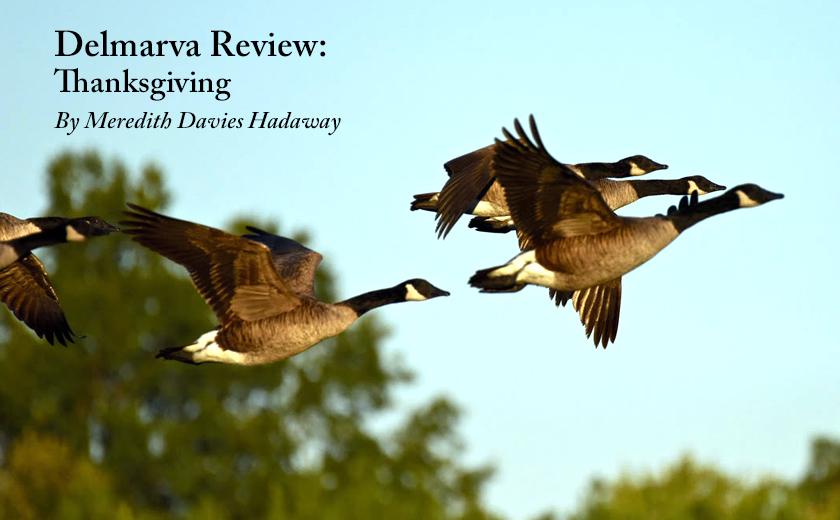
Delmarva Review: Thanksgiving by Meredith Davies Hadaway

November 26, 2020 by Delmarva Review
Leave a Comment

Delmarva Review: Thanksgiving by Meredith Davies Hadaway

Author’s Note:  It’s pretty quiet right now on the Chester River. We’ve pulled our boats and turned our gardens under. Now gray skies and bare trees come alive with the migratory birds that are my favorite Fall visitors. This poem is just to say, even with the disruption and the uncertainty of this season, I am grateful for all that remains.

Thanksgiving

Because I wake up here where a kingfisher flits
to a piling, where the heron strides his patient

watch, and a sparrow chips away at the feeder.

Birds go about their business, the winged
body of one soul, lodged briefly 

in another, stitching clouds to the tide. 

From somewhere a shotgun stutters. One goose
Tumbles—skims the edge of soft 

and familiar. No wind, no sound beyond
my own breathing. Just a thick, hovering 

sky. The bare limbs hold it
between them. 

Meredith Davies Hadaway has been a featured writer in Delmarva Review. She is the author of three poetry collections: Fishing Secrets of the Dead, The River is a Reason, and At The Narrows (winner of the 2015 Delmarva Book Prize for Creative Writing). She holds an MFA in Poetry from Vermont College of Fine Arts. Hadaway is a former Rose O’Neill Writer- in-Residence and chief marketing officer at Washington College.

Photography by Wilson Wyatt

Delmarva Review is an independent literary journal publishing the best of new prose and poetry selected from thousands of submissions nationwide, and beyond. It’s thirteenth annual edition was released this month. It receives partial financial support from individual tax-deductible contributions and a grant from the Talbot County Arts Council with funds from the Maryland State Arts Council. The review is available from Amazon.com and specialty booksellers like Mystery Loves Company, in Oxford. For more information, see the website: www.DelmarvaReview.org.
The Spy Newspapers may periodically employ the assistance of artificial intelligence (AI) to enhance the clarity and accuracy of our content.

Filed Under: 1 Homepage Slider, Delmarva Review

Delmarva Review: When Friendship Dies by Sue Ellen Thompson 

November 21, 2020 by Delmarva Review
Leave a Comment

Author’s Note:  The end of a long friendship is not unlike a death in the family: Suddenly, someone who was always there is gone. “When Friendship Dies” tells the story of two college classmates whose friendship survived marriage, children, geographical separation, and the death of a spouse. Then—unexpectedly but not without warning—it was over. It was my need to understand how this particular friendship was formed and what led to its demise that compelled me to write this memoir.

When Friendship Dies 

Memoir 

SO MUCH SNOW FELL DURING THE WINTER OF 1970-71 in Lincoln, Vermont, that when I looked out the window in the morning, I often thought my car had been stolen. Or that I’d forgotten to set the emergency brake, and it had rolled back down the steep mountain road where I was living in a charming but dilapidated farmhouse with another young woman who had just graduated from Middlebury College. It was so cold during the month of January that our pipes remained frozen for weeks, and we had to haul water for flushing the toilet and brushing our teeth by chopping a hole in the ice covering the river that ran through the backyard—something we often did in the pitch dark, in parkas over flannel nightgowns, with bare feet in unlaced boots. She was a teacher in a two-room schoolhouse; I was marking time as a legal secretary between summers at The Bread Loaf School of English, where I was studying for my M.A. We hadn’t been that close in college, but we both needed a place to live and wanted to stay in Vermont. The harsh confines of that winter turned us from survivors into friends—and, by the time the ice on the river began to buckle and the faucets ran freely again, into something more like sisters. 

We both married Middlebury men, had daughters eight months apart, and pursued careers that involved teaching and writing—she in upstate New York, Hawaii, and North Carolina, while I settled in southeastern Connecticut. But distance never mattered. For twenty-three summers we spent two weeks in July with our kids at her cabin in Maine. When she and her husband were living in Hawaii during the Kilauea eruptions of the early 1980s, my husband and I flew down to visit and from their deck watched the lava fountain and tumble, hissing, into the sea. During the more than three decades I lived in Mystic, Connecticut, we saw each other whenever she visited her mother in Newport, Rhode Island, where we cruised the shops on Bannister’s Wharf and drank wine in the bar at the Viking Hotel. Eventually we both gravitated back to Vermont: I bought a small cottage for weekends and vacations just over the mountain from Middlebury, while she and her husband found what would become their retirement home just north of town. Our friendship was a given. It would endure as long as we did. 

DECEMBER 2018

“You’re not really going to East Middlebury today, are you?” my husband asked, staring out the window of our Vermont cottage, watching as rain spread a gauze of ice over the snowy street. 

I hesitated before admitting why I was determined to drive to The Waybury Inn, thirteen treacherous mountain miles to the west, for lunch. “It’s taken me this long to pin her down,” I told him. “If I cancel now, I may never find out why she did it.” 

“She” was the friend of forty-eight years I’ll call Jane, and “it” was not to invite me to her second wedding, which had taken place six months earlier; in fact, she never even told me she was going to remarry. After her first husband, whom I’ll call John, died in 2013, I thought she was headed for a prolonged period of mourning. To my surprise, she flung herself almost immediately into an affair with a man she’d known for years, who took full advantage of her weakened emotional—and robust financial— condition. It didn’t last long, but she shared enough—how he persuaded her to buy an expensive boat so that he could sail it, how she discovered he was still involved with another woman— to make me feel relieved it was over. Then, just as it seemed she might be ready to explore the complicated grief she had postponed—for a husband who suffered from depression and had long since ceased to make her happy, but whom she had steadfastly refused to divorce—she met another man, a New England blueblood, the kind of man her mother might have chosen for her when she was a young Newport debutante. He was well dressed, well-mannered, and a former commodore of the New York Yacht Club. We socialized with them a number of times during their two-year courtship, but I was completely blindsided by her blunt text, “We got hitched.” Who, with adult children and grandchildren to please and provide for, gets married at our age? Given the fact that he had been divorced twice, I assumed they had opted for a quiet civil ceremony. 

I was wrong. When I asked for details, she admitted they’d had a church wedding in Middlebury with thirty-five guests. She sent me a few photos the next day, and I could make out the faces of several mutual acquaintances and former classmates. Why was I—the maid of honor at her first wedding and, I thought, her closest woman friend—not among them? The rejection and bewilderment I felt were visceral. 

After vacillating between hurt and anger for several days, I wrote her a long and very frank email describing my reaction and asking what I had done to provoke such treatment. Had I said something to upset her? Had I excluded her from some facet of my own life? Was she afraid I would judge her for re-marrying so soon after her husband’s death or probe her motivations too deeply? Perhaps I let my anger get the best of me, because all I received was a curt reply informing me that no explanation would be forthcoming. We both fell silent after that, but six months later she invited us to her annual Christmas party as if nothing had changed. “What should I say?” I asked my husband when the invitation arrived. “Say we’re not coming” was his advice. But I couldn’t do that—not without asking her face-to-face why she hadn’t told me about her wedding until it was over. 

She was already seated when I arrived at the Waybury, her arms folded tightly over a voluminous wool scarf. She didn’t move to embrace me. 

As we waited for the waitress to bring our food, Jane fired questions at me about everyone in my immediate and extended family. As an only child, she’d always been interested in the lives of my four siblings and their offspring. I gave brief answers— relieved, I suppose, not to have to broach “the subject” any sooner than was absolutely necessary. But when our food arrived and the questions kept coming, I wondered if she had any idea why I’d asked to have lunch with her. “Jane,” I said, when she stopped talking long enough to blow on her soup, “I have to know why you didn’t invite me to your wedding.” 

I was braced for a spirited self-defense. Instead, she declared flatly, “It’s not about you”—a common enough phrase whose full meaning I had yet to grasp. She went on to explain that her wedding had been an “extremely emotional” occasion—the implication being, I suppose, that it was too emotional to share with me. I wanted to interrupt with, But haven’t we shared dozens of ‘extremely emotional’ experiences over the years? Wasn’t I the first friend you told when your husband found out he had myelofibrosis? Weren’t you the one I called before dawn when my mother died? And didn’t you call me, weeping, from the highway when you didn’t reach your father’s bedside in time? Weren’t you still at the hospital when you called me to say your husband was gone? Haven’t we, in fact, shared almost every extremely emotional experience we’ve been through since our early twenties? I understood that a marriage ceremony is about two people, but when you have a church wedding with a few dozen guests, it would seem that you have chosen to let others share that very personal moment. Objections swirled in my head, but words deserted me. 

It’s not about you—she kept falling back on this phrase as I continued my probing and her side of the conversation floundered. It was typical of Jane to hide behind an all-purpose scrap of language when a more honest response required too much introspection. Another favorite was “Of course you do”—a phrase that could easily be modified to suit almost any context. A few years earlier, when I dropped what I thought would be a bombshell—that my husband was interviewing for a job in another state—her comment was “Of course he is,” the implication being that she had foreseen this turn of events and needed no further details. She often employed such conversational drop shots, if only to mask her unwillingness to engage at any greater depth. So, at first, I assumed that It’s not about you meant “It’s not about anything you did to upset me.” But when I asked her, with some embarrassment, about one of the faces I’d glimpsed in the wedding photographs she’d sent me—a woman I knew was only a casual friend—Jane blurted out that she’d run into her at the grocery store the day before and had invited her on the spur of the moment. I couldn’t help but think, You invited someone you ran into by chance, but not a friend who has stood by you for forty-seven years? Again, I was too incredulous to say anything. 

It wasn’t until we were waiting for the check that I realized “It’s not about you”—which Jane had said at least a dozen times in response to my repeated attempts to unearth her motivations— meant neither “You didn’t do anything to provoke me” nor “Stop trying to draw attention to your own hurt feelings.” She meant it quite literally: Sharing her decision to remarry—let alone inviting me to the wedding—had simply never crossed her mind. I had seen her cut people off before—most recently her stepbrother, after a dispute involving the distribution of family heirlooms. I had seen how quickly she put her forty-year marriage behind her. Did she associate our friendship with those decades she’d spent married to a man who had been a hero to both of us in our twenties but with whom she’d ended up locked in a relationship characterized by competition and conflict—a man she would never leave but who, mercifully, set her free by dying at sixty- two? 

I interrupted her rambling about how happy she was in the new life on which she had embarked. “So, what you’re telling me is that you want to leave everything and everyone associated with your old life behind, and that includes me?” She hesitated for just a moment. “Yes. Basically.” 

So that was it: I was part of the skin she was trying to shed. 

MAY 2013

This wasn’t the first time Jane had shut me out. The day her husband died, she called me from the hospital, sobbing. “Can you find me that poem that ends with the line about ‘your one wild and precious life’?” I immediately went to the Mary Oliver books on my shelf and copied “The Summer Day” into an email. 

A couple of weeks later, as we talked on the phone about plans for a memorial service, Jane said, “I want you to write a poem.” I cringed inwardly: I’d been asked to write poems for such occasions before, and I knew how impossible the task could be. “Why don’t I read that Mary Oliver poem?” I suggested. But Jane was adamant. “I want you to write a poem about John,” she insisted, “about how much he loved his kids and our land in Vermont. And I want it to say that although he was a lawyer, all he ever wanted was to be a farmer. And don’t forget to mention how he could fix anything mechanical. And you should say something about his orchard—he was so proud of those trees.” She went on and on, while I furiously took notes. Of course, I would do it, but I had only six weeks to pull something together. 

I began setting aside a couple of hours each day to work on my assignment. Periodically Jane would call, asking me how the poem was coming along but never pressing me for details. She wanted to hear it for the first time at the service. She was trusting me to do a good job. 

The result was a villanelle—a nineteen-line poem whose first and third lines alternated at the end of each subsequent three- line stanza and then reappeared as a concluding couplet. By varying the two repeated lines but keeping the end-rhymes, I was able to cover everything on Jane’s list. The poem began: 

He could fix what was broken, make anything grow,
was good with animals, feathered and furred,
liked churning rivers and winter’s blue snow,

could expound on a rare strain of apple or rose
while tuning an engine or tending a small herd
of cattle. The crops he’d always wanted to grow 

needed land to expand on, as all farmers know,
so he left his career as a lawyer behind and adjourned
to this place of white water and snow, 

where he and his life’s mate could both
have what they wanted: an orchard for him, and for her
a house that didn’t need fixing, where they could grow

older together, perhaps even old… 

I tinkered and tweaked, spending more and more time on the poem as the deadline approached. When Jane called a few days before the memorial service, I told her it was done. She didn’t ask to read it but only whether I thought it should be included at the beginning or the end of the service. I told her I thought the poem would be more appropriate as a final tribute. 

When I arrived at her house the day of the outdoor event, Jane didn’t mention the poem, but she must have seen the blue folder with the Middlebury College seal that I was carrying. I sat in the row behind her, holding it on my lap for almost two hours while John’s friends, their daughter, and John’s brother delivered their eulogies. I could feel tears welling and practiced some of the breathing exercises I’d learned in yoga. As a poet who was accustomed to public readings, I had perfected a number of techniques to keep my voice steady. I reminded myself that I was speaking for Jane, who was too overwhelmed by loss to speak for herself. I sat there with the folder pressed beneath my clasped hands, awaiting my turn. I felt as though I had a doorknob lodged in my throat. 

Then, suddenly, it was over. The minister who was officiating invited us all to join the family for a traditional Hawaiian pig roast in the field beyond the house. My husband gave me a startled look. Had there been a mistake? I tried to catch Jane’s eye, but she was already engulfed by family and friends. 

I was shocked. But I was also embarrassed, because I knew that there were times during the service when, instead of listening to the heartfelt reflections of others, I had been priming myself for my own performance. Perhaps I deserved to be ignored; after all, I’d been thinking about how my own words would be received when I should have been thinking about my friend. But that didn’t explain why it had happened. 

My husband and I ate quickly and told Jane we didn’t want to drive over the mountain in the dark. I left the blue folder on her desk. 

I had planned to stay in Vermont for the rest of the week while my husband returned to his job in Connecticut, assuming that Jane might need me to get through her first several days as a widow. When I didn’t hear from her, I called and invited her for dinner. We drank a great deal of wine and talked late into the night, but she never mentioned the poem. So after clearing the dishes I said, as gently as I could, “Jane, can you tell me why I wasn’t asked to read the poem?” 

She blushed furiously. “It was the kids’ decision. They only wanted their dad’s friends to speak at the service, and they regard you as one of my friends.” I was unprepared for this explanation. Although I knew that the marriage had been a contentious one, I hadn’t given much thought to how Jane’s children—whom I’d known since birth—might view me and my friendship with their mother. But I quickly came to the conclusion that if those two kids, now in their thirties, viewed their parents as being so at odds with one another that even their parents’ friends were relegated to opposing camps, then Jane had more serious issues to deal with than my injured ego. I wished that she had given me a heads-up when I first arrived at the service, but she was a grieving widow and couldn’t possibly be held to normal standards of etiquette. I told her that I understood. 

“Don’t worry,” she assured me. “On the anniversary of John’s death, I’m going to invite all of our Vermont friends to help scatter his ashes over the orchard and around the sugar- house. Afterward, we’ll have a huge bonfire and you can read the poem.” But when that first anniversary rolled around, Jane was in France with her new lover. She never once alluded to the significance of the date. 

Four years later, however, caught off guard by the news of Jane’s wedding, this incident came back to haunt me. In some intimate negotiation she’d had with her own nature, I’d once again been the loser. 

MT. CYANIDE, 2012

It was during her husband’s hospitalization for a bone marrow transplant that I first became aware of the fissures forming in our friendship. I had known that they were facing a crisis since his diagnosis seven years earlier, and I was fully prepared to support Jane in whatever way I could. I stepped up the frequency of my phone calls and emailed her almost daily. I visited her in the apartment she was renting in New York City, near Mt. Sinai Medical Center—which she misspelled so regularly in her emails that my husband began calling it Mt. Cyanide. But she didn’t seem to need the kind of one-on-one support I stood ready to provide, and I found the group emails she sent out—sprinkled with vague references to white cell counts and peripheral blasts but curiously devoid of any real information about her husband’s prognosis or her own emotional state—frustrating. They almost always ended with a request to “hold us in the light,” a Quaker commonplace although Jane was no Quaker. I suppose she meant “Keep us in your prayers,” but as a poet, my resistance to anything approaching a cliché or New Age platitude ran deep. Those emails left me feeling more like a casual friend than a close one—that I was merely part of the audience she’d assembled to witness her unfolding tragedy. 

I remember a phone call with Jane, following an email indicating that John had entered a critical phase in his treatment. I wanted to know more; I wanted to understand what he was going through and what it would take to emerge at the other end of this ordeal. I did some internet research and had a list of very specific questions to ask. But all she wanted to talk about was her budding friendship with a wealthy, socially prominent New York City woman married to a Middlebury alum—an Impressionist scholar and former curator at the Met. He, too, was being treated at Mt. Sinai, but I never found out the exact nature of his disease. All I heard about was their elegant New York City apartment, at which Jane had become a regular visitor. 

Was I jealous of this new friendship? Did I resent the fact that she’d spurned my attempt to show a more granular interest in her husband’s treatment? Both of these are possible, but all I felt at the time was disappointed by how easily Jane had let herself be distracted. 

VERMONT, 1970
The common wisdom is that shared values are what holds a marriage together, and I suppose that a friendship is not all that different. But aside from our Middlebury education, Jane and I defied that wisdom. She was the only child of wealthy parents and grandparents in Rhode Island, who spent Thanksgiving at the Agawam Hunt Club and had Christmas Eve dinner at Harbour Court, the New York Yacht Club’s waterfront mansion in Newport. I was the second of five children, and holiday dinners meant my mother standing in an apron over a six-burner stove and cousins, aunts, and uncles massed around a dining room table with three extra leaves. Jane’s parents divorced when she was in boarding school, and her father never let her forget how much he’d wanted a son. She responded by grasping every opportunity to prove her own worth: After earning a Ph.D. in education, she applied to law school and was accepted, although she had no intention of actually enrolling. Her mother compensated for her ex-husband’s disparagement by treating their daughter’s every achievement as if it were a Nobel Prize. I suppose Jane was as fascinated by my childhood tales of competing for food and my parents’ attention as I was eager to accept her invitations to Harbour Court. We each longed for more of what the other had grown up taking for granted. But was this the only basis for our friendship? 

My husband, who had known us both since we were in college, often asked why I put up with Jane’s treatment of me, which over the years had often been less than considerate. My stock response— “Because she’s the only woman I can be naked with”—was true. During my summer visits to Maine, we would frequently end up sharing the one small bathroom. I would step into the shower as she got out, so as not to waste the precious warmth and steam that were the only cure for a swim in the frigid cove. But there was more to our friendship, at least in the beginning, than a comforting lack of modesty. 

When we lived together in that Lincoln, Vermont farmhouse after graduating from Middlebury, I came home from work one day to find Jane dragging bales of hay from the back of a pickup truck to the house, whose fieldstone foundation she had already wrapped in plastic sheeting secured with furring strips. “Insulation,” she told me when I asked what she was doing. On another occasion that same winter, I was puzzled the first time I turned on the kitchen faucet and no water came out. It was Jane who took a hairdryer down to the basement to thaw out the pipes—and, when that failed, who threw on her parka and ventured out on the frozen river with an axe and a bucket. It seemed to me that there was no situation she was not equipped to handle. I was the one who had grown up in a big family, but it was Jane who knew how to survive. 

AS I DROVE BACK OVER THE MOUNTAIN following my lunch with Jane on that icy December day in 2018, I knew that our friendship was over—that, like the snow-laden barn next to the farmhouse we’d shared forty-seven winters ago, it had finally collapsed under the weight of too many slights. I passed the dirt road that led to that house and could see Jane in her Bean boots, barn jacket, and Nordic hat with tasseled earflaps, hauling those bales of hay and wrestling them in close to the foundation. I thought of the winter days when, after shoveling out her own car to get to work, she would trudge over to the shapeless mound where mine was parked and start scooping snow from the roof with her mittens. I thought of the day we went into a skid in Jane’s Volvo on a snow-covered back road and ended up with our right front fender submerged in a mountain stream. “Here, give me your hand,” she said, having already climbed out the driver’s side window and reaching back into the car to help me escape. I was so shaken that I had trouble clambering up the steep bank, but she had already flagged down a passing car that would take us home. I recalled the night in 1971 when snow sifted into her room through a window that, although closed, had plenty of gaps. She stood over my bed just before dawn, her blonde hair and the yoke of her flannel nightgown dusted with white. “Do you want to come in with me?” I asked, holding back the covers. Of course she did. 

Sue Ellen Thompson is the Featured Writer for Nonfiction in the new edition of the Delmarva Review (Volume 13). Her fifth book of poems, They, was published in 2014. An instructor at The Writer’s Center in Bethesda since 2007, she has previously taught at Middlebury College, Binghamton University, University of Delaware, and Central Connecticut State University. She received a Pushcart Prize, the Pablo Neruda Prize, two Pulitzer Prize nominations, and an Individual Artist Award from the state of Connecticut. In 2010, she won the Maryland Author Award from the Maryland Library Association. Website: sueellenthompson.com.

Delmarva Review is an independent literary journal publishing the best of new prose and poetry selected from thousands of submissions nationwide, and beyond. It’s thirteenth annual edition, released this month, features the new work of sixty-four authors. It receives partial financial support from individual tax-deductible contributions and a grant from the Talbot County Arts Council with funds from the Maryland State Arts Council. The review is available from Amazon.com and specialty booksellers like Mystery Loves Company, in Oxford. For more information, see the website: www.DelmarvaReview.org. 

#  #  #

The Spy Newspapers may periodically employ the assistance of artificial intelligence (AI) to enhance the clarity and accuracy of our content.

Filed Under: 3 Top Story, Delmarva Review

Delmarva Review:  Bread by Alamgir Hashmi

November 14, 2020 by Delmarva Review
Leave a Comment

Author’s Note: “Bread” arrived as part of a sonnet sequence, and a consolation, after much mulling over privation and constraint. Work and all life’s effort appeared, somehow, not to add up to the needed relationships or fulfillment. Some lines might suggest it, but there was no premonition of public calamities when I wrote the poem. It would seem, though, that the poem knew more than its author as it found its place (as sonnet IX.) eventually as part of a poem sequence about the COVID pandemic, titled “Virus Regulation” (https://newworldwriting.net/alamgir-hashmi-virus-regulation/). Retrospectively, thus, perhaps “Bread” telescoped into the future that many of us in the COVID-19 world must live with.

Bread

Warm bread from the oven,
your hands smell of dough,
baking, the science of hunger
or satisfaction. You only say
we are out of cinnamon
just as yesterday.
Another mile to go for spring water,
more herbs, and nuts for the buns. 

Year-round
it’s been
plowing or gathering,
prayers for good weather.
Is it this we live for?
One waiting, the other away. 

Alamgir Hashmi is the author of numerous books of poetry, including My Second in Kentucky (Vision) and A Choice of Hashmi’s Verse (Oxford), as well as volumes of literary criticism. His recent work appears in anthologies and journals including Poetry Review, Prairie Schooner, Poet Lore, New Letters, The New Quarterly, Chicago Review, Poetry London, Paris Voices, and Connecticut Review. Hashmi is a Rockefeller Fellow and Pushcart Prize nominee. As a professor he has taught English and literature in North America, Europe, and Asia. Web: www.alamgirhashmi.com

Delmarva Review is an independent, nonprofit literary journal published annually to encourage outstanding writing. It is supported in part by individual contributions and a grant from the Talbot County Arts Council with funds from the Maryland State Arts Council. Copies are available at Amazon and a number of regional bookstores. Website: DelmarvaReview.org.


The Spy Newspapers may periodically employ the assistance of artificial intelligence (AI) to enhance the clarity and accuracy of our content.

Filed Under: 3 Top Story, Delmarva Review

Delmarva Review: Famous People by Mark Jacobs

November 7, 2020 by Delmarva Review
Leave a Comment

Author’s Note: My stories fall into modes. Some are set in rural Virginia, others in countries overseas where I lived and worked. Some seek their setting in Western New York, where I grew up. Some, like “Famous People,” are lighthearted and come out of a sense of play. Contrary to the view that a writer needs to know where a story is going, I had no idea where this one would wind up.

I’M NOT A NEUTRAL PARTY. I HAVE MY POINT OF VIEW. But for what it’s worth, I believe that a goodly percentage of the hell that Aunt Elodie kicked up was intended to rectify a problem. You might agree with her, if you agree that a lack of any famous people where you grew up is a problem. For the sake of argument, let’s say you do.

By its name, you would imagine Plains City is bigger than it is. The fact is, it’s not really a city, it’s just a town. Specifically, it’s a town that never had any famous people. I don’t count mayors or other ambitious people with overactive Facebook pages, or the guy from the West Edge who put his mother-in-law up for auction on eBay.

There was one bidder, by the way, by the time the powers that be made him take down the offer. Wouldn’t you like to understand that guy’s thought process?

Anyway, I love my aunt but have my own idea of famous. In my opinion, it’s what comes to a person on wings when he isn’t looking.

Aunt Elodie was my mother’s older sister. Momma was unstable and traveled frequently, and Daddy set no world records in coping skills, so Aunt Elodie had a heavy hand in the raising of me, her nephew, Augustus Milton. Which, of course, is another reason why I am the last thing from a neutral party in this discussion.

One of my aunt’s peculiarities was never admitting how old she was. Momma claimed she couldn’t remember, Daddy couldn’t be bothered to answer the question, and nobody else I knew had any reason to hazard a guess. I asked Aunt Elodie herself point blank on more than one occasion, and each time she boxed my ears. The last time I asked her, I was 23 years old, and believe me, it is humiliating for a full-grown man to have his ears boxed. According to Daisy, there are states where ear-boxing has been outlawed. Ours is not one of them. Daisy, I should say, is the woman I intended to marry when the time came.

Old, is the point. Aunt Elodie was of seriously advanced years when she dropped down on her hands and knees and bit the letter carrier’s ankle on the front stoop. She⎯I’m talking about Aunt Elodie, not the letter carrier, who also was female⎯had a walnutty look with oddly short limbs and currant eyes like a gingerbread person just out of the oven.

The letter carrier took the attack on her ankle with good grace, all things considered. She admitted that Aunt Elodie had a point, the amount of junk mail she was on the receiving end of was truly excessive. No charges were filed, although of course people talked. Man, did they talk. I think⎯I’m not going to pretend this is anything but my personal interpretation of events; I couldn’t get away with it if I tried⎯I think when it happened that Aunt Elodie saw herself as a modern-day Susan B. Anthony, taking action on an issue of social significance. Maybe that should have set off alarm bells for me. Sad to say, it didn’t.

In self-defense, I will say that things were complicated for me at the time of the ankle bite. Daddy had just retired. He was a washing-machine repair man and a ham radio operator. When he quit fixing broken washers, he began spending a high proportion of his day on the radio. In and of itself that was not a problem. But somehow⎯and to this day I cannot explain it to my own satisfaction⎯all that air time led to his Chinese theory.

According to Daddy’s theory, the Chinese were converting every last English-language transmission on every single radio frequency on the planet to their own language. You could press the transmit button on your radio and sa One small step for mankind, or What hath God wrought? but what came out was intelligible only to speakers of Mandarin. Not Cantonese speakers, interestingly. He used to read thick books on his lunch break, back when he was working, which presumably led to his knowing there was more than one Chinese language. I’m willing to bet not more than twelve percent of the residents of Plains City knew that particular fact, or cared.

Again, in and of itself, the Chinese frequency theory was not necessarily a huge problem. But the mental stress it put my father under caused me considerable heartache. It was like watching him drift away down the River of Bats, hands folded on his lap in the disappearing dinghy, and me with no boat to go after him.

By the way, if the Chinese did have the technology to do what Daddy thought they were doing, it would be curtains for Shakespeare, wouldn’t it? Not to mention Mark Twain and other writers you may enjoy reading. Make your own list of endangered authors. It’s good mental exercise.

Also, around the time of the ankle bite, I was dealing with the problem of Daisy. I hate calling the woman I love a problem. You’re probably already wondering, never mind his old man, does this guy have any coping skills of his own? Let me explain.

Daisy was a born entrepreneur, and she had gotten herself tangled up in what I can only describe as an insidious pyramid scheme. I did not understand it. I didn’t want to understand it, especially the financial aspect of the thing. But the business model involved linked investments in skin care products, spreading out like the ripples on a lake when you toss in a stone. The New Radiant You boasted an impressive range of products for every imaginable skin tone and color. In a multicultural society like ours, it seemed to Daisy, the potential market was vast.

She was spending so much time trying to make a go of it with the skin care scam that she pretty much ignored me. Daisy is an attractive woman. Not every woman in her mid-twenties can wear pigtails and mean it, but Daisy did. Not that how she looked is relevant, except to me. The point is, we had words. The words were sharp, and I got cut. I suppose it’s fair to say I cut her back.

Patching up the wounds was taking time, so when I heard about Aunt Elodie biting the letter carrier, I figured it was a one-time aberration and went back to worrying about Daddy and Daisy. And, of course, I was working, myself. I don’t mean to give the impression that all I did was sit around and fret. I had my own little janitorial business going. It kept me plenty busy, cleaning up other people’s messes.

Augustus Milton Janitorial Services, that’s the name of my business. It’s not catchy, but I couldn’t think of anything better the day I had the sign painted on my truck.

One day driving home from work, I stopped over to see my aunt. She lived in a very small two-story house on the East Edge. You’ve heard of a salt box? Aunt Elodie’s was a cracker box. It was blue and ramshackle to the point of falling down, but I was fond of the place because I had sheltered there, off and on, during my formative years. For example, there was the time Momma joined the circus and was gone for eleven months. Of course, she meant ‘join the circus’ in a figurative sense, but I was young and pictured her as a lion tamer cracking her whip in a leopard-skin bikini. When she did that, I believed, the crowd went wild.

It was summer, and the grass was extremely high, full of dandelions and clover and bees. The bees were members of some sort of club. I got out Aunt Elodie’s push mower and went at the lawn, which did not make the bees happy. They were not going to make me a member of their club anytime soon. When I finished, I put the mower in the shed and went in through the kitchen door expecting, I don’t know, a plate of chocolate and peanut butter cookies and Thank you, Augie, you’re a good nephew.

No cookies. But I did find a sword. It was being inserted into Aunt Elodie’s mouth. She was standing at a peculiar angle on the kitchen linoleum, which had that old-fashioned checkerboard pattern I notice people are bringing back lately. I saw right away that the angle she had adopted was intended to facilitate the entry of the sword down her throat. There was a bottle of cooking oil handy. Thankfully, she had researched the sport enough to know you had to lubricate the sword.

Which didn’t go all that far down her throat. For one, she noticed I had come into the room. For two, this turned out to be only her second stab at it, so to speak, and the blade nicked the skin on the wall of her throat. Which was probably the reason her voice sounded funny posing the question, as though she had swallowed a cat.

“Why is it, August, that Plains City never had a municipal sword-swallower?”

There are people who could come up with a clever comeback that would make the other person forget sword pain in the throat. I am not one of them. I told her I didn’t know. But it turned out to be a rhetorical question anyway.

“They’re too lazy to do the practice it calls for,” she told me. “If you intend to do the thing properly, that is.”

“Are you okay?” I asked her.

“What makes you ask?

“I want to give you a birthday party.

“My birthday’s not until October.”

“You know me, I like to plan ahead. I was just wondering how many candles to put on the cake.”

A bold question, you’ll say. A foolish question. With all that ear-boxing history between us, wasn’t I taking a gamble, asking the question that had set her off so many times before? All I can say is, I was now seriously worried about her, and my judgment was off. Later, thinking back to the conversation, I kept picturing that sword being inserted somewhere that was not down her throat.

I took her out to eat. She had a hankering for pizza, so we went to Pino’s, which had kept the same name through three changes of ownership that I knew of. To the best of my knowledge, none of the proprietors was even slightly Italian, and they never changed the menu. Aunt Elodie drank two glasses of house red because it soothed the pain in her throat. Halfway through the second Chianti, I got her to promise me to give up sword-swallowing. All in a day’s work, I told myself driving home after I dropped her off.

Or that’s what I would have told myself if it hadn’t been for something she said. I parked in front of the house. I went around the truck to open her door. As we went up the walk to the cracker box, she leaned on my arm just a little. In a woman a third of her age, it would have felt like flirting.

“One of these days, Augustus, I’m going to be an old woman.”

Another nephew, in similar circumstances, might have come back with a crack to the effect of What do you think you are now? Me, I was not even tempted. As I noted earlier, Aunt Elodie stood in for Momma all the many times she joined the circus, and I was grateful to her.

At the door, on the same stoop where she bit the letter carrier, she said, “I want to leave my mark.”

At first, I thought she meant on the woman’s ankle, but she was talking about posterity.

“I want to leave something behind, and I’m not talking about money. I want people to say, ‘Just like that woman over in Plains City, what was her name, the one that…?’ The only problem is, I don’t know what the ‘it’ I’m meant to accomplish is.”

I didn’t know what to say, so I said goodnight. There are lots of things I’m no good at.

Well, she kept her word when it came to sword-swallowing, which was a relief. Things in my life motored along smoothly for a couple of weeks. I picked up a new contract, cleaning Pino’s once a week. And Daddy began taking one of those online Chinese language courses, which for reasons unknown to me put him in a good mood. He went around the house whistling and humming and spouting Chinese syllables. On top of all that, Daisy and I met for dinner⎯it had to be Pino’s, I seemed to have Pino’s on the brain⎯and put together a guest list for the wedding. Normally, I would not have the patience for that kind of thing, but this time, after all the cutting words, it was positively pleasant.

And then it was July, and hot, and Aunt Elodie climbed the water tower in her bathing suit⎯thank God it was a one-piece⎯and announced she was on a hunger strike. When I say announced, I mean with a bullhorn. She must have bought it for the occasion. I had spent a lot of time at her place and never saw one lying around the house. She also took a banner with her up the tower. She draped it from the little steel platform where she set up camp. The banner read Give Peace a Chance.

It worked, if by worked you mean she got the attention she was after. She went up the tower at nine a.m. on a Monday. By noon the TV trucks were there, and spectators swarmed on the ground below. There was oohing, there was ahhing, there was a fair amount of authentic consternation. I should have mentioned before that the water tower sits on the edge of Philipot Park, so there is almost always something of a crowd available, regardless. If you don’t care for the sounds of kids playing on swings and slides, you’ll want to avoid the place like the plague.

Really, it’s not surprising that my aunt drew the massive attention she did. An elderly woman in a floral one-piece at the top of a water tower with a banner demanding peace and threatening not to eat until her demand was met? Plus, she was breaking a town ordinance by climbing the tower, not that anyone considered that a significant factor.

The cops showed up. The mayor showed up. More and more reporters and film crews showed up. Somebody put up a website, trying to crowdfund a sketchy project only tangentially related to Aunt Elodie’s pacifism campaign. None of the authorities wanted to climb the tower and haul her down forcibly. That was basic public relations. You didn’t need to hire an expert to know this was a situation that called for kid gloves. The mayor and the chief of police drove off in the chief’s cruiser to think things through. Meantime, the sun climbed higher, and I began to worry about Aunt Elodie’s exposure, in more ways than one.

By four o’clock that afternoon, a guy was selling T-shirts that said Free the Old Lady on the Water Tower, and the sheriff and the mayor had approached me. Somebody must have told them Aunt Elodie and I were related. I agreed, at their request, to climb the tower and reason with her. With luck, I might talk her down. There has been no reason to mention this before, but I have always had a terrible fear of heights. Only love made me wrap my hands around the metal handrail and climb those damn steps. I went slowly, gut twisting at every step.

“I knew they were going to send you,” Aunt Elodie told me when I got within conversational range.

I froze where I was. I didn’t think I could climb and talk at the same time.

“You’re famous,” I told her.

“Tell that to the warmongers. Well, you’ve come this far, you may as well come the rest of the way.”

I did, but every step was an agony of vertiginous dread. She was sitting on the walkway, which was reassuringly solid, assessing the crowd size below her. Legs trembling, I sat beside her and handed her a ham and cheese sandwich from my backpack.

“What’s this?”

“If you’re going to be up here, you have to keep up your strength, Aunt Elodie.”

“Haven’t you been paying attention, Augustus? I’m on a hunger strike. If I so much as sniff that sandwich, I become a laughingstock. Trust me, I know the difference between famous and infamous.” She shook her head. “Not now, not when I’m this close.”

“This close to what?”

“Why, to winning, of course.”

“That was one of the things I wanted to talk to you about.”

“Bill Jenkowitz sent you up here, didn’t he?”

I nodded. Jenkowitz was the police chief.

I was feeling put upon. The feeling overcame my normal diffidence, and I asked her,
“How will you know when they’ve given peace a chance?”

“I’ll know. Believe me, I’ll know. You don’t get to my ripe old age without figuring out a thing or two.”

It was the perfect moment to ask her again how old she was. I didn’t.

I knew I was not going to win the argument about war and peace, so I said, “Will you please come down?”

She hesitated. She seemed to consider my request. Being her only nephew, I was her favorite nephew by default. She made up her mind.

“You can go now, Augustus. Go back down there and tell them I am staying up here until they call off the dogs of war.”

There was no point going back and forth with her. It would only get her back up. Previous experience trying to convince her to do a thing or not to do a thing had taught me how stubborn she was. I was defeated. Just as bad, or maybe worse, I still had to climb down the steps again.

I did. Not gracefully, and not fast, but eventually my feet touched solid ground again and I felt like a human being. Daddy was there in the crowd, which continued to swell. So was Daisy. Both of them were beaming. They had the idea that my climbing the tower in full view of a crowd of voyeurs, being filmed all the while and having my name shouted by twenty reporters, was a good thing. I was sidestream famous. But when the journalists converged on me, I shook my head. In retrospect, I kind of wish I had said No comment.

When Bill Jenkowitz heard that Aunt Elodie was refusing to come down, he ordered up a cherry picker and was ready to send highly trained personnel up to snatch her to safety. The mayor, a redheaded woman who was always trying to quit smoking and had made a campaign issue out of how hard it was, overruled him. I have to say, it was good to see civilian authority reinforced in a tense situation. These days, it doesn’t always turn out that way.

In addition, I tend to think the mayor⎯her name was Linda Garrett⎯saw the media frenzy as some sort of publicity bonus for Plains City. She would never admit that, but it had to enter into her calculations. At any rate the cherry picker went back to the fire station, night fell, and my aunt lay down on a foam pad she had thought to bring up with her. She covered herself with a blanket.

I was snappish that night. I couldn’t help it. Daddy tried to distract me with a demonstration of the progress he was making, learning to draw Chinese characters. I didn’t want anything to do with his amateur logograms and went to my room. Daisy kept texting me, but I did not respond. She had an idea about how to take advantage of Aunt Elodie’s newfound fame to sell more cosmetics. I didn’t want anything to do with that, either.

What does an older woman in a bathing suit at the top of a water tower on a hunger strike dream about when she lies down to sleep? If you could answer that question, you’d know something that was worth knowing.

The hunger strike went on. So did the media circus. Daisy was interviewed, making sure they introduced her as my fiancée. Daddy was interviewed, which gave him a chance to propagate his theory of Chinese radio frequencies. Bill Jenkowitz and Linda Garrett were interviewed, together and separately. There was talk of an Aunt Elodie biopic. Believe it or not, a film producer on CNN mused on camera at some length about how difficult it was going to be to amass enough film footage to do justice to the project. So much of Elodie’s life had taken place before cameras came on phones.

On the second day, I climbed the tower again to take Aunt Elodie a sweater, because our summer nights can be nippy. I’d like to say it was easier going up the second time. It wasn’t.

I was asked again and again to be interviewed. I refused to open my mouth. I was afraid I might tell them to give peace a chance.

After three days, the altitude and the solitude and the lack of food were taking their toll on Aunt Elodie. I climbed the tower again and sat there with her. She dozed a lot. Now and then, when she came to, she told me anecdotes about how it had been, raising me in Momma’s absence. I never got tired of hearing those little stories.

“Will you go down now?” I asked her as the sun was setting in the west.

It looked like a ball that had gotten away from some kid on the beach, floating on a lake too deep to go after it.

“Is there peace, Augustus?”

I couldn’t lie to her. She was too sharp. She would see through any subterfuge or false reasoning I came up with.

I went down. Back at ground level, I felt helpless. That’s the only excuse I can give for doing what I did. I called Linda Garrett. She called Bill Jenkowitz. Bill called the fire chief, a loudmouth whose only talent was spitting tobacco juice into a spittoon with deadly accuracy and needs no further mention. And at three a.m., the cherry picker made its way stealthily back to the park. I rode in the basket with a highly trained combat veteran who had a square jaw up to the platform where my aunt was sleeping on her foam pad.

The noise of the cherry picker woke her, quiet as we tried to be. She sat up, but she was disoriented. Later, she told an interviewer she had sleep in her eyes; otherwise, we would not have been able to take her. Be that as it may, we did take her. On the ride down, I wrapped my arms around her and felt the odd combination of strength and fragility in her beating heart. It made me think of a bird, how it soars and then plummets.

I’m hoping Aunt Elodie will forgive me, but at this point I have no idea if or when. I respect the fact that she does not sit at the computer all day looking and looking again at the enormous volume of coverage her hunger strike on the tower generated. She has integrity. It’s the integrity that makes her refuse to let me into the house when I knock.

My heart hurts on account of Aunt Elodie. It’s a dull ache that is always there. It hurts more acutely, at this point, on account of Daisy. The police arrested her the day after we brought Aunt Elodie down. There’s a whole long complicated list of charges having to do with A New Radiant You, whose founder was led away in handcuffs in downtown Minneapolis. I’m not interested in knowing, specifically, what the charges are. In her own way, Daisy is now famous, too. It won’t last. I’m glad it won’t last.

Well, but then there is Daddy. I marvel at the progress he is making learning Chinese. They say some people have an aptitude for languages. If that’s true, he is definitely on the list. There was an ad in the paper the other day for a part-time washing machine repair man. I told him he ought to go ahead and apply for it. Lord knows he is qualified. I could tell by the way he cocked his head to one side when I showed him the ad that he is thinking about it. So that’s another thing I think I’ve learned. You take your satisfaction where you find it. In the future, I want to say, spare me from the ambitions of famous people. I’ll wait for the thing that comes on wings. Not that I’m expecting it.

♦

Mark Jacobs has published more than 150 stories in magazines including The Atlantic, Playboy, The Baffler, The Iowa Review, and Delmarva Review. His stories are forthcoming in several magazines including The Hudson Review. His five books include A Handful of Kings (Simon and Shuster) and Stone Cowboy (Soho Press). Website: https://www.markjacobsauthor.com.

Jacobs’s story is from the new Delmarva Review, now in its 13th year as an annual literary journal. It publishes the best of original new stories, nonfiction, and poetry from thousands of submissions nationwide, and beyond. Partial financial support is from individual tax-free contributions and a grant from the Talbot County Arts Council with revenues provided by the Maryland State Arts Council. It is sold at Amazon.com and other online booksellers. For submission and other information, see the website: www.DelmarvaReview.org.


The Spy Newspapers may periodically employ the assistance of artificial intelligence (AI) to enhance the clarity and accuracy of our content.

Filed Under: 3 Top Story

Delmarva Review Releases 13th Annual Journal

November 3, 2020 by Delmarva Review
Leave a Comment

Delmarva Review announced publication of its 13th annual literary journal presenting new poetry, short fiction and creative nonfiction by authors from 21 states, the District of Columbia and 5 other countries.

“The new issue is our largest, with 362 pages filled with exceptional new prose and poetry,” said Wilson Wyatt, executive editor. The work of 64 writers was selected from thousands of submissions during the year. 

The review also announced the opening of the submission period today (November 1), for the 14th issue. It will remain open until March 31, 2021. Editors read all submissions. There are no reading fees. Submissions are made electronically through Submittable. Guidelines and submission access can be found on DelmarvaReview.org.

“A number of human themes are represented in this issue. One, in particular, gives life to the others—change. We strive to deal with change in our daily lives,” Wyatt writes in the opening Preface. “There have been mega-changes in the last year, ones sharply affecting the human condition: a worldwide pandemic, climate change, and harsh societal division, to name a few. While change is uncomfortable, often confronting personal denial, it finds its natural place in all forms of writing.”

The cover image, “Cedar Island Watch House,” by contributing photographer Jay P. Fleming, of Annapolis, Maryland, captures the feeling of nature’s power and symbolizes the realities of climate change. The “watch house” has since been swept into the sea.

This issue highlights the writing of three featured authors with interviews by the review’s editors, each followed by the writer’s original work. Sue Ellen Thompson, from Oxford, Maryland, is interviewed about selecting memoir over poetry to write about the demise of a close friendship. Her answers reveal thoughts about memoir as a form.

Acclaimed Argentine author Guillermo Martínez is interviewed by fiction senior editor Harold O. Wilson about writing fiction and specifically about Martínez’s story, first published in English in this edition. Poetry editor Anne Colwell interviews Luisa A. Igloria, of Norfolk, who was recently named Poet Laureate of Virginia, about influences on her poetry, including seven of her new poems in this edition. 

Delmarva Review was created to offer writers a valued home in print to publish their best writing at a time when many commercial publications were reducing literary content or closing their doors.

The journal favors the permanence of the printed word, but it also publishes electronic versions to meet the digital preferences of readers. Both paperback and electronic editions are immediately available at Amazon and other major online booksellers.

Delmarva Review’s contribution to the writing community is reflected in part by the breadth of original work selected since the review’s origin in 2008. The journal has published new poetry and prose by 390 writers. They are from 42 states and 14 other countries. About half are from the Delmarva and Chesapeake region of the Mid-Atlantic. Seventy-two have been nominated for a Pushcart Prize. Some have attained notable attention in “best of” anthologies or received acclaim from other literary critics and editors.

In addition to Wyatt, the journal’s staff for this edition includes Bill Gourgey, the managing editor who designs and publishes the review, fiction senior editor Harold O. Wilson, fiction c0-editors James O’Sullivan and Lee Slater, poetry editor Anne Colwell, poetry assistant editor Wendy Elizabeth Ingersoll, creative nonfiction editor Ellen Brown, book section editor Gerald Sweeney, copy editor Jodie Littleton, and treasurer Judy Reveal.

Published by the Delmarva Review Literary Fund Inc., a 501(c)(3) nonprofit organization in Talbot County, the journal receives partial funding support from individual tax-deductible contributions and a grant from the Talbot County Arts Council, with revenues from the Maryland State Arts Council.


The Spy Newspapers may periodically employ the assistance of artificial intelligence (AI) to enhance the clarity and accuracy of our content.

Filed Under: Spy Highlights

Delmarva Review: I Donate My Aunt’s Clothes to the Unfinished Business Thrift Shop by Irene Fick

October 31, 2020 by Delmarva Review
Leave a Comment

Author’s Comment: This poem was triggered by the difficulty of witnessing the dying and ultimate death of my dear aunt, listening to her regrets and feeling a sense of guilt for gathering her belongings, furniture, and clothes and disposing of them.

My maiden aunt lies in that uneasy truce
between living and dying, cradled in the calm
of hospice on the health care wing. Each day,

another small loss. We falter through shards
of conversation—what about the good times? Tell me
about those family dinners, vacations in the Catskills…

but she dwells on the loneliness of being left behind,
her four sisters dead, nieces and nephews who play dead
all year long. On the dresser, a black and white

photo of the tight Italian family. Better times. Each day,
my aunt grows smaller, yet she is a giant in the shadow
of her misery. Her apartment is now bare,

prepared for new tenants: rose-colored sofa and chairs,
mahogany hutch, old hope chest, all sent to auction.
Last week, I donated her clothes. She smiled

when I told her the shop ladies were thrilled
with her tailored black wool coat and the turquoise silk
dress and matching jacket. I told her the ladies admired

her impeccable taste. We are near the end.
Each day, another small loss, and truth becomes the intruder.
She will never know how I crammed her things

into jumbo plastic bags, then dropped them off
at the shop’s back door. Just some women’s clothes, I said.
I don’t need a receipt.

♦

Irene Fick’s poem was published in the Delmarva Review, Volume 12. Her second collection of poetry, The Wild Side of the Window, was published by Main Street Rag (2018) and received a first-place award from The National Federation of Press Women, as did her first book, The Stories We Tell (The Broadkill Press, 2014). Her poems have been published in Poet Lore, Gargoyle, the Broadkill Review, Philadelphia Stories and (forthcoming) The Blue Mountain Review.

Delmarva Review’s thirteenth annual edition will publish on November 1 with the best of original new poetry and prose, from sixty-four writers, chosen from thousands of submissions during the year. For more information, see the website: www.DelmarvaReview.org.

The Spy Newspapers may periodically employ the assistance of artificial intelligence (AI) to enhance the clarity and accuracy of our content.

Filed Under: 3 Top Story, Delmarva Review

Delmarva Review: El Salvador by Marvin Jonathan Flores

October 25, 2020 by Delmarva Review
Leave a Comment

Author’s Note:  The poem draws largely from my first visit to El Salvador in 1986.  While much has changed in the ensuing years, much remains the same, and today everywhere you look evidence abounds of a country disfigured by years of war, political intrigue and national unrest.  And yet there is something special, heroic even, in the national character of the campesino who bears it all with a simple dignity that makes of life an enduring song. 

Marvin Jonathan Flores is a first generation American whose parents emigrated from El Salvador during the Salvadoran civil war.  He began writing at the age of nineteen, shortly after his best friend died in a car accident. Flores currently resides near Washington D.C. in Falls Church, Virginia, where many of his stories and poems take place. 

Delmarva Review was pleased to publish “El Salvador” in its 2019 edition.  Authors like Flores give discerning readers a human perspective of a country’s culture often  missing from the headlines. Delmarva Review’s thirteenth annual edition will publish on November 1 with the best of original new poetry and prose, from sixty-four writers, chosen from thousands of submissions during the year. For more information, see the website: www.DelmarvaReview.org. 

The Spy Newspapers may periodically employ the assistance of artificial intelligence (AI) to enhance the clarity and accuracy of our content.

Filed Under: 3 Top Story, Delmarva Review

Delmarva Review: A Rose by Any Other Name by Alison Thompson

October 17, 2020 by Delmarva Review
Leave a Comment

Author’s note: This story arose from a period in my life when I was thinking about relationships between women within families, especially intergenerational relationships⎯between mothers, daughter, grandmothers. It led to the discovery of several secrets from past female antecedents that question identity and relationships today. The confluence of all of this was the arrival in my head of the title character’s voice⎯clear and distinctly unique⎯musing on these very topics.

A Rose by Any Other Name

What’s in a name? That which we call a rose

By any other name would smell as sweet

    Romeo and Juliet, Act II Scene II, William Shakespeare 

I GUESS YOU’RE WONDERING WHO I AM. I’ve been wondering that myself. My birth certificate arrived in the post today. Annabel Shoshana Smith. Born: April 3, 1982. Mother: Rosemary Shoshana Smith. As expected, the box for my father’s name is blank. 

Rose—my grandmother—said my mother didn’t want my father (whose first name was Ron, I found out later) to have any claim on me if he came back. Not that he ever did, not even after my mother died. “A no-hoper,” Rose said. I’ve always called my grandmother Rose. She said it made her feel younger, that being reminded she was a grandmother depressed her. 

Anyway, back to the task at hand. Now that my birth certificate has arrived, I can fill in the forms that have been sitting on my kitchen bench for a week. Change-of-name forms. 

You see, I’m recently divorced. Currently, I’m Annabel Butterfield. A lovely name, Butterfield. In hindsight, I think perhaps it was the name I fell for, not the man. Pity. Now that he’s remarried and has little twin Butterfields on the way, it seems rather lame to keep it. 

The question is, though, which name to change back to? This is not my first divorce. Butterfield is my second husband’s name. My first husband’s surname was Pritchard—very English and proper. Like him. I certainly don’t want to revisit that. 

But I balk at going back to Smith. So ordinary. It reminds me of roll call and nicknames. Smithy, Smitho, Smelly-belly- smith. I don’t want to be that braces-wearing, pigeon-toed girl again. I’ve left that all behind. The funny thing is, a year or two following my first divorce, after some careful cajoling on my part and a couple of shots of Irish whiskey, I found out my father’s surname from my grandmother. She laughed as she told me.

“Ron bloody Smyth,” she chortled. “Smyth with a y!”

How unfair is that?

My girlfriends were less than helpful. My attempts at a discussion on the matter at my impromptu divorce party two weeks ago largely failed, probably on account of the quantity of champagne being imbibed. 

“Take a famous actress’s name—from the past,” Stacy said. 

“No, make one up,” said Ash. “Like Daylight, or Seagull.” 

They started giggling. Stacy slopped champagne down the front of her blouse.

“How about Butthead?” she said, spilling more champagne on the floor. “Or…”

Angela interrupted her. “Just go without a surname—like Madonna, or Pink.” She reached for the champagne bottle and refilled Stacy’s glass. 

Only Lucy, my best friend, could see I was serious. She pulled me aside, out of earshot of the others. 

“Have you considered taking an old family name? There must be one you like.” 

I’d been pondering that idea the morning after the party when Jane, my flatmate, made a comment that stopped me in my tracks. I’d said I was considering O’Reilly, my grandmother’s maiden name, given that she’d raised me from the age of three. 

“And,” I added, “it was her mother’s name, not her father’s. I like the strong female vibe of taking a female ancestor’s name.” 

Jane was leaning against the kitchen bench, eating yogurt from the tub.

“True, though…” She paused and licked the spoon. “There’s an argument that all surnames are male. Your grandmother’s name, O’Reilly, her mother’s name—it’s actually her father’s name, isn’t it? Your great-grandmother’s father’s name?” 

Damn. She’s right. All surnames are male. Passed on to women by fathers or husbands. There are no female surnames, at least not in this culture, unless you make one up. So, I put the forms away, and now I’m back at square one. I check the time. A quarter to twelve. Time to get to the hospital. I’m running late. I leave the forms on the bench and grab my keys. Perhaps Rose has some suggestions. 

SHE IS SLEEPING AS I ENTER HER ROOM. I pause just inside the doorway, taking stock as I do each day. There is her spare bathrobe, slung over the chair. Her overnight bag, full of clothes for me to take home to wash, her toiletries bag, hairbrush and glasses on the table by her bed. Today, though, I see something different. A leather satchel, a little smaller than A4 size, lies on the floor by the bedside cabinet. It is old and looks homemade, the leather lacing cracking around the edges. It looks strangely familiar, but I cannot place it. Then I remember, I have seen it before, in the bottom drawer of the wardrobe in Rose’s bedroom in her house, where she keeps her sewing kit and through which I’d occasionally rifle looking for old buttons or bits of ribbon. For a moment, I am disoriented. I shake the feeling off and slip back out to the tearoom, where I make a coffee from the automatic espresso machine. It’s awful, and at first, I only drank it for something to do, but lately I seem to have become addicted to its curiously metallic taste. 

As I walk back into the room, Rose opens her eyes. Her skin is parchment pale. I can see the blue veins underneath. 

She smiles.

“Annabel,” she says. “I have something to show you.”

The exertion of speaking sparks a coughing fit. A nurse 

glides in. I can’t watch. It’s a problem I have, confronting unpleasant truths. Probably why I’m twice divorced. I want things to be OK; otherwise, I’d rather not know. 

You live in the clouds, Rose would say when I was little. You have to learn to face up to things, or they’ll knock you down. 

“I’m all right now, Annabel—you can look.” 

She hasn’t lost her sense of humor. That’s good, but as I turn back to face her, it’s clear she’s more tired than yesterday. She pats the bed and I half-sit on the edge, not wanting my weight to impact her in any way. 

“Have you come to any conclusions?” she says, not without effort. “About a name?” 

I try not to let my anxiety at her frailty show on my face. She doesn’t like to see that kind of concern; it offends her in some way. Poor man’s pride, she once said to me after I’d done something she didn’t like, something that made her feel small. That admission was her way of apologizing. I look away and fiddle with the corner of her bedsheet. 

“I thought perhaps O’Reilly?”

She looks at me, an eyebrow raised.

“By all means, though—if you’re going to the trouble of choosing a name, make sure it means something. Don’t pick one by default—that’s just being lazy.” 

“It’s your name,” I say. 

“Yes—well,” she says, leaning forward. “Speaking of which…” 

She coughs again, a long, drawn-out spasm. This time I stay put, perched awkwardly on the bed. After she recovers, she looks at me for a moment and then says, “I’ve made a discovery, albeit one rather late in the day.” 

“My satchel,” she says, pointing down to the floor beside the bed. 

I reach down and pick it up. It smells of stale boot polish and old newspapers and dust. I stifle a sneeze. The latch is stiff, and I tear a thumbnail opening it. It is full of old documents and letters, tea-colored with age. 

“The envelope with the airmail pattern,” she says.

I place the satchel on my knees and take out the envelope. It is not sealed. Inside are three folded sheets. The first is a marriage certificate. November 1943. London. Bride: Mary O’Reilly. Groom: Jozsef Telmann. 

“That’s my father,” she says. 

The second is a birth certificate. Rose pushes herself up higher in the bed and leans closer. 

“Look,” she says. “Look at what it says.” She waves her finger at the document. “Shoshana Telmann, born May 17, 1944. That’s me. I never knew. My mother said Shoshana was an old family name, so I gave it to…” 

Her eyes fill with tears. 

“…your mother as her second name. Then Rosemary gave it to you, as yours. She liked the way it sounded.” 

She sits forward, her hands animated. 

“I didn’t know. Shoshana is me. I’m not Rose O’Reilly. I’m Shoshana Telmann.” 

She lies back down again, her breathing more pronounced. After a moment, she says, “So strange to find this out now, at the end, that the name you have—that the who you thought you were—is wrong. That it’s a lie.” 

She points at the satchel still open on my lap. 

“Letters. From Mary and Jozsef. I couldn’t read them. You can, if you’re interested. I find I’m not. The time to find out has passed for me. All those years wondering. Now it’s too late.” 

She closes her eyes and rests her head against the pillow. 

“I’m tired. Come back tomorrow and we’ll talk.” 

SHE WAS TOO WEAK TO TALK THE NEXT DAY, and for some days after that. 

“She’s deteriorating,” the doctors said. “It won’t be much longer now.” 

Each time they’d said that before, she’d rally, but even I can’t pretend now. 

Sitting by her bed, I reexamine the papers. The third document is a divorce certificate. 1949. Rose would have been five. Pinned to it is a newspaper cutting. An obituary. Jozsef Telmann—1962. The year before my mother was born. 

Among the papers are some letters tied up with twine. I open one and begin to read. 

When I get home that night, I search online for Jozsef’s grave. I find it listed in the Jewish cemetery at Rookwood. Mary O’Reilly is there, too, in the Catholic section. I’m not sure why, but I decide I have to see them for myself. 

ROOKWOOD CEMETERY IS HUGE, and I’m terrible with maps. I wander around for most of the morning, my energy fading, until I locate the Jewish section. There is a simple headstone: Jozsef Telmann, 1919–1962. Beneath this, a Star of David and an inscription in a language I can’t read, then—“Beloved Husband of Rina, Father of Ruth and Isaac.” So, he married again. There are plastic flowers in the vase. I’m relieved my grandmother cannot see it. That she has a half brother and sister won’t matter to her now. She’s right. It’s too late. 

It’s a long walk to the Catholic section. Mary’s grave is in the lawn cemetery. 1984. The year before my mother died. I feel a curious sense of déjà vu. A memory of being carried. With Rose and my mother. I must have been very small, less than three. I glance at the grave next to Mary’s. It’s my mother’s. How come I didn’t know it was here? I hear my grandmother’s voice inside my head. 

Because you avoid everything unpleasant, Annabel. I’ve warned you, it comes back to bite you. 

I drive home in a daze. How is it I’ve never given any real thought to my mother’s death? About where she was buried? Or, come to think of it, much about her life? Something like shame passes through me. 

My phone rings. It’s the ward sister.

“You should come in,” she says.

At the hospital, I hover outside my grandmother’s room 

while they attend to her. She’s drifting in and out of consciousness.

“How long?” I say to the doctor.

She’s noncommittal. She touches my arm, a light but firm touch. Her eyes are kind.

“If you need to say anything to her—anything particular—now is the time. She’ll need sedation soon. Once we start that, she won’t be able to respond.” 

IT’S EARLY WHEN ROSE WAKES. I’m not sure if she knows I’m here. Her voice is surprisingly clear. 

“I saw him once; I remember now. My mother took me to see him. He was in a park. I must have been about ten. He was thin and tall, with a beard. My mother said he was an uncle, but it was him. Something about him was familiar.” 

I lean in close so she can hear me. 

“They divorced,” I say, ‘but they loved each other. The letters…” 

She’s drifted off again. I sit down, the letters crumpled in my hand. 

I’ve read them all, night after night, waiting for Rose to die. I’ve been practicing saying it: She will die. I’ve watched how the nurses answer the questions anxious relatives ask at the end. Yes, he/she will die. They’ve learned the art of not flinching when the time for platitudes is over. 

I know Mary and Jozsef’s story now, as much as anyone can from the bits and pieces left behind. She was an Irish girl, working as a nurse in London. He was a Hungarian refugee who escaped to England just before the war broke out. He joined the British Army and served in the Jewish Brigade. They met while he was recovering from a minor shrapnel wound to his leg. She became pregnant and they married. They immigrated to Sydney after the war—for some reason separately—Jozsef in 1947, then Mary and the baby a year later. From the tone of their letters, they had hope then. I can’t tell what changed, but there are hints. Mary mentions deciding not to convert. Jozsef writes of his renewed faith in God. Then nothing, just the divorce papers, and a letter transferring their house into her name. The grounds for divorce are listed as drunkenness and desertion. 

There is another letter. This one is still sealed and is more recent, dated 1984. It’s addressed to Rose. On the envelope after the name Rose is the word Shoshana in brackets. I turn it over in my hands, then tear it open. 

My dear Rose,
I hope you are reading this in a forgiving frame of mind. It’s not in my nature to ask for it, but impending death has a way of changing one’s habits. There are a few things you should know. I loved the man who was your father, but we were not compatible. For more reasons than mere religion. The divorce papers state he was a drunkard and left us, but it is not true. I left him. It was the only way to procure a divorce. He was very kind. I changed our names back to O’Reilly. An Irish name was easier than a Jewish one in Sydney then, though barely. I’m sorry you could not see him again. I know he loved you. He named you Shoshana, after his mother. It means Rose. And you are. A beautiful rose. I know I have not been a mother comfortable with endearments, but there it is. I love you, my darling, my Rose.
Your mother, Mary O’Reilly. 

I wonder how it can be that Rose hasn’t read this. That she hasn’t even opened it. 

In the morning, she stirs. I take her hand. 

“I have something to tell you,” I whisper. She murmurs something inaudible. 

“I’ll read it to you.” 

And I do. I don’t know if she understands or can even hear me. When I finish reading, I kiss her cheek. 

“I love you,” I whisper. “I love you, Shoshana Rose.”

I brush away tears. I never allow myself to cry, but today is different. She doesn’t release my hand, and for a moment I’m convinced she has squeezed it. Then the sensation is gone. Her breathing becomes labored. A nurse appears. Her eyes are gentle, but steady. 

“You don’t have to stay,” she says. “I’ll stay.” 

WHEN IT’S OVER, I head home. Jane is out. There’s no one to greet me, not even a cat. Perhaps I should get a cat. 

Lucy has left a message on the answering machine.

“Have you decided? On your new name?”

The name-change forms are still on the bench. I’ve filled in everything except the desired name. I like that description. Desired. I pick up the pen and write in my name. 

Rose. That’s it. I now know who I am. 

I am Annabel Shoshanna Rose. 

Alison Thompson is an award-winning writer from New South Wales, Australia. She was selected for an Art Omi: Writers Residency (Spring 2019) and is a member of the Kitchen Table Poets. Her chapbooks Slow Skipping (2008) and In A Day It Changes (2018) were published by PressPress. Her poetry and stories have appeared in journals and anthologies internationally. Website: alisonthompsonpoetry.wordpress.com.

Delmarva Review publishes evocative new prose and poetry selected from thousands of submissions annually. Designed to encourage outstanding writing, the literary journal is nonprofit and independent, supported in part by a grant from the Talbot County Arts Council with funds from the Maryland State Arts Council. The submission period for the next issue opens on November 1. See the website: www.DelmarvaReview.org.


The Spy Newspapers may periodically employ the assistance of artificial intelligence (AI) to enhance the clarity and accuracy of our content.

Filed Under: 3 Top Story, Delmarva Review

  • « Previous Page
  • 1
  • …
  • 20
  • 21
  • 22

Copyright © 2025

Affiliated News

  • The Chestertown Spy
  • The Talbot Spy

Sections

  • Arts
  • Cambridge
  • Commerce
  • Ecosystem
  • Education
  • Food & Garden
  • Health
  • Local Life
  • News
  • Point of View
  • Senior Nation

Spy Community Media

  • Subscribe for Free
  • Contact Us
  • COVID-19: Resources and Data

© 2025 Spy Community Media. | Log in