
MENU

Sections

  • About Us
    • Editors and Writers
    • Sponsorship Terms & Conditions
    • Code of Ethics
    • Sign Up for Cambridge Spy Daily Email Blast
  • The Arts and Design
  • Culture and Local Life
  • Food & Garden
  • Public Affairs
    • Commerce
    • Health
    • Ecosystem
    • Education
    • Senior Nation
  • Point of View
  • Chestertown Spy
  • Talbot Spy

More

  • Support the Spy
  • About Spy Community Media
  • Advertising with the Spy
  • Subscribe
December 6, 2025

Cambridge Spy

Nonpartisan and Education-based News for Cambridge

  • About Us
    • Editors and Writers
    • Sponsorship Terms & Conditions
    • Code of Ethics
    • Sign Up for Cambridge Spy Daily Email Blast
  • The Arts and Design
  • Culture and Local Life
  • Food & Garden
  • Public Affairs
    • Commerce
    • Health
    • Ecosystem
    • Education
    • Senior Nation
  • Point of View
  • Chestertown Spy
  • Talbot Spy
Food and Garden Garden Notes

May Gardening Tips

April 27, 2021 by University of Maryland Extension
Leave a Comment

The promising warm weather of May is nipping at our heels; the gentle buzz of bees is among us and the buds of trees will soon be full-fledged leaves. In a matter of time, gardening season will be in full bloom. Here are some helpful tips to growing a successful garden.

Outdoor Garden and Yard Tips

  • If your azaleas, rhododendrons and other spring flowering shrubs are growing too large prune them after they bloom.
  • Thin out interior boxwood branches to improve air circulation and reduce disease problems such as volutella canker. Also, look out for boxwood blight.  Watch How to Prune Your Boxwoods.
  • Older leaves of holly and magnolia may begin to yellow and drop. This is a natural process of regeneration and does not indicate a problem with the trees.
  • Lace bug feeding may be seen on rhododendrons, azaleas, andromeda (Pieris japonica), and mountain laurel. Look for small white or yellow spots on the upper sides of leaves. On the underside of leaves, you may notice small black fecal spots, nymphs, and adults. Damage on new growth indicates overwintering eggs have hatched and the new generation has started to feed. There are multiple generations per growing season.  Lace bugs are more of a problem on stressed plants growing on exposed, hot, and sunny sites.
  • Rose Rosette, a relatively new disease of roses caused by a systemic virus and spread by small eriophyid mites, can kill landscape roses. Including the more disease resistant roses such as the Knockout cultivars.
  • Summer annual bulbs like gladiolus, tuberous begonias, cannas, caladium, and dahlias can be planted now.
  • Attract pollinators and natural enemies to your landscape by planting a wide variety of flowering annuals and perennials, including native plants that will bloom over the entire growing season.
  • Did your garden get overtaken by weeds last year? Start spreading mulch around plants and between rows. Use dried grass clippings, leaves collected from last fall, sections of newspaper covered with straw, black landscape fabric.
  • Cover strawberry plants with bird netting, tulle (found in fabric stores), or floating row cover before the berries become ripe to exclude birds, squirrels, and other hungry critters.
  • Leave grass clippings where they lay. Grasscycling eliminates bagging labor and costs, adds organic matter and nitrogen to your soil and does not contribute to thatch build-up.
  • Carpenter bees cause concern at this time of year. They make clean, round holes about a ½ inch in diameter but usually will not bother wood that is freshly painted or stained.
  • Ticks are active when the temperature is above freezing. Wear light-colored clothing and get in the habit of checking yourself, your loved ones, and pets closely for ticks after spending time outdoors. Repellents are also an effective tool to keep ticks away.

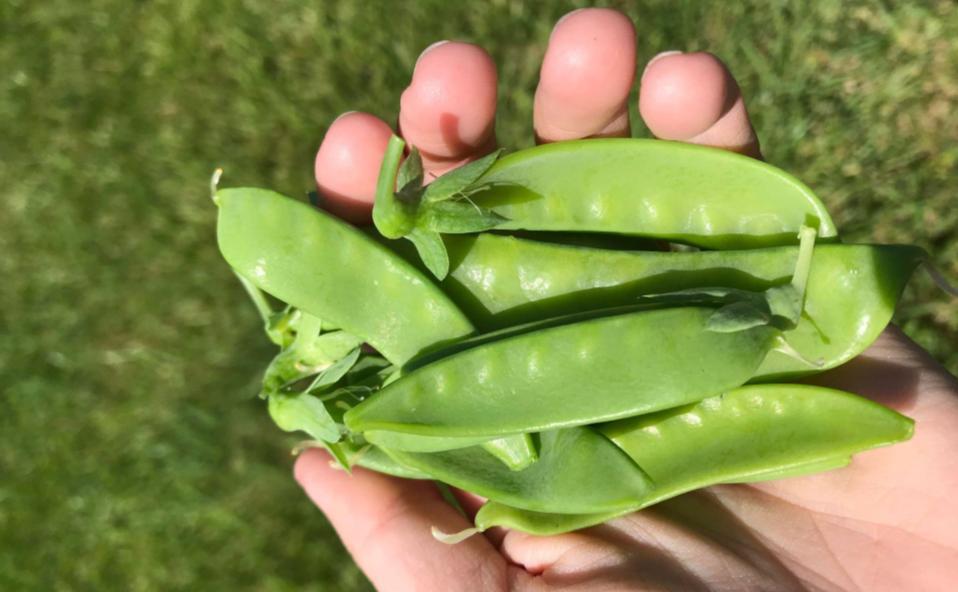
Photo: For snow peas – pick when pods are large and flat but before seed begins to enlarge.For snap peas (edible pods) – when pods are succulent and seeds are small. Remove “strings” from along the suture of the pod before cooking or eating. Always pick pods when they are tender, to keep plants producing. (Photo credit: Rachel Rhodes)

Vegetable Garden

  • Pinch the blooms off tomato, pepper and other plants before setting them out in the garden; this will encourage root and stem growth. Continue to pinch off pepper blossoms for 2-3 weeks to establish a stronger, higher yielding plant.
  • Keep cutworms away from cabbage, broccoli and other susceptible plants by putting a cardboard or plastic collar around each plant, or sprinkle ground up oyster shells, cat litter, sharp sand, or other gritty material around each one.
  • Keep weeding and thinning plants. To keep down weeds, mulch plants with dried grass clippings, sections of newspaper covered with straw, black landscape fabric or black plastic. Do not mulch with wood chips or bark, which takes nitrogen out of the soil as it decomposes.
  • As peas ripen, pick pods when tender, to keep plants producing.
  • Don’t let transplants or young seedlings dry out. Use a drip irrigation system, soaker hose, sprinkler, or hand-held hose with a water breaker (shower head), to keep beds evenly moist, but not too wet.
  • Plant warm-season crops like tomatoes and peppers, only after danger of frost is past. Mix ½ cup of ground lime with soil in the planting hole to prevent blossom-end rot. Water each transplant with a soluble fertilizer, like compost tea or kelp extract to get them off to a good start.
  • Pound in stakes or install tomato cages, at planting time, to prevent plant damage later.
  • Set out herbs in pots or plant in garden beds.
  • Inspect plants daily for cucumber beetles, cabbageworms, vine borers and flea beetles, which can be excluded with row covers. For plants requiring cross-pollination—cucumber, squash, melon, pumpkin—take covers off when plants are flowering, to let in pollinators.
  • Hand pick cabbage worms from broccoli and other members of the cabbage family, or spray with Bt (Bacillus thuringiensis). Bt may injure non-pest butterfly larvae, though, so use judiciously.

Indoor Plants and Insect Tips

  • Fleas are sometimes observed in homes where there are no pets. The most likely source is a wild animal such as a raccoon living in the attic, crawl space, chimney or some other sheltered area connected to the inside of the home. If you have pets that have a flea problem, contact your veterinarian for the safest and most effective flea control products.
  • Clover mites are usually most noticeable in the spring when temperatures are between 45° and 80°F and the humidity is high. On warm days they cross the grass and crawl up the sunny sides of buildings and will possibly enter into homes.

Rachel J. Rhodes, [email protected]is the Horticulture Educator and Master Gardener Coordinator for the University of Maryland Extension in Queen Anne’s County. She is one third of the Garden Thyme Podcast. The Garden Thyme Podcast is a monthly podcast where University of Maryland Extension Educators, help you get down and dirty in your garden, with timely gardening tips, information about native plants, and more!

For further information, please visit https://extension.umd.edu/queen-annes-county/master-gardener-home-gardening or see us on Facebook @ https://www.facebook.com/QueenAnnesCountyMasterGardeners or listen to The Garden Thyme Podcast at: https://www.buzzsprout.com/687509

University programs, activities, and facilities are available to all without regard to race, color, sex, gender identity or expression, sexual orientation, marital status, age, national origin, political affiliation, physical or mental disability, religion, protected veteran status, genetic information, personal appearance, or any other legally protected class.

The Spy Newspapers may periodically employ the assistance of artificial intelligence (AI) to enhance the clarity and accuracy of our content.

Filed Under: Garden Notes Tagged With: Gardening, local news, University of Maryland Extension

April Gardening Tips

April 7, 2021 by University of Maryland Extension
Leave a Comment

“Spring will come and so will happiness. Hold on. Life will get warmer.” -Anita Krizzan. It is officially spring, and it is time to dig out of the wet winter weather and get outside. Here are some helpful tips to get your garden started this season.

Photo: Plant a butterfly garden – Butterflies add beauty and help pollinate flowering plants. A variety of nectar plants for adult butterflies and host plants (food) for the caterpillars will attract them. Milkweed species is a popular nectar and host plant for the Monarch butterfly. The Monarch Caterpillar goes through five instars or stages between molts, during which they can range in size from 1/12″ –13/4″. Their life cycle is dependent on the milkweed plant. (Photo of monarch caterpillar photo credit: Rachel Rhodes)

Outdoor Garden and Yard Tips

  • Cedar-apple rust disease forms its galls on Virginia cedar (Juniperus virginiana) in April. The odd-looking galls are at first bright orange gelatinous balls with long “horns” or projections; they later turn brown and become hard. They are the alternate host structure for a disease that does very little harm to the junipers but can be quite destructive to apple trees, hawthorns, and quince.
  • Continue planting and transplanting trees and shrubs.  Choose quality trees: shade trees should have a single, straight trunk. Planting and transplanting should be completed before the end of June.
  • Viburnum leaf beetle is a serious pest of native arrowhead viburnum, cranberry bush, and many others. Look for feeding damage on viburnum and yellow larvae. Control them promptly since they can defoliate plants. Repeated defoliation can result in the death of native viburnums.
  • Spotted lanternfly eggs will start hatching late April or early May depending on the weather.
  • Eastern box turtles and various species of snakes are coming out of hibernation and may visit your yard. Box turtles are becoming scarce through much of Maryland because of road mortality and habitat destruction. Observe it but leave it in the wild.
  • Many spring bulbs have fully emerged and are flowering. Remove spent flowers but leave the green bulb foliage alone until it yellows and dies back naturally.
  • Lawn mowing season begins in April. The height and how frequently you mow your lawn is very important. Cool season grasses such as tall fescue and bluegrass should be maintained between 3 – 4 inches for most of the growing season and no more than 1/3rd of the leaf blade should be removed at each mowing. Always make sure to sharpen your mower blades at the beginning of the season.

Vegetable Garden

  • Continue to sow lettuce, spinach, Swiss chard, beets and other favorite salad vegetables.
  • Thin seedlings of leafy greens, to a few inches apart and eat the ones you pull. Check planting chart for final spacing between mature plants.
  • Plant seeds of carrots, turnips and parsnips in deeply worked, well-draining soil.
  • Don’t jump the gun with warm season crops; plant outside only after all danger of frost is past. (Night temperatures below 45º F. can damage plants and later fruiting.) Optional: lay down black plastic mulch to warm the soil, two to three weeks before planting warm season crops, like tomato, pepper, eggplant, and melon. Plastic mulch also keeps down weeds. (Biodegradable non-plastic mulch, made out of corn, is now available; www.highmowingseeds.com is one source.)
  • Sow beans and corn outdoors late this month or early May, when soil temperatures are above 50º F. (Or pre-start them indoors to get them off to a faster start.)
  • Start squash, melon and cucumbers indoors to be transplanted in the garden, in two to three weeks. (These plants also benefit from black plastic or biodegradable mulch.) Or, plant them directly in the garden, in late May through mid-June.
  • Start seeds of herbs, including rosemary, thyme, lavender, sage, basil and tarragon. Make cuttings of fresh mint, tarragon and rosemary from potted plants or from stems purchased in food markets. Root the cuttings in soil-less mix, under lights.

Indoor Plants and Insect Tips

  • Groom houseplants by removing dead and diseased foliage or spent flowers; this reduces insect and disease problems and improves their appearance. Gently dust the leaves with a soft rag. If possible, periodically place your plants in the shower to remove dust and to give them a good drink of water. This can revive a tired houseplant and helps to leach soluble salts (from fertilizers) from the soil.
  • Fungus gnats are small, harmless black flies that hover around, breed in and feed on moist growing media. Be careful not to over-water houseplants. Growing media should be allowed to dry out before watering again.
  • Different types of foraging ants may appear in your home. Try using bait stations to control minor infestations. Liquid and gel formulations are usually quite effective.

Rachel J. Rhodes, [email protected] is the Horticulture Educator and Master Gardener Coordinator for the University of Maryland Extension in Queen Anne’s County. She is one third of the Garden Thyme Podcast. The Garden Thyme Podcast is a monthly podcast where University of Maryland Extension Educators, help you get down and dirty in your garden, with timely gardening tips, information about native plants, and more!

For further information, please visit https://extension.umd.edu/queen-annes-county/master-gardener-home-gardening  or see us on Facebook @ https://www.facebook.com/QueenAnnesCountyMasterGardeners or listen to The Garden Thyme Podcast at:  https://www.buzzsprout.com/687509

University programs, activities, and facilities are available to all without regard to race, color, sex, gender identity or expression, sexual orientation, marital status, age, national origin, political affiliation, physical or mental disability, religion, protected veteran status, genetic information, personal appearance, or any other legally protected class.

The Spy Newspapers may periodically employ the assistance of artificial intelligence (AI) to enhance the clarity and accuracy of our content.

Filed Under: Garden Notes Tagged With: Gardening, local news, University of Maryland Extension

The Garden Thyme Podcast Release March Episode

March 10, 2021 by University of Maryland Extension
Leave a Comment

When the Pandemic gripped the world in early 2020, the rates of gardening and purchasing backyard chickens soared. For many families, the uncertainty of finding staple foods at the grocery store gave way to the resurgence of raising backyard chickens and growing a garden. Likewise, with millions of Americans working from home, having a garden and raising a backyard flock not only provided a family activity but it also transitioned into a stress reliever.  In this special episode, we are joined by the University of Maryland Extension Poultry Specialist Jon Moyle. We invited Jon to give the cockadoddledoo details on raising backyard chickens. Jon and Jenny cover information such as basic chicken biology, basic needs, and protocol for keeping poultry at home. More importantly, Jon discusses important facts homeowners should consider before taking on their own flock. To learn more about backyard flocks, visit the University of Maryland Extension Small Flock Production website. To register your flock through the Maryland Department of Agriculture click here.

Photo credit (Jon Moyle): Thor was a Light Brown Leghorn. He was proud of his ability to protect his flock of hens, (I have the scars to prove it) and he met his demise to a raptor.

Timing:

To listen to the podcast visit https://www.buzzsprout.com/687509/episodes/8072155

Native Plant of the Month (Spicebush- Lindera benzoin) at ~30:59

Bug of the Month (Multicolored Asian Lady Beetle) at ~35:53

Garden Tips of the Month at ~38:31

We hope you enjoyed this month’s episode and will tune in next month for more garden tips.

  1. If you have any garden related questions please email us at  UMEGardenPodcast@gmail.com

or look us up on Facebook at https://www.facebook.com/GardenThymePodcast

  1. For more information about UME and these topics, please check out the UME Home and Garden Information Center website at  https://extension.umd.edu/hgic

The Garden Thyme Podcast is a monthly podcast where we help you get down and dirty in your garden, with timely gardening tips, information about native plants, and more! The Garden Thyme Podcast is brought to you by the University of Maryland Extension. Hosts are Mikaela Boley- Senior Agent Associate (Talbot County) for Horticulture, Rachel Rhodes- Agent Associate for Horticulture (Queen Anne’s County), and Emily Zobel-Senior Agent Associate for Agriculture (Dorchester County). The University of Maryland is an Equal Opportunity Employer and Equal Access Programs. We want to remind everyone that we are open to all audiences, and will continue to serve our communities.

University programs, activities, and facilities are available to all without regard to race, color, sex, gender identity or expression, sexual orientation, marital status, age, national origin, political affiliation, physical or mental disability, religion, protected veteran status, genetic information, personal appearance, or any other legally protected class.

The Spy Newspapers may periodically employ the assistance of artificial intelligence (AI) to enhance the clarity and accuracy of our content.

Filed Under: Garden Notes Tagged With: Gardening, local news, University of Maryland Extension

UMD Extension Educators Produce New Mindfulness Instruction Guide

February 15, 2021 by University of Maryland Extension
Leave a Comment

While teaching a nutrition program series, Dhruti Patel, family and consumer sciences faculty with the University of Maryland Extension (UME), was approached by a single mother with three children. The last thing this mom wanted to think about is putting nutritious food on the plate for her or her children — she just doesn’t have time, according to Patel. This mom holds three jobs, has a household to run, and a “healthy meal” doesn’t rank as a priority. Consumed by exhaustion, she needed tools and information from Patel that focused on mental well-being and how she could take care of herself so that she could prioritize taking care of her children.

That offered a new realization for Patel. “I was under the assumption that I was helping my students, but I may have been missing the mark. They were not ready for the nutrition information yet, there were more basic needs that needed to be met,” said Patel.

Thus began Patel’s journey of looking into stress management and mindfulness in a professional capacity. Eventually, she was taken to a world-renowned Mindfulness-Based Stress Reduction evidence-based program, offered by the University of Massachusetts Medical Center.

“As a young girl, I noticed my grandfather engaged in meditative practices; and he looked pretty cool and he was my idol, so I started following in his footsteps and practicing,” said Patel, who has been utilizing mindfulness since she was a child. “I remember it was more of a personal journey. I never thought about that in a professional aspect.”

Patel brought in her own personal experiences through the lens of evidence-based programming, and began developing the guidebook, teaming up with colleagues Amy Rhodes, 4-H Youth Development Specialist and Erin Jewell, Family and Consumer Sciences nutrition educator, to create a book that would be an all-inclusive resource for people interested in incorporating mindfulness practices into their personal and professional spheres. The new Mindfulness Activity Guide for Adults, is a full educational program designed to teach people about reducing stress and maintaining a healthy well-being, providing the breadth and depth for those interested in teaching and instruction, as well as incorporating those techniques into our everyday lives.

“There is a plethora of information on types of mindfulness and meditative practices, but there are none which takes you from A to Z of the understanding and background knowledge part of mindfulness. We didn’t want to just focus on practice, but also on background and purpose,” said Patel. “This book was created to serve as something that’s one-in-all that adults can take with them and know everything about the activity or practice.”

“The book itself is a great introduction to what mindfulness is, the types of mindfulness, and how to create an environment of tranquility in order to achieve mindfulness,” said Amy Rhodes, 4-H educator in Wicomico County, and one of the authors.

According to the National Institute of Mental Health, long-term stress can harm your health. Continued strain on your body from stress may contribute to serious health problems such as heart disease, high blood pressure, diabetes, and mental disorders like depression or anxiety. Incorporating mindfulness and meditative practices can alleviate the stress that leads to these debilitating conditions.

This book is useful for any adult, to either take on this understanding of mindfulness activities on a personal note or to the person who would like to be an instructor or use these practices in their daily activities guiding others. The book contains information based on the benefits of mindfulness and meditation in everyday life, as well as meditation and non-meditation based mindfulness step-by-step guides to practice.

“You could use this in many scenarios,” said Rhodes. “Let’s say you’re getting ready to start a meeting, and you know it’s going to be a long stressful meeting. Maybe you can choose one of the activities from the guide to help people transition into the meeting, or have a mid-morning, mid-afternoon break where you use these tools to help your team de-stress and refresh.”

This book offers the opportunity for beginner to advanced mindfulness practitioners to use this guide to build confidence in leading mindfulness activities and complement existing programs. It’s a tool for educators, professionals, and personal use. “It’s very versatile and adaptable to many different situations. It’s useful for people working with groups, child caregivers, and even single moms.”

The guide incorporates meditation practices, stretching and postures designed to help relieve physical stress, and mindful eating habits, said Erin Jewell, who specializes in nutrition and mindful eating, part of the holistic approach to mindful living. “In our fast-paced world, mindfulness just helps us to slow down and appreciate things; and I think that’s what we need right now, especially as we are currently out of touch with people and things that we lose focus on things that we should be more grateful for.”

The Mindfulness Activity Guide for Adults is now available for purchase through the University of Maryland Extension. For ordering information, go to https://go.umd.edu/buymindfulguide.

The Spy Newspapers may periodically employ the assistance of artificial intelligence (AI) to enhance the clarity and accuracy of our content.

Filed Under: 7 Ed Notes Tagged With: Education, local news, University of Maryland Extension

January Gardening Tips

January 7, 2021 by University of Maryland Extension
Leave a Comment

After almost an entire year of quarantining, it is a great time to pause and reflect on last year’s gardening success and failures. Here are some simple easy tips to help get your mind and garden ready for the upcoming growing season.

  • Do not handle the hairy poison ivy vines wrapped around trees. Be aware that the offending oil of poison ivy, urushiol, is active and can produce symptoms during any time of the year. Be very careful not to bring firewood into the house with poison ivy vines attached
  • Heavy snow and ice loads can damage shrubs. Using an upward motion, gently sweep snow loads off shrubs to prevent breakage. However, oftentimes bent or weighed down branches will spring back after the snow/ice melts.
  • Order fruit plants from mail-order companies in January and February for early spring planting. Refer to our small and tree fruit sections on the website.
  • Decide on a good site for a new vegetable garden: sunny, level, access to water.
  • Make a garden plan. Put your plan in a notebook or garden journal and start recording ideas, notes from reading, or websites.
  • Purchase a high-low thermometer, to track weather patterns throughout the year.
  • Order catalogs and seeds, especially if you want to start slow-growing, unusual, or heirloom varieties indoors under lights. (See HG #70 “Recommended Vegetable Cultivars for Maryland Home Gardens”- on the Grow It Eat It website).
  • Test viability of saved or leftover seeds by placing 20 on a moist paper towel; roll up and put in a perforated plastic bag. Set bag on top of the refrigerator; in 7 days, count sprouted seeds. If less than 70 percent, toss out and buy new seed.
  • Be sure to clean your bird feeders once every two weeks or more often if seeds get wet or if sick birds visit your feeder. Dirty feeders can spread disease, and spoiled seeds can make birds sick.
  • Bird’s remember-feeding them regularly brings them back. Provide high-fat feed during the winter.
  • Birds are thirsty. Clean your birdbaths regularly. Even during winter, birds need a reliable source of freshwater.
  • Recycle your Christmas tree. Recycled Christmas trees can be used for mulch, soil erosion barriers and many other environmentally friendly uses. Click on the links below to find out how your county recycles Christmas trees. https://mde.maryland.gov/programs/Marylander/Pages/ChristmasTreeRecycling.aspx

Bagworm (Photo credit: Rachel J. Rhodes)–Remove and destroy bagworm bags from affected trees especially if seen on evergreens.

Indoor Plant and Insect Tips

  • Be careful not to overwater houseplants. Most houseplants should be watered only when the top of the growing medium begins to dry out.
  • Cut back or stop fertilizing houseplants unless they are grown under supplemental lighting.
  • Did you receive amaryllis for the holidays? Keep it in a sunny window. After it is done flowering, the plant will produce leaves and with proper care can rebloom.
  • Indoor herb plants benefit from daily misting and full sun windows.
  • Avoid the temptation to start seeds too early. Check seed packets for detailed information on starting various types of flowers. Do not depend on windowsill light to grow these seedlings. Refer to our instructions on starting seeds indoors.
  • Indian meal moths are a common problem of grains and grain products, cereals, birdseeds, dried pet food, etc. You may see adult moths flying, larvae crawling, or webbing. Always check bulk foods before purchasing for signs of meal moth infestation.
  • Don’t store firewood inside your home. Only bring in enough to burn at one time. Bark and other wood-boring beetles may emerge inside the home.

The Spy Newspapers may periodically employ the assistance of artificial intelligence (AI) to enhance the clarity and accuracy of our content.

Filed Under: Garden Notes Tagged With: Gardening, local news, University of Maryland Extension

Good Morning, Farmer! Brings Farming Community Together for Education and Fellowship

November 26, 2020 by University of Maryland Extension
Leave a Comment

University of Maryland Extension (UME) educators Jeanette Jeffrey, Dave Myers and Kayla Griffith developed a new virtual morning program for farmers and farm families, called Good Morning Farmer!, featuring speakers from the Extension agricultural community.

The new weekly program encourages farmers and those who work in the agricultural industry, to come together virtually every week for one hour, beginning on Dec. 2 at 8 a.m., to discuss topics like farm stress reduction, agricultural law, financial management, and much more.

“Good Morning Farmer! is an opportunity for fellowship and candid discussions about topics that matter to farmers, their families, and businesses,” said Jeanette Jeffrey, nutrition and health educator, and co-organizer of the program.

With the pandemic and associated stay-at-home orders, stress on the farm communities has been compounded, said Jesse Ketterman, financial educator with UME. “Farmers are isolated to begin with due to the nature of their work, and now they’re even more isolated. Programs like Good Morning, Farmer! help them make connections and interact within their community,” he said.

The program occurs weekly, with a different featured speaker during each session. Topics vary throughout the duration of the morning meetings, which continue through March 31, 2021, and include machinery breakdowns, injury and pain management, nutrition, and financial planning. The first session, beginning at 8 a.m. on Dec. 2, 2020 features Paul Goeringer, Extension specialist speaking on Agricultural Law and Farm Policy.

For more information and to register for this free program, go to https://go.umd.edu/GoodMorningFarmer.

The Spy Newspapers may periodically employ the assistance of artificial intelligence (AI) to enhance the clarity and accuracy of our content.

Filed Under: Garden Notes Tagged With: local news, University of Maryland Extension

  • « Previous Page
  • 1
  • 2
  • 3

Copyright © 2025

Affiliated News

  • The Chestertown Spy
  • The Talbot Spy

Sections

  • Arts
  • Cambridge
  • Commerce
  • Ecosystem
  • Education
  • Food & Garden
  • Health
  • Local Life
  • News
  • Point of View
  • Senior Nation

Spy Community Media

  • Subscribe for Free
  • Contact Us
  • COVID-19: Resources and Data

© 2025 Spy Community Media. | Log in