
MENU

Sections

  • About Us
    • Editors and Writers
    • Sponsorship Terms & Conditions
    • Code of Ethics
    • Sign Up for Cambridge Spy Daily Email Blast
  • The Arts and Design
  • Culture and Local Life
  • Food & Garden
  • Public Affairs
    • Commerce
    • Health
    • Ecosystem
    • Education
    • Senior Nation
  • Point of View
  • Chestertown Spy
  • Talbot Spy

More

  • Support the Spy
  • About Spy Community Media
  • Advertising with the Spy
  • Subscribe
January 12, 2026

Cambridge Spy

Nonpartisan and Education-based News for Cambridge

  • About Us
    • Editors and Writers
    • Sponsorship Terms & Conditions
    • Code of Ethics
    • Sign Up for Cambridge Spy Daily Email Blast
  • The Arts and Design
  • Culture and Local Life
  • Food & Garden
  • Public Affairs
    • Commerce
    • Health
    • Ecosystem
    • Education
    • Senior Nation
  • Point of View
  • Chestertown Spy
  • Talbot Spy
Spy Highlights

Have another? By Roger Vaughan 

January 29, 2025 by Spy Daybook
Leave a Comment

The surgeon general cautioned the public that even light or moderate drinking is harmful.
New York Times 1-3-25

There have been a lot of scary headlines recently. The US has resigned from the Paris Agreements, a coalition of countries that promotes cohesive efforts to suppress climate chaos. Sixteen hundred convicted January 6 insurrectionists have been pardoned. Birthright citizenship has been challenged. A slew of seemingly unqualified people have been given cabinet positions in the new administration. It’s a long, ongoing list. But none of them struck quite so comprehensively at the heart of our cultural habitat as the series of articles reporting that consuming any amount of alcohol is bad for us. Verboten! First, tobacco. Now, booze? 

It started the middle of last year with the headline, HOW BAD IS DRINKING FOR YOU, REALLY? It went on, with the research increasingly convincing: ALCOHOL IS RISKIER THAN PREVIOUSLY THOUGHT; MODERATE DRINKING RAISES HEATH RISKS; ALCOHOL CARRIES NEW RISKS IN MIDDLE AGE; WHAT, EXACTLY, IS MODERATE DRINKING?, until the Surgeon General laid it on the line, suggesting a cancer warning should be printed on all alcoholic beverages. 

This is a shocking development. The consumption of alcoholic beverages in America is right up there with motherhood and apple pie as a commonality. Alongside sex, drinking is perhaps the primary indulgence of our culture that knows not religion, race, sexuality, or (unfortunately) age. There are teetotalers who don’t drink any alcohol. The Pew Research Center reports they represent 38% of the population, leaving nearly twice that many drinkers among us. 

World-wide – “Skàl! Salud! Prost! Salute!” — the alcoholic beverage business is valued at nearly $2 trillion. In the US – “Cheers!” — the business reached $2,313 billion in 2023. That’s a lot of drinks served by some 63,000 bars and clubs in our 19,500 incorporated towns and cities, in addition to what is purchased from 46,000 liquor stores and consumed at home. 

Drinking is nearly as integral a part of our culture as cell phones and guns. When is the last time you watched a movie or TV series that didn’t show some character having a drink? We toast engagements, marriages, job promotions, and we enjoy meals with wine. Watching sports we dutifully consume beer. We drink spirits to celebrate or forget, or to bury relatives and friends. 

Overindulgence is common. For way too many people the use of alcohol is a disease. There are a reported 30 million alcoholics (ages 12 and older) in the United States; roughly 10% of our population. And now the surgeon general has reported any alcohol is bad for us. That’s almost like finding out toothpaste is toxic in the long run. 

This development, the flurry of scary headlines, caused me to review my own history of drinking, which peaked in college (a long time ago). I drank too much despite the thoughtful approach to alcohol that had been practiced by my parents. They were of a generation that was thoroughly engaged in drinking. My father was probably an alcoholic, but a small-town family doctor of his stature would not have been considered so. In those days, alcoholism, which was then not yet understood to be a disease, and the lower classes were mistakenly, yet firmly linked. Middle class professionals were simply not considered alcoholics. But two drinks and my father was a goner. A struggling golfer, he always birdied the 19th hole. He had given me a miniature, two-ounce mug when I was seven years old. When my father opened a beer, he would pour a dollop into my mug. 

My parents suggested I sample liquor at home so I would know what effect it had on me. Despite undergoing such a proper orientation, I drank excessively and irresponsibly in college. I joined a fraternity of lushes and went enthusiastically along with their frequent, three-day-weekend blow outs. I was focused on skiing and drinking, sailing and drinking, and just drinking to the point my grades suffered. A dean ordered me to take a semester off. That got my attention. I returned to college with new purpose. 

Working for a big magazine in Manhattan, I was often lured into my bosses’ two-martini lunches, which caused afternoons to blur. Then I just stopped drinking for many years. Blame it on my introduction to marijuana, a more benign way (we thought, and as it turns out) to achieve an enhanced perspective. 

Over the last ten years, I started having a couple ounces of rum with a dash of orange juice before dinner. I find this habit relaxing, and I savor the taste of rum. Exploring brands from different countries has become an engaging study. The one drink has little more than a calming effect on me, and there is no morning head at all. I do this four or five evenings a week. I don’t “need” it. I don’t miss it on the days I pass.

The current Surgeon General’s report on the danger of alcohol prompted me to consider quitting altogether, but I have decided to continue my one drink program for several reasons. First of all, as a senior citizen, long term effects of anything are no longer taken as seriously. And having a rum is one of the few pleasures left. Second, the older I get the more regard I have for moderation as a useful life guide. In younger days we teased each other for being moderate. Use it up, get more! Point those skis downhill! But moderation has repeatedly proved its worth. It has outlasted the competition. Having one drink is definitely moderate behavior. For me. 

Finally, there is consistency. That involves one’s awareness of self. One two-ounce drink that proves right for me might not suit someone else. Despite what our various catalogs and manufacturing processes now frequently promise, one size does not often fit all. I just published a biography of a woman who rarely has fewer than three drinks every evening. Enthusiastic drinking has been lifelong for her. She’s 81 now and still going strong. 

Cheers! 

Roger Vaughan, a Massachusetts native, began writing, photographing, playing music, and sailing at a young age, pursuits that shaped his lifelong career. After earning a BA in English from Brown University, he worked as an editor and writer for Saturday Evening Post and Life magazines, covering major cultural events of the 1960s and 70s. His first book, The Grand Gesture (1973), launched a prolific freelance writing career. He’s written more than 20 books, including numerous biographies, films, and many videos. Since 1980, Vaughan has lived on Maryland’s Eastern Shore, where he continues his work documenting remarkable individuals and events.
 

The Spy Newspapers may periodically employ the assistance of artificial intelligence (AI) to enhance the clarity and accuracy of our content.

Filed Under: Spy Highlights

Talbot Thrive helps local family discover the joy of biking  by Deidra Lyngard

January 16, 2025 by Spy Daybook
Leave a Comment

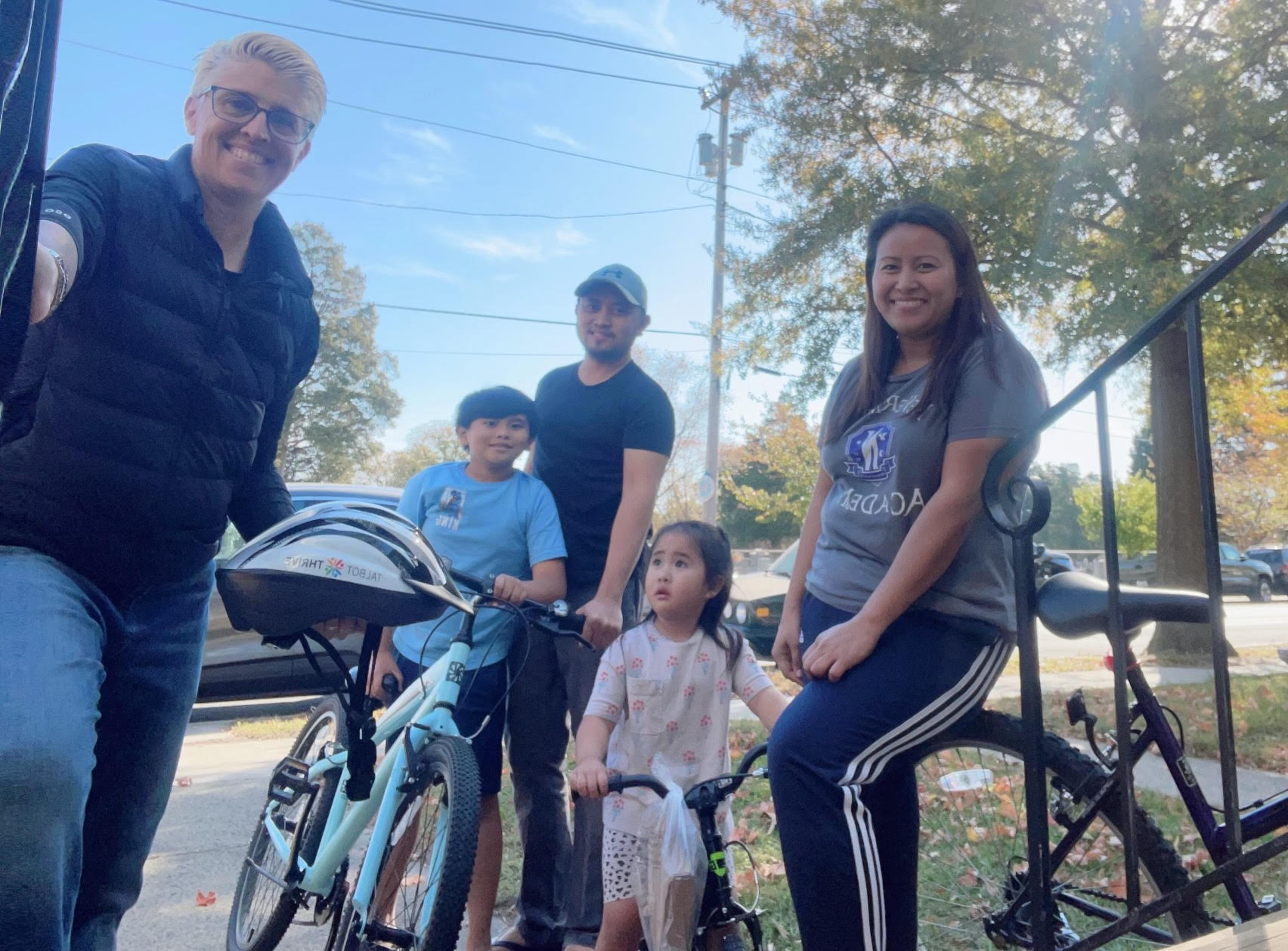
When the Molina family arrived in Easton from the Philippines, they never expected that four bicycles would open the door to a new chapter in their lives. But thanks to Talbot Thrive, that’s exactly what happened. The family first connected with Talbot Thrive during last fall’s Rolling Rodeo, a lively community event that brings kids and families together to learn traffic safety in the most fun way possible. 

Picture it: kids zipping through a specially designed course that mimics real streets—complete with traffic signs, lanes, and ramps—while enthusiastic volunteers cheer them on and teach valuable safety tips. It was here that the Molinas discovered the spirit of Talbot Thrive and its mission to make transportation safer and more sustainable for all. Now, with their donated bikes, the family is ready to explore their new community and embrace all that life in Talbot County has to offer. 

Shiela Molina was familiar with the concept of bike rodeos back home in the Philippines but had never been able to attend one with her children due to the pandemic. “When the school sent a flyer to my son for the Rolling Rodeo here in Easton, he wanted to go,” says Shiela. “I was pleased to learn that we could participate even if we didn’t have bicycles.” 

Joshua and Jeerah enjoying loaner bikes at the Rolling Rodeo at Easton Elementary School

In the Philippines, the Molina children—Joshua (8) and Jeerah (3)—had strider bikes but were only able to use them in their yard as there were no trails nearby. At the rodeo, they were fitted with loaner bikes and given free helmets. Within an hour on the course, Joshua had graduated from his strider to a pedal bike and his sister had advanced from walking to confidently zipping around the course. 

Even Shiela, who hadn’t ridden a bike since she was a child, got back on two wheels after being encouraged by a rodeo volunteer saying the event was for riders of all ages. Soon, she was pedaling around the course with her children and feeling comfortable on a bicycle again. 

After gaining their new skills, the Molinas were eager for more, but they didn’t have any bikes. On learning of their predicament, Heather Grant, Talbot Thrive’s executive director, suggested they enter the rodeo’s bike raffle. 

“Heather told me if we don’t get the raffle, she would find a way to get us bikes,” recalls Shiela. “We exchanged phone numbers and she told me to keep in touch.” When Shiela found out that they didn’t win the raffle, Heather put the word out on Facebook, and through donations from community members, Talbot Thrive was able to outfit the entire family with three gently used bikes, tuned up by a Talbot Thrive volunteer, and one new strider.   

Now the Molinas are a bicycling family. “We try to go out every weekend, weather permitting,” says Shiela. “We ride on the rails-to-trails, which is near our home.” Shiela says it’s great to have the bikes because the family can do something together while getting exercise outdoors. It also helps keep the kids away from “using gadgets!” 

The Molinas’ story highlights Talbot Thrive’s commitment to creating safe, accessible spaces where families can enjoy biking and develop healthy habits. Through educational events like the Rolling Rodeo, Talbot Thrive encourages both kids and adults to embrace outdoor recreation and learn essential bike safety skills. And by facilitating bike donations and engaging community support, it hopes to enable more families like the Molinas to experience the joy of riding together. 

Three Rolling Rodeos are planned for 2025—two in the spring and one in the fall. Learn more at TalbotThrive.org/RollingRodeos. If you have a gently used bike you’d like to donate, please contact Talbot Thrive at [email protected] 

The Spy Newspapers may periodically employ the assistance of artificial intelligence (AI) to enhance the clarity and accuracy of our content.

Filed Under: 3 Top Story

Ten new things at the Academy Art Museum to kick off the new year by Daedelus Hoffman

January 14, 2025 by Spy Daybook
Leave a Comment

The turning of the calendar to January feels like stepping into a freshly stretched canvas—open, bright, and waiting for something meaningful to happen. As the holiday decorations come down and resolutions take shape, there’s a collective sense of ambition in the air. Whether it’s learning a new skill, meeting new people, or finding inspiration, the new year calls us to action. At the Academy Art Museum, we’re here to help you channel that energy into something creative, fulfilling, and, most importantly, fun. Here are ten ways to make your new year a masterpiece.

1. Check Out a New Exhibition in Our Galleries

Nothing says “fresh start” like stepping into a gallery and seeing the world through an artist’s eyes. Our current and upcoming exhibitions are carefully curated to introduce you to thought-provoking works by both renowned and emerging artists. Each piece tells a story, invites reflection, or sparks a conversation that might stay with you long after you leave. Make it a goal to visit at least one exhibition this year—you never know which piece might inspire your next big idea.

2. Learn About a New Artist Through Our Amazing Collection

Art is more than what you see; it’s what you discover. Take a closer look at the treasures within our permanent collection and uncover the histories and ideas behind them. You might find yourself captivated by a painter you’ve never heard of or see connections between their work and your own life. Exploring our collection is an invitation to learn, to reflect, and to see art—and the world—through a different lens.

3. Take a New Class from One of Our Incredible Teaching Artists

Have you ever wondered what it feels like to throw clay on a potter’s wheel, wield a paintbrush with confidence, or capture the perfect photograph? Our teaching artists are experts in their crafts and passionate about sharing their knowledge. Classes are designed for everyone, from absolute beginners to those looking to hone their skills. This is your chance to turn “I’ve always wanted to…” into “I can’t believe I made this!”

4. Learn About a New Book at One of Our Shore Lit Book Talks

If the thought of curling up with a good book appeals to you, our Shore Lit series is the perfect fit. These events dive into books that connect art, literature, and culture, sparking meaningful conversations in an intimate setting. Meet other book lovers, exchange ideas, and leave with fresh insights that will linger long after the last page. It’s a book club, a community gathering, and an intellectual treat all in one.

5. Meet Somebody New by Attending One of Our Engaging Public Programs

Art has a magical way of breaking the ice and creating connections. Whether you’re attending a lecture, a workshop, or a family-friendly event, you’re bound to meet people who share your curiosity and enthusiasm. Conversations that start with “What do you think of this piece?” can quickly turn into friendships or even collaborations. Step outside your comfort zone, and see how art can bring people together in unexpected ways.

6. Check Out a New Movie at Our New Film Series

Lights, camera, action—our new film series brings the magic of cinema to the museum. Featuring carefully selected films that highlight the beauty, challenges, and humor of the human experience, this series is a feast for the senses. Each screening is an opportunity to see the world through a director’s lens and discuss it with fellow moviegoers. Bring a friend, grab some popcorn, and let the storytelling begin.

7. Share a New Experience with Someone Close to You at One of Our Exhibitions

Art is even better when shared. Bring a friend, a family member, or someone special to explore our galleries and spark a new kind of conversation. Exhibitions have a way of revealing things about ourselves and each other, deepening connections and creating lasting memories. Whether you’re marveling at a painting together or debating its meaning, it’s an experience that goes beyond words.

8. See Something Familiar in a New Way Through One of Our Tour Experiences

Sometimes, all it takes is a fresh perspective to see something familiar in a new light. Our guided tours are designed to do just that, offering behind-the-scenes insights and stories that enrich your understanding of the art on display. Even if you’ve visited before, a tour can reveal nuances and details you might have missed. Bring your questions, your curiosity, and your sense of wonder—you’ll leave with a deeper appreciation for the art and the museum.

9. Travel to a New Museum Through One of Our Day Trips

Art lovers, adventurers, and curious minds—our day trips are tailor-made for you. Join us as we explore other museums and cultural institutions, expanding our horizons and building connections between the Eastern Shore and the wider world. These trips are more than just visits; they’re opportunities to learn, bond, and be inspired alongside fellow travelers. Leave the logistics to us and focus on the joy of discovery.

10. Discover Your New Favorite Piece of Art at the Academy Art Museum Gift Shop

Art doesn’t have to stay in the galleries. Visit our gift shop and find a treasure to take home, whether it’s a locally made craft, a beautiful print, or a book that sparks your imagination. Every purchase supports the museum’s mission, so you’re not just shopping—you’re contributing to the community. Start your year with a piece of art that makes your everyday life a little more beautiful.

Start Your Year With Creativity and Connection

The new year is a blank slate, and at the Academy Art Museum, we’re here to help you fill it with inspiration, connection, and discovery. Whether you join us for an exhibition, a class, or a conversation, we can’t wait to welcome you. Let’s make 2025 a year filled with creativity, community, and meaningful experiences—together.

Daedelus Hoffman is the Director of Education at the Academy Art Museum. For more information about the AAM please go here.

The Spy Newspapers may periodically employ the assistance of artificial intelligence (AI) to enhance the clarity and accuracy of our content.

Filed Under: 1A Arts Lead

A lifelong canvas: How museums enrich the lives of lifelong learners by Daedelus Hoffman

December 14, 2024 by Spy Daybook
Leave a Comment

What if the first person to live to 150 years old has already been born? According to David Sinclair, a leading researcher at Harvard Medical School, advancements in science and medicine are rapidly extending the boundaries of human longevity, making this once-unimaginable milestone more plausible than ever before. Americans are not only living longer but are also redefining what it means to age. Here in Talbot County, where nearly 40% of residents are over the age of 60, this longevity revolution is already reshaping our community. The question isn’t just about how long we’ll live, but how well. And in the pursuit of a meaningful, high-quality life, museums like the Academy Art Museum play a pivotal role.

In this era of increased lifespans, the concept of lifelong learning is more essential than ever. As our years expand, so too must the opportunities to remain mentally, socially, and creatively engaged. Research increasingly reveals that lifelong learning is critical to aging well. A study published in Frontiers in Psychology underscores how engaging with cultural institutions like museums enhances cognitive function, emotional well-being, and social connections for older adults. Similarly, the American Alliance of Museums highlights how museums can serve as vital resources for elder communities, providing spaces for discovery, creativity, and intergenerational connection.

These findings aren’t abstract—they’re a blueprint for how museums like the Academy Art Museum can shape a vibrant, inclusive future for aging adults on the Eastern Shore. The evidence is clear: fostering connections, learning new skills, and engaging in creative practices are not just beneficial but necessary for maintaining a high quality of life as we age. Museums, with their unique ability to combine education, art, and community, are perfectly positioned to address this need.

At the Academy Art Museum, lifelong learning isn’t just a buzzword—it’s embedded in everything we do. From art classes that spark creativity in seasoned hands to gallery tours that invite reflection and dialogue, the museum fosters spaces where older adults can thrive. Programs like our intergenerational workshops pair seniors with younger participants, creating not only art but shared stories and connections that span decades. Whether it’s a painting class or a lecture on art history, these activities are about more than learning—they’re about belonging.

Imagine a retired teacher discovering a new passion for sculpture or a former engineer exploring the intricacies of watercolor painting. These are not just hobbies; they’re lifelines that keep minds sharp and spirits high. The Academy Art Museum provides these pathways, offering opportunities to try something new or deepen an existing interest. And in doing so, it builds a community of learners where everyone’s voice and creativity are valued.

But museums don’t just offer senior citizens a place to learn—they provide a stage for them to teach. Older adults bring with them lifetimes of experiences, perspectives, and skills that enrich every corner of the Academy Art Museum. Programs that encourage older participants to share their insights not only empower them but also enhance the learning experience for everyone involved. Whether mentoring younger artists, sharing historical perspectives, or leading discussions, these contributions transform the museum into a true community hub—a place where generations meet, stories are exchanged, and the past informs the future.

In Talbot County, where the population of seniors is among the highest in Maryland, these initiatives are not just relevant—they’re essential. As our community evolves, the Academy Art Museum is committed to evolving with it, creating programs and opportunities that meet the needs of all its members. This commitment includes ensuring that our spaces are welcoming and accessible, our programs are inclusive, and our mission resonates with individuals of all ages.

Consider the ripple effects of this work. A senior citizen who finds joy and purpose in a museum class goes on to inspire their family and friends. A grandparent and grandchild who collaborate on an art project deepen their bond. A retired professional who leads a workshop shares their knowledge with a new generation. The benefits extend far beyond the museum walls, enriching lives and strengthening our community.

As we navigate this era of longer lifespans, institutions like the Academy Art Museum have an opportunity, even an obligation, to respond. We aren’t just curators of art; we’re curators of connection, learning, and quality of life. For Talbot County’s older residents, the museum isn’t merely a destination; it’s a partner in living fully, deeply, and creatively. And as we imagine a future where some of us may live to see 150 years, there’s no better time to build the intergenerational bridges that make life worth living.

Whether you’re a seasoned artist, a curious learner, or simply someone seeking community, the Academy Art Museum welcomes you to join us in the lifelong pursuit of discovery.

Daedelus Hoffman is the director of education and interpretation at the Academy Art Museum.

The Spy Newspapers may periodically employ the assistance of artificial intelligence (AI) to enhance the clarity and accuracy of our content.

Filed Under: 3 Top Story

A reflection on veterans and the Greatest Generation by Kate and Matt LaMotte

November 11, 2024 by Spy Daybook
Leave a Comment

Landing at Omaha Beach on June 7, 1944 – one day after the historic D-Day invasion of Normandy, France – U.S. Army Captain Jack King was ordered to immediately march his Company inland. Within 48 hours of coming ashore,’ K’ Company was engaged in combat. In a bold move, Captain King – who had enlisted in the Maryland National Guard shortly after his graduation from Princeton in 1940 and was called up to active duty in 1941 – decided to move his troops across a shallow stretch of the Vier River to take control of the German-occupied village of Auroville. Control of Auville was important because Captain King and his troops were the “tip the spear” of the U.S. Army regiments coming from Omaha Beach, clearing the way for the U.S troops traveling from Utah Beach and Omaha Beach to join forces, so the Allies could wrest control of Normandy from the Nazis and then push across France into Germany.

With the bridge destroyed, Captain King settled on a risky, but brilliant alternative strategy: on the misty afternoon of June 9, he deployed his 150 remaining troops in a single, horizontal line, crossing the river with their guns blazing, giving the enemy troops the impression that a large Allied force was attacking. The ruse worked – the Germans retreated and Auville was relieved of enemy occupation, clearing the way for the U.S troops to join forces. Shot in both legs by machine gun fire, Captain King was among the few American troops (all Marylanders) wounded during the crossing and capture of Auville.

Raised in Baltimore’s historic Bolton Hill as one of three sons and a daughter of a prominent Johns Hopkins Hospital cardiologist, John T. King Jr and his wife, Charlotte. Throughout his youth, Jack King was a voracious reader and strong student who excelled at the Gilman School and graduated from Princeton University in 1940. Along with his personal achievements and his tall, dark and patrician good looks, King was widely appreciated by friends and family for his unfailing modesty and occasionally mischievous sense of humor.                                  

With World War II looming, levity and mischief were soon left behind and, like many of his peers, Jack King enlisted in the military. King was assigned to the 9th Army, 13th Corps, 29th Division, 175th Infantry. Known as the “Blue and Gray” Regiment or Maryland 5th, the unit traced its origins back to the Maryland/Virginia National Guard Regiment that had formed at the conclusion of the Civil War. By 1943, the 175th had shipped out to England and spent long months in extensive training preparing to invade Europe at Normandy, France.

By October 1944, within five months of his injuries at Auville, Captain King had recovered and was returned to his regiment. By then, the 175th had marched into the province of Brittany in an offensive designed to capture an important Atlantic coast seaport, which was successful. From there, the 175th was deployed to Belgium to support the Allied thrust over the Roer River into Germany. Once again, King’s company was in the thick of the fighting, and his leadership in combat proved to be invaluable. 

After crossing the Rhine in late April, 1945, the 175th’s primary role was to round up and process Nazi soldiers who had been taken prisoner. By early May, they had captured more than 15,000 prisoners. In later years, King recalled that they found this as “an easy task” because the German soldiers preferred surrendering to the Americans rather than being captured by the Soviet Russians.

In September of 1945, now promoted to Major, King returned home to civilian life. While awaiting processing out of the military at Fort Benning (now Fort Moore), Georgia, he met and married Elizabeth (Betty) Plant of Macon, Georgia. Returning to his native Baltimore, Jack and Betty raised their two children, John Holmes King and Elizabeth Leighton King Wheeler. One of his three granddaughters, C. Lee Gordon, and her family have made their home here in Talbot County.

In civilian life, King spent a successful career as vice president and executive assistant to the CEO at the Baltimore Gas & Electric Company, now Constellation Energy. As corporate historian as well as a public relations officer for BG&E, he also served on the boards of numerous area charities and non-profit organizations including the Enoch Pratt Free Library, the Gilman School and the St. Paul’s Girls’ School, Brown Memorial Presbyterian Church, and several area family foundations. 

While King rarely discussed his wartime experiences, the memories lingered. While PTSD was not a recognized diagnosis until after the Korean War, Jack King – a good-humored, lively young man before the War – became more subdued and introspective upon his return from Europe. He would talk about his experiences with his children in the form of humorous, anecdotal bedtime stories. Beyond that, he rarely spoke about The War. 

In his later years, King became less sociable and was haunted more frequently by nightmares about his wartime experiences. Yet, he never complained or made an issue about his wartime experiences. Upon his death in 2001, he was buried with full military honors at Arlington National Cemetery.

For his heroic leadership, Jack King was awarded the Silver Star, the Bronze Star, a Purple Heart, France’s Croix de Guerre, and the British Military Cross. He was one of the most decorated men in the entire Division. One citation read, “King’s aggressiveness and leadership ability under enemy fire, with total disregard for his own safety, were an inspiration to all his troops.” 

A Gilman classmate and friend, Walter Lord (author of A Night to Remember, the best-selling book about the sinking of the Titanic), reflected in a 1994 letter to him that “What you went through must have cost you great pain, but you, and those with you, did an enormous amount for the rest of us.”

While Veterans Day is designed for those who served in the line of duty, it is also an occasion to remember and appreciate the heroic service provided by Jack King and thousands of his fellow members of the “Greatest Generation” who fought valiantly and returned after World War II.

Matt LaMotte, an Eastern Shore native from Kent County, spent his youth between Baltimore, Chestertown and Easton. After college, he delved in the world of finance, raising his two sons while honing his passion for history and lacrosse. He spent two decades teaching and coaching in independent schools across Virginia, New Hampshire and Ohio. In 2018, he headed the History Department at Sts. Peter and Paul High School, Easton, until retirement in 2021. A reformed duck hunter, now bird enthusiast and conservationist, Matt is currently engaged in outdoor education and various affairs.

Kate LaMotte spent the first half of her life in Baltimore and then 10 years in Montclair, New Jersey. In 1996 she moved to Talbot County and raised her two daughters here. She has had a long (and getting longer) career in communications – primarily writing and editing — in Maryland, New Jersey and the Eastern Shore in service to higher education institutions, nonprofit organizations and presently, UM Shore Regional Health. She also serves on the Board of the Neighborhood Service Center, Inc.


The Spy Newspapers may periodically employ the assistance of artificial intelligence (AI) to enhance the clarity and accuracy of our content.

Filed Under: 9 Brevities

Spy Daybook: How museums offer a cure for loneliness in modern America by Daedelus Hoffman

November 5, 2024 by Spy Daybook
Leave a Comment

I believe the Academy Art Museum is more than a place where people look at art—it’s a place where people find each other. Art is a powerful connector, bridging gaps between strangers and building bonds that feel something like family. That’s what drives me: creating spaces where people aren’t just spectators but instead play an active role in building something bigger together. That thing is called community.

The importance of this work feels especially urgent today. Loneliness has become a silent epidemic, affecting Americans of all ages and backgrounds. According to a 2021 report by Harvard’s Making Caring Common project, over one-third of U.S. adults report feeling serious loneliness. In response, the U.S. Surgeon General Dr. Vivek Murthy has issued a stark warning: chronic loneliness is a public health crisis with risks to physical and mental health equivalent to smoking 15 cigarettes a day. Loneliness isn’t just an emotional experience—it’s a health risk that shortens lives and leaves people vulnerable to conditions ranging from heart disease to depression.

One reason for this epidemic is the decline of “third places”—those public, community-centered spaces outside of work and home where people can naturally gather, relax, and connect. Sociologist Robert Putnam explores this concept in The Upswing, where he argues that third places like coffee shops, libraries, and yes, museums, are crucial for building social cohesion. Without these gathering places, people lose opportunities to connect in a meaningful way with others in their community. In their absence, isolation grows.

Museums are particularly well-suited to fill this gap. Daniel Weiss, in his book Why the Museum Matters, describes museums as “cathedrals of the imagination,” where visitors are encouraged to pause, reflect, and find meaning. Unlike many other public spaces, museums offer an environment that’s both welcoming and contemplative, where people can take their time, engage with ideas, and share their experience with others. Museums make space for thoughtful encounters that often lead to meaningful connections.

At the Academy Art Museum, we see this potential for community building firsthand. Our public programs, like a film screening or a lecture, bring people together in shared experiences. These events are more than just cultural outings; they’re opportunities to bond over mutual interests and form lasting friendships. When visitors come for a film screening or a lecture, they’re joining a gathering of people who share an appreciation for creativity, curiosity, and dialogue. It’s a chance to become part of something larger.

Beyond these public events, our adult classes and workshops offer another layer of connection. In a world where adult friendships can be hard to sustain, these programs offer a rare opportunity to meet people who share similar interests in art and creativity. Whether it’s a painting workshop or a photography course, these classes invite participants to engage deeply with a craft while connecting with others. It’s a different kind of learning environment, one that values collaboration and exchange as much as individual growth.

And as people learn together, something transformative happens—they build a community. In a museum setting, that community becomes woven into the larger fabric of the institution itself, bringing new life to the art on the walls and new stories to the people who walk through our doors.

So yes, art has the power to inspire, challenge, and provoke. But just as importantly, it has the power to connect. In a society increasingly marked by isolation, museums are one of the last places where people can meet face-to-face, share a moment of insight, and leave feeling a little less alone. At the Academy Art Museum, that sense of connection is central to everything we do, because we know that the arts are most impactful when they bring people together.

For those on the Eastern Shore, the Academy Art Museum is here for you—not just as a gallery of beautiful things, but as a space to belong, to connect, and to be part of something bigger. Whether you’re here for an exhibit, a program, or a class, we invite you to come as you are, and maybe, just maybe, leave with something unexpected: a new friend, a sense of purpose, and the feeling that you’re part of a community.

Daedelus Hoffman is the director of education at the Academy Art Museum in Easton, Maryland.


The Spy Newspapers may periodically employ the assistance of artificial intelligence (AI) to enhance the clarity and accuracy of our content.

Filed Under: Spy Highlights, Spy Journal

Virtuoso Cellist Sterling Elliott to Perform at the Chesapeake Chamber Music Festival By James Carder

June 10, 2024 by Spy Daybook
Leave a Comment

Cellist Sterling Elliott

“Perfect intonation, style, and total involvement.”

“His discernible love for the music won over the audience.”

Praised for his musicality, sensitivity, dexterity, and performing ease by audiences and critics alike, the 25-year-old American cellist Sterling Elliott will be featured in three concerts at the 2024 Chesapeake Chamber Music Festival held at the Academy Art Museum. in Easton, Maryland. A child prodigy, Elliott began playing the cello at the age of three. He made his orchestral concerto debut at the age of seven and has since received numerous prestigious awards and performed with the world’s leading symphony orchestras. A graduate of The Juilliard School in New York City, he currently is pursuing an Artist Diploma at Juilliard under the direction of renowned cellists Joel Krosnick and Clara Kim.

Chesapeake Music audience members will remember Sterling Elliott’s exciting recital with pianist Elliot Wuu in 2022. The two musicians will be reunited at this year’s Festival performing Claude Debussy’s famous Rêverie in an arrangement for cello and piano (Saturday, June 15). Sterling Elliott will also perform Brahms’ beautiful and majestic first piano trio (with Sahun Sam Hong and Max Tan on Thursday, June 13). He will take the demanding, virtuosic first cello part in Luigi Boccherini’s String Quintet in A Major (with Catherine Cho, Max Tan, DanielPhillips, and Marcy Rosen on Friday, June 14). The last opportunity to enjoy Elliott’s stellar stage presence and joyous musicianship will be at the Festival Finale on Saturday, June 15, where, in addition to Debussy’s Rêverie, he will perform Arthur Foote’s A Night Piece and Scherzo for Flute and String Quartet (with Tara Helen O’Connor,Daniel Phillips, Max Tan, and Catherine Cho).

Asked what he envisioned his future as a classical musician to be, Elliott replied: “My goal as an artist has always been to simply share my passion with audiences across the globe. However, as my career develops and I can expand further on the idea of my role as an artist in society, I would like my ultimate goal in music to be focused on furthering music’s reach in all communities.” To that end, he takes seriously his standing in the classical music world as a Black role model. “Along with performing in concert halls, I frequent smaller communities and educational settings in which my position as a role model and an inspiring figure becomes clearly evident to other people of color.” “It brings me great satisfaction to be at a point in my career where I have the freedom to open up my agenda to several artistic engagements in under-resourced communities which might have a little budget for public music education, let alone a traveling guest artist.” In recognition of this commitment and of his astounding success as a classical musician, in March 2024 Sterling was awarded the highly coveted Sphinx Medal of Excellence and a $50,000 career grant, the highest honor bestowed by the Sphinx Organization – a non-profit dedicated to the development of young Black and Latino classical musicians. The award was presented in recognition of Sterling’s artistic excellence, his outstanding work ethic, and his ongoing commitment to leadership and his community.

And when he is back home, he loves working on, and building cars. “That’s what I love to do – be in the garage all day.”  In Easton, his love for his art, his total involvement with his music, will win over the audience.

For program information and to purchase tickets, go to https://chesapeakemusic.org/festival/.


The Spy Newspapers may periodically employ the assistance of artificial intelligence (AI) to enhance the clarity and accuracy of our content.

Filed Under: 1A Arts Lead, Arts Portal Lead

Spy Daybook: An Outdoor Education Experience Worth 1,800 Miles by Cailey Tebow 

May 19, 2024 by Spy Daybook
Leave a Comment

At 7:00 AM on a bright Tuesday morning, the nineteen restless students from The Logan School for Creative Learning entered the airport, eager to begin their journey. The trip ahead required the group to travel five hours by plane and bus, leaving from Denver, Colorado, before eventually arriving at Echo Hill Outdoor School in Worton, Maryland. Led by their environmental education teacher, Matt Kohn, the 6-8th graders were prepared to spend the week exploring the Eastern Shore nearly 1,800 miles from home. 

Deciding on this destination was no coincidence. In fact, EHOS was hand-picked by the students as a part of the final project for their travel unit at The Logan School. The project required students to divide into four-person groups and pitch an ideal location for the class’s annual Spring trip. As a part of their assignment, they assumed the responsibility of outlining the trip’s budget, itinerary, geography, and sustainability efforts and serving as the initial point of contact with the potential host organizations. As a class, they immediately saw the appeal in EHOS, ultimately deciding to split their week-long trip between the allure of the outdoor classroom and the urban excitement of nearby DC. 

When asked what stood out about EHOS, the students excitedly spoke over each other, passionately sharing their recent experiences with the interactive classes, the engaging nighttime programs, the generous amount of free time, and even the delicious food. When designing the official schedule, Matt selected which of the ~15 classes offered at EHOS best suited his students. This unique scheduling option allowed Matt to decide on classes most specific to the area. Each class was wholly hands-on. In Early American Studies, students used oyster shells to scrape out a model of a dugout canoe, built a fire, and made popcorn over it. They were later prompted to consider how their lives were similar to those on the land before them. In Orienteering, students had to work as a team to use compasses and map their routes along the campus. They enjoyed learning about waste practices in Garbology, facing their fears in the Adventure course, and bonding through games, music, and nights spent making s’mores around a fire. A favorite of the group was the program known as Opinions, where students reviewed “The Lorax” in theatrical form. After the performance, they were assigned varying roles and encouraged to consider what environmental solutions would satisfy different groups of people in the real world. 

Aside from classes, The Logan School students valued their extensive rest periods throughout the day. At their age, children are typically bombarded with assignments and structured programs that restrict their self-direction and sense of unfiltered wonder. To prevent these limitations, EHOS provides students with a safe space to build a community and let their imaginations run wild. One student, Sydney, reflected on this when sharing what she liked most about EHOS, “I think that’s what makes us gel so much with [Echo Hill]. Our school is really student-driven.” While The Logan School allowed them to design their own major trip, Echo Hill Outdoor School allowed them the space to truly enjoy it. 

For many, the food was also a major attraction at EHOS. If the middle school lunchroom of my memory was everyone for themselves, The Whip dining hall was the epitome of collaboration. Each mealtime began with a gathering outside, complete with an offering of thanks to fellow classmates, educators, and the natural world. Students and staff worked together to set tables, serve food, and clean up while singing camp songs and sharing anecdotes from the day. The “magic chef”, Cindy Jackson, was a charming and talented woman who put together miraculous meals from cinnamon vanilla pancakes to 

cheesy scallop potatoes and baked chicken. All dietary restrictions were accounted for, ensuring that each visitor was well fed regardless of their preferences, and suggestions were taken seriously. With her sassy chihuahua, Jerry Garcia, by her side, Cindy impressed any group that came through the school. At the end of each mealtime, students participated in “Slop Count”, where they combined their food waste and weighed it. In doing this, they competed with themselves for lower weights each meal and learned about the impacts of food waste. Slop proved shockingly effective with students gleefully pounding on the tables in anticipation of the final weight announcement. When they enjoyed their final meal together, the final weight was 0lbs. A meal shared among ~30 people without any waste is an impressive feat. 

After discussing with the well-spoken, sociable students of The Logan School, it quickly became apparent to me why EHOS was worth the distance. I had the honor of experiencing the magic of EHOS myself while observing two incredible classes: Bay Studies and Scanoe. Run by the charismatic associate director, Captain Andy, “Bay Studies” was an exhilarating introduction to the importance of watershed health and estuary ecosystems. Captain Andy was no stranger to using humor as a learning tool, sparking giggles throughout the group as he pretended to have a taste of a soil sample. He ensured that each guest on his boat felt comfortable and cared for, introducing himself to everyone individually as he helped them aboard ceremoniously. The students were giddy, encouraging each other to hold the fish, and audibly gasping as new information was shared. They were even prompted to compliment the fish and give them a peck, a suggestion that led to endless laughter and shrieks. “I kissed a carp,” one student grinned, “Put that in the article.” 

Swamp Canoe class, or “Scanoe”, was led by long-time class leader, Jake Swane, and was equally as exciting as the first. Jake led students across the swamp boardwalk, discussing the succession of the ecosystem and human impact on the area throughout history. They eventually reached a canoe raft where everyone had room to pile on and paddle through the landscape together. In 2015, Jake was first hired at EHOS with the intention of summer-long employment. Instead, he fell in love with the school and has taught there for nearly ten years. This was a common sentiment among staff who tested out assistant teaching positions on a whim and ended up unable to part with such an incredible place. A visitor of EHOS will often hear the senior educator, Amanda Fry, saying that hospitality is their specialty. No truer words were ever spoken. Each staff member was gracious, kind, and constantly willing to drop whatever they were doing to help a visitor or colleague. Even after a windy night huddled in sleeping bags, they remained highly engaged and welcoming to everyone involved. 

The impact of outdoor education is in full force at Echo Hill Outdoor School and it is essential for the future health of our planet. EHOS inspired a sense of childlike wonder within me that is often diminished in higher education and the professional world. The students at The Logan School for Creative Learning feel this inspiration just as strongly. Seventh-grader Hari explained the appeal of EHOS perfectly, saying, “Out of the building is the best way to learn it all… there’s just something about getting out of the classroom.” While they gathered together to take turns petting an eel or holding onto each other to avoid slipping in the ankle-deep slush of the swamp, they were learning so much more about the power of nature than could be achieved in the silence of a classroom. These types of lessons spark activism and understanding in the upcoming generations, encouraging motivation for environmental problem-solving that has the potential to last a lifetime. Without engaging, informative, and optimistic programs like those at EHOS, environmental health suffers and young environmentalists lose hope. Captain Andy conveyed this perfectly while addressing his class: “Humans figure things out,” he said confidently. “We can do this. That’s the good thing.” 

Cailey Tebow is a Salisbury University grad with a passion for the environment and journalism.

The Spy Newspapers may periodically employ the assistance of artificial intelligence (AI) to enhance the clarity and accuracy of our content.

Filed Under: 9 Brevities

Chicken Scratch: All clear. Are you ready? By Elizabeth Beggins

February 25, 2024 by Spy Daybook
Leave a Comment

Editor Note: With permission of the author, the Spy is delighted to share local author Elizabeth Beggin’s latest addition to her Subtack website Chicken Scratch. 

I followed two ladies down the grocery store aisle, like a bad odor, unpleasant and ignored. One woman walked alongside her cart, talking on her phone, while the other, a few paces on, ran her hand along the shelves as if checking for dust. I had a death grip on my Zen. The rack stroker was far enough ahead that I was sure I’d soon have a shot at a clear passage. Just then, another shopper wheeled into the vacancy from the opposite direction. I must have scowled. She made a point of apologizing.

“It’s not YOUR fault,” I said, none too pleased, as I finally pushed past them all.

In the time it took for the bottleneck to resolve, I’d had a spirited internal conversation, proud of my relative self-restraint, critical of Madam Chatty for taking up most of the aisle.  The spongy computer that lives inside my skull took a nanosecond to assess, assemble data points it recognized, and generate a narrative about the two women. And every word of it was an assumption based on prior experience and preconceived ideas. Quite satisfied with its ability to organize and recall information in the blink of an eye, my brain fed me its version of their story without need of a prompt, the prototypal ChatGPT, and similarly lacking in emotional intelligence.

This was implicit bias in action, the automatic reactions, attitudes and stereotypes—be they positive or negative—we all have toward other people. It’s there whether we acknowledge it or not. Most of us don’t, but we should, because the stories we tell ourselves are at the heart of our polarization.

Yep, it’s us. We’re the problem, it’s us. Among people who have the luxury of focusing on challenges that extend beyond keeping themselves fed and sheltered, it is human hostility catalyzing the avalanche of political, racial, gender, climate, immigration, you-name-it division we’re all trying desperately to outrun. The world is awful, and we’re the cause.

But that, too, is just one version of our story.

It’s true, the world is awful. It is also true that the world is much better and can get better still.

In an essay titled,The world is awful. The world is much better. The world can be much better, Max Roser, founder and director of Our World in Data reminds us that unsolved problems and progress are not mutually exclusive. He writes, “If we only see the problems and only hear what is going wrong, we have no hope that the future can be better. If we only hear about progress and what is going right, we become complacent and lose sight of the problems the world is facing. Both of these narrow perspectives have the same consequence: they leave us doing nothing — they are worldviews that paralyze us.”

Thus, he encourages us to accept that all of these statements can be simultaneously accurate. Certainly, there is deep suffering, but not as much as there was a century or two ago. Tragedies still occur with great frequency, but history teaches us that change is possible. The world can improve, and it is.

Roser points to trends in global child mortality by way of example, but there are other markers to validate his premise: advances in emissions, improved voter representation, the eradication of extreme poverty, and so on. These are skillfully illustrated in Beautiful Numbers, a visual story crafted by Austrian graphic designer Stefan Sagmeister.

In The Illusion of Moral Decline, a report published last June, researchers Adam M. Mastroianni and Daniel T. Gilbert conclude, as the study title suggests, that despite a pervasive notion, spanning 60 countries and 70 years, that we are on a highway to hell, “people’s reports of the morality of their contemporaries have not declined over time, suggesting that the perception of moral decline is an illusion.”

Importantly, the researchers also note concern that such beliefs make us less likely to ask for help or accept help from strangers, and more likely to use declining morality as a “veritable call to arms.” All the misperception feels real, and in the wrong minds, with a false narrative about exacting justice, that may be enough to provoke drastic consequences.

So, what of that? Should we sit tight, hold our breath and hope the other shoe doesn’t drop on our watch? Wring our hands and Henny Penny our way through life with no recourse? Continue feeling hopeless and helpless?

If that and your vote are all you feel you have to offer, then who am I to insist you do more? I promise I’m not judging you. The grocery lane is all clear. My implicit bias is fully in check, for the time being.

That said, I’m going to offer an overarching solution for those who sense that the time has come to do more. It is an approach that can be simple and straightforward, requiring minimal input on your part. Or it can expand to become a bigger, more collaborative investment while still being relatively accessible.

Are you ready? Here it is:


Talk with people.

In the grocery store. In the post office. On the bus. On social media. Around the dinner table. At the library. In the cafeteria. At the gym. Wherever you are, wherever you go, open the door to conversation.

Maybe you’re an introvert. Maybe you’re worried you’ll mess up. At its most basic level, we’re just talking about a mutual exchange, a casual remark, a dollop of decency dropped into the day.

“You have such a great smile.”

“I love your shoes.”

“Watching you interact with your children has brought me so much joy today.”

“I really appreciate you.”

While planning this piece, I reviewed a significant number of articles and books, videos and blogs. I found countless accounts of how we got this way and how long it has been building. (Hint: Much longer than the last two presidential terms). I read about extremism and nationalism. I found well-reasoned analyses of how social media algorithms are designed to engender disunion. I read about lack of trust and partisanship. I looked at list after list of supposed solutions until I finally landed on a theme that anyone at all could grab.

It works for individuals, and it works for groups. In communities across the nation, the programs with the most remarkable results were those that involved reaching out to people, respectfully and with a desire to learn, programs anchored in civil discourse.

There was the Tulane University Medical Center intervention that brought together local government and civic organizations, advocates and academics, to help reduce gun violence. There was a program model in Washington state called The If Project (the linked TED talk here is so damned inspiring!) designed to bring currently- and formerly-incarcerated adults, community partners, and law enforcement together to reduce rates of incarceration and recidivism. There were toolkits for library-hosted community conversation programs that truly seemed manageable for just about anyone with a desire to get something of value going in their area.

What I didn’t see was superiority or hubris. I didn’t see groups of people who were unwilling to accept that theirs might not be the only story.

In his book, Belonging: The Science of Creating Connection and Bridging Divides, psychologist, and Stanford professor, Geoffrey L. Cohen details how situations and circumstances shape people far more than their inherent personality traits. What happens to us and around us is more impactful than our feelings, behaviors and character. What matters most are feelings of belonging.

It follows, then, that anything any one of us can do to shape perception and build inclusivity, even in our own minds, has the potential for profoundly positive results.

In the smallest corners of social life, we can look for opportunities to conjure some of the magic of belonging. Community can be found and created in the most unlikely places. We can all change the world in small ways. We can shape situations to make them less threatening and more welcoming, allowing people from all walks of life to feel that they belong and thrive.

~Geoffrey Cohen, Next Big Idea Club


I don’t know what will come in the next nine months, or four years, or the rest of my lifetime, or my children’s, or their children’s. I only know that I inhabit this swirling, warming, mass of matter with countless other beings who are doing their best to live good, happy lives. I have to believe that if we open ourselves to the possibilities, we can continue to form a more perfect Union.

Together.


p.s. There are many organizations nationwide who are committed to this kind of work. I am updating this post to include a few more here and, if time allows, will create a Google Doc to house a running list. Happy to add your suggestions!

  1. Braver Angels
  2. Listen First Project
  3. Civil Conversations Project

Elizabeth Beggins spent over a decade as a niche farmer before becoming a food-focused freelance writer, educator, and consultant. As director of the You Food Project, an initiative rooted in school and community gardens, Elizabeth facilitated increased awareness of the connection between personal and environmental health.  Now focusing on soil health, Elizabeth works through Chesapeake Bay Foundation as the Maryland Agriculture Outreach Specialist for the Million Acre Challenge. She is a graduate of the University of North Carolina at Chapel Hill. 

Chicken Scratch is a reader-supported publication. To receive new posts and support my work, consider becoming a free or paid subscriber here.

The Spy Newspapers may periodically employ the assistance of artificial intelligence (AI) to enhance the clarity and accuracy of our content.

Filed Under: Opinion

A Word Girls Teaser – Part One: Meredith Davies Hadaway

February 14, 2024 by Spy Daybook
Leave a Comment

In a few weeks, the Spy will once again be collaborating with the Avalon Foundation on our evening program entitled Spy Nights. On the 28th, we will be taking over the Stolz Listening Room in downtown Easton for a remarkable evening of poetry with a special performance of the Word Girls.

Made up of three gifted poets—Meredith Davies Hadaway, Erin Murphy, and Amanda Newell—with strong local ties to Chestertown, Gunston School, and Washington College. They’re all set to captivate audiences with original verses that span environmental, societal, and deeply personal themes.

We begin our Word Girls Tease with Meredith. Meredith Davies Hadaway is the author of four poetry collections, most recently, Small Craft Warning, a collaboration with visual artist Marcy Dunn Ramsey. She has received fellowships from the Virginia Center for Creative Arts as well as a Maryland Arts Council Individual Artist Award. She is currently the Sophie Kerr Poet-in-Residence at Washington College.

This video is approximately two minutes in length.

WORD GIRLS
Stoltz Listening Room
Doors: 5:30pm / Talk: 6:00pm
WED 2/28 6:00PM

All proceeds go directly to support the arts on the Mid-Shore by the Spy and the Avalon Foundation. Tickets can be purchased here.


The Spy Newspapers may periodically employ the assistance of artificial intelligence (AI) to enhance the clarity and accuracy of our content.

Filed Under: 1 Homepage Slider

  • « Previous Page
  • 1
  • 2
  • 3
  • Next Page »

Copyright © 2026

Affiliated News

  • The Chestertown Spy
  • The Talbot Spy

Sections

  • Arts
  • Cambridge
  • Commerce
  • Ecosystem
  • Education
  • Food & Garden
  • Health
  • Local Life
  • News
  • Point of View
  • Senior Nation

Spy Community Media

  • Subscribe for Free
  • Contact Us
  • COVID-19: Resources and Data

© 2026 Spy Community Media. | Log in