
MENU

Sections

  • About Us
    • Editors and Writers
    • Sponsorship Terms & Conditions
    • Code of Ethics
    • Sign Up for Cambridge Spy Daily Email Blast
  • The Arts and Design
  • Culture and Local Life
  • Food & Garden
  • Public Affairs
    • Commerce
    • Health
    • Ecosystem
    • Education
    • Senior Nation
  • Point of View
  • Chestertown Spy
  • Talbot Spy

More

  • Support the Spy
  • About Spy Community Media
  • Advertising with the Spy
  • Subscribe
January 23, 2026

Cambridge Spy

Nonpartisan and Education-based News for Cambridge

  • About Us
    • Editors and Writers
    • Sponsorship Terms & Conditions
    • Code of Ethics
    • Sign Up for Cambridge Spy Daily Email Blast
  • The Arts and Design
  • Culture and Local Life
  • Food & Garden
  • Public Affairs
    • Commerce
    • Health
    • Ecosystem
    • Education
    • Senior Nation
  • Point of View
  • Chestertown Spy
  • Talbot Spy
00 Post to Chestertown Spy Food and Garden Notes

Wine of the Week: Erbaluce di Caluso DOCG from the Cieck Winery

December 12, 2025 by Jennifer Martella
Leave a Comment

Ciao Tutti!

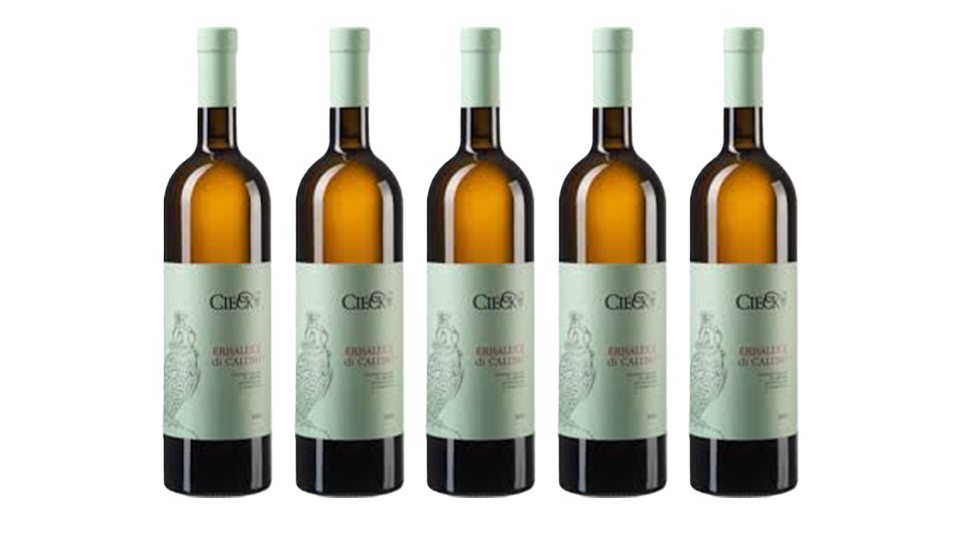
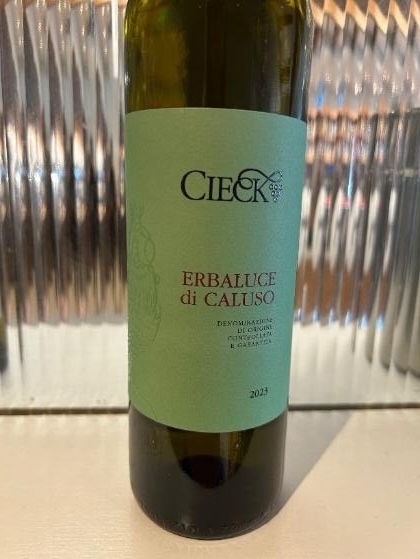
This weekend at Piazza Italian Market, we will taste the Erbaluce di Caluso DOCG ($19.50, 12.5% ABV) from the Cieck winery in San Giorgio Canavese, near Turin in Piemonte.  “Erbaluce” translates as “dawn light” for the grape’s pale yellow-green color that resembles dawn’s early light. “Cieck” was the name of an old farmhouse on the site where the winery was founded in 1985, on land where at the end of the 19th century, one of the owner’s great-great-grandfather grew his grapes. The embossed profile of a falcon on the label is a sly reference to the last name of two of the three winemakers, “Falconieri”. The design also includes a swirl of the “k” in Cieck that becomes a stem above a triangle of circles that symbolize grapes.
Erbaluce is an ancient grape that was Piemonte’s first white wine DOC and now enjoys its DOCG designation. Initially, winemaker Remo Falconieri intended to grow grapes to become a small producer of sparkling wines. He left his job at Olivetti as a typewriter designer to spend time in France learning about the production of sparking wines. His first harvest of Erbaluce Metodo Classico was released in 1987. Fate intervened and now Cieck is a trio who produce three sparkling wines, one rose’, two white wines, three red wines and one dessert wine. 

Remo Falconieri
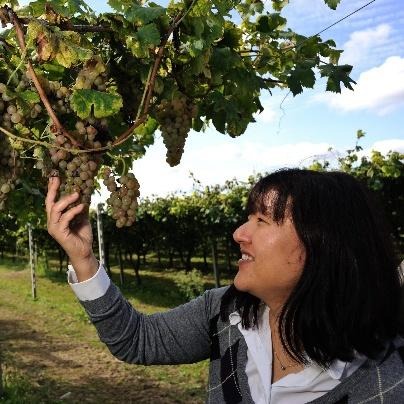
Lia Falconieri

Domenico Caretto


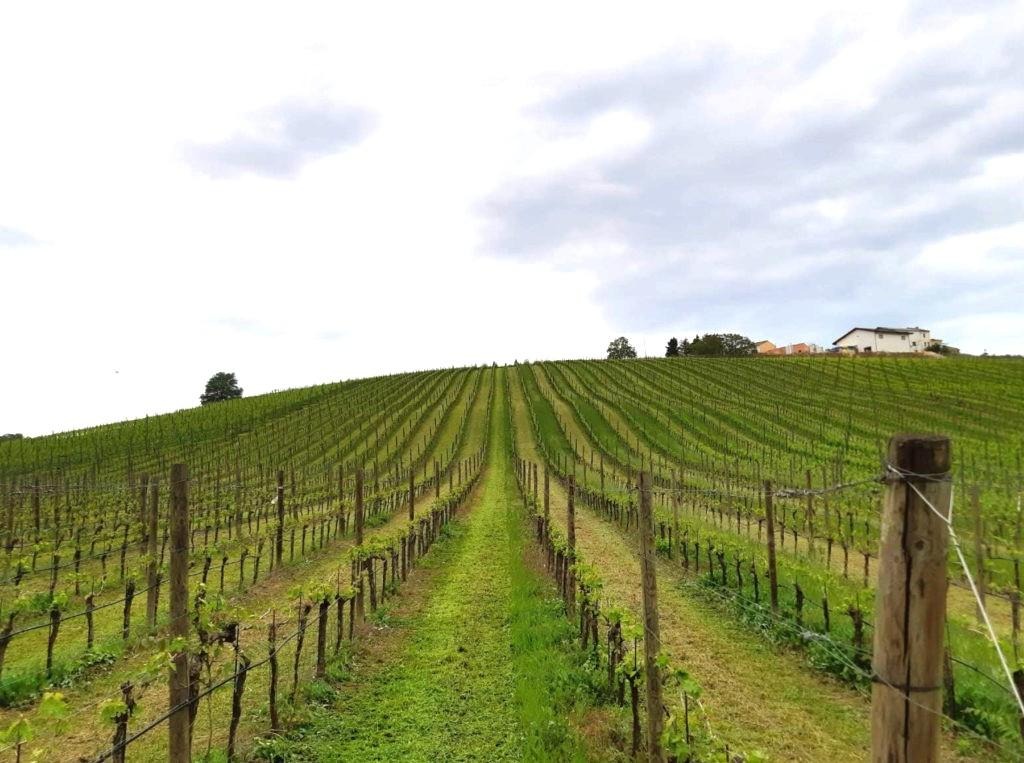
The winery has five vineyards and Erbaluce is grown in the 1.8 hectare Misobolo vineyard. It is the oldest vineyard that still has an original, ungrafted vine that is almost 100 years old. The vine was planted before the attack of phylloxera that decimated Europe’s vineyards. Cieck uses the “pergola” system to train their vines to spread out and form canopies in neat rows throughout the vineyard. At harvest time, workers must reach up instead of down to harvest  the grapes. 

I enjoy Erbaluce for its fresh bouquet, minerality, and bright acidity; it is a perfect paring with one of Piazza’s cheeses, which we will taste this weekend. It is also pairs well with oysters, any fresh fish or light creamy entrees. Erbaluce has earned a following with customers but if you have not yet tasted it, come join me Friday from noon to 5:45 or Saturday from noon to 4:45.

Cin Cin!

Jenn


Piazza Italian Market is located in the Talbot Town Shopping Center, suite 23, in Easton, MD.

Contributor Jennifer Martella has pursued dual careers in architecture and real estate since she moved to the Eastern Shore in 2004. She has reestablished her architectural practice for residential and commercial projects and is a real estate agent for Meredith Fine Properties. She especially enjoys using her architectural expertise to help buyers envision how they could modify a potential property. Her Italian heritage led her to Piazza Italian Market, where she hosts wine tastings every Friday and Saturday afternoons.
The Spy Newspapers may periodically employ the assistance of artificial intelligence (AI) to enhance the clarity and accuracy of our content.

Filed Under: 00 Post to Chestertown Spy, Food and Garden Notes

House of the Week: Treasure in Trappe

December 11, 2025 by Jennifer Martella
Leave a Comment

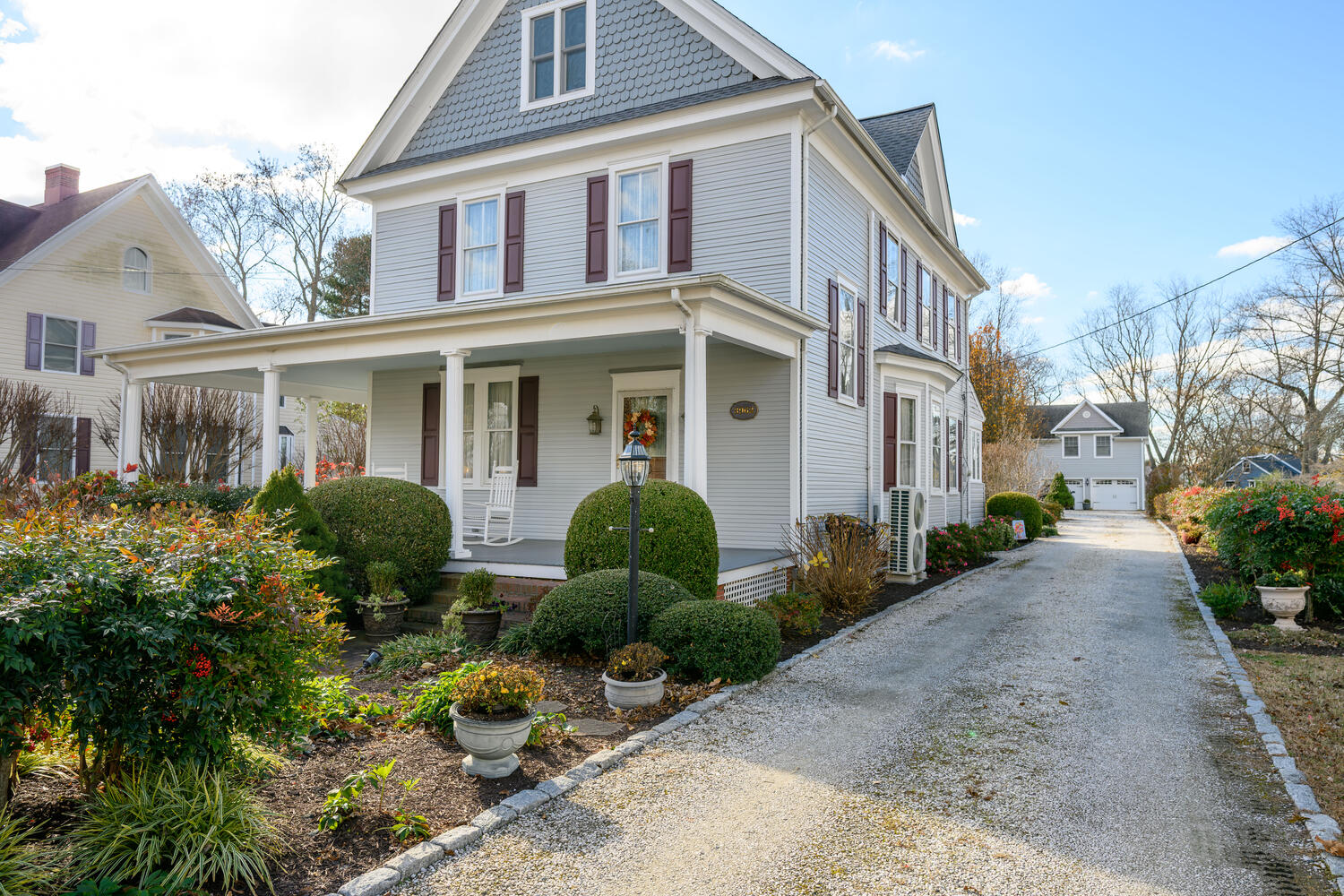
This Queen Anne and Victorian-inspired home, with its wrap-around porch, blends historic charm and modern functionality alongside the garage and guest apartment.

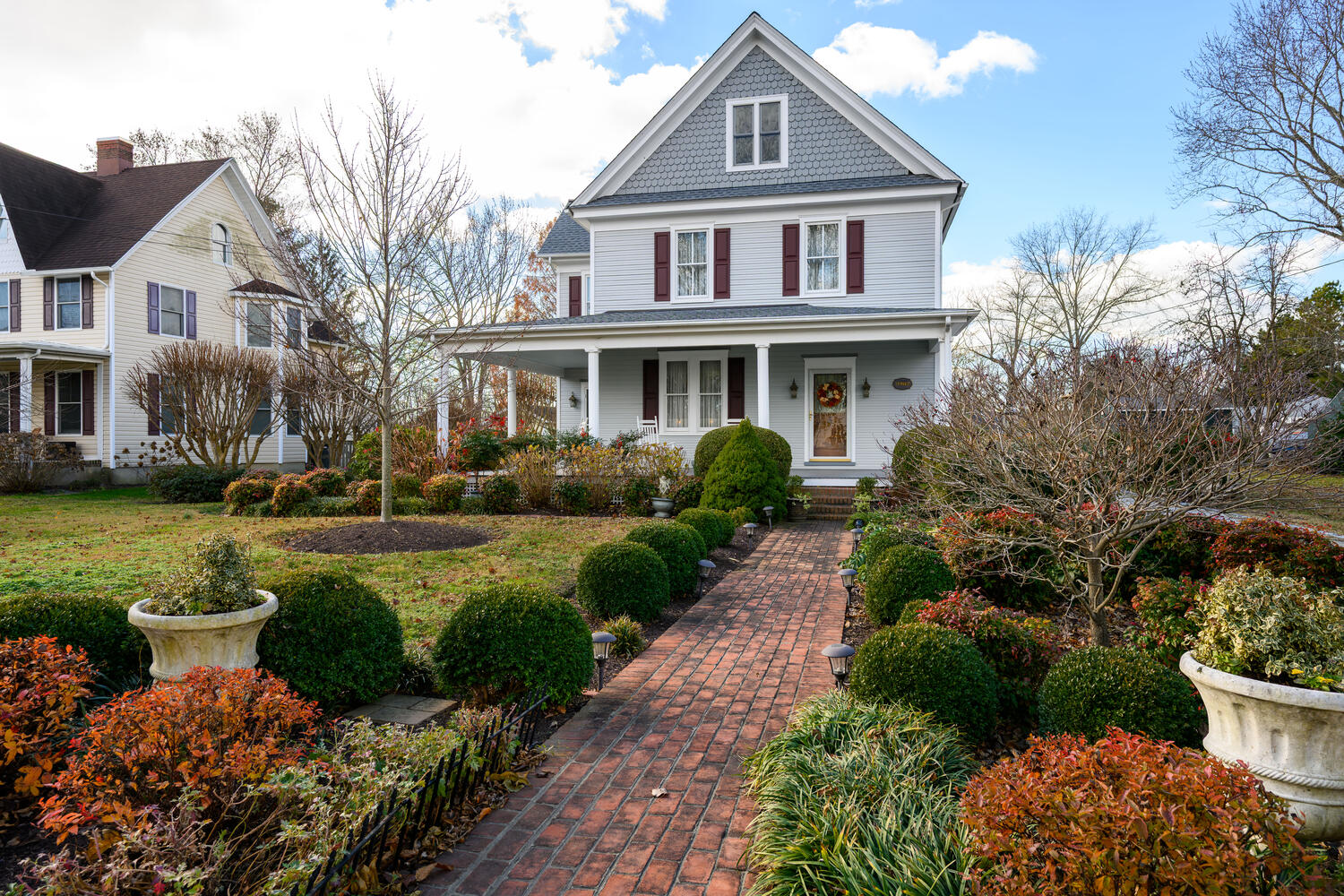
Several of my friends who wanted to purchase historic houses and found Easton’s Historic District too costly have discovered Trappe. Being a history buff, I am always curious to know the origin of a town’s name. I learned Trappe was incorporated in 1827 and its name may have been inspired by either wolf traps or a Trappist Monastery. This charming house caught my eye several years ago when  I featured another House of the Week that was located across the street and I am so pleased to feature this house today. The long and deep lot is located in the heart of Trappe’s residential district and the house and landscaped grounds have been lovingly maintained by its current owner who purchased it from the original owner. As I walked up the driveway for my tour, I admired the original lap siding that has been meticulously sanded down and repainted so it looks like new. The two-bay, two room wide, four rooms deep house’s multiple gables, wrap-around porch, 2/2 windows and bay windows identify its blend of Queen Anne and Victorian styles. 

The updated gray palette with textured scalloped shakes and mulberry shutters enhances curb appeal while maintaining the home’s historic elegance.

When the current owner bought the house, the exterior color palette was tan siding with green shutters. She chose an exterior color palette of light gray, white trim and deep mulberry shutters was spot on and gives the house a much better curb appeal. The darker gray of the third floor’s scalloped shakes is a great accent  of both color and texture. The landscaping along the brick sidewalk is a prelude to the manicured landscaping of the grounds; even in the beginning of winter, there is still color in the plantings.

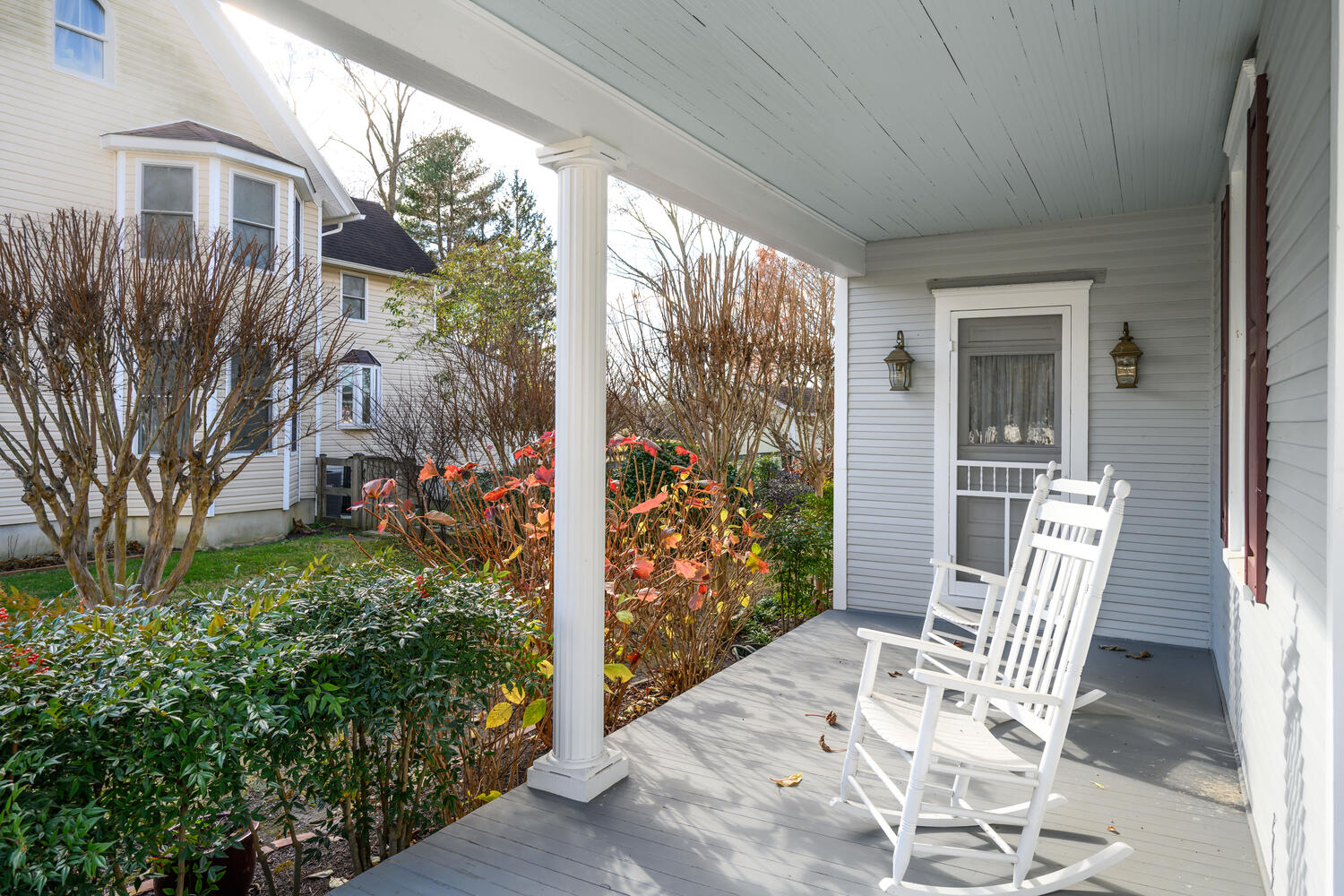
Generous proportions and classic fluted columns create a welcoming outdoor space with a nod to timeless architectural detail.

The deep wrap-around porch easily accommodates rocking chairs and circulation space. The light blue-gray ceiling and darker blue-gray flooring contrasts with the white fluted columns. 

The porch seamlessly connects to the family room, framed by sculptural crape myrtles for privacy and seasonal color.

The porch ends at the door to the family room for great outdoor-indoor flow. The crape myrtles are sculptural elements and await their next season of color that will provide even more privacy. 

Layered gables, screened porch transparency, and thoughtful massing elevate the architectural appeal of the home’s rear and side views.

All of the elevations of this charming house are architecturally interesting. The rear elevation’s overlapping gables and the side elevation’s gable enliven the facades. The screened porch is another delightful outdoor room that also adds transparency to the house’s very appealing massing. 

This pre-fabricated gazebo, crafted with care by the owner and her children, creates a serene space surrounded by gardens and complemented by wind chimes.

Walking through the gardens along hardscaped paths that varied from gravel to brick to stone pavers led me to this delightful gazebo next to the garage with an apartment above. I especially liked the pendant light fixture so one could dim the light after sunset and savor being surrounded by the sounds of nature to the tune of the wind chimes. 

I later learned from the owner that the gazebo was a pre-fab kit that she and her children assembled! It was tempting to linger and listen to the sounds of the wind chimes but I was eager to explore the full extent of the grounds

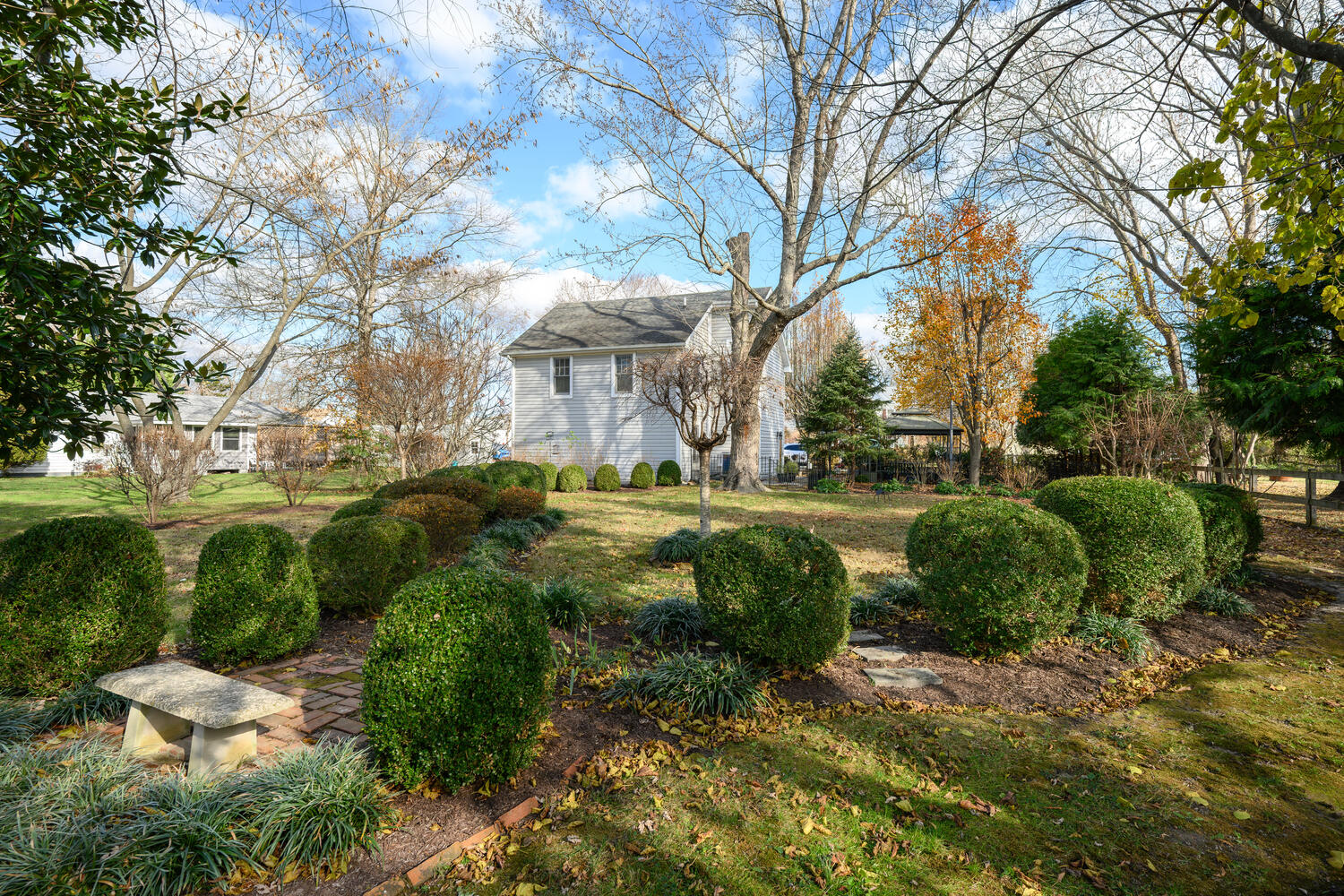
Formal landscaping breaks into lush greenery, leading to the brick terrace with views of the expansive grounds and discreet garage-apartment.

My walk ended at this brick terrace surrounded by boxwoods.  I paused on the bench to appreciate the full depth of this unique property and its landscaping. From the bench, the garage-apartment was visible but the house was totally obscured. 

Original oak balustrades and curved stair detailing highlight craftsmanship from the home’s early 20th-century origins.

Having explored the grounds, I was quite eager to begin my tour of the house. The front door opens into a spacious foyer with daylight from two windows above the stair. I admired the stair’s detailing with its stained winders and treads,  painted risers that accentuates beauty of the wood and tall oak newel posts whose recessed panels are lined with egg and dart molding . I especially liked how the bottom two treads have curved ends that gracefully spill into the foyer. 

The house was built in 1900 and I was so thankful that the beautiful stained oak balustrade had not been painted over the years! I also admired the trim at the stair wall that adds texture and how both the doors and windows are trimmed with fluted jambs and headers with rosette trim at the corners-details from the era of gracious living.

Corner windows frame the wrap-around porch, while the open layout welcomes natural light into this versatile space.

A stained wood French door leads from the foyer into the living room that was probably the formal parlor of the house when it was built. The windows at the corner look out onto the wrap-around porch. The spacious room easily accommodates seating for a gathering of family or friends. 

Angled bay windows and built-in cabinetry enhance this central gathering space, featuring vistas to the lush gardens beyond.

My fave room was the large dining room that was probably the family room when the house was built. Currently furnished as a dining room, it is connected to both the foyer and the living room. The subtle bay angled wall of windows, the recessed cabinet with an arched top and glass doors and the fireplace create a wonderful setting for cocktails by the fire and dinner by the windows overlooking the grounds. The light wall and historic trim green color continues throughout the house.

Stained wood accents, corner windows, and access to the wrap-around porch connect this cozy space to the home’s exterior.

Off the dining room is the family room that also has an exterior door to the wrap-around porch. I admired the stained wood of the exterior door and again was thankful that the house’s doors had not been painted over the original wood. Windows at the corner walls offer views of the gardens.

Sunlit windows and a clever mirrored backsplash reflect thoughtful design in this bright, well-planned kitchen.

A short hall off the dining room leads to a powder room, the screened porch, a secondary stair to the second floor and a doorway to the kitchen. The window overlooks the driveway so the distance from this house to the neighbor’s house allows full sunlight into the kitchen. Since the sink is located on an interior wall, the owner cleverly added a mirror detailed like a window. As I stood at the sink, I could see the reflection of the glass in the door at the rear wall of the house overlooking the gardens.

Framed panels maximize sightlines, while hedges create outdoor privacy within this delightful, enclosed retreat.

The cozy screened porch is a perfect Snug for relaxing at the end of the day or for warm weather meals. Hedges provide seated privacy and the framing of the screened panels maximizes one’s view of the landscape and the garden shed beyond. Behind the screened porch at the rear of the house is a full bath and laundry and a mud room with an exterior door to the driveway and gardens.

The landing’s angled walls and full newel post offer elegant detailing, while creating opportunity for functional desk space.

Instead of climbing the secondary stair from the kitchen, I went back to the foyer and climbed the main stair. The stair landing blends into the large hall connecting three spacious bedrooms and the hall bath. 

I especially liked how the balustrade detailing included a full newel post against the wall. I also liked how the wall opposite the stair has an angled edge which gives room for a desk on the wall opposite this window. Mounting a mirror above the desk would provide a view of the window for a respite from computer work. 

Three large windows illuminate this spacious corner room, showcasing its handsome trim and functional original radiator heating.

The largest bedroom is the primary bedroom located at the front corner of the house with three windows on the two exterior walls for abundant daylight. I noted the radiators for heating which to me is the best source of heat when combined with high velocity AC for thermal comfort.

Windows on three walls provide sun-filled views of the gardens throughout the day, creating a bright and welcoming retreat.

The middle bedroom has windows on each of its three exterior walls for sunlight throughout the day and bird’s eye views of the side and rear gardens. 

Dual access via the secondary stair and hall makes this rear corner bedroom a versatile and sunlit space.

The third bedroom is located at the rear of the house and has the secondary stair leading to the first floor hall. The bedroom has windows on all three exterior walls for sunlight throughout the day. 

Natural daylight flows in through high windows, and its central layout offers convenient access to all second-floor bedrooms.

The hall bath has doors to both the rear bedroom and to the stair hall. My architect’s imagination kicked in and I believe a second bath could be created next to this one so the new one could be dedicated to the primary bedroom.

Unfinished yet full of potential, this attic’s skylights and gable windows create a foundation for a future office or recreation space.

The house’s bonus room is the unfinished attic space, accessed by stairs off the landing at the second floor. With windows at each gable end and skylights, this space could be renovated into myriad uses; office, recreation room, studio, etc., or simply storage.

The apartment’s entry balances functionality with proximity to the gazebo, offering an inviting connection to its own outdoor room.

I reluctantly ended my tour of this exquisite house to explore the apartment above the garage. Opposite the building’s entry door is the large gazebo which is a wonderful outdoor room for the apartment.

Sloped ceilings and dual gable windows create dynamic architecture within this bright apartment, perfect for extended stays.

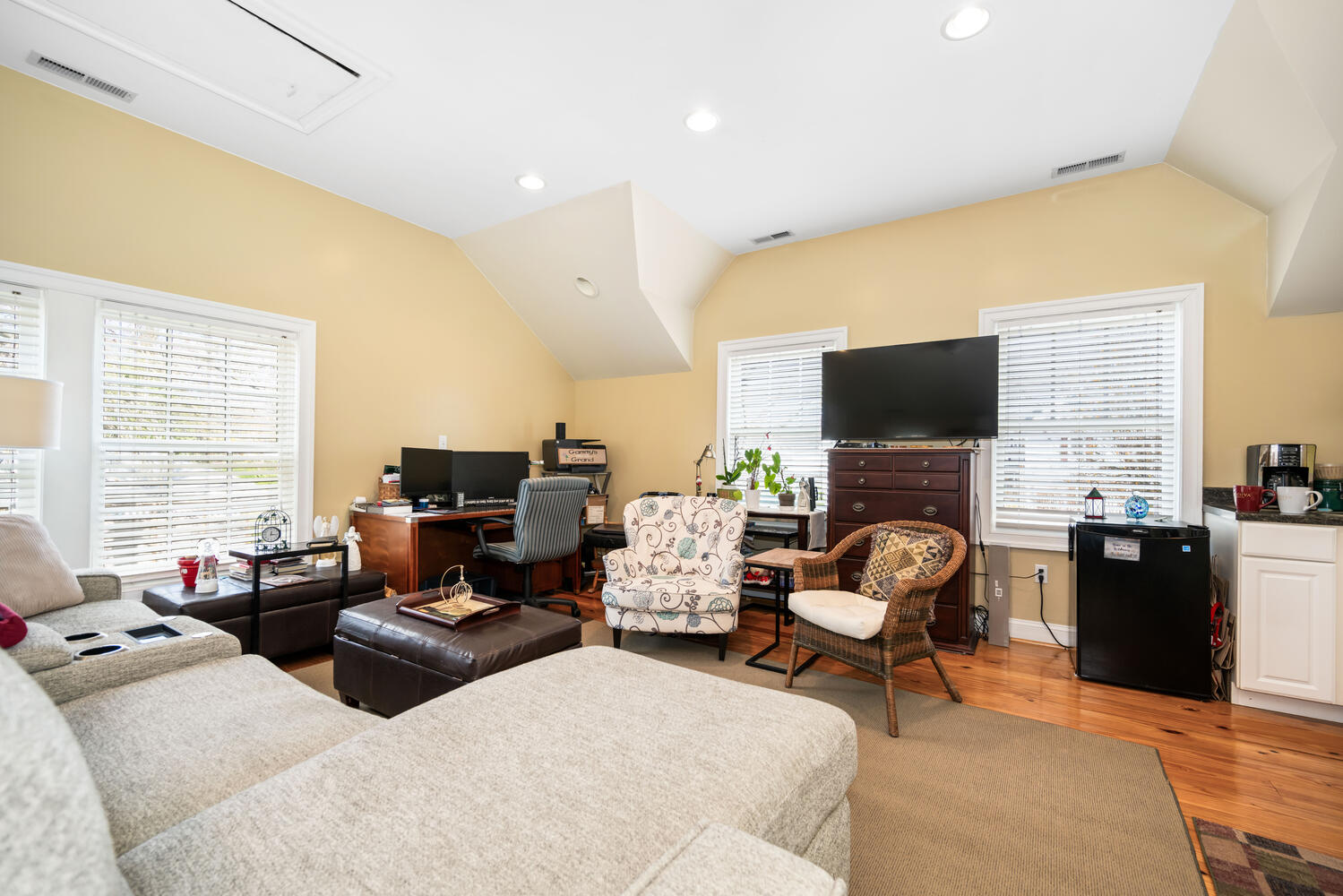
The apartment’s front gable wall with the two windows and the mix of flat and sloped ceilings creates delightful interior architecture. With a full bath, stack W/D and mini-kitchen, this bonus room with multiple windows would be hard to beat for extended stays. 

This historic gem in the heart of Trappe’s residential district have been meticulously maintained and offers the charm of two appealing architectural styles with modern conveniences. The compact floor plans on both floors maximizes the room sizes and multiple windows provide abundant sunlight. Details including the wood floors, trim and built-ins offer character from an era of gracious living. Garden enthusiasts would enjoy the spacious grounds and add their own finishing touches. The outdoor rooms of the front wrap-around porch, screened porch, terraces in the gardens and the gazebo keep one close to the sights and sounds of nature. The double garage and the apartment above are both a bonus as well as the full third floor attic of the main house. Wonderful property!


For more information about this property contact Judy Moore with Benson and Mangold at 410-822-0415 (o), 410-463-1730 (c) or [email protected]. For more photographs and pricing visit  www.TheMarylandShore.com, “Equal Housing Opportunity”. 

Photography by Janelle Stroop, 845-744-2758, [email protected]. ‘

Contributor Jennifer Martella has pursued dual careers in architecture and real estate since she moved to the Eastern Shore in 2004. She has reestablished her architectural practice for residential and commercial projects and is a real estate agent for Meredith Fine Properties. She especially enjoys using her architectural expertise to help buyers envision how they could modify a potential property. Her Italian heritage led her to Piazza Italian Market, where she hosts wine tastings every Friday and Saturday afternoons.

The Spy Newspapers may periodically employ the assistance of artificial intelligence (AI) to enhance the clarity and accuracy of our content.

Filed Under: 00 Post to Chestertown Spy, Design with Jenn Martella

Wine of the Week: Montepulciano D’Abruzzo from the Coste Di Brenta Winery

December 5, 2025 by Jennifer Martella
Leave a Comment

Ciao Tutti!

This weekend we will taste a new wine to our collection, the Montepulciano D’Abruzzo ($14.50, 13.5% ABV)  from the Coste Di Brenta winery  in Lanciano, Abruzzo. The colorful abstract label pays tribute to Abruzzo’s unique geography of the Apennine Mountains, three national parks and over thirty nature reserves that cover over two thirds of the its area; deep valleys, the Adriatic Sea,  hilltop towns and castles dating from the medieval and Renaissance periods. 

The importer for this wine, Williams Corner, has a reputation for seeking passionate artisan winemakers whose work is done in an environmentally conscious manner. Coste Di Brenta’s 17+ hectares organic farm is set high on a hill between the Majella Mountains and the Adriatic Sea. Founded in 2004, it is a family endeavor with Augusto Tano, his wife Anna Giovana Di Ludovico and their three children. 

The property had been in Augusto’s family for many generations when Augusto and Giovanna  became the managers and renovated the 17+ hectares of vineyards and the cellar. From the beginning, they were committed to organic viniculture. Abruzzo is a region known for estates with large productions; Costa Di Brenta stands out with their emphasis on production of small-batch, high quality wines.

Their 100% Montepulciano is a blend of cherries and mixed berries infused with soft earthy notes on the nose, lush fruit  flavor, medium to full body, soft tannins with a long finish and a touch of acidity. Pair with Piazza’s pizza or pasta dishes hearty soups and stews. 

Come join me for a taste on Friday from noon to 5:45; please note that special Saturday tasting hours are 11 to 2:30, as I am a member of the Easton Choral Arts Society and I must leave Piazza early for our Saturday concert. 

Cin Cin!

Jenn


Piazza Italian Market is located in the Talbot Town Shopping Center at 218 N. Washington St., suite 23, in Easton, MD

Contributor Jennifer Martella has pursued dual careers in architecture and real estate since she moved to the Eastern Shore in 2004. She has reestablished her architectural practice for residential and commercial projects and is a real estate agent for Meredith Fine Properties. She especially enjoys using her architectural expertise to help buyers envision how they could modify a potential property. Her Italian heritage led her to Piazza Italian Market, where she hosts wine tastings every Friday and Saturday afternoons.
The Spy Newspapers may periodically employ the assistance of artificial intelligence (AI) to enhance the clarity and accuracy of our content.

Filed Under: 00 Post to Chestertown Spy, Food and Garden Notes

Design with Jenn Martella: Contemporary on the Chesapeake Bay

December 4, 2025 by Jennifer Martella
Leave a Comment

Design with Jenn Martella: Contemporary on the Chesapeake Bay

4.4-acre waterfront retreat in Neavitt features decks designed to take full advantage of Chesapeake Bay views.

When I began my home search after moving to Talbot County twenty one years ago, I fell under the spell of the charming village of Neavitt. I liked both its location near St. Michaels’ amenities but also its privacy from being a peninsula surrounded by various creeks and the Chesapeake Bay. The picturesque houses, the former Post Office building that has been restored by architect Mark McInturff, the Community Park and Neavitt Landing give Neavitt its unique charm.  This contemporary house was built in 1986 and is sited on a 4.4 acre lot with both mature trees and also its long driveway for privacy. Decks at both floors of the house offer panoramic views of the Chesapeake Bay.

Compact yet striking, the layered rooflines and large windows add architectural interest while maintaining a minimal site footprint.


The house’s compact footprint minimized disturbance of the site and its simple sloped roof is enlivened by a layer of shed roofs infilled with windows at both the front and the rear of the house. At the front of the house, one shed roof provides headroom for the second floor primary suite.    

The elevated first-floor deck and expansive windows create seamless indoor-outdoor living with stunning Bay vistas.

The rear elevation opens up the house to unobstructed vistas of the Chesapeake Bay and the offsets of the second floor rooflines enliven the façade. The first floor deck is elevated to maximize the water views and is connected to the stone terrace by a paved walkway.

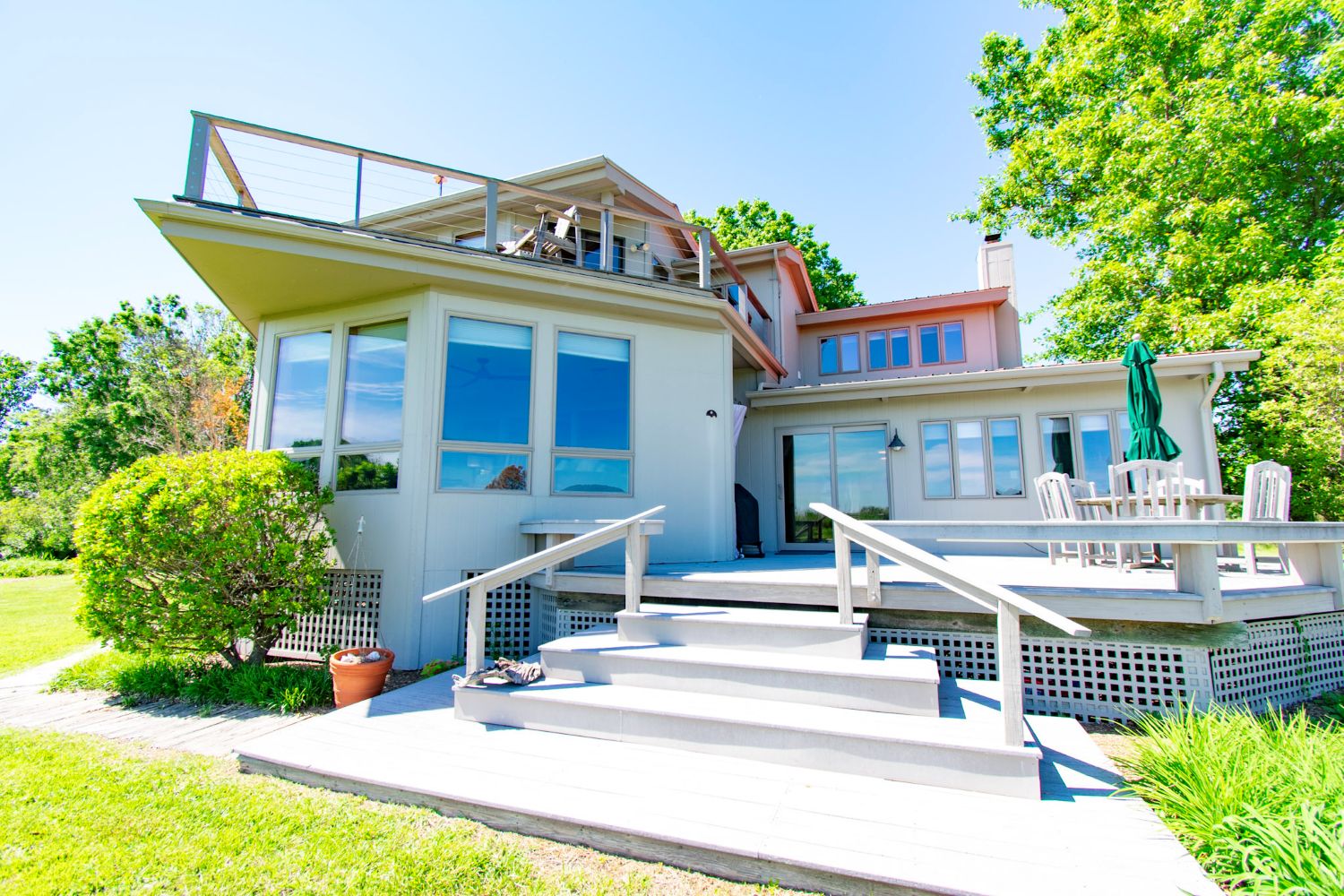
A prow-shaped upper deck with sleek cable railings offers uninterrupted panoramic views of the Chesapeake Bay.

The second floor deck is shaped like the prow of a ship above the bay wall projections of the living room below. The railing of horizontal cables and thin cap offers clear bird’s eye views of the Chesapeake Bay. 

Multi-level outdoor spaces, including a deck, terrace, and screened gazebo, provide versatile areas for relaxation.

The placement of the main level outdoor spaces, from the large deck with a wide railing for extra seating to the stone terrace below and the screened gazebo offer a variety of options for relaxing outdoors. The blue cushions and the green umbrella are colorful accents to the house’s  and deck’s exterior palette of light gray.

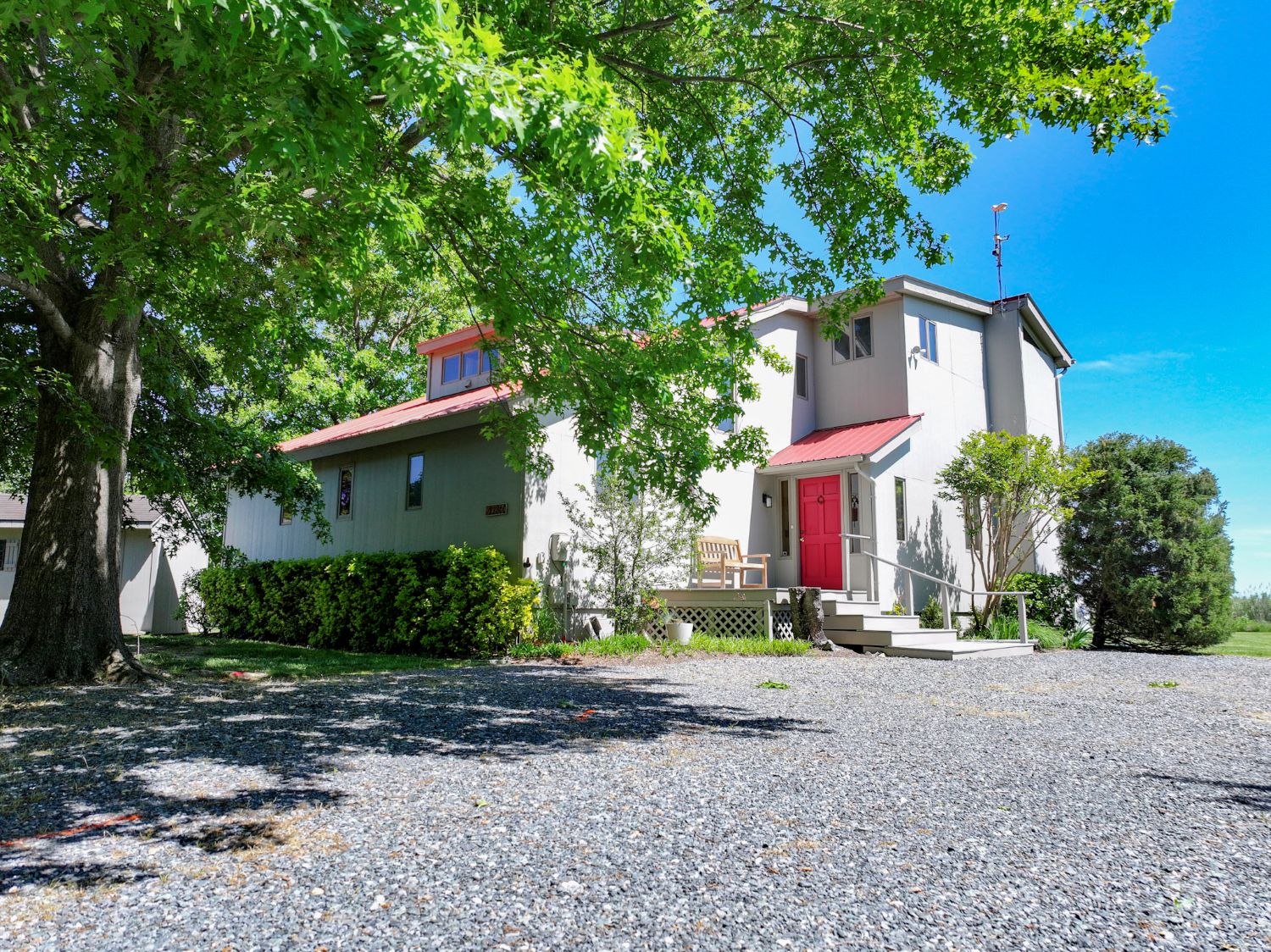
The red roof, bold door, and accents create a vibrant entry, warmly welcoming visitors into the home.

A welcoming front entry is crucial for a house that is for sale. As I walked up the steps to the front entry deck, I admired the deep aqua pot with red flowers and the bench accented by a striped, multicolored pillow. The other red accents, that symbolize welcome, of the door and the red roof created an entry that beckoned me inside.

Natural light pours into the foyer through sidelights and a central window, complementing the wood floors and pale yellow walls.

I opened the front door into a foyer with daylight from both the sidelights on either side of the front door and a window on axis with the interior French door that creates a vestibule and airlock. Opposite the front door is a long closet for family coats and another closet under the stair to the second floor. The wood floors and trim accentuated the pale yellow walls. As I walked down the hall, I glimpsed a view of the water through both an arched opening of the adjacent office and also the living room’s exterior wall of windows. 

Sloped ceilings and tiered windows add character and light to the cozy guest spaces.

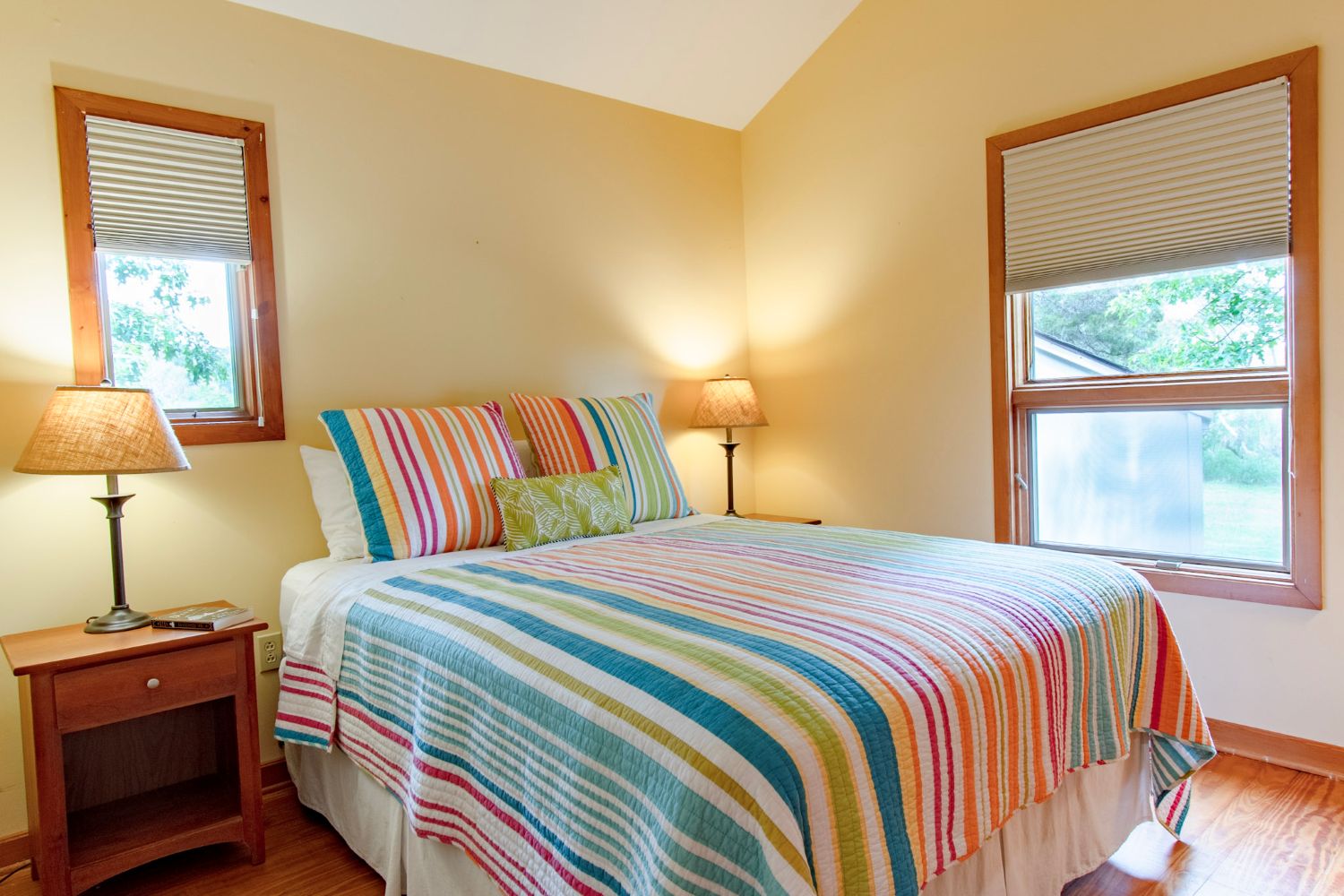
At the end of the hall a short hall leads to the guest suite at the front of the house. The bedrooms are compact but their sloped ceilings give them a pleasing spatial volume and the soothing neutral wall color is accented by the colorful striped bed linens. The side window has both a low operable window as well as a picture window above.

Thoughtful design, such as L-shaped cabinetry and glass shower walls, maximizes the functionality and openness of this shared space.

Between the two guest bedrooms is a large bath with “L” shaped  cabinetry that wraps around one corner. Placing the lavatory in the corner provides separate space for each guest’s  toiletries. The transparent glass shower maintains the spatial volume.

Visible roof beams and partial-height walls maintain an open, airy flow throughout the hall and living spaces.

The entry hall ends at the open plan kitchen-office-living room. The hall table is strategically placed for entertaining and the kitchen’s breakfast bar has a vista down the stair hall. I admired the lightly stained wood framing that frames the partial height wall between the adjacent office and dining room so the expanse of the exposed stained roof beams and decking is uninterrupted. 

The U-shaped design features granite countertops, airy shelving, and uninterrupted views.

The large “U” shaped kitchen has everything a  cook would want-plenty of counter space, an easy care floor finish, white cabinets, dark granite countertops, and stainless steel appliances.  I appreciated the lack of cabinets at the rear wall so windows could instead offer views of the landscape and water.

Stained sloped ceilings anchor this light-filled dining room surrounded by wrap-around windows and custom millwork.

The large dining room’s wrap-around windows and the sloped ceiling with stained exposed beams and decking create a stylish space for family dinners or celebrations. The bespoke millwork with glass fronted upper cabinets tucked into a recess in the room and the rattan backing of the dining room chairs maintain the transparency of the space. Windows on both exterior walls provide panoramic views of the landscape and water.

Arched shelves and open sightlines connect the office with the entry hall while framing views of the landscape.

The office ‘s interior wall’s rhythm of recessed arched openings infilled with open shelves has a full center opening that creates a “peek-a -boo” space to the entry hall. Cabinets below the arches provide ample storage for office supplies. Next to the desk at the rear corner of the space is a wall opening to the living room. Seated at the desk, one can enjoy views through the living room’s wrap-around windows. 

A bay window wall creates a focal point, framing water views while complementing the warm tones of the living room addition.

The living room addition with a rear bay-shaped wall infilled with long windows of picture planes above operable units for ventilation maximizes the vistas to the landscape and water. The room’s other angled side contains the fireplace and TV with shorter windows above more bespoke millwork.

The sloped ceilings and trio of large windows fill the serene primary suite with light and views of the landscape.

The stair to the second floor ends in a hall that contains to the primary bedroom, bath, laundry and a family room. The primary bedroom is tucked under the sloped roof with high knee walls that can easily accommodate a bed’s high headboard. A door in the knee wall painted to match the wall leads to eave storage. At the side wall, a vertical window containing a picture unit, ventilated unit and transom with a sloped top stretches from the baseboard to just below the underside of the ceiling.  

Expansive windows ensure waking up to tranquil Bay views in the light and airy main bedroom.

Opposite the bed is a trio of windows that offer views of the landscape and water. The light blue walls and white furnishings create a serene setting for sleep.

A trio of high-set windows provides ample light while maintaining privacy and adding symmetry to the bright, spacious bath.

The bath for the primary bedroom is located off the hall. The trio of windows provides ample daylight and their high sill height accommodates towel racks below and also eliminates the need for window treatments. The primary bedroom’s blue and white scheme extends into the bath.  

Wrap-around windows and deck access offer a seamless indoor-outdoor connection in the second-floor family room.

The house’s bonus room is this delightful family room, reached by additional steps from the second floor’s stair hall. The long pitched ceiling begins at the corner windows and extends past the dropped stained beam and ends at the rear wall of windows. The large closet is convenient for extended stay guests.

Built-in millwork blends seamlessly with wrap-around windows and sliding doors that frame breathtaking water views and lead to the angled deck beyond.

The notch in the family room’s side wall accommodates bespoke millwork without compromising the water view from the sitting area. This delightful room has wrap-around windows of both picture and ventilated window units for panoramic views of the landscape and water beyond. The neutral colors of the upholstered furnishings and blue accents create a great space for relaxing with family and friends. Sliding doors lead to the large deck with angled sides for panoramic water views. 

The ship-inspired angled deck and low-profile railings maximize water views, creating an outdoor oasis for relaxing.

My fave room was this deck off the family room with Adirondack chairs facing the tip of the angled deck that reminded me of the prow of a ship. The slender cap rail and horizontal cable lines disappear into the lawn beyond. With the south facing orientation, this outdoor room must be quite popular during the warm months. 

This waterfront retreat combines its close proximity to St. Michaels with its location in the  picturesque village of Neavitt. Carefully designed to maximize the expansive views of the Chesapeake Bay, the house’s compact footprint is seamlessly integrated into its natural surroundings. The contemporary architecture of sloped ceilings and wrap-around windows enliven the spaces with daylight, maximize the spatial volume and offer panoramic views of the landscape and the Chesapeake Bay. 

The compact floor plan is zoned very well with the first floor’s living-dining-kitchen spaces and guest rooms and the second floor’s primary bedroom, bath, laundry and family room. The outdoor rooms of  the terrace and gazebo, the first floor’s elevated deck and the second floor’ deck with its prow shape facing the water keeps one connected to the landscape and water. Nature enthusiasts would enjoy sightings of deer, eagles, foxes, geese, osprey and other shorebirds and water enthusiasts would enjoy the private pier to launch a boat for an afternoon on the water.  The property also has a detached shed for storage or a workspace. Great property for weekend or full time living!


For more information about this property contact Wink Cowee with Benson and Mangold at 410-745-0415 (o), 410-310-0208 (c) or [email protected]. For more photographs and pricing visit  www.buythechesapeake.com, “Equal Housing Opportunity”. 

Photography by Janelle Stroop, 845-744-2758, [email protected]
Architecture for the addition by Atelier 11,  www.atelier11architecture.com ,(410) 310-1385

Contributor Jennifer Martella has pursued dual careers in architecture and real estate since she moved to the Eastern Shore in 2004. She has reestablished her architectural practice for residential and commercial projects and is a real estate agent for Meredith Fine Properties. She especially enjoys using her architectural expertise to help buyers envision how they could modify a potential property. Her Italian heritage led her to Piazza Italian Market, where she hosts wine tastings every Friday and Saturday afternoons.

The Spy Newspapers may periodically employ the assistance of artificial intelligence (AI) to enhance the clarity and accuracy of our content.

Filed Under: 00 Post to Chestertown Spy, Design with Jenn Martella

Wine of the Week: Rosso del Veronese IGT

November 28, 2025 by Jennifer Martella
Leave a Comment

I hope everyone had a great Thanksgiving and safe travels!

This weekend at Italian Market we will welcome the annual return of another of my fave wines for fall, the Rosso del Veronese IGT ($35.75, 14% ABV) ) from the L’Arco Vivi di Luca Fedrigo, in the Valpolicella region of the Veneto. The winery is named for the “Arco di Giove”, the only one of seven arches dating from the 16th and 17th centuries that remain on the road to Negrar, near the winery. It is winemaker Luca’s link to his past and its image adorns his hand sketched wine labels. I thought the text “Merum ad Lapideum” might be a family motto but the Latin translation is only “a mere stone”. 

Rosso del Veronese IGT

The story of Luca Fedrigo begins with his meeting the legendary winemaker Giuseppe Qunitarelli. The winemaker’s granddaughter was a close friend of Fedrigo and she persuaded Quintarelli into giving Fedrigo a job on the estate. Fedrigo began working in the garden and soon more than flowers blossomed. Fedrigo then began an apprenticeship in the winery, under Quintarelli’s supervision. The two worked side by side with each other for more than ten years as Fedrigo absorbed Quintarelli’s passionate respect for the Veneto’s terroir, indigenous grapes and tradition.

In 1998, Fedrigo founded L’Arco by planting 2.2 hectares of vines that were surrounded by his father’s vineyards from the 1960’s. His cellar was in the basement of the old family home.  Fedrigo personally manages all aspects of sustainable production, including using natural yeasts and aging the wines in wood barrels from Slovenia. Fedrigo is a true artisan winemaker whose wines differ from year to year, depending upon the blends he uses to make the best wines he can. Testament to his vision is that his wines sell out year after year. 

Fedrigo’s Rosso del Veronese is a blend of 50% Corvina and Corvinone, 30% Rondinella,15% Sangiovese Grosso and 5% Molinara. It is fruit-forward with herbal aromatics, good tannin and acidity; pair with Piazza’s pasta or risotto with meat and/or mushroom sauces. Come join me Friday from noon to 5:45 or Saturday from noon to 4:45 to welcome back this delicious red wine!

Cin Cin,

Jenn


Piazza Italian Market is located in the Talbot Town Shopping Center at 218 N. Washington St, suite 23, in Easton, MD.

Contributor Jennifer Martella has pursued dual careers in architecture and real estate since she moved to the Eastern Shore in 2004. She has reestablished her architectural practice for residential and commercial projects and is a real estate agent for Meredith Fine Properties. She especially enjoys using her architectural expertise to help buyers envision how they could modify a potential property. Her Italian heritage led her to Piazza Italian Market, where she hosts wine tastings every Friday and Saturday afternoons.

The Spy Newspapers may periodically employ the assistance of artificial intelligence (AI) to enhance the clarity and accuracy of our content.

Filed Under: 00 Post to Chestertown Spy, Food and Garden Notes

Design with Jenn Martella: “Friendship House”, circa 1782

November 27, 2025 by Jennifer Martella
Leave a Comment

Originally the back of the home, the north façade of “Friendship House,” showcases pristine 18th-century Quaker vernacular architecture.

“Friendship House” is aptly named, for its original owners were members of the Society of Friends, or Quakers. In the mid-17th century, Quakers were encouraged to leave Pennsylvania and claim this part of Maryland for William Penn. in 1695, Pearce Lamb answered the call and built his house, “Lambs Meadow” in the Georgian Colonial style of that time.  

Native Americans sold him their finest farmland because Quakers had a reputation of religious tolerance and were also abolitionists. In 1858, one of Pearce Lamb’s descendants, James Lamb Bowers, paid a heavy price for his anti-slavery stance. He and the Free Black Preacher Harriet Tillison had been helping enslaved people escape via a network of other Quakers’ stations along the Underground Railroad. A pro slavery mob tricked James out of his house and tar and feathered him. Then they went to Chestertown and Harriet Tillison suffered the same treatment. The mob ordered the Lambs to leave Maryland and they relocated to  Camden, DE, until the end of the Civil War. James’ and Harriet’s valor is illustrated on a tile mural at the Harriet Tubman Museum and Education Center in Cambridge, MD. 

The Lamb Family also co-founded and constructed the Cecil Meeting House that was built next door to “Friendship House”. At that time, this area was part of Cecil County. The Pearce Lamb family later subdivided their farmland and several homes were built by their descendants, including this house that was built in 1782 by Daniel Lamb and his wife Harriet Bowers. Historians consider “Friendship House” to be one of the finest example of 18th century Quaker vernacular architecture on the Eastern shore, if not all of Maryland.  This north façade was originally the back of the house; the south façade faced a colonial road and that was the main access to the house.  

The stoop reflects 1792 expansions, marked by artifacts left by Harriet and Daniel Lamb, blending history with timeless colonial charm.

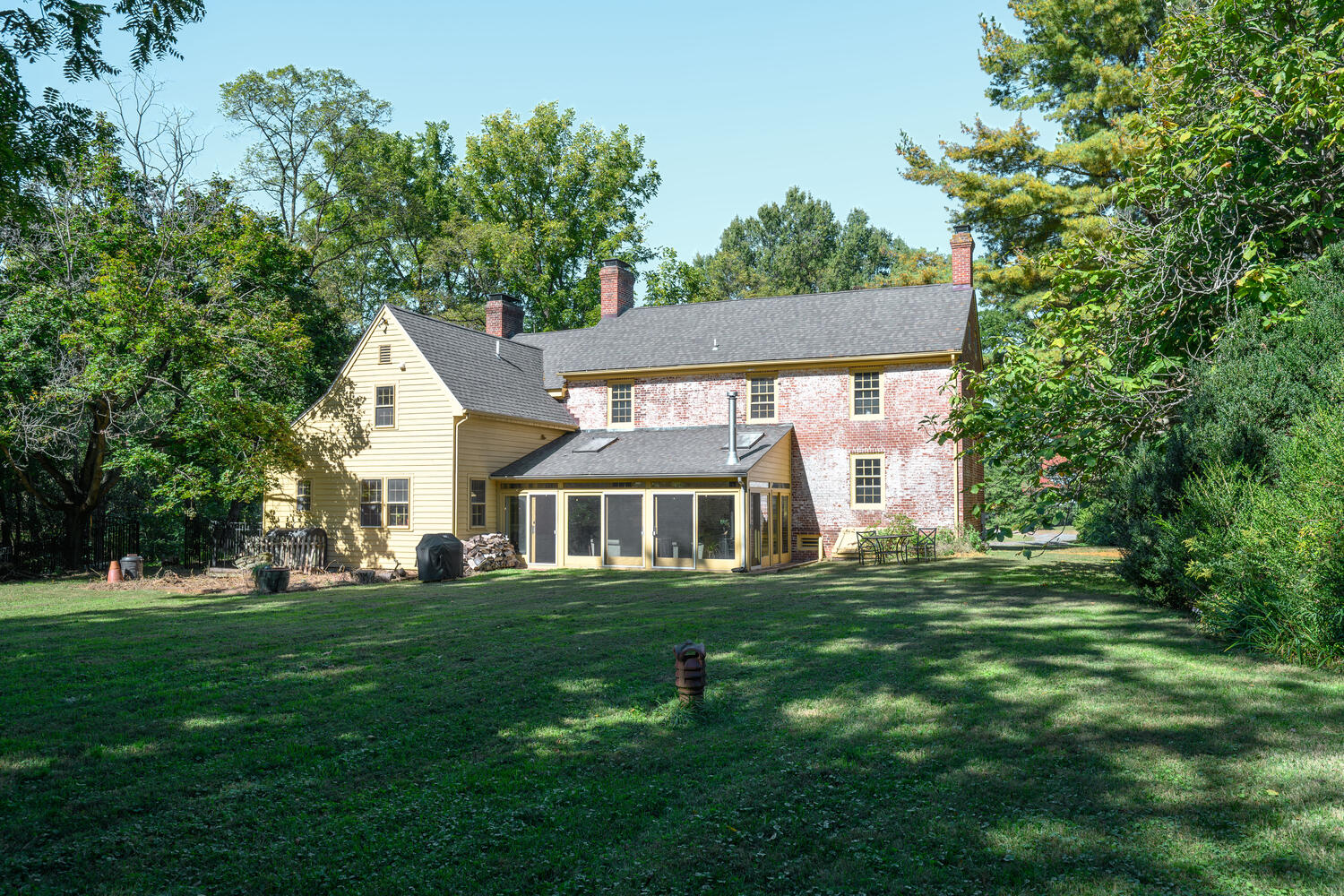
“Friendship House” began its life as a two story, one-bay kitchen with a dirt floor next to a two-story, one bay living room; each room had a fireplace on the west facing walls. The vertical line on this north side marks the 1792 expansion of the house that added a foyer and living room to create a four-bay, center hall floor plan. The bricks for the house were probably fabricated by brick makers who traveled the countryside seeking work during the time this house was built. 

Daniel and Harriet Bowers Lamb left clues about their house’s timeline. The initials “DL” on a date brick was salvaged when the original chimney in the kitchen was reconstructed in 1985. Between two windows in the attic, another brick inscribed with “H DL 1792” for Harriet Bowers and Daniel Lamb was discovered. The last clue was the discovery of “Harriet” signed on one of the ceiling beams of the second floor middle bedroom, by a young daughter named for her ancestor.

Dormers added in 1830 enhance symmetry and light while remnants of whitewashing preserve the home’s layered architectural history.

“Friendship House” endured an 1830 renovation when the next generations of Lambs preferred the Federal architectural style. Dormers were added in the attic to augment the side windows flanking each chimney; the house was whitewashed; layers of lathe and plaster were applied to the ceilings; doors were upgraded from plank to paneled styles; the windows were made taller and shutters were added; fireplace mantels were also updated to the current style.

I prefer the house’s look as it is today because it is in keeping with the earlier Lamb family members wish for their house to embody simplicity, domestic equality and function. I also like how remnants of the whitewashed period remain as they are both part of the house’s life and the facades are more interesting than a monochrome colored brick facade. 

The mid-20th-century additions complement the home’s massing, while restorations bring the historic south façade to life.

In the mid 1950’s, the house acquired modern necessities, including electricity and indoor bathrooms. The kitchen’s fireplace and chimney breast were removed for the kitchen’s redesign and a mud room was added at the south facing exterior door. The house entered a new phase of being a rental property for much of the rest of the century. 

In 1985, “Friendship House” was fortunate to have new owners, Reverend David LaMotte and his wife Liz, who oversaw the house’s restoration. They enlisted the knowledge, expertise and workmanship of artisans, architectural historians, and experts in restoration to restore “Friendship House to its 18th century appearance; an effort that lasted for many years and the house’s interiors today are the result of their herculean efforts. 

As an architect, I especially admired how the massing of the frame additions of the kitchen and the sunroom respect the existing house and the “Chestertown Buff’ color, chosen by the current owners is simply perfect. Prior to selling “Friendship House” in 2007,  the LaMottes renovated the kitchen. Unfortunately, the buyer was unable to keep the house up and the house was shuttered for almost ten years. The current owners came to the rescue of “Friendship House” when it was a short sale due to the sorry state of both the grounds and the house. The current owners slightly modified the kitchen but the majority of their focus was to save and update the house for the next steward of this exceptional house.

Pumpkin pine floors and a black walnut staircase reflect the home’s commitment to beauty and Quaker simplicity.

On the day of my tour with the Listing Agent, one of the Owners graciously joined us; due to his being an architectural historian, I could not have asked for a better guide. I am indebted to his passion about “Friendship House” and for sharing his research material with me. I admired the beautiful wood floors that I learned were yellow pine, sometimes referred to as “pumpkin pine ” because of the lovely color it turns into as it ages. I also discovered he and I share a passion for the Arts & Crafts movement, when I saw the exquisite umbrella stand in the corner of the stair hall. 

Both the front and rear doors align with each other for symmetry, ventilation and for vistas to the landscape from each door. Wide doorways lead from the stair hall to both the living and dining rooms. I admired the black walnut stair and its simple design in keeping with the simplicity of Quaker interiors.

Textures of paneled wood walls and ceilings highlight craftsmanship alongside the understated geometry of the stair design.

Before exploring the living and dining rooms, I walked past the wide doorways to both rooms to admire the simple geometry of the stair as it winds its way to the second floor as the Owner pointed out the pegs at the top of the stair’s newel post. I also admired the texture of the wood paneled walls and ceiling that is so much more interesting than an expanse of drywall. 

The hand-hewn Linden wood joists and Stickley settee enrich this historic room rooted in Tidewater traditions.

Like other Tidewater houses of the late 18th century, a thin wood wall separates the stair hall from the living room. The Owner pointed out the ceiling/second floor joists that were hand hewn from Linden wood, a species known for its long and clear grain. The Quakers added their signature beaded edge to the side edges of each joist as the joists were never expected to be covered. I coveted the Owner’s  Stickley settee, which he discovered at the Crumpton auction near Chestertown.

Exposed ceiling beams complement bespoke millwork around the fireplace, creating a space for quiet evenings and music.

Bespoke millwork flanks the working fireplace and the rhythm of the exposed ceiling’s stained beams creates charming interior architecture for one to read by the fire or listen to someone playing the grand piano.  

Wide doorways reflect Quaker egalitarian values, while custom tin sconces and paneled elements honor 18th-century design.

As I passed through the wide doorway into the dining room, the Listing Agent pointed out another historic clue, the patch in the SE corner of the room. This patch covered up the stair to the original second floor. Unlike most houses of this period that had a clear distinction between the dining room and the kitchen, the wide doorway to the kitchen reflected the Quakers’ belief in everyone participating in daily domestic tasks that was key to their integrated and egalitarian lifestyle. The simple interior design of the paneled mantel and adjacent cupboard were installed during the 1985 restoration by the LaMottes, after much research to find the best example for “Friendship House”. Custom tin sconces by John Ramsey’s Deep Landing Workshop in Chestertown are the finishing touches.  

Reconstructed fireplace features hand-hewn walnut mantel and brick remnants from the 1782 structure, preserving its historic essence.

Steps leading down from the dining room to the former kitchen give the family room extra ceiling height. The kitchen probably had a dirt floor and the owners did not find any evidence to the contrary in the 1985 renovation/restoration of this room. Its historic focal points are the fireplace, chimney and steep stair that are all conjectured reconstructions. Amazingly, the original bricks that had been discarded during the 1955 renovation were found in the wooded dell at the rear of the property, including the 1782 date brick, which now has a pride of place in the side of the chimney next to the bespoke millwork. A black walnut tree that was removed during the 1985 restoration and the construction of the kitchen and sunroom additions, now lives on as the fireplace’s mantel, proudly showing her hand hewn marks. I could easily be quite content sitting on the simple rocker by the fire in this exquisite room so filled with history!


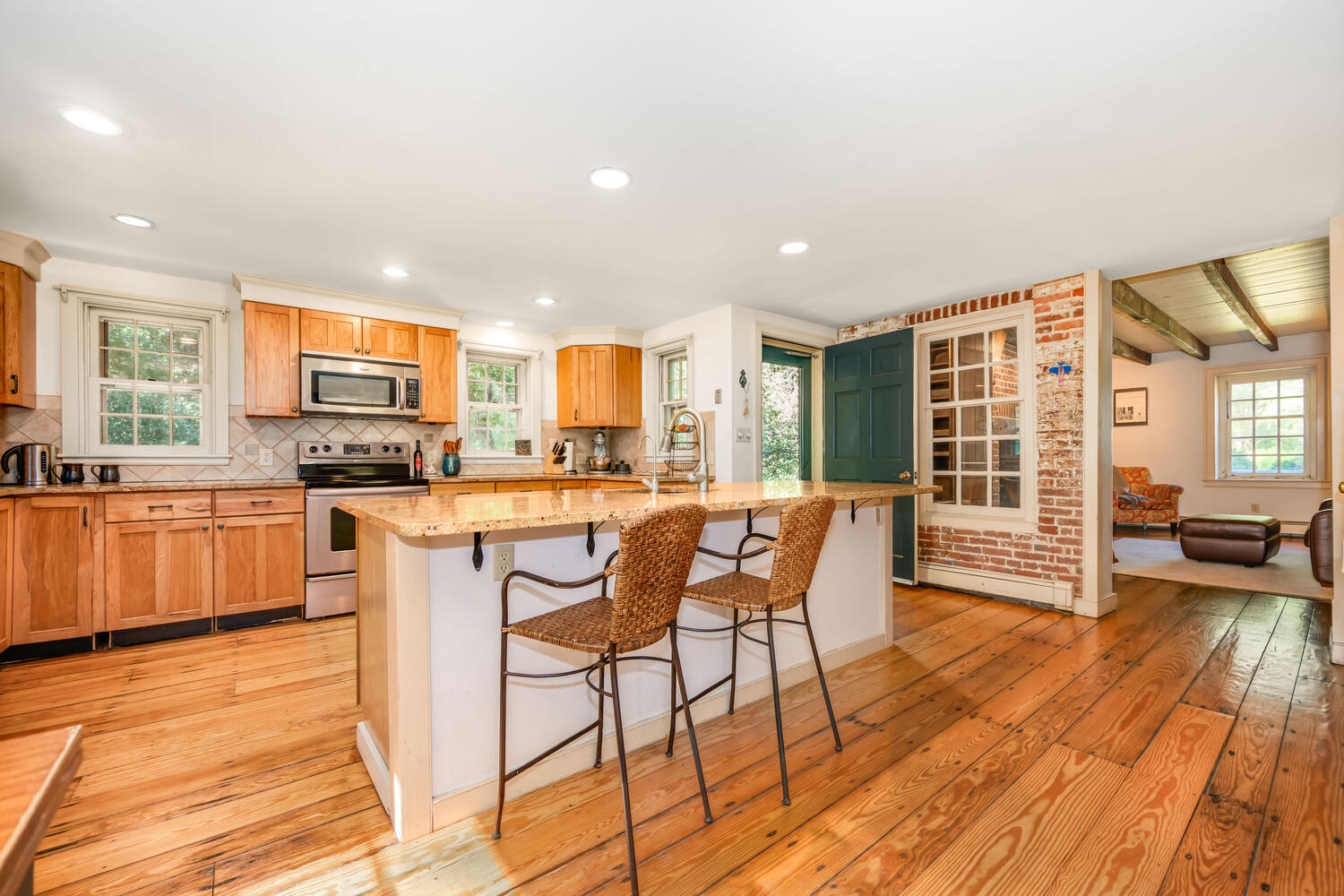
Craftsman cabinetry, granite countertops, and wide pine flooring anchor this updated kitchen in the home’s colonial history.

The addition of the spacious kitchen was designed for today’s lifestyle with an “L” and island arrangement. The exposed brick and window in the original exterior wall of the house grounds it to the history of “Friendship House”. The flooring of wide pine planks could easily be thought of as original to the house. I am quite partial to the simplicity of Craftsman style cabinets and they are befitting for a Quaker house too. The warmth of the wood cabinetry and the granite countertops that complement the color of the cabinet doors make the kitchen the hub of the house where everyone wants to be.

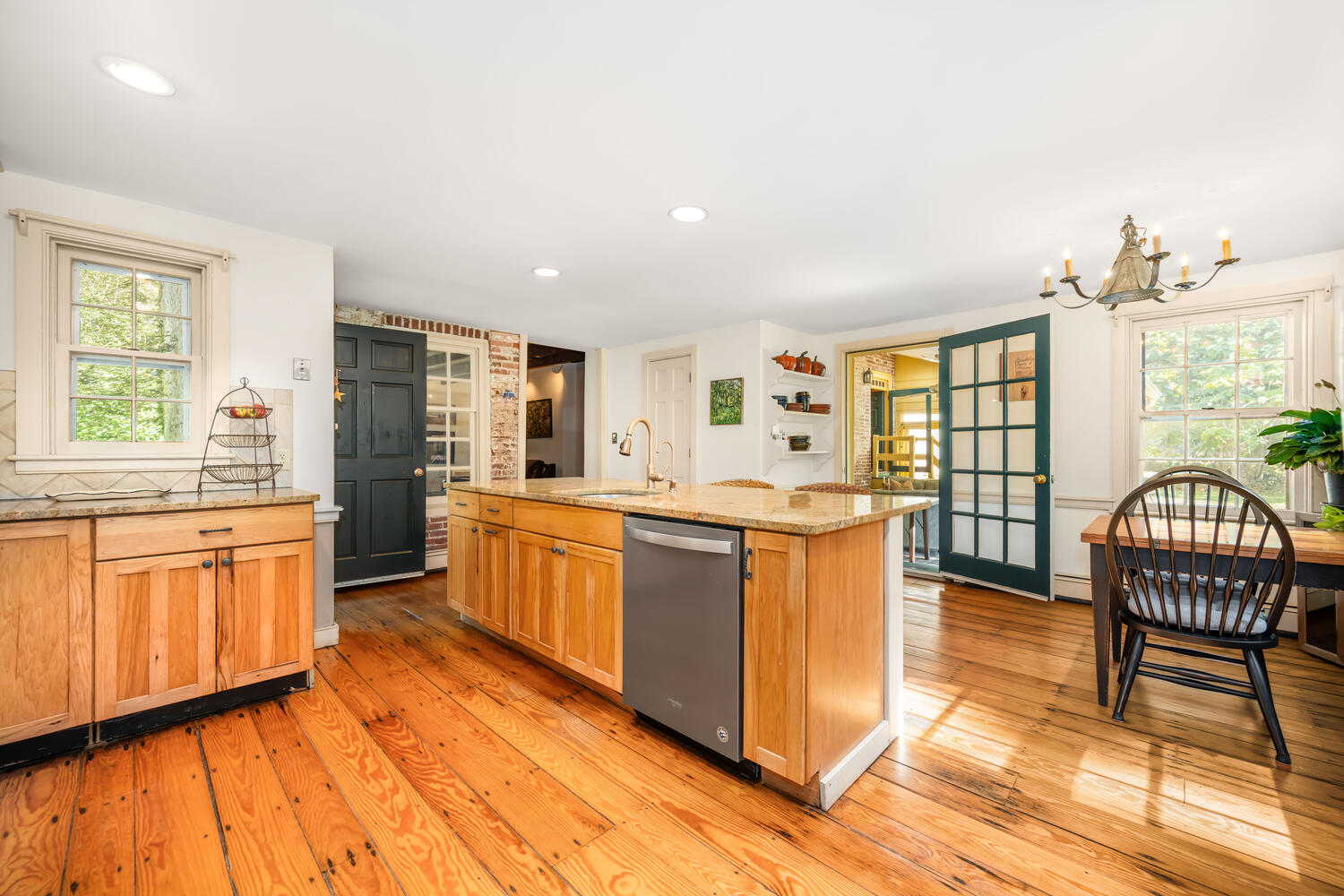
The repositioned sink and island promote modern flow, while wide counters offer space for casual dining and entertaining.

The current owners modified the kitchen layout slightly and one of their changes was to relocate the sink and dishwasher to the island. Now the cook is in center of the action and the island is a great buffet for entertaining or for perching on the bar stools to catch up on emails. 

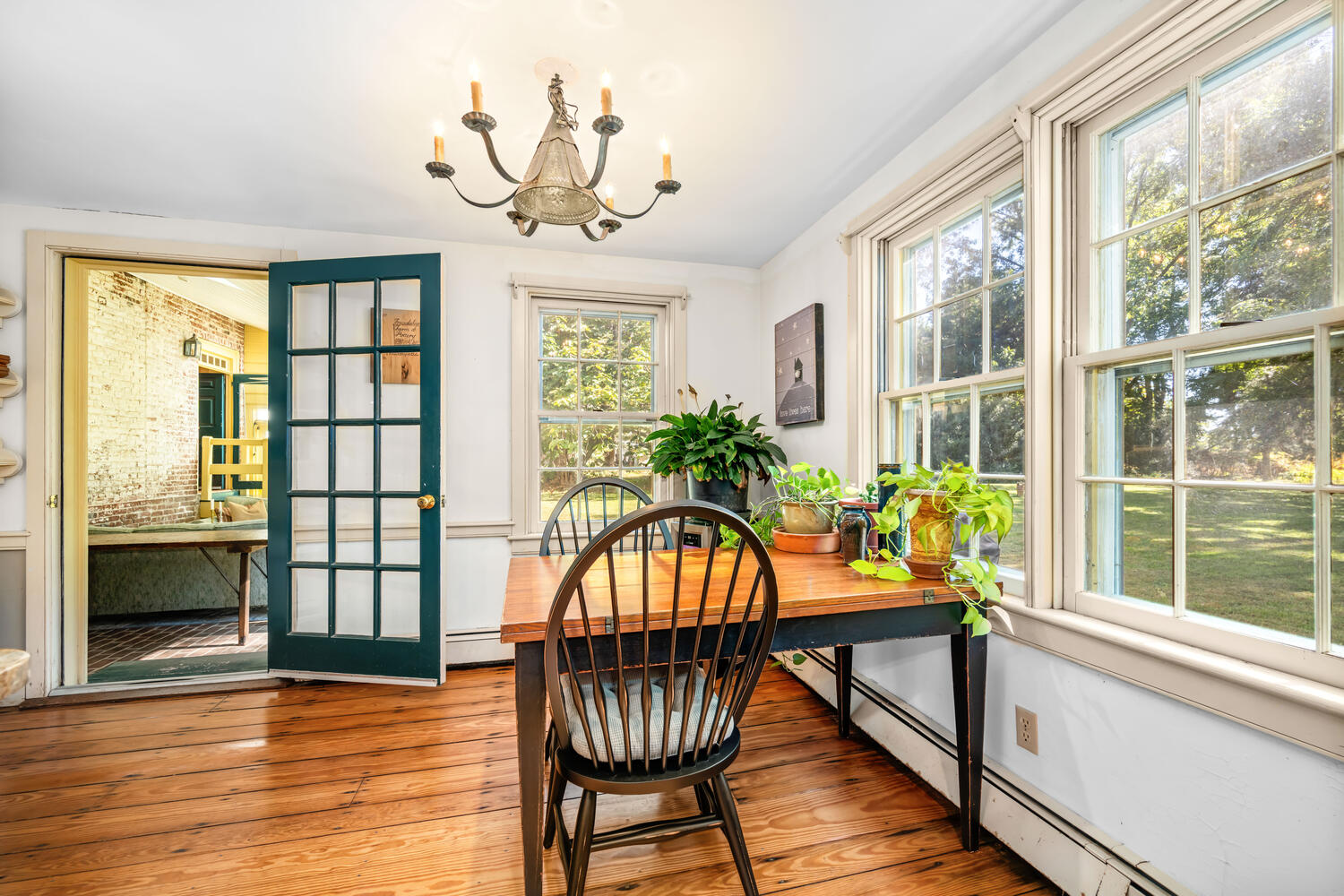
Bright windows and tapered table legs mirror the simplicity of Quaker design in this cozy breakfast nook.

The corner of the kitchen is a delightful dining space for breakfast or informal meals. Daylight steams in from the south and west windows for panoramic views of the landscape and the potted plants look very happy in this charming location. I admired the simple table design with its slightly tapered legs that match the color of the Windsor chairs and the table top that matches the floor color. Opposite the informal dining area, a discrete powder room is tucked against the side wall of the sunroom with a window to allow light to filter into the space from one of the sunroom’s skylights.  


The sunroom’s brick floor and skylights harmonize historic materials with abundant daylight and dynamic ceiling geometry.


The open French door in the informal dining area beckoned me into this exquisite  sunroom that spans across the stair hall and the dining room. I admired the space’s interior architecture with its sloped ceiling with skylights to augment the daylight/moonlight from the five pairs of sliding doors that embrace the space. The brick floor is the perfect transition from outdoors to indoors. The mix of brick sizes and colors on the wall was fascinating as it told the history of the house’s construction periods. 

The low windows whose sills are just above the floor look into the basement below that is accessed by steps from the family room. In the early days, the space was also used for cold storage and for a respite from the warm weather. The bases of the two chimneys end at the basement floor. Arched openings inside the chimneys both distribute the structural load and provide space for shelving to keep items cool since the enclosure of the thick brick walls maintained an even temperature (also worked well for wine storage too!)


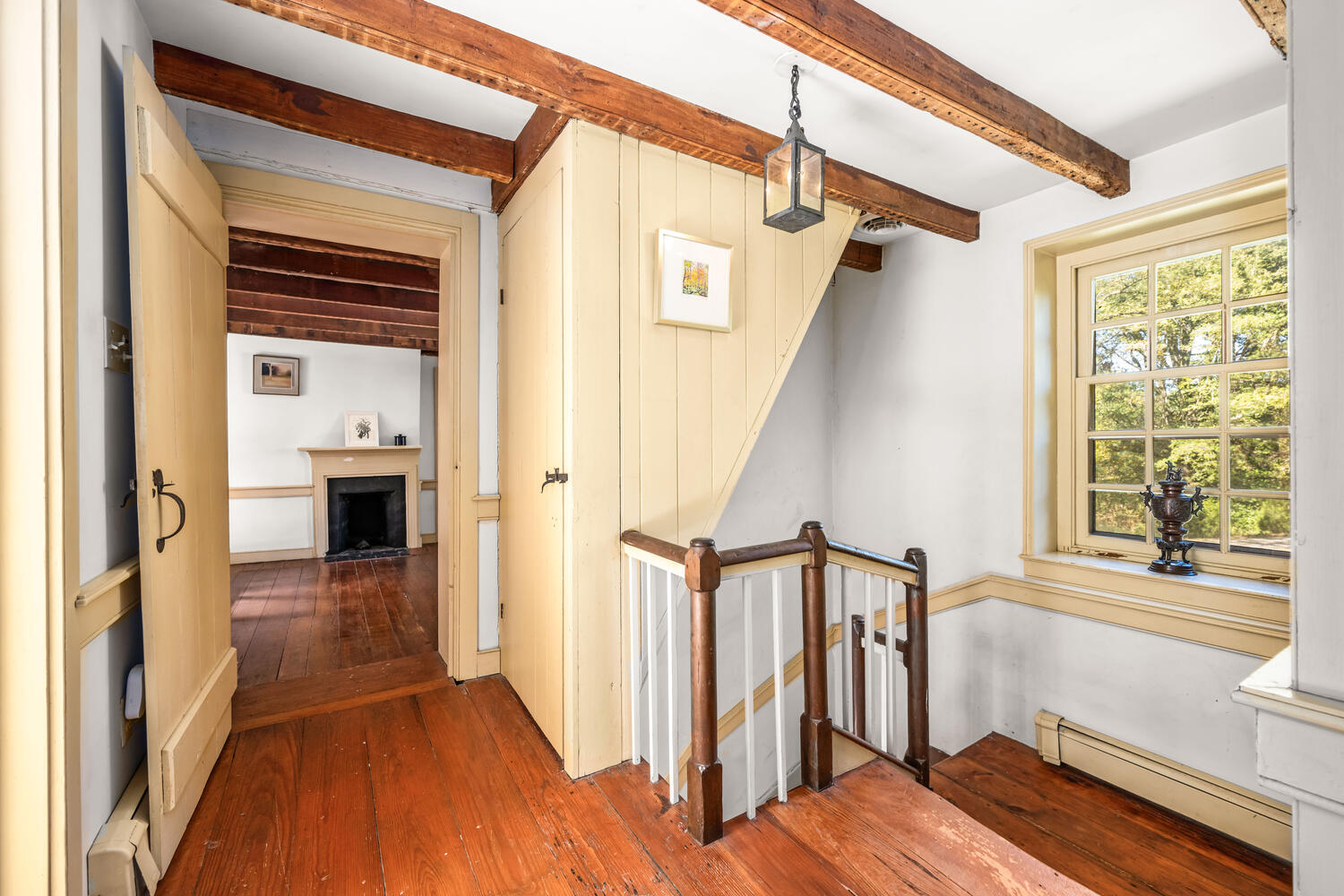
Period hardware meets discrete modern closets along the landing’s expanded hall connecting guest bedrooms above.

To begin my tour of the second floor, I went up the second set of steps in the sunroom that led me back to the stair hall. My hand glided over the walnut cap rail of the banister as I went upward to the expanded landing that blended into a short hall connecting the two guest bedrooms. Opposite the hall is a large bathroom serving both guest bedrooms. Closets with period hardware and paneling that replace historic armoires have been carefully inserted into the hall and both bedrooms. 


Exposed beams and rustic vertical paneling frame this inviting guest retreat, accented with handcrafted quilted bedding.


If I were a lucky guest, I would choose this charming room over the living room at the corner of the house.  The interior architecture of the exposed beams, accent wall of vertical paneling, and the beautiful wood floors and the quilt by Helen Maenner-Clark in the give and take pattern would be hard to resist!


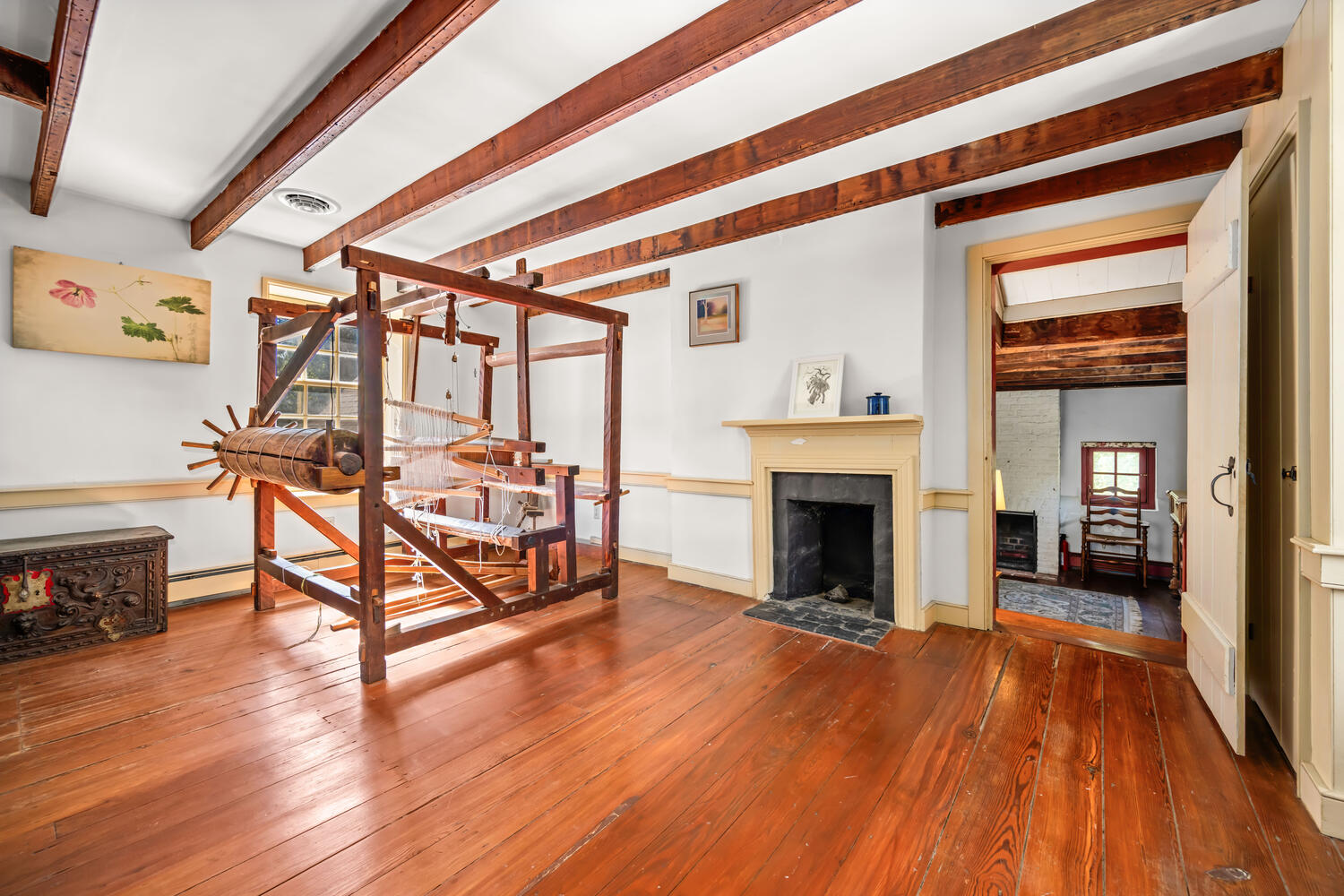
This expansive bedroom highlights a working loom and a fireplace while retaining original architectural clues and charm.

Across the hall from the corner guest bedroom is this spacious guest bedroom with its own fireplace. I was astounded to find this loom that is the size of a canopy bed and I learned it is very much a working loom for one of the owners. This room is accessed from both the stair hall and steps down to the primary bedroom, so it could have myriad uses. 

This room was once divided into two bedrooms. Near the door into the adjacent primary bedroom is another historic clue. Past the exposed beam near the door is an early cursive signature “Harriet Lamb” on another beam.  The architectural historian owner explained that is was common for children in the 18th and 19th centuries to mischievously add their signatures on walls and furniture; some homes show initials scratched onto the windowpanes!

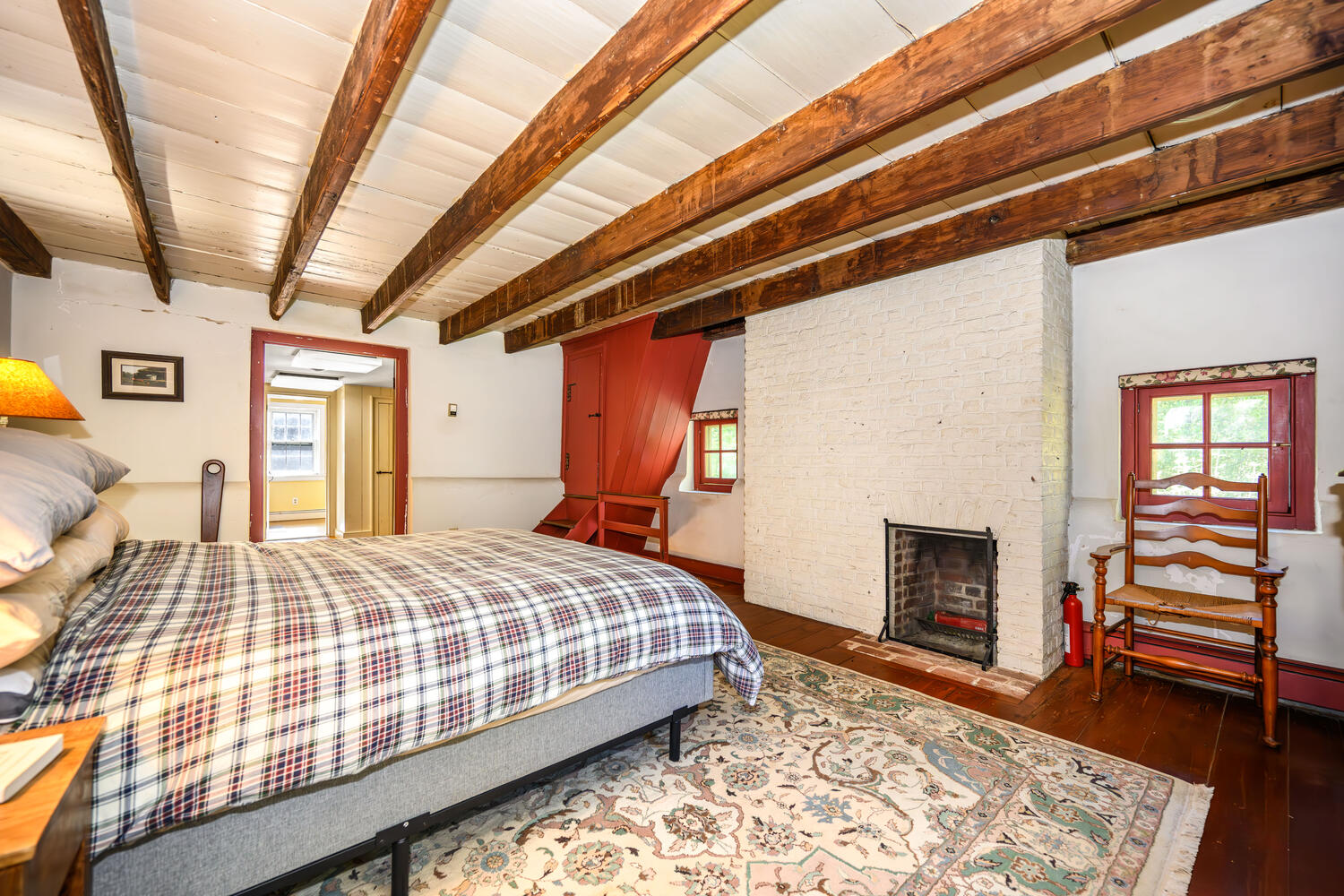
Exposed masonry walls and thick beams create a tranquil corner overlooking the property’s picturesque landscape.

The sumptuous primary suite is located at the other corner of the house and spans over the family room and the kitchen. During the 1985 restoration, the La Mottes left the exterior masonry walls exposed so the thickness of the wall can be appreciated at its depth creates a ledge when the  first floor wall transitions to the reduced wall thickness of the second floor’s wall due to the latter’s  lighter structural load. 

The room is bathed in sunlight from the rear south facing window and the two small windows flanking the chimney at the east wall. The textures of the exposed wood beams below the ceiling’s wide white decking and the colors of the rug, bedspread and the red enclosure for the stair to the family room below create a restful haven for sleep.


A clever multi-use space with historic details where Reverend LaMotte once crafted sermons at a desk by the window.

Between the primary bedroom and the primary bath is this spacious dressing room that also contains the laundry area and closets and storage under the eaves. The wood chest is located at the spot where Reverend LaMotte would sit at his desk to write his Sunday sermon.

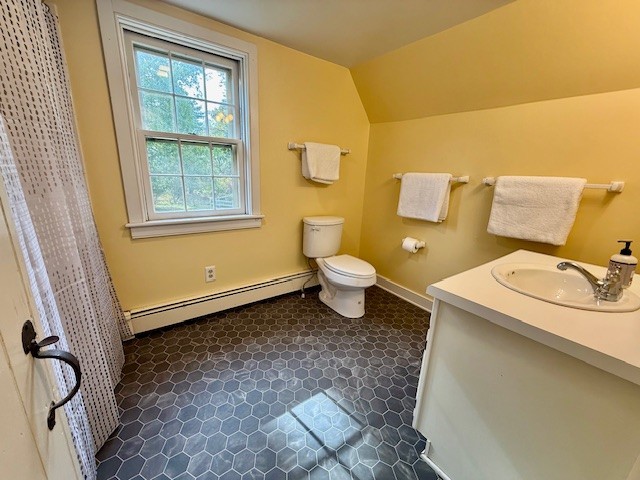
Vaulted ceilings follow the roof’s lines, framing bright gabled views amidst period-inspired cabinetry and warm tones.

Off the dressing room is a large bath with high knee walls and a ceiling plane that follows the outline of the gable roof rafters above to meet the bottom of the collar beam above. The yellow wall accentuates the fixtures and cabinetry. 


The 6.8-acre property offers lush paths, boxwood hedges, and a modernized studio barn that blends utility with heritage.

The property’s 6.8 acres offer peace and privacy with mature boxwood hedges, mature evergreen and deciduous trees, perennials that return in the spring  and wildflowers that bloom in the summer to add color to fallow pastures. Enjoy a daily stroll on the paths that meander throughout the grounds or sit and relax to savor the quiet, broken only by the songs of birds. 

The property also has a studio barn that is accessed by its own gravel drive and parking pad. The barn contains a two-bay garage next to a workshop that has its own access and has been updated with insulation and finished in drywall. It also has its high voltage electric, fiber optic internet lines, its own water system and a pellet stove for heat in the winter.

“Friendship House” mid 1898’s restoration that included installation of handcrafted oak windows and mahogany doors with period hardware has been lovingly maintained with materials and preservation sensitive practices by its current owners. They also installed new HVAC units, preservation sensitive insulation, professionally restored windows and two new wood stoves for a turn-key home that offers low maintenance for the next very lucky steward of this remarkable piece of Maryland’s historic residential architecture. As we celebrate Thanksgiving today, I thought it was fitting to feature a house that was built less than 100 years since the Pilgrims landed at Plymouth Rock that has been so magnificently restored-Bravissimmo!! 


For more information about this property, contact Liddy Campbell at TTR Sotheby’s International Realty, 410-673-3344 (o), 410-708-5433 (c) or [email protected]. For more photographs or pricing, visit  bit.ly/LiddyCampbellRealtor,  “Equal Housing Opportunity”.

Photography by Janelle Stroop, 410-310-6838, [email protected] 

The Author is indebted to both the Listing Agent and the Owners for sharing their treasure trove of historic documents and photos of the renovations of this property that certainly shows “Friendship” belongs on the National Register of Historic Places!

Contributor Jennifer Martella has pursued dual careers in architecture and real estate since she moved to the Eastern Shore in 2004. She has reestablished her architectural practice for residential and commercial projects and is a real estate agent for Meredith Fine Properties. She especially enjoys using her architectural expertise to help buyers envision how they could modify a potential property. Her Italian heritage led her to Piazza Italian Market, where she hosts wine tastings every Friday and Saturday afternoons.
The Spy Newspapers may periodically employ the assistance of artificial intelligence (AI) to enhance the clarity and accuracy of our content.

Filed Under: 00 Post to Chestertown Spy, Design with Jenn Martella

Wine(s) of the Week: Thanksgiving Trio 2025

November 21, 2025 by Jennifer Martella
Leave a Comment

Ciao Tutti!

This is the weekend before Thanksgiving so once again at Piazza Italian Market, we will offer a trio of wines for your consideration to accompany your Thanksgiving feast. For a gathering wine that could also accompany your turkey and cranberry sauce, , we suggest the “Timido”( $14.50, 12 % ABV);  from the Scarpetta Winery in Friuli Venezia Giulia; for a white wine we suggest the “Muni Larion” ($24.25, 12.5% ABV) from the Daniele Piccinin winery near Verona and for a red wine we suggest the “Bozner Leiten /Alte Reben ( $21.25, 12.5% ABV) from the PutzenHof winery near Bolzano in Alto Adige.  Since Thanksgiving is all about food and family, I have inserted pictures of the families or individuals who produce  their wines:

Scarpetta: ”Timido” Rose’ Vino Spumante Brut                                                            

Many years ago, Lachlan Patterson, former chef of California’s iconic French Laundry and Bobby Stuckey, Master Sommelier, fell under the spell of Italy’s Friuli-Venezia region tucked into the NE corner of Italy. Their dream of opening a restaurant whose cuisine would be based upon authentic Friulian recipes came true when they opened a restaurant Frasca Food and Wine, in Boulder, CO. The duo traveled to Friuli several times a year to discover local foods and recipes for their restaurant.

In 2007, the talented duo decided to create their own wine brand and christened it “Scarpetta” to immortalize the Italian name for the tiny morsel of bread left on one’s plate for soaking up the last bit of delicious sauce. Their Scarpetta brand began with 50 cases of old vine Friulano that was sold at Frasca Food and Wine. Their ultimate goal was to create a portfolio of affordable wines. The Friulano was a big hit with the restaurant’s customers who clamored for more Friulian varieties including their Rose Vino Spumante Brut. Patterson and Stuckey continue to seek  out partnerships with both established growers and celebrated oenologists that spotlight each grape variety. 

Their “Timido” is my fave go-to wine for aperitivi or brunch but many of Piazza’s customers serve this wine throughout their Thanksgiving meal since it pairs very well with cranberry sauce. I like Timido for its aromatics, flavors of honeysuckle and green apple with notes of melon, hazelnuts and melon. 

Perfetto for those of you who enjoy a sparkling wine throughout  your celebration!


Daniel Piccinin: Muni Larion IGT

In 2006, Daniele Piccinin left his career in the restaurant business to fulfill his dream of his own winery with the purchase of seven hectares in the Veneto. From the beginning, he embraced a natural approach to viticulture, and he soon discovered VinNatur, the 300 member organization representing 12 countries who share a common goal to “put the terroir of their homeland into a wine bottle, while making as little impact as possible on the environment and making a wine that is authentic and alive. His dedication to their principles resulted in his becoming the organization’s Vice President.

“Bianco Veneto” identifies this wine as a blend, but Piccinin wanted a name that better defined this special blend of 85% Chardonnay and 15% Durella grapes so he chose “Larion” since San Gioani Larion is the dialect version of the municipality where the winery is located . 

I like Larion’s rich aromas of ripe fruit and floral nuances, dried fruit and spicy notes, good structure and great acidity for food. 

Perfetto for those of you like me who want a white wine for your celebration!


Putzenhof: Bodzer Leiten Sudtirol Alto Adige Alte Reben DOC

Putzenhof’s story begins in 1956, when Johann and Viktoria Schweigkofler purchased the Putzenhoff estate. The road to the estate was arduous, the vineyards were old (“Alte Reben” means old vines) and had been neglected for years and the dilapidated buildings would require extensive renovation. 

What looked like a poor real estate investment to the untrained eye, to the Schweigkoflers, the property’s potential was worth the price. Instead of liabilities, they saw vineyards at the foot of a granite wall, (ideal for winemaking because granite’s high thermal mass and insulating properties naturally maintain cool, stable temperature and consistent humidity); slopes with southwestern exposure, good drainage and ideal climate conditions for winemaking. 

The third generation of the family, grandson Roman Mottironi, practices organic viticulture and manages the 5.5 hectares of vines and 1.5 hectares of apple trees on the estate.  Since 2009, Mottironi began bottling and labelling the wines made with the estate grown grapes. 

Bozner Leiten is 85% Schiava and 15% Lagrein-both Alto Adige indigenous grapes. I like Bozner Leiten for its fruity, intense nose, black cherry and violet notes, and its round and well balanced palate. 

Perfetto for those of you who want a lighter red for your celebration!

Cin Cin,

Jenn


Piazza Italian Market is located in the Talbot Town Shopping Center at 218 N. Washington St., suite 23, in Easton, MD

Contributor Jennifer Martella has pursued dual careers in architecture and real estate since she moved to the Eastern Shore in 2004. She has reestablished her architectural practice for residential and commercial projects and is a real estate agent for Meredith Fine Properties. She especially enjoys using her architectural expertise to help buyers envision how they could modify a potential property. Her Italian heritage led her to Piazza Italian Market, where she hosts wine tastings every Friday and Saturday afternoons.
The Spy Newspapers may periodically employ the assistance of artificial intelligence (AI) to enhance the clarity and accuracy of our content.

Filed Under: 00 Post to Chestertown Spy, Food and Garden Notes

Design with Jenn Martella: Sherwood Style

November 20, 2025 by Jennifer Martella
Leave a Comment

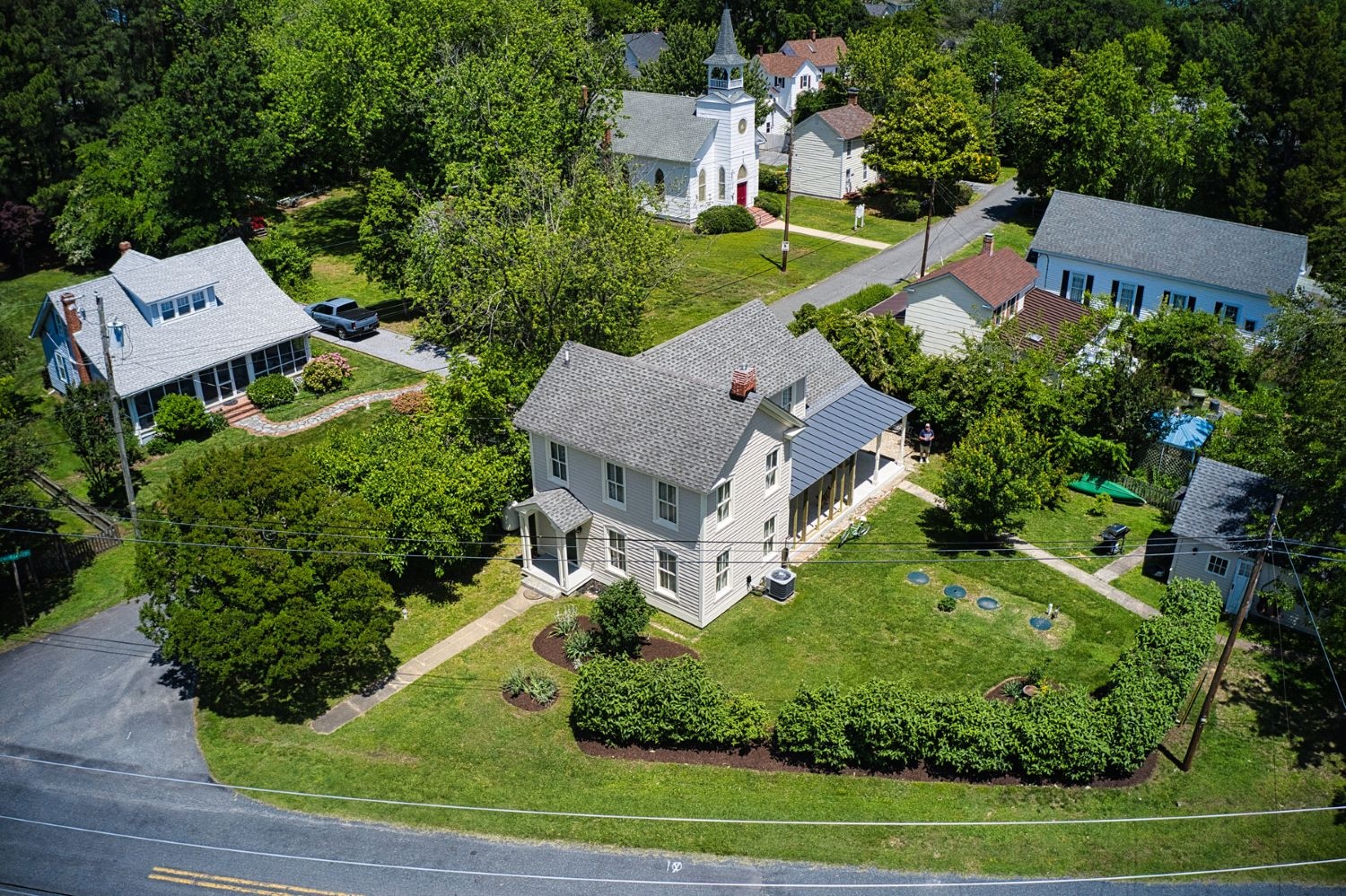
Sherwood’s historic village displays diverse architectural styles framed by mature trees and nestled around Harris Creek.

Sherwood’s historic village displays diverse architectural styles framed by mature trees and nestled around Harris Creek.

The picturesque unincorporated village of Sherwood between Tilghman Island Road and Waterhole Cove to Harris Creek was established in 1928 by developer William F. Cochran. He named the community for the legendary Sherwood Forest of Robin Hood and his Merry Men. The community’s Methodist Church is still active and is surrounded by charming cottages and larger houses of diverse architectural styles that, along with the mature trees, give the community its charm. I have featured several houses in Sherwood and it is always a pleasure for me to revisit this special place.

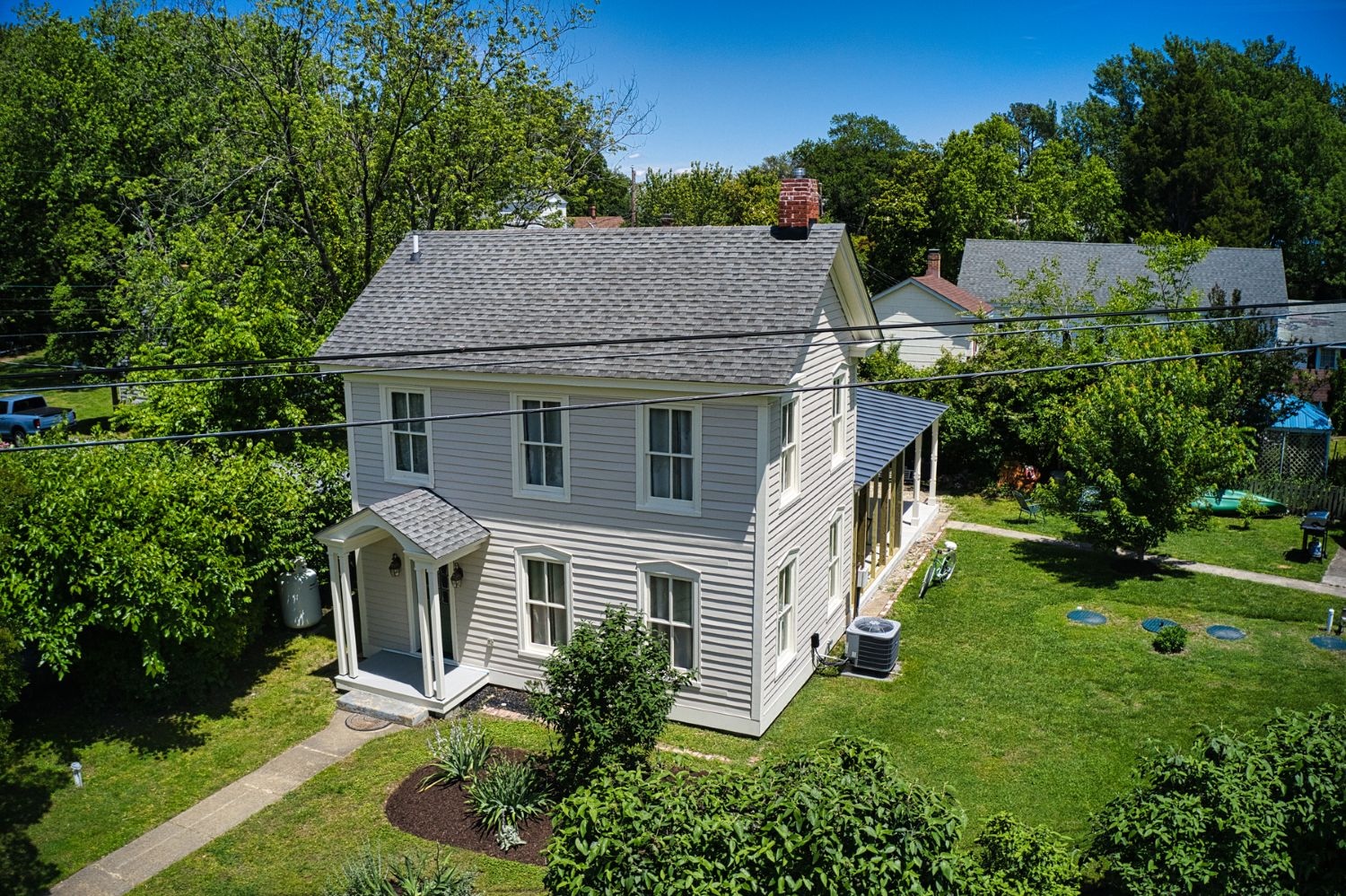
This corner-lot home balances farmhouse-inspired architecture with vibrant metal roof accents and thoughtful siting for yard space.

Today’s featured property sits on a corner lot with off street parking at the side street.  The house was sited as close as possible to the setback from the side street to create a larger yard on the other side of the house. The front façade’s stoop is covered by a pitched roof that adds both shelter and character to the house’s farmhouse vernacular architecture and the low slope metal roof over the side porch adds a splash of color.  

Privacy is achieved through dense landscaping while original wood siding restoration highlights period authenticity.

Privacy is achieved through dense landscaping while original wood siding restoration highlights period authenticity.

The house enjoys privacy from the dense grouping of tall trees and shrubbery along the side street. As I walked around the grounds, another dense row of viburnum becomes a natural fence along the curve of Sherwood’s main street for total privacy. I was quite impressed to see that the original wood siding has been both meticulously scraped and freshly painted as part of the owner’s meticulous restoration. In colonial and post-colonial architecture, window pediments were scaled down to become low-pitched headers for windows like these that are found throughout the Eastern Shore.  

The stepped massing flows to a porch featuring screened and open sections for seamless indoor-outdoor living.

The stepped massing flows to a porch featuring screened and open sections for seamless indoor-outdoor living.

The house’s massing steps down from the front two-story wing to the rear one-story wing. The side elevation facing the grounds opens up to the landscaping with a porch that is half open, half screened for great indoor-outdoor flow from both the kitchen door and the dining room’s pair of French doors. The soft neutral palette of the siding and trim makes the house seem larger than it is.  

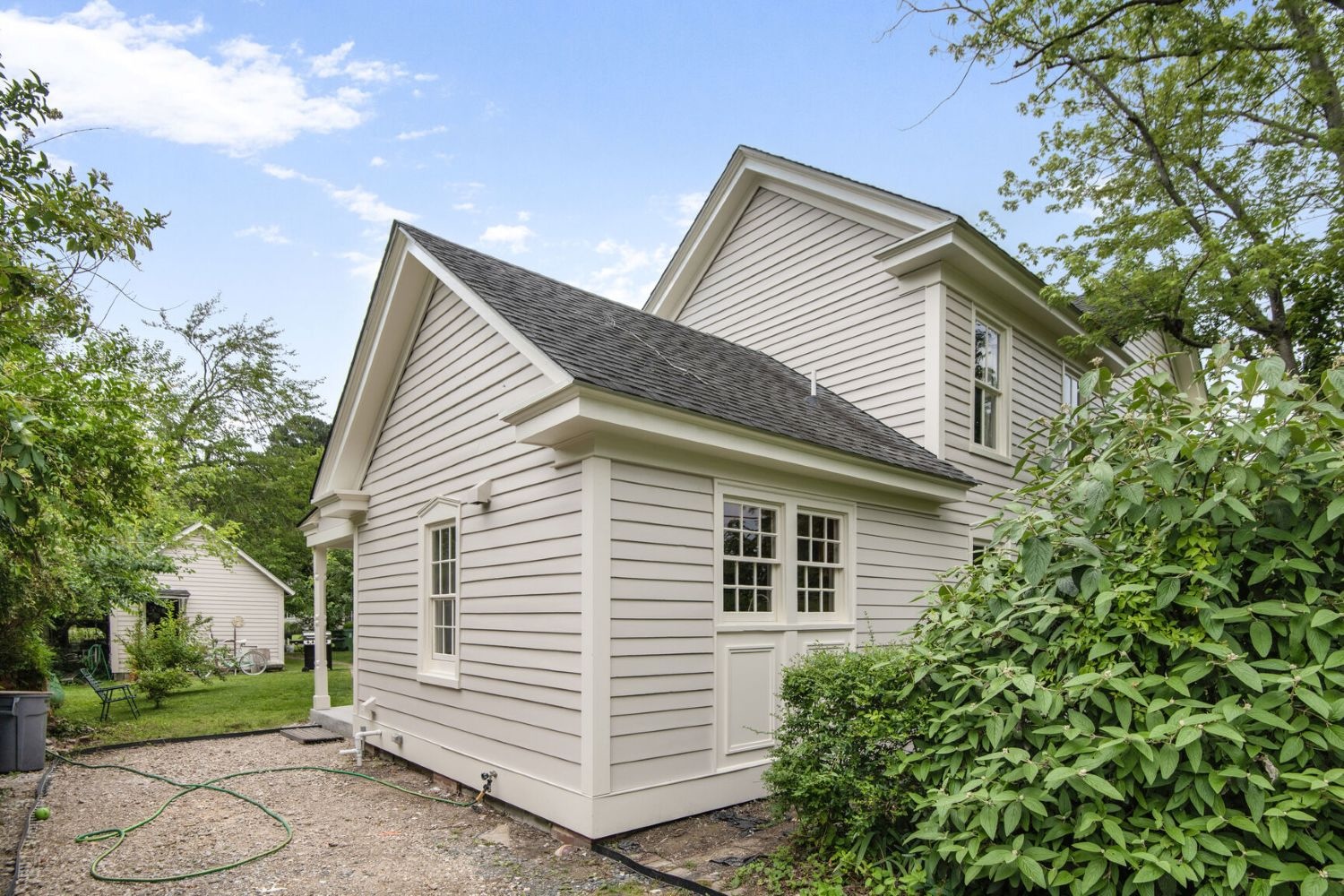
A versatile outbuilding complements the detail-rich rear elevation, including stylish window panels and skirt boards.

A versatile outbuilding complements the detail-rich rear elevation, including stylish window panels and skirt boards.

The side driveway ends at the open porch to the one-story wing of the kitchen. Beyond the lawn is an outbuilding that is currently used as a workshop for the house’s restoration; other myriad uses could be an office, studio, etc.  I admired the detail of the panels beneath the kitchen window-much more stylish than extending the lap siding below the window and both the corner and skirt boards are the perfect finishing touches.

Shiplap walls, ceiling molding, and timeless wood floors create texture and elegance in the compact living space.

Shiplap walls, ceiling molding, and timeless wood floors create texture and elegance in the compact living space.

I opened the front door to a foyer opposite the stair that is partially open to the living room. The large closet next to the stair defines the edge of the foyer. Beautiful wood floors and moldings that span across the ceiling and the accents of shiplap walls adds texture. The floor plan is compact so rooms flow into each other without halls. 


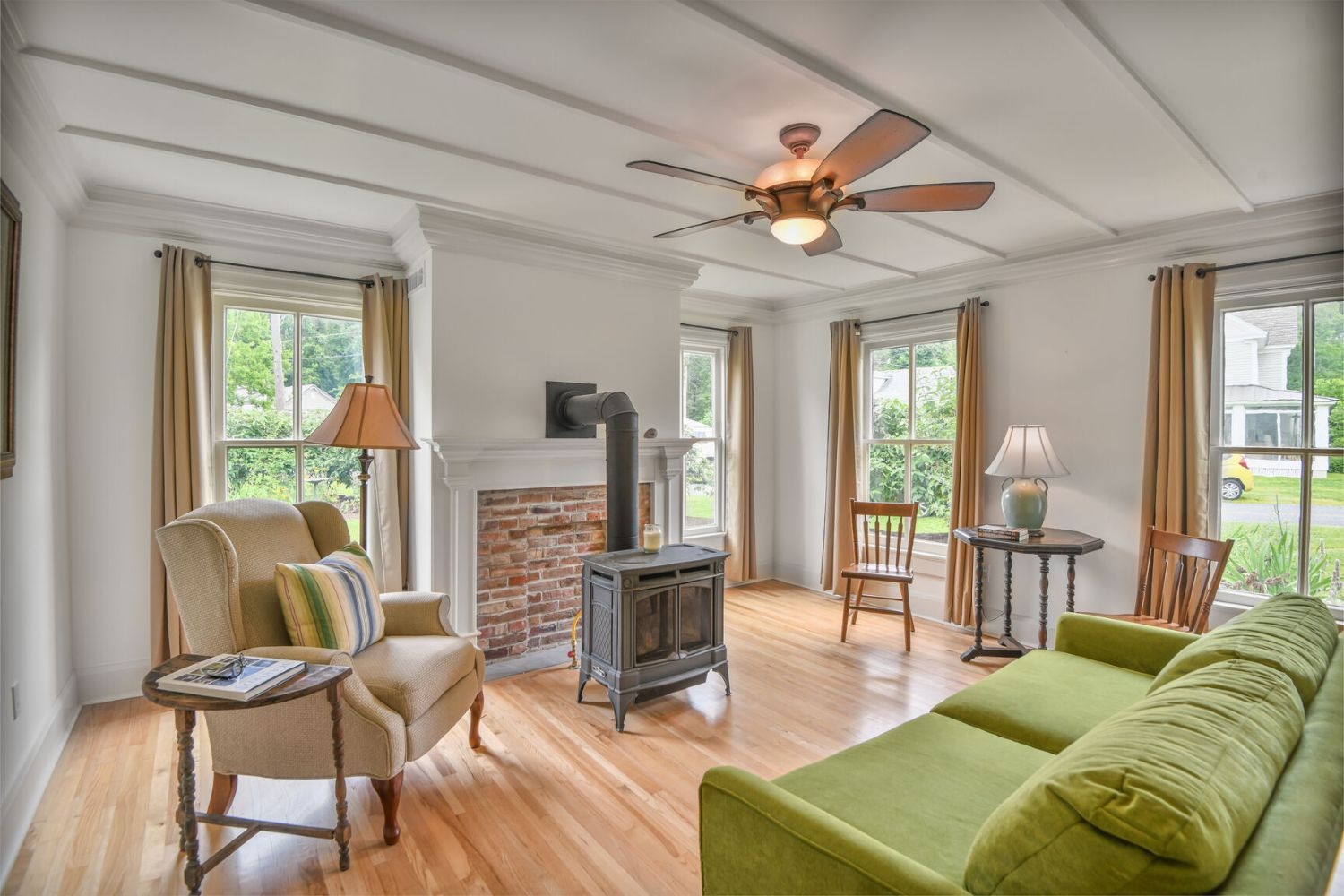
Tall windows infuse the living room with light, while the gas stove brings warmth to crisp autumn evenings.

Tall windows infuse the living room with light, while the gas stove brings warmth to crisp autumn evenings.

On the day of my visit, the sky was slightly overcast but the living room’s tall windows that rise to the ceiling flooded the space with daylight. In front of the chimney breast, a gas stove stands ready to take the chill off our fall nights.

Wide openings connect spaces, while long windows enhance the dining room’s serene views of private greenery.

Wide openings connect spaces, while long windows enhance the dining room’s serene views of private greenery.

A wide wall opening connects the living room to the dining room. The living room’s shiplap and ceiling molding continues around the chimney’s projection into the dining room and the wall of the full bath. Two long windows make window treatments unnecessary since the side yard’s dense evergreen and aucuba shrubbery provide privacy. I admired the artisanal wood table and the wood chairs that reminded me of Shaker simplicity.

French doors reveal a picturesque vista through the screened porch to the secluded garden beyond.

From the dining table, there is a long and serene vista through the screened porch to the private garden. Since the dining room is spacious, one could orient the table perpendicular to the French doors so all diners could have a garden view.

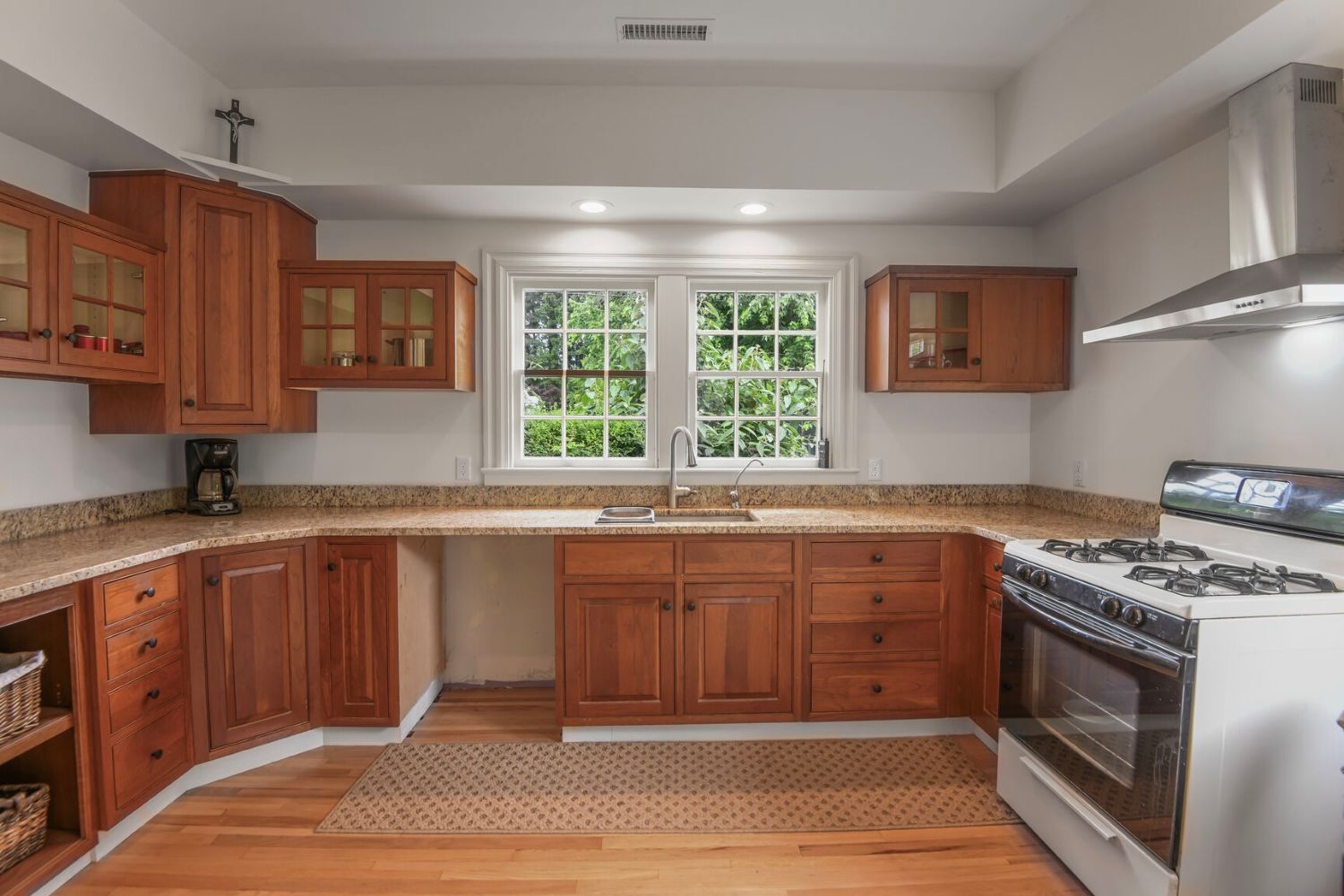
Thoughtfully designed with cherry cabinets and granite countertops, the kitchen opens to lush side yard views.

Thoughtfully designed with cherry cabinets and granite countertops, the kitchen opens to lush side yard views.

The kitchen’s cherry cabinets, granite countertops, stainless steel appliances pleased this cook and the wood floors add warmth. The double window unit over the sink has a view of the side yard’s dense foliage.

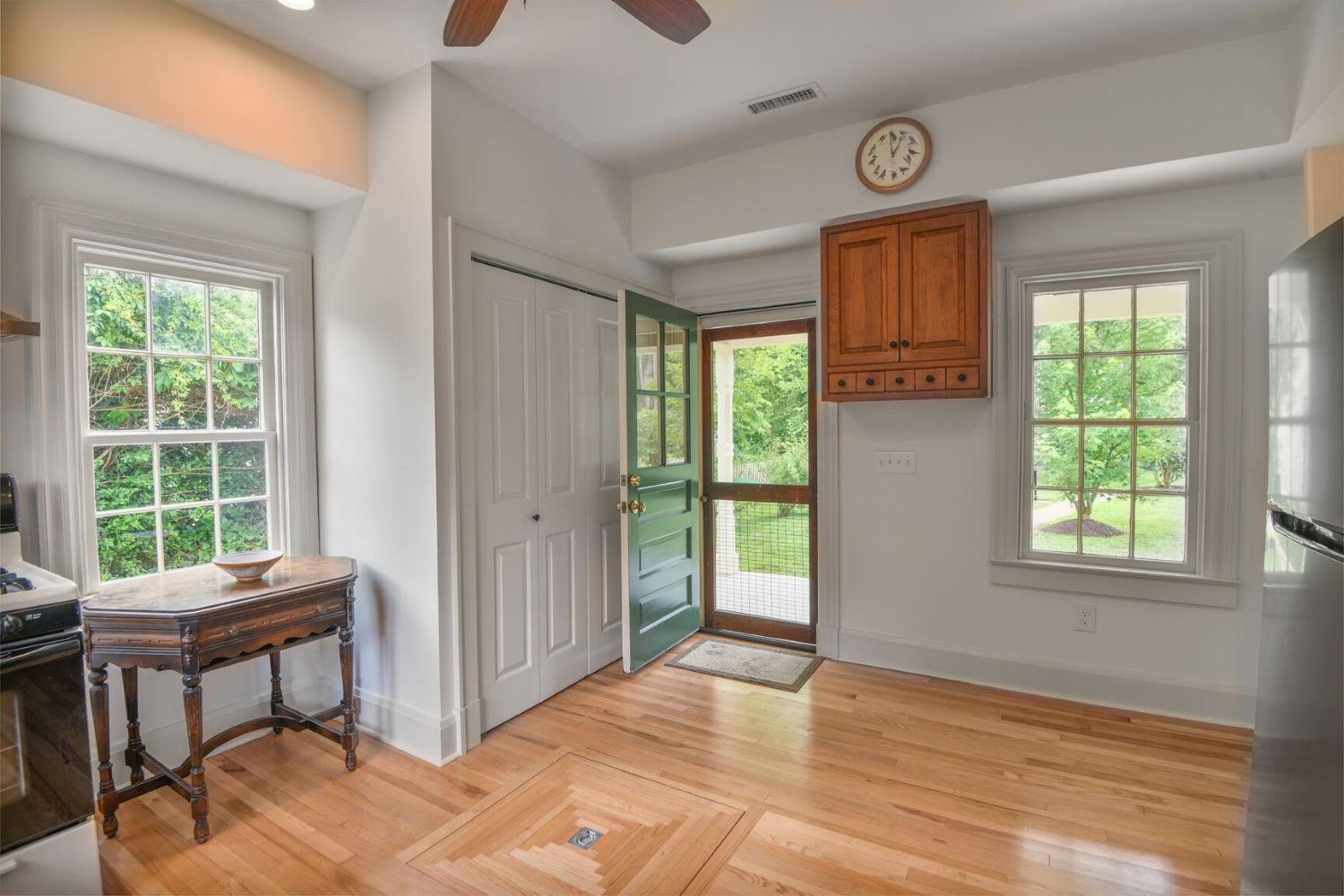
An exterior door leads to an airy porch perfect for al-fresco dining, complemented by vintage furniture and smart layout solutions.

The closet in the kitchen corner contains the washer and dryer which leaves space under the rear window for a small seating area to keep the cook company or a breakfast area. I admired the antique wall hung cabinet and the lovely antique table with angular sides under the side window. The wood square shape with a ring inset into the floor is the access to the encapsulated crawl space below. The exterior door leads to the open portion of the porch for al-fresco dining.

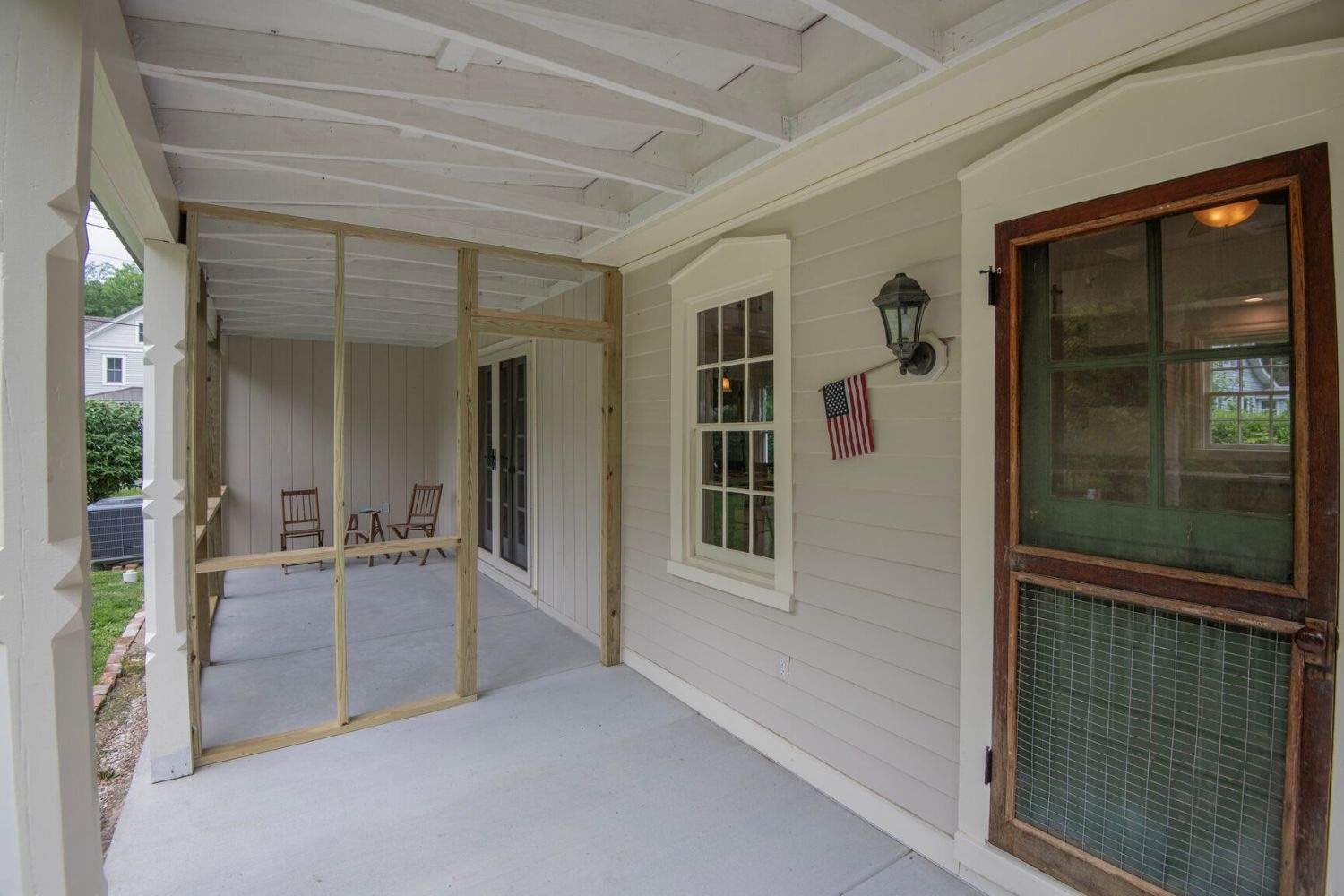
Open rafters and detailed columns enrich the porch, while separate screened and open spaces expand outdoor living opportunities.

Open rafters and detailed columns enrich the porch, while separate screened and open spaces expand outdoor living opportunities.

The porch is a delightful outdoor room with a wall separating the screened part at the dining room from the open part at the exterior door to the kitchen. The sloped ceiling is open to the roof rafters above and the rhythm of the sloped rafters and the horizontal beams creates a lively ceiling pattern. I especially liked the notched details of the porch’s columns. 


Shiplap detailing, exposed beams, and large windows shape the character of this inviting upper-level retreat.

Shiplap detailing, exposed beams, and large windows shape the character of this inviting upper-level retreat.

After exploring the main floor, I climbed the stair to the second floor whose layout includes a short hall connecting two large bedrooms with the hall bath. At the top of the stair, I looked back to the stair’s opposite wall that had an opening to the wall of the bath. This clever detail brings filtered daylight from the bath’s window into the stairwell. 

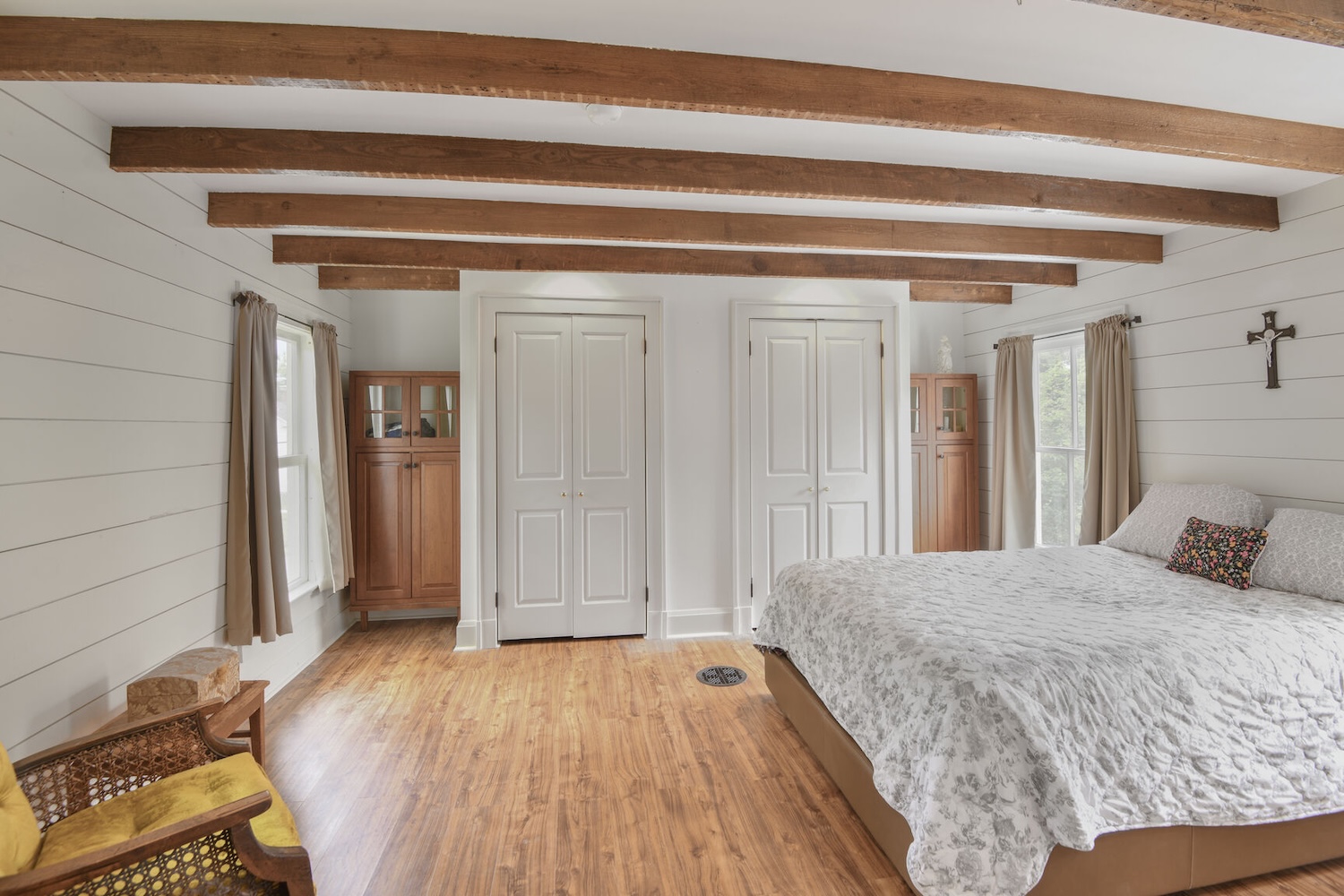
The primary bedroom is located above the dining room with windows on each side wall and the bedroom’s detailing of shiplap on the window wall, the exposed stained beams and the wood floors give the space character. 


Hand-hewn rafters and clever alcove storage preserve history while enhancing functionality in the primary suite.

Hand-hewn rafters and clever alcove storage preserve history while enhancing functionality in the primary suite.

The primary bedroom has ample storage from the two closets and the freestanding wood storage units in the alcoves. I especially liked how the marks on the underside of the original exposed rafters were not sanded down but left alone to show the hand hewn workmanship. 

A clawfoot tub and repurposed wood dresser bring distinct charm to the updated hall bathroom.

A clawfoot tub and repurposed wood dresser bring distinct charm to the updated hall bathroom.

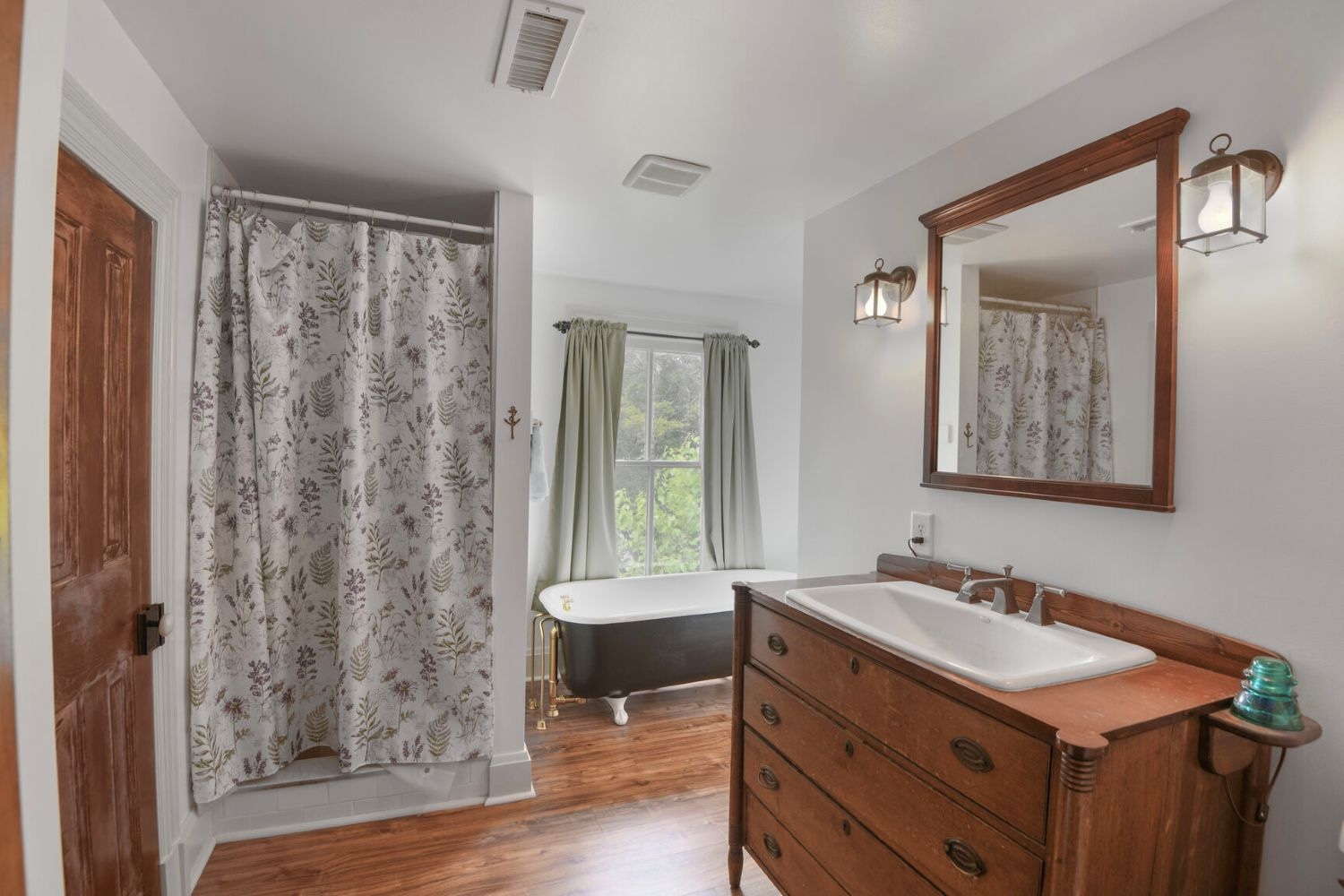
The hall bath has both a shower and a clawfoot tub and the wood dresser now has a new life as a lavatory cabinet. The vertical four-panel style wood door is typical for the doors that are original to the house. 

The community dock invites neighbors to gather and enjoy stunning sunsets over Harris Creek’s expansive views.

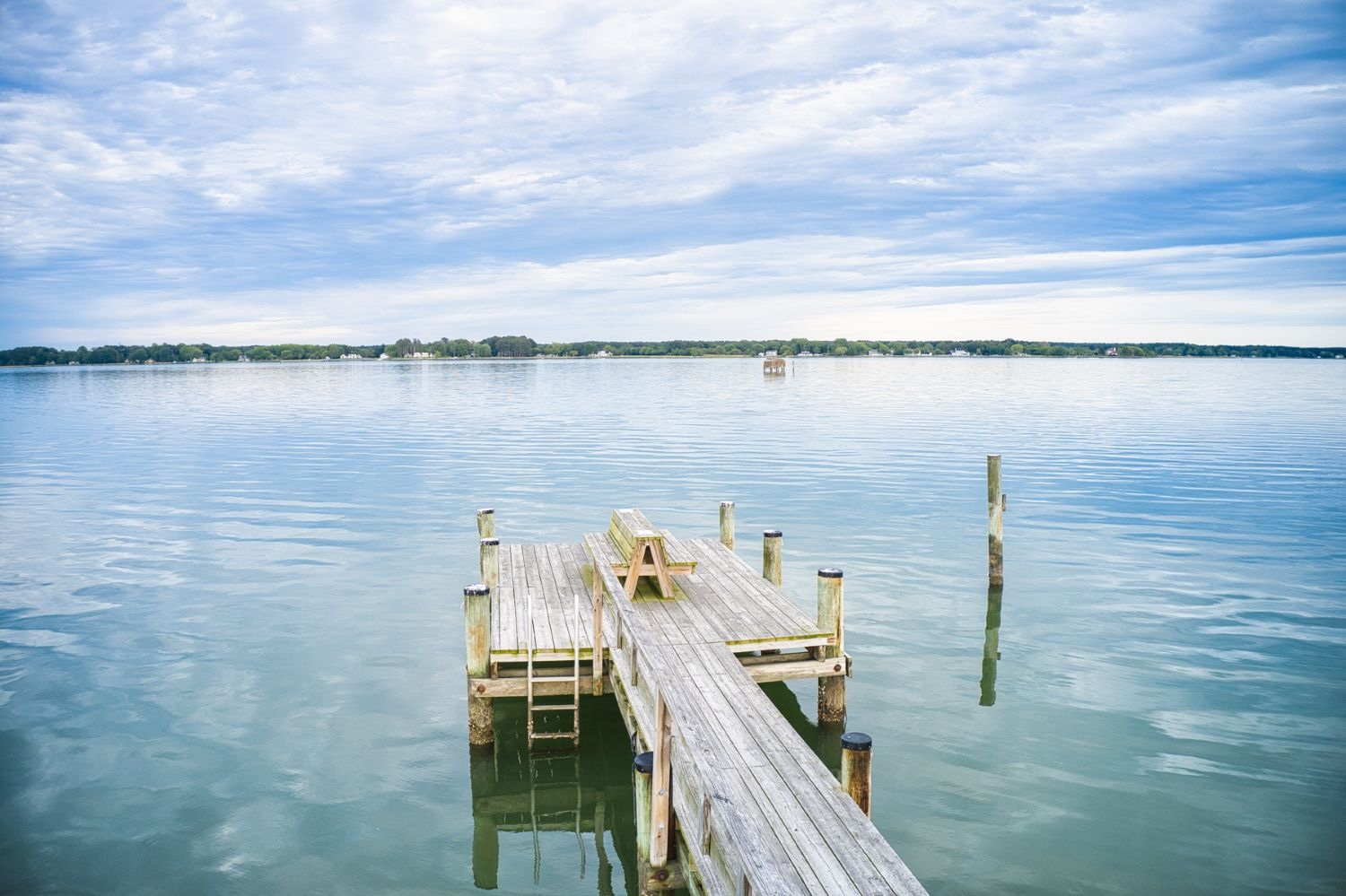
The bonus of living in Sherwood is the community dock with multiple slips, a floating dock and a kayak landing. The dock has become a neighborhood gathering space, especially in the late afternoon when neighbors gather to savor the expansive views as the sun sets over Harris Creek. 

Location, location, location-this charming Eastern Shore vernacular house on a corner lot in one of Talbot County’s most picturesque unincorporated communities is close to the both Tilghman Island’s and St. Michaels’ restaurants and attractions. The Community Dock is both for launching boats and kayaks, but it is also a neighborhood gathering space for “Merry Men and Maid Marians” to  watch the sun set over the wide expanse of Harris Creek. The house has been meticulously restored and lovingly maintained including updated kitchen and baths as well as an encapsulated crawl space, septic system with a new BAT system, new well, new Renai hot water heater and new HVAC.    The compact floor plan with minimal halls maximizing room sizes for furnishings. The outdoor room of the porch with both open and screened areas overlook the private back yard outlined by a dense viburnum “fence”. This move-in ready house would be a perfect weekend/summer home, first time home or retirement home. My compliments to the Owner for his design and construction work!


For more information about this property, contact Cornelia C. Heckenbach, Associate Broker at Long and Foster Real Estate, 410-310-1229 (c) or [email protected] . For more pictures and pricing, visit www.StMichaelsMdWaterfront.com,  “Equal Housing Opportunity.”

Aerial Photography by Robert Thayer, www.thayerfilm.com , 443-253-1716

 Interior and Exterior Photography by HomeVisit, www.homevisit.com ,703-953-3866

Contributor Jennifer Martella has pursued dual careers in architecture and real estate since she moved to the Eastern Shore in 2004. She has reestablished her architectural practice for residential and commercial projects and is a real estate agent for Meredith Fine Properties. She especially enjoys using her architectural expertise to help buyers envision how they could modify a potential property. Her Italian heritage led her to Piazza Italian Market, where she hosts wine tastings every Friday and Saturday afternoons.
The Spy Newspapers may periodically employ the assistance of artificial intelligence (AI) to enhance the clarity and accuracy of our content.

Filed Under: 00 Post to Chestertown Spy, Design with Jenn Martella

Wine of the Week: Langhe Nas-Cetta DOC “Anas-Cëtta”

November 14, 2025 by Jennifer Martella
Leave a Comment

Ciao Tutti!

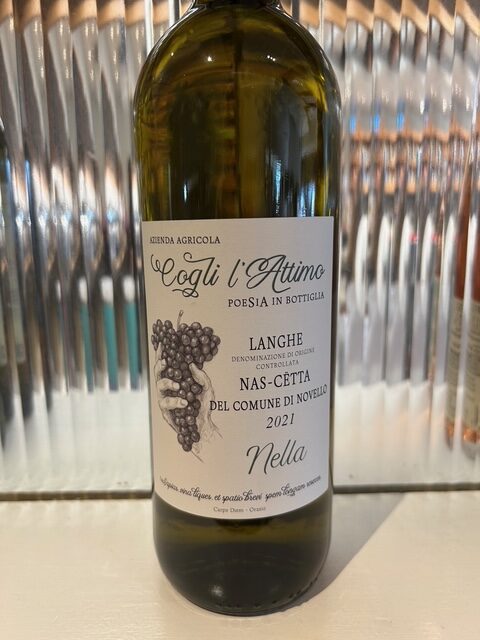
This weekend at Piazza Italian Market we will taste a white wine from the Langhe Nas-Cetta del Commune di Novello 2021 ($26.99, 12.5% ABV) from the Azienda Agricola Cogli l’Attimo in Novello, Piemonte. “Cogli L’Attimo” translates as “seize the moment”, which is a fitting phrase for how this wine has made its way to Piazza’s shelves. The grape’s name, nas-cetta, translates as “little girl is born” which is also fitting for a nascent winery as young as Cogli l’Attimo.

Vinitaly  is the leading international wine & spirits trade fair for exhibitors, buyers and wine lovers. Last year, Emily attended Vinitaly and her focus was wine from small scale producers, one of which was Serena Anselma, whose first production was in 2021.  She seized the moment and asked Emily for advice about breaking into the US market. Emily contacted one of Piazza’s importers, Doria Wines, who seek out artisanal winemakers. The brother and sister duo of Marco (Torino) and Cristina (DC) seized their moment and Marco visited Serena and now they represent Cogli L’Attimo!  The winery is a perfect fit with Doria Wines’ criteria of native grape varieties, sustainable farming, minimal intervention, and small scale production and winemakers who are personally involved from planting the vines to bottling.

Serena Anselma left her career of teaching languages to fulfill her dream of producing wine from her family’s old vineyards, whose grapes had previously been sold for bulk production.  In 2016, she founded her own winery on her grandparents’ land in Novello, one of the eleven municipalities that produce Barolo. Her annual production is small (about 15,000 bottles). Her winery may be less than ten years old, but it is firmly rooted in the ancient Langhe hills. She works with Sergio Molino, a renowned oenologist, to produce wines that are authentic native varieties since a great wine is dependent upon the quality of the grapes.

Cogli l’Attimo is a family business- Serena and her mother manage most of the vineyard tasks themselves and Serena’s father joins them on weekends for the heavy tractor work.  Currently, Serena produces Barolo cru Cerviano Merli, Nebbiolo d’Alba, Barbera d’Alba, Dolcetto d’Alba, Nas-cetta and one orange wine.

The native grape Nas-cetta almost disappeared, but has a new life thanks to its rediscovery by small producers in the municipality of Novello like Serena and her wine entered the market in 1994. Eight years later, it became part of the Langhe DOC. In 2010, the Langhe Nas-cetta del Comune di Novello DOC designation was created to recognize only one municipality, Novello, for the production of 100% Nas-cetta grapes.

I like Nas-cetta’s floral and fruity aromas and its vibrant citrus flavor. Pair with fresh seafood or risottos, white meat entrees with lemon and herbs, dishes with asparagus or fennel, goat or feta cheese.

Come seize your moment and join me Friday from noon to 5:45 or Saturday from noon to 4:45 for a taste!

If you wish to order a full case of a wine for Thanksgiving, we need to know by Wednesday 11-19 since our deliveries will occur on Monday 11-24 instead of our regular Thursday schedule. Our annual tasting of wines for Thanksgiving will be next week so stay tuned for our selections for this year!

Cin Cin,

Jenn


Piazza Italian Market is located in the Talbot Town Shopping Center, 218 N. Washington St., suite 23, in Easton, MD

Contributor Jennifer Martella has pursued dual careers in architecture and real estate since she moved to the Eastern Shore in 2004. She has reestablished her architectural practice for residential and commercial projects and is a real estate agent for Meredith Fine Properties. She especially enjoys using her architectural expertise to help buyers envision how they could modify a potential property. Her Italian heritage led her to Piazza Italian Market, where she hosts wine tastings every Friday and Saturday afternoons.

The Spy Newspapers may periodically employ the assistance of artificial intelligence (AI) to enhance the clarity and accuracy of our content.

Filed Under: 00 Post to Chestertown Spy, Food and Garden Notes

Design with Jenn Martella: Gobbler Hill circa 1858

November 13, 2025 by Jennifer Martella
Leave a Comment

65 acres of stunning landscape perched on one of Kent County’s highest points

This exquisite four parcel, sixty-five acre property is listed on the National Register of Historic Places and is located on one of Kent County’s highest points, at the intersection of two state routes near Chestertown. The two-story, five-bay wide, two bays deep, center hall plan was built in 1858, during the transition from Greek Revival to Italianate architectural styles. From its high vantage point, the house sits in a well maintained landscape of lawn, mature shade trees, woods, wild flowers, native prairie grasses and a large pond. The house’s shallow hipped roof is topped by a belvedere that offers stunning 360 degree vistas of the surrounding area.  

The reconstructed Doric columned porch and delicate “cyma recta” brackets honor the original 1858 craftsmanship.

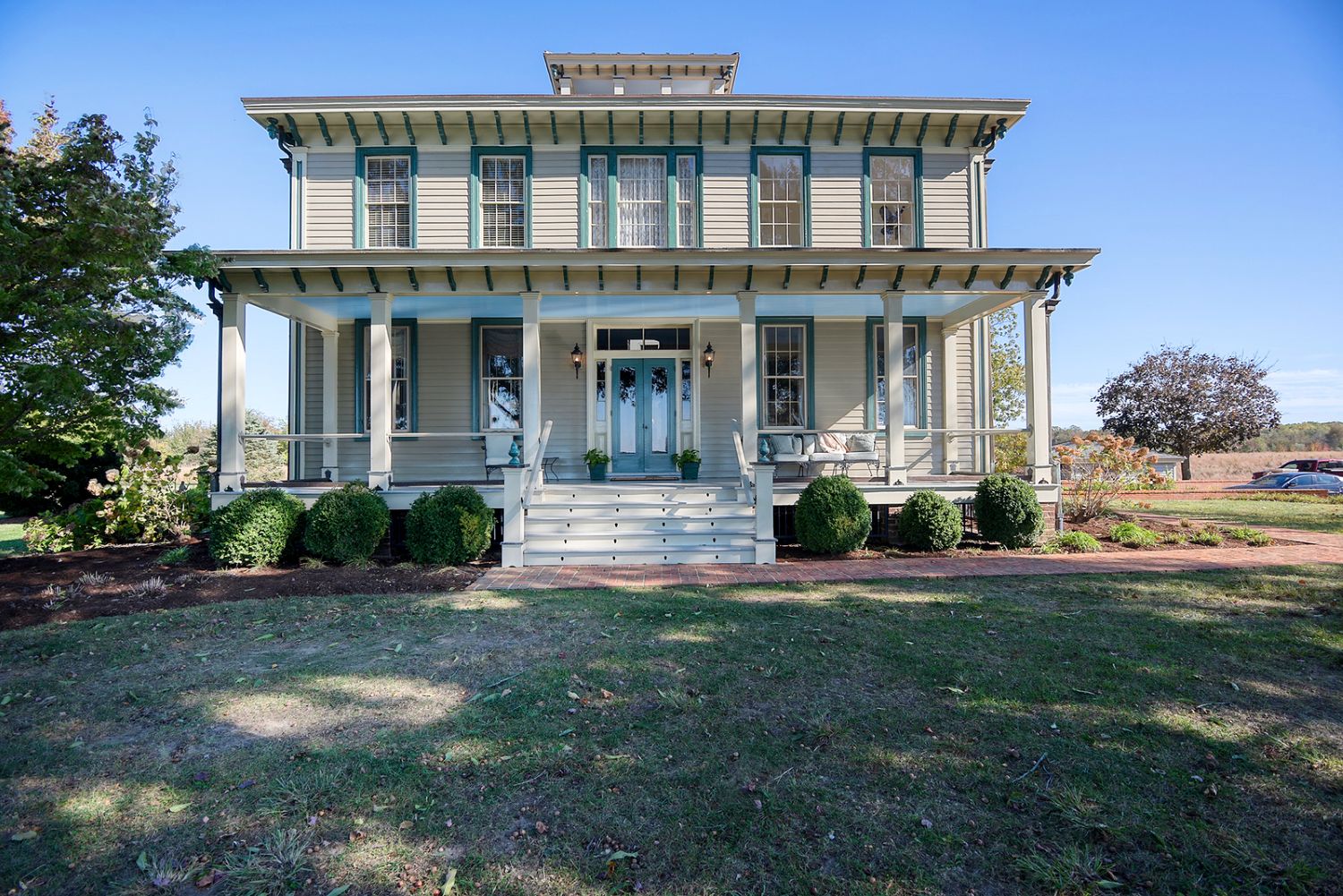
The original post and beam wooden clapboard house has a foundation of local fieldstone and brick. The cornice, porch beam and the belvedere are all embellished with “cyma recta” (S-shaped brackets with a concave upper curve and convex lower curve). I admired how the color of the brackets accentuated their form and echoed the color of the window trim, the front entry doors and the pilasters at each corner. 

The existing porch is a reconstruction that faithfully followed the original design by means of historic photographs and on-site archeological evidence. The Doric columns rest on copper capped brick piers and the center bay of the porch is wider than the other four bays to accentuate the entry doors, sidelights and full transom. The soft colors of the exterior walls and trim, with the accents of the blue trim and the compact massing creates great appeal.  

Details like acorn finials, carved bases, and beadboard ceilings add whimsy and historic charm.

In 1996, the porch’s full wooden handrail was replaced by a simple top and bottom rail for greater transparency. I lingered at the front porch to admire the details of the acorn finials atop the two newel posts at the end of the stair run and the sly and clever acorn cap shape that was carved at the bottom of each column’s base. (Every house should have a touch of whimsy for pure delight!).

I also admired how the doors and the long windows rise to the underside of the ceiling. The finishing touch is the light blue beadboard ceiling whose color the Gullah people of South Carolina believed could ward off evil spirits; it also had a practical reason since lime in the paint was a natural insect repellent.  

The stately foyer features original plaster walls, Lincrusta finishes, and a traditional uncluttered vista to the rear of the home.

When I entered the foyer, the interior design clearly evoked the influence of the house’ original historic period. The characteristic deeply embossed surface of the “Lincrusta” wall covering was invented in 1877 and this technique is still found in historic houses and restoration projects. The graceful “U” shaped stair’s design features thick balusters, decorative brackets and the flair at the bottom tread that meets the heavily articulated newel post. The ivory button atop the newel post signifies that the owners have no mortgage, a tradition that began in the 1930’s. I admired the eleven foot ceiling and the beautiful pine floors that flow throughout the original part of the house and the finishing touches of the period medallion and pendant fixture. Amazingly, the original part of the house still has plaster walls and ceilings.  From the front entry door, there is a clear vista through the original part of the house to the rear of the addition.  

Period-appropriate faux mahogany graining accents both the trim and moldings crafted painstakingly by the owners.

To the right of the foyer is the dining room, where the owners discovered the original mahogany faux painting on both the dining room’s window and door trim. They researched the 19th century formulas and reproduced this graining throughout the original part of the house. I also learned that the owners added the chandelier medallions and crown moldings that are period appropriate. The crown living room’s crown molding was the work of artisans from DC’s Monumental Plaster Moulding. The current owners carefully duplicated their profile of the crown molding for the dining room’s molding and crafted it themselves; clearly, this restoration/renovation was a labor of love for them. 

Preserved plaster walls frame this thoughtfully restored living room, complete with elegant French doors leading to the adjacent library.

To the left of the foyer is the living room; as in most restoration projects, the owners removed the exterior siding to add insulation and electrical wiring so the original plaster walls could be preserved. 

My fave childhood toy was a dollhouse so I was drawn to the firebox infilled with what I thought was a dollhouse, but I discovered it is actually a paper mache replica of the house that has its pride of place during the warm months in the firebox. The spacious living room accommodates a baby grand piano and ample seating space. French doors lead to the adjacent library for continuous circulation  through the house. 

Saltillo tile flooring, custom walnut millwork, and panoramic views create an inviting study space.

The library’s interior finishes include Saltillo tile flooring from Mexico, bespoke black walnut millwork by a local artisan woodworker and a paneled ceiling whose finish matches the millwork. The pair of wide doors and full transom offers a pastoral view of the landscape when one needs a respite from computer work. 

Gray and white checker tile flooring extends beneath a floating wood-paneled ceiling in the heart of the home.

In contrast to the original house’s historic finishes, the main floor of the addition at the rear of the house has light colored finishes and an open plan kitchen-informal dining and family room. The kitchen is the hub of the house and is accessed from both the foyer and the library. The light gray wood ceiling floats over the gray and white checkboard floor with a diagonal pattern to visually stretch the space. The stainless steel island and pot rack adds an industrial touch and is surrounded by white cabinetry whose upper cabinets rise to the underside of the molding. 

Light from the addition’s central skylight bathes the dining area and cleverly connects the original house with the new wing.

As I walked through the kitchen, the truncated “L” shaped open plan kitchen-informal dining and family room came increasingly into view. The dramatic informal dining area is open to the addition’s second floor “bridge” that connects the original part of the house to the addition. Above the bridge, a skylight filters daylight and moonlight below. (Skylights are a great way to get direct sun into rooms; rule of thumb is to calculate your floor area and then take 5% of the floor area for rooms with many windows and 15% for rooms with few windows). 

Centered in the space, the bridge also cleverly hides conduit for the pendant fixture over the table. The family room’s geometry is offset to create a cozy sitting area grouped around the fireplace with corner windows for panoramic landscape views.

French doors fold away to extend the family room into the screened porch for seamless indoor-outdoor living.

The larger area of the family room is designed for TV viewing. Two pairs of hinged French doors when folded back  to the screened porch create a warm weather indoor-outdoor-room for great flow between the rooms. This part of the addition has 8’-6” ceilings to create cozy spaces for relaxing with family and friends..

Thoughtful framing optimizes serene views of the pond and lush landscape from this cozy alcove.

The offset spaces of the screened porch create two sitting areas and the horizontal framing is positioned to maximize clear views of the landscape. The cushioned rattan settee with upholstered cushions in this corner area of the screened porch beckons one to relax, surrounded by pastoral views of the landscape and the pond beyond.  A pair of French doors leads to steps to the pool area.

A versatile outdoor room with spacious seating to enjoy uninterrupted views in the morning or evening.

The screened porch area adjacent to the informal dining area has two strategically placed chairs and a side table ( for morning coffee or an aperitivo, perhaps?) -a perfect spot to relax at the beginning or end of the day while enjoying panoramic views of the landscape.

Windows on dual walls provide natural light and picturesque landscape views in this tranquil corner suite.

To begin my tour of the second floor, I retraced my steps to the foyer stair. The second floor contains the primary ensuite, one guest ensuite, four other guest bedrooms, baths and the stair to the rooftop belvedere. The finishes of this spacious guest ensuite at one of the front corners of the house echo the historic colors of the original main floor rooms. The beautiful antique wood bed is positioned for views from the windows on each corner wall; the other corner wall’s windows flank a fireplace to create a welcoming sitting area. 

The bay projection adds architectural charm, while closets with mirrored doors expand the room’s geometry.

My fave guest bedroom is this charming room with a bay window projecting from the exterior wall. The window seat is flanked by two closets with extra storage above and the mirrors on the closet doors and the neutral color palette expand the space. The finishing touches of blue accents, the contemporary Chevron pattern rug and the furnishings create an serene retreat for any guest.

Panoramic corner windows frame uninterrupted vistas of prairie grasses and the pond for reflection or work.

This office/guest bedroom is located at the offset in the rear of the addition that steps back to the primary ensuite that creates corner windows for this room. From both the workspace area and the cushioned Craftsman style chairs, the panoramic views of the landscape unfold.   

The floating wood lavatory and vessel sink highlight innovative design while maintaining spatial flow.

This guest bath was my fave one for both its wood lavatory and vessel bowl that float over the tile floor and the glass walled shower that maintains the spatial volume. The polygonal dark tile flooring balances the white walls and ceiling and the rug runner with its subtle geometric pattern is the perfect accent. 

A pitched skylight illuminates the hallway bridge, blending natural light and modern uplighting above the dining room.

The second floor hall blends into the bridge that overlooks the informal dining room below and ends at the primary ensuite. The natural light from the rectangular pitched skylight above and the  contemporary uplights around the perimeter of the space create a dramatic space, especially when the uplights are turned on in the evening.  


A tray ceiling defines the elegant proportions, while French doors grant access to the private screened porch.

The primary ensuite’s bedroom is located at the rear of the addition and its interior architecture features a tray ceiling that rises to 10 feet. I admired how the perimeter molding defines the spring line of the tray ceiling’s sloped sides that are painted the same soothing aqua of the walls below. The tray meets the flat portion of the ceiling and is finished with the same light gray wood of the kitchen. The large bathroom with a corner jacuzzi tub and closets complete the ensuite.  A pair of French doors lead to the private screened porch. 

The suite’s personal screened porch offers bird’s eye views of the landscape, perfect for warm-weather lounging.

This cozy space is a warm weather snug for the primary bedroom with its bird’s eye views from the wrap-around windows overlooking the landscape and pond through the mature trees that surround the room. 

The copper roof’s intersecting hips and ridges complement the belvedere’s expansive 360-degree panoramic views.

I saved the best view for last and climbed the stair to the belvedere and slowly turned around to savor the 360 degree view. Historically, small cupolas penetrated roofs to provide both natural light and ventilation; belvederes were larger and were used to provide views or to watch over one’s property.

As an architect, I was fascinated by the complexity of the roof’s plan with seven intersecting roof planes of hipped, valley and ridge forms. Rainwater is carried away by a built-in gutter system. The current owners of this unique house realized that the best long term roofing solution would be a hand turned copper batten system. This ambitious project began in 1999 and ended in 2025. This solution, traditionally used for monumental public buildings for its lifetime of over 200 years, was a very generous one for the current owners who have been exceptional stewards. 

Fall colors frame an updated landscape addition that seamlessly celebrates historic architecture.

As I took my leave of this historic gem, I stood on the front porch and once again savored the fall colors and textures of the landscape and hardscape that surround Gobbler Hill. The seamless addition not only respects the original structure’s massing, color palette and details but also creates an updated family home that reflects today’s family lifestyle. 

The property’s sixty-five acres offer expansive vistas through mature trees of fields, native prairie grasses, wild flowers, woods, gardens and a large pond.  Outdoor rooms of the full front porch , wrap-around screened porch on the first floor, the primary suite’s private screened porch and the poured concrete in-ground pool inlaid with tile enable one to enjoy the sights and sounds of nature.

Gobbler Hill is a wonderful example of preservation/restoration of a National Registry of Historic Places property. Bravissimo!! and Bravissima!! to the owners whose meticulous care of this important piece of Kent County’s architectural history will enable them to pass on “Gobbler Hill” to the next very lucky owners to continue its preservation and protection for years to come.  


For more information about this property, contact Tracy Stone of Coldwell Banker Chesapeake Real Estate Company at 410-778-0330 (o), 443-480-0610 (c), or [email protected] , For more photographs and pricing, visit

www.tracystonehomes.com , “Equal Housing Opportunity”.

Aerial Photography by Dylan Wayne, Shore Studios, www.shorestudiosdrone.com

Photography by Patty Hill, www.pattyhillphotography.com , (410) 441-4719

Contributor Jennifer Martella has pursued dual careers in architecture and real estate since she moved to the Eastern Shore in 2004. She has reestablished her architectural practice for residential and commercial projects and is a real estate agent for Meredith Fine Properties. She especially enjoys using her architectural expertise to help buyers envision how they could modify a potential property. Her Italian heritage led her to Piazza Italian Market, where she hosts wine tastings every Friday and Saturday afternoons.
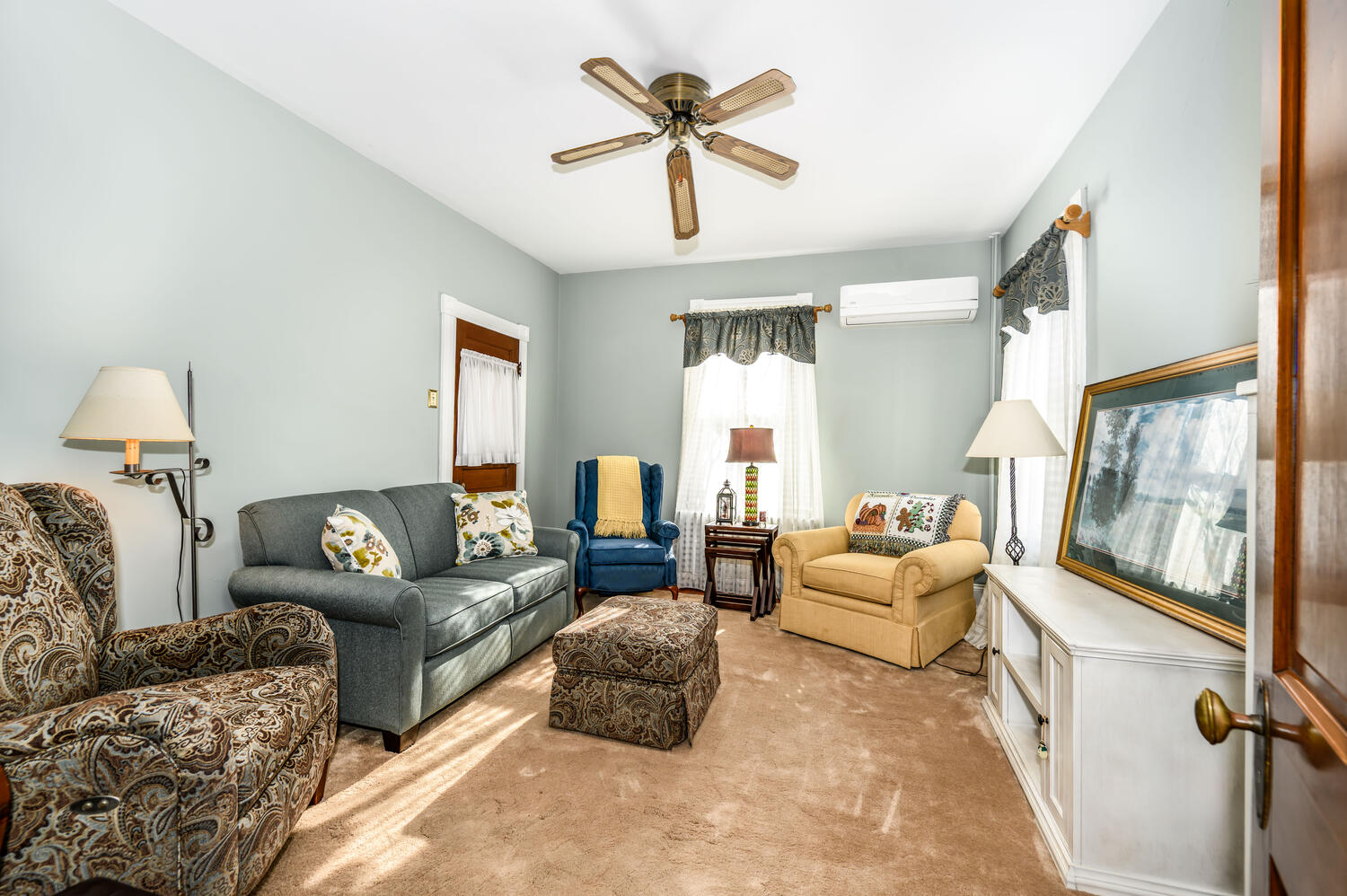
The Spy Newspapers may periodically employ the assistance of artificial intelligence (AI) to enhance the clarity and accuracy of our content.

Filed Under: 00 Post to Chestertown Spy, Design with Jenn Martella

  • « Previous Page
  • 1
  • 2
  • 3
  • 4
  • …
  • 28
  • Next Page »

Copyright © 2026

Affiliated News

  • The Chestertown Spy
  • The Talbot Spy

Sections

  • Arts
  • Cambridge
  • Commerce
  • Ecosystem
  • Education
  • Food & Garden
  • Health
  • Local Life
  • News
  • Point of View
  • Senior Nation

Spy Community Media

  • Subscribe for Free
  • Contact Us
  • COVID-19: Resources and Data

© 2026 Spy Community Media. | Log in