

My formative years unfolded during a time of great social unrest in our country. The world was changing, loudly, messily, and all at once. Protests filled the news, songs carried messages of defiance, and questions about fairness and equality seemed to hum in the air like static. Inside our home, my parents were quietly living out their own version of that social revolution. They believed in equality, not just in theory, but in the daily workings of our family life.
My mother, especially, stood apart from most women I knew. She managed her own finances, investing in the stock market, paying all of our household bills, and keeping credit cards, a checking account, and a car in her own name. That independence wasn’t a rebellion for her, it was simply the way she lived. My father respected her completely, and their marriage was a partnership, one I took for granted as normal until I grew older and saw how unusual it was in that era.
Our dinner table was the center of our home, a place of conversation, debate, and discovery. Topics ranged from local news, like sheep ranchers shooting bald eagles to protect their flocks, to larger issues like the civil rights movement and the growing demand for women’s equality. My parents encouraged us to think, to form our own opinions, and to defend them with reason. Books were woven into these conversations, their themes often spilling over into the real world around us.
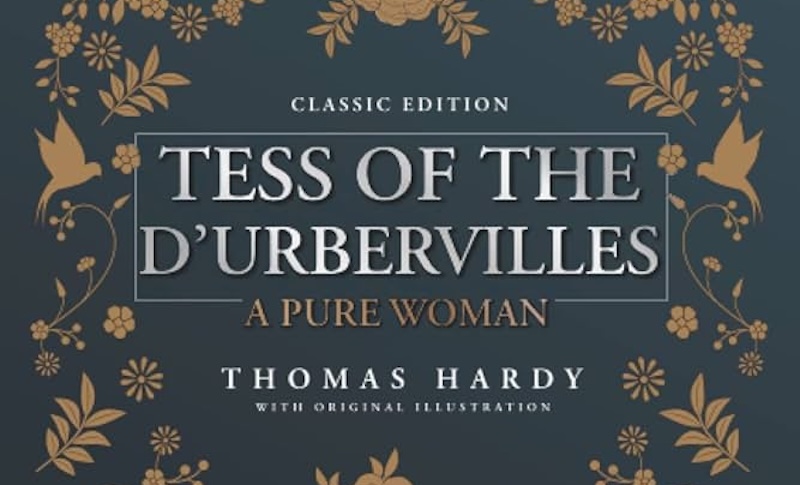
It was during one of those years that I read Tess of the d’Urbervilles by Thomas Hardy. The book still grips me in a way few others had. Tess was a character unlike any I had encountered, innocent yet strong, victimized yet resilient. Her world was mercilessly unfair, and Hardy’s sympathy for her, his insistence on her purity of spirit despite society’s condemnation, stirred something in me.
When I wrote my paper on the novel for my English class, I argued that Thomas Hardy was an early feminist. I believed he saw Tess not as a cautionary figure, but as a mirror reflecting the cruelty of a world built on male privilege and rigid moral codes. Hardy’s condemnation of the double standards of Victorian England; where a man’s sins were forgivable but a woman’s were ruinous, felt both historic and hauntingly current. I saw echoes of those same double standards in the world around me, where women were still fighting to be heard, to be taken seriously, to be allowed control over their own lives.
Tess’s suffering made me think about my mother. Though their circumstances were worlds and generations apart, both lived in societies that placed invisible boundaries around women. My mother had quietly pushed against those walls, making her own way, refusing to ask permission. She might not have called herself a feminist, but her actions spoke for her. Reading Hardy’s novel gave me a language for what I had witnessed growing up, it named the struggle, the injustice, and the quiet courage it took to live with integrity in a world that didn’t always allow it.
I remember the ending of the novel vividly, Tess’s tragic acceptance of her fate, her calm resignation in the face of inevitable punishment. I was devastated, angry even. It seemed unbearably unfair that such a pure-hearted character should be crushed by a society so blind and hypocritical. Yet, in that anger, something awakened in me: the realization that literature could illuminate truths that polite conversation often avoided. Books could challenge the world.
That idea, born somewhere between my mother’s quiet strength and Hardy’s fierce compassion, stayed with me. It shaped the way I approached life, teaching, and even the way I raised my own children. I came to see that empathy, once awakened, is a kind of moral compass. And it often begins with stories, stories like Tess’s, that make us see injustice not as an abstract concept but as a fault in the human spirit.
Looking back, I can trace so much of my understanding of equality, dignity, and resilience to those early years, the dinner table debates, the newspaper headlines, and the paperback copy of Tess of the d’Urbervilles that I read, notes written in the margins, until the spine cracked. I learned that ideas have power, but compassion has endurance. Hardy taught me that literature can stir the conscience. My mother showed me that courage can be quiet. Together, they formed the foundation of who I have become.
Kate Emery General is a retired chef/restaurant owner who was born and raised in Casper, Wyoming. Kate loves her grandchildren, knitting, and watercolor painting. Kate and her husband, Matt are longtime residents of Cambridge’s West End where they enjoy swimming and bicycling.
I too gained a lot of insight to the world through reading Thomas Hardy. He has been my favorite author for some time. I remember reading in an Introduction to Tess that he saw a beautiful young farm girl riding on the back of a wagon. He wondered how her life would unfold in those pre-feminist times. Even now, as a woman, being attractive to the opposite sex can be a blessing and a curse. Hence, the MeToo Movement was born.