
MENU

Sections

  • About Us
    • Editors and Writers
    • Sponsorship Terms & Conditions
    • Code of Ethics
    • Sign Up for Cambridge Spy Daily Email Blast
  • The Arts and Design
  • Culture and Local Life
  • Food & Garden
  • Public Affairs
    • Commerce
    • Health
    • Ecosystem
    • Education
    • Senior Nation
  • Point of View
  • Chestertown Spy
  • Talbot Spy

More

  • Support the Spy
  • About Spy Community Media
  • Advertising with the Spy
  • Subscribe
November 14, 2025

Cambridge Spy

Nonpartisan and Education-based News for Cambridge

  • About Us
    • Editors and Writers
    • Sponsorship Terms & Conditions
    • Code of Ethics
    • Sign Up for Cambridge Spy Daily Email Blast
  • The Arts and Design
  • Culture and Local Life
  • Food & Garden
  • Public Affairs
    • Commerce
    • Health
    • Ecosystem
    • Education
    • Senior Nation
  • Point of View
  • Chestertown Spy
  • Talbot Spy
1 Homepage Slider 3 Top Story Point of View George

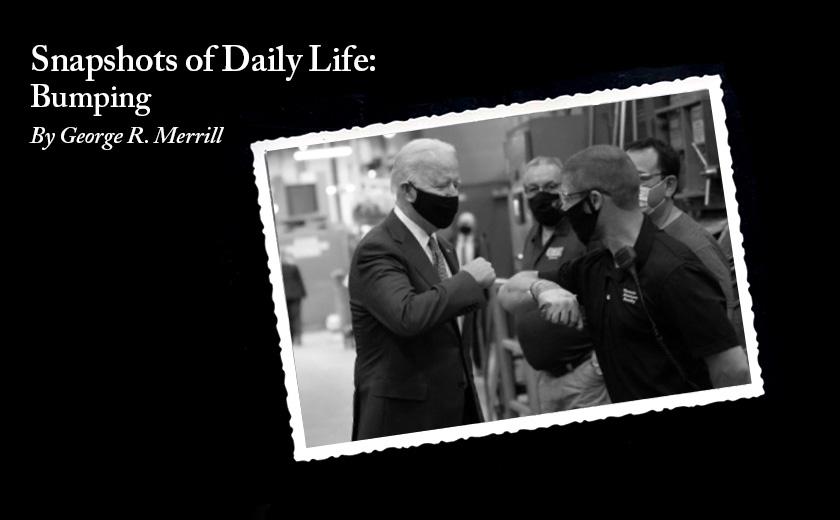
Snapshots of Daily Life: Bumping by George Merrill

November 22, 2020 by George R. Merrill
Leave a Comment

In this coronavirus era, bumping’s a way of life.

Recently I saw a doctor. I’d never met him before. As I sat waiting in the examining room he came in and greeted me by name. He was outfitted like people I’ve seen working in nuclear plants, covered head to foot in some kind of coverall. He looked, at first glance, as if he were in a diving suit. The doctor wore a mask over his mouth and a clear plastic face protector which reminded me of the facial guards we see on welders. As formidable as his presence appeared –– extra-terrestrial, I thought –– I instinctively put out my hand to shake his, while he extended his to shake mine.

We barely touched before each of us suddenly withdrew our hands. It was as if we had just touched a hot stove or felt an electrical charge. For a second or two, we both stood there awkwardly. Then the doctor raised his elbow, signaling he was about make the proper elbow bump greeting. We bumped amicably.

It was a curious meeting. I described my complaint. I told him how my aging infrastructure was malfunctioning and giving me a fit. He listened very intently and patiently as I described my symptoms. With all of his paraphernalia on I could see little of his face. Facial expressions are one of the signature gestures we make in communicating our feelings or intentions to others. I could only see his eyes, but without seeing them in the context of an entire face, I could see no expressions. I felt treated well throughout the interview and thought that he was competent to address my complaint. Something about the consultation had still left me feeling tentative; I think it was because I never saw his face or shook his hand. He may just as well have been a robot, albeit a kindly and helpful one.

He reminded me of clips I’d seen of first responders in action.

I remember watching scenes from New York City when, at an assigned time of day, people lowered their windows in high rise buildings, leaned out to clap and cheer for first responders and those who were a part of the medical teams. Even the least acknowledged persons in the work chain, the janitors who cleaned the hospital room floors, because of the risks they we’re taking for us, we recognized as heroes along with doctors and nurses. In my lifetime, to see this kind of grateful recognition for public service is unusual, except perhaps for the military. The recognition of support personnel brought to mind the biblical phrase where God, who loves the poor and disenfranchised, is said to lift up the lives of the humble: “and the lowly shall be exalted.” When it’s all in, everyone counts.

I have thought how PPE (personal protective equipment) that medical personnel must wear to avoid infection has, in a metaphorical way, reflected the prevailing social climate of mutual distrust that’s been plaguing us for some time. It’s as if we are not neighbors anymore –– not fellow Americans –– but have become potential threats to each other from which we must protect ourselves. The recent political leadership actively provoked this distrust of others at a time when, more than ever, we needed to lean on each other. This pitting Americans against one another, the physical threat the pandemic poses, and the protections it has required, have combined to foster our present atmosphere of fear and distrust.

Recently, Vice President Joe Biden and Senator Kamala Harris won the election. It did little to mitigate the virulence of the coronavirus or the country’s troubled psyche. However, I did see encouraging aspects of their election.

President elect Biden is by reputation a team player. He does not appear defensive in acknowledging what he doesn’t know. I believe he is as much of a truth teller as is possible for anybody in that office where every word and syllable uttered undergoes public scrutiny and gets obsessively parsed on cable channels. He doesn’t exhibit compulsive ego needs. As such, he is psychologically free to surround himself with the best expertise to help him guide and direct national policies. My sense is that Biden enjoys working collegially, and actually likes people. I’m sure he enjoys the power and control the office of the presidency confers –– he has been a professional politician his whole life, after all –– but I believe he is less driven by the darker sides of power needs than we’ve seen in the last administration.

I see another hopeful sign, at least for now. Apparently, it was important for many Republicans to make a statement by joining the president in not conceding the election, insisting that “every ballot” be counted, even crying ‘foul.’ Having made the statement, some of them have begun to say they are satisfied to get on with it and start the next chapter of American life. I felt a sense of relief.

But about my visit to the doctor? He told me that I must take better care of my body. My toxic habits have done damage over the years. In a similar way, the recent election revealed to all who would listen that our nation’s health had been seriously jeopardized. The body politic has been abused. Still, as bad as they are, old habits die hard.

The doctor recommended that I change some of my old habits, with particular regard to exercise and diet. The thought of surrendering my old habits –– some I’m really invested in like food and remaining inert –– was painful. After the doctor made his recommendations, I winced discreetly. He told me to come back in December for a follow up. As I left, we bumped elbows, amicably.

Columnist George Merrill is an Episcopal Church priest and pastoral psychotherapist. A writer and photographer, he’s authored two books on spirituality: Reflections: Psychological and Spiritual Images of the Heart and The Bay of the Mother of God: A Yankee Discovers the Chesapeake Bay. He is a native New Yorker, previously directing counseling services in Hartford, Connecticut, and in Baltimore. George’s essays, some award winning, have appeared in regional magazines and are broadcast twice monthly on Delmarva Public Radio.


The Spy Newspapers may periodically employ the assistance of artificial intelligence (AI) to enhance the clarity and accuracy of our content.

Filed Under: 1 Homepage Slider, 3 Top Story, George

Snapshots of Daily Life: Elections

November 8, 2020 by George R. Merrill
Leave a Comment

I am writing this essay on Sunday morning, November 1st, All Saints Day in the Christian calendar and two days before the election when America chooses its next president.

I would describe my feelings that day in this way: it’s the kind of anticipation I remember having as a boy on Christmas Eve. I knew exciting things were on the way and I could hardly wait for the day to come. However, now there’s a new rub. On Christmas Eve, I was always sure it was Santa who’d come down the chimney. On Election Day, I fear it might be the Grinch.

It may seem odd to some that I entertain Election Day and Christmas morning in the same thought. It’s not as quirky as it first appears. Consider, that for many people, both events are significant communal experiences involving the entire nation, if not religiously, certainly socially. In one sense, Election Day and Christmas Day have this in common: it’s a time when we finally learn what’s been wrapped up and hidden, or, in election parlance, the ballots are unpacked, counted, tabulated and the results made public. We open up on Election Day what has been wrapped and kept from us, like the Christmas presents that sat unopened under the Christmas tree.

There are other ironic parallels to the social experience of Christmas morning and Election Day. It’s the common experience of people, when getting what they say they want, to find fault with it. They soon feel cheated. They complain it wasn’t what they really wanted after all. This is why stores, the day after Christmas, never sell a thing; they only exchange. On Election Day, what we get is like a sale item; there’s no taking it back or exchanging it for a long time. That makes people mad.

I suspect this kind of disappointment happens a lot more in elections than with Christmas presents. I hear people complain regularly that politicians are all liars and not to be trusted. In saying that, I think I must also own the fact that there is nothing as fickle as the American electorate. A blog called, ‘The Fickle Finger,’ announced giving its, “2016 Fickle Finger of Fate Award” to the American electorate. It was the tenth year in succession that only fifty to fifty five percent of Americans turned out to vote in the presidential elections. This recognition was not meant to bestow honor on the electorate. The number may be greater this time around.

Americans complain loudly if they think their rights are being taken away. They’ll get mean if they think they are being denied any of them. We demand our rights, but even having them we fail to exercise some of the most important ones, like voting. I think of such people like the kid who wants straight ‘A’s in school, but never does any homework or studies. Still, he faults the teacher who flunks him. American citizens have trouble showing up: We take our blessings for granted. Americans are also embarrassingly ill informed.

I confess I was feeling very nervous in anticipating how this election might go. An aura of uncertainty, even fear, has characterized the experience for me and for many; it seemed as if the president himself was working hard to stir up confusion during the election. How odd, I thought, from the very person who is supposed to champion and assure the optimum conditions for Americans in exercising their rights.

I have a book I’ve looked at over the years, particularly on mornings when I have sought inspiration for the day. The book is about saints. The saints have been selected from a broader base than sectarian hagiographies normally choose. The author’s intent was not to showcase a gallery of stained glass saints, colorful but remote. He wished to present us with stories of authentic human beings “endowed to awaken that vocation in [us] others.”

For each of the year’s 360 days, there’s a brief sketch of one saint’s life and work. It names saints we’re familiar with like St. Mary or St. Francis, but also people whom we don’t normally think of as saints; historical figures like Dag Hammarskjold, Dorothy Day, artist Vincent van Gogh, the prophet Moses, and George Fox, the founder of the Quaker movement.

I couldn’t resist an impulse to look and see what saint the author selected for Election Day November 3rd. I will own, being nervous as I was, that I was indulging in some magic thinking, hoping for a sign from heaven that would signal, when the election was over, that all would be well.

The saint profiled for that day happened to be St. Martin de Porres, a 16th century, mixed-race Peruvian. Martin’s bi-racial profile –– African and Peruvian –– placed him in the culture’s social “minority,” its underclass. Dirt poor, profoundly humble, he exhibited great compassion for all living things and, like St. Francis, had a mystical relationship to nature, even to the most humble of creatures like the mice that plagued the monastery. Martin had an extraordinary gift for healing. He healed noblemen, as well as slaves and other disenfranchised folk. He made diseased animals well again.

If I could have it my way, I ‘d like the person we elect as our next president to have at least two of those characteristics: a heart for compassion and the gift for healing and reconciling. We are, after all, a deeply wounded nation, hungry for healing.

Columnist George Merrill is an Episcopal Church priest and pastoral psychotherapist. A writer and photographer, he’s authored two books on spirituality: Reflections: Psychological and Spiritual Images of the Heart and The Bay of the Mother of God: A Yankee Discovers the Chesapeake Bay. He is a native New Yorker, previously directing counseling services in Hartford, Connecticut, and in Baltimore. George’s essays, some award winning, have appeared in regional magazines and are broadcast twice monthly on Delmarva Public Radio.


The Spy Newspapers may periodically employ the assistance of artificial intelligence (AI) to enhance the clarity and accuracy of our content.

Filed Under: 1 Homepage Slider, 3 Top Story, George

Snapshots of Daily Life: Cardinals

October 25, 2020 by George R. Merrill
Leave a Comment

The cardinal from hell is back. This time, he’s assaulting my studio windows.

Many years ago, I had a disturbing experience with a cardinal. He became obsessed with the rear-view mirrors of my car. Every day he would fly at them, pecking furiously at the mirror while leaving his droppings down the side of my car. What was he doing? Was he attacking what he saw in the mirror as if it were his adversary or had he fallen in love with his own Image and, like Narcissus, lavished it with pecks and kisses?  After a while he finally gave up and that ended the matter. In the meantime, he’d left a dreadful mess on my car. I was furious. 

In my studio recently, I heard a noise at the window. Would you believe it was a cardinal attacking or ravishing the window exactly as I’d seen happen years ago with my car mirrors? What does one do? He would not stop. The light struck the window such that the window was able to reflect his image, like a mirror. I thought the only thing I could do was to somehow put something over the window so that there would be no reflection.

Taking several sheets of paper on which I had old research material written, I taped the papers on the window, effectively blocking the reflection. That way I hoped he would lose interest in the window.  I inadvertently left a small section of the window uncovered and sure enough he went for it and began his combative assaults, or was he abandoning himself to his passions. I never knew which

I was determined to put an end to this outrageous behavior. I went outside again with more paper, and taped additional pages on all of the places at the window where I thought he would be able to see his image. After taping them up, I went back into the house. I stayed there, undisturbed for several hours. I knew that I’d successfully driven him off.  I had put an end to this unnatural behavior. I went outside just to check to see how secure the pages were. 

I noticed for the first time the nature of the research material I had written on the several sheets of paper. The material contained data I’d collected on the history of cathedrals.

I am a member of Trinity Cathedral here in Easton. There had been increasing interest in the diocese in reviewing the place and function of a cathedral in the religious and social life of the twenty first century. What new functions might cathedrals have in today’s changing society. I did some research on how cathedrals evolved and what role they played in English, French, Spanish and more recently in American societies.

Cathedrals have occupied a significant place in medieval social and religious life. As the Church of England spread its influence here on the shore, Trinity Cathedral here in Easton was the Shore’s first and only Cathedral. I am a communicant, there.

Cathedrals today are visual remnants of the power and wealth that Christianly once enjoyed. The majestic aura of cathedrals that once awed Christians and others as well, had mystical significance, to be sure, but were also monuments to power and prestige. They remain an awesome sight today and people the world over, religious or not, travel to see them, simply because they are magnificent structures. I myself was ordained a priest in the Cathedral of St. John the Divine in New York City. Sadly, many cathedrals have become increasingly museum pieces, valued for their architectural magnificence, but not venerated for the divine vision that inspired them. 

I had since lost interest in my research and doubted whether I’d ever apply what I’d learned to anything useful. I tucked the papers away planning to use the blank sides for scrap paper.

Only much later did it occur to me that cardinals (clerics) are regular visitors to cathedrals. They go in and out of them all the time. Cardinals belong there.  They perform many of the ritual and liturgical rites of Christianity. What had not occurred to me until I recognized the subject of the papers I’d placed on the windows, was how, in a sense, I was using my investigation into one kind of cardinal’s habitation, to drive another kind away from my own. Like a homeopathic physician, I was administrating to myself a modified dose of the toxin attacking me, in order to mitigate its debilitating effects.

Of course, cardinals, the ones with wings, are not literate. The cardinal attacking my windows would have no way of knowing anything about the subject of the documents that were frustrating his access to my studio windows. While the irony of this may well have been lost on this cardinal, it was not lost on me. Where the papers ended up may have been an ignominious end to my noble research endeavors. They were covered with bird droppings. I took some comfort in the thought that at least my efforts were not totally in vain. They found a use.

I normally associate a cardinal (cleric) with heavenly preoccupations. This cardinal hammering at my studio windows, was surely from hell. It’s worth noting how traditional satanic images appearing in masks and paintings, will portray the devil as bright red . . . like a cardinal.

There are cardinals and there are cardinals.

Columnist George Merrill is an Episcopal Church priest and pastoral psychotherapist. A writer and photographer, he’s authored two books on spirituality: Reflections: Psychological and Spiritual Images of the Heart and The Bay of the Mother of God: A Yankee Discovers the Chesapeake Bay. He is a native New Yorker, previously directing counseling services in Hartford, Connecticut, and in Baltimore. George’s essays, some award winning, have appeared in regional magazines and are broadcast twice monthly on Delmarva Public Radio.

The Spy Newspapers may periodically employ the assistance of artificial intelligence (AI) to enhance the clarity and accuracy of our content.

Filed Under: 1 Homepage Slider, George

Snapshots of Daily Life: Slugs by George Merrill

October 18, 2020 by George R. Merrill
Leave a Comment

Slugs prefer getting out at night. They’re at their best in the dark.

Slugs travel nightly along the brick walk leading to my studio. I see glistening trails left from their nocturnal sojourns. I notice the trails routinely on my morning treks to the studio. I’d not seen one quite like the one I saw just the other day.

The trails I normally see suggest that a slug is on his way somewhere; heading to a definite destination so that, although the trail may weave a little this way and that, it’s usually comparatively straight.

This trail however seemed as if he’d created a minimalist painting, making some kind of statement; but just what is anyone’s guess. It looked to me like a human head, a person whose mouth seems open, trying to say something. It looks as though he had not finished making up his necktie.

When I see minimalist paintings, my first thought is, “That’s easy, I could do that.” I think viewers work harder trying to guess what a picture means than the artist took in painting it. All the slug had to do was keep walking (slithering? crawling?) and his or her wake became the creation. That’s about as easy as art can be. Its apparent simplicity seems free from all the intense angst normally associated with creative acts.

But, of course I am reading into the glistening trail he left and shamelessly attributing anthropomorphic motives to this humble slug.
I photographed the slug’s trail so that when writing my essay, anyone reading it could see why I might have been fascinated, and be on the same page with me as I ruminate about this creature’s remarkable ability to capture my attention.

We have had this brick walk for about 20 years. While seeing these trails regularly, I’ve never actually seen a slug. Where do they come from? Where do they live, I wonder?

Doing some light research on slugs, what appeared first on several sites were ways to get rid of them. Why so harsh? I’ve never been bothered by a slug. I thought they were slimy and maybe slightly icky, but not harmful. In fact, they are a sort of lagniappe for birds and other animals and for thrushes especially, slugs are regarded as haute cuisine.

The hapless slug’s vulnerability, brings out the worst in little kids. They delight in watching the slug shrivel up into nothing when covered with salt. For kids, the kick they get is up there with pulling the wings from flies. Hopefully, mellowed with time and experience, this unfortunate inclination to harm others will disappear. I do know that our dark side can be mitigated some, but we need to remain alert to it.

When we’re provoked, it can return with surprising vengeance.

But to return to the slug as artist; after seeing his artwork, I now think of slugs differently, even reverently.

Art and creativity of most kinds involve a person’s entire being. Artists, writer’s, and sculptors speak regularly of how their work proceeds from some place deep within them; it rises unbidden ––it just comes out.

Certainly, the same might be said of the slug who leaves his trails behind. Something within him is naturally released –– it just comes out. He does his finest work crawling around at night. Like all artists, slugs are never sure that what comes out of them will look like or what shape it will finally take. It’s too dark to see. I can say this confidently of the slug; that whatever he does, he gives it his all. The legacy he leaves behind –– the visible one –– can be surprisingly enchanting.

Slugs, like most artists, are plodders. Plodders creep along, grinding away slowly at their tasks, and, like the mills of the gods, they ‘grind slowly but exceedingly fine.’ In that regard, I’m thinking of a botanical artist whom I know. Her work renders stunning illustrations of various plants and flowers, studiously crafted with minute and in the sharpest detail. It is slow, tedious work. I’ve been told that it once took her three months to illustrate one ear of corn. I can only imagine that a person’s whole being must be totally absorbed, even consumed by such activity. The art of seeing more deeply into things is not to regard them hurriedly, but to slowly ponder them. I read somewhere that a famous writer, when asked how his writing had gone that day, replied, “I finished a sentence.”

There are, so many dreams, hopes, and wonders that come to us under the cover of night only to vanish at daybreak, in the way our nocturnal dreams, so vivid in darkness are lost to the light.

This is not so with my tiny friend, the minimalist slug; his narrow path says so much with so little. What he conceived in darkness, glistens in the light for all to celebrate.

Of course, this is fanciful thinking. I’m imputing more to what this slug is and has done than he ever has ever himself . . . or have I, really? But I will tell you that I have to wonder how many people there are in this world –– how many creatures there are who will never know how much beauty and grace they have brought to others from the hidden riches of their own inner lives, resources they never really knew they themselves had. They discovered them when they were reflected back to them by those people whose lives they had made better because of who they were. I wish I could say thanks to the slug. I guess by writing this, I am.

Think this is too far-fetched? St. Francis didn’t.

Contemplative, Fr. Richard Rohr, writes: “Francis of Assisi is known for his love for animals, but too often the stories become overly romanticized . . . Francis’ respect for animals is far more profound than mere “birdbath Franciscanism” lets on. Everything was a mirror for Francis. What he saw in the natural world, in the sky, in animals, and even plants was a reflection of God’s glory.”

If Francis hadn’t already, I’d op for adding the humble slug to his list.

Columnist George Merrill is an Episcopal Church priest and pastoral psychotherapist. A writer and photographer, he’s authored two books on spirituality: Reflections: Psychological and Spiritual Images of the Heart and The Bay of the Mother of God: A Yankee Discovers the Chesapeake Bay. He is a native New Yorker, previously directing counseling services in Hartford, Connecticut, and in Baltimore. George’s essays, some award winning, have appeared in regional magazines and are broadcast twice monthly on Delmarva Public Radio.

The Spy Newspapers may periodically employ the assistance of artificial intelligence (AI) to enhance the clarity and accuracy of our content.

Filed Under: 1 Homepage Slider, George

  • « Previous Page
  • 1
  • …
  • 3
  • 4
  • 5

Copyright © 2025

Affiliated News

  • The Chestertown Spy
  • The Talbot Spy

Sections

  • Arts
  • Cambridge
  • Commerce
  • Ecosystem
  • Education
  • Food & Garden
  • Health
  • Local Life
  • News
  • Point of View
  • Senior Nation

Spy Community Media

  • Subscribe for Free
  • Contact Us
  • COVID-19: Resources and Data

© 2025 Spy Community Media. | Log in