MENU

Sections

  • About Us
    • Editors and Writers
    • Sponsorship Terms & Conditions
    • Code of Ethics
    • Sign Up for Cambridge Spy Daily Email Blast
  • The Arts and Design
  • Culture and Local Life
  • Food & Garden
  • Public Affairs
    • Commerce
    • Health
    • Ecosystem
    • Education
    • Senior Nation
  • Point of View
  • Chestertown Spy
  • Talbot Spy

More

  • Support the Spy
  • About Spy Community Media
  • Advertising with the Spy
  • Subscribe
December 8, 2025

Cambridge Spy

Nonpartisan and Education-based News for Cambridge

  • About Us
    • Editors and Writers
    • Sponsorship Terms & Conditions
    • Code of Ethics
    • Sign Up for Cambridge Spy Daily Email Blast
  • The Arts and Design
  • Culture and Local Life
  • Food & Garden
  • Public Affairs
    • Commerce
    • Health
    • Ecosystem
    • Education
    • Senior Nation
  • Point of View
  • Chestertown Spy
  • Talbot Spy
1 Homepage Slider Cambridge

Pride of Baltimore II Calls at Cambridge

October 28, 2025 by Zack Taylor
Leave a Comment

Under a clear October sky last weekend, the Pride of Baltimore II, a 97-foot topsail schooner, glided through the calm waters of the Choptank, offering three groups of visitors a brief glimpse of its 19th-century heyday, when the river served as the epicenter of transit, economics, and politics. 

This vessel, faithfully modeled after the Baltimore clippers of the War of 1812, marked one of three trips that day. The weekend featured six sails before concluding the ship’s 2025 Chesapeake season with a stop in Chestertown before returning to its winter port in Canton on the Inner Harbor.

The ship was under the capable command of Captain Jeff Crosby, one of the ship’s two rotating skippers. Growing up sailing on the Great Lakes, the Duluth, MN native joined the crew in 2008 and rose to captain in 2020.   

It was a lovely weekend for sailing on the Choptank for the Pride of Baltimore II. The wind could have been a little stronger.

“Cambridge is great,” Crosby told The Spy.  “There’s a lot of history over here, much of it tied to ships like the Pride. The intricate web of waterways on the Eastern Shore shaped their design, with fast, agile hulls built for winding rivers with shallow depths.”

As bos’un Kai Joswig, of Las Vegas, NV, and originally from Belize, barked orders repeated by the crew in unison, the ship slipped out of the Long Wharf and onto open waters. 

The deck, lined with coiled ropes and wooden fixtures, buzzed with activity. The experience offered a hands-on connection to the ship’s traditions. The deck, lined with coiled ropes and wooden fixtures, buzzed with activity. The experience provided a hands-on connection to the ship’s traditions. 

Pride II, with its tall masts and American flag, stands as a living testament to maritime heritage. Its lifeboat, aptly named the Chasseur (French for “hunter”), honors the 1812 clipper on which Pride II is modeled.


Captain Jeff Crosby learned to sail on the Great Lakes, and is a big fan of ice boating.


When it was time to man the halyards to raise the foresail and jib, guests, including Alex and Lisa Green, operators of Harriet Tubman Tours, added their muscle to the exercise.  Alas, The Spy would have joined in but was fully occupied by his reportorial obligations.  

The Greens’ presence was meaningful. Each of the weekend’s sails carried the theme ‘Sailing the Chesapeake Through Ebony Eyes,’ a tribute to Vincent O. Leggett – the ‘Admiral of the Chesapeake’ – whose work illuminated the Black maritime history on the Bay.  Leggett passed away in November 2024 at age 71.   

From Baltimore, Leggett founded the Blacks of the Chesapeake Foundation in 1984. His work chronicled the contributions of African American watermen, oystermen, and shipbuilders. His two books on the subject earned him the honorary title from former Governor Parris Glendening in 2003. 

Alex Green grew up in Bellevue on the Tred Avon. His family worked on the water, and now he operates Harriet Tubman tours.

“When Vince was working on his book ‘Ebony Eyes,’ he interviewed all of the old black watermen, one of whom was my grandfather,” Alex Green said.  “He wanted to hear all of his old stories. I met him then, and we became great friends.  

“He mentored and encouraged me to share these stories when there wasn’t much public interest.  We later became colleagues, and near the end of his life, I would step in to handle certain projects on his behalf.”  

Longtime Dorchester residents, the Greens (Lisa’s family ties reach back to the Tubman era), have guided tours along the Harriet Tubman Underground Railroad Byway for over a decade.   

Crew members take a break to chat with The Spy.

Launched in 1988, the Pride II replaced the original Pride of Baltimore, which was tragically lost in 1986 in the Caribbean to a microburst squall, claiming four lives. “It was just a freak of nature,” is how Crosby described the storm. 

The new ship has since traveled 350,000 miles, visiting more than 200 ports across 40 countries. Since then, the Pride II has sailed more than 350,000 miles to over 200 ports in 40 countries, carrying Chesapeake’s maritime story from the Choptank to the world.



The Spy Newspapers may periodically employ the assistance of artificial intelligence (AI) to enhance the clarity and accuracy of our content.

Filed Under: 1 Homepage Slider, Cambridge

So Happy Together: Waterfowl and AAM Team Up Again this Fall

October 27, 2025 by The Spy
1 Comment

The Academy Art Museum and the Waterfowl Festival have been creative partners since 1971, a collaboration so long-running that Director Charlotte Potter Kasic jokes they’ve been “married” since the beginning. This year, she and Festival Director Deena Kilmon are bringing the partnership back to its roots by filling the AAM with true “Masters Gallery” works, high-end sporting art from national galleries like Copley Auction House, the Sportsman’s Gallery, and Red Fox Fine Art in Middleburg, Virginia.

They’re also adding something new: two pop-up shows that link past and present. One, in partnership with Salisbury University, highlights historic waterfowl carvings and paintings, including a rare collection of swans. The other presents contemporary wildlife-inspired art, from Spencer Tinkham’s abstract feather carvings to Tina Affiero’s glassworks that blend art and science. It’s a festival moment that honors tradition while keeping the art — and the story —alive in a very new way.

This video is approximately four minutes in length. For information about this year’s Waterfowl Festival, please go here, and for the Academy Art Museum, use this link.

The Spy Newspapers may periodically employ the assistance of artificial intelligence (AI) to enhance the clarity and accuracy of our content.

Filed Under: 00 Post to Chestertown Spy from Cambridge, 1 Homepage Slider

No Easy Love By Laura J. Oliver

October 26, 2025 by Laura J. Oliver
Leave a Comment

At my training session at JT’s gym, I swing open the glass door and call out, “Oh, thank God she’s here!” to make him laugh. He’s killing time waiting for me between clients, running on the treadmill to keep himself in shape. He laughs, pretends to check his mileage monitor as the treadmill slows. “Gee, only 17, eight-minute miles,” he sighs as he turns it off. I laugh at the lie, then I plop down in the chair next to his desk.

“What’s up?” he says, pulling out his chair as well and yawns while he waits for the latest installment of my past week’s activities. 

“You’ve been doing that a lot lately,” I say. 

He nods, yawns again. “I wake up every night at 3:30. But the good thing is, it doesn’t affect me at all.” 

“Yeah, I can see that,” I say. “Are you anxious about anything?” The dreaded cable pulls are behind me, waiting as I settle in. “We should talk about this.” 

“Nice try. Get up,” he says, ending the best of my delaying tactics. “Let’s see whatcha got.”

JT has learned the art of revealing nothing while having a conversation, which makes sense since he has to talk to someone new for an hour at least 8-10 times a day. At the computer all day, I am a boundary-challenged bean spiller. Do not confide in me—the brain hates to keep a secret—it’s spelled s-t-r-e-s-s. The alternative spelling is s-t-o-r-y, and we live for it.  

After demonstrating the way I am to lift some weights while simultaneously lunging, JT stands aside, and I take the stance, trying not to tip over. Yesterday, I spun around with my eyes closed in the shower and thought, Uh-oh, this could have gone badly. So, I tell him that maybe we should work on balance and not strength today. He is already on it, dragging over the heinous half-ball thing on which you must balance, much like trying to stand on one foot in a bouncy house while some kid jumps up and down right next to you.

JT and I feel the same way about virtually everything except politics, so we never talk about that, but our attitudes are often apparent in our responses to other things. 

“They’ve just discovered another rogue planet not connected to any solar system,” I report, excited about this discovery. He eyes me as if scientists are tricksters out to get us—their ulterior motive–to fool humanity about everything from planets to platelets. “How do they know that?” he asks.

“And tomorrow is the shortest day in history,” I add. “Thanks to the Earth spinning slightly faster, it’ll be 1.34 milliseconds less than the standard 24 hours.”

“How do they know?” he asks again. “Says who?”

This is often the response to facts I share, and it’s one that I can’t answer because I can’t reproduce the corresponding research proving this fact off the top of my head. I read it, but I just can’t retain it. I guess I only have the mental bandwidth to remember the fascinating end product of research, so that’s what I share. 

For instance, the Appalachians are far older and were once taller than the Rockies. I remember they are lower in altitude because they have eroded centuries longer, but I don’t remember how scientists know that. 

Being able to explain how seemingly impossible things could be true is something I’ve surrendered spiritually as well. I’ve experienced enough miracles not to need the “how.” Likewise, when I pray, I ask for what would be impossible for me to accomplish on my own, trusting that it is effortless for a power greater than myself. I see it as done– this healing, this reconciliation, this grace. Strategizing means I still think the universe needs my input. 

Hard pass, says the universe.

JT takes me off the half-ball and tells me to walk the length of the gym, heel-to-toe, lifting a 10-pound weight extended over my head. I do this easily, my confidence returning. “Want me to go faster?” I ask.

“No. I want you to close your eyes and do it backwards,” he says.

Our relationship is one of balance. We are so far apart politically we can only 

acknowledge that fact with a laugh or a joke once in a while. 

But I often ask what JT did on the weekend and it’s what I did, as well. And he has two daughters he adores, and I have two daughters I adore. And I listen to him put their welfare ahead of his own desires, week after week, and I know I’d walk backward and blindfolded across the Bay Bridge for mine, so there’s that. 

He loves a dog who is a real pain, and I love one of those, as well. He has a roof that needs replacing, and I have one, too.

I was recently told that my soul’s purpose in this life is to experience all forms of love—parental, romantic, for humanity at large. In this life, I needed to love as a sibling, a spouse, and a friend —surely, we all do. But that’s easy love. I don’t think it counts toward being a good person. Love like that makes you a regular person. It’s the least you can do.

I saw a greeting card the other day that said, “One of us is right, the other one is you.”

How do we find common ground when it feels as if our very morals conflict?

I don’t know. It’s like finding my way backward and blindfolded to those with whom I don’t agree. But I can place my attention on judgment and strategy, or I can ask that love magnifies all that we share.

Rumi wrote, “Out beyond our ideas of right-doing and wrongdoing, there is a field.

 “I’ll meet you there.” 


Laura J. Oliver is an award-winning developmental book editor and writing coach, who has taught writing at the University of Maryland and St. John’s College. She is the author of The Story Within (Penguin Random House). Co-creator of The Writing Intensive at St. John’s College, she is the recipient of a Maryland State Arts Council Individual Artist Award in Fiction, an Anne Arundel County Arts Council Literary Arts Award winner, a two-time Glimmer Train Short Fiction finalist, and her work has been nominated for a Pushcart Prize. Her website can be found here.

The Spy Newspapers may periodically employ the assistance of artificial intelligence (AI) to enhance the clarity and accuracy of our content.

Filed Under: 1 Homepage Slider, Laura

Food Friday: Pumpkin Patch

October 24, 2025 by Jean Sanders
Leave a Comment

You really should go visit a local pumpkin patch. Don’t get lazy and buy a pumpkin at the grocery store. Go wander, and wonder at how many amazing shapes, forms, colors and aromas there are. Pumpkins aren’t just perfect orange spheres these days. There are white, green, grayish green, mottled tangerine, and warty beasties of pumpkins out there in the wild.

Last week I was shocked, shocked to see a family buying a pumpkin at Target of all places! Where is the magic? I had a charming morning encounter with a couple of sprightly old men when I walked into the Episcopal church pumpkin sale in our town. The pumpkins were grouped by size and shape on several of the flat gravestones in the 18th century churchyard. I strolled around, enjoying the views of exotic gourds and enormous squashes before I bought a couple of decorative white pumpkins to put on the kitchen table, and a small pumpkin for making my own pumpkin purée. I’m sorry, Libby’s, but we are going full tilt, homemade for baking this week.

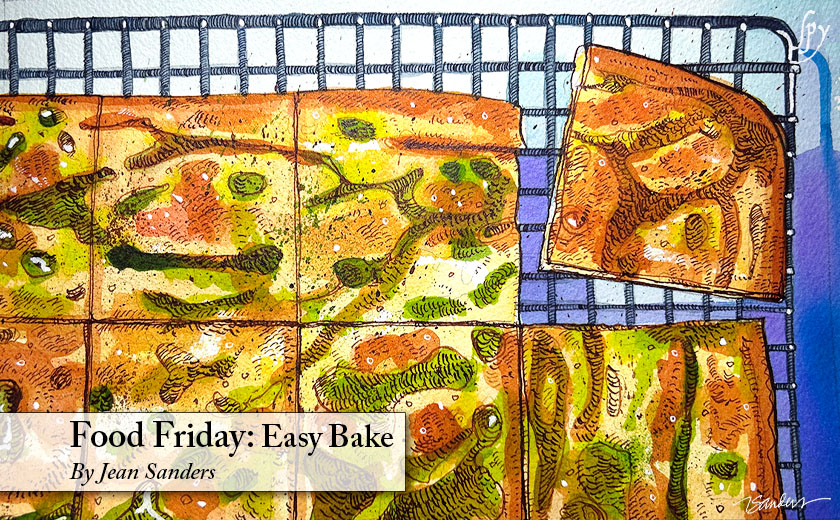
Pumpkins are not just for Halloween decorations and Thanksgiving pie. It’s time to expand our repertoires and use some of our local produce with seasonal gusto. I love a nice spicy pumpkin cake, and even though I have it all gussied up as a fancy cupcake in this week’s illo, it tastes just as deelish when baked as a utilitarian sheet cake, slathered with un-photogenic swathes of cream cheese icing. Homely sheet cakes are every bit as wonderful as all those fancy shop cupcakes, and easier to pack in lunch boxes, too.

You will need to make pumpkin purée. It is messy and fun, and for your first batch you should employ child labor, if you can. After that they will be wise to your ways, so enjoy yourselves for an afternoon. It is an early lesson in farm-to-table. They can pick out the pumpkin, bring it home, carve it up, bake it, purée it, and bake a pumpkin cake. So artisanal!

While making your decision in the pumpkin patch be sure to choose smaller pumpkins, weighing 2 to 4 pounds, for making purée. Larger pumpkins tend to be dry and stringy. An ice cream scoop is a handy tool for removing the seeds and membrane from inside the pumpkin – but I once used an electric jig saw for jack-o-lantern carving (which was exhilarating), but use whatever makes you happy. You can store the purée in bags or in freezer-proof dishes, which means you can whip out homemade purée for almost any occasion.

Pumpkin Cake from Sally’s Baking Addiction

Ingredients
2 cups all-purpose flour
2 teaspoons baking powder
1 teaspoon baking soda
1 teaspoon salt
1
1/2 teaspoons ground cinnamon
2 teaspoons pumpkin pie spice
1 cup vegetable oil
4 large eggs
1 cup packed light or dark brown sugar
1/2 cup granulated sugar
2 cups pumpkin purée
1 1/2 teaspoons pure vanilla extract

Cream Cheese Frosting
8 ounces full-fat block cream cheese, softened to room temperature
1/2 cup butter, softened to room temperature
3 cups confectioners’ sugar, plus an extra 1/4 cup if needed
1 teaspoon pure vanilla extract
1/8 teaspoon salt

Preheat the oven to 350°F and grease a 9×13 inch baking pan. I always use this glass pan.
Whisk the flour, baking powder, baking soda, salt, cinnamon, and pumpkin pie spice together in a large bowl. Set aside. Whisk the oil, eggs, brown sugar, granulated sugar, pumpkin, and vanilla extract together until combined. Pour the wet ingredients into the dry ingredients and use a mixer or whisk until completely combined. Batter will be thick.

Spread batter into the prepared pan. Bake for 30-36 minutes. Baking times vary, so keep an eye on yours. The cake is done when a toothpick inserted in the center comes out clean. If you find the top or edges of the cake is/are browning too quickly in the oven, loosely cover it with aluminum foil.
Remove the cake from the oven and set the entire pan on a wire rack. Allow to cool completely. After about 45 minutes, I usually place the cake in the refrigerator to speed things up.

Make the frosting: In a large bowl using a handheld or stand mixer fitted with a paddle or whisk attachment, beat the cream cheese and butter together on high speed until smooth and creamy. Add 3 cups confectioners’ sugar, vanilla, and salt. Beat on low speed for 30 seconds, then switch to high speed and beat for 2 minutes. If you want the frosting a little thicker, add the extra 1/4 cup of confectioners sugar (I add it). Spread the frosting on the cooled cake. Refrigerate for 30 minutes before serving. This helps sets the frosting and makes cutting easier.
Cover leftover cake tightly and store in the refrigerator for 5 days.

Sally’s Pumpkin Cake

Pumpkin cake from Martha – she calls for canned pumpkin purée

Grown-up pumpkin bundt cake (no frosting!)

Pumpkin cupcakes

I found this recipe at the Redman Farms Facebook page.

“Like many indelible family memories, carving a pumpkin begins with someone grabbing a really sharp knife.”
– Dana Gould

I love this idea and plan on swiping it for a Thanksgiving centerpiece: Pumpkin Marigold Centerpiece


Jean Dixon Sanders has been a painter and graphic designer for the past thirty years. A graduate of Washington College, where she majored in fine art, Jean started her work in design with the Literary House lecture program. The illustrations she contributes to the Spies are done with watercolor, colored pencil and ink.

The Spy Newspapers may periodically employ the assistance of artificial intelligence (AI) to enhance the clarity and accuracy of our content.

Filed Under: 1 Homepage Slider, Food Friday

Black Water Bakery’s Jamie Summers Spills Secrets of Success

October 20, 2025 by Zack Taylor
2 Comments

First things first: Black Water Bakery isn’t named after the nearby refuge. For Jamie Summers, it’s all about black water — coffee.   Speaking of which, caffeine has always been the driving substance at the popular Cambridge eatery Summers owns with her husband Brett, from servers zipping around the crowded tables to customers fueling up to meet their days.  The chemical formula for caffeine can be found on the wall, and if you look closely, it’s on the floor too. 

And that jolt of energy has fueled more than just mornings — it’s powered the bakery’s rise since 2017.  Since then, it has doubled in space, survived COVID-19, honed and expanded its menu to become a community favorite, and established a reputation for serving some of the best breakfasts in town.

Jamie fell into running Black Water somewhat accidentally.  An initial tenant bowed out after only a few months, leaving Brett with a fully-finished restaurant and no one to run it.  Would she?  Despite having three school-aged children, she agreed, and has never looked back — spending every day on site, keeping the menu fresh, mentoring the staff, managing crowds, and mitigating the occasional snarky review.  

Today, Black Water is the longest-tenured restaurant in town, with honors like the People’s Choice Award at Taste of Cambridge and ‘Best Bakery’ on the Eastern Shore. It’s become a centerpiece of a revitalized downtown and an appealing employment gig for local young people.

Sitting down with The Spy, Jamie reminisces about the early days and talks about how Black Water has gradually earned its place as a Cambridge institution, the place to go for breakfast. 

The video is approximately eight minutes long.


The Spy Newspapers may periodically employ the assistance of artificial intelligence (AI) to enhance the clarity and accuracy of our content.

Filed Under: 1 Homepage Slider

The Story of Us By Laura J. Oliver

October 19, 2025 by Laura J. Oliver
Leave a Comment

Anthropologist Jane Goodall, whom I greatly admire, died recently.  Until Jane, we believed we were the only species on the planet to make and use tools. Of course, Jane was a single, blond, 26-year-old female when she proved otherwise through her patient observations of a wild chimp she had named David Greybeard, so her discovery was discounted by the established (read primarily male) scientific community for years. Eventually, we (they) had to admit, Holy cow, that little gal was right. We aren’t quite so unique after all. 

She also proved that we are not the only species to kiss and to beg. Interesting juxtaposition.  

We are falling from the pedestal of our self-proclaimed uniqueness. We had to learn that the Earth is not the center of the solar system, that the Milky Way is not the center of the universe. We may not be the only planet upon which life has arisen, and we are not the only species to reason, feel affection, and gratitude. Perhaps we are not even unique in this last bastion of distinction. After watching chimps discover a waterfall, then stop to gaze at it as if mesmerized, Goodall speculated we may not be the only species to feel awe. 

We are, however, the only species for which nearsightedness has become a global epidemic. In the U.S., there is a national surge of over 36%, and globally, 224 million people are highly nearsighted, meaning they can’t see things clearly that are far away.

Another word for nearsighted is shortsighted. Ahem.

We are in the middle of the 6th mass extinction event; did you know that? We are losing biodiversity at a rate 1,000 to 10,000 percent higher than would occur naturally if humans were not affecting the environment. Humanity itself may be dying out. There is currently an unprecedented decrease in birth rates worldwide, with fertility rates falling below replacement levels in most countries. Statisticians report that the effect of these trends will be felt on a global scale in about 60 years. 

There are cultural reasons for this trend, and many reasons we could still reverse. “How is it possible,” Jane Goodall asked, “that the most intellectual animal to have ever walked on planet Earth is destroying its home?” Talk about shortsighted.

In 1977, NASA launched twin Voyager probes into space, weeks apart, carrying identical golden records imprinted with a message from humankind to any intelligent life form in the cosmos who might find them. 

The records carry both audio and visual messages that represent Earth’s diversity of life and diversity of human life, with greetings in 59 human languages and 115 images. Sounds include footsteps and whale songs, laughter, and thunder, a rain forest teeming with life, and the heartbeat of a woman in love. Voyager 1, carrying that greeting, is now more than 15.6 billion miles from home, sailing in silence through the constellation Ophiuchus, still seeking someone to tell: we are here, we are here, we are here.

This is who we are.

Goodall’s last published work is “The Book of Hope: A Survival Guide for Trying Times,” but she warns that the window of opportunity in which to reverse our path is closing. How accurate will Voyager 1’s message be if it is ever found? What if 59 languages have become four, and back on Earth, no one recognizes the sound of a rainforest? Or the heartbeat of a human in love?

If we are losing our ability to see clearly what is approaching from a distance, we should at least see clearly what is right here: the precious, rare beauty of this Earth and the interconnectedness, the holy interdependence of all who inhabit it. 

Interestingly, for all our lack of uniqueness, there is one thing that it seems only we do: bury our dead. Not for fear the body might attract predators to the campfire, but with ritualistic reverence because those who died were loved and their loss mourned. This practice dates back at least 150,000 years, to the time of the Neanderthals. How do we know?

Because Neanderthals didn’t just bury their dead, they filled their graves with flowers. 

If the Golden Record is ever found and decoded, I hope the message it carries remains true. 

We are a blue planet orbiting a yellow star, 26,000 light-years from the center of a galaxy called the Milky Way. We teem with whale song and laughter, babies’ cries and thunder, and evidence that we have loved each other for a long, long time.  


Laura J. Oliver is an award-winning developmental book editor and writing coach, who has taught writing at the University of Maryland and St. John’s College. She is the author of The Story Within (Penguin Random House). Co-creator of The Writing Intensive at St. John’s College, she is the recipient of a Maryland State Arts Council Individual Artist Award in Fiction, an Anne Arundel County Arts Council Literary Arts Award winner, a two-time Glimmer Train Short Fiction finalist, and her work has been nominated for a Pushcart Prize. Her website can be found here.

The Spy Newspapers may periodically employ the assistance of artificial intelligence (AI) to enhance the clarity and accuracy of our content.

Filed Under: 1 Homepage Slider, Laura

Food Friday: Easy Bake

October 17, 2025 by Jean Sanders
Leave a Comment

Now that the threat of the nor-easter has swept past us, and there are cooler, clearer days ahead, we seem able to prepare for autumn. I have a new copse of trees out my window – no more dramatic pecan orchard swinging its loose limbs with abandon. Instead I look out at tall, skinny birches and long-legged long-needled pines. Some of their leaves are turning yellow and gamboge as they glisten and sway with dappling light, shuffling cards and dancing in place. I don’t see many of the opportunistic squirrelly boys we had patrolling the orchard, but this weekend I did see a merry band of bluebirds, joyously celebrating their farewell tour. The changes are slow-moving as we wait for summer to finally depart, and for the cool breezes of fall to waft over our fevered brows.

It’s time to do some easy baking; baking that delivers deliciousness for our minimal investment of time (and skill). It’s time for focaccia. Which is sublime when hot from the oven. It is good warm, it freezes well, and can be eaten for any meal. It is deeply satisfying to bake something warm and oozing olive oil and garlic – without all the bother of sour dough starter maintenance that found its way onto every homebound COVID-19 survivor’s to-do list.

Focaccia can be mixed up after breakfast, and ignored until an hour before dinner. Or you can make the dough after watching the Slow Horses, letting it rise over night, to be put it in the oven the next day. Yet, if you are suddenly seized with the yen for warm, home-baked bread, you can start the dough at lunch and hurry it along through the afternoon, and start baking in time for cocktail hour.
The Practical Kitchen We spent this past week experimenting.

Years ago I found a mix for focaccia at our local IGA market and it was a revelation to someone who had grown up on Pepperidge Farm white bread, Levy’s Jewish rye bread and the occasional loaf of freshly baked Italian bread from the red sauce Italian restaurant my family frequented for celebrations. I wasn’t used to warm and crusty, fresh, yeasty bread. During my European interlude I experienced the standard American food epiphany upon discovering baguettes, brioche, pain perdu, naan, crumpets, scones, hot cross buns, challah, pita, ciabatta, and finally focaccia di Recco col formaggio. Translation: my unformed suburban brain was blown.

Moving to the south brought me a deep appreciation for the simplicity of the biscuit. Upon moving further south (though considering Florida “south” is often debated, volubly) we found a wonderful French bakery, and we worked our way through their inventory of baked daily epi breads, baguettes, pain aux chocolate, croissants, and brioche. Jim and Kim’s bakery on Flagler Street in Stuart was deliciously aromatic, and educational.

This week our first batch of homemade focaccia was wrong in so many ways. The pan I used was too small, so the dough rose to epic, cornbread-y heights. Focaccia is considered a flatbread, or a hearth bread, not a voluminous soufflé. I also relied on the recipe, instead of my experience, and merely coated the pan with olive oil. What I should have done was use a larger, shallower pan, (thank you, Food52 for the sheet pan suggestion) and line it first with parchment paper, and then generously coat the parchment paper with olive oil.

The second batch was better, and more attractive. I dotted the dimpled top with halved cherry tomatoes, and a scattering of Maldon salt, finely minced garlic, and fresh rosemary. You can also consider decorating with cheese, basil, or onion. To bask in the glow of the Mediterranean, you could add lemon slices and green olives. For a more abundantly flavored focaccia you could add Prosciutto, mushrooms, green onions, and arugula. If you’d like something sweeter, for a breakfast dish, consider honey, apples, raisins, raw sugar, orange peel or lemon zest.
I aspire to baking airy, crisp baguettes, and hope in time I will master some of the necessary skills. In the meantime, I am content to have spent a week learning about the simple goodness of focaccia. In these perilous times, it is good to ratchet down some of the anxiety with soothing oozy, warm, crunchy, garlicky goodness. And with the stash in the freezer, it is always close at hand.

Taste Atlas

Bon Appétit

Food52

These are easy – you can start after lunch and have tasty, fresh, piping hot focaccia for dinner. My favorite part was poking the little dimples into the dough after it has risen. And then artfully scattering the rosemary leaves, which I picked from the plant running wild in the container garden. (The rosemary plant has thrived outside even through the past two winters. It is an amazement to me.)

I just loved baking a version of focaccia in our trustworthy cast iron skillet. I’m adding it to the list of good foods that can be prepared in just one pan – always a plus in my book because most of the time I am the designated dishwasher. It was crispy and crusty and tasted divine dipped in a small saucer of olive oil and garlic, salt, pepper, dried oregano and basil. It is practically a meal unto itself. Add salad and wine, and if you are being really pesky, a protein. Mr. Sanders and I gobbled up half a pan, which left half a pan to go in the freezer, that we hauled out delightedly a few nights later. Food in the freezer = money in the bank and less prep time. More time to paint the back porch, or weed the lettuce bed, or watch the blue birds soar through the shimmering, pointillistic autumn leaves.

Skillet focaccia

“The smell of good bread baking, like the sound of lightly flowing water, is indescribable in its evocation of innocence and delight…”
—M.F.K. Fisher


Jean Dixon Sanders has been a painter and graphic designer for the past thirty years. A graduate of Washington College, where she majored in fine art, Jean started her work in design with the Literary House lecture program. The illustrations she contributes to the Spies are done with watercolor, colored pencil and ink.

The Spy Newspapers may periodically employ the assistance of artificial intelligence (AI) to enhance the clarity and accuracy of our content.

Filed Under: 1 Homepage Slider, Food Friday, Spy Journal

Community Center Will Soon Bring History & Hope

October 16, 2025 by P. Ryan Anthony
Leave a Comment

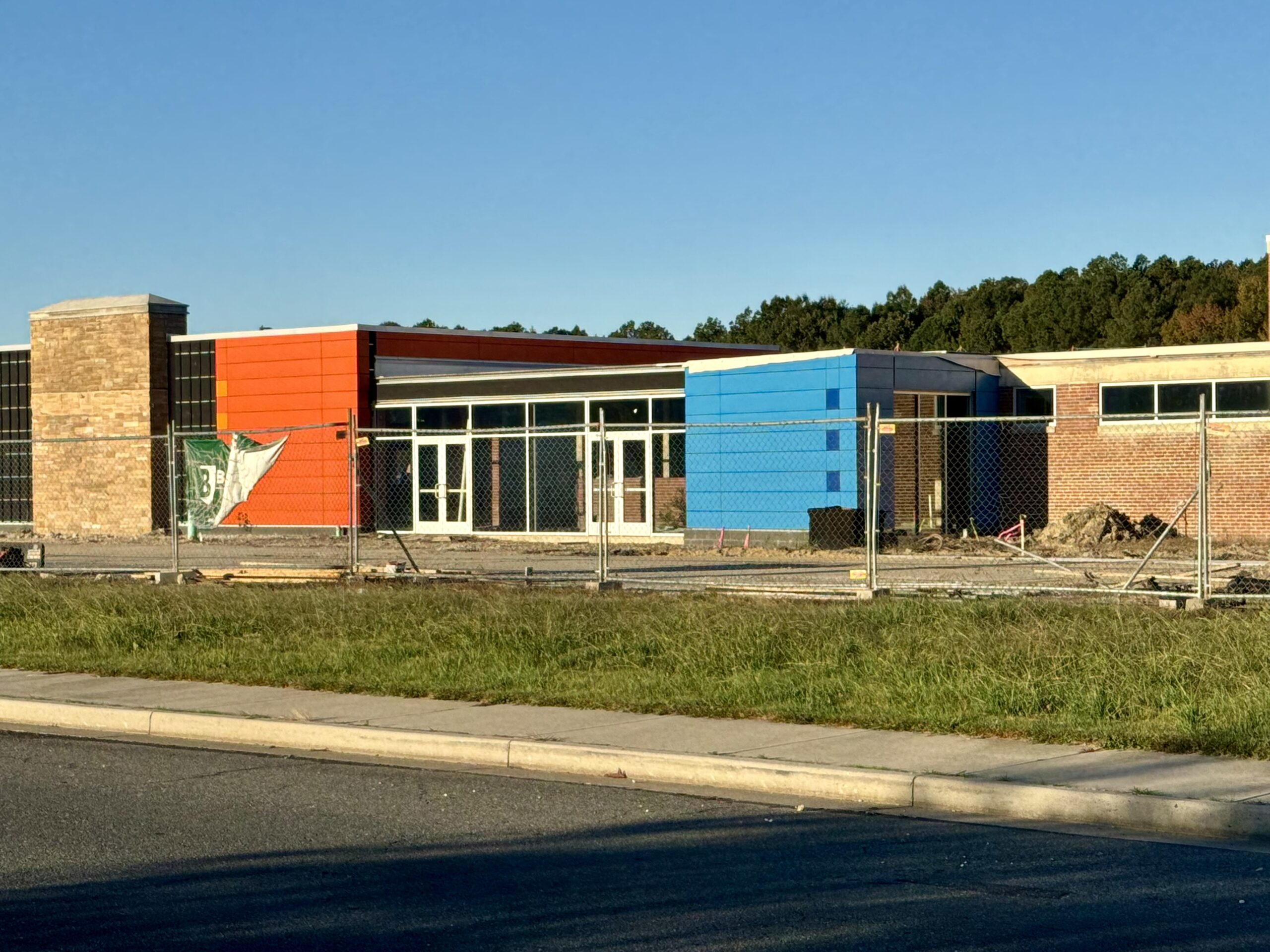
The Mace’s Lane Community Center is under construction.

After decades of dreams, years of planning, and a remarkable outpouring of community effort, the Mace’s Lane Community Center is less than a year from completion upon the bones of a landmark of segregation-era education. It will be a vibrant, state-of-the-art hub for families, recreation, and cultural pride.

The project, led by the nonprofit Mace’s Lane Community Center, Inc. (MLCC), represents both preservation and progress. Formed to save the 1952 Mace’s Lane High School building, MLCC’s mission has been to create a space where history, education, and community converge.

From Segregation to Transformation

For nearly two decades, Mace’s Lane High School was Dorchester County’s only such institution for African Americans. Integration in 1969 turned it into a junior high, and it later became a middle school, serving the community until 2004. Though the building fell silent, its alumni refused to let its legacy fade.

In 2017, the Mace’s Lane High School Alumni Association partnered with the Good Shepherd Association to form a steering committee exploring ways to revive the site. A year later, MLCC was incorporated as a nonprofit to Preserve, Inspire, and Empower—a vision soon to take physical form.

In April 2021, after extensive negotiations with the City of Cambridge and community partners, the Dorchester County Council approved a 99-year lease of the building to MLCC for $1, a symbolic step that set the project firmly in motion.

Breaking Ground and Building Momentum

In June 2022, then–Governor Larry Hogan joined local officials for the project’s groundbreaking, praising the determination that had brought it this far. “I know this project is fueled by the pride that this community feels, and by the desire to build an even brighter future for Cambridge.”

Plans unveiled at the ceremony called for a 26,000-square-foot community center anchored by a 16,000-square-foot Boys & Girls Club. The facility will feature a full-size gymnasium that doubles as an auditorium, classrooms, a tech lab, and flexible spaces for programs focused on academics, leadership, and wellness.

A highlight of the project will be the Edythe M. Jolley Museum & Cultural Center, honoring MLHS’s first principal. The museum will preserve the stories of the school’s teachers, students, and leaders who thrived despite segregation’s challenges, linking their legacy to the community’s ongoing pursuit of equity and empowerment.

The community center has doors!

Demolition and Renewal

By early 2023, construction crews began carefully removing deteriorated sections of the old school to prepare for renovation. That fall, Maryland’s U.S. Senators Chris Van Hollen and Ben Cardin announced $1 million in federal funding, helping propel the project toward its $15 million goal.

The road to completion has not been without obstacles, but progress in 2025 has brought the end within reach.

In July 2025, MLCC leaders announced they were lacking only $1.5 million of full funding, crediting partnerships with the city, the state, and organizations such as the Boys & Girls Club of Maryland.

Two months later, the City of Cambridge applied for an $800,000 Community Development Block Grant to help close the remaining gap. City Manager Glenn Steckman said the funds would allow final exterior work, including window and door installation, to be completed by late October. Additional contributions from public and private partners continue to pave the way for the Boys & Girls Club’s anticipated opening in summer 2026.

“I’m hopeful that by this time next year, we’ll see kids inside this historic structure engaged in meaningful programming,” said Cambridge Mayor Lajan Cephas-Bey. “While the museum remains part of the long-term plan, our top priority right now is getting children in the building for after-school programs.”

A Bridge Between Past and Future

The center is expected to serve more than 1,500 young people within a mile of the site. Residents say it will give neighborhood children new opportunities and restore a sense of pride to a historic corner of Cambridge.

“This is more than just a building,” said Cephas-Bey. “It’s about building social infrastructure for our young people, with the help of the Boys and Girls Club of Metropolitan Baltimore.”

The Mace’s Lane Community Center will honor the legacy of Black resilience on Maryland’s Eastern Shore while creating a living space where Cambridge’s youth can learn, grow, and dream—just as generations did in those same halls more than 70 years ago.

The Spy Newspapers may periodically employ the assistance of artificial intelligence (AI) to enhance the clarity and accuracy of our content.

Filed Under: Cambridge, 1 Homepage Slider

Who Framed You: A New Chapter on Harrison Street

October 15, 2025 by Val Cavalheri
Leave a Comment

It started with a bit of Beatles memorabilia:

“My strongest recollection,” said Richard Marks, “was ages ago walking into Easton’s premier framing shop, Lu-Ev Gallery, mostly known for framing Waterfowl Art with lithographs signed by John Lennon. The prints were from one of the 300 sets made as a wedding gift to Yoko. Lu-Ev framed five from the set beautifully”.

And, up until a few years ago, despite other framing choices, Lu-Ev was where you went to have things framed—artists preparing for Waterfowl, museum shows from across the Shore, or neighbors carrying in photos from graduations, anniversaries, and fishing trips. The faces behind the counter never changed much, and neither did the feeling. “To me, it was an anchor downtown,” Marks said. “And you knew the work there would be done professionally”.


The anchor began in 1946, when Lucille and Everett Henry opened Lu Ev Gift Mart, a tidy white storefront near the bank on Dover Street. “Framing wasn’t even part of the equation,” said Wayne Johnson, who would take over the business decades later. “They sold engraved invitations and greeting cards.” Everett, always tinkering, added framing a few years later, working out of a small shop near Hill’s Drug Store and carrying finished frames back across town for pickup.

It was a different Easton then—small, local, and stitched together by family businesses whose names everyone knew. After the war, Lu Ev was one of them.

By 1973, the Johnson family took over. They were not experienced farmers. In fact, they ran a bus company. “My great-grandfather started our transit company in 1921,” Johnson said. “We had 500 buses on the street in the district area.” When the Washington Metro absorbed the private lines in the early ’70s, the family looked for a new start. “Dad came up to Easton, walked into Lu Ev, met Everett Henry,” Johnson said. “Dad expressed interest, and Everett told him he wanted to retire.”

They bought the shop. “We knew nothing about it,” Johnson said. But his father loved finish carpentry, his brother Bobby could fix anything, and Wayne handled customers. They kept the invitations for a while, sending the engraving work out, but framing soon became the heart of the business.

“We bought molding by the length—twelve-foot sticks stacked along the wall—and cut every frame ourselves,” Johnson said. “With forty or fifty styles in stock, we could move fast. If the size was right, a customer could drop off a picture and we’d have it ready in a day.”


When suppliers began offering pre-cut molding—”chops,” as they were called—the business changed again. “There’s almost no waste in a chop,” Johnson said. “With length molding, there’s a lot of waste because there are imperfections.” The shop’s sample wall grew, and so did its reputation. Within a decade, Lu Ev needed more room.

“In less than ten years, we moved across the street,” Johnson said. “We went from about 1,500 square feet to 7,000.” The new space brought better tools—pneumatic nailers and pinners that turned 24-hour jobs into two-hour ones, a vacuum press, and the capacity to handle major projects for the Waterfowl Festival and the Academy Art Museum, as well as custom work for collectors and homeowners throughout the Shore.

“When we moved across the street, we became a legitimate art gallery,” Johnson said. “We had room to expand.”

Marks remembered that era. “When I moved here in 1976, most art was either a duck print or a decoy,” he said. “Waterfowl weekend was probably a month’s business in one weekend.”

Lu Ev became part of Easton’s rhythm. “We were approached once to close our store during Waterfowl weekend,” Johnson said. “I told them, we’re here 365 days a year—and you’re here for one.” He smiled. “This is Easton. We stay open.”

The people made the place. “We had Joanne—she worked 27 years,” Johnson said. “Another lady was Chris Barr, she worked 25.” Marks agreed. “Joanne was wonderful and helpful and knowledgeable,” he said. “She always gave great advice on mattes and frames and called to let me know when the work was finished.”

For 50 years, the sound of saws and the smell of fresh mat board never stopped. Then life changed. “In 2017, my youngest brother died,” Johnson said. “In 2022, my other brother died. We went from three down to one. Age catches up.”

By 2023, it was time. “I wanted something to happen to the business before something happened to me,” he said. “I did not want to sell it piece by piece.”

That’s when Marks stepped in.

He hadn’t planned to run a ‘shop.’ “The original intent of getting the equipment was knowing we needed another frame shop,” he said. “I can acquire the equipment and figure out the rest later.” Then local artists started calling. “They asked, could you carry art supplies?” Marks said. “A lot of them have special brands they like—quality they prefer that’s not always available. Some of it can be found online, but not all of it. People wanted more than just the big box stores; they asked for the local touch.”

That changed everything. If they were going to carry art supplies, they needed a visible storefront. When the former Trade Winds boutique closed, the space became available. “Alice Ryan and her family, who owned Trade Whims, were wonderful in helping with the transition,” Marks said. “Even some of the furnishings they left behind were useful.”

He also had help from the man who came before him. “We didn’t just buy the equipment from Lu-Ev,” Marks said. “Wayne came with the equipment—helping us get things set up, showing us how to operate it. He made the transition smooth.”

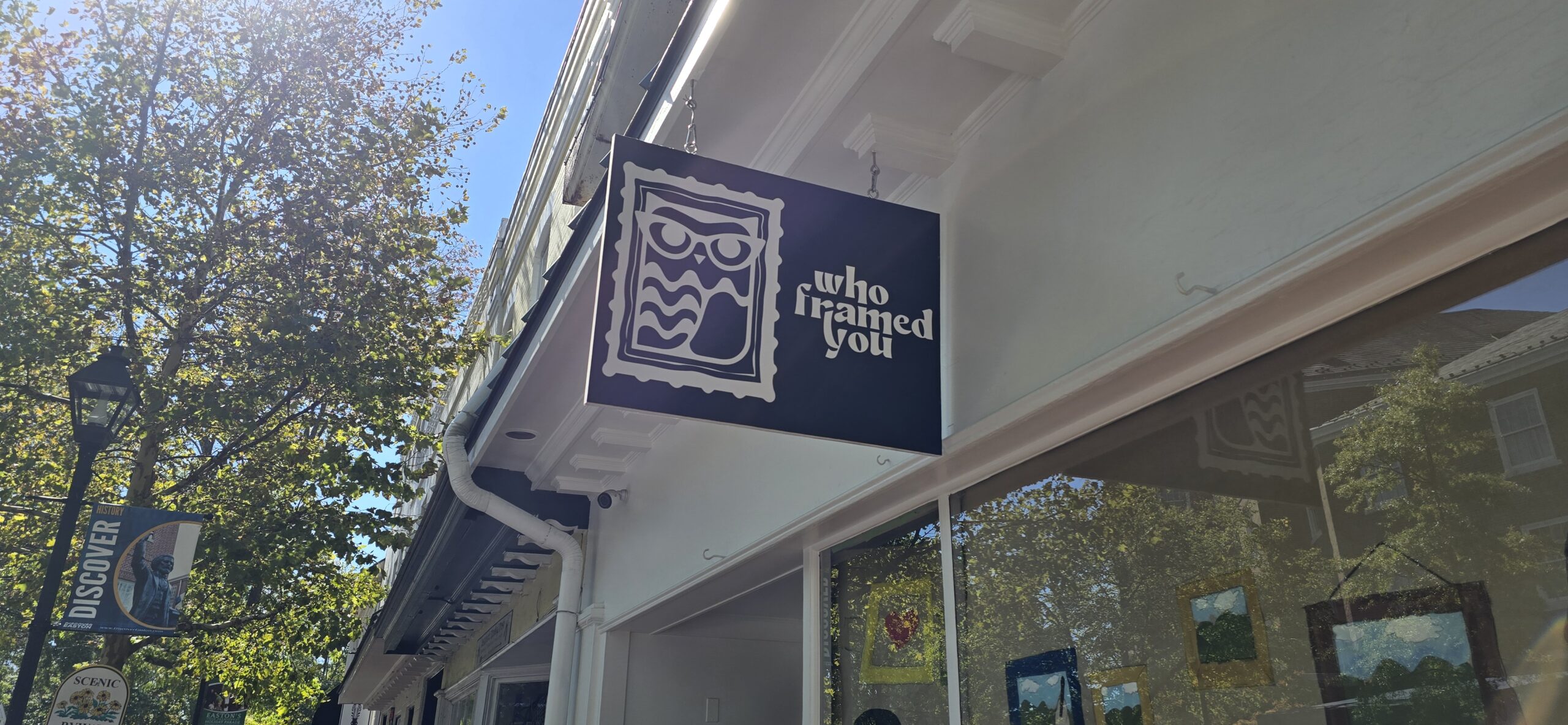
The new shop will open as Who Framed You, a name suggested by artist Shelton Hawkins. “My niece’s husband, a graphic designer in Asheville, did the logo,” Marks said. “I told him an owl would be cool, and I sent a picture of Amy wearing these funky glasses. The result fits perfectly.”

Marks’s team includes familiar faces. “Artist Cheryl Southwick is amazing—she framed for years at the Academy Art Museum,” he said. Also joining are Taylor Wheatley and Kearson Harnon, both former Michaels managers who know the ropes. “We could not be more fortunate to have assembled such an incredible team.”

The shop is now open, with a ribbon-cutting ceremony planned for October 20. “Even though we do not have a complete art supply inventory yet, we want to be ready for Waterfowl and the holidays,” Marks said. “Our focus will be on custom framing, curated art supplies, and quick turnaround. We hope folks recognize that small business is part of the fabric of the community and are banking on the loyalty small towns still have for small stores, but know we still need to be competitive.”

If there’s a thread running from 1946 to today, it’s continuity—of craft, of people, of care. Johnson put it: “We were very fortunate to have good people. That’s what kept it going.” Marks agreed. “Good things come together when good people work together,” he said.

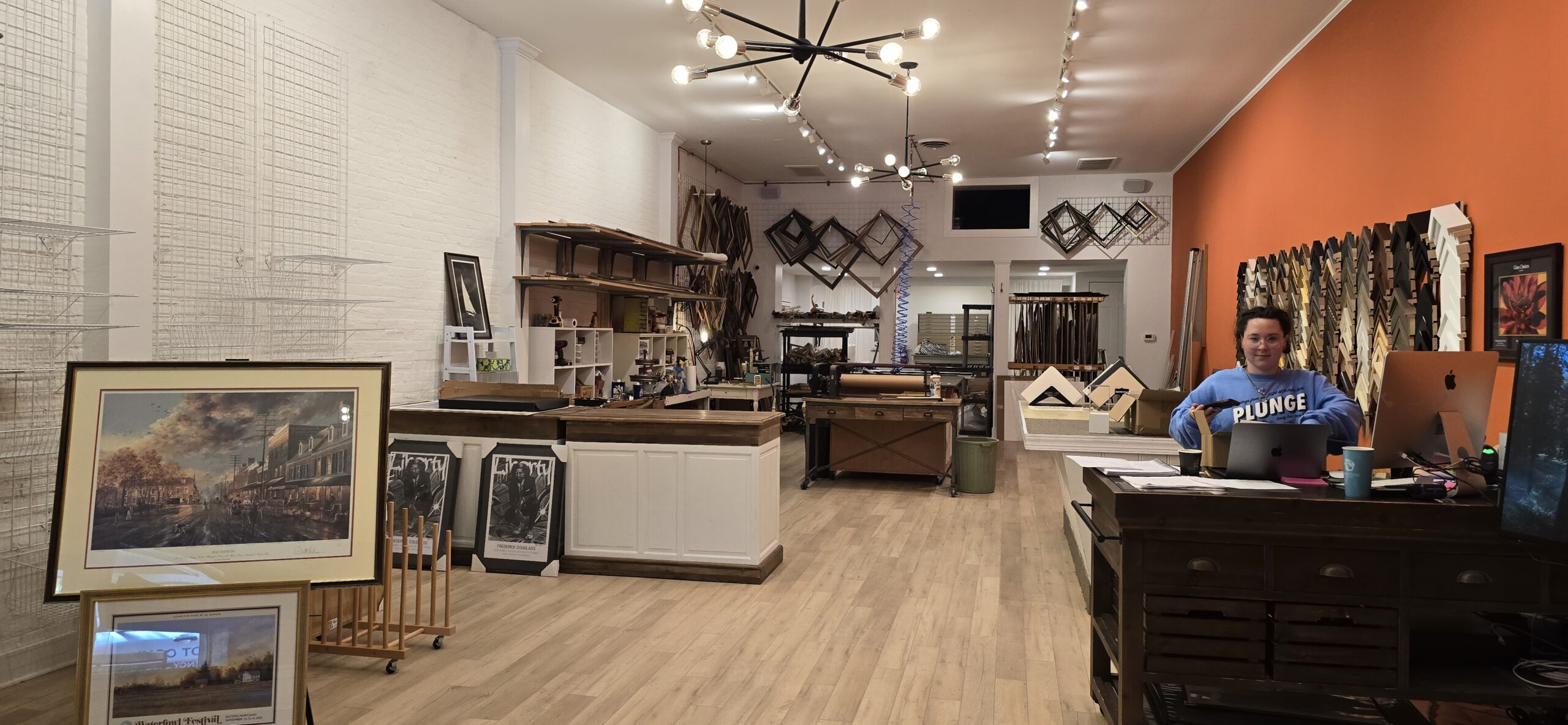
The framing lights are on again, though not in the old Lu Ev building. Who Framed You has opened around the corner at 11 North Harrison Street. New space, but with the same tools, the same craft, and the same care that framed Easton’s history for nearly fifty years. Inside, the scent of fresh matte board returns. Hands accustomed to the craft are at work. The name on the door is new, but the soul of the business endures.

Val Cavalheri is a writer and photographer. She has written for various publications, including The Washington Post.  Previously, she served as the editor of several magazines, including Bliss and Virginia Woman. Although her camera is never far from her reach, Val retired her photography studio when she moved from Northern Virginia to the Eastern Shore a few years ago.. She and her husband, Wayne Gaiteri, have two children and one grandchild.

The Spy Newspapers may periodically employ the assistance of artificial intelligence (AI) to enhance the clarity and accuracy of our content.

Filed Under: 1 Homepage Slider

Near-Miss Miracles By Laura J. Oliver

October 12, 2025 by Laura J. Oliver
Leave a Comment

It is October, the month in which both my daughters were born. I guess back in March of the year in which each was conceived, I thought that to have an autumn birthday in Maryland would be to celebrate the rest of your life in the prettiest month of the year, and somehow that worked out not once, but twice.  

We lived in a neighborhood that had long been a working-class fishing community but as waterfront property became coveted by Washington professionals willing to commute, the peninsula was becoming slowly gentrified. At the time we brought our firstborn home, however, it still possessed an eclectic diversity we were drawn to as young adults, but worried about now that we were parents. There were sirens at night, and once, gunfire right down the street. 

We pulled up in front of our white stucco Victorian with the picket fence I’d painted in the last days of my pregnancy, and I lifted my two-day-old daughter from her car seat for the first time. This was to be a private homecoming, with my mother arriving after we got settled to make us her Hawaiian chicken for dinner. Unfortunately, I hadn’t anticipated Mrs. Rosman next door. She was old and eccentric, unkempt in an unpleasant way, and her silent, staring husband was very strange. I was young and superficially friendly but kept my distance.  

What I didn’t know was that she had been waiting for this moment since seeing me lowered gingerly into the passenger seat of the car and an overnight bag stowed in the back. She emerged from her house with the sagging sofa on the porch, and hobbled out onto the sidewalk, her thin hair lifting in the breeze. 

“Let me see the baby,” she demanded. She stared critically at the little face. “Well, what is it?”

“It’s a girl,” I said, leaving the blanket partially covering the baby’s mouth like a miniature surgeon’s mask. I smiled and tried to turn away, to get to the safety of my own front door, when Mrs. Hosfeld’s claw-like hand grabbed my arm and twisted the baby towards her. She lowered her face and planted a big, wet, germ-laden kiss right on my new baby’s face. Hormones surging, ready to cry at everything, and completely irrational, I was horrified. “Oh my God,” I thought, with all the sense of the sleep-deprived, “She just ruined my baby!” 

Once in the house, I needed to take a shower. Should I bring the baby into the bathroom with me? The idea of not being in the same room seemed intolerable, like breaking the law. I think I thought I had to carry her around in her carrier like a purse.

Over the next few weeks, I realized protecting my daughter was more immediate, more irrational, and more primal than love. The need to keep her safe, encountered for the first time there on the sidewalk, was the first fierce attachment I had felt as an adult. It was in the following days of feeding, rocking, diapering, and bathing that protection took on its true identity, which was, of course, profound and abiding love. I have thought about this often since then, having learned that love can be inspired by service, not the other way around. But there was another lesson here. 

Sometimes we are the recipients of miracles and too distracted or oblivious to notice. It is only years afterward that it dawns on us that, but for an alert stranger on the beach, we might have drowned, or two seconds later into that intersection, we might have crashed. 

So, it was years later that I realized I had not thanked God for the biggest miracle in my life. 

The night this child was born, I’d been in prodromal labor for the preceding 24 hours, where you suffer contractions hour after hour that do not move the baby down. Eventually hospitalized, with some intervention, labor finally became productive, but she was a very large baby and had been unceasingly active in the womb most of those nine months.

 By 3 am, I’d been pushing for two hours, and my doctor wanted to leave for a hunting trip on the Eastern Shore in the morning. The decision was made to use forceps for the last couple of pushes to get this show (and him) on the road. It worked. But until that moment, no one realized that the umbilical cord had been wrapped tightly around the baby’s neck throughout the entire ordeal. Not wrapped around once. Not twice. But cinched around her tiny neck three times like a belt, strangling her through all those crushing contractions and hours of pushing. 

“Jesus!” the nurse exclaimed as the doctor uncoiled loop after loop after loop. 

They put her in my arms, and all I saw was a perfect baby. It didn’t occur to me then or for years how easily we could have lost her. And it makes me want to heap retroactive gratitude upon the universe for sparing me that near-miss tragedy and for giving me that joy. 

How many miracles have gone unheralded? Having missed this one, I’m assuming on principle that my life and yours have been flooded with them.

 Like having been lucky enough to live next door to an elderly lady who had waited all night and all day to welcome home the new little life next door. Who gave the only thing she had to give: a kiss. 

And just like learning that service generates love, retroactive gratitude is now a continuous wave, a spiritual practice, especially in October, when I find myself saying thank you for the gifts I recognize, like you, beloveds, and for all those I will become aware of in the fullness of time. 


Laura J. Oliver is an award-winning developmental book editor and writing coach, who has taught writing at the University of Maryland and St. John’s College. She is the author of The Story Within (Penguin Random House). Co-creator of The Writing Intensive at St. John’s College, she is the recipient of a Maryland State Arts Council Individual Artist Award in Fiction, an Anne Arundel County Arts Council Literary Arts Award winner, a two-time Glimmer Train Short Fiction finalist, and her work has been nominated for a Pushcart Prize. Her website can be found here.

The Spy Newspapers may periodically employ the assistance of artificial intelligence (AI) to enhance the clarity and accuracy of our content.

Filed Under: 1 Homepage Slider, Laura

  • « Previous Page
  • 1
  • 2
  • 3
  • 4
  • 5
  • …
  • 105
  • Next Page »

Copyright © 2025

Affiliated News

  • The Chestertown Spy
  • The Talbot Spy

Sections

  • Arts
  • Cambridge
  • Commerce
  • Ecosystem
  • Education
  • Food & Garden
  • Health
  • Local Life
  • News
  • Point of View
  • Senior Nation

Spy Community Media

  • Subscribe for Free
  • Contact Us
  • COVID-19: Resources and Data

© 2025 Spy Community Media. | Log in