MENU

Sections

  • About Us
    • Editors and Writers
    • Sponsorship Terms & Conditions
    • Code of Ethics
    • Sign Up for Cambridge Spy Daily Email Blast
  • The Arts and Design
  • Culture and Local Life
  • Food & Garden
  • Public Affairs
    • Commerce
    • Health
    • Ecosystem
    • Education
    • Senior Nation
  • Point of View
  • Chestertown Spy
  • Talbot Spy

More

  • Support the Spy
  • About Spy Community Media
  • Advertising with the Spy
  • Subscribe
December 7, 2025

Cambridge Spy

Nonpartisan and Education-based News for Cambridge

  • About Us
    • Editors and Writers
    • Sponsorship Terms & Conditions
    • Code of Ethics
    • Sign Up for Cambridge Spy Daily Email Blast
  • The Arts and Design
  • Culture and Local Life
  • Food & Garden
  • Public Affairs
    • Commerce
    • Health
    • Ecosystem
    • Education
    • Senior Nation
  • Point of View
  • Chestertown Spy
  • Talbot Spy
1 Homepage Slider

Design with Jenn Martella: The New Welcome Center at CBMM

December 21, 2022 by Jennifer Martella
Leave a Comment

My first introduction to the Chesapeake Bay Maritime Museum was during a visit to my sister over the July 4th weekend in 2003.  We joined the throng of people passing through CBMM’s entrance gate and found a spot to enjoy our picnic before the Fireworks Display began. As twilight became night, the lights on the masts of the boats in the harbor were soon joined by the spectacular light show in the sky.  After I moved to Talbot County in 2004, I have returned many times to enjoy the exhibitions and events held throughout the year that celebrate our unique area’s history and culture from the Eastern Shore Sea Glass & Coastal Arts Festival, the Antique & Classic Boat Festival & The Arts at Navy Point, Big Band Night & Fireworks, Watermen’s Appreciation Day, Charity Boat Auction, Boating Party Fundraising Gala, Mid-Atlantic Small Craft Festival and Oysterfest.  

From its beginning on Navy Point fifty-seven years ago, the CBMM has grown to an eighteen acre complex along the Miles River leading to Chesapeake Bay. The historic Hooper Strait Lighthouse resting on its foundation of screw pilings is my favorite building. I was surprised to learn that the lighthouse’s original site was sixty miles south and that the US Government had condemned the deteriorated building. The Lighthouse’s  fate appeared to be demolition but through the efforts of the one year-old CBMM, the building serenely traveled by barge to its new home and was lovingly restored.  The Lighthouse now overlooks a campus of thirty-five other buildings. Twelve buildings contain exhibits that are open to the public and during my first visit, my favorite display was a row of blocks of wood showing the evolution from the initial block to a finished waterfowl. 
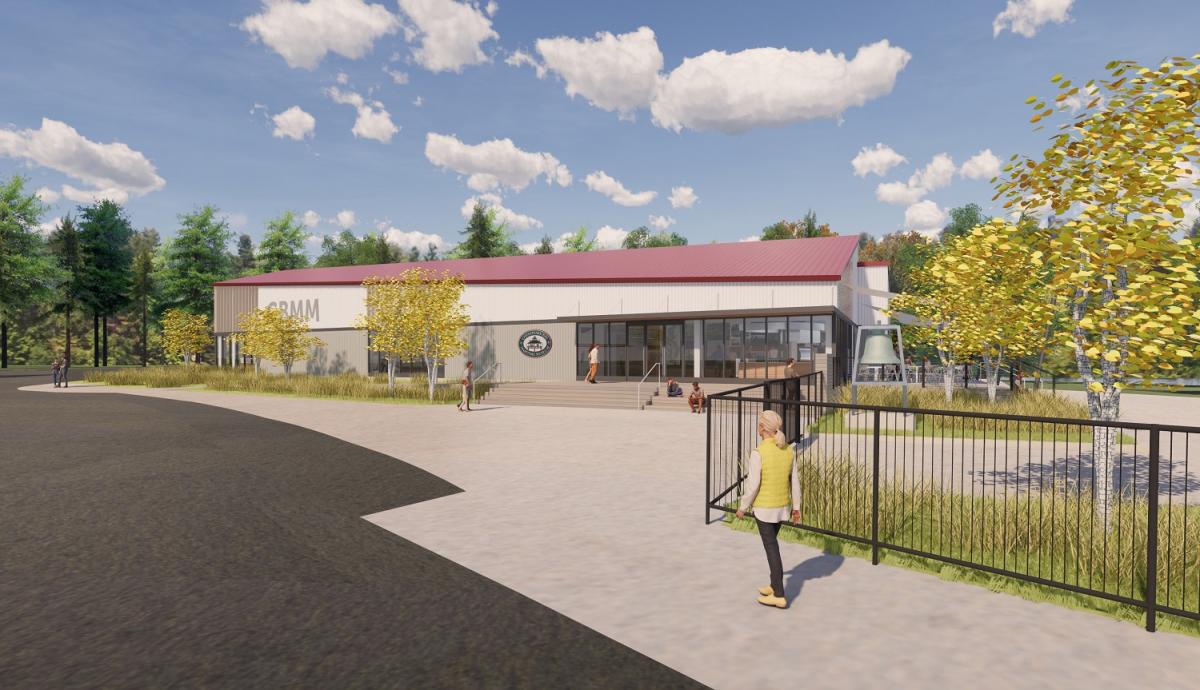
The expanded mission of CBMM and the steady increase in yearly visitors resulted in the beginning of a planning process and fundraising that culminated in the CBMM’s retaining the firm of Annum Architects to guide the visionary and strategic planning process. The firm is based in Boston and has special expertise in master planning and design of academic, civic and cultural buildings. For the CBMM, the Annum Architects analyzed and explored the location of proposed new buildings, parking areas, infrastructure upgrades, wetlands revitalization, boardwalks and docks. Arrival, wayfinding, and pedestrian flow have been reimagined to create a welcoming, accessible, and logical walking sequence.

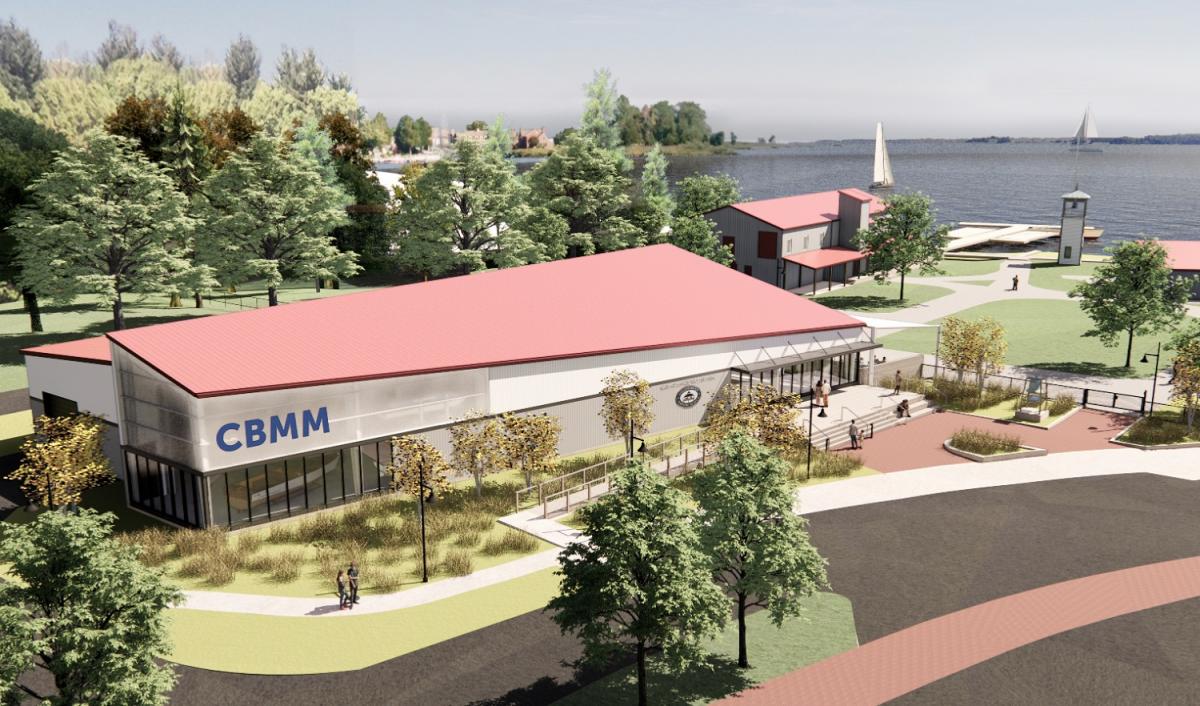
Creating a cohesive master plan of the eighteen acre site and thirty five buildings has been a unique challenge. The most important component of the plan is the new Welcome Center, which broke ground this summer. When I reviewed the Master Site Plan, I admired how the front wall of the new building was sited parallel to the existing parking lot off Talbot St. that created a diagonal vista through the site to the Lighthouse. The front façade with its giant CBMM letters will be a wayfinding beacon for visitors as they move through the site. The new Welcome Center is sited on the highest point of the campus to protect it from tidal surges and hurricanes. Visitors will enjoy direct accessible access from the parking lot for a one-stop entry and exit from the campus. 
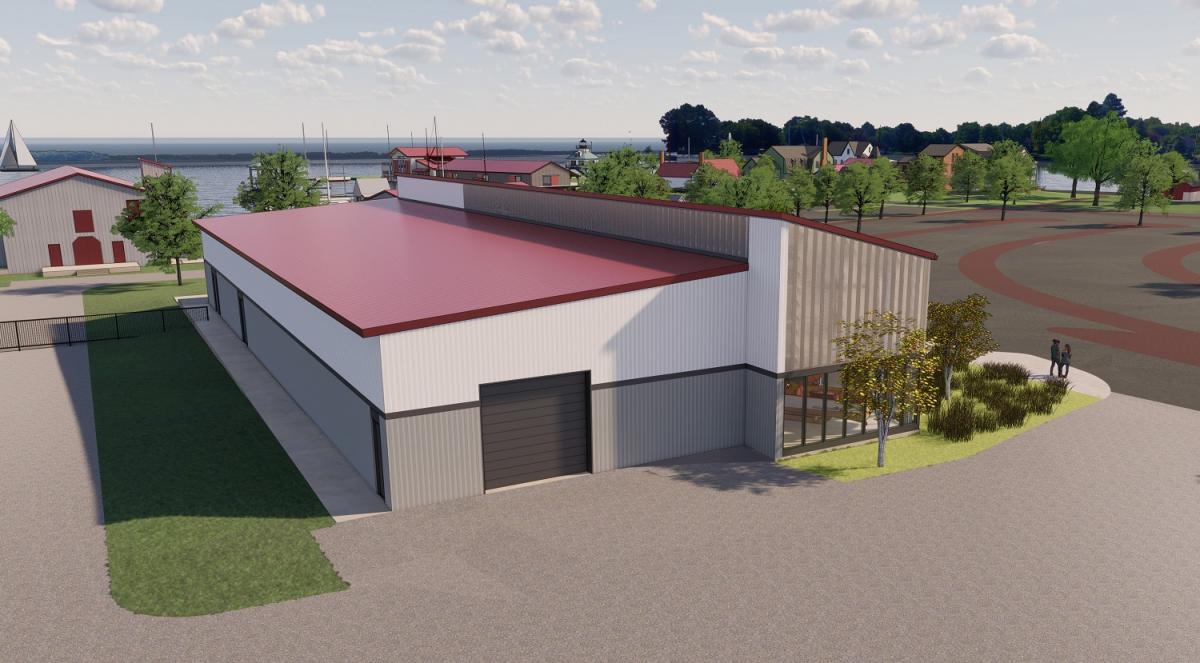
The shape and red roof of the new building pays homage to the rural vernacular forms of barns and sheds of the existing buildings, interpreted with a contemporary flair.  The building’s massing is created by the juxtaposition of two single sloped forms of different heights that creates a clerestory for the higher form.  The building’s structure is a combination of pre-engineered building components, customized for the Welcome Center’s needs. The cladding for the building is a combination of insulated metal panels, translucent polycarbonate panels and glazing with a color palette of white, light gray and dark gray walls.  
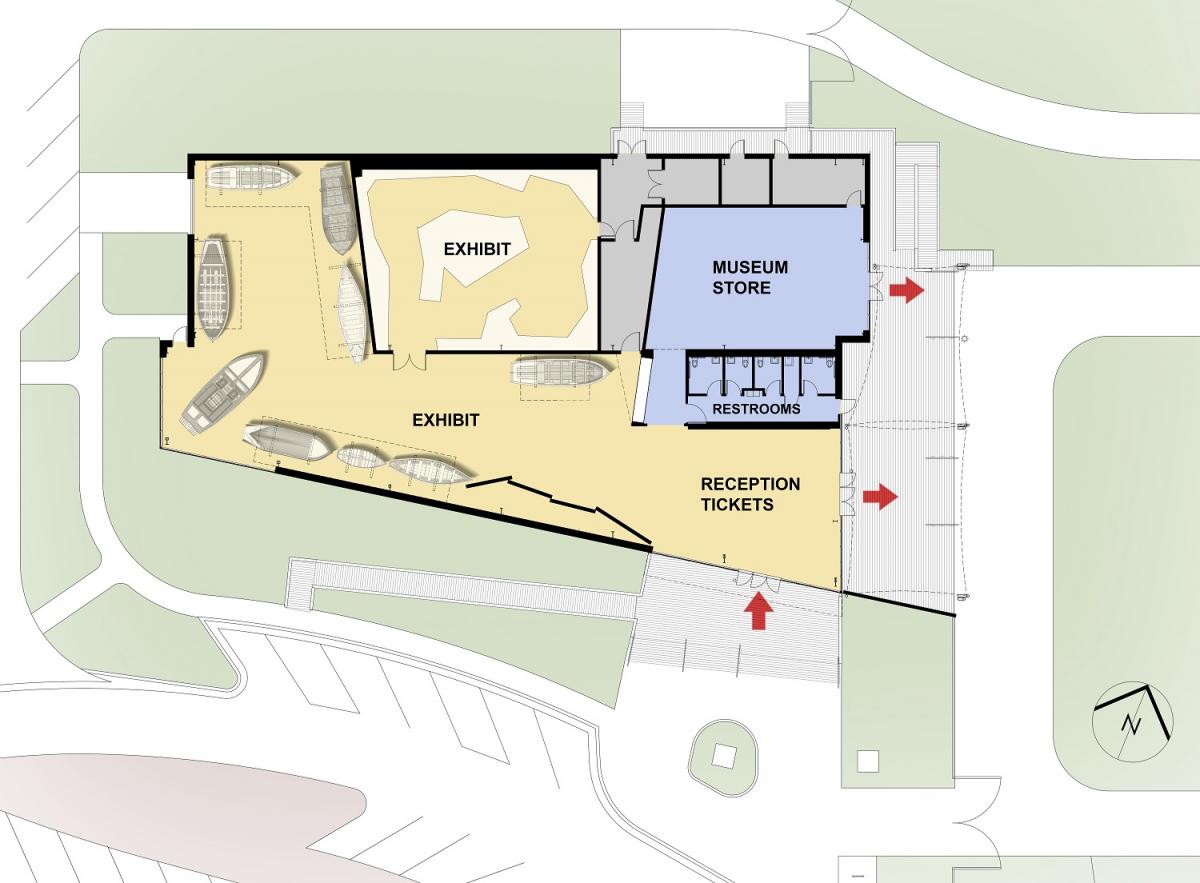
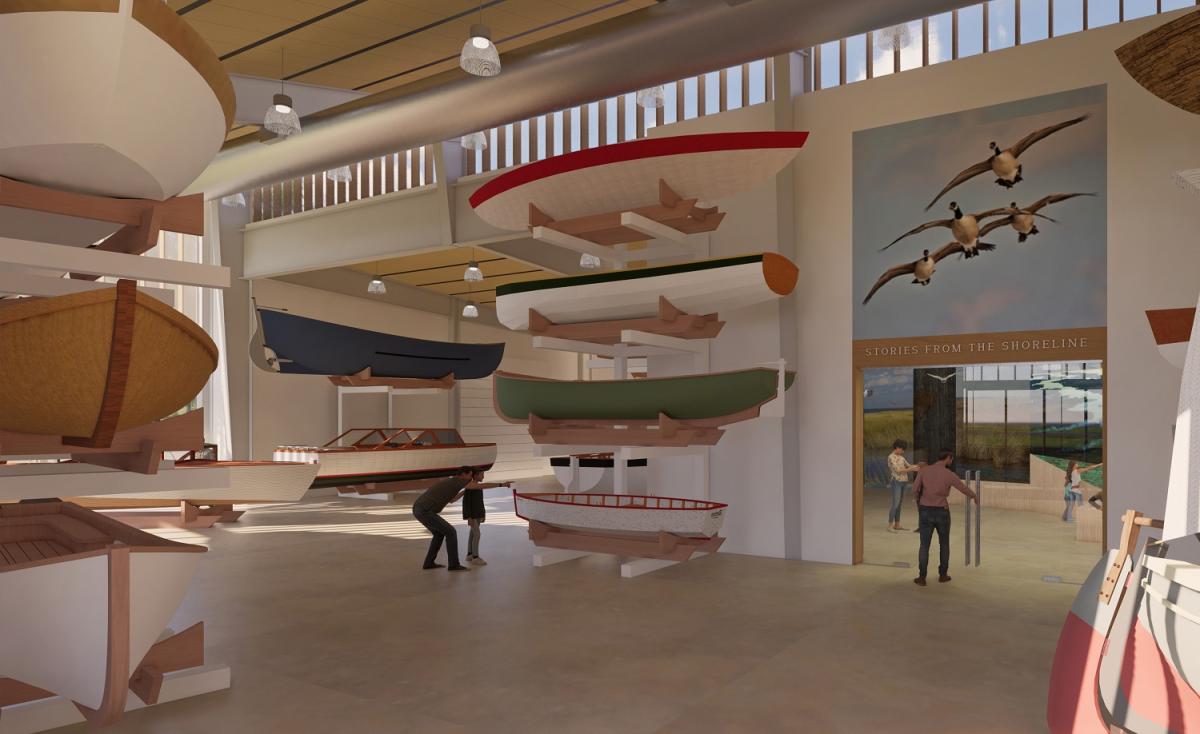
The one-level building will be fully ADA-accessible and will contain a reception/orientation/ticketing area, restrooms, Museum Store, coffee station and two exhibition spaces. The architects’ clever interiors included the map of the Chesapeake Bay into the concrete floor. 
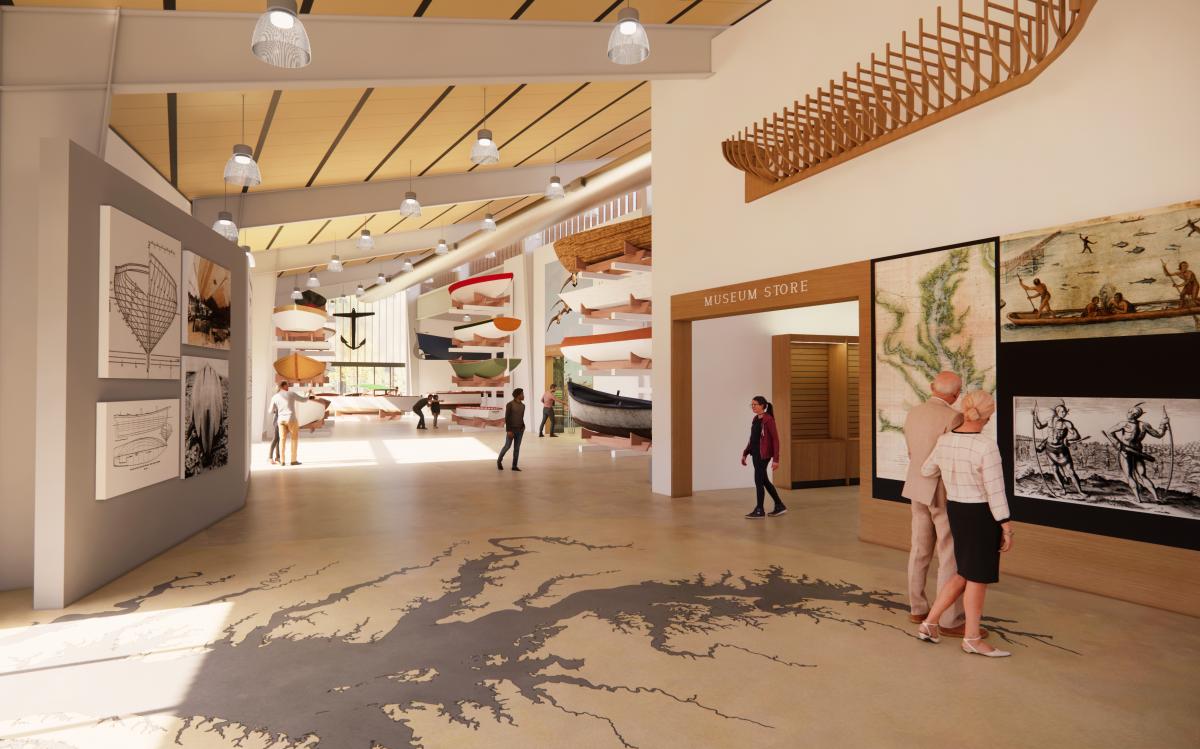
The high-ceiling gallery will showcase the Museum’s collection of historic watercraft, many of which have never been on display. The lower-ceiling gallery will provide a more intimate and climate-controlled setting for the Museum’s “Stories from the Shoreline” exhibit. 
At the side elevation facing the water, there will be a terrace that spans the full width of the building. This outdoor room will be covered by tensile fabric sail canopies for shade and rain cover as needed for visitors. The deck then shortens to become another ADA ramp and a walkway around to the exit door at the exhibit area.

Designed to fulfill the needs of greater CBMM community, the new Welcome Center will be the next step in the implementation of the Master Plan. Funding for continued Master Plan improvements come from individual donations and naming opportunities, grants, and operations. 

The Chesapeake Bay Maritime Museum, https://cbmm.org/, 410-745-2916 Annum Architects, annumarchitects.com , 617-226-1612

Jennifer Martella has pursued her dual careers in architecture and real estate since she moved to the Eastern Shore in 2004. Her award winning work has ranged from revitalization projects to a collaboration with the Maya Lin Studio for the Children’s Defense Fund’s corporate retreat in her home state of Tennessee.


The Spy Newspapers may periodically employ the assistance of artificial intelligence (AI) to enhance the clarity and accuracy of our content.

Filed Under: 1 Homepage Slider

Design with Jenn Martella: On High Street Before Renovation

December 15, 2022 by Jennifer Martella
Leave a Comment

Earlier this fall, I wrote a tribute to the architect Peter Newlin, FAIA, which included images of his award winning houses that have also been Houses of the Week in the Chestertown Spy. Each house bore the imprint of his longtime collaborator and master carpenter, Patrick Jones, who has now formed Jones and Jones LLC, with his sister Kathleen. Their passion and focus is restoration and renovation of Chestertown’s older properties so these houses can once again proudly take their place in the Town’s streetscapes. 

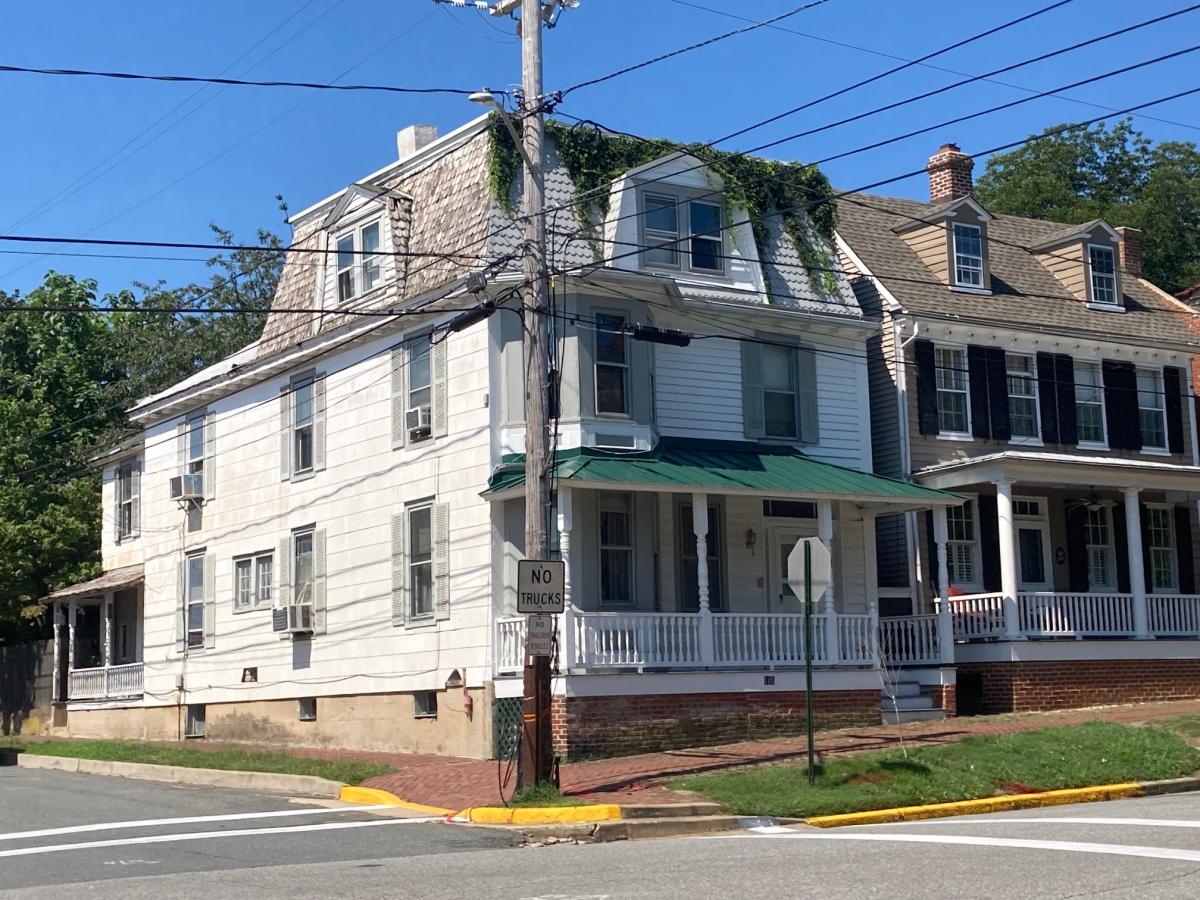
They first renovation is now a rental property. Their next project was a “House of the Week” feature on Cannon St., about which I wrote “before” and “after” articles. That house has since sold and now this talented duo is taking on their most ambitious project, the renovation of a two and a half story house at the corner of High and Water Streets. When they called to tell me they were ready for my “Before” visit, I eagerly made an appointment to see it. 

The house sits on a prominent corner of a streetscape of houses that have been renovated so this house will soon once again proudly take its place as one “bookend” of the block. The architectural style of the front elevation is primarily Second Empire, with its mansard roof, asymmetrical composition of the double unit window dormer at the third floor, the bay shaped projection at the front corner of both the first and second floors, windows and doors next to a single window on the second floor that do not align with the single window or door at the first floor. 

The original part of the house was the mansard roofed section at the front corner with one addition that blends into the original house and the second addition at the rear that is stepped back slightly for a shallow covered porch for access to the rear yard. The side elevation is simply articulated with single  2/2 windows between shadows of former shutters. 

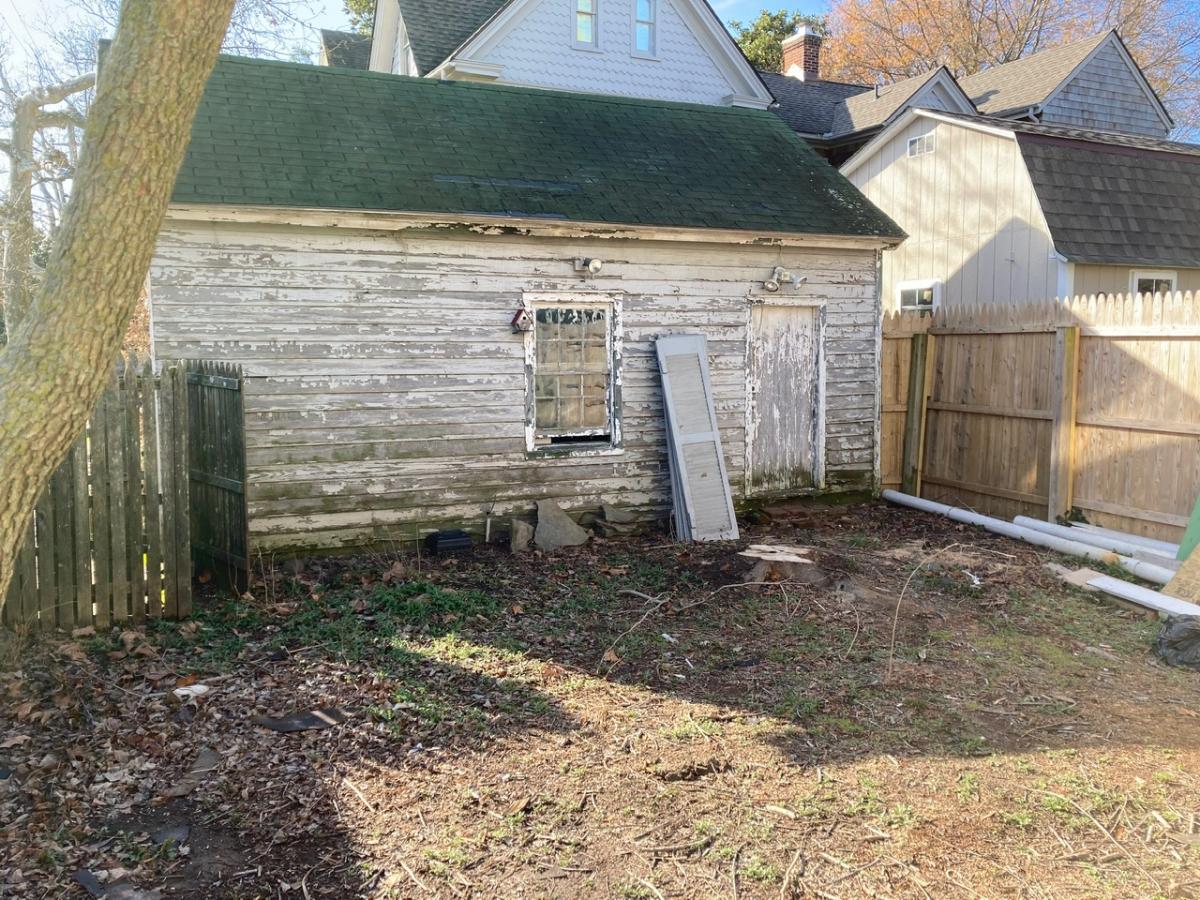
Between the house and the one-car garage with attic storage is a fenced yard that could easily be transformed into a private urban garden. Along the second addition is a shallow covered porch that connects the house to the rear yard. 

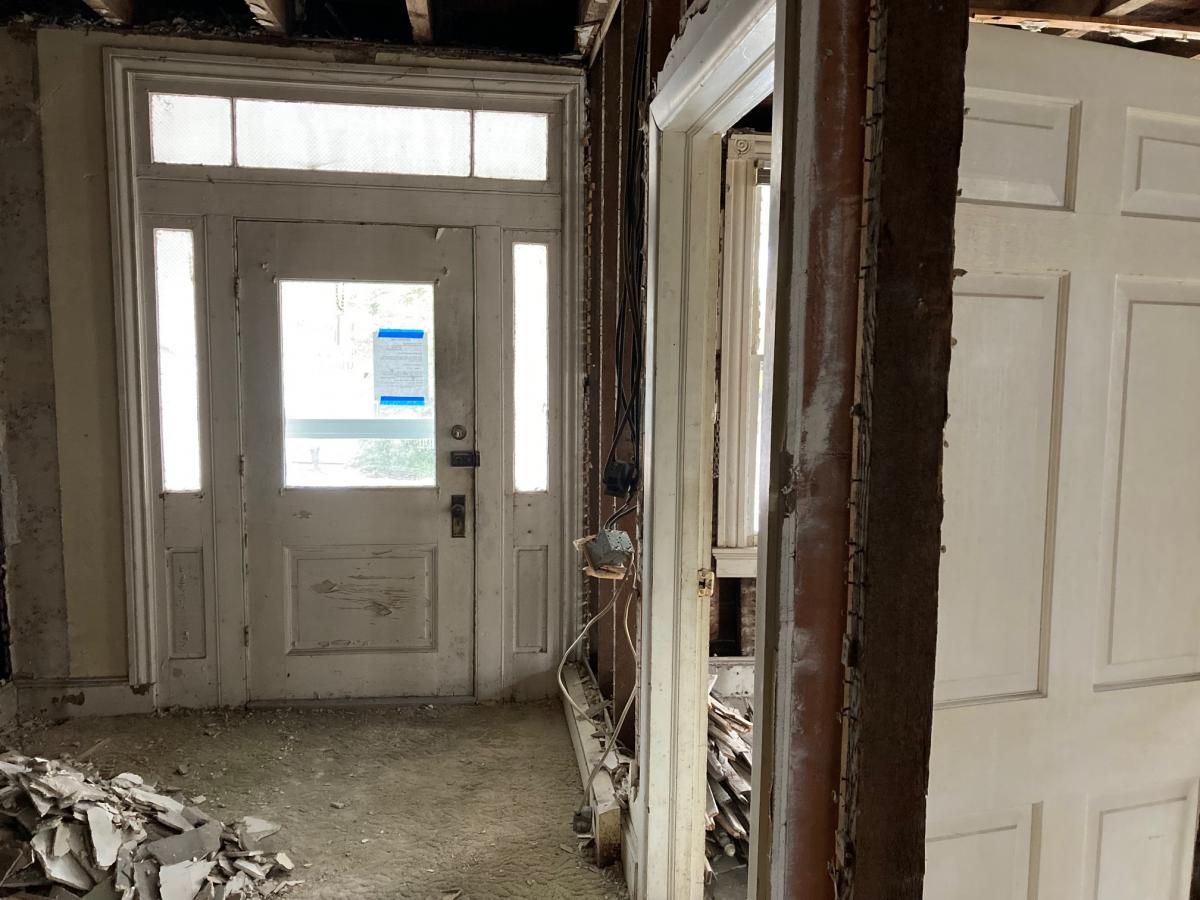
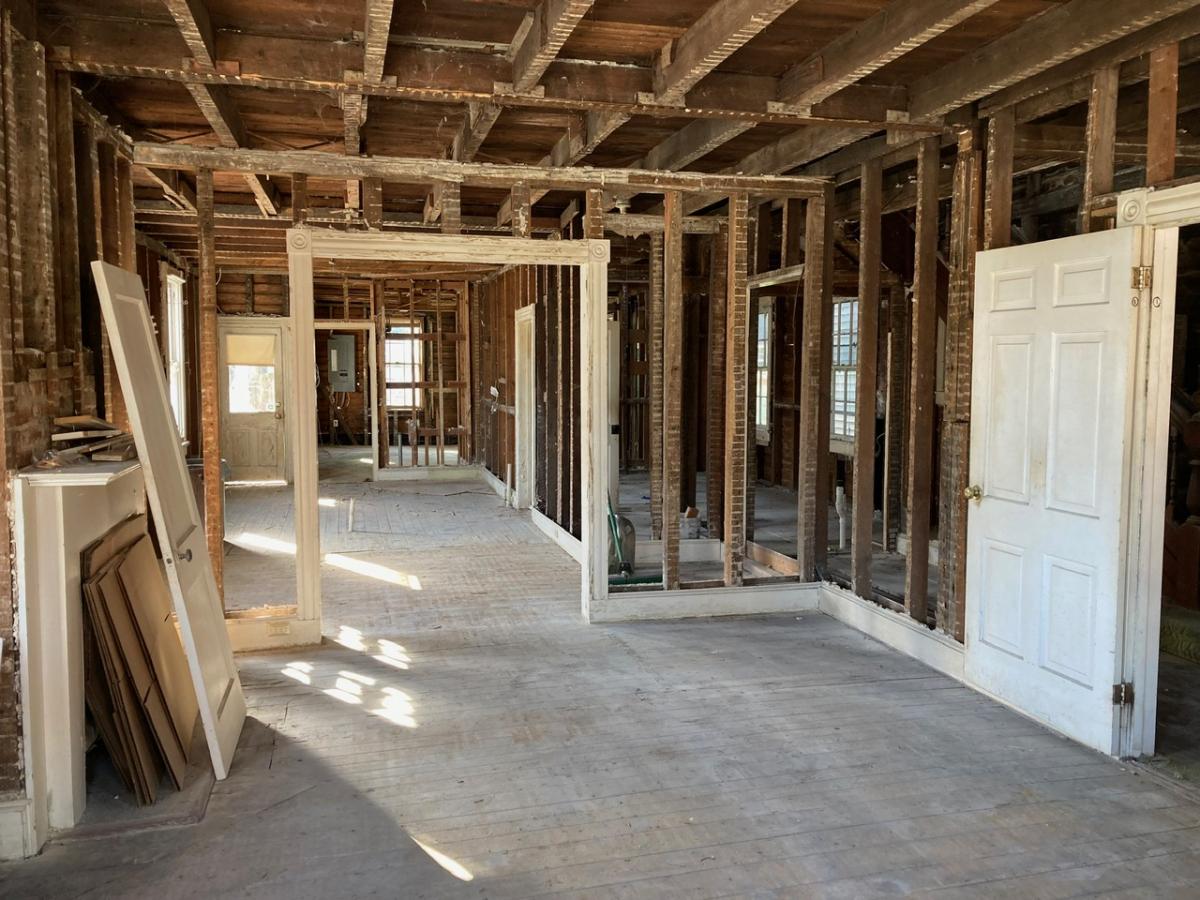
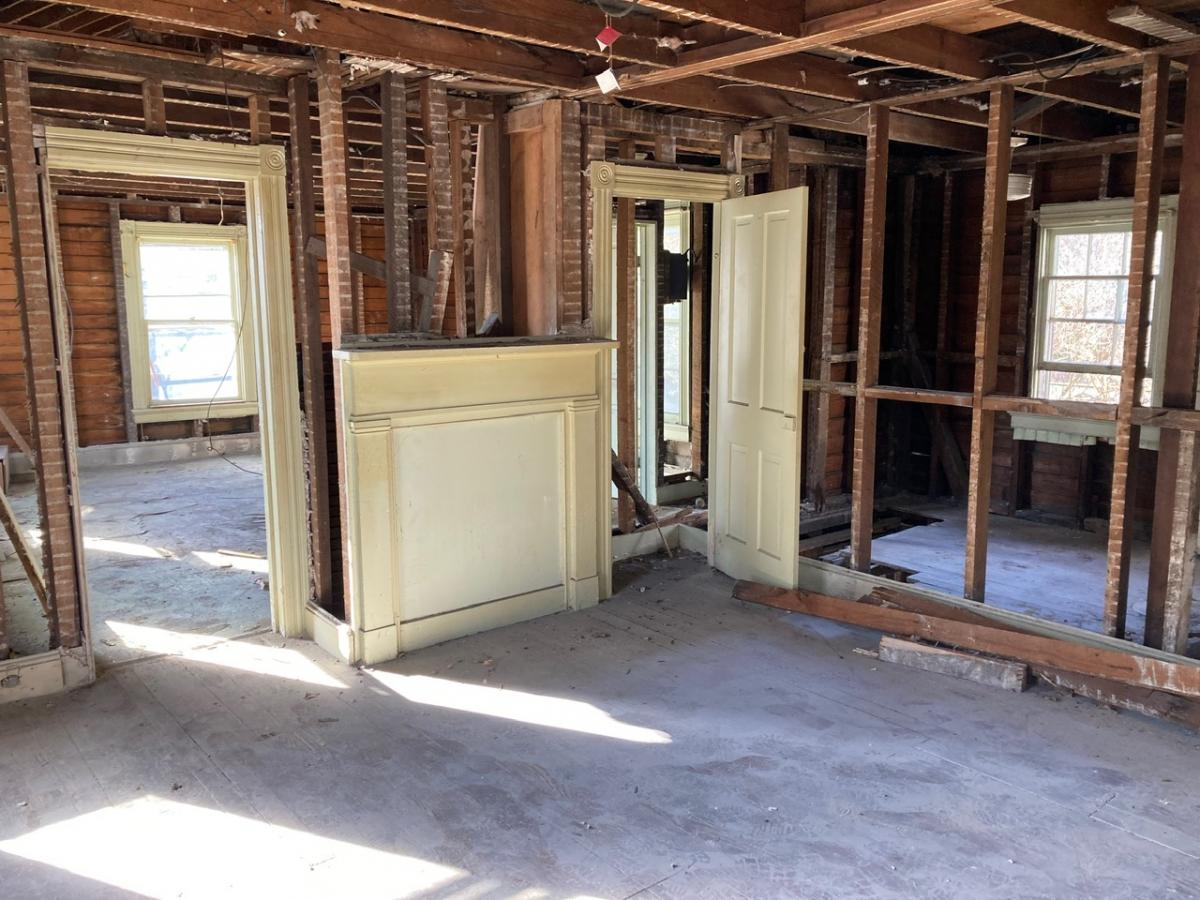
Kathleen and I entered the house from the front porch with broad views across the parking lot at the end of High St. and the Chester River down to the bridge, now that the deciduous trees have shown their leaves. We passed through the original half glass/half carved wood front door with fleur de lis details at the top trim, so fitting for an architectural style that pays homage to the reign of Napoleon III of France. The original staircase rises to three floors and mercifully it has it original stained finish. Like their other projects, this house is now stripped down to the studs and flooring with the original baseboards, window and door trim intact. Their painted finish stands out against the exposed wood framing. Unlike their last project, this house has both a basement and an attic so new HVAC, electrical and plumbing can be easily installed. 

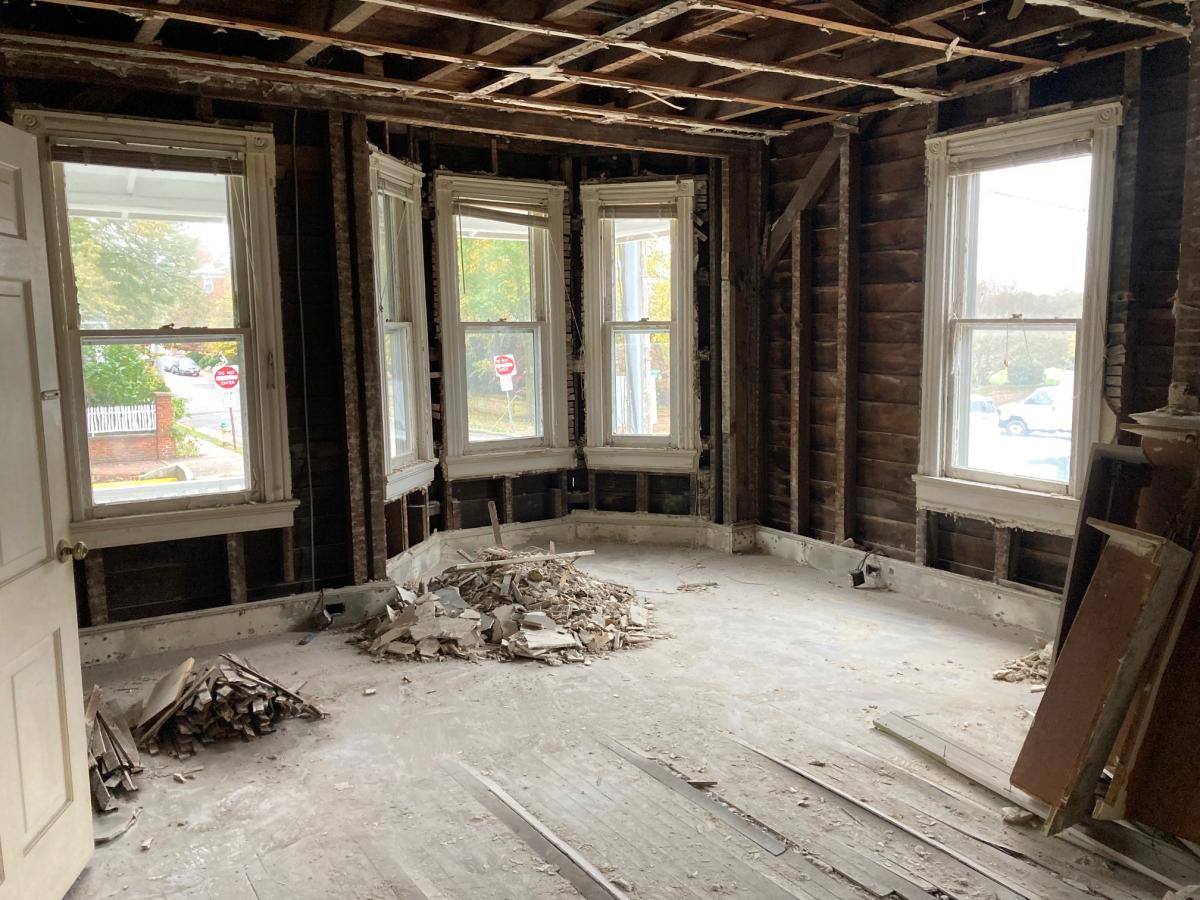
With the studs exposed now to show vistas through the house, I enjoyed discussing the renovation possibilities with Kathleen. The house is two rooms wide, four rooms deep with the single rear room centered on the width of the house. Wide wall openings define the living room off the foyer and the adjacent dining room leading to the kitchen. We both gravitated to the bay window at the front of the living room and admired the panoramic views of the surrounding stately homes and views of the river. 

At the rear wall of the kitchen is an exterior door to the side porch that leads to the rear room formerly used as a bedroom. Next to the kitchen and closets behind the foyer is another room with two windows at the side wall that was also used as a bedroom. For better flow, I suggested removing the closets behind the foyer so the side room could become the dining room, opposite the kitchen. Part of the kitchen could become a breakfast area, butler pantry, or both. The rear room could either become a family room but it would be a perfect master bedroom. Kathleen said she and Patrick thought so too and they plan to add a French door between the two single windows at the rear wall overlooking a future garden or hardscape with potted plants. The rest of the floor could easily accommodate a closet and dedicated full bath for the rear room and a powder room off the foyer for guests.

The second floor has four rooms along the front and side of the house opposite the hall next to the stairs and bath. Since this is a corner lot, there are unobstructed views of the streetscape and the river. The front bedroom with the bay projection would be another option for the primary bedroom with the bed set into a deep alcove for views of the water. The second bedroom could become the primary bath and closets for the primary bedroom. The side and rear bedroom could share the hall bath with a “Jack and Jill” layout. 

The boxy form of the mansard roof maximizes the extent of the third floor’s useable space. This part of the original house offers myriad possible uses-office, teen room, storage, etc. I recommended to Kathleen that she and Patrick include stacked closets in their final layout so an elevator could be installed in the future, which could be an appealing selling point. 

With the former asbestos siding removed, the siding is in good shape and ready for minor patching, sanding, paint and new shutters. I am especially looking forward to touring the finished house to report on its “after” state that will be fully renovated and move-in ready!

For more information about this property, contact Patrick Jones or Kathleen Jones at 410-708-2534 or [email protected].

Jennifer Martella has pursued her dual careers in architecture and real estate since she moved to the Eastern Shore in 2004. Her award winning work has ranged from revitalization projects to a collaboration with the Maya Lin Studio for the Children’s Defense Fund’s corporate retreat in her home state of Tennessee.
The Spy Newspapers may periodically employ the assistance of artificial intelligence (AI) to enhance the clarity and accuracy of our content.

Filed Under: Design with Jenn Martella

Design with Jenn Martella: Tilghman Treasure

December 7, 2022 by Jennifer Martella
Leave a Comment

This house caught my eye for its eclectic mix of styles from the Victorian spindle work at the front porch columns and along the eaves of the two-story front gable, and the Queen Anne steeply pitched roof over the asymmetrical façade and turret at the corner created by short wall segments infilled with windows. The simple color palette of wood shake siding painted a deep red and the white trim stands out against its background of green trees. The Queen Anne part of the house seems to be an addition to the “T” shaped part of the part of the three-bay Victorian house.

As I drove down the quiet dead-end street, Dogwood Harbor came into view and I noticed a pier at this house’s rear yard for access to the water. The front of the house faces the streetscape along the shoreline of the Bay offering views of the water across the side yards now that all the deciduous trees have lost their leaves. Before I went inside, I walked around the property and discovered a detached shed set back deep into the rear yard that could be a workshop or garage.

The front door opens into a foyer with a magnificent staircase, detailed with an oak balustrade and moldings. The front door design includes a full transom and half glass/ half paned sidelights of colored glass in geometric designs. Both the front door and the door to the adjacent living room are trimmed in oak with decorative corner blocks and plinth blocks. 

The spacious living room has two focal points, one being the fireplace with its original stained oak mantel flanked by large 6/6 single windows and the exquisite turret with a window in each of the five segments for panoramic views. Turrets are irresistible to me for the cozy enclosure they provide and this one would be the perfect spot for a reading nook. Behind the living room is a space divided into a full bath and a mud room with an exterior door to the yard. I would prefer to relocate the mud room to the laundry area and make this space an office. 

Opposite the living room, a wide arched wall opening leads to the dining room with water views. On either side of the opening are full height built-in hutches with upper glass doors above cabinets below. The large 6/6 windows overlooking the front porch and the two side windows add to its charm and set the stage for memorable dinner parties. I admired how the molding at the ceiling, the baseboards, door trim and pine flooring in both the dining and living rooms still have their original stained finish. 

The adjacent kitchen is open to a separate pantry next to a sunroom. To me, the layout could be improved by expanding the sunroom into the pantry and making the entire space an open plan kitchen-breakfast area-sunroom. Behind the sunroom is a large laundry so relocating the mudroom there would also be plausible. The exterior door to the yard  would make clean-up easy after a day on the water or gardening. If one wanted to use the detached shed as a garage, moving it forward with a breezeway connection to the laundry door would both open up the vistas across the rear yard and would also create an enclosure for a  terrace for al fresco dining. 

The stair to the second floor has two landings, one to reach the second floor over the front of the house and another to access the rooms at the rear of the “T.”  Like the main floor, all of the rooms have stained oak window and door trim and pine floors. 

The primary bedroom is located over the living room and its turret creates a nook in the bedroom for morning coffee to start the day. Single windows at the other front corner of the room also provide water views. There is only one bath to serve all the bedrooms but the small room next to the primary bedroom could become a primary bath. 

All of the bedrooms have windows on three side walls for sunlight throughout the day. The suite over the kitchen reached from the intermediate stair landing could have myriad uses as a playroom for children, a second floor sitting room or a teen bed-sit. 

Quiet street with water views, water access, historic architecture with many of the original details intact, spacious living and dining rooms for relaxing with your family or entertaining friends, and the possibility of upgrades to suit one’s tastes! 

Photography by Eve Fishell, Chesapeake Pro Photo LLC, 443-786-8025, www.chesapeakeprophoto.com, [email protected]

Spy House of the Week is an ongoing series that selects a different home each week. The Spy’s Habitat editor Jennifer Martella makes these selections based exclusively on her experience as a architect.

Jennifer Martella has pursued her dual careers in architecture and real estate since she moved to the Eastern Shore in 2004. Her award winning work has ranged from revitalization projects to a collaboration with the Maya Lin Studio for the Children’s Defense Fund’s corporate retreat in her home state of Tennessee.
The Spy Newspapers may periodically employ the assistance of artificial intelligence (AI) to enhance the clarity and accuracy of our content.

Filed Under: Design with Jenn Martella

Design with Jenn Martella: Thornton in Kent County

November 30, 2022 by Jennifer Martella
Leave a Comment

Thornton Estate in Kent County is a quintessential Eastern Shore estate that is remarkable for many reasons. It is an important part of Kent County’s history from the time that King Charles I granted the original patent in 1664 to Lord Baltimore. In 1693, Thornton was conveyed to Philip Brooks who built the original house and for over three hundred years, subsequent owners included Philip George Wilmer (Mayor of Chestertown from 1935-1963). Remarkably, Thornton is still owned by Brooks’ direct descendants and the current stewards are the 12th direct descendant generation of the family. Inside the house is a delightful photograph, dated 1898, showing ancestors gathered for a family portrait in front of the house. 

The manor house was renovated in 1980 as a family home and it was again renovated in 2008. The 325 acres of farmland, including traditional and organic cropland, are protected in perpetuity by conservation easements established in the 1980s. On the day I visited, I drove down the gravel drive that first passes through an allee of trees. The vista changes to open up between the house and the Merlot vineyard and curves around the side elevation to the parking area. Before entering the house, I studied each elevation to savor the beauty of the house and the additions that both respected and enhanced the original house. 

The original five-bay, one room deep, two and a half story house is constructed of earth toned brick, probably built on site and laid in an English bond pattern with a water table detail. I was very impressed to learn that the bricks for the additions were custom fabricated to match the color pattern of the original brick and I realized how seriously the family considered their stewardship of this house to be. I paused at the symmetrical front elevation to admire the arrangement of the center door and full surround of pilasters, entablature and pediment flanked by  two pairs of single 12/12 windows at each side with brick headers and paneled shutters in deep blue. The second floor 8/12 windows are aligned above the first floor door and windows and the three attic 8/8 windows are aligned over the front door and between the side windows. Brick chimneys act as bookends at each end of the elevation to complete the harmonious arrangement. The side addition telescopes down and contains the kitchen, delightful breakfast area and a greenhouse that extends the full length of the elevation overlooking the vineyard.

The original house contained the entrance hall, living room and dining room on the main floor and two bedrooms and a bath on the second floor. Seamless additions updated the house and created an easy flow among the rooms with minor alterations to the architecture. One side window of the dining room became the door to the kitchen/breakfast room that contains a laundry closet and exterior door to the greenhouse. The family room addition perpendicular to the main wing was created by replacing two exterior windows with cased openings to both the living and dining rooms. From the openings, short halls past the elevator, bar and powder room lead to the spacious family room with a fireplace at the rear wall. A door at one side of the family room leads to an “L” shaped sunroom and mudroom with its exterior door and a door at the opposite side wall leads to a den with wrap-around windows and a door. Both rooms offer panoramic  views of the landscape.

The main floor rooms’ interior finishes include the original wide plank pine flooring that has been lovingly maintained and baseboard, chair rail and crown molding built up with multiple moldings. I admired how the windows’ top trim blends into the bottom crown molding and the sill trim blends into the chair rail for a seamless look. I especially admired how the windows’ jamb trim extended down to the top of the baseboard to accentuate the tall ceilings in each room. The fireplaces in both the living and dining rooms are beautiful focal points and are detailed with crown molding wrapping around the full chimney that projects into the room and paneled side walls. The wall above the mantel is also paneled and above the architrave is a broken pediment with the pineapple, the symbol of hospitality, at the center. 

The ”T” shape of the original house and the additions create three private bedroom suites at the second floor. The original windows were strategically placed for cross ventilation and offer views of the landscape. The bedroom over the dining room below has a unique framed low door with the header slanted to follow the roof slope above. The  door leads to another bedroom with stairs down to the kitchen-breakfast room below. I imagine this space was a great spot for hide and seek for young children of past generations and for tiptoeing down to the kitchen for post bedtime snacks. The primary suite is located at the front corner of the house and the suite includes a hall to the bath and dual closets as well as the rear room with recessed built-in shelving. This space has myriad uses from a sitting room, nursery or extra bedroom for families with young children. Off the hall is a deck over the sunroom below overlooking the landscape. All of the rooms on the second floor are detailed with crown molding, baseboards and trim around the windows that extends at the header to create a pocket for drapery. 

The third floor’s layout also three private bedrooms are positioned over the bedrooms on the second floor. This level tucked under the roof rafters creates delightful interior architecture and at the gable walls, the wide chimneys provide a full height wall so the rooms could be furnished with beds having high headboards. Dormer windows and windows in the gable walls gives each bedroom expansive bird’s eye views of the landscape. I admired how the low windows at the gable wall were positioned  just above the top of the bed and how the deep dormer windows had window seats for bedtime stories, star gazing, or a perch for a beloved pet.

If you are seeking a private place for a family vacation or a business retreat, the property also includes 3.5 miles of walking trails, in-ground pool, fire pit, helipad, stocked pond for catch and release fishing, goose pits and deer stands for hunting and a creek to the Chester River for kayaking. For more information about bookings, visit https://thorntonestate.com/. My compliments to the family for their centuries of stewardship of this exquisite house and grounds and for the opportunity to tour the property.

Located six miles from Chestertown, Thornton Estate is a magnificent 6,000 square foot manor house built in 1815. The manor house was recently renovated 

Jennifer Martella has pursued her dual careers in architecture and real estate since she moved to the Eastern Shore in 2004. Her award winning work has ranged from revitalization projects to a collaboration with the Maya Lin Studio for the Children’s Defense Fund’s corporate retreat in her home state of Tennessee.
The Spy Newspapers may periodically employ the assistance of artificial intelligence (AI) to enhance the clarity and accuracy of our content.

Filed Under: Design with Jenn Martella

Design with Jenn Martella: North Point 

November 23, 2022 by Jennifer Martella
Leave a Comment

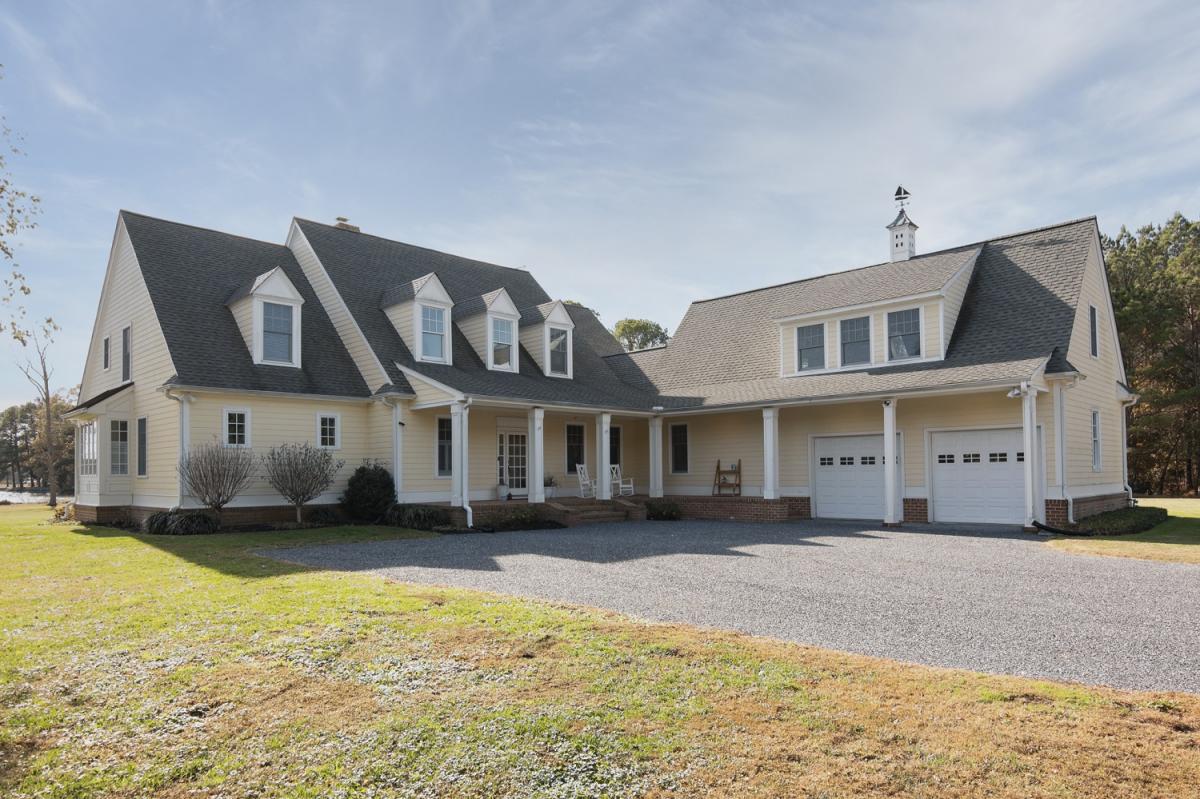
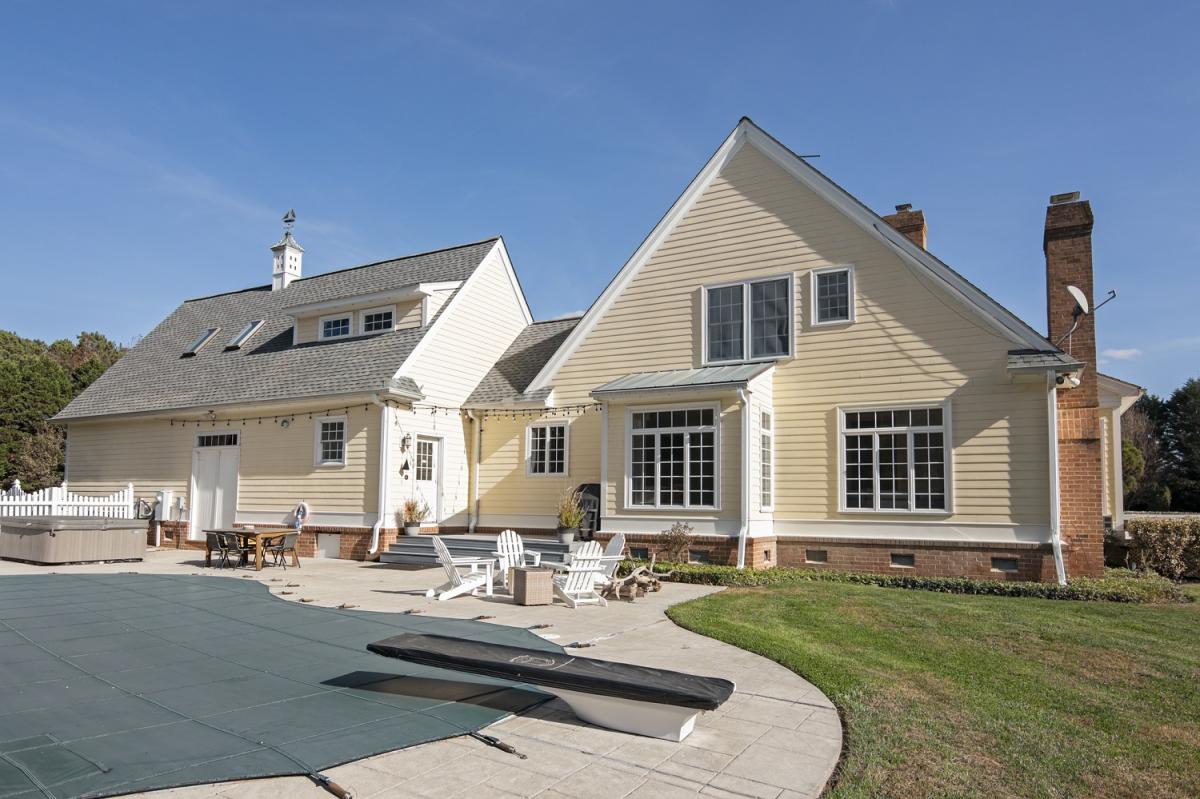
Royal Oak is one of my favorite areas for its desirable location between Easton and St. Michaels and its range of house styles have inspired many of my past articles. This house on a quiet dead-end street was built in 2001 on 2.89 acres along the Tred Avon River in the North Point subdivision. As I drove up the driveway, I noticed how well the house was sited to maximize the side yards for privacy and play. One side yard has trees at the street side and the side property line for a grassy play area for play from tag to touch football and the other side yard has a large pool, hot tub and trampoline against the dense background of trees. 

The massing of the traditional styled “L” shaped one and half story house has the two-car garage in the short leg of the “L” facing the parking area. The story and a half center wing’s full front porch wraps around the front of the garage and the column bays lessen the impact of the garage doors. A side wing containing the primary suite steps down from the main wing and a short hyphen connects the main wing to the garage. Each elevation includes a range of design features that articulate the massing including single window dormers at the front roof, shed dormers over the garage, a shed roof projection at the rear of the main wing that creates a sunroom and another shed dormer at the second floor, two bay projections at each side elevation that creates a space for breakfast at one side and a nook for the primary suite 

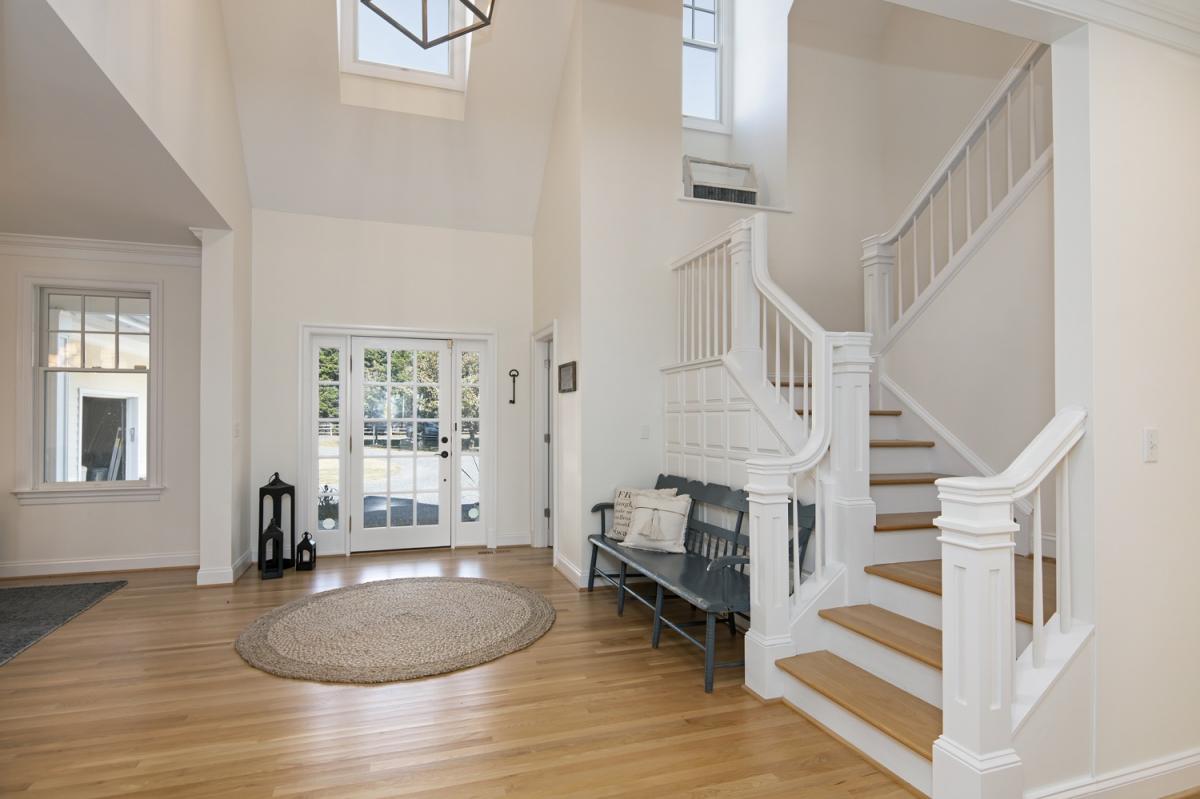
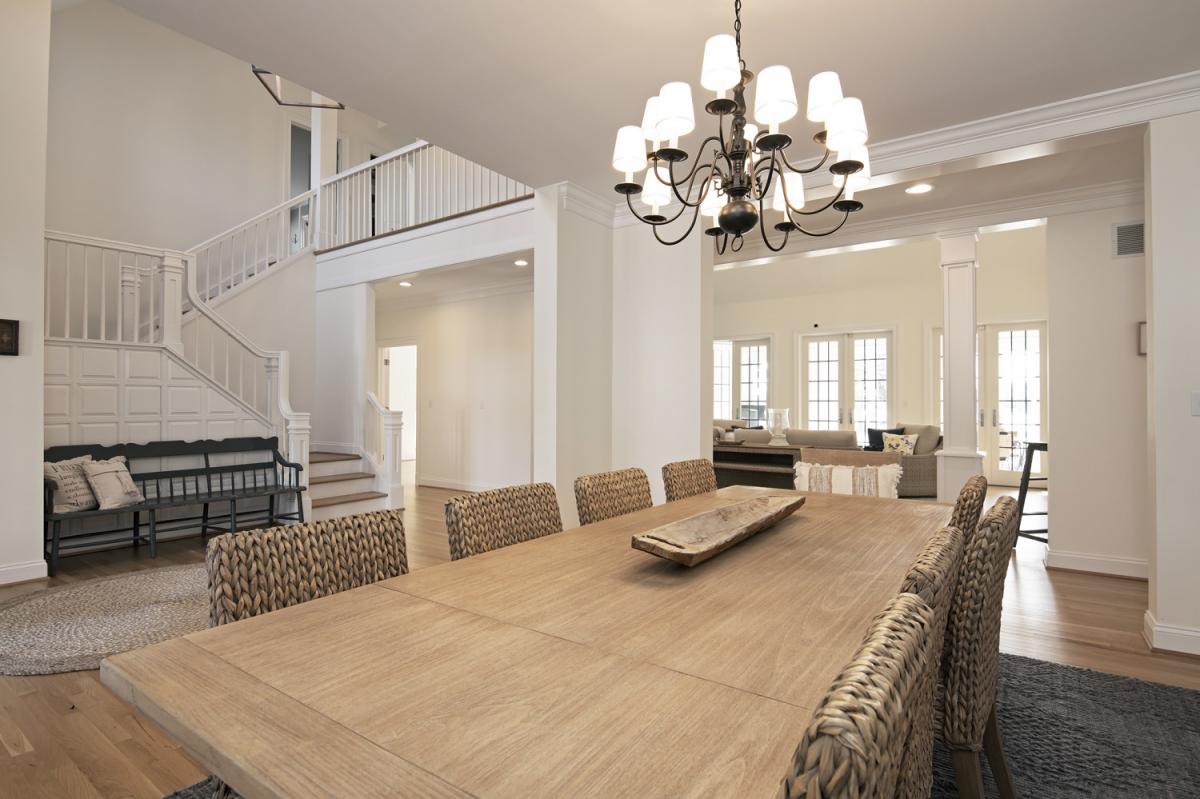
When I opened the door, the dramatic two-story foyer’s interior is defined by the staircase at one side and wide wall openings to the dining room opposite the staircase and another wide wall opening across the hall to the living room that create an easy flow among rooms. The staircase wall is detailed with panels below the treads painted white as a backdrop for the blue wood settee set into the alcove created by the stairs and the powder room that is below the stair landing above. Single window dormers centered over both the front door and the stair landing bring sunlight within. Another blue accent are the tall blue double shutters between the cased opening between the dining area and the kitchen that are fixed against the wall as decorative accents. 

The spatial volume changes from the two-story foyer to the one-story dining room and hall to the two-story living room with the pitched ceiling that follows the underside of the roof rafters. The brick fireplace soars to the ceiling and its white brick chimney becomes a sculptural element between the slate blue shiplap laid on a diagonal. Three pairs of French doors lead to the waterside sunroom. 

One end of the center hall off the foyer ends at the open plan family room, breakfast area and kitchen.  The bay wall projection of the breakfast area overlooks the pool and the family room has millwork on the interior wall for TV and books, rear windows with transoms flanking the fireplace and a triple unit window with transom that keeps this room sunny throughout the day. The “U” shaped spacious kitchen another blue accent in the range hood that stands out against the light colored cabinetry and marble countertops. 

Between the kitchen and the garage is a large laundry, powder room, mudroom with space for the family pets’ food bowls in the corner opposite the stairs to the private guest suite over the garage.  The exterior door in the laundry room leads to a deck and then to the pool deck for ease of clean up after a day on the water or in the pool. 

At the other side of the center hall is the sumptuous primary suite. The bedroom has two pairs of long triple unit windows for water views and a side door to the deck, pool and hot tub. I envied the large bath with a dual lavatory with both drawers and open shelves for storage and mirrors over each lavatory bowl.  Opposite the lavatory wall is the bay wall projection with long windows behind the soaking tub. In the next compartment is the large shower with a front glass wall and a side wall that provides privacy for the water closet.

The second floor is zoned well with the stairs ending at a “bridge” connecting the three bedrooms and one office/TV area. Two bedrooms share a “Jack and Jill” bathroom and the third bedroom is accessed by the office/TV area so it could become a private bed-sit suite. If I were a guest, I would claim the suite over the garage with its own staircase and large bathroom. The shed dormer on one side with triple windows would be the perfect space for a window seat. The window at the gable end wall and skylights above the knee walls on the other side of the room provide ample daylight.

Great home for relaxing with family or entertaining, 

Since this is the month for giving thanks, I wish to thank each of you for being readers of my articles. I am especially grateful to those of you who post comments or tell me personally how much you enjoy reading them. Stay Tuned!

Photography by Eve Fishell, Chesapeake Pro Photo LLC, 443-786-8025, www.chesapeakeprophoto.com, [email protected]

Jennifer Martella has pursued her dual careers in architecture and real estate since she moved to the Eastern Shore in 2004. Her award winning work has ranged from revitalization projects to a collaboration with the Maya Lin Studio for the Children’s Defense Fund’s corporate retreat in her home state of Tennessee.
The Spy Newspapers may periodically employ the assistance of artificial intelligence (AI) to enhance the clarity and accuracy of our content.

Filed Under: Design with Jenn Martella

Design with Jenn Martella: Cottage on Kent in Chestertown

November 16, 2022 by Jennifer Martella
Leave a Comment


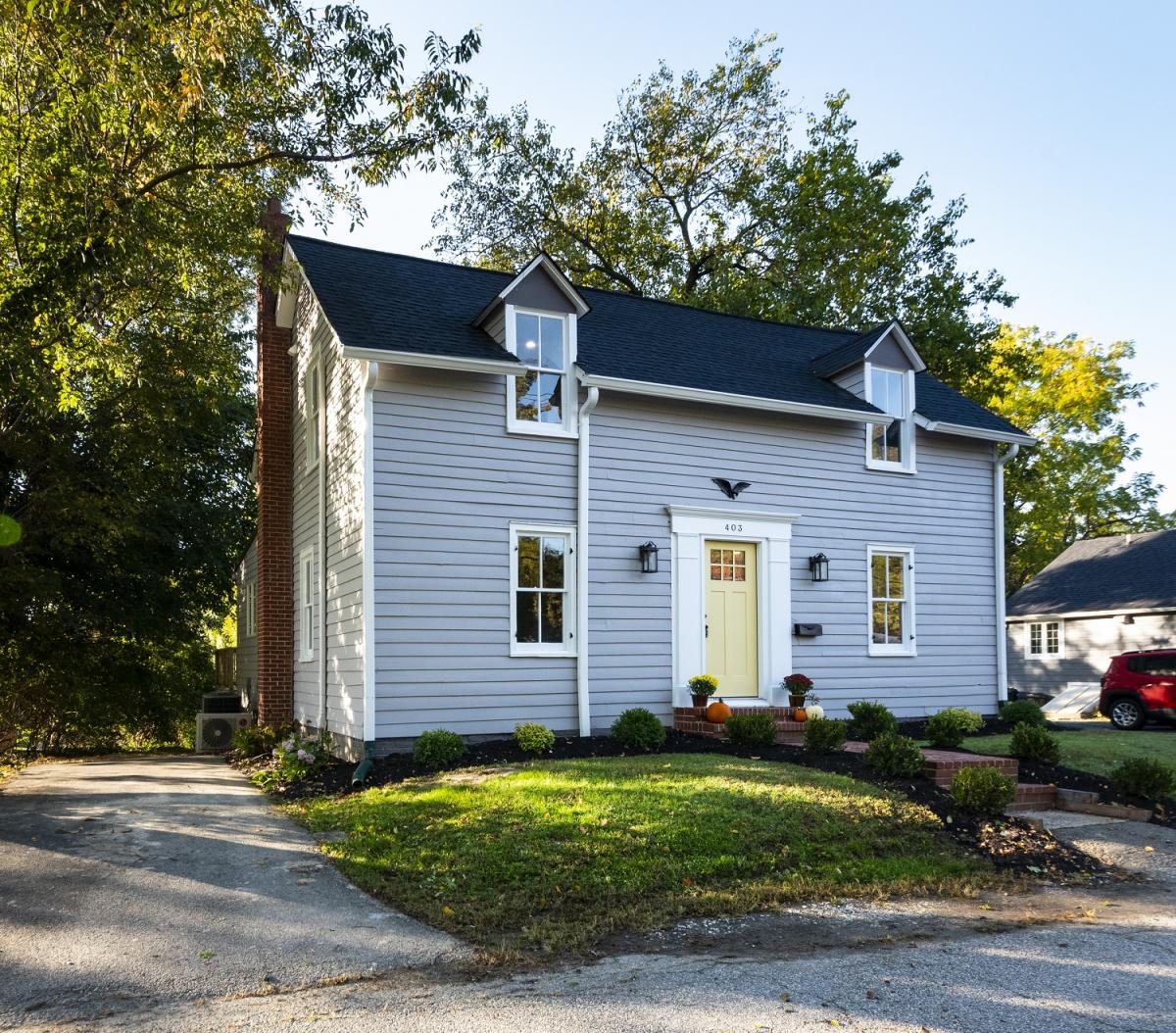
When I saw the front elevation for this charming cottage, I was drawn to its curb appeal for many reasons. The complimentary colors of blue and yellow inspired the color palette of light blue lap siding, white corner boards, white window trim and dark blue roofing that stands out against its background of leafy trees. I especially liked the detailing of the entry door with its Craftsman style 3/3 glazing above two vertical panels and the beautiful sunny yellow color. The door’s  white surround of pilasters supporting the architrave, the red brick stoop, steps and sidewalk down to the Town’s sidewalk and the low landscaping complete the welcoming look. The massing of the three-bay house is also pleasing with the center door between single windows on either side below single dormer 2/2 windows above that penetrate the eave line to give architectural interest to the two-room wide, two room deep house with a pitched roof.

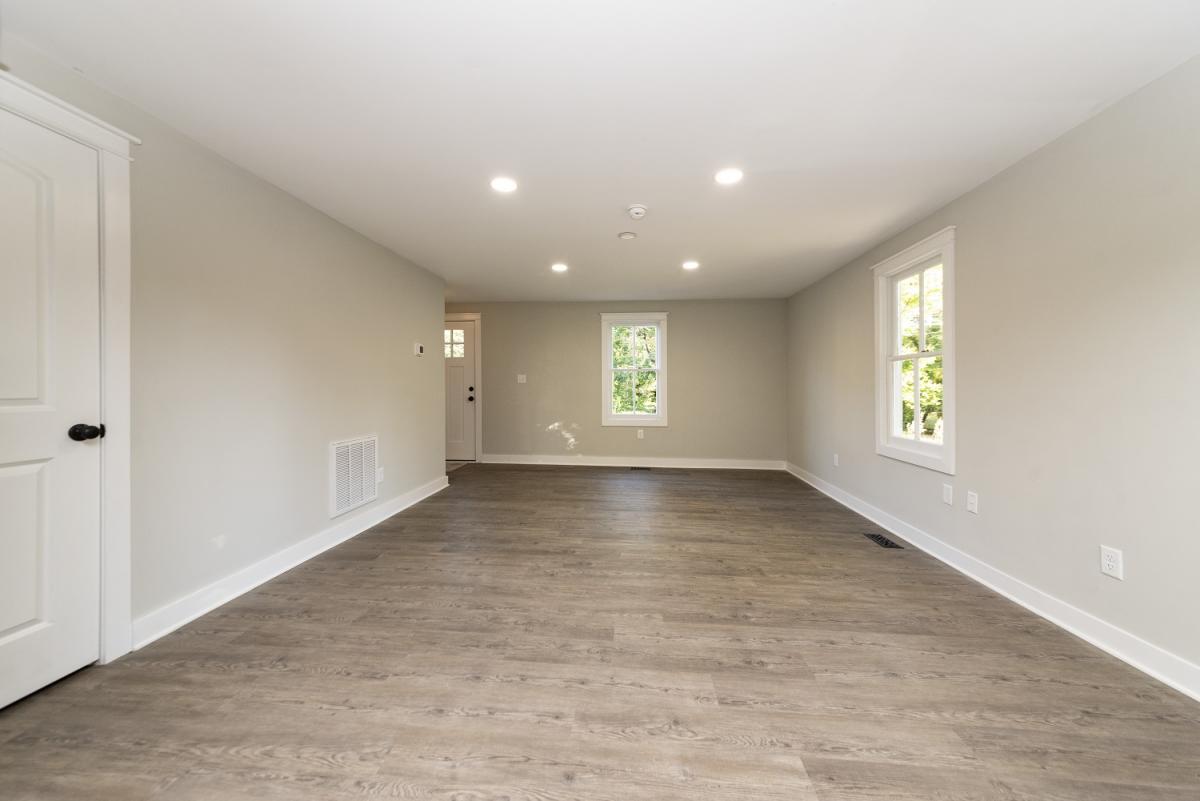
The front door opens in front of the stairs to the second floor that divides the open plan living-dining-kitchen area on the left from the primary suite on the right. The stair treads are painted gray and blend into the gray carpet runner with white risers. The plank flooring in a medium toned gray, light gray walls and white trim throughout the main floor unifies the rooms. The primary suite space is flexible for other uses such as a family room and the sliding barn door can be closed off for privacy. The primary suite/family room includes a large walk-in closet and a full bath. The bath has a lavatory detailed as a free-standing piece of furniture and contemporary hardware with a framed mirror above. There is also a half bath on the main level for the convenience of guests.

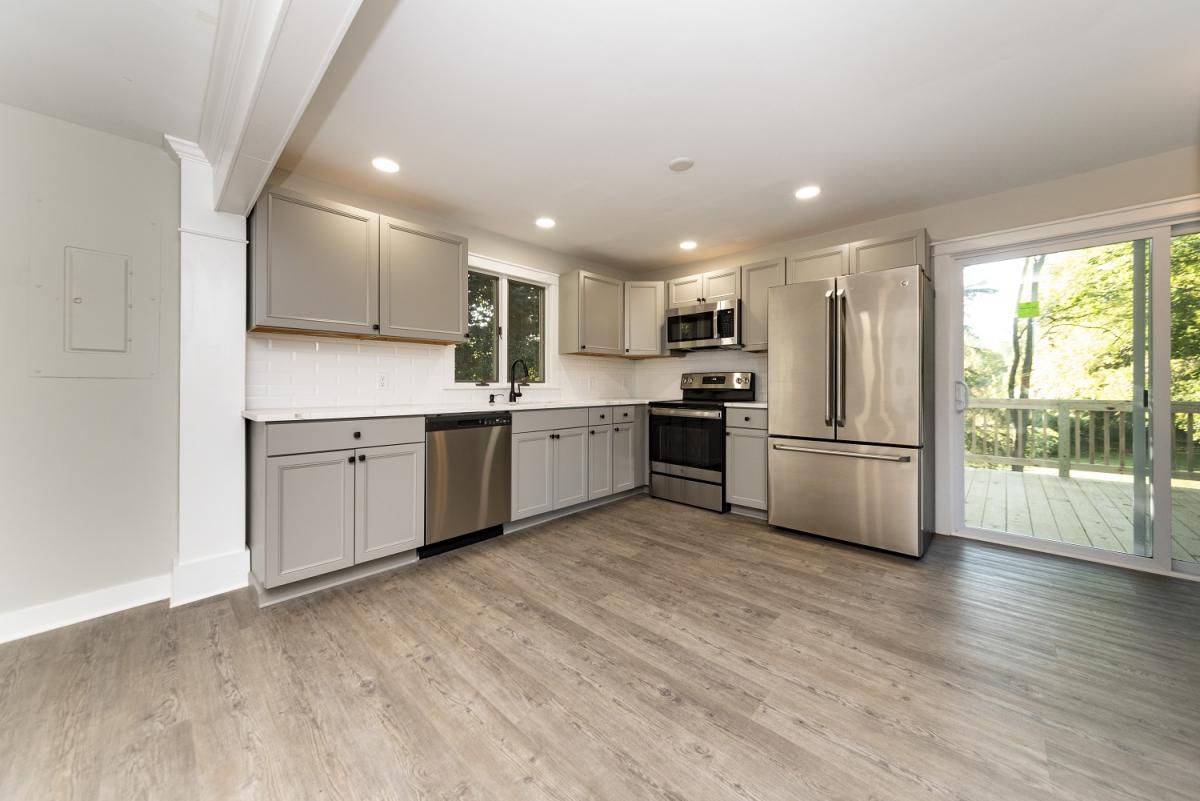
The living-dining area has windows on both the front and side walls for daylight throughout the day. A wide cased opening articulated with moldings leads to the kitchen and a vista through the sliding glass doors to the deck. The “L” shaped kitchen has light gray Craftsman style cabinets, white marble countertops, white tile backsplash and stainless steel appliances. The finishing touch would be a furniture style island with bar stools. The side window over the sink, another longer window on the opposite side wall and the sliding doors to the deck provide ample sunlight. The alcove formed by the laundry room off the kitchen has an accent lighting fixture in case an owner wishes to use this space as a breakfast space for a view to the rear yard’s landscaping. Off the spacious deck that is raised above the ground is a concrete terrace to extend your outdoor entertainment area with space for a grille for al-fresco dinners.

The second floor is tucked under the roof rafters that creates delightful interior architecture with the dormer windows between the knee walls at the eaves. The spacious bedrooms have windows on two exterior walls for ample sunlight and the larger bedroom at the gable end has a double unit window. I envied the large walk-in closets that are not often found in older houses like mine! The large shared bath is detailed with a wide lavatory cabinet for storage and the stylish dark fittings contrast with the white walls and white tub surround with its accent band. 

This 3 bedroom, 2-1/2 bath, 1250 sf house seems larger than it is due to the light color palette, the spacing of the windows and the open plan areas. Recently, I featured another design/build company, Jones and Jones LLC, who are restoring older homes in downtown Chestertown. Like that duo, Valley View Services, LLC was responsible for the design, construction and carpentry for this house. They carefully blended the original wood siding and the fully restored windows with new interior finishes, cabinets, fixtures and fittings. As an architect, my only addition would be a gas fireplace for the living-dining room. This charming cottage surrounded by mature landscaping is now fully renovated and is move-in ready, with a great location in the heart of Chestertown and close to Washington College-Bravo!

For more information about this property, contact Rosendale Realty agent Matt Wilson at 410-758-0333 (o), 301-955-6323(c), or [email protected]. For more photographs and pricing, visit www.rosendaleRealty.com , “Equal Housing Opportunity.” 

Photography by Juliette Anderson,410-490-9518 ,[email protected].

Spy House of the Week is an ongoing series that selects a different home each week. The Spy’s Habitat editor Jennifer Martella makes these selections based exclusively on her experience as a architect.

Jennifer Martella has pursued her dual careers in architecture and real estate since she moved to the Eastern Shore in 2004. Her award winning work has ranged from revitalization projects to a collaboration with the Maya Lin Studio for the Children’s Defense Fund’s corporate retreat in her home state of Tennessee.
The Spy Newspapers may periodically employ the assistance of artificial intelligence (AI) to enhance the clarity and accuracy of our content.

Filed Under: Design with Jenn Martella

Design with Jenn Martella: New Work by David Dunn

November 9, 2022 by Jennifer Martella
Leave a Comment

I have followed the career of the talented metal artisan David Dunn since I first wrote about his work in November of 2018 for the Spy. When I met David, he was working in his parents’ garage on their property in Bozman. As he showed me around his work area, there were boxes of wrenches, pipe, screws, gears, etc.-ordinary things found in a toolbox or workshop. When David showed me a completed work, I realized how David’s imagination and craftsmanship brought these creatures of the deep to life. 

From his earliest years growing up on a creek flowing into the Chesapeake Bay, David  combined driftwood and other found objects deposited by high tides onto the beach. He repurposed them into art objects while daydreaming about what lurked beneath the waves. The son of an American diplomat, David spent his formative years living in Paris, France, surrounded by the medieval and renaissance imagery of the old world. 

David’s art is defined by his unique ability to invest his inanimate metal constructions with both  whimsy and primordial dark mystery. His works draw on imagery and meaning from a metallurgical era lost to the modern age. His frequent use of medieval elements in his welded and forged work style evokes a recognition of historical elements, while imbuing the work with nuance and fantasy. With a modern environmental consciousness, he assembles repurposed tools, found metal pieces or modern steel implements with deft creativity, and he brings to life primordial creatures with movement and personality. Characterized by the spiked steel edges of medieval armaments and imbued with a dose of mid-century 

B-movie curiosity, his creatures reflect mysterious and fantastical life forms that combine both natural and historical imagery.

From my perspective of seeing his work over the past four years, the tough of whimsy that I first admired is still there but David’s creatures have evolved into more sophisticated works. As one collector remarked, “His new art is much more graceful without being delicate, but still incredibly strong.”  David’s work area has evolved too from his parents’ garage to his DunnIn Metal Studios in Silver Spring, MD. You can also find his work on the high end art website “Artsy” where New Orleans’ Octavia Art Gallery represents him. 

Recently, I was fortunate to have been a guest at the home of the Commissioners of St. Michaels President David Breimhurst and his wife Sara Robins, who hosted a reception for Dave to showcase his new work. Throughout their lovely historic home, each room’s focus was one or more of Dave’s new pieces, large and small. The hosts had added spotlights to feature each work and as I moved through the rooms, I felt as if I were on a delightful scavenger hunt. Since I was born under the sign of the Crab, I was drawn to the large coffee table in the family room covered with rows of small crabs, as if they were scurrying over sand. Now this transplanted Tennessean has a crab creation who graces my front garden, resplendent in the colors of the Maryland flag. 

Dave’s work is now found internationally in private collections in Paris and Normandy, France and Willerzell, Switzerland. Nationally, his work is found in collections in New York City and Shelter Island NY; Los Angeles and Malibu, CA; Washington DC, New Orleans, LA, Lexington KY, Asheville NC, Austin TX, Key West FL, Santa Fe New Mexico, and the Hunt Country of Virginia.

Now that the holiday season is upon us or if you are searching for a unique gift for a birthday anniversary or other special occasion, take a walk on the wild side and visit David’s website, www.dunninmetal.com. You can also contact Dave at [email protected] or 202-390-1881. 

Jennifer Martella has pursued her dual careers in architecture and real estate since she moved to the Eastern Shore in 2004. Her award winning work has ranged from revitalization projects to a collaboration with the Maya Lin Studio for the Children’s Defense Fund’s corporate retreat in her home state of Tennessee.


The Spy Newspapers may periodically employ the assistance of artificial intelligence (AI) to enhance the clarity and accuracy of our content.

Filed Under: Design with Jenn Martella

Design with Jenn Martella: “Oyster Shell” and the Architecture of Mark Beck

November 3, 2022 by Jennifer Martella
Leave a Comment

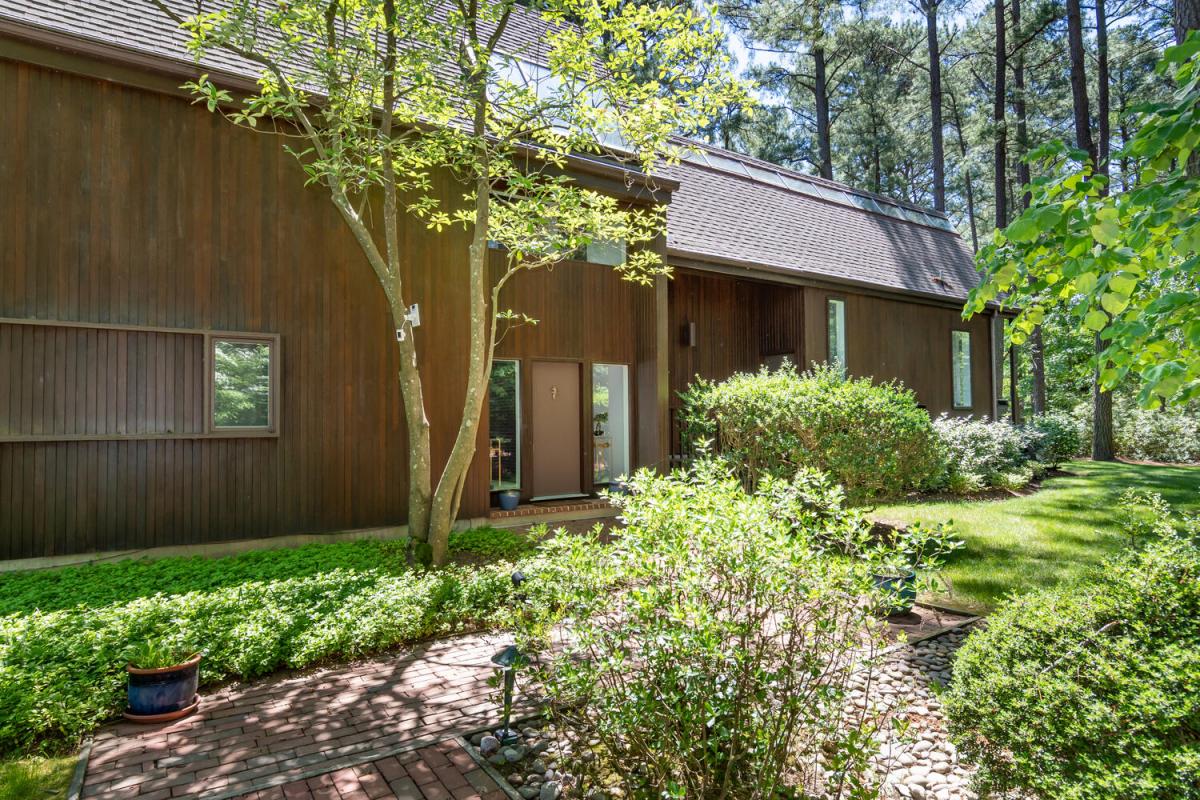
Earlier this year, I wrote about how the late architect Mark Beck transformed the interior architecture of his Royal Oak residence. In my research, I learned he had designed other houses on the Eastern Shore. When I heard that another of his house designs was for sale, I made an appointment for a tour. I was accompanied by his long-time collaborator, the Landscape Designer Jan Kirsh, who enhanced this property’s natural landscape. We drove down a meandering gravel driveway through woods of loblolly pine trees with their ramrod straight trunks, furrowed bark and tufted green crowns that always remind me of giant feather dusters. I especially liked how the pine needles had fallen and remained in the wooded areas to create a dense and soft carpet that added color to the ground. 

The drive then followed along the shoreline of Broad Creek and ended in a circular shape at the house. Jan had designed a brick walkway with wood edging that staggered in a series of right angles up to the entry porch. I noticed the grouping of river rock next to the brick and Jan mentioned this was the first time she had included this rock for a change in color and texture. I admired how Jan had added pachysandra and other ground cover to minimize the grass area at the front of the house and enhanced the area around the drive with shrubbery and trees including Kousa Dogwood, Sarcococca and Bayberry. 

The massing of the two-room deep house with a simple pitched roof is camouflaged by its earth toned color. The notch at the side wall facing the pool adds architectural interest to what could have been a blank wall since there are no windows on that side. As I walked around the house’s two telescoping wings, I observed a variety of glazing types. Skylights were individual units or a row of units ganged together, picture windows were tall and/or narrow and along the rear wall, full height sliding doors opened up the foyer and the sunroom to the water. My favorite window was the narrow full height picture window cleverly infilling the chamfered corner of the deck off the living room that must cast a glow at sunset into the living room. 

Several decks offer opportunities to enjoy the water views and the peaceful setting from the deck off the kitchen that wraps around one side wall to the sunroom and another spacious deck at the other end of the sunroom that extends to the edge of the other side wall of the house. At the second floor, a deck off the loft overlooks the kitchen deck below and off the  primary suite, another deck overlooks the lawn to the water and has a chamfered edge that creates diagonal vistas to the water. 

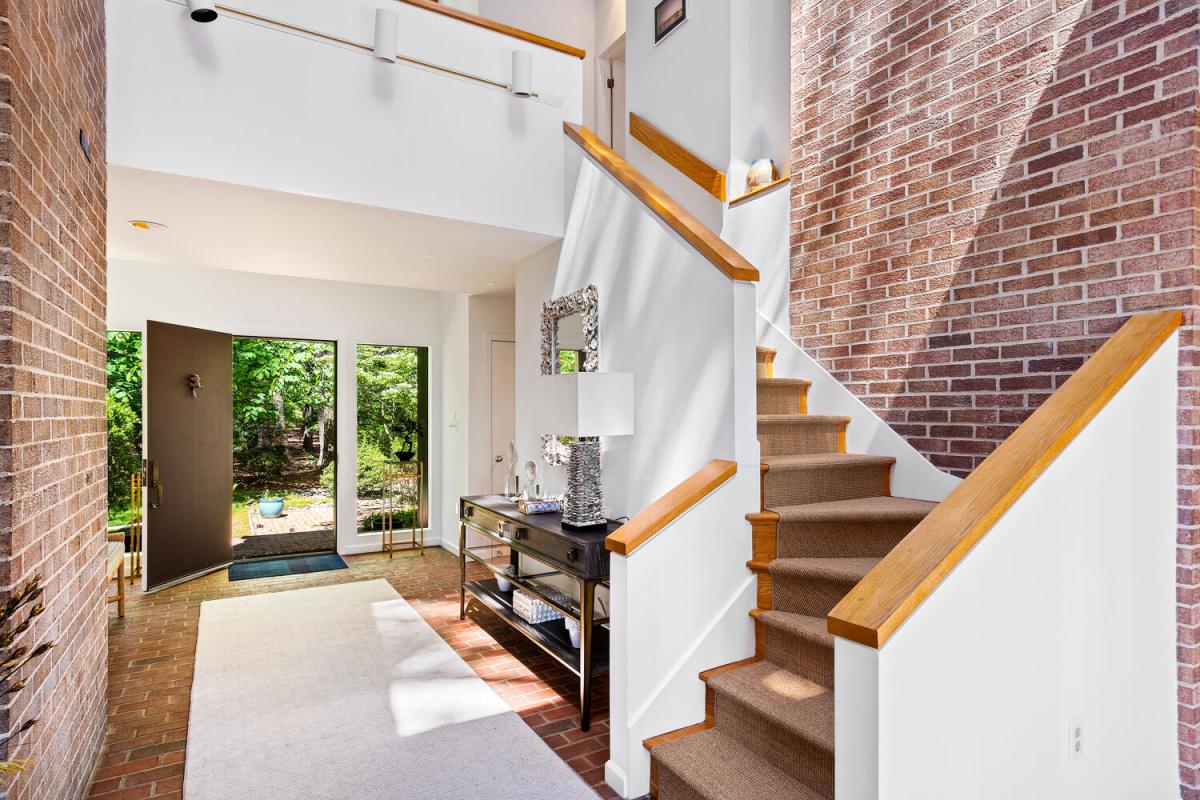
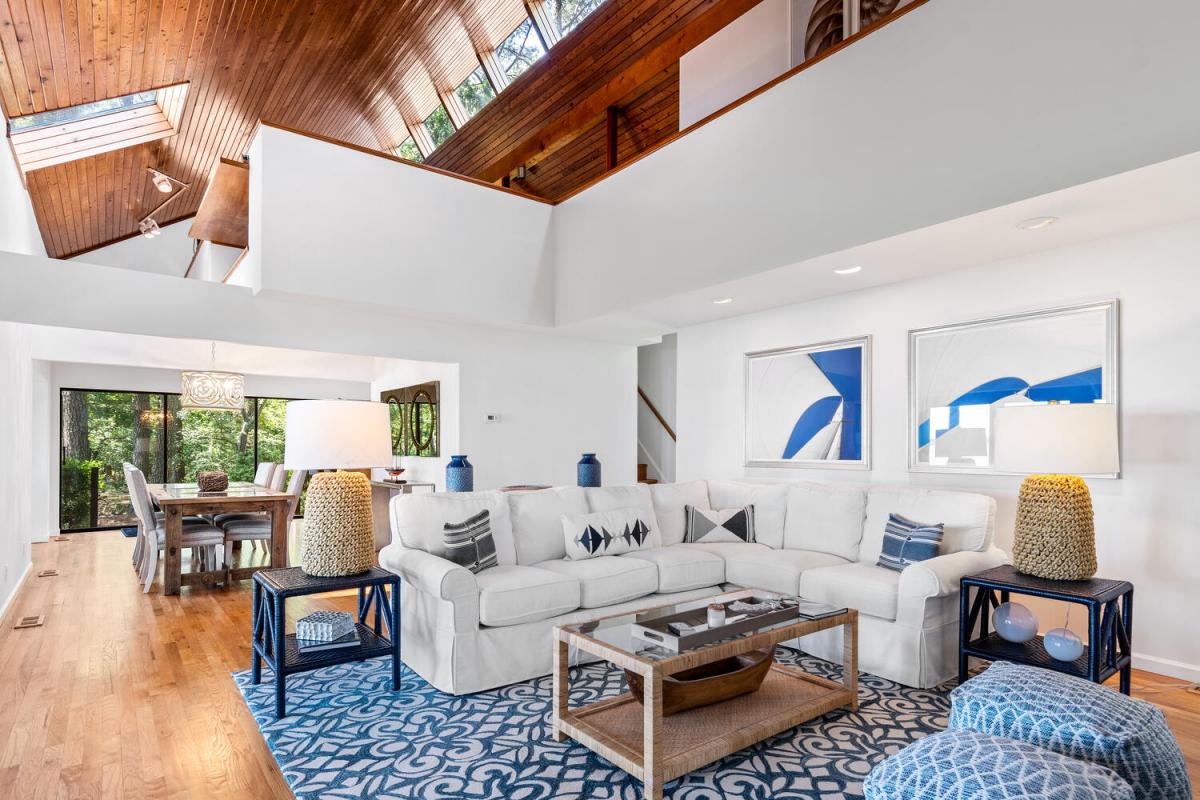
I opened the front door into the foyer that spans the depth of the house and the brick floor continues both beyond the sliding doors at the rear wall to the terrace and to the adjacent mud room/laundry and full bath next to the pool. As I moved though the foyer, I admired how the vertical height changes from two-story just inside the front door, then one-story below the “bridge” that connects the second floor suites then back again to two-story at the “L” shaped stairs to the second floor. The ceiling plane follows the underside of the roof rafters and is clad in wood to contrast with the white walls. Even though the weather was overcast, light filtered in from the full height sidelights flanking the front door, the trio of transoms above with their sills aligned horizontally with the cap of the railing of the “bridge” and the sliding doors leading to the rear terrace. The deft finishing touch was a single round window centered both on the front wall’s transom trio and below the triple skylight at the rear roof. Next to the foyer is the family room with its rear wall of sliding doors to the terrace. The sectional sofa arranged around the fireplace at the side interior wall make this spacious room with a flat ceiling feel cozy.

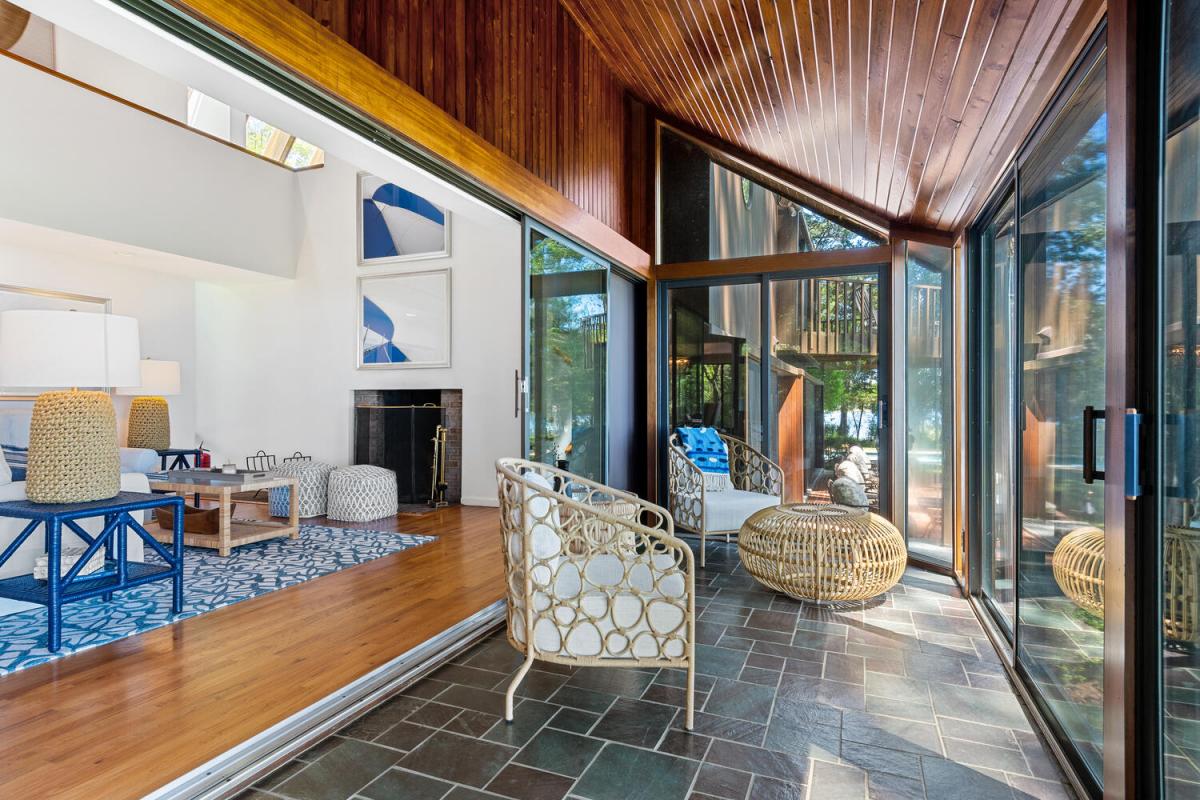
On the other side of the foyer is the open plan living and dining room. I noticed the “bridge” is shifted along the front wall of the house so the living room space soars to the underside of the wood ceiling with sunlight from the continuous row of skylights at the loft level and the wall of sliding doors to the sunroom. Massive beams trimmed in drywall define the enclosure of the dining area and support the loft above. The door units in both the living and dining rooms slide into the walls to the sunroom for a continuous flow and clear vistas to the water.

 I liked how the outside corners of the sunroom are chamfered for diagonal views of the water and the long room has ample space for both sitting and dining. The finishes were carefully specified for an indoor/outdoor room with the sloped ceiling and the wall above the sliding doors is clad in wood above the flagstone floor. 

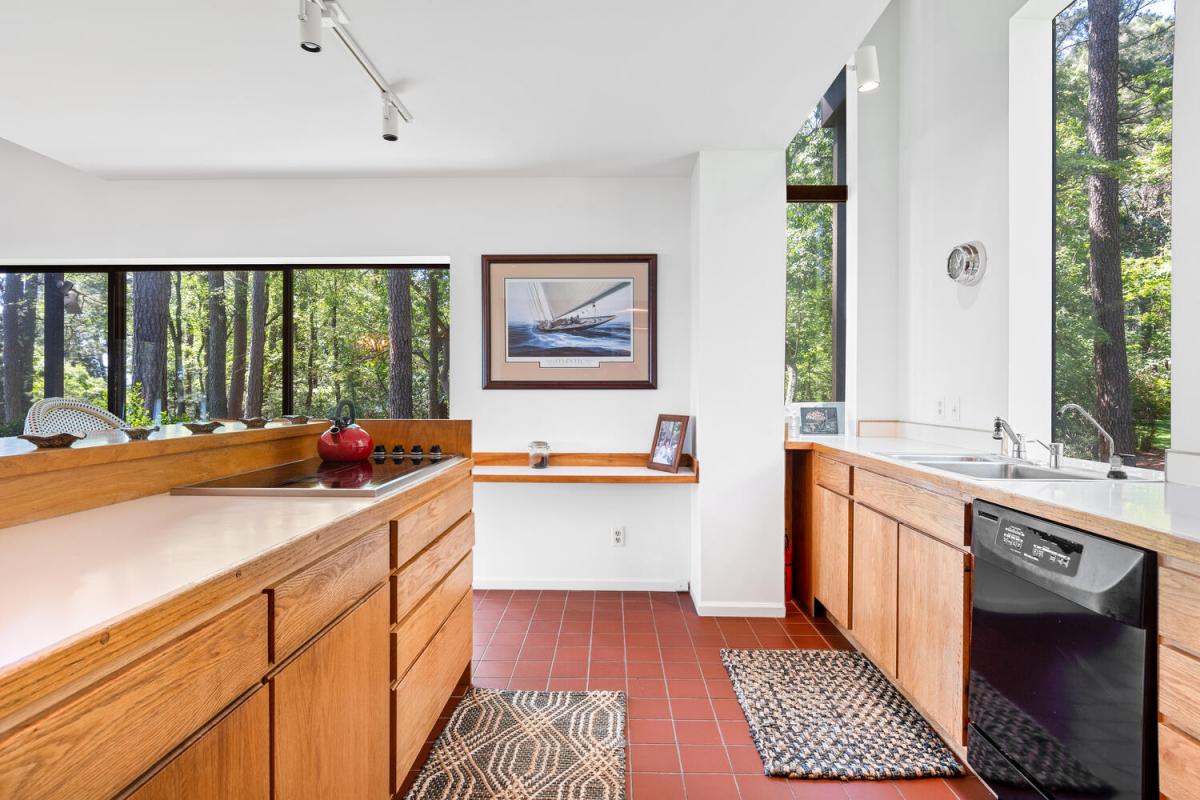
Behind the dining area is the “L” shaped kitchen and my only suggestion would be to revise the layout to a galley arrangement to create easier flow among the rooms and allow direct access to the front deck for a cozy breakfast. I especially liked the juxtaposition of the tall and wide window directly over the kitchen sink with the tall and narrow window at the rear wall. The quarry tile flooring is easy to maintain and the oak cabinetry without hardware is a sleek look.

The primary suite is located at the rear corner of the second floor with the family room’s brick chimney exposed as it rises to the underside of the ceiling. Between the chimney and the rear wall is a partial height wall overlooking the stairs in the foyer. The desk and chair in this space create a convenient and quiet space for checking emails before turning in for the night. The rear wall with its triple sliding doors leads to the spacious balcony with a slender dark railing that disappear into the verticals of the loblolly pines’ tall trunks. At the front of the house, the primary bath and separate walk-in closets complete the suite. 

On the other side of the upper foyer is the loft bedroom at the opposite corner of the house. The rear skylight was positioned perfectly in the roof so one could use a desk for drafting or other creative endeavor with a direct view to the woods and water. The loft also has sliding doors to its own deck at the side of the house. The front wall of the loft railing is pulled back to create a narrow overlook that allows light to filter down from the row of skylights just below the roof’s ridge into both the loft and the kitchen below.

This private 4- ½ +/- acre property includes a dock, a detached building that could be used as an office, a two- car garage with workshop and plenty of storage space. Le Corbusier once said “Space and light and order. Those are the things that men need just as much as they need bread or a place to sleep.” Mark Beck did a masterful job with this house’s spaces and various sources of sunlight to create interior architecture that makes the sequence of moving through the spaces delightful. I hope I have more opportunities to feature the work of this talented architect-Bravo!

For more information about this property, contact Jane McCarthy at Benson and Mangold Real Estate, 410-822-1415 (o), 410-310-6692 (c) or [email protected] .For more photographs or pricing, visit  www.marylandseasternshorehomes.com ,  “Equal Housing Opportunity.”

Architecture by Mark Beck

Landscape Design by Jan Kirsh Studio,  https://jankirshstudio.com

Jennifer Martella has pursued her dual careers in architecture and real estate since she moved to the Eastern Shore in 2004. Her award winning work has ranged from revitalization projects to a collaboration with the Maya Lin Studio for the Children’s Defense Fund’s corporate retreat in her home state of Tennessee.

The Spy Newspapers may periodically employ the assistance of artificial intelligence (AI) to enhance the clarity and accuracy of our content.

Filed Under: Design with Jenn Martella

Design with Jenn Martella: A Moment of Praise for Mid-Shore Architect Peter Newlin

October 27, 2022 by Jennifer Martella
Leave a Comment

When I began writing articles for the Spy, my “beat” was both Chestertown/Kent County and Talbot County. Since I was a newcomer to the area, the Spy Publisher put me in touch with Peter Newlin, an architect and old friend of his. Before I met with Peter, I visited his website and discovered he had achieved FAIA (Fellow of the American Institute of Architects) status in 1996. I later learned he was the first architect on the Eastern Shore to become a FAIA, which is the highest accolade my profession can bestow upon a member. When I visited Peter’s office for the first time, the wall behind the stairwell to Peter’s office was filled with award winning projects from local and state AIA chapters. As I studied each submission, I began to appreciate the depth of Peter’s talent. He was clearly equally adept at designing either historical or contemporary architecture. 

Before Peter entered college, he served in the US Army for four years and was a translator in Germany. Peter’s academic career began with his degree in Cultural History and Literature from Connecticut College. Taking a break from academia, Peter worked as a welder in his father’s machinist business and his carpentry skills led him to a mentor, Michael Borne, who lived in Chestertown and was a historian with Maryland’s Historic Trust. Peter worked for him as a carpenter and honed his skills in the art of historic restoration work. Peter then enrolled in the University of Virginia and after one semester he switched his major from Architectural History to Architecture and received his MA degree. His love for historic architecture drew him to Annapolis and after researching the historic buildings he most admired, he realized their common denominator was an architect named Jim Burch, FAIA. 

Peter joined the firm which became Burch & Associates in 1978 and he established the Chestertown branch in 1978. Their best known projects from that time were the conservation/renovation of Chestertown’s Fire Hall into the Town Hall and the passive-solar Galena Bank which won an award for energy conservation. He purchased the office in 1982 and established his own firm as Chesapeake Architects to specialize in waterfront architecture and historically sensitive design which he operated for thirty-nine years until his recent retirement. Throughout his distinguished career, Peter was recognized for his design talents from local, state and international entities including Progressive Architecture magazine for a rural town planning project, the Maryland Historical Trust for preservation projects, Delmarva Power for energy conscious design and numerous “Excellence in Architecture” awards from chapters of the American Institute of Architects. It has been my privilege to feature Peter’s award winning work in The Spy as Houses of the Week. To honor Peter upon his retirement, I offer highlights of my favorite Houses of the Week designed by this remarkable architect: 

Aerie-The Ornithologist’s House: One of my readers recently told me she reads my “House of the Week” columns in both The Chestertown Spy and The Talbot Spy so I asked her which house was her favorite. Without hesitation, she replied “the Ornithologist’s House.”  This property began its life as a weekend two-room cabin for an ornithologist, who asked for a three-story addition to better observe the birds since different species seek different heights for feeding or nesting areas. She explained to Peter that the conifers on the property provide shelter, nest sites, and food for birds who prefer high spaces. The wild grasses and weeds provide cover for ground-nesting birds and their seeds provided abundant food for many other types of birds. Trees that bore fruit in autumn such as dogwoods and berry plants provide food for migratory birds and allowed non-migratory birds to “fatten up” to face the food challenges in winter. The oaks and other trees provide food for jays, titmice, woodpeckers as well as nesting habitats for many other species.


The design challenge was how to join a three-story vertical addition to a one-story  small cabin without overwhelming the cabin’s scale and to insert the addition as carefully as possible for minimum invasion of the wildlife’s habitat. The hipped roof of the original cabin inspired the shed roof of the wrap-around porch whose depth varies around the rectangular footprint to create a variety of indoor spaces and outdoor rooms. Breaking the tower massing up by stepping it back as it passed through the roof behind and above the one-story original cabin, recladding the entire house and new roofing met the challenge for a seamless blend of old and new. Many windows became “outlooks” for endless birdwatching. I especially liked the middle level bedroom with a balcony overlooking the woods and the top level sitting room/studio with windows on all four sides and the hipped roof/ceiling. 

The Octagon House: The clients lived in the heart of Chestertown’s Historic District on Water Street. Their historic house had architectural appeal but needed better views of the Chester River. They wanted a seamless addition to open up the rooms to expansive water views and what they received was much more. Their program for the addition included a new river room on the main level with a master suite above. Peter quickly realized that an octagonal form was the solution to blend the existing house with the addition. From the water, the octagon reads as a two-story bay addition for panoramic water views and the new decks at both the main and upper levels gave the Owners front row seats for the parade of craft on the Chester River. The Jury for the Design Award agreed that the choice of the octagonal shape was key to the success of this design. 

This strategy reduced the impact of the addition but what it did to the interior architecture was magical. Suddenly new diagonal connections to the existing rooms opened and panoramic views of the river were visible through the octagon’s wrap-around windows, the master suite’s deck and a covered terrace on the main floor. Doorways were enlarged, the hefty exposed ceiling beams that created the octagon’s clear span were painted out white to disguise their mass, resulting in an articulated ceiling plane and airy and light interiors. At the side of the house, a new two-story entrance linked the existing house to the octagonal addition. French doors at the main floor and an accent window at the second floor brought light into both floors of the hall. The design’s finishing touch was a direct path to the river from steps at the main floor covered terrace.

Great design is timeless and it is no surprise that this exquisite addition won a Merit Award from the Maryland AIA Chapter. This house was sold a few years ago to new owners who were delighted with the addition. They completed the renovation by closing off the door to the kitchen next to the entrance hall, removing the wall between the kitchen and the sitting room beyond, updating the kitchen and master bath and changing the exterior wall color to a marine blue.

“Rive Du Temps”  This house was christened “Rive Du Temps” by its owner. In her preliminary programming discussions with Peter, the Owner asked for a “thoroughly interesting house” with “an intimate experience of the weather and nature.”  She also expressed a fondness for curved walls. Peter listened intently and their collaboration resulted in a site plan and house design that takes maximum advantage of the wooded site along the bank of the Chester River. The river curves and turns both upriver and downriver to provide broad long views from the house. 

A previous house had burned and this house was built on top of the original rectangular footprint to maintain the close proximity to the water. The detached garage and the hyphen from the main house to the “summerhouse” disguise the original house’s simple geometry. The airy summerhouse is a delight with its screened walls and curved ceiling. The roof decking is painted light cream to reflect the light from the clerestory windows at the rear and to accentuate the bark-brown roof joists. I could easily imagine dozing in a hammock in this marvelous space through the summer.

In homage to historic Maryland houses, the center hall plan separates one sitting room from the kitchen, dining area and another sitting room. A rhythm of two rows of beautifully detailed wood columns with headers float below the exposed ceiling joists. The vista ends at French doors to the deck overlooking the water. On either side of the center hall, bowed walls of windows capture the broad views of the river bends, opening the entire rear wall to the water views. Another curved wall of cabinetry becomes a boundary to the kitchen area and a soffit above echoes that curvature. Instead of walls, the dining area between the two sitting rooms is defined by millwork on each side and on one side upper cabinets with glass fronts continue the transparency. The cross-axis of the house leads on one side to the hyphen and summerhouse and on the other side to the stairs and the second floor bedroom suites. The Owner’s collections of Native American pottery and other artifacts from her travels, art, accessories and furnishings articulate this house’s unique personality. “Rive du Temps” was featured in HGTV’s “Dream Builders,” Episode 1207, and won an award from the AIA for its unique design.

The Pavilion House on Davis Creek: Like their boat with its functional, snug fitting cabinetry, the clients wanted the interior of their new home to contain functional cabinetry to minimize furniture for storage. Newlin’s masterful solution was to create five pavilions, linked together by overlapping their corners, like a string of pearls along the gently sloped ridge. The creek then becomes a design element visible from every pavilion and house and landscape are inseparable. North facing walkways tucked under the deep roof overhangs lead to the “Summerhouse” pavilion with its walls of full height screened panels open to the gentle morning sun and breezes. I especially admired the massing of the pavilions with the hipped roofs, some with triangular dormer windows and others with shed dormers. I also appreciated that many of the window units had vented windows below the picture window above for natural ventilation and for clearer views of the surrounding woods and water.

The hierarchy of interior spaces ranges from the Guest Wing to the “Summerhouse.” The living area with its free-standing fireplace chimney and its soaring ceiling is the centerpiece of the plan and is open to the dining and kitchen areas with their morning sunlight. The dramatic stair tower leads down to the basement utility areas and up to the master suite above. The master suite has built-ins that divide the sleeping area from the dressing area lined with a wall of closets. The built-ins also function as a headboard for the bed so the sunlight from the windows opposite the bed can penetrate the dressing area. A wonderful nook with a window seat provides a cozy spot for reading or for contemplating the views of nature from the large window.

The finishes are outstanding including custom recessed lighting in the coffered ceilings, beautiful inlaid wood floors and the sleek cabinetry throughout the house. The recessed lighting between the exposed ceiling joists was designed by Newlin and fabricated by Deep Landing Workshop. The pendant lighting was also designed by Deep Landing Workshop.

Peter’s legacy lives on in both these and other extraordinary house designs and his mentorship of intern architects, one of whom, John Hutchinson, now has his own firm in Chestertown, John Hutchinson Architecture. 

To learn more about Peter’s projects, visit his website.

Jennifer Martella has pursued her dual careers in architecture and real estate since she moved to the Eastern Shore in 2004. Her award winning work has ranged from revitalization projects to a collaboration with the Maya Lin Studio for the Children’s Defense Fund’s corporate retreat in her home state of Tennessee.

The Spy Newspapers may periodically employ the assistance of artificial intelligence (AI) to enhance the clarity and accuracy of our content.

Filed Under: 1 Homepage Slider, 3 Top Story

Design with Jenn Martella: Fairest of the Fair on Fairgale

October 19, 2022 by Jennifer Martella
Leave a Comment

I enjoyed returning to the small neighborhood of Fairgale Farms, a picturesque development named for the original farm along Fairlee Creek. My former article featured a contemporary house that the original owners had built for their daughter. This house is hidden from the road by surrounding wooded areas and the driveway off the meandering road through the neighborhood is lined with trees and ends at a circular drive around the pond and a gazebo. The two room wide, four room deep house is located across the pond and was built in 1999 on 20 +/- acres. The design of the custom built house was inspired by the style of Captain’s fishing cottages on Nantucket. The house is connected to the two-car garage by a hyphen containing a spacious laundry/mudroom and full bath that are both set back deep from the front elevation.

Four steps lead up to the deep front porch overlooking the pond and at certain times of the day, the four-bay front elevation casts a beautiful reflection on the surface of the water. The house’s front gable form is detailed with a full hipped roof over the porch that extends over the foyer with a large multi paned picture window. At the back wall of the porch are the living room’s two long 9/1 windows and at the second floor, four single 6/1 windows are spaced evenly across the façade. The beaded lap siding changes to vertical siding at the third floor with a 6/1 accent window. The exterior color palette of white 1 x trim around the windows, doors and corner boards blends into the slightly darker siding color for a classic look.
The eave line is lower than usual and adds architectural interest to the gable form. The shorter hyphen has a pitched roof that ends at the side walls of the house and the garage/apartment wing. The front gable form of the garage/apartment is similar to the main wing with two single windows at the garage level and one window above. The same combination of lap siding and vertical siding as the main wing unifies the composition.

The entry door is located at the side wall of the porch and opens into a spacious foyer with the stairs creating a hall with a wide cased opening to the large living room. The coat closet defines the end of the foyer that leads to another hall to access the kitchen-dining area, full bath and laundry/mudroom hyphen. The “U” shaped stairs has white risers and stained treads to match the flooring throughout the main floor with beautiful earth-toned runners and hall rugs. Instead of an open railing, there is a partial height wall and a half column to separate the foyer from the hall.

The focal points of the living area are the fireplace at the side exterior wall and the large armoire-bookcase unit with solid doors in the middle to store the TV. The large Oriental rug anchors the seating arrangement of the sofa and chairs in earth tone colors and the wood coffee and end tables create a room for relaxing. Another cased opening leads to the dining-kitchen area and I especially liked the box bay that wraps around the corner of the dining area with a double window at the rear wall and a single window at the side wall that creates a cozy window seat ending at the fireplace next to another window. The checked valances over the top windowpanes and the cushions that pick up the rosy red color of the fireplace brick surround, the black framed wood table with a stained wood top, black chairs and the pale green armoire create a delightful dining area for family and friends.

The “U” shaped kitchen with its neutral tones has a charming combination of upper cabinets with solid and glass fronted doors and open shelves with corner cabinets for appliances and drawers. The white subway tile backsplash that contrasts with wallpaper above the upper cabinets, the stainless steel appliances and the island with open shelves, drawers and a stained countertop completes the look. A pair of French doors between the dining and kitchen areas leads to the screened porch with white rattan furnishings below the white pitched ceiling. A screened door in the side wall leads to both the brick terrace, the stairs to the apartment over the garage and a walkway to the pool.

I envied the layout of the large laundry with its triple windows for daylight at the rear wall above the side by side washer dryer for loading/unloading that is easy on the back and knees! The door to the laundry chute eliminates the trip up the stairs to collect the dirty laundry from the bedrooms and baths. The farmhouse sink with gooseneck fitting next to a counter with open shelves below for easy access of laundry detergent and the wall hung wood expandable drying rack creates a highly efficient laundry. Exterior doors at the front and rear walls, the door to the garage and the interior stairs to the second floor apartment make this space the circulation hub of the house.

The stairs to the second floor end at a sitting area with double windows at the side wall and doors to all three bedrooms. The sumptuous primary suite is located at the rear of the house and the bedroom is sized for a sleeping area with a pencil post wood bedframe with white linens and a sitting area around the fireplace. The warm red walls, pine floors, the pine chest at the foot of the bed and the bookcase next to the fireplace full of books creates a serene retreat.

The other two bedrooms are located at the front of the house and their interiors are equally charming. One corner bedroom has wrap-around windows and a wallpaper pattern of small flowers on a sage green background, wood furnishings and a white applique bedspread. The smaller of the bedrooms is a sweet room for young children with white iron bed frames, white spreads with rose motifs, a beautiful oval multi-colored hooked rug, wood chest, nightstand and bookcase. Stuffed animals patiently await their nighttime snuggling with the little ones. Between the front and rear bedrooms is a large bath that is compartmentalized for privacy, with a shower and a clawfoot soaking tub underneath a double window. Above the two-car garage is a one-bedroom guest suite that includes a kitchenette for guests with its own deck overlooking the pool and the grounds.

20 +/- acres, 50% wooded for privacy, custom house built in 1999 inspired by the classic Nantucket fishing captain’s cottage style, outdoor rooms of a front porch, rear screened porch, pool, pergola and gazebo for picnics overlooking the pond, amenities including nine foot ceilings and wood burning fireplaces, attached two-car garage with one-bedroom apartment above, fenced acreage, turn-out sheds, a three stall barn with connected paddocks-all this in the quiet neighborhood of Fairgale Farms!

For more information about this property, contact Liddy Campbell at TTR Sotheby’s International Realty, 410-673-3344 (o), 410-708-5433 (c) or [email protected]. For more photographs or pricing, visit https://liddycampbell.ttrsir.com , “Equal Housing Opportunity.”
Photography by Janelle Stroop, 410-310-6838, [email protected]

Jennifer Martella has pursued her dual careers in architecture and real estate since she moved to the Eastern Shore in 2004. Her award winning work has ranged from revitalization projects to a collaboration with the Maya Lin Studio for the Children’s Defense Fund’s corporate retreat in her home state of Tennessee.

The Spy Newspapers may periodically employ the assistance of artificial intelligence (AI) to enhance the clarity and accuracy of our content.
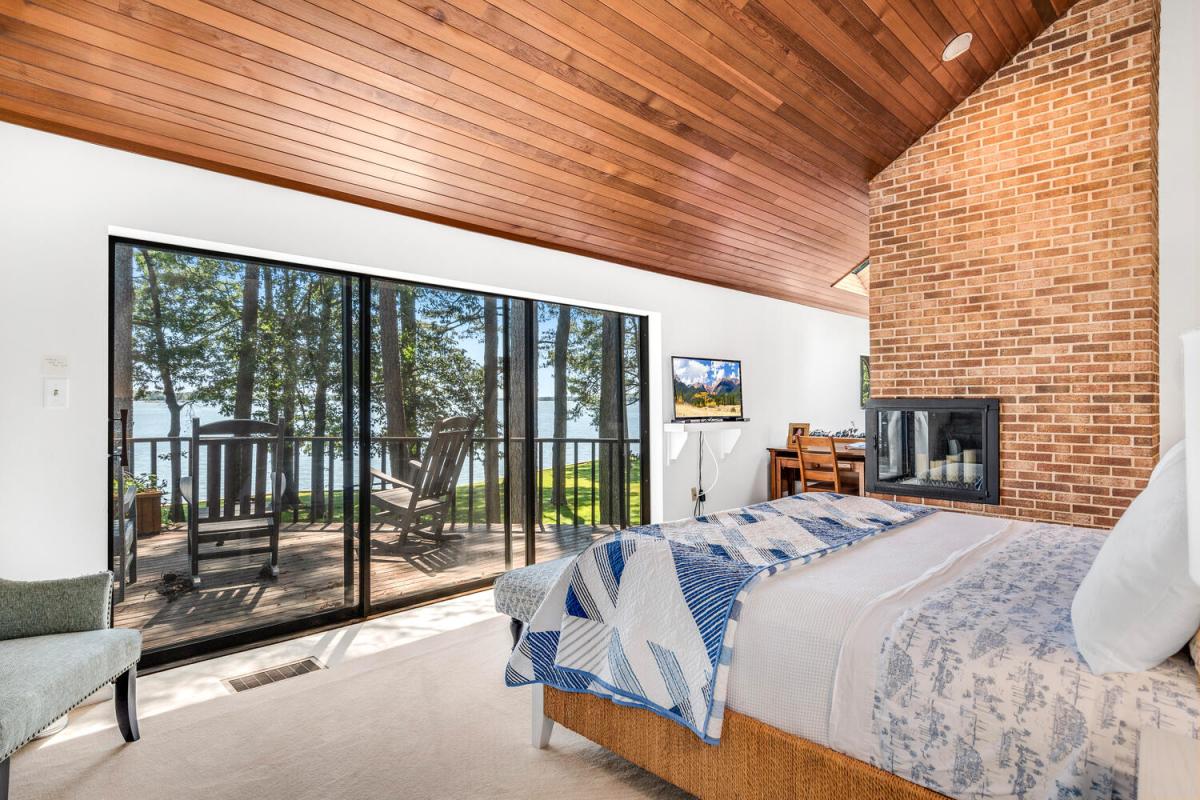
Filed Under: Design with Jenn Martella

  • « Previous Page
  • 1
  • …
  • 24
  • 25
  • 26
  • 27
  • Next Page »

Copyright © 2025

Affiliated News

  • The Chestertown Spy
  • The Talbot Spy

Sections

  • Arts
  • Cambridge
  • Commerce
  • Ecosystem
  • Education
  • Food & Garden
  • Health
  • Local Life
  • News
  • Point of View
  • Senior Nation

Spy Community Media

  • Subscribe for Free
  • Contact Us
  • COVID-19: Resources and Data

© 2025 Spy Community Media. | Log in