
MENU

Sections

  • About Us
    • Editors and Writers
    • Sponsorship Terms & Conditions
    • Code of Ethics
    • Sign Up for Cambridge Spy Daily Email Blast
  • The Arts and Design
  • Culture and Local Life
  • Food & Garden
  • Public Affairs
    • Commerce
    • Health
    • Ecosystem
    • Education
    • Senior Nation
  • Point of View
  • Chestertown Spy
  • Talbot Spy

More

  • Support the Spy
  • About Spy Community Media
  • Advertising with the Spy
  • Subscribe
December 8, 2025

Cambridge Spy

Nonpartisan and Education-based News for Cambridge

  • About Us
    • Editors and Writers
    • Sponsorship Terms & Conditions
    • Code of Ethics
    • Sign Up for Cambridge Spy Daily Email Blast
  • The Arts and Design
  • Culture and Local Life
  • Food & Garden
  • Public Affairs
    • Commerce
    • Health
    • Ecosystem
    • Education
    • Senior Nation
  • Point of View
  • Chestertown Spy
  • Talbot Spy
3 Top Story Arts Looking at the Masters

Looking at the Masters: Alfred Sisley

September 29, 2022 by Beverly Hall Smith
Leave a Comment

Alfred Sisley (1839-1899) was a founding member of the Anonymous Society of Painters, Sculptors, and Engravers in Paris. The group of artists were students at the Ecole des Beaux-Arts, and all painted in “plein air” (outdoors) near Paris at the Forest of Fontainebleau. The original group of artists included Sisley, Monet, Renoir, and Bazille, and they quickly were joined by several others. The group held their first exhibition in Paris in1874. A critic, making fun of the title of Monet’s painting “Impression Sunrise,” wrote sarcastically how impressed he was. From that time on, the group has been known as the Impressionists. 
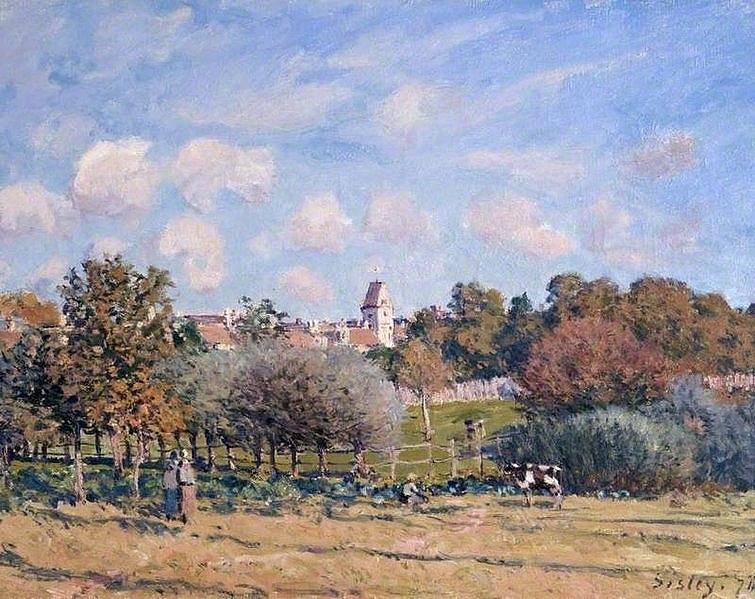
 

“The Bell Tower at Noisy-le-Roi, Autumn” (1874)

Alfred Sisley is one of the lesser-known Impressionists who became popular after his death. “The Bell Tower at Noisy-le-Roi, Autumn” (1874) (17” x 24”) illustrates Sisley’s style and his talent. The inspiration for the Impressionists was the scientific discovery that sunlight, which illuminates everything, was composed of the colors of the rainbow: purple, blue, green, yellow, orange, and red. All Impressionists began painting in plein air, but Sisley never stopped. He was not a painter of people or the bustling city life of Paris. He was the painter of landscapes and villages up and down the Seine near Paris. He and his family lived in several of these villages his entire life, and local landscapes never failed to inspire him. He painted the villages, fields, forests, and rivers that composed the beauty of the French countryside.

“The Bell Tower at Noisy-le-Roi, Autumn” presents the viewer with a field that has been harvested, a few town residents, and a black and white spotted cow in front of a wooden fence. The fence divides the fields from the town’s bright yellow-green lawn. The sunlight on the field is painted with bright yellow, green, and orange. The deeper furrows in the field are blue, green, and purple. In contrast, the shade under the autumn trees is painted in cool greens and blues. 

The orange tile roofs of village houses and the bell tower can be seen beyond the trees.  It is a beautiful fall day with a blue sky and scudding white clouds. The complementary colors of orange and blue, green and red, and yellow and purple are distributed throughout the peaceful village scene.  

Half the painting is of the sky, the white clouds shadowed underneath with light orange paint. Sisley once said to a critic, “…the sky cannot only be a background…I always begin by painting the sky.” He explained his approach in a letter to his friend Adolphe Tavernier: “The sky is not simply a background; its planes give depth (for the sky has planes, as well as solid ground), and the shapes of clouds give movement to a picture. What is more beautiful indeed than the summer sky, with its wispy clouds idly floating across the blue? What movement and grace! Don’t you agree? They are like waves on the sea; one is uplifted and carried away.”
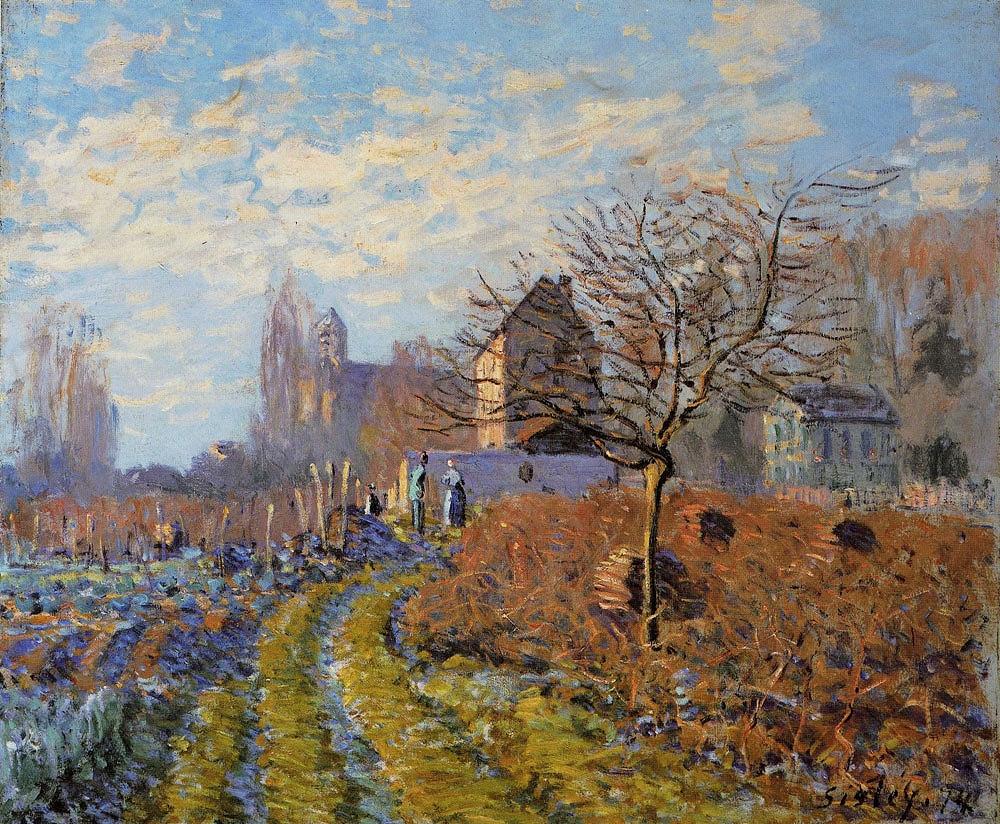
 

https://ts.spycommunitymedia.org/files/2022/09/2-White-Hoar-Frost-St-Martin-Autumn-Indian-Summer-1874.jpg

“White Hoar Frost, St. Martin, Autumn, Indian Summer” (1874) (18’’x 21.5’’) depicts another scene of autumn, but it shows the unending variation Sisley found outside his own front door. Autumn is on full display, and the nearby tree has lost all its leaves. At the right, the plants in the field have gone gold and orange, and stacks of logs are ready for winter fires. The furrows are deep and depicted with dark blue and purple in contrast with the yellow and orange of the harvested crops. Sisley’s paintings include a small number of figures, letting the viewer know that the townsfolk are there and active. 

The nearer buildings are painted with wide brush strokes and more intense colors to emphasize the solid structures. As the buildings recede into the distance, they are painted with lighter, feathery brush strokes. Sisley employs the technique of aerial perspective: more distant objects are affected by the atmosphere and appear fainter and bluer.
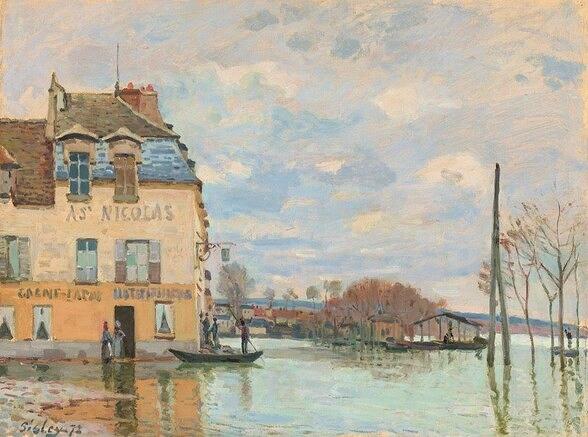
“The Flood at Port Marly” (1872)

During his lifetime Sisley painted two series of major floods of the Seine at Port Marly. His first-hand record of the floods was unique among the subjects painted by the Impressionists.  “The Flood at Port Marly” (1872) (18.25’’ x 24’’) (National Gallery of Art, Washington, D.C.) is one of four paintings he made of the 1872 flood. He captures the swollen river as it rises to the door of the Restaurant a Saint Nicholas. Two women stand on a slip of land in front of the door while a boatman poles his boat in the water. Two others stand around the corner on a set of stairs that have not been submerged. Above them a wrought iron bracket displays the restaurant’s name. At the right a pilon and a few trees bring balance to the foreground of the composition. One figure stands among the trees on an outcropping that is surrounded by water. Another figure rows a boat in front of a shed.  More trees and houses recede into the distance. 

Sisley details the three-storied structure of the Restaurant: curtains at the windows, shutters both open closed, tall windows with stone cornices on the third floor, and sloped roofs of grey-blue slate and tiles, and multiple chimneys. The painting is composed mainly of the complementary colors blue and orange. Sisley artfully places several horizontal dark blue and purple dashes across the center of the composition, with small touches of the darker colors on the roof of the restaurant and on the foliage of the trees that recede into the background. Sisley was a master of composition, arranging everything to create harmony, balance, and calm even in a dire situation. 
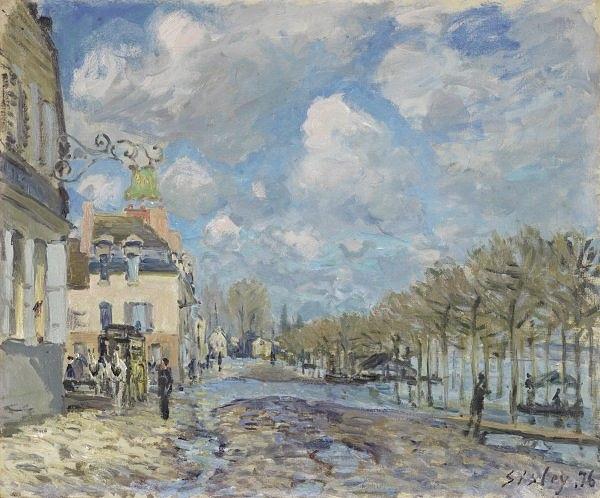
“Flood at Port Marly” (1876)

Water was another of Sisley’s favorite subjects, and he frequently painted bridges over water and landscapes including rivers. His ability to observe sunlight, movement, and reflections on water was unique. Four years after the 1872 flood, Sisley painted seven pictures of the 1876 flood. At that time, he was able to chronicle the flood from the beginning to the end. As the flood increased, the village of Port Marly was submerged. “Flood at Port Marly” (1876) (19.5’’ x 24’’) depicts the waters of the Seine flowing across the street. Sisley set up his easel around the corner from the Restaurant a Saint Nicholas, the second building on the left. A coach drawn by white horses appears with luggage piled high. Rows of trees, rowers in a boat, and the dark roofed shed can be seen across the street.

Steven Mallarme, French poet and art critic, wrote an article on Impressionism for The Art Monthly review in London shortly after he saw Sisley’s 1876 paintings of the flood: “He captures the fleeing effects of light. He observes a passing cloud and seems to depict it in its flight. The crisp air goes through the canvas, the foliage stirs and shivers.”

Born in Paris to English parents, Sisley was therefore English. However, he lived and worked almost his entire life in France. He visited England only a few times. The last time, in 1897, he married his companion of 31 years, Marie-Louise Adelaide Eugenie Lescouezec. They had a son and a daughter. Sisley applied for French citizenship in1898, but he was refused. 

Sisley asked his longtime friend Monet to look after his children when he died. Marie-Louise died in 1899, Sisley three months later. That year, Monet asked George Petit, an art dealer and promoter of Impressionism, to hold an auction of Sisley’s paintings to help support the children. One of “The Flood at Port Marly” paintings sold for 43,000 francs to Count Isaac de Camondowho. Interest in Sisley’s art was thus established. 

The well-known art critic, painter, and art theorist Wynford Dewhurst (1864-1941) wrote in one of books on Impressionism: “Rare are the artists who distinguish themselves in every branch of art, lucky the man who excelled in one. An example of the latter is Sisley, ‘pausagiste’ [landscapist] pure and simple, who has left a legacy of some of the most fascinating landscapes ever painted.”

Beverly Hall Smith was a professor of art history for 40 years.  Since retiring with her husband Kurt to Chestertown in 2014, she has taught art history classes at WC-ALL. She is also an artist whose work is sometimes in exhibitions at Chestertown RiverArts and she paints sets for the Garfield Center for the Arts.

 

The Spy Newspapers may periodically employ the assistance of artificial intelligence (AI) to enhance the clarity and accuracy of our content.

Filed Under: 3 Top Story, Looking at the Masters

Looking at the Masters: Samuel Findley Breese Morse

September 22, 2022 by Beverly Hall Smith
Leave a Comment

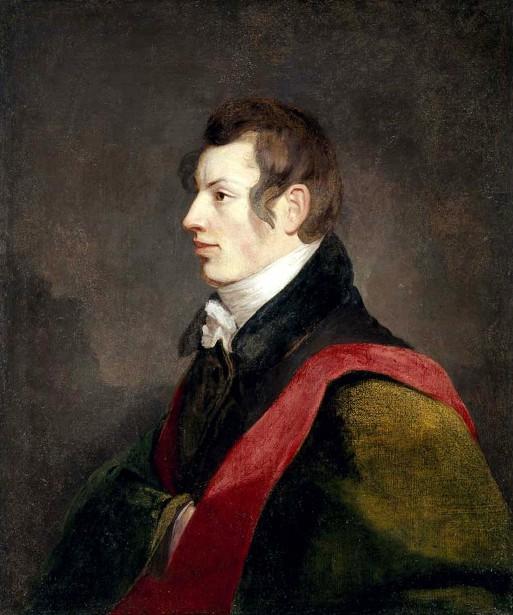
Samuel Morse “Self-Portrait”

Born in 1791 in Charlestown, Massachusetts, Samuel Findley Breese Morse was raised by Jedidiah Morse, a well-known minister and supporter of Calvinism and Federalism. Samuel was an “eccentric” student, but he did graduate from Phillips Academy in Andover, Massachusetts, and graduated (Phi Beta Kappa) from Yale in 1810. He studied religious philosophy, mathematics, and science. However, he began his career painting miniature portraits, and he worked as a clerk in a Boston book store. His interest in art was discouraged by his father, who finally relented and supported Samuel going to England (1811) to study with the American painter Washington Allston. He remained in England for three years, met the prominent American painter Benjamin West, and his artistic talent earned him admission to the Royal Academy in London in 1811. His “Self- Portrait” (1812) (10.75’’ x 8.85’’) evidences his skill as an artist. It is in the collection of the National Portrait Gallery, Washington, D.C.

During his three-year stay in London, Morse produced several paintings in the popular Neo-Classical style based on Italian Renaissance realism and history and mythology.  “Dying Hercules” (1812) and “Judgment of Jupiter” (1814) were well received in London. However, Morse was well aware of the issues that caused the War of 1812, and felt the Federalists, who supported England in America “were cowards, a base set, [I] say they are traitors to their country and ought to be hanged like traitors.” During the presidency of Monroe, the Federalist party collapsed.

“James Monroe” (1819)

Morse returned to America in 1815, and he established residence in Greenwich Village in New York City. Americans were not interested in history or myth, and he began as an itinerant portrait painter. Notable early portraits were of president “John Adams” (1816) and “James Monroe” (1819). Adam’s portrait is in the Brooklyn Museum, and Monroe’s is in the White House.  Morse painted portraits of other famous Americans including Eli Whitney (1822), De Witt Clinton (1826), William Cullen Bryant (1829), and Noah Webster (n.d.). 

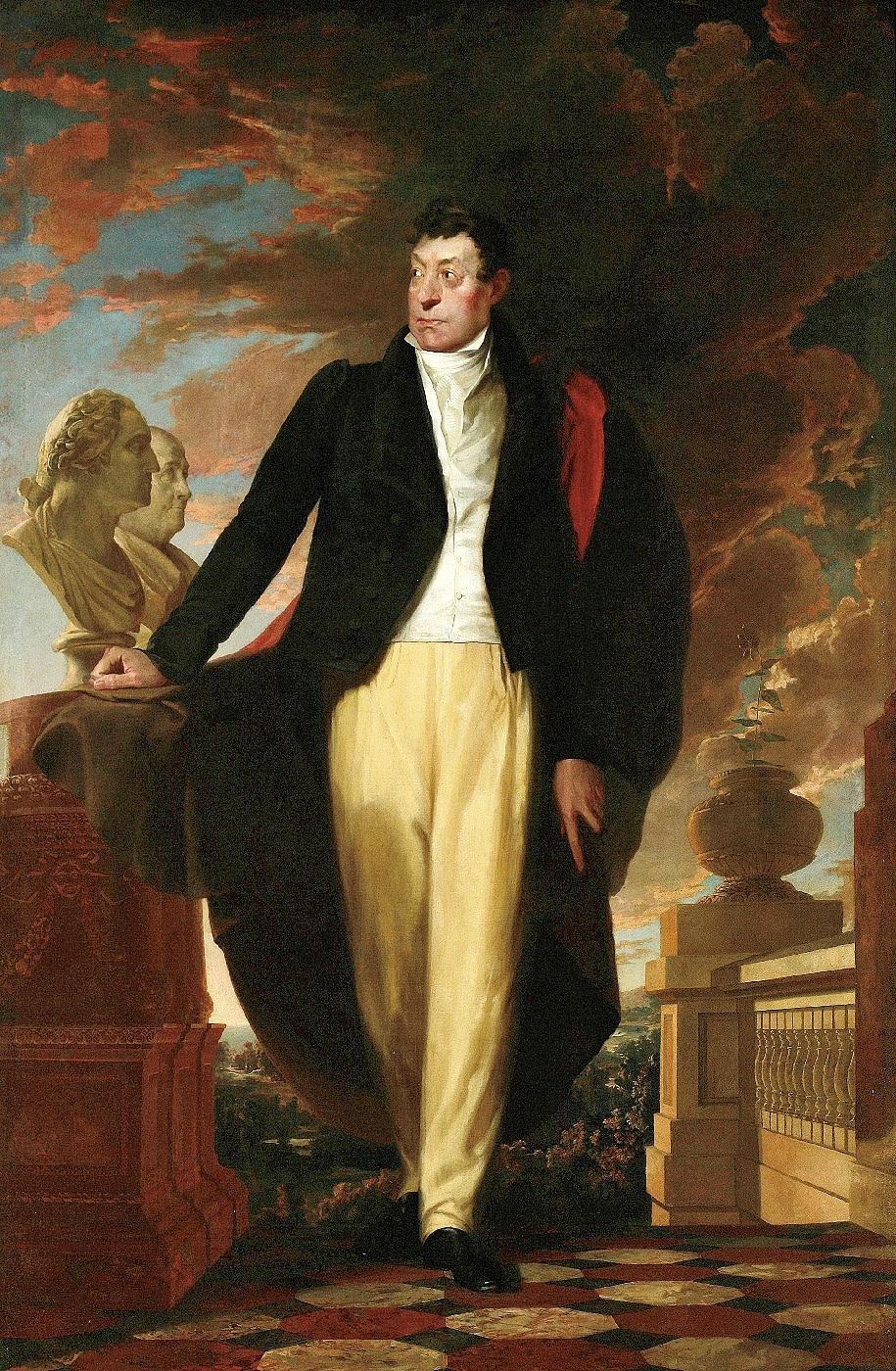
“Marquise de Lafayette” (1825-26)

The Marquise de Lafayette was an American celebrity after his participation in helping to win the American Revolution. Morse’s “Marquise de Lafayette (1825-26) was commissioned by the City of New York. The two men discussed the Revolution, and their friendship strengthened Morse’s already significant embrace of America and democracy. George Washington and Lafayette were fast friends, and Lafayette’s pose is reminiscent of the 1780 portrait of Washington by Charles Willson Peale. 

Lafayette stands on the top step of a porch. A flourishing landscape and a dramatic blue sky with turbulent red, gold, and dark clouds provide the backdrop. Instead of creating a stormy effect, the rose glow of a sunset after a storm gives a sense of power and presence to the figure of Lafayette. 

The porch has an inlaid marble floor, with stone balcony railings and a large carved vase. The new shoots of a leafy vine growing from the vase perhaps represent the young Democracy. Three stone pedestals at the left hold busts of George Washington and Benjamin Franklin.  A third pedestal, on which Lafayette rests his right hand, is empty. Likely, it was intended as a tribute to Lafayette, who someday would have his bust placed there to mark his accomplishments. 


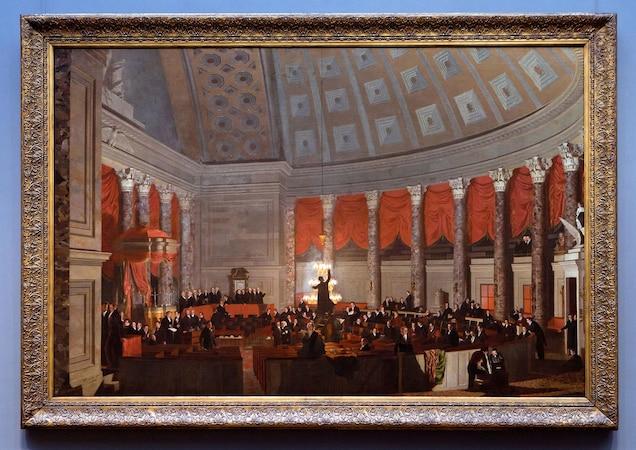
“The House of Representatives” (1822)

Morse painted “The House of Representative” (1822) (7.5’ x 11’) (National Gallery of Art, Washington, D.C.). The commission for four panels for the Rotunda of the Capitol would pay the artist $10,000. Morse traveled to Washington to make an accurate drawing of the House architecture with 80 people in the chamber. Morse choose to set the scene at night to illustrate the dedication of the house members to their work. The painting was exhibited in 1823 in New York City, but it was not a success. John Adams questioned if an American artist was up to the task. Morse’s close friend James Fenimore Cooper wrote a letter, published in the New York Evening Post arguing the Capitol would be an “historic edifice” and must showcase American art. The painting was not chosen, and Morse blamed Daniel Webster and John Adams, a Federalist, who voted against it.

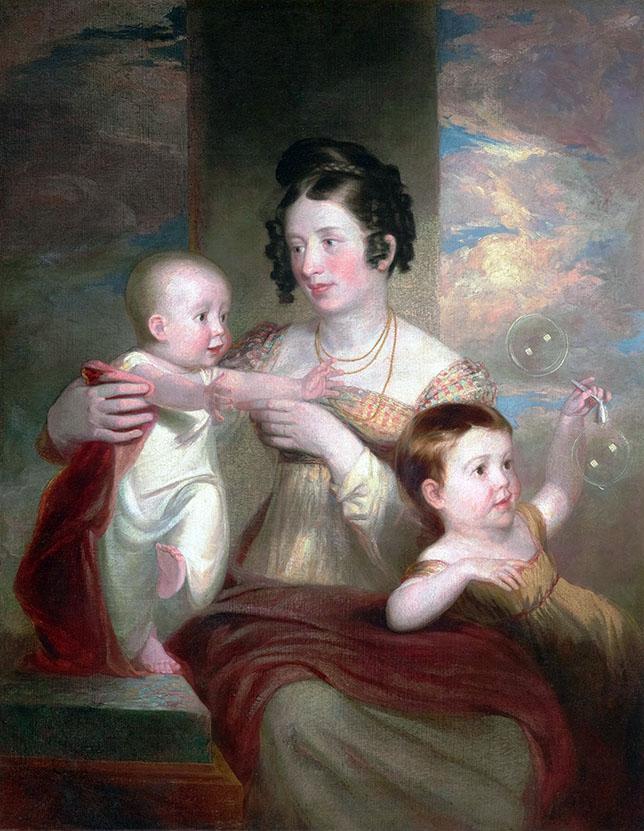
“Mrs. Morse and Two Children” (1824)

Morse married his first wife Lucretia in 1818. “Mrs. Morse and Two Children” (1824) depicts her with their two children Susan and Charles. Morse chose a classic triangular pose, with a dark column placed behind his wife. He encircles them with a dark red shawl and darker green in the left background, and the cushion and Lucretia’s skirt. However, he centers the tender interaction of the three figures in a soft, pastel palette of the Rococo. To match their rosy pink cheeks and light clothing, Morse paints a soft blue and pink sky. Lucretia tenderly embraces baby Charles, an active and delighted child. Susan happily plays with a bubble pipe.

The love of his wife and children is evident in this painting. Attached to the painting was a letter Morse wrote just before leaving for Washington in 1824: “A thousand affecting incidents of separation from my beloved family crowded upon my recollection. The unconscious gayety of my dear children as they frolicked in all their wonted playfulness, too young to sympathize in the pangs that agitated their distressed parents; their artless request to bring home some trifling toy; the parting kiss, not understood as meaning more than usual; the tears and sad fare wells of father, mother, wife, sister, family, friends; the desolateness of every room as the parting glance is thrown on each familiar object, and farewell, farewell seemed written on the very walls, — all these things bear upon my memory, and I realize the declaration that the places which now know us shall know us no more.” Unfortunately, Lucretia died in 1825, soon after the birth of their second son James.

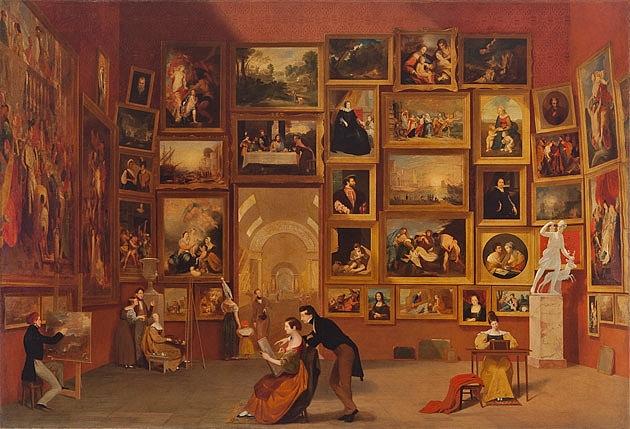
“Gallery of the Louvre” (1831-1833)

Morse was a founder of the National Academy of Design in New York City, and he served as its first president from 1826 to 1845. The Academy became the center of the arts in Greenwich Village. Returning to Europe in1831, Morse decided to paint “Gallery of the Louvre” (1831-1833) (6 ft. x 9 ft.). The painting includes 38 miniatures of works by Renaissance and Baroque masters. He thought this painting would be an excellent teaching tool for his students and an introduction for Americans to the splendors of European art. The work took months, and Morse moved a scaffolding he invented around the Louvre in order to have a closer look at each painting. Masterpieces by da Vinci, Raphael, Titian, Tintoretto, Caravaggio, Rubens, and Rembrandt are among the works included. The miniature of the “Mona Lisa” is placed in the center of the canvas on the lowest row of paintings. The fourth painting in the row is of Rubens’s beloved second wife Suzanne Fourment. Morse’s recent loss of his own wife might have influenced the placement of the Rubens portrait.

In the foreground of the canvas, Morse leans over the shoulder of his daughter Susan giving her advice concerning the drawing she is sketching. At the left, Richard Habersham, a young artist from Georgia and a roommate of Morse’s in Paris, is working on a landscape study. In the left corner are James Fenimore Cooper and his wife and daughter Susan, an art student seated in front of her easel and holding a palette. Cooper was a long-time friend, and spent many days with Morse in the Louvre. He described his time with Morse: “I sit and have sat so often and so long that my face is just as well-known as any Vandyke on the walls. Crowds get round the picture, for Morse has made quite a hit in the Louvre, and I believe that people think that half the merit is mine.”

In the arched doorway is the American sculptor Horatio Greenough and a women and child in traditional Briton costumes. Greenough, hat in hand, looks across the gallery to the ancient sculpture of “Diana and a Deer,” placed on a pedestal in the right corner. A young woman, wearing a gold gown, sits at a table painting a miniature. She may be Miss Jorester, a young woman who took lessons from Morse in the Louvre, or his deceased wife Lucretia. The figures were added to the canvas after Morse returned to New York. 

Morse exhibited “Gallery of the Louvre” in New York City on August 9,1833. The work received critical praise, but it sold for only $1300. Morse had hoped for $2500. When Morse did not receive a commission from the Government to paint one of the history panels in the Capitol building, he became depressed: “Painting has been a smiling mistress to many, but she has been a cruel jilt to me. I did not abandon her, she abandoned me.” “Gallery of the Louvre” sold in 1982 for $3.5 million to the Terra Foundation for American Art in Chicago.

The name of the artist Morse and the name of the inventor of the telegraph and code Morse are the same. Morse did abandon art, and he turned to science. A talk he had heard years earlier at Yale (1810) inspired him to use the wooden canvas stretcher bars from his studio to construct his earliest version of the telegraph. After a great deal of trial and tribulation, Congress funded wiring American from coast to coast, and Morse received a patent in 1844. Morse purchased in 1847 the estate Locust Grove on the Hudson River. In 1848 he married Sarah Elizabeth Griswold. They had four children.

On May 24, 1844, Morse sent his partner Alfred Vail the first telegraph message from Washington to Baltimore: “What hath God wrought.”

Beverly Hall Smith was a professor of art history for 40 years.  Since retiring with her husband Kurt to Chestertown in 2014, she has taught art history classes at WC-ALL. She is also an artist whose work is sometimes in exhibitions at Chestertown RiverArts and she paints sets for the Garfield Center for the Arts.
The Spy Newspapers may periodically employ the assistance of artificial intelligence (AI) to enhance the clarity and accuracy of our content.

Filed Under: 3 Top Story, Looking at the Masters

Looking at the Masters: Thomas Cole and his Voyage of Life

September 8, 2022 by Beverly Hall Smith
Leave a Comment

Born on February 1, 1801, in Lancashire, England, Thomas Cole emigrated to the United States with his family in 1818. The family moved in 1819 to Steubenville, Ohio where he learned to use oil paint from an itinerant artist. Cole essentially was a self-taught portrait artist. He began drawing from nature in 1823, while he was in Pittsburgh. Later that year he studied at the Pennsylvania Academy of Fine Arts in Philadelphia. Moving to New York City in 1825, Cole became enamored with the natural beauty of the Catskills. He exhibited a small collection of Catskill landscapes in October 1825 in New   York City. He was discovered by Asher B. Durand, a well-respected artist and engraver. Durand helped organize the National Academy of Design in New York City. Thomas Cole became a member in 1826.   

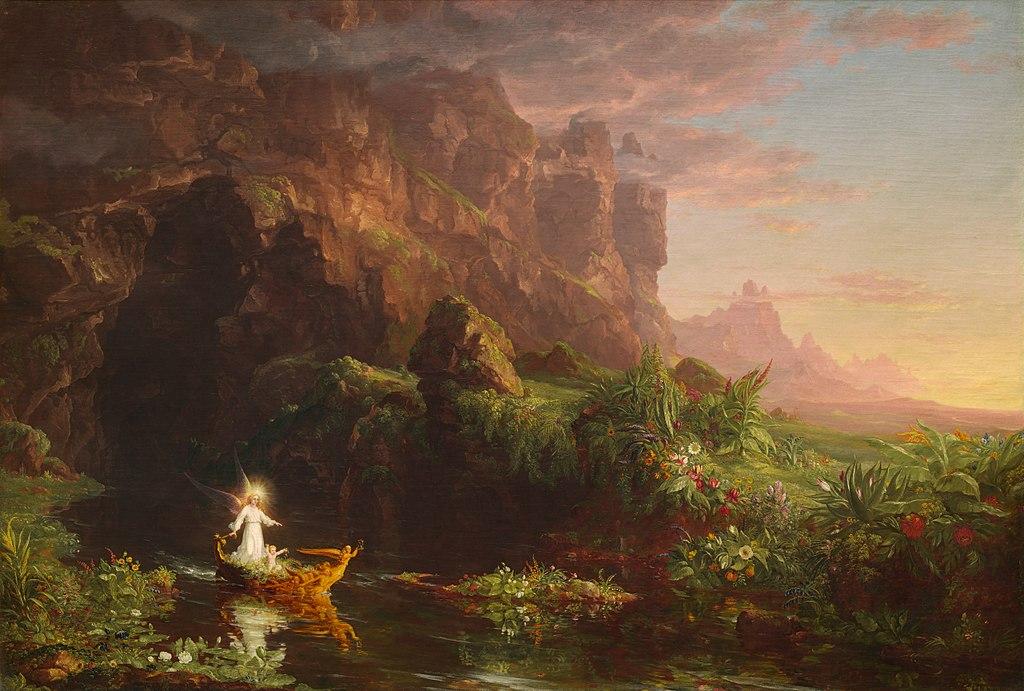
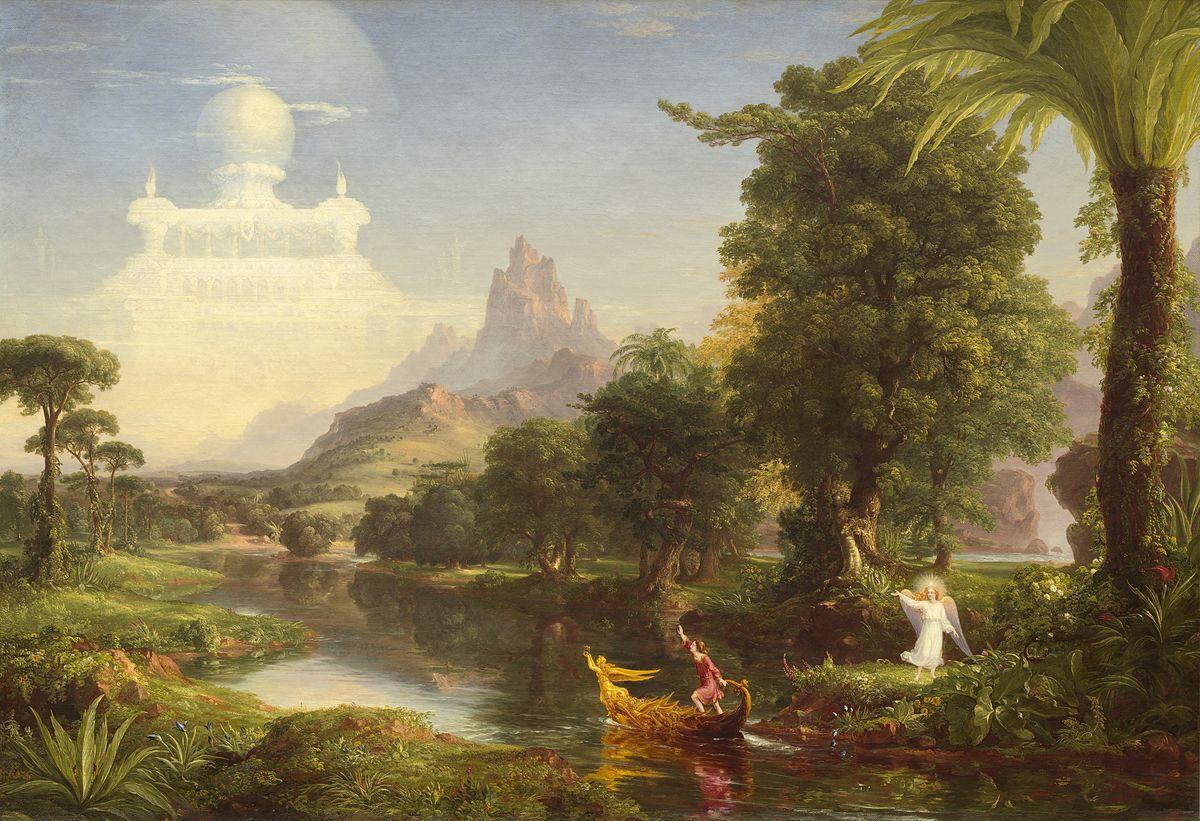
Childhood” from Voyage of Life (1842)

Cole’s landscape paintings were supported by a number of influential patrons including Robert Gilmore, Jr. (1774-1848) of Baltimore.  He was a merchant and shipowner with the East-India company, and one of America’s most important patrons and collectors of art before 1850. Another Cole patron was Samuel Ward, Sr. (1786-1839), a New York City banker and philanthropist. Cole wrote: “I have received a noble commission from Samuel Ward, a commission to paint a Series of Pictures the plan of which I conceived several years since and had an opportunity of presenting to him in the Spring. The Subject is to execute in four pictures about 6 ft. 6 in. or 7 ft. long each, and is entitled Voyage of Life…The subject is an allegorical one, but perfectly intelligible & I think capable to making a strong and moral religious impression.” The commission price was $5000.

Cole’s theme divided the journey into “Childhood,” “Youth,” “Manhood,” and “Old Age.” “Childhood” was begun in September 1839. Cole was determined that his paintings should create a “higher style of landscape” reflecting a moral and religious message. The four landscapes follow a river flowing through the same landscape and the four seasons. “Childhood” depicts an abundance of spring flowers in a sun filled landscape. An elegant gold vessel emerges from a dark cave deep in a mountain that Cole describes as “emblematic of our earthly origins, and the mysterious Past.”

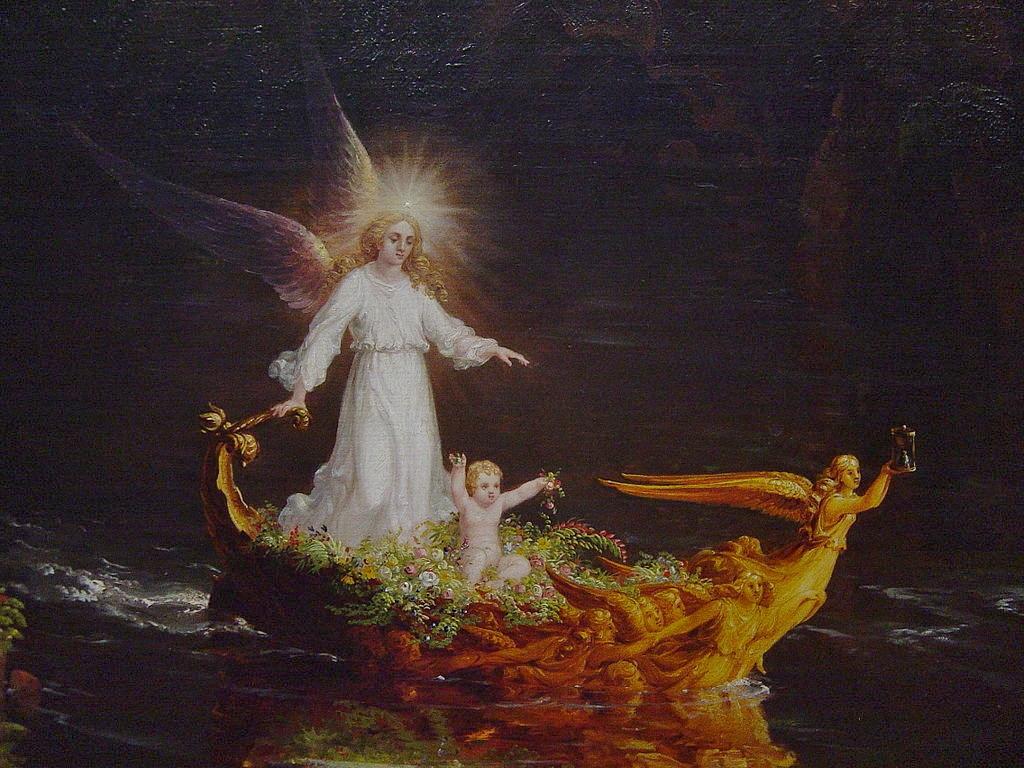
“Childhood” (detail)

A radiant guardian angel is at the tiller of the vessel. The figurehead is a gold angel holding an hourglass, representing time. Several sculpted gold angels form the body of the vessel. A joyful infant sits among the flowers, arms raised and looking forward. The river flows smoothy toward the viewer.

“Youth” (1842)

“Youth” (painted in early 1840) depicts a young man holding the tiller of the gold vessel. The guardian angel stands on the shore, waving good-bye. The river winds through the landscape which expands into a rich summer panorama. The clouds above form a glowing white temple. Cole described the scene: “The scenery of the picture–its clear stream, its lofty trees, its towering mountains, its unbound distance, and transparent atmosphere—figure forth the romantic beauty of youthful imaginings, when the mind elevates the mean and common in the magnificent, before experience teaches what is the Real.”

“Manhood” (1842)

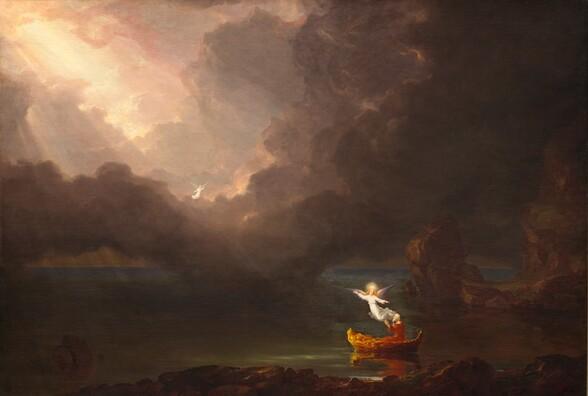
“Manhood” was painted in the summer and fall of 1840. The man is carried by rushing and choppy water from the cave where he floated peacefully as a child. Cole wrote about the scene: “The helm of the boat is gone; the voyager has lost control of his life. The angel looks down from the clouds as he [the man] is whirled forward toward violent rapids and bare, fractured rocks. Only divine inspiration can save the voyager from a tragic fate.” The man kneels and prays. The figurehead still holds the hourglass. Cole’s fall landscape is under a dark and stormy sky. However, the sun breaks through in the distance.

“Old Age” (1842)

The river is calm. The storm clouds part in the distance to reveal an angel and the rising sun. The old man rides in the vessel which is battered and missing the figurehead. The edge of the river has been reached, and the old man has passed by the rocky landscape. The heavens are opening. For Cole it was the man’s Christian faith that saved him: “The chains of corporal existence are falling away; and already the mind has glimpses of immortal life.”

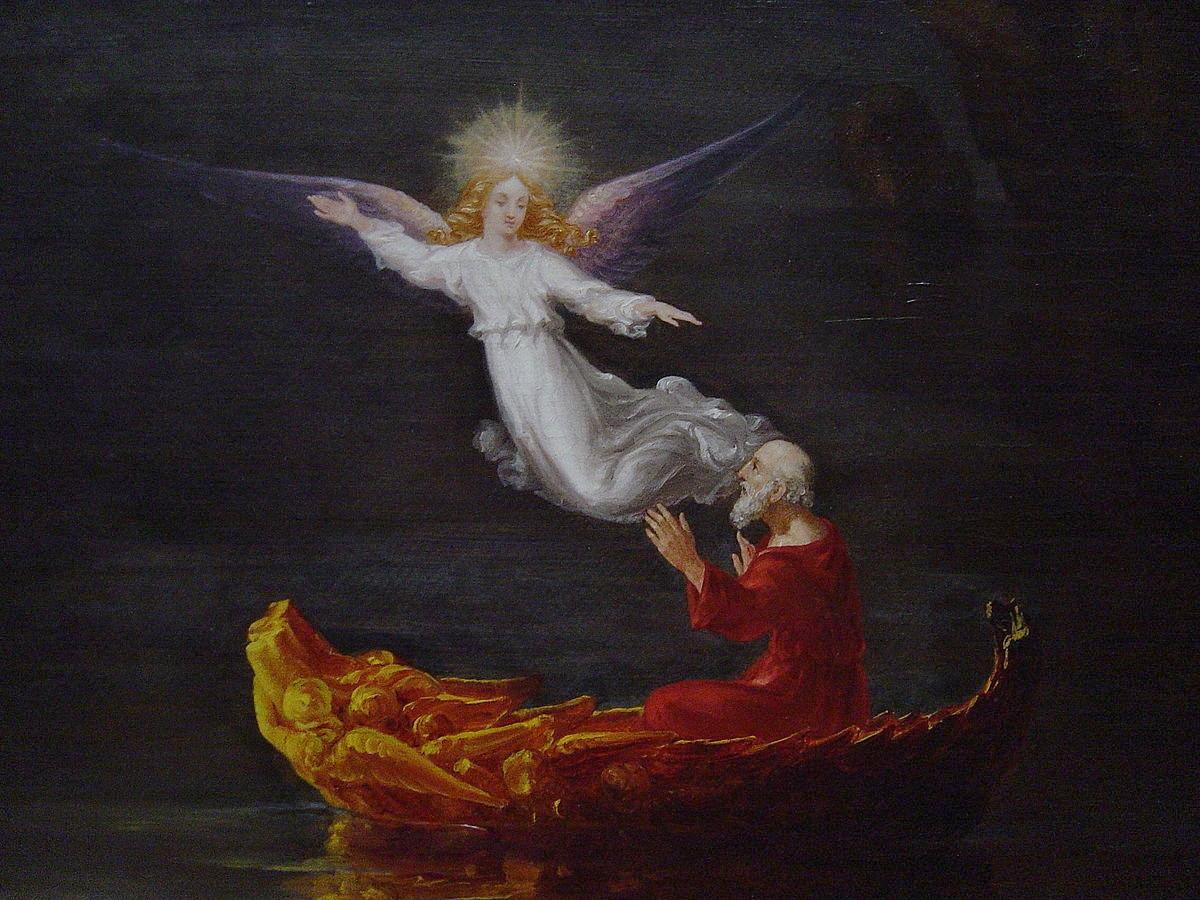
“Old Age” (detail)

Pointing toward to heavenly light, the guardian angel is with the old man. His arms wide-spread, he thankfully accepts the forgiveness he perceives in the distance.

Cole’s patron Samuel Ward, Sr. died in 1839, before the commission was completed. Ward’s heirs created difficulties for Cole about showing the work in a public exhibition. Cole went to Rome during the winter of 1841-42, and there painted a second set of the series. Cole wrote about the difficult circumstances: “I shall take the series to England & shall endeavour to dispose of them there. I have but little hope of doing so. The fashionable taste (if I may dignify if with such a name) is for works of another order, pictures without ideas, mere gaudy display of color and Chiro Scuro without meaning, showy things for the eye. If I do not dispose of my pictures in England, I must take them home and hang them in my own rooms & content myself with the conviction that the time will come when they will be more valued.”

Cole and his good friend William Cullen Bryant, poet and editor of the New York Evening Post, agreed that “God’s nature” was a refuge from the industrialization and ugliness that was occurring in American cities. The series has been interpreted by historians as Cole’s response to “Manifest Destiny.” The term coined in1845 expressed the belief that the United States was destined by God to conquer the continent. For Cole and Bryant, and others like them, this ultimately meant to civilize nature.

“If I live to be old enough. I may sit down under some bush, the last left in the utilitarian world, and feel thankful that intellect in its march has spared one vestige of an ancient forest for me to die by.” (Thomas Cole)

Beverly Hall Smith was a professor of art history for 40 years.  Since retiring with her husband Kurt to Chestertown in 2014, she has taught art history classes at WC-ALL. She is also an artist whose work is sometimes in exhibitions at Chestertown RiverArts and she paints sets for the Garfield Center for the Arts.
NOTE: When Cole returned to American, the second set of paintings were a great success when they were exhibited. The first set is now in the Munson-William-Proctor Art Institute in Utica, New York. The second set, described in this article, hangs in the National Gallery, Washington, D.C.

The Spy Newspapers may periodically employ the assistance of artificial intelligence (AI) to enhance the clarity and accuracy of our content.

Filed Under: 3 Top Story, Looking at the Masters

Looking at the Masters: Neuschwanstein

August 25, 2022 by Beverly Hall Smith
Leave a Comment

King Ludwig I of Bavaria (Wittelsbach) was born in the Nymphenburg Palace in 1845. He died in 1886 under mysterious circumstances. He and his brother Otto lived in Hohenschwangau (High Swan Castle), built by his father King Maximilian II of Bavaria.  The boys were brought up to learn their duty as intended leaders of Bavaria. Ludwig took his education very seriously. However, his mother Marie of Prussian noticed another side to her son, and she wrote, “Ludwig enjoyed dressing up…took pleasure in play acting, loved pictures and the like…and liked…making presents of his property, money and other possessions.” Crown Prince Ludwig also was fascinated particularly by the music and drama of Richard Wagner’s operas. 

Ludwig became King of Bavaria in 1864 at age 18. In 1873 he reflected upon his reign: “I became king much too early. I had not learned enough. I had made such a good beginning…with the learning of state laws. Suddenly I was snatched away from my books and set on the throne. Well, I am still trying to learn….” His reign lasted only two years. Bavaria was conquered by Prussia, and Ludwig became a vassal of his Prussian uncle. Ludwig had no real power. 

Neuschwanstein

Ludwig traveled to Paris in 1867, and he visited Versailles. He understood the importance of the castle as a symbol of power. Ludwig was related to the French Bourbons, and he felt a strong relationship with them and the kingly power they possessed. He believed he was head of state by the grace of God, but that role was taken from him. 

Two years after his displacement, Ludwig commissioned the building of Neuschwanstein (1868) on the mountain above Hohenschwangau. It was to be a show of power and fantasy. Set designer Christian Jank drew the castle based on Ludwig’s specific visions of Versailles and the castles of the Christian Knights of the Middle Ages in Wagner’s operas. The architecture is Gothic, Romanesque, and Byzantine. The architect and set designer Eduard Riedel oversaw construction according to Jank’s painting. Construction began in the summer of 1868, and the corner stone was laid in 1873. The foundation was cement and the walls were brick, but the exterior was clad with light colored limestone. The original design included 200 rooms, but no more than fourteen were finished. Neuschwanstein provided the setting for Ludwig’s private fantasy of living as a Swan Knight or a King. Ludwig was said to sleep during the day and rise at night. 

Throne Room (apse)

The Throne Room was designed after a Byzantine Basilica.  Ludwig was a Catholic. The gold mosaics in the apse depict Christ surrounded by angels. The Madonna kneels at Christ’s right and John the Baptist kneels at the left. Below are six holy kings. Marble steps lead to a platform where the throne would be placed. It was on order when Ludwig died; the order was cancelled. The mosaic floor is designed in a circle to represent the Earth and depicts many of God’s creatures. Along the sides are Imperial Red Porphyry columns. First discovered in Egypt, Imperial Red Porphyry is rare and a symbol of wealth and power.

Throne Room

On the walls are depictions of the twelve apostles and the deeds of kings and saints. The room is two stories high, making space for the chandelier (13’ tall). In the middle of the arched ceiling is a large dome, painted blue to represent the sky and covered with gold stars. Ludwig would rule under heaven and over the earth. On the wall opposite the throne is a large painting of St George slaying the dragon.

 Wagner’s opera Parsifal (1877) is about one of King Arthur’s knights who searches for the Holy Grail. Parsifal is young and innocent, but along the way he learns a great deal about the world and about compassion. Wagner included many of Ludwig’s problems in the story and referred to Ludwig as Parsifal. The Throne Room was renamed the Hall of the Holy Grail.

Singer’s Hall

The name Singer’s Hall is a reference to Wagner’s opera Tannhauser, the title character a minstrel and poet, and the Warburg Song Contest.  At 2906 square feet, the Singer’s Hall is the largest room in the castle. It was intended to be a ballroom and a theater. The walls are painted with scenes from Lohengrin and Parsifal.  Enormous gold chandeliers hang from the Gothic wood-beamed ceiling.

Singer’s Hall stage with “Klingsor’s Forest”

The stage of Singer’s Hall contains a painted backdrop of Klingsor’s Forest. In Parsifal, Klingsor is an evil magician who was rejected as a Knight of the Holy Grail. The forest is the setting for his attempt to kill Parsifal, but a miracle occurs, and Parsifal is successful in his quest for the Holy Grail. There were no performances in the Singer’s Hall until 1933, on the 50th anniversary of Wagner’s death.

Kitchen

Ludwig’s obsession with Wagner and his operas was matched by his obsession with modern conveniences. Neuschwanstein had running water throughout, hot and cold water in the baths and kitchen, flush toilets, and forced-air central heating. An electrical bell system was installed for calling servants, and meals were brought by lift to the dining room from the kitchen three floors below. The kitchen has a large stove, large and small spits, a built-in roasting oven, plate warmer, baking oven, and fish tank. Ludwig had a telephone installed, although few phone lines were available. He could call only the nearby village of Fussen. 

Cave of Venus

Beneath the salon and study on the third floor, a grotto was built to represent Venusberg, Wagner’s interpretation of the ancient “Tannhauser” poem. Tannhauser was a mortal man who succumbed to the seductress Venus in Wagner’s opera. An erotic seduction scene is painted in Ludwig’s private apartments and on the rear wall of the cave. Ludwig commissioned August Dirigl, a stage designer, to construct the cave with stalactites and a waterfall. 

King Ludwig II, Coronation Portrait (1865) (by Ferdinand von Piloty (1828-1895)

Ludwig saw Lohengrin when he was 15, and Wagner and his operas became a lifelong obsession. After he became King, he summoned Wagner to Munich in 1864, and he supported Wagner from then on. Ludwig was moved by their first meeting: “Today I was brought to him. He is unfortunately so beautiful and wise, soulful and lordly, that I fear his life must fade away like a divine dream in this base world…You cannot imagine the magic of his regard; if he remains alive it will be a great miracle!” Ludwig made a promise to Wagner: “I’m going to build a fantasy castle dedicated to your works and we should go live there together forever.” He described the location to Wagner “as one of the most beautiful to be found, holy and unapproachable, a worthy temple for the divine friend who has brought salvation and true blessing to the world. It will also remind you of Tannhäuser and Lohengrin.”

Ludwig’s sponsorship made Munich the music capital of Europe. The premiers of Tristan und Isolde (1865), Die Meistersinger von Nürnberg (1868), Das Rheingold (1869) and Die Walküre (1870) were sponsored by Ludwig. Wagner was forced to leave Munich in 1865 as a result of his anti-Semitism. Ludwig did not agree with Wagner on this point but continued to support his music. Wagner conducted a private performance for Ludwig of the prelude to Parsifal at the Court Theatre in Munich in 1882. Ludwig’s plans for an opera festival to be held yearly were realized when Der Ring des Nibelungen was performed as the inauguration opera of the Bayreuth Festival in 1876. 

Ludwig spared no expense on the several castles he built. Foreign banks threatened to seize his property beginning in 1885, as a result of non-repayment of loans. Ludwig lived at Neuschwanstein for six months off and on, and reports say he spent only 11 nights there. The government in 1886 declared that Ludwig was insane and deposed him. He was interned in Berg Palace. The following day (June 13, 1886), Ludwig drowned in Lake Starnberg under mysterious circumstance. 

When Ludwig was a young boy, he said to his governess, “I want to remain an eternal mystery to myself and to others.” 


The Spy Newspapers may periodically employ the assistance of artificial intelligence (AI) to enhance the clarity and accuracy of our content.

Filed Under: 3 Top Story

Looking at the Masters: The Garden and Pavilions at Nymphenburg

August 18, 2022 by Beverly Hall Smith
Leave a Comment

Nymphenburg Palace served as the summer residence of the of Bavarian Elector Ferdinand Maria Wittelsbach (Holy Roman Emperor (1651-1679) and his wife Henriette Adelaide of Savoy. She gave birth to their son Maximilian II in 1662 after ten years of marriage. As a gift to his wife, Ferdinand Maria commissioned Agostino Barelli, Enrico Zuccalli, Antonio Viscarde, and Joseph Effner to remodel the existing palace and to extend the gardens. The name Nymphenburg honored his beloved wife, as nymphs were associated with fertility, water, and nature, and were depicted as beautiful young women who were loved by many in Greek mythology.

Nymphenburg Palace (front canal)

Remodeling of the Nymphenburg Palace began 1664. The palace building is entered by walking down a long walk beside a canal that extends through the palace and garden for 1.6 miles. The canal is populated with swans and ducks. 

Nymphenburg Palace (1761)

Nymphenburg Palace (1761) (front) (27’’ x 47’’) was depicted by Bernard Bellotto in an oil painting now in the National Gallery in Washington, D.C. The east canal ends at the front garden with the Cour d’honneur, the water parterre designed by Joseph Effner. The canal splits and flows north and south, and it flows under the wings of the palace into the back garden. There it forms two lakes: the Badenburg and the Kleiner. Wings were added to the palace, eventually extending the facade to 2297 feet. The wings include a natural history museum (1889), an Orangery (1758), the Marstall Museum (1740) (carriages and sleds), and the Porcelain Museum (1747). The front canal was used for gondola rides, and when it froze over, for skating, ice hockey, and curling.

Amalienburg (1734-1739)

Amalienburg (1734-1739) was commissioned by Elector Karl Albrecht as a pleasure palace and hunting lodge for his wife Maria Amalia. The Amalienburg was part of the18th Century trend of building “maisons de plaisance,” where the nobility could escape strict court etiquette and indulge in relaxing pleasures. An English flower garden laid out behind the palacel was design by Dominique Girard, a pupil of Andre Le Notre. Versailles remains the influence. Several unique pavilions were tucked into the woods, along with fountains, temples, and surprise sculptures. 

Amalienburg was designed by Francois de Cuvillies (1695-1768). Born in Belgium and a dwarf, he was discovered to have artistic talents by Max Emanuel the Elector of Bavaria, who introduced him to Joseph Effner. They sent Cuvillies to Paris to study art from 1720 until 1724. When he returned to Munich, he was appointed a court architect. He introduced the Rococo style to Germany. The pink and white exterior reflects the trend away from the Baroque’s rich dark colors to the pastels of the Rococo. The sculpture in the arch over the front door depicts Diana, Goddess of the Hunt, accompanied by putti, dogs, and hunting equipment. On the flat roof in the center of the pavilion a decorative circular railing encloses an area where hunters could shoot pheasants.  

Hall of Mirrors, Amalienburg

The Hall of Mirrors, recalling the Hall of Mirrors at Versailles, is small in comparison, but exceeds Versailles in its splendor. It is a circular room with alternating mirrors and windows placed to reflect the outside gardens. It is a paradise of silver and blue, the national colors of Bavaria. The mirrors, walls, and ceilings are decorated with silver stucco frames that depict flowers, trees, garlands, birds, and chubby cherubs. The new Rococo style rejects straight lines and symmetry in favor of an abundance of curves, spirals, and swirls that were thought to emulate nature. The silver stuccos are the work of Johann Baptist Zimmermann, a painter and master of stucco.

Maria Amalia’s Bedroom, Amalienburg

The Amalienburg contained several small but elegant rooms, allowing Maria Amalie to stay there in comfort. The lemon and silver bedroom contains a bed with the traditional hanging curtains. In the bed niche is a silver coated wood carving by Johann Joachim Dietrich, one of the best court wood carvers. The portrait of Maria Amalia in hunting dress and with one of her favorite dogs is above the door. On the opposite wall is a portrait of Max Emanuel, also in hunting attire. Next door is the Hunting Room containing paintings of court hunts. Next is the Pheasant Room, or Indian Cabinet, with linen walls painted in Chinese designs. The Blue Cabinet room holds necessary equipment for the hunt. The Dog and Gun Room also is painted in blue and white Chinese designs. Several dog kennels have been incorporated at the base of the walls.

Delft Kitchen, Amalienburg

What hunting lodge would be complete without a kitchen to cook the game? The Amalienburg kitchen is decorated with blue and white Delft tiles imported from Holland. Brightly colored, these depict Chinese scenes and elaborate flower arrangements. The “stew stove” is masonry, with the fire box enclosed below and iron plates on top. This stove was the first of its kind. 

Badenburg (1718-1722)

The Badenburg (1718-1722) is located in the southern part of the park. Designed by Joseph Effner, it is a rectangular building with rounded ends. Like the Amalienburg, it contains several rooms: the two-story Banqueting Hall, the Elector’s apartment which includes an antechamber, bedroom, dressing room, and a cabinet decorated with monkeys for the Elector’s toilette. The rooms were decorated lavishly with paintings depicting elements of water from mythology, paneling, and mirrors. 

Badenburg Swimming Pool

The Badenburg has the first heated swimming pool in modern times. Public baths and bathtubs have existed since the ancient world, but they were not swimming pools. The Badenburg pool is lined with Delft tiles. The upper walls look like marble, but they are not. They are made of scagliola (chips), not found in nature. The Egyptians, Greeks and Romans used a mixture of plaster, water, glue, and pigments to simulate marbles and precious stones. The technique was popular because it was easier and cheaper than quarrying and moving marbles and other stones. The basement includes a bath, the heating room, a kitchen, and more bathing rooms. Pierre de Bretangne, Max Emanuel’s father confessor observed: “The house of baths is a veritable artistic masterpiece.”

Magdalenenklause (1725-1728)

The Magdalenenklause (1725-1728) also was designed by Joseph Effner for Max Emanuel. It was purposefully located in an overgrown wooded area to simulate a hermit’s hut, hidden far from the complexities of the world. The construction was new, but made to look old and run down. The brick walls are chipped and missing bricks. They are patched with what looks like cracking cement. The rectangular one-story building expands to semi-circular walls on either end, as seen in the turret. The front entrance simulates a church. The first room is paneled with oak, and it contains book shelves holding leather bound books. It is austere in design and intentionally dark to support intense thought and study. The Magdalenenklause, like fake Roman ruins, is a result of the romantic streak present in Germany at the time.  

Cave of Mary Magdalene, Magdalenenklause

Beyond the Emperor’s study, a second room contains a chapel with an altar and a cave. The cave is constructed of seashells, rocks, and chunks of minerals plastered onto the wall to hold the statue of a praying Mary Magdalene. She looks at a crucifix. After the crucifixion of Christ, Mary Magdalene retreated to a cave in the mountains to meditate on the message of Jesus. She became an ascetic, living a spiritual life. Max Emanuel died before the building was completed. It was finished by his son Elector Karl Albrecht.

“Pan” (1815)

A visit to a spectacular garden and its pavilions cannot end in sadness. “Pan” (1815) by Peter Simon Lamine is one of the many surprises that visitors encounter when walking through Nymphenburg’s gardens. He and his goat are perched slightly above ground level, catching the passerby unaware. He plays music from the pipes he invented. 

Beverly Hall Smith was a professor of art history for 40 years.  Since retiring with her husband Kurt to Chestertown in 2014, she has taught art history classes at WC-ALL. She is also an artist whose work is sometimes in exhibitions at Chestertown RiverArts and she paints sets for the Garfield Center for the Arts.


The Spy Newspapers may periodically employ the assistance of artificial intelligence (AI) to enhance the clarity and accuracy of our content.

Filed Under: 3 Top Story

Looking at the Masters: The Gardens at Schoenbrunn Palace

August 11, 2022 by Beverly Hall Smith
Leave a Comment

The reign of Louis XIV was absolute, and it lasted 70 years (1643 to 1715). Louis inspired Europe’s ruling families to emulate his unbelievable success. A tangible symbol of his success was the enlargement of the palace and gardens at Versailles, setting a new standard for Europe. Country palaces and gardens were enlarged by several Austrian, German, and Russian monarchs. Andre Le Notre’s garden design at Versailles influenced these gardens. The Schoenbrunn Palace outside Vienna became a part of the Hapsburg properties in 1569, when Holy Roman Emperor Maximilian II purchased the small Kattenburg mansion for use as a hunting lodge. Schoebrunn was passed down through the Hapsburg family, and each new owner reorganized and added to the palace and gardens

The origin of palace garden design started with the Villa of Hadrian (118 to 134 CE). Hadrian’s garden influenced Pirro Ligorio’s design for the Villa d’Este (1569 to 1577). Andre Le Notre continued the tradition with his garden design for Versailles (1661 to 1682). The elaborate garden symbolized the glory of the reign of Louis XIV.

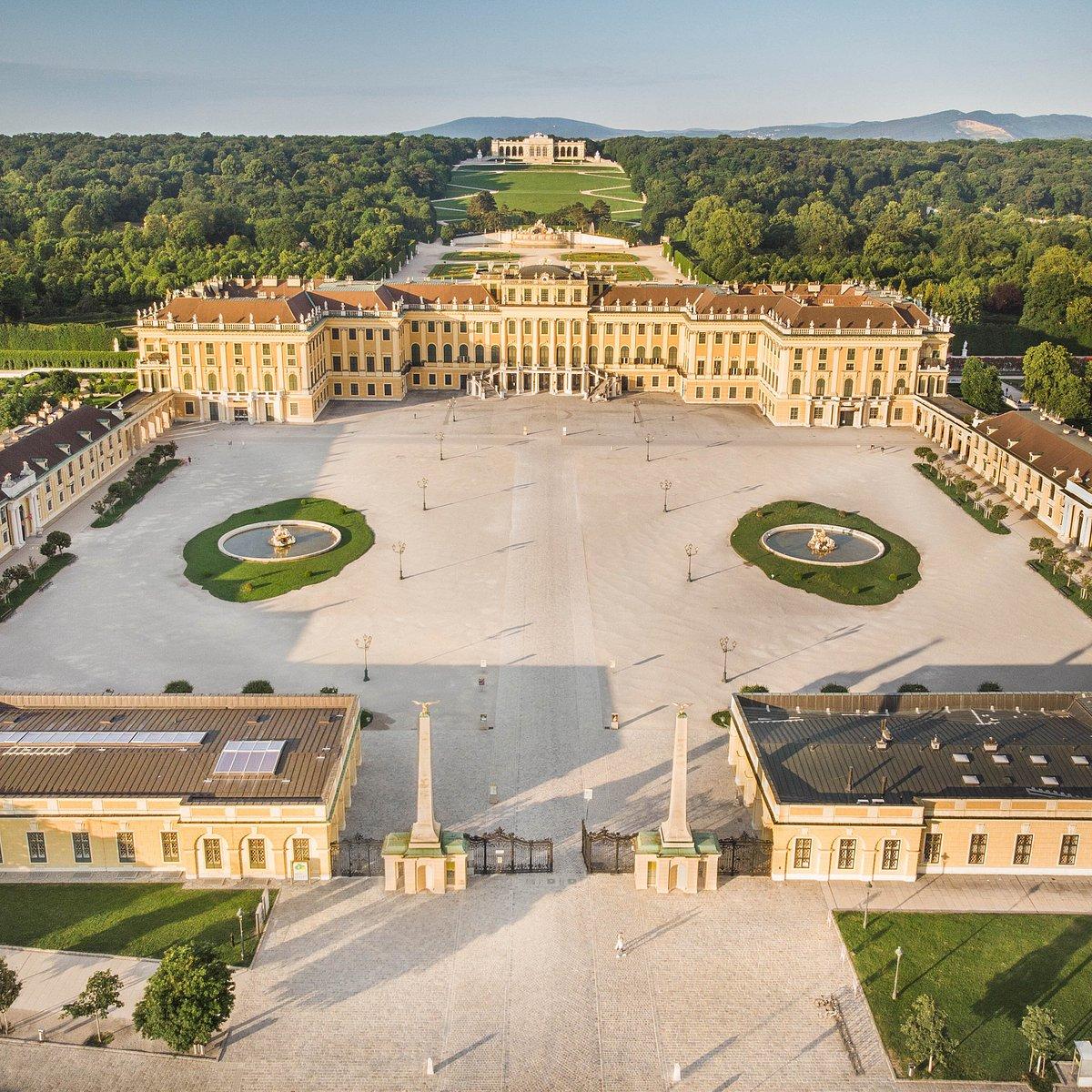
Schoenbrunn Palace

When Emperor Ferdinand II died in 1637, the Schoenbrunn became the residence of his widow Eleonora Gonzaga. The name Schoenbrunn (beautiful spring) was first found on an invoice dated 1642. Unfortunately, the chateau was destroyed by the Turks in 1693.

Emperor Leopold I commissioned Johann Fischer von Erlach (1693), popular with the Hapsburgs and builder of many buildings in Austria, to build a new grand lodge for his son Joseph I. Leopold instructed that the palace should rival Versailles. Von Erlach drew up two plans, and the second was accepted in 1695-96. The palace was finished in 1711 with 1,441 rooms. Jean Trehet, a student of Andre Le Notre, designed the gardens that cover more than three-quarters of a square mile. Emperor Charles VI inherited the palace and gave it to his daughter Empress Maria Theresa (reign 1740-1780). After her husband Emperor Francis I died, she made Schoenbrunn her primary residence. She is responsible for the design of the palace and grounds as they exist today. 

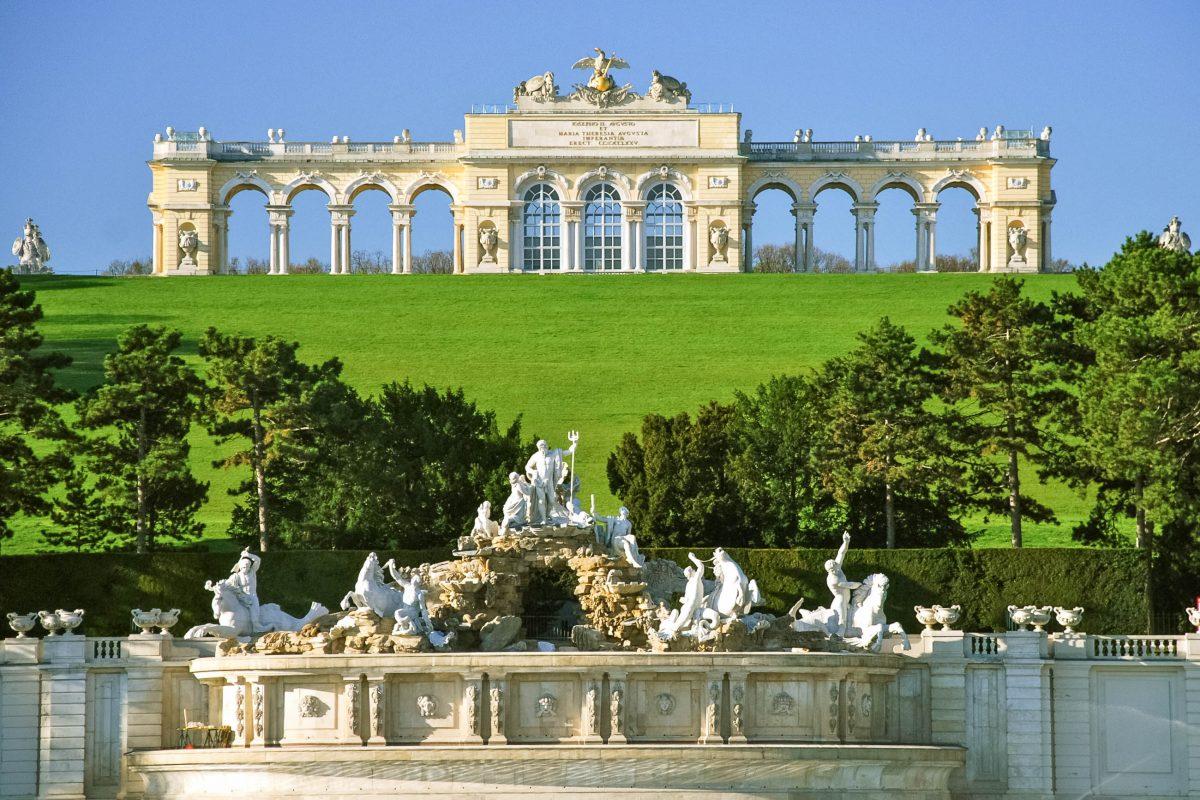
A large courtyard is surrounded by several outbuildings such as the stables. Two fountains represent the lands of the Empire of Austria, Galacia, Lodemeria, and Transylvania. Behind the palace is the Great Parterre (1776-1780). A gravel path is divided into eight sections of symmetrical gardens, including 32 sculptures that represent deities and virtues important to the Hapsburgs. Visible beyond the lawns is the circular Fountain of Neptune, and in the distance the Gloriette.


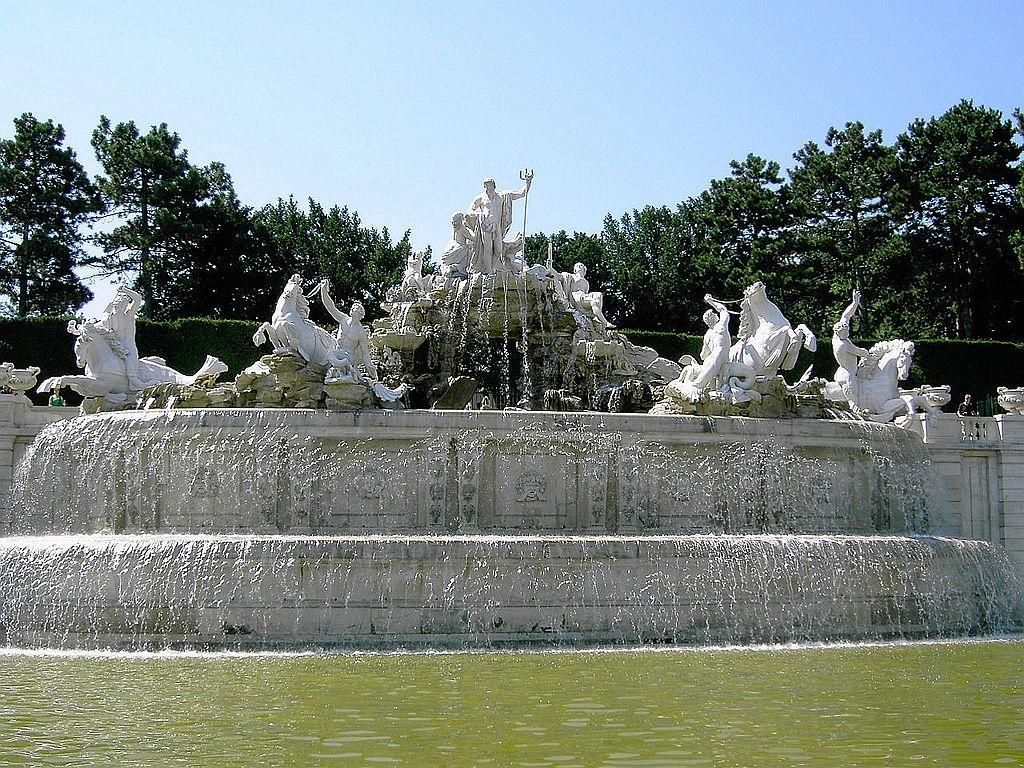
Fountain of Neptune (1776-1780)

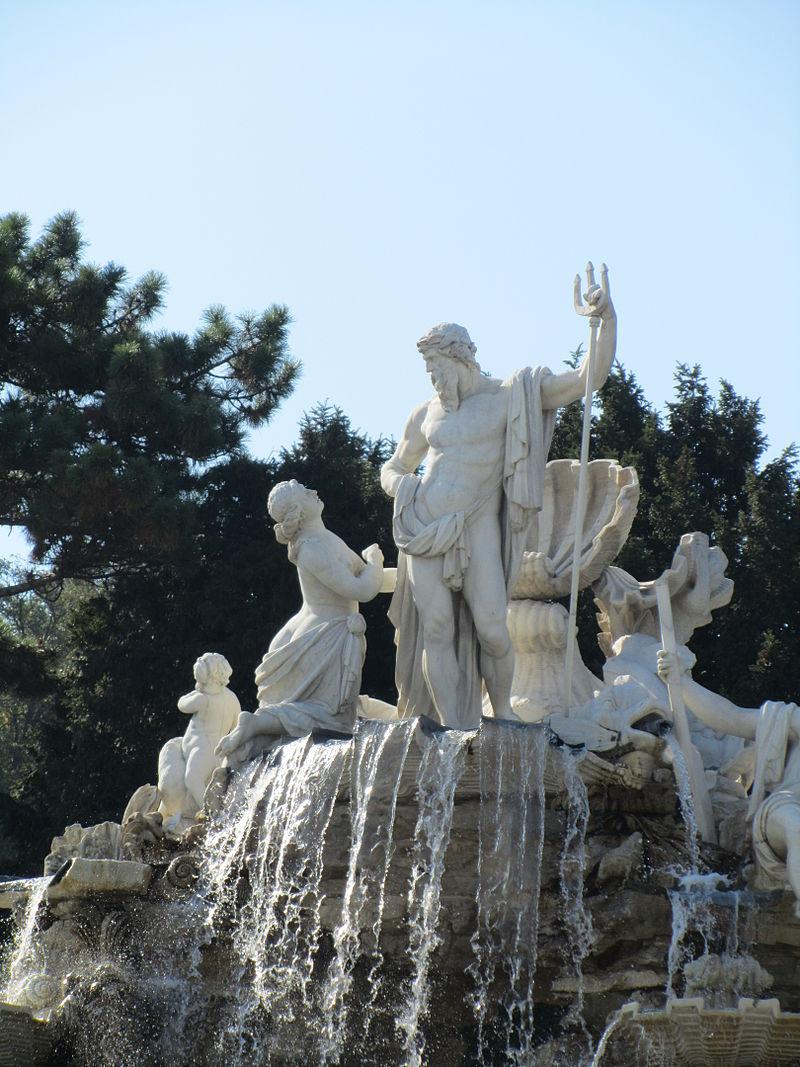
God of the sea, Neptune stands holding his trident at the center of the fountain in front of his seashell chariot. He is surrounded by tritons (mermen, demigods of the sea) riding rearing hippocampi (winged sea horses). Neptune is the Roman name for the Greek god of the sea Poseidon. The Hapsburgs were the legitimate descendants of the title Holy Roman Emperor (King of the Romans), the title granted to Charlemagne by Pope Leo III in 800 CE.  The Hapsburgs also believed they were the descendants of the ancient Roman Empire and chose to celebrate the Roman gods in sculptures.

Fountain of Neptune (detail)

At the top of the fountain, Thetis kneels before Neptune and pleads with him to keep her son Achilles safe in the coming Trojan war. Austria is a land-locked country, but did maintain a strong navy when the Austria-Hungary alliance was formed in 1786. The choice of Neptune by Empress Maria Theresa is an open question. It is speculated that her tribute to Neptune, like Thetis, sought Neptune’s protection.

Gloriette (1775)

The last structure on the Great Parterre is the Gloriette (1775). The Gloriette was included in Fischer von Erlach’s design for the Schoenbrunn, and was built by Johann Ferdinand Hetzendorf von Hohenberg.  Maria Theresa’s idea was the Gloriette should represent “Just War,” fought only as a necessity to achieve peace. She ordered the use of stones that were left from the nearly demolished palace near-by. The center structure is a triumphal arch. The eagle on top is part of the Hapsburg coat-of-arms and symbolizes both the Roman Empire and the Austrian Empire. 

Roman Ruins (1778)

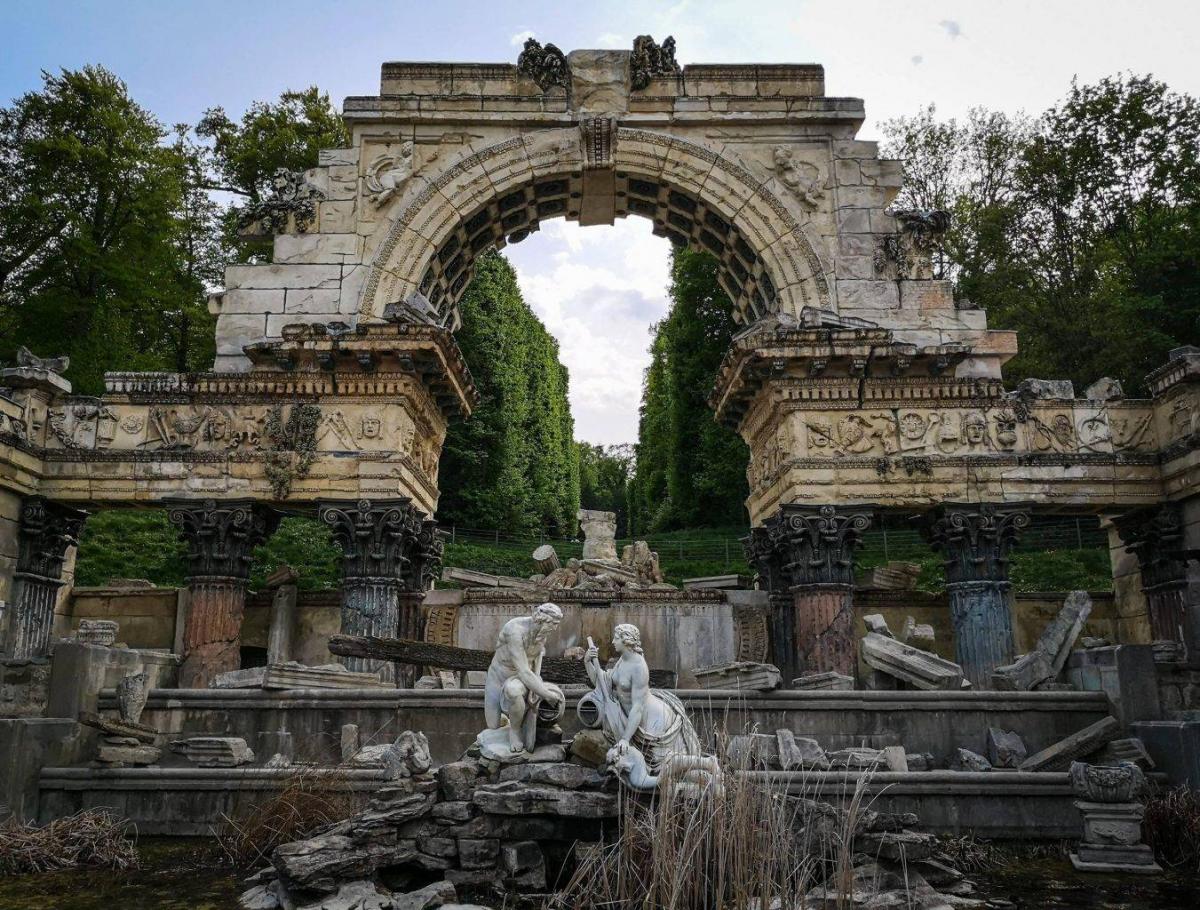
Johann Ferdinand Hetzendorf von Hohenberg also designed the Roman Ruins (1778) in the garden. They sometimes were called the “Ruins of Carthage,” a reference to the defeat of Hannibal by the Romans in the Second Punic War in 146 BCE, when they sowed salt into the land so nothing would grow. Building fake ruins was a romantic idea that became popular in the 18th Century. Von Hohenberg’s design was based on the temple of Vespasian and Titus, excavated in 1756. The structure was built with more recycled stones from the nearby palace. A ruined triumphal arch is supported by crumbling walls. A fountain in the center of a square pool depicts two river gods of the Danube and the Enns Rivers. Fragments of sculptures depict stories of the victories of Hercules (Greek Heracles). 

Palmenhaus (1882)

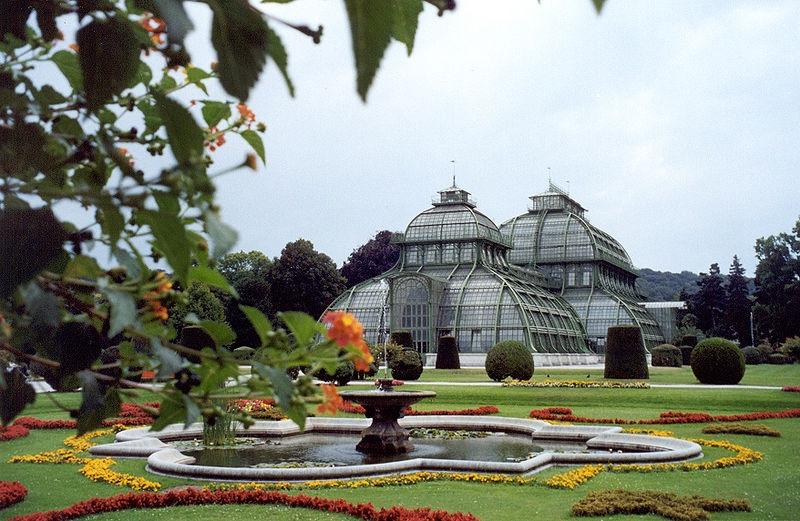
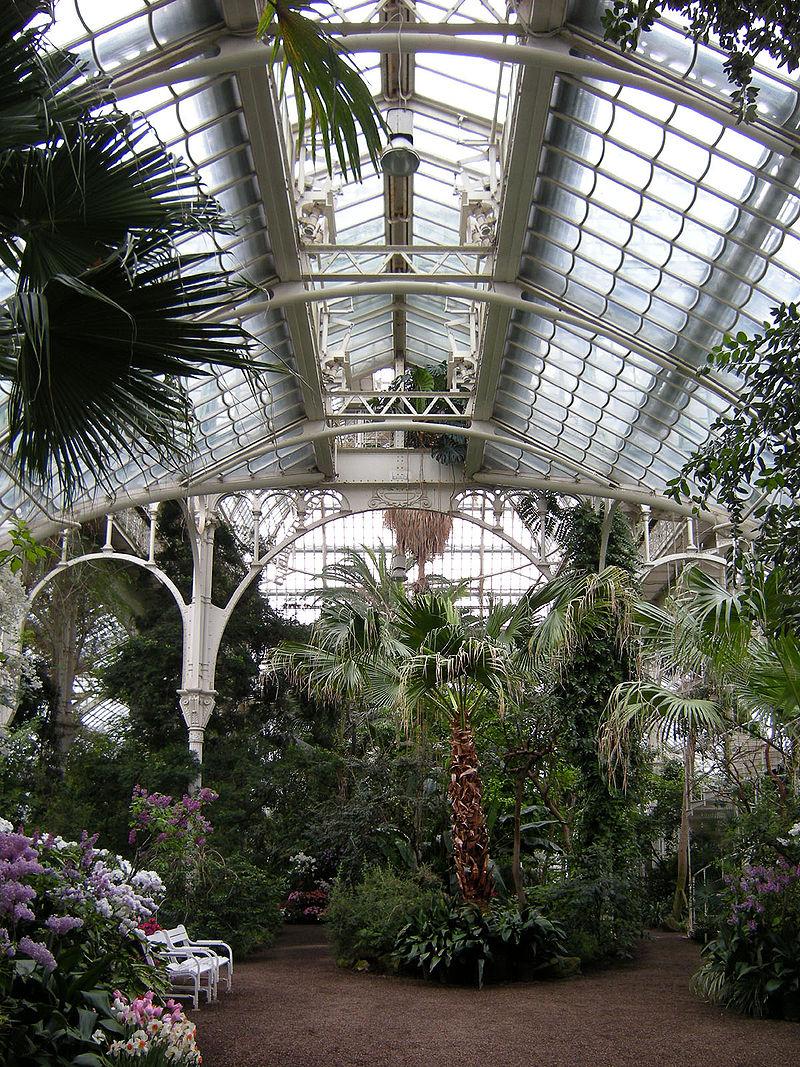
Andre Le Notre’s garden designs also included orangeries for growing of oranges and other fruit trees. Schoenbrunn also had a Palmenhaus, a greenhouse for tropical plants. Built by Emperor Franz Joseph I in 1745. It was destroyed, and the present Palmenhaus was built in 1882. Palmenhauses were status symbols. The Schoebrunn’s is one of the largest palmenhauses in the world at 360 feet long, 92 feet wide, and 82 feet tall, with 45,000 glass panels. In 1882 railroads and railway stations were being built all over Europe. These enormous structures were constructed of the new building materials cast iron and glass. Ignaz Gridl, architect of the Palmenhaus, employed this new method of construction.  

Palmenhaus Central Hall

Walking through the winding paths of the Palmenhaus is a gardener’s dream. Not only are the 4500 species spectacular, but also the creative use of iron lends the structure its own elegance.

Palmenhaus stairs and gallery


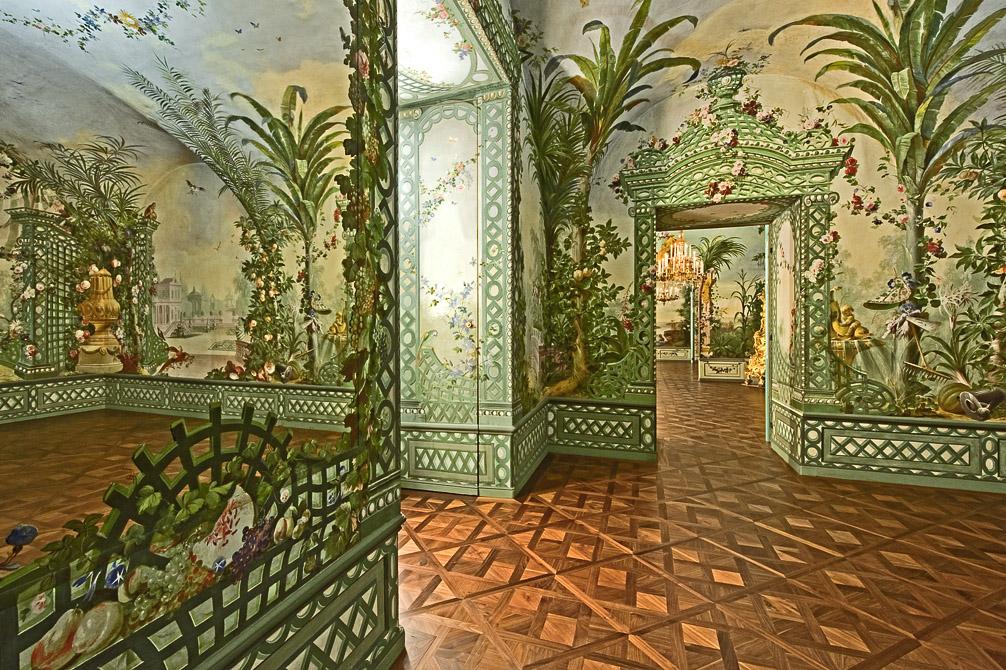
Bergl Rooms (1769-1777)

Maria Theresa suffered from the summer heat. She commissioned Johann Wenzel Bergl (1719-1789), a decorative painter and one of her favorites, to paint murals on the walls of several rooms on the first floor of the palace. She used these as her summer rooms. Bergl covered the walls and ceilings with paintings of exotic landscapes and formal gardens. His use of the tromphe-l’oeil (to fool the eye) effect is extraordinary.

The Schoenbrunn was declared a UNESCO World Heritage Site in 1996. At the age of six, Mozart’s played his first concert for Maria Theresa at Schoenbrunn in 1762. Maria Theresa was Marie Antoinette’s mother.

Beverly Hall Smith was a professor of art history for 40 years.  Since retiring with her husband Kurt to Chestertown in 2014, she has taught art history classes at WC-ALL. She is also an artist whose work is sometimes in exhibitions at Chestertown RiverArts and she paints sets for the Garfield Center for the Arts.
The Spy Newspapers may periodically employ the assistance of artificial intelligence (AI) to enhance the clarity and accuracy of our content.

Filed Under: 3 Top Story

Looking at the Masters: Louis XIV and Apollo in the Gardens of Versailles 

August 4, 2022 by Beverly Hall Smith
Leave a Comment

Louis XIV of France (1638-1715) reigned from 1643 until his death in 1715. When his Prime Minister Mazarin died in 1661, Louis decided he would not have another Prime Minister but would administer the government himself. He also had his finance minister Fouquet arrested and confiscated his residence Vaux-Le-Vicomte. Impressed by the magnificent gardens of Vaux, Louis hired Andre le Notre (1613-1700), who had designed the gardens, to design the gardens at Versailles. Although the Paris Palace of the Louvre had been splendidly refurbished, Louis wanted a palace that would match the intended glory of his reign.

“Versailles” (1668) (Pierre Patel)

Versailles originally was a small hunting lodge built by Louis XIII. Louis XIV had hunted there many times, and he became more and more attracted to the area. Soon after the death of Mazarin, Louis decided to make Versailles his permanent residence. Work on the palace and grounds began in 1661 and lasted for the next 21 years. Eventually the palace was enlarged, containing 700 rooms and 2,153 windows. Andre Le Notre also laid out the radiating plan of the town of Versailles.  “Versailles” (1668), painted by Pierre Patel, presents the entire garden plan. The semi-circular avenue of trees, with roads from the town at the left, right, and center, lead to the grand entrance courtyard of the palace. 

Le Notre’s gardens covered 2000 acres surrounding the palace, with land extending 12 miles beyond the last water pool. The land was leveled, and the woods and marshes were transformed into an elaborate garden containing 200,000 trees, 210,00 flowering annual plants, 55 major fountains with 620 water jets, and 221 sculptures. Louis XIV designed 15 groves that were included in Le Notre’s plan. Le Notre also collaborated with Charles Le Brun, First Painter to the King, who provided drawings for some of the fountains and sculptures. Numerous sculptors were engaged to execute the work. Louis XIV kept watch over every detail.

“Seine River” (1685)

Le Notre’s design began with a water parterre (level space) just outside the Hall of Mirrors. Louis XIV identified with Apollo, god of the sun and the arts. Louis was called the “Sun King.” Paintings and sculptures of the life of Apollo dominate the palace and gardens. The Hall of Mirrors was a long gallery with mirrors on the inner wall that reflected the sunlight streaming through the French doors on the outer wall. The Mirror Pool (1672) also reflected the sunlight. “Seine River” (1685) was one of the sculptures at each end of the pool that represented the rivers of France. According to LeBrun’s design, sculptures of males represented rivers that reached the sea, sculptures of females represented tributaries, and sculptures of four nymphs were present as protectors of the water. 

“Latona’s Fountain” (1689)

The center concourse of the gardens is laid out in parterres, each one lower than the last. The second parterre is dedicated to Latona, mother of both Apollo and Diana. “Latona’s Fountain” (1689) is circular and consists of four levels. According to Greek mythology, Latona and her children (placed on the top level of the fountain) were surrounded by a group of peasants who prevented them from drinking from the river. Latona called upon their father Jupiter/Zeus to punish the peasants. He transformed them into frogs.

“Latona’s Fountain” (lower levels)

The third and fourth levels of the fountain depict the peasants, who spout water from their mouths, and their transformation into frogs. The group, sculpted by the Marsy brothers, originally was placed on a rock, with six peasants and 24 frogs placed on the ground. The sculptures were incorporated (1687-89) into a fountain by Jules Hardouin-Mansart. Reworking of the sculptures was not unusual; however, Le Notre’s original ground plan was maintained.

“Apollo’s Fountain” (1668-1670)

Beyond Latona’s parterre is the Royal Way, or the Great Lawn, that is 1099 feet long and 131 feet wide. Louis XIV designed it with trees that lined either side of the walk. Le Notre added marble statues alternating with marble vases on either side of the walk. At the foot of the walkway is “Apollo’s Fountain” (1668-1670) (gilded lead), added by Louis XIV. “Apollo’s Fountain” was designed by Le Brun and sculpted by John-Baptiste Tuby. Apollo crashes out of the darkness of night and the sea, and he drives the chariot of the sun across the sky. Four valiant horses pull the chariot.  Apollo is accompanied by Tritons, fish-tailed gods of the sea, and children of the god of the sea Poseidon and his wife Amphitrite. They blow conch shells announcing the rising of the sun.

“Apollo’s Fountain” (side view)

Apollo rides in his golden chariot pulled by four fiery horses. Even when the fountain is not running, the image is dynamic.

“Apollo Attended by Nymphs” (1668)

Le Notre’s plan included crosswalks at all the major levels of the parterres. Each crosswalk leads to more fountains and grottos. “Apollo Attended by Nymphs” (1668), by Francois Girardon (1628-1715), is considered another of the important works in the gardens. In fact, Girardon was the most employed sculptor in the gardens.

The sculptures were originally intended for the grotto of Thetis, but they were moved in the 18th Century by Hubert Robert to their present location. Girardon’s sculpture is in the center of the grotto, and two small lower niches depict Apollo’s four horses being groomed.  

“Apollo Attended by the Nymphs”

While Girardon was developing the seven figures, he made a second trip to Rome to gather additional inspiration from the Greek Hellenistic sculptures found there. Apollo’s face and upper torso were based on the famous Hellenistic “Apollo Belvedere” (Roman copy 120-140 CE) in the Vatican. The figures and drapery of the nymphs are also Hellenistic. The seated Apollo is being bathed by the nymphs. One washes his feet and another kneels with a pitcher of water at the ready.  Apollo’s lyre rests against his chair. A third nymph washes his back and neck, while two others fill a basin with water The seventh nymph takes an already used basin away. 

Versailles from the end of the grass lawn to the back of the Palace

The gardens planned by Le Notre and the sculptures designed by Le Brun and others cannot be seen in one day. The Palace is large, the gardens are even larger. Le Notre’s plan was adopted thereafter for several new gardens in Europe. When Charles L’Enfant designed the plan for the city of Washington, Le Notre’s design for the garden of Versailles was the primary influence.

Beverly Hall Smith was a professor of art history for 40 years.  Since retiring with her husband Kurt to Chestertown in 2014, she has taught art history classes at WC-ALL. She is also an artist whose work is sometimes in exhibitions at Chestertown RiverArts and she paints sets for the Garfield Center for the Arts.


. 


The Spy Newspapers may periodically employ the assistance of artificial intelligence (AI) to enhance the clarity and accuracy of our content.

Filed Under: 3 Top Story

Looking at the Masters: Hadrian’s Villa, Tivoli

July 28, 2022 by Beverly Hall Smith
Leave a Comment

Roman Emperor Hadrian reigned from 117 until 138 CE, the last years of the Roman Peace (Pax Romana). One of the good emperors, Hadrian was the commander of the Eastern Army and a learned scholar and philosopher. He traveled throughout the Empire visiting every province from Britain to the Middle East. His purpose was to oversee and maintain the unified Roman empire. Historical documents say Hadrian was an intellectual with an unbounded curiosity about everything. Beyond rebuilding the Pantheon in Rome and building his tomb on the Tiber River, he built temples and triumphal arches in Lebanon, Turkey, Ephesus, and Athens, and the famous Hadrian’s Wall in Great Britain.

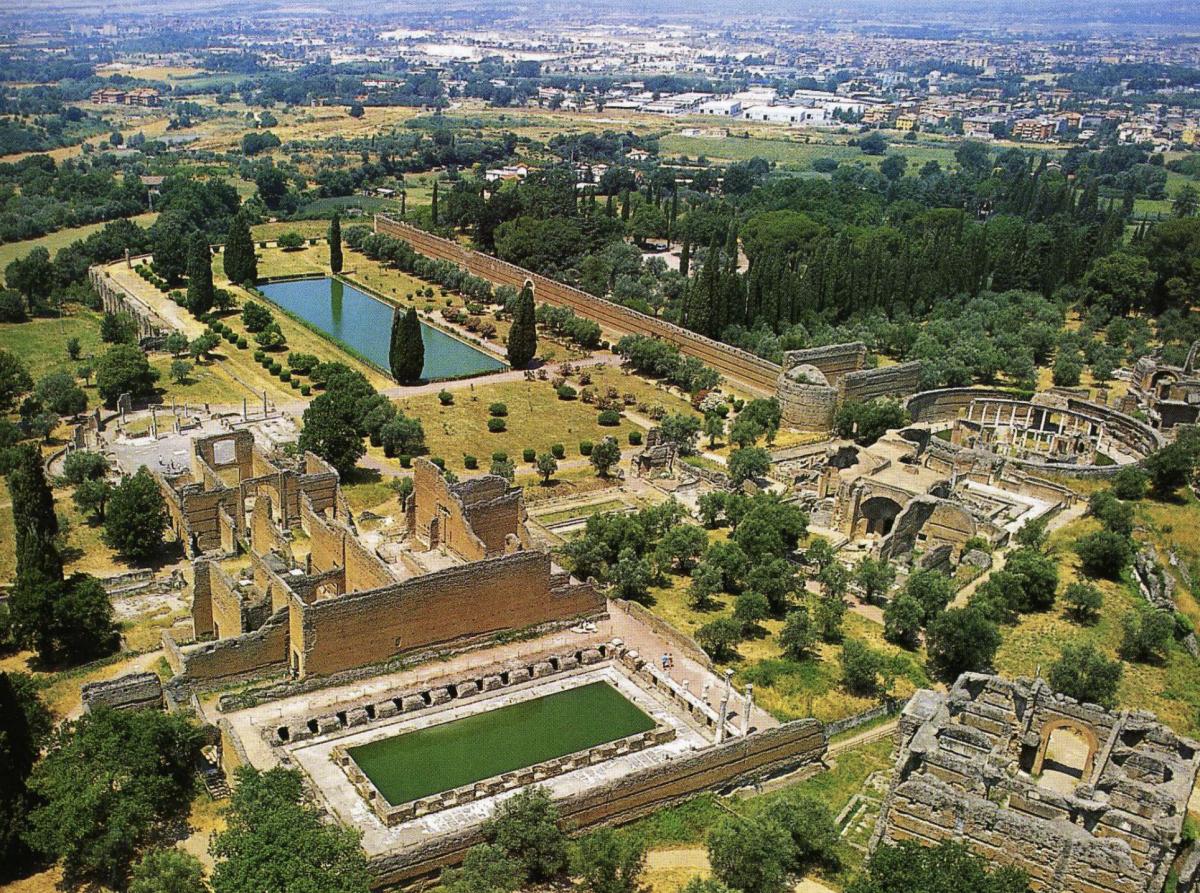
Hadrian was the chief architect of his Villa at Tivoli. He was inspired by the numerous architectural designs he saw in his travels. Construction began on the 300 square acres of land for the Villa in118 CE and continued until 133/34 CE.  Hadrian made the villa his primary residence in order to escape Rome. Mail and travel from Rome were made easy by well-developed Roman roads. Tivoli’s hillside location is splendid as a result of its altitude, cooler temperatures, and landscape with waterfalls. The villa comprised 100 buildings: a main palace, libraries, theaters, baths, dining halls, outdoor pavilions, grottos, and sculpture gardens. Hadrian lived there until his death in 138 CE.

Hadrian’s Villa at Tivoli (118-134 CE)

The original Villa covered 296 acres; what is visible today covers about 100 acres.  From the time it was rediscovered in 1461, its sculptures, mosaics, and other items have been looted and placed in Renaissance and Baroque collections. Most of the looted objects are now in museums all over the world. The first excavations were conducted by Pope Alexander VI Borgia (reigned 1492-1503) in order to find coins and sculptures. Cardinal Ippolito d’Este was the second to the loot Hadrian’s Villa of sculptures and marble for his nearby Villa d’Este.

“Canopus” (125-138 CE)

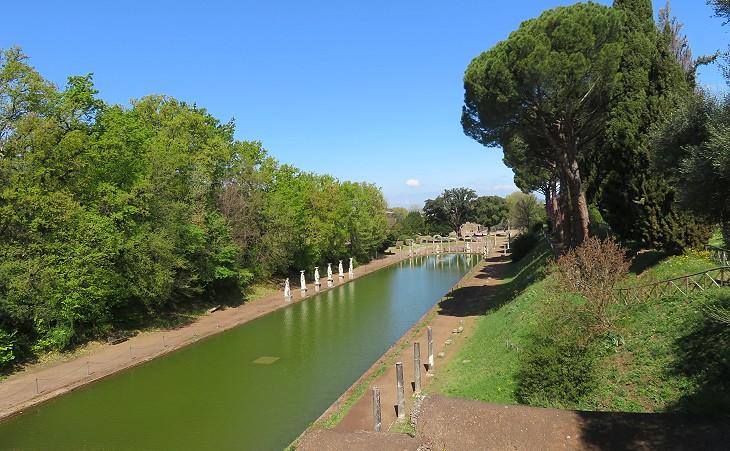
The “Canopus” (125-138 CE) is one of the remaining partial structures. Based on the concept of the Nile in Egypt, the pool was 393 feet long. It was surrounded by a Roman colonnade with Corinthian (leafy) capitals, arches, and Greek sculptures. The Romans knew a great work of art when they saw one. Original Greek sculptures were one-of-a-kind cast bronze statues. Most of these were melted down in the Middle Ages to make weapons. The only original marble sculptures are those that are part of a building. The Romans’ love of Classical Greek sculpture caused them to make hundreds of marble copies that survive today. The Roman copyists were skilled artists, but they were unable to balance standing figures without adding a strut, an additional sculpted support in the form of a tree trunk or vase that added a third support leg. 

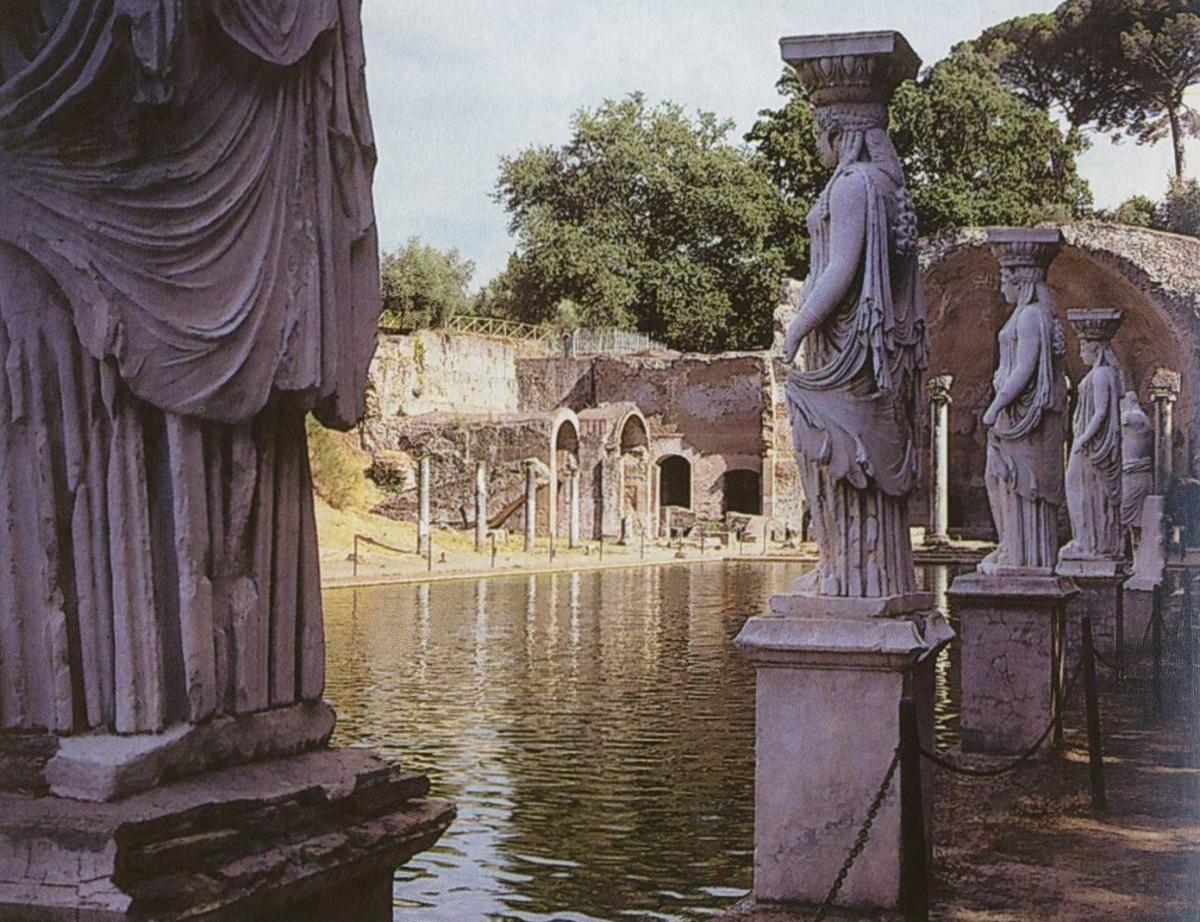
“Canopus” (125-138 CE)

The long Canopus pool was surrounded with sculptures of Greek gods and goddesses, athletes, and mythological figures. A series of caryatids, draped female figures that act as the pillars to support the roof of Greek buildings, can be seen in this picture. The most famous caryatids are found on the Erechtheun (409-404 BCE), on the Acropolis in Athens. It was dedicated to Athena Polias, protector of the city-state of Athens. The six original caryatids were carved during the era of Pericles (461-429 BCE), also known as the “Golden Age.” It was the great Classical period of Greek art when Polycleitus, Phidias, and Myron discovered the proportions and posture of the human body–the perfect human body. The Caryatids were sculpted by the workshop of Alcamernes, student and colleague of Phidias. The figures stand in the perfect body position known as contrapposto; the weight of the body is shifted onto one leg as the other leg rests. The original marble caryatid figures also shift onto the appropriate leg, the fabric of their gowns bunched around the supporting leg like the flutes of a column. 

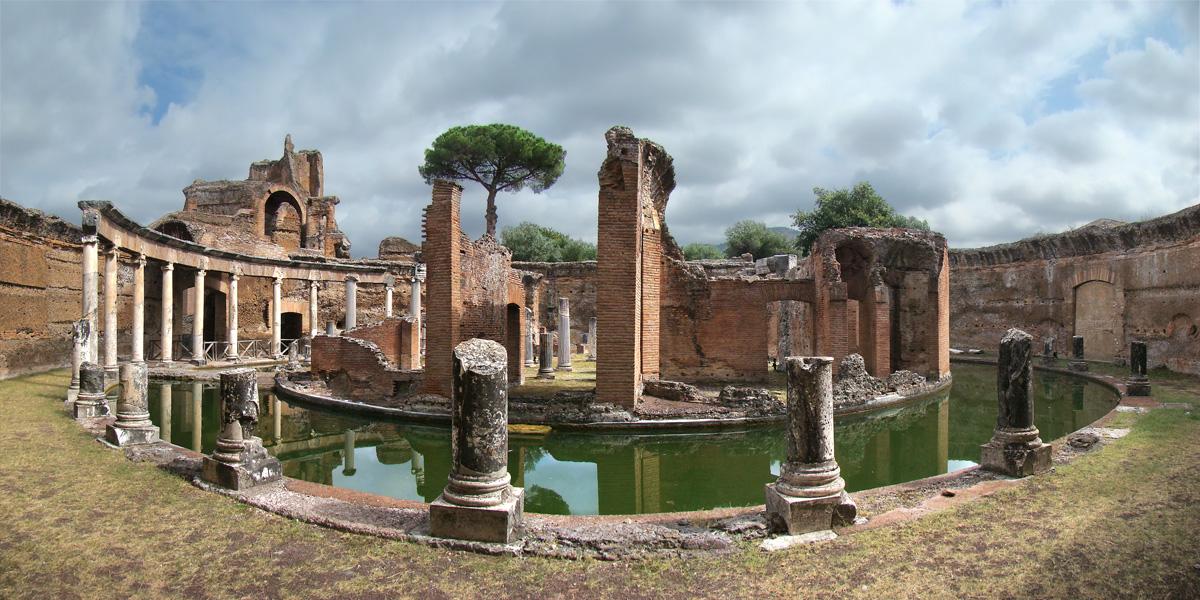
“Maritime Theatre” (begun 117 CE)

The “Maritime Theatre” is not a theater in the usual sense, it is in fact Hadrian’s private villa within the villa. Hadrian designed his island with wooden bridges he could pull up to prevent anyone from coming in. The island has a central open atrium, a small central garden, two bedrooms, a triclinium (dining room), hot and cold baths, and a latrine. Another room was Hadrian’s study, where he studied architecture and he painted. He enjoyed swimming in the marble-lined channel. The floors of the villa were decorated with opus sectile, marble cut to form pictures and patterns. The Greeks used white marble for their columns, but Hadrian also used grey and pink granite from Egypt and green cipollino marble from the Greek islands. 


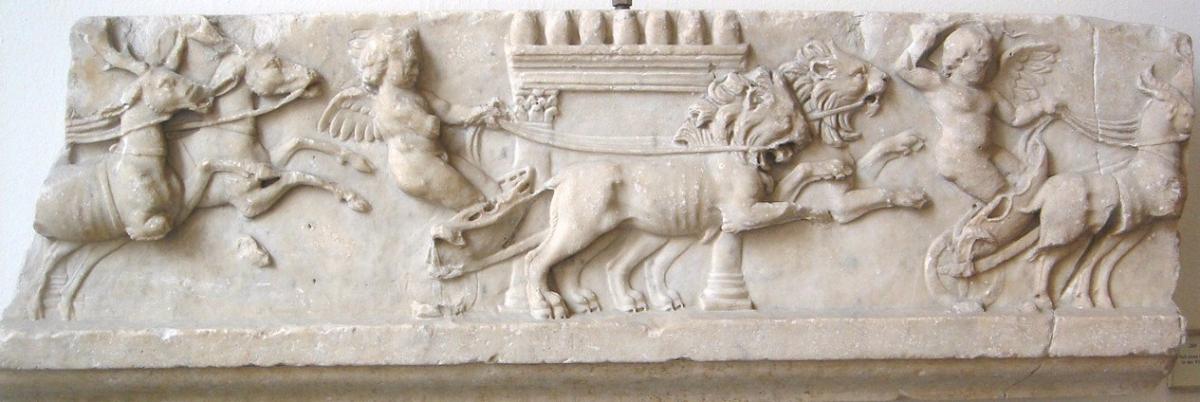
“Gladiators in Chariots” (118-138 CE) (Maritime Theatre)

Pirro Ligorio, the designer of the gardens and fountains at the nearby Villa d’Este, named this structure the Maritime Theatre because of the colonnade in the atrium was decorated mainly with a frieze of sea images. “Gladiators in Chariots” (118-138 CE) (Maritime Theatre) (12’’ high), although not an image of the sea, was part of the frieze. The gladiators are chubby winged putti, and their chariots are driven by deer, lions, and goats. Since the frieze is incomplete, the only clearly defined animals are the lions. They closely resemble lion reliefs Hadrian would have seen on his travels in Persia and Mesopotamia. The putti figures are not well developed, suggesting the frieze was not Greek, but from somewhere in the Middle East.

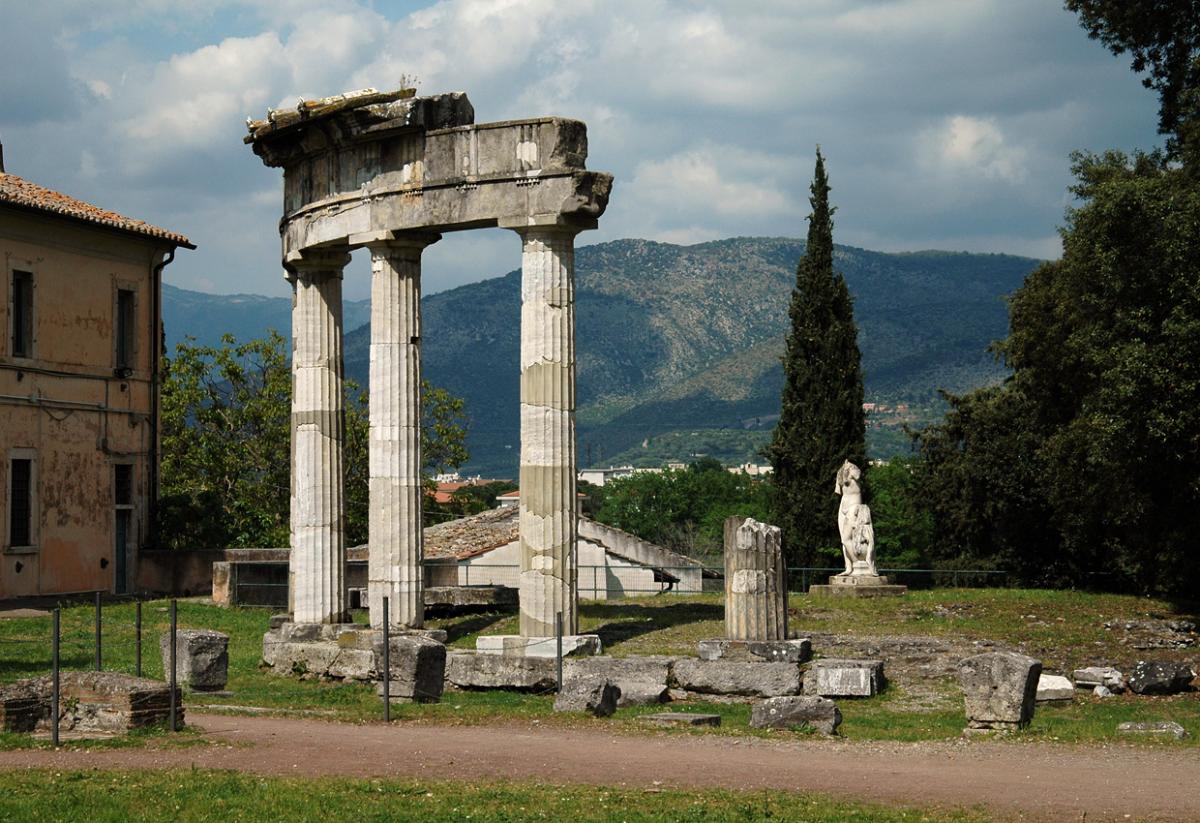
“Temple of Venus of Cnidos” (121-135 CE)

 A “Venus of Cnidos” (c.400-300 BCE), by the great Classical sculptor Praxiteles, was found in the “Temple of Venus of Cnidos” (121-135 CE) in Hadrian’s Villa. Hadrian’s copy of the Praxiteles work, now in a museum, is considered to be one of the finest extant copies. The sculpture was placed in the center of a circular temple constructed in the early Greek Doric temple design. The columns are topped with a simple Doric pillow. Praxiteles’ “Venus of Cnidos” was the first nude female sculpture in the Greek world. At first it was thought to be scandalous and was rejected, but soon became popular in Athens and beyond. 

Hadrian was a connoisseur of the arts. He decorated his Villa with the finest art available. In addition to Greek sculptures, he amassed a collection of sculptures from Egypt, one of his favorite cultures. The walls and floors of the buildings were decorated entirely with marble floors and mosaics. The Villa’s design was a profound influence on Renaissance and Baroque architecture, and it influenced many 19th and 20th Century architects.  

“The written word has taught me to listen to the human voice, much as the great unchanging statues have taught me to appreciate bodily motions. On the other hand, but more slowly, life has thrown light for me on the meaning of books.” (Hadrian)

Beverly Hall Smith was a professor of art history for 40 years.  Since retiring with her husband Kurt to Chestertown in 2014, she has taught art history classes at WC-ALL. She is also an artist whose work is sometimes in exhibitions at Chestertown RiverArts and she paints sets for the Garfield Center for the Arts.
The Spy Newspapers may periodically employ the assistance of artificial intelligence (AI) to enhance the clarity and accuracy of our content.

Filed Under: 3 Top Story

Looking at the Masters: Gardens and Fountains of the Villa d’Este

July 22, 2022 by Beverly Hall Smith
Leave a Comment


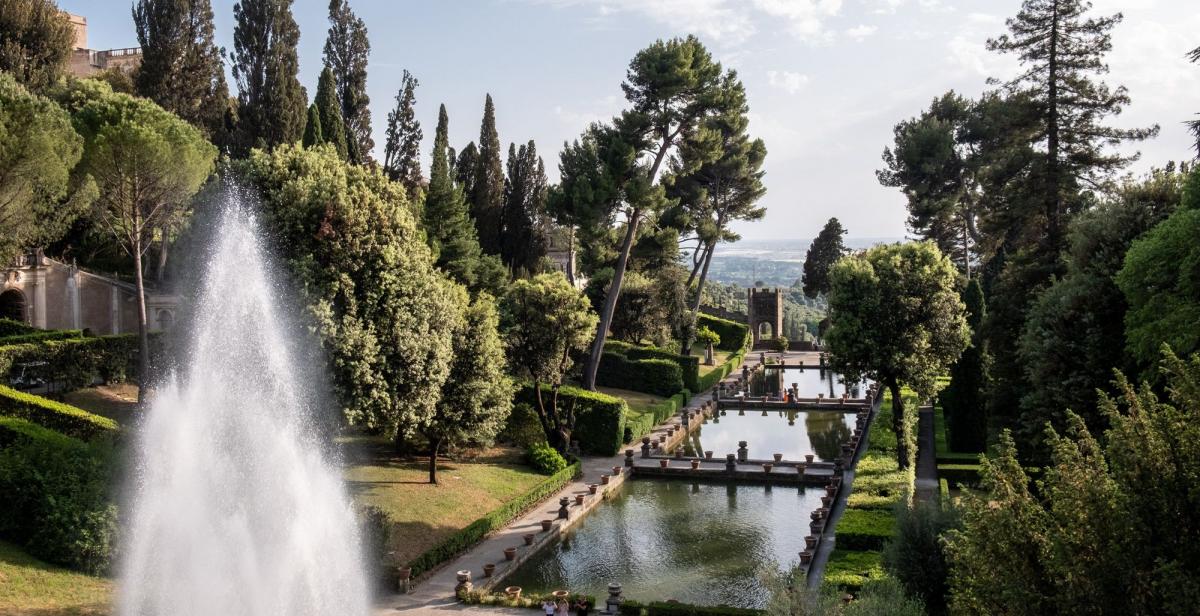
Gardens and Fountains of the Villa d’Este, Tivoli

Pirro Ligorio (1512-1583), Italian painter, architect, garden designer, and classical scholar, was a well-known and respected artist in 16th Century Italy. Today his name is much less familiar to us than Michelangelo’s; however, when Michelangelo died in 1564, Ligorio was named architect of Saint Peter’s. He served as the Vatican’s Papal Architect under Paul IV and Pius VII. Beyond architecture and painting, Ligorio restored the Aqua Vergine, the ancient roman aqueduct that brought fresh water to Rome. The garden he designed for the Villa d’Este in Tivoli was and is praised as one of the most extraordinary gardens in the world. It was designated in 2001 a UNESCO World Heritage site. 

Tivoli is on the western slopes of the Sabine Hills, east of Rome. Its location close to Rome, the beauty of the hills, and the high waterfalls made Tivoli a desirable location for Emperor Hadrian to build his sumptuous villa (118 CE) away from the busy center of Rome. Tivoli also was the site of the great ancient temple complex built to honor Hercules Victor, a god who protected the Tiber River.

A former 9th Century Benedictine convent, built on the site of a Roman villa, became the site for the Villa d’Este. The site and the title of Governor of Tivoli were a consolation prize given to Cardinal Ippolito II d’Este (1509-1572) by Pope Julius III when Ippolito failed in his bid to become Pope. The son of Lucrezia Borgia and grandson of Pope Alexander VI, Ippolito was made archbishop of Milan at age 10, and Cardinal at age 30. He was a patron of the arts and sponsor of the composer Palestrina, the sculptor Cellini, and the poet Tasso. He also was a passionate collector of antiquities. The small and undistinguished so-called palace did not suit one of the wealthiest ecclesiastics of the 16th Century.

The view from the convent into the valley was spectacular and included a view of Hadrian’s Villa.  Renovations of the villa were begun in 1550. The primary architect was Giovanni Alberto Glavani.   

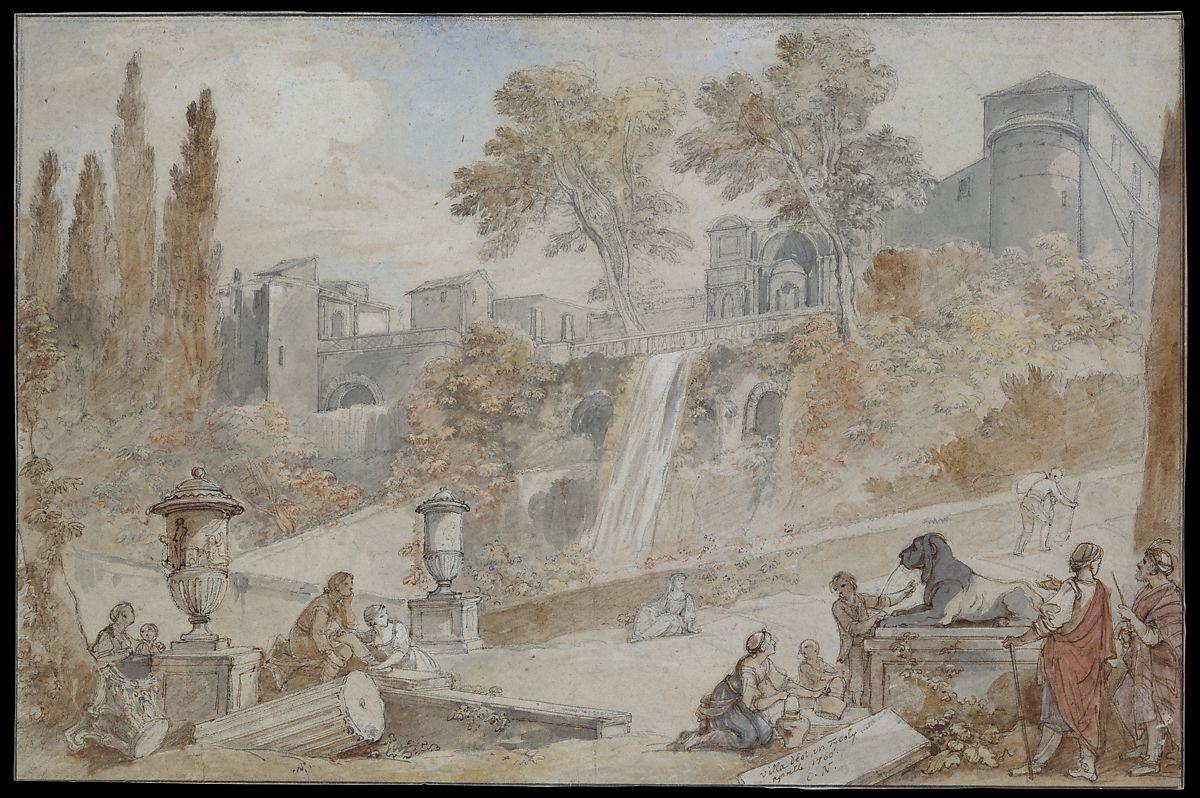
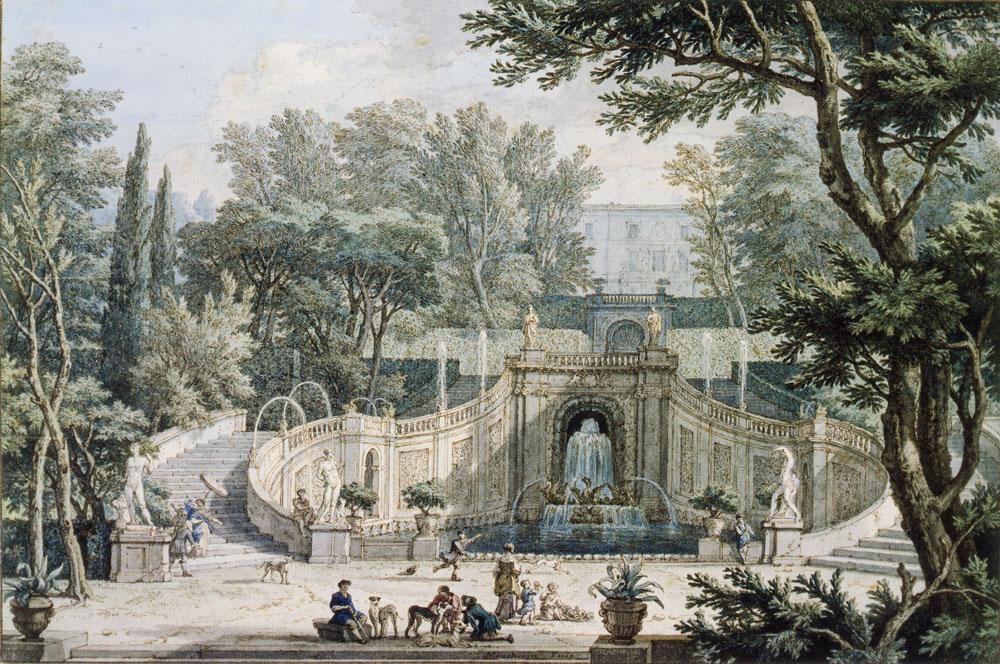
Gardens of the Villa d’Este at Tivoli” (1760) (Charles Joseph Natorie)

Cardinal Ippolito d’Este commissioned Pirro Ligorio in 1565 to design a classical Roman program for the paintings in the rooms of the villa and the garden. He also supervised the construction of the gardens. The gardens covered 35,000 square meters (8.65 square acres). The new villa and garden were intended to exceed anything the Romans had built. The garden is laid out in a grid pattern with three major walkways ascending the hillside. Cross walks allowed access to all parts of the garden.

The drawing “Gardens of the Villa d’Este at Tivoli” (1760) by Charles Joseph Natorie, the Director of the French Academy in Rome from 1751 until 1775, captures one of Natorie’s favorite spots to bring young French artists to draw. The palace structure can be seen above the three fountains: the arched Water Castle, the smaller Fountain of the Organ inside the arch, and the Fountain of the Dragon with a large cascading waterfall beside it. Walkways, ancient urns, columns, and a lion fountain sprouting water can be seen below. Villagers in contemporary dress are depicted along with two men in Roman togas at the lower right corner. The Avenue of Cypress trees can be seen at the upper left.  Mostly reality but part fantasy, the gardens were inspirational for all who drew or painted them.


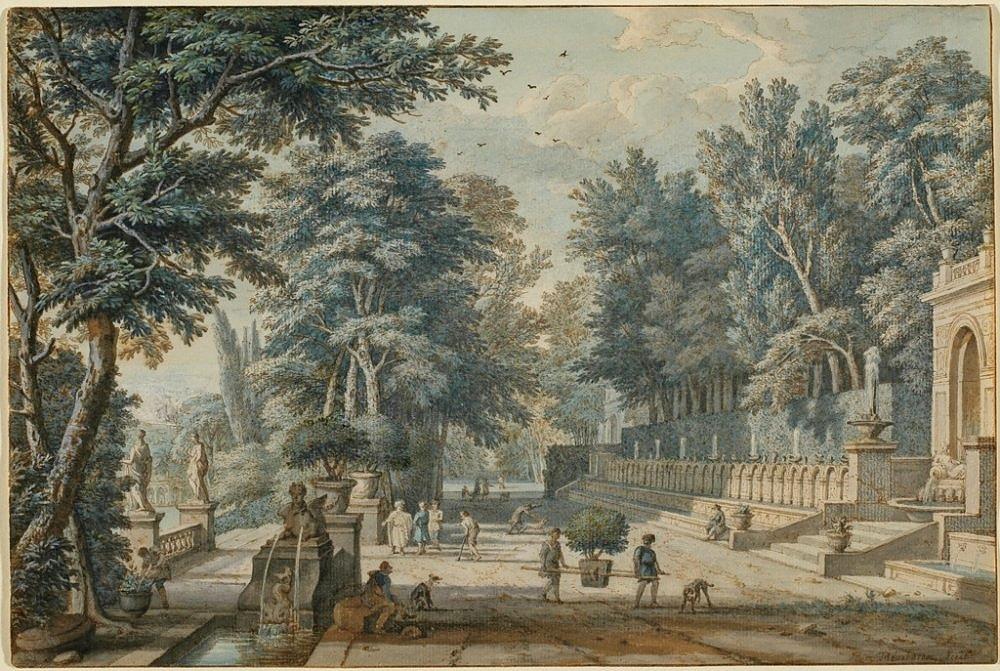
“Viale delle Centro Fontane in the Garden of the Villa d’Este, Tivoli” (1731) (Isaac de Moucheron)

     Ligorio’s first task was to secure the water necessary to supply his elaborate garden design that consisted of 51 fountains and grottos, 398 spouts, 364 water jets, 64 waterfalls, and 220 basins, fed by 2900 feet of canals, channels, and cascades. The Aniene River that runs from Tivoli to Rome, and the Albuneo and Ercolaneo Rivers supplied the necessary water for the elaborate system he and the engineers devised. There were no pumps, only gravity to move the water. 

The color print of the “Viale delle Centro Fontane of the Garden of the Villa d’Este, in Tivoli” (1731) (Isaac de Moucheron) depicts the beginning of the central downward axis of the garden. The Avenue of 100 Fountains runs diagonally from the right side of the drawing. Visitors walk across the wide concourse and pass through two short columns with potted trees on top. In front of the closer column, a large sphinx spouts water from her nipples. The visitor walks farther to the left where a parapet holds two statues of Roman goddesses. On either side of the parapet are semi-circular stairs that lead to the next level of the garden. De Moucheron depicts gardeners at work and a few visitors enjoying the spectacular vistas of the gardens and hills.

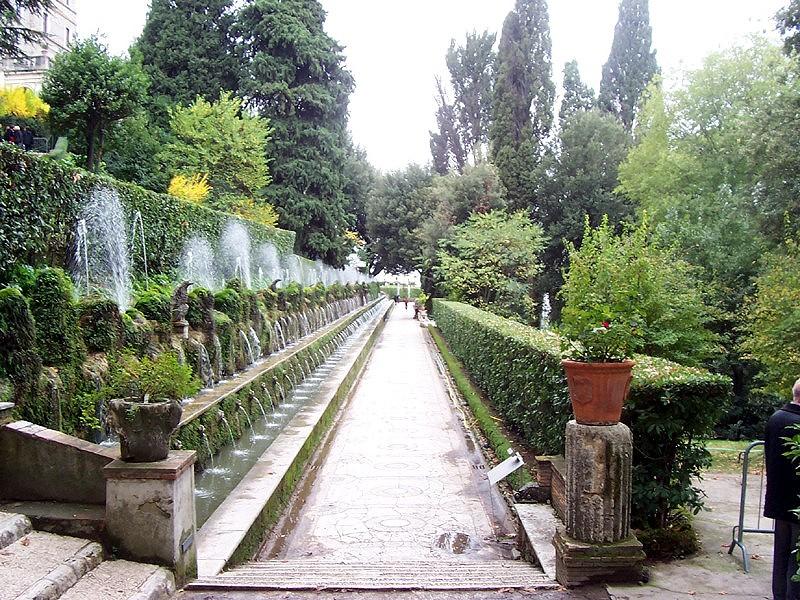
Avenue of 100 Fountains

The 100 fountains were under construction from 1566 until 1577. The avenue was lined with three tiers of fountains with sculptures placed on the marble wall depicting episodes from Ovid’s Metamorphosis. Three hundred spouts feed the three parallel canals. The garden above was planted with fruit trees, and the upper water spouts were sculptures of fleurs-de-lis, eagles, obelisks, and ships, drawn from the d’Este family coat-of arms. The spouts of the lower canal are grotesque masks, a favorite of Ippolito’s. Many of the features have decayed or been removed over the centuries. 

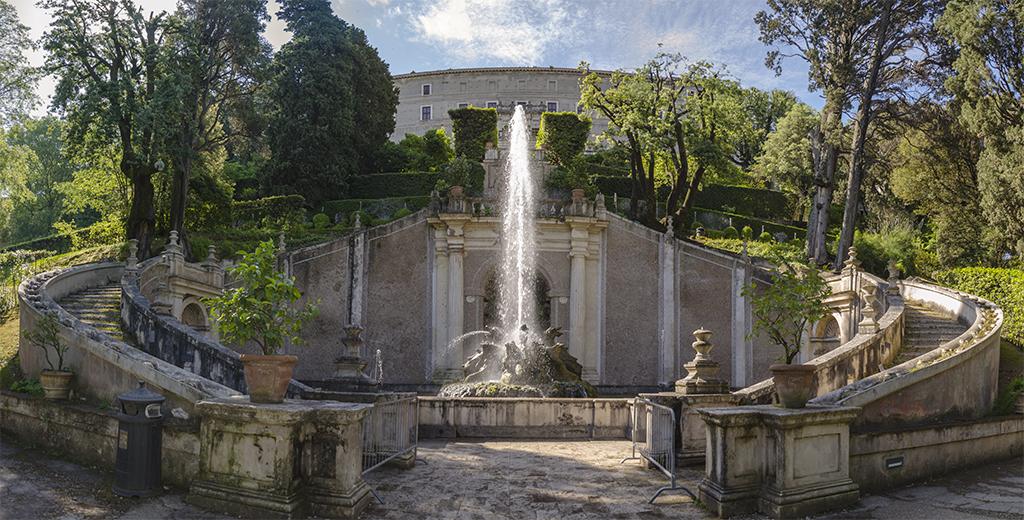
Fontane Dragons” (1772-30) (Isaac de Moucheron)

Isaac de Moucheron (1667-1744), a Dutch painter and interior decorator (wall painter), came from a family of painters. After he returned to the Netherlands from his travels in Italy, he became famous for his Italian landscapes that were much in demand by the wealthy Dutch to decorate the walls of their houses. Several of his sketches from Italy were of the fabulous gardens of the Villa d’Este. The color print “Fontane Dragons” (1772-30) depicts the Villa set between the lush variety of trees and Ligorio’s elaborate stairways that surround the Fountain of the Dragons, below the Avenue of 100 Fountains. 

A major theme of the villa wall paintings and gardens, as designed by Ligorio, is the 11th labor of Hercules. He succeeds in gathering the golden apples from the Garden of Hesperides, overcoming the 100-headed dragon that guards them. A d’Este family historian traced the family’s origins back to Hercules. Ippolito and Ligorio intended the villa’s garden to replicate the Garden of the Hesperides, the most beautiful garden in mythology. “Fontane Dragon,” the major feature in the central axis of the garden, tells of Hercules’s triumph in the combat of good and evil. Given a moral choice as a young man, Hercules could live a long but easy life, or a short life of virtue and fame. Hercules chose a life of virtue. 

One side featured a statue of Hercules with his club and the other side statues of Mars, the god of war, and Perseus, who slayed Medusa. The 100 dragons were placed on an island in the middle of the fountain. After Pope Gregorio XIII visited the Villa in 1572, Ippolito had the design changed to four winged dragons, the symbol of the Pope’s family. Amidst the center of the dragons, a jet of water shoots up so high that it can be seen from anywhere in the garden. Two dolphins spray water across the pool. Water kept under pressure was suddenly released, and the sound was like fireworks or cannon fire. 

Ligorio removed the ancient art from the nearby Villa of Hadrian in order to place pieces throughout the palace and the gardens. Muret, a friend of Ippolito reflected on the theme of the fountain: “The same apples that Hercules took away from the sleepy dragon, now belong to Ippolito, who, grateful for what he received, wanted that his garden was considered sacred by the author of the gift.”

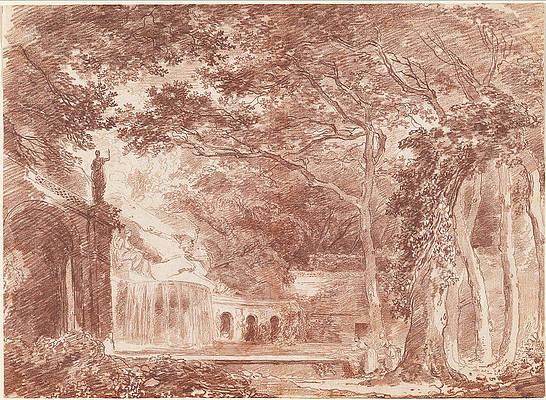
“Oval Fountain in the Villa d’Este Gardens, Tivoli” (1760) (Hubert Robert)

The Oval Fountain was one of the first fountains Ligorio designed (1565-1570). “The Oval Fountain” (1808) (1.28” x 1.77”) was drawn by Hubert Robert (1733-1808) with red chalk and graphite. Robert was one of “the masters” of 18th Century French art. His clientele included Catherine the Great of Russia. Nicknamed “Robert of the Ruins,” he specialized in landscape paintings, some true to the scene, but many creative compilations of ancient ruins. One of the best paid painters of his time, he also was commissioned to designed porcelain and furniture, and he was appointed Designer of Gardens by the King of France to design the gardens at Versailles. His knowledge of the gardens of the Villa d’Este influenced strongly his work at Versailles.

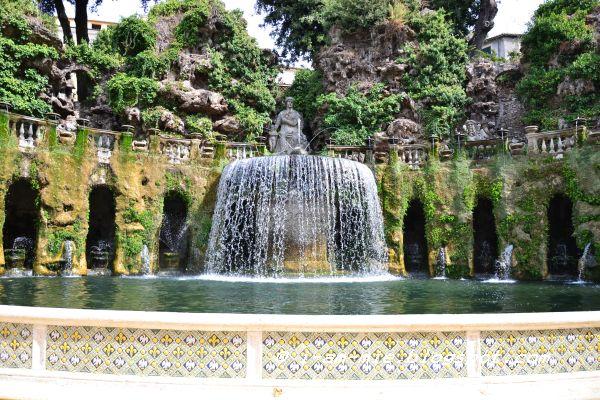
The Oval Fountain

The Oval Fountain, designed by Ligorio (1565-1570), is a large stone basin set against a semicircular wall. The series of niches once contained statues of Nereids (sea nymphs), goddesses of the sea who protected the oceans’ treasures and sailors, and who possessed the power of healing. Water jetted into the fountain from the vases the Nereids held. While they are no longer in the niches, fan sprays spout from the vases. The bottom of the basin is decorated with ceramics in the shapes of lilies and eagles from the d’Este coat of arms. 

The two mountains that rise from the top of the fountain represent the Tiburtine mountains. Grottoes in the mountains once held statues representing the Ercolaneo and Aniene rivers. Centered above the oval is the figure of the Tiburtine Sibyl, who hold her son’s hand. She is the goddess of the Tiber River, a major source of fresh water for Rome. The fountain also is known as the Tiburtine Fountain.  Water flows from the fountain from the Sibyl’s breast, a symbol of continuous abundance. The statue of the Tibertine Sibyl is important to Ippolito’s papal ambitions. She prophesied that a Roman Emperor would hand over the Roman empire to the Christian religion. The Oval Fountain was called the “Queen of Fountains.”

These are but three of the fountains he designed.  Ligorio’s gardens at the Villa d’Este inspired the grand gardens at the Palace of Versailles and the Alhambra Garden in Spain, among others. Ligorio certainly deserves the title “Master Gardener.” 

Alas, Cardinal Ippolito died in 1572. He had been expelled from the church by Pope Paul IV for simony, the sin of profiting by the selling of church offices and relics.

Beverly Hall Smith was a professor of art history for 40 years.  Since retiring with her husband Kurt to Chestertown in 2014, she has taught art history classes at WC-ALL. She is also an artist whose work is sometimes in exhibitions at Chestertown RiverArts and she paints sets for the Garfield Center for the Arts. 
 

The Spy Newspapers may periodically employ the assistance of artificial intelligence (AI) to enhance the clarity and accuracy of our content.

Filed Under: Arts Top Story

Looking at the Masters: Jeppe Heim 

July 7, 2022 by Beverly Hall Smith
Leave a Comment

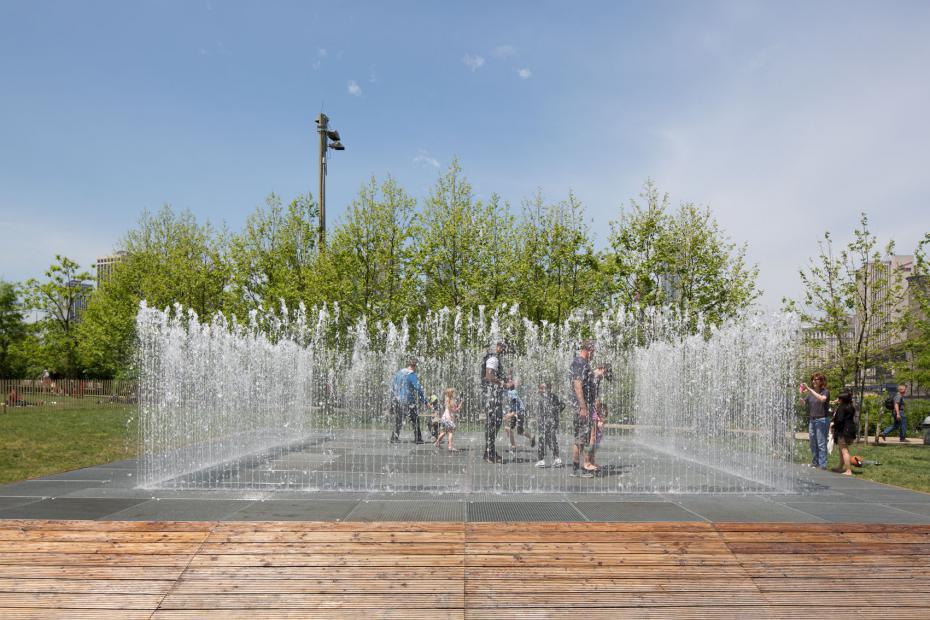
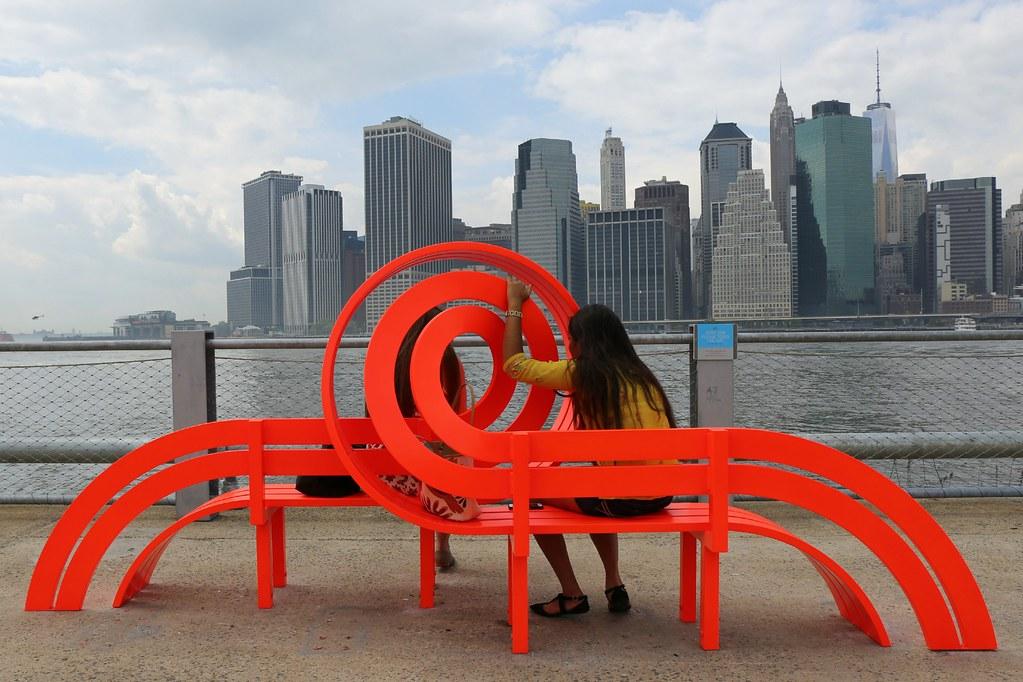
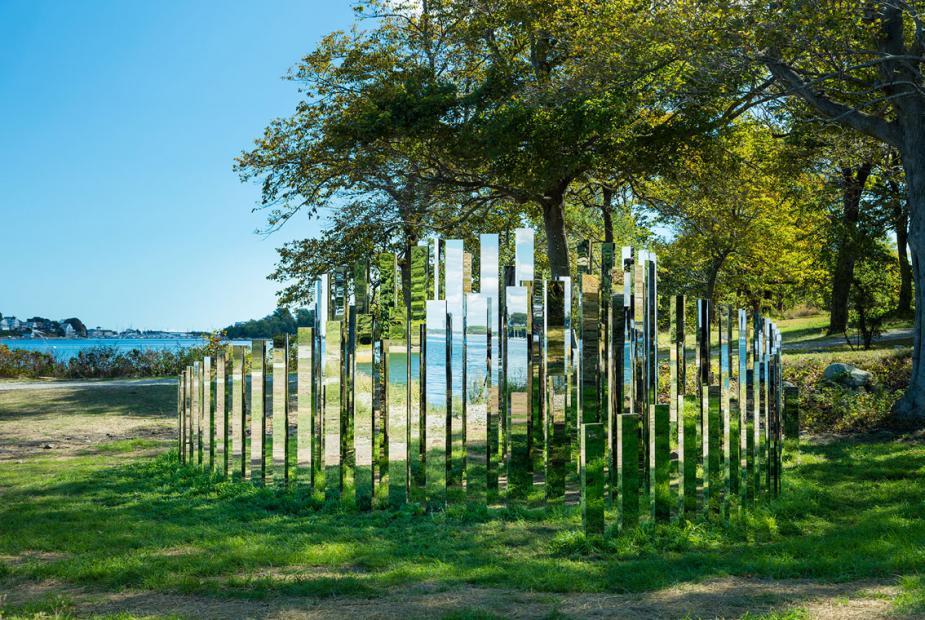
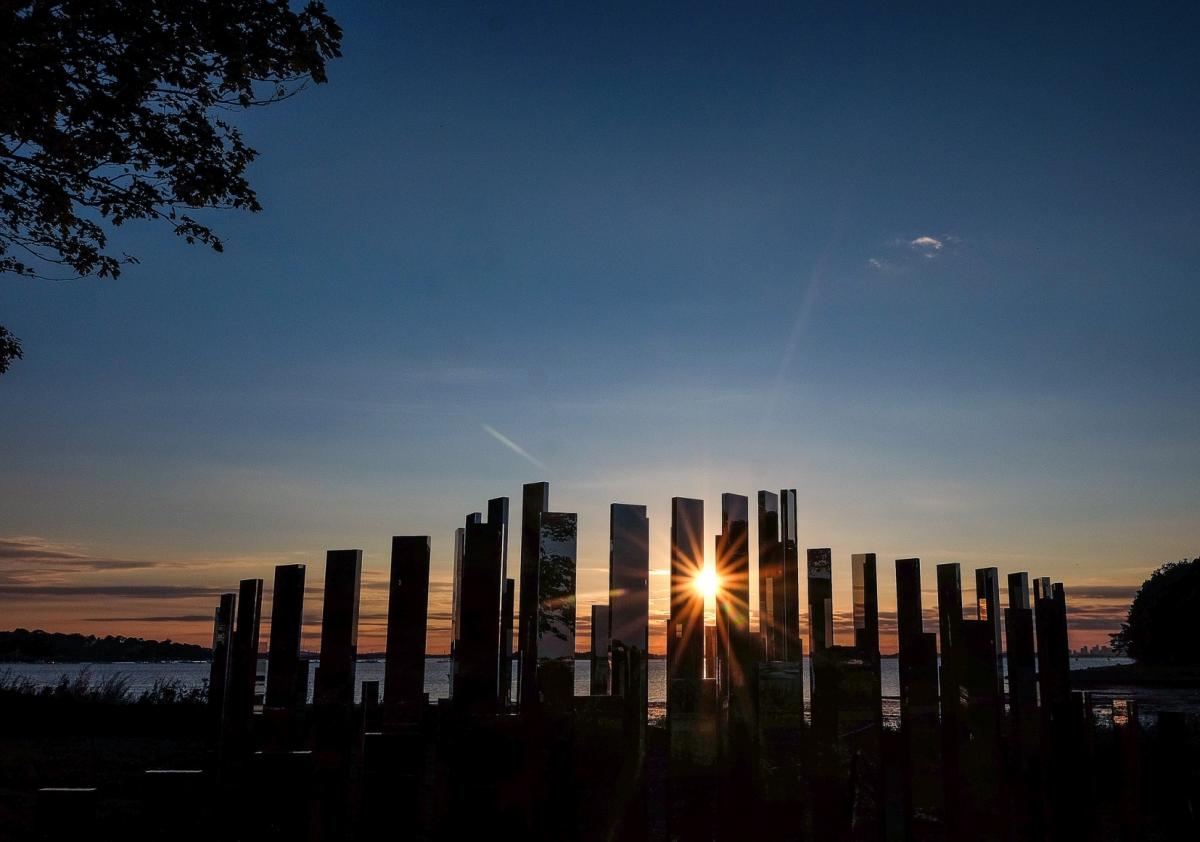
Jeppe Heim (b.1974, Copenhagen, Denmark) is an artist who believes viewers should touch the art. He was trained at the Royal Danish Academy of Art (1997-2003), and in 2009-10, he completed a residency at the Alexander Calder studio in Sache, France. Where ever his work is shown, in outdoor sculpture installations or inside on walls, his works invite viewers to participate in the art in a number of sensory ways. 

“Appearing Room” (2015) (Brooklyn Bridge Park)

“Please Touch the Art” (2015) consists of Heim’s three installations in Brooklyn Bridge Park, New York City, from May 2015 through April 2016. Brooklyn Park Bridge stretches 1.24 miles along the East River from Pier 1 to Pier 6. His installations began at Pier 1.  “Appearing Room” was a system of water jets with sensors that responded to the movement of people walking through the space. Seven-foot-high columns of water shot upward at staggered intervals. Participants could avoid getting wet if they wanted to, but why would anyone want to miss out on the fun. When Heim introduced “Appearing Room” at the 2003 Venice Biennale, it attracted the largest crowds of any of the Biennale exhibits. According to Heim, “If you’re creating a smile in yourself and also giving it to someone else, then you’ve started a dialogue. You also start to play.”


“Mirror Labyrinth” (2015) (Brooklyn Bridge Park)

Heim’s second installation “Mirror Labyrinth” was at Pier 3 on Greenway Terrace. Heim’s piece was designed to work with the natural landscape and the view of Lower Manhattan. Mirror-polished stainless-steel posts were installed in three arcs to create a labyrinth path through which viewers could walk. The labyrinth appears in Greek mythology. Daedalus built a labyrinth for King Minos of Crete to contain the dangerous Minotaur. Heim intended his “Mirror Labyrinth,” light and airy, to create a sense of wonder, of adventure, and happiness. He hoped the unexpected encounters with other visitors would encourage dialogue. The mirrors changed the viewers’ perspectives of the Manhattan skyline as it interacted with the green lawn. Heim commented on his use of mirrors: “…people reflect themselves in the work and [it] becomes a tool for communication and dialogue.”

Modified Social Benches” (2015) (Brooklyn Bridge Park)

“Modified Social Benches” (2015) (Brooklyn Bridge Park)

Sixteen different “Modified Social Benches,” painted in bright red, created unique places to sit and enjoy the scenery, the day, and people in Brooklyn Bridge Park. The benches encouraged children to climb and slide, and adults to rest, read, and talk.  

“A New End” (2016-2017)

Heim created “A New End” for the area known as World’s End, a 251-acre park in Hingham, Massachusetts, one hour south of Boston. The park consists of four spoon shaped hills that connect two islands with a man-made sandbar. Designed by the American architect Frederick Law Olmsted in 1890, the park includes rolling hills, a rocky shoreline, open fields, and a tree-lined carriage path, all with a beautiful view of the Boston Harbor. In 1996, it became part of the Boston Islands National Recreation Area, including trails for walking and horseback riding, and cross-country skiing in winter. Heim said, “I had to find out what people used this place for…I was inspired by that.” He also talked about “A New End” as a title: “I think the name “World’s End” is really interesting. What is it? What is the world’s end? Where? I don’t believe in ends. I think that when something ends there’s something new starting. The name was to inspire people to not believe in ends…If it’s not good, it’s not the end.”

A New End” (2016-2017)

Heim was attracted not only to the beauty of the park and the recreation opportunities it provided, but also to the park’s stillness and seclusion. Heim practices yoga, and he believes that dialogue with oneself and with others is essential to a good life. He chose a mirror labyrinth to encourage contemplation and reflection. The new site-specific labyrinth was placed at the foot of a hill where the sandbar began. The stainless-steel columns were configured in three lines to create a spiral design. Starting with three-foot columns on the outside, the columns rise to nine feet at the center. From above, the design resembles a nautilus shell. The year-long instillation, allowed the numerous park visitors to view the labyrinth in all four seasons and at all times of day and night.

Heim wants his art to encourage interaction and conversation, and contemplation and reflection: “We’re in a society, I think, where everyone thinks it’s so cool to work, it’s so cool to be online, so cool to be super busy. I think it’s super cool not to be busy.”

“Changing Spaces” (2022)

Heim’s “Changing Spaces,” an “Appearing Rooms” installation he now calls “liquid architecture,” currently is in Rockefeller Center’s Central Plaza (30 Rock) in New York City through September 9, 2022. He says, “My artistic approach was to invite people to make use of the work, either as a space of seclusion and relaxation or the opposite, a place of pure joy and playfulness. The shape was meant to contrast the rectangular layout of New York embracing people in a circle of water.”

Heim’s outdoor sculptures have been commissioned by the cities of London, Los Angeles, Boston, Helsinki, Miami, Cadiz, and New York, among others.  “Appearing Rooms” are now permanently installed in both London and Zaragoza, Spain. His gallery exhibitions are as popular as his outdoor installations. Different from the large outdoor work, they often employ mirrors to encourage self-reflection, participation, and dialogue by viewers.

“We don’t understand each other. That’s why there are so many bad things happening… Not that I’m trying to save the world … but I try to do my part and if you can somehow engage with this art piece… If you’re creating a smile in yourself and also giving it to someone else, then you’ve started a dialogue active. I’m not politically active, but I’m saying [that] you can open up people’s understanding of themselves and others with play.”

Beverly Hall Smith was a professor of art history for 40 years.  Since retiring with her husband Kurt to Chestertown in 2014, she has taught art history classes at WC-ALL. She is also an artist whose work is sometimes in exhibitions at Chestertown RiverArts and she paints sets for the Garfield Center for the Arts.
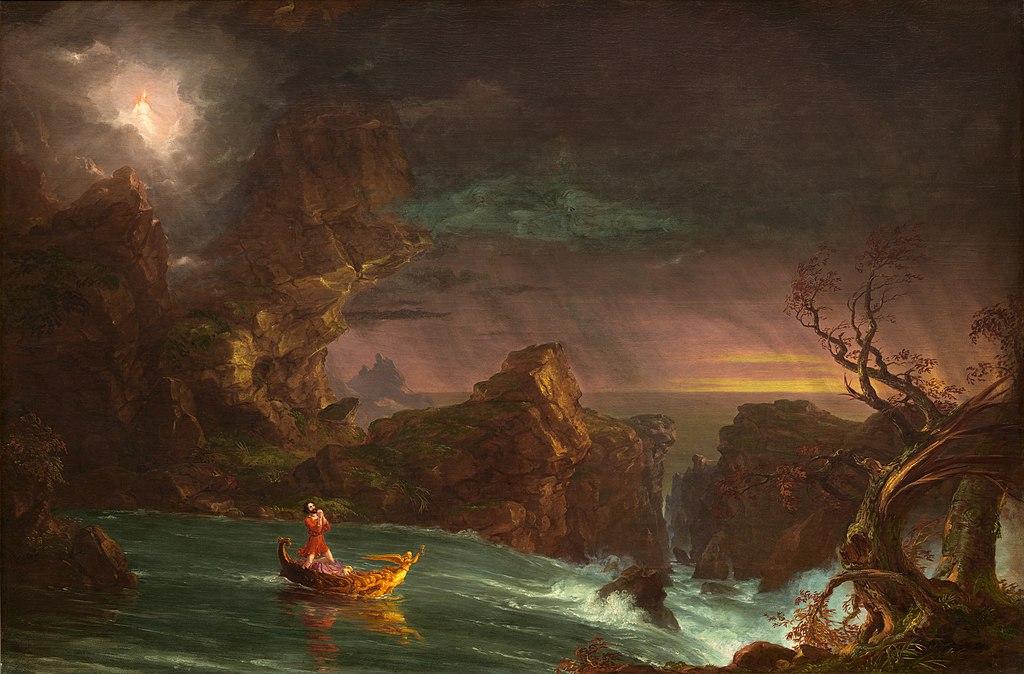
The Spy Newspapers may periodically employ the assistance of artificial intelligence (AI) to enhance the clarity and accuracy of our content.
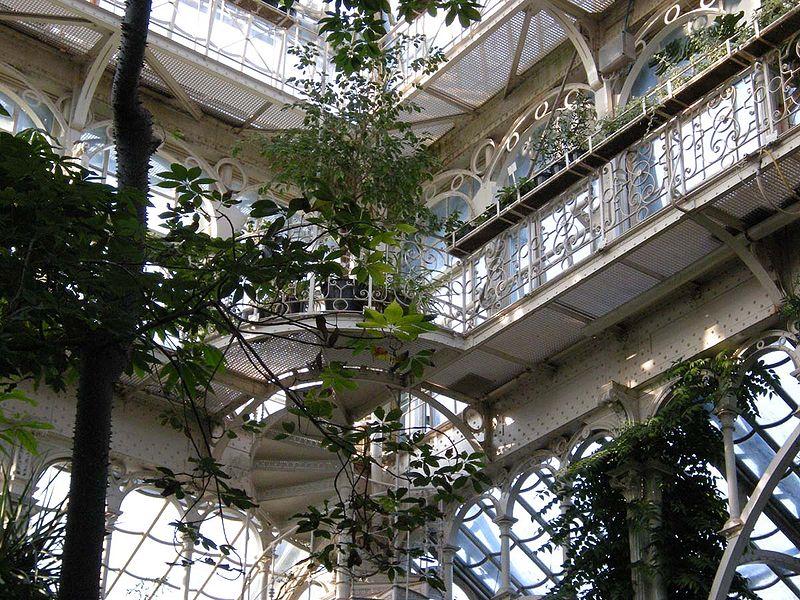
Filed Under: 3 Top Story

  • « Previous Page
  • 1
  • …
  • 13
  • 14
  • 15
  • 16
  • 17
  • …
  • 24
  • Next Page »

Copyright © 2025

Affiliated News

  • The Chestertown Spy
  • The Talbot Spy

Sections

  • Arts
  • Cambridge
  • Commerce
  • Ecosystem
  • Education
  • Food & Garden
  • Health
  • Local Life
  • News
  • Point of View
  • Senior Nation

Spy Community Media

  • Subscribe for Free
  • Contact Us
  • COVID-19: Resources and Data

© 2025 Spy Community Media. | Log in